
Class 26 Computing Genomes Genomes Computing David Evans
- Slides: 42
Class 26: Computing Genomes, Genomes Computing David Evans http: //www. cs. virginia. edu/evans cs 302: Theory of Computation University of Virginia Computer Science
Final Exam Sneak Preview • Handout available now • Honor policy: you may discuss these problems with others and use any resources you want until the Final • No notes or other resources may be used during the final • Intent is to give you an idea what to expect on the final and a chance to start thinking about some problems – Don’t attempt to memorize answers: need to understand things since the actual questions may be different 2
Menu • Computing Genomes (PS 6, Problem 6) – Crash course in biology • Busy Beaver result! • Computing with Genomes • Conclusion 3
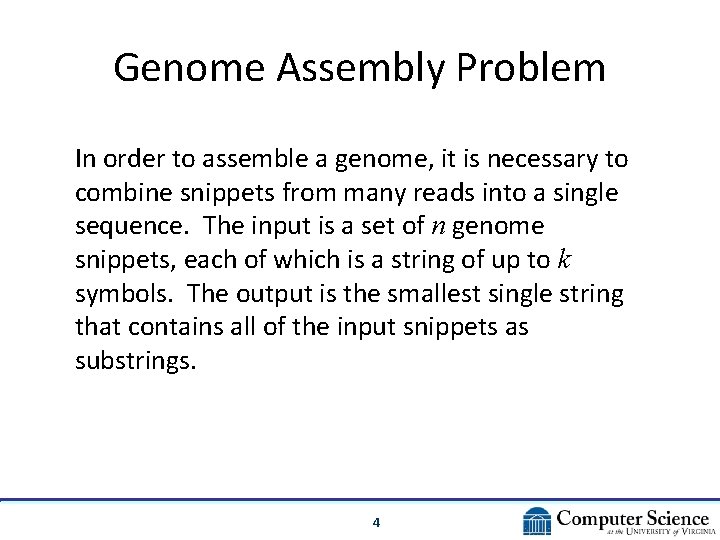
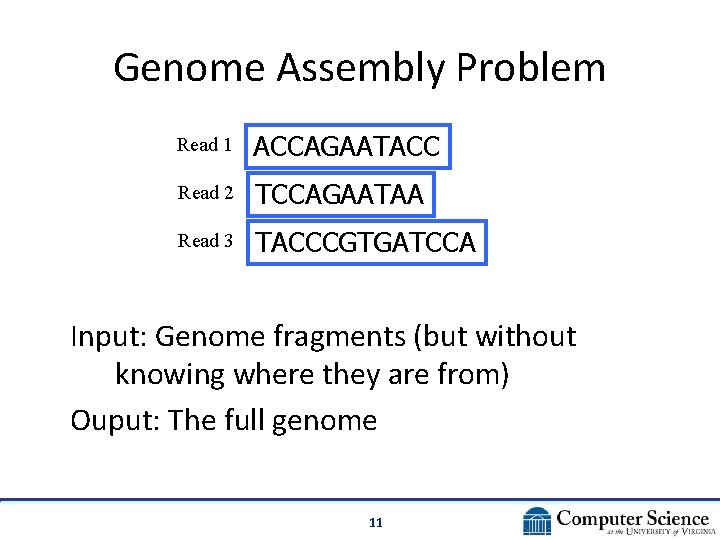
Genome Assembly Problem In order to assemble a genome, it is necessary to combine snippets from many reads into a single sequence. The input is a set of n genome snippets, each of which is a string of up to k symbols. The output is the smallest single string that contains all of the input snippets as substrings. 4
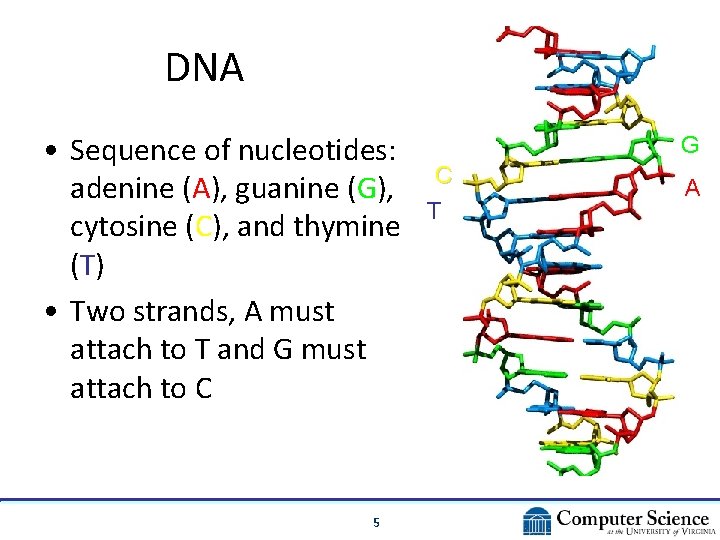
DNA • Sequence of nucleotides: adenine (A), guanine (G), cytosine (C), and thymine (T) • Two strands, A must attach to T and G must attach to C 5 G C T A
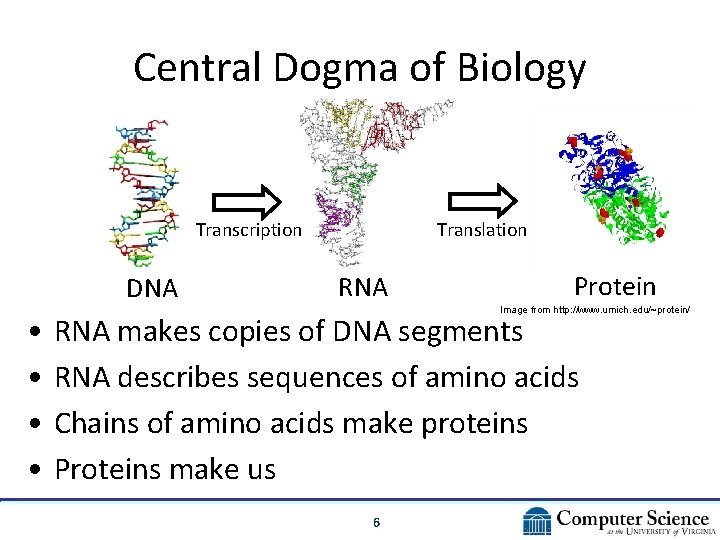
Central Dogma of Biology Translation Transcription DNA • • RNA Protein Image from http: //www. umich. edu/~protein/ RNA makes copies of DNA segments RNA describes sequences of amino acids Chains of amino acids make proteins Proteins make us 6
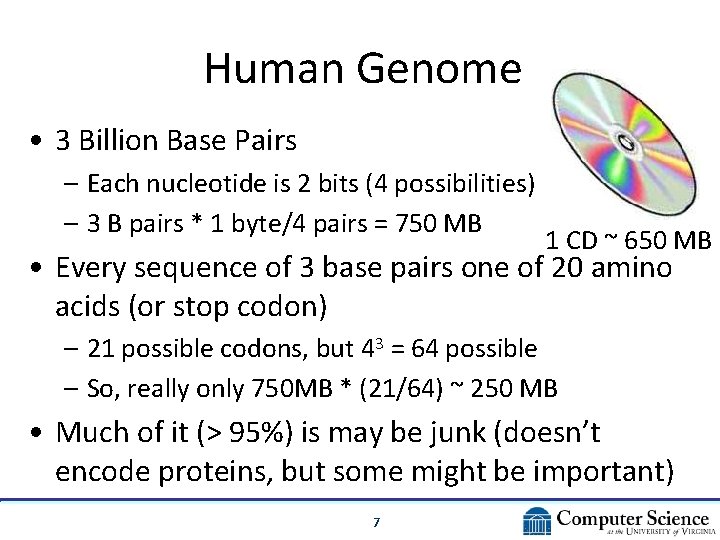
Human Genome • 3 Billion Base Pairs – Each nucleotide is 2 bits (4 possibilities) – 3 B pairs * 1 byte/4 pairs = 750 MB 1 CD ~ 650 MB • Every sequence of 3 base pairs one of 20 amino acids (or stop codon) – 21 possible codons, but 43 = 64 possible – So, really only 750 MB * (21/64) ~ 250 MB • Much of it (> 95%) is may be junk (doesn’t encode proteins, but some might be important) 7
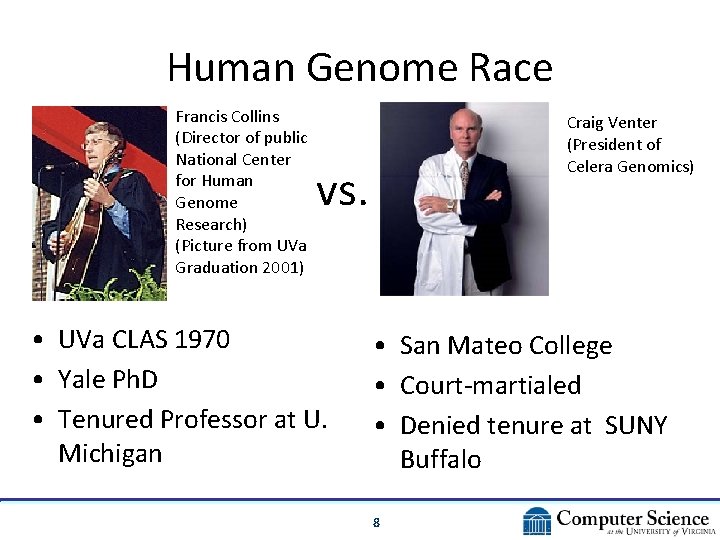
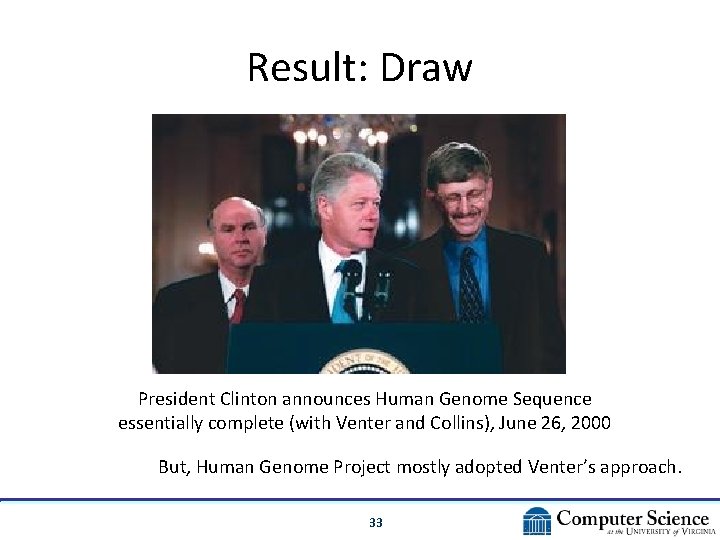
Human Genome Race Francis Collins (Director of public National Center for Human Genome Research) (Picture from UVa Graduation 2001) Craig Venter (President of Celera Genomics) vs. • UVa CLAS 1970 • Yale Ph. D • Tenured Professor at U. Michigan • San Mateo College • Court-martialed • Denied tenure at SUNY Buffalo 8
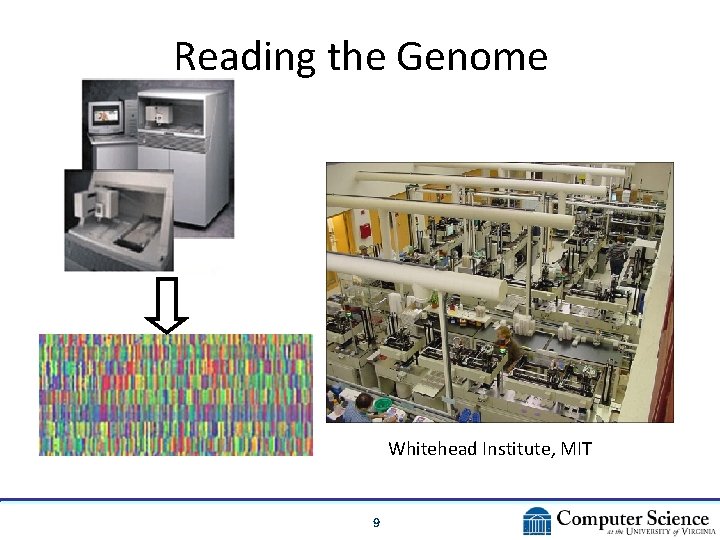
Reading the Genome Whitehead Institute, MIT 9
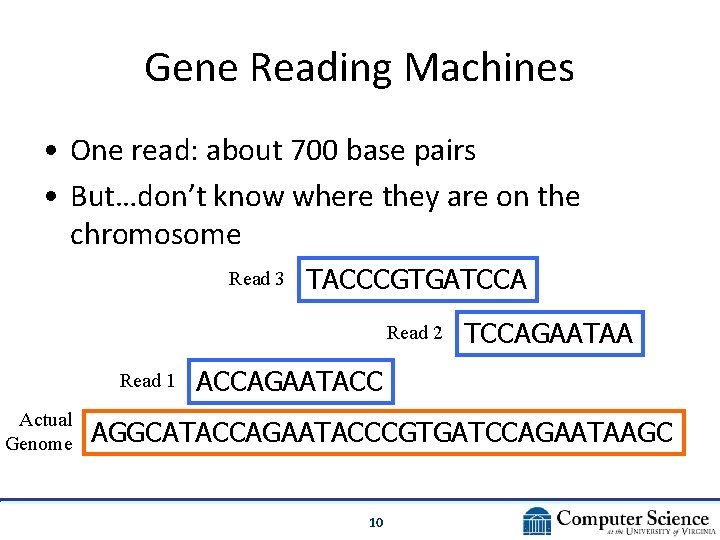
Gene Reading Machines • One read: about 700 base pairs • But…don’t know where they are on the chromosome Read 3 TACCCGTGATCCA Read 2 Read 1 Actual Genome TCCAGAATAA ACCAGAATACC AGGCATACCAGAATACCCGTGATCCAGAATAAGC 10
Genome Assembly Problem Read 1 ACCAGAATACC Read 2 TCCAGAATAA Read 3 TACCCGTGATCCA Input: Genome fragments (but without knowing where they are from) Ouput: The full genome 11
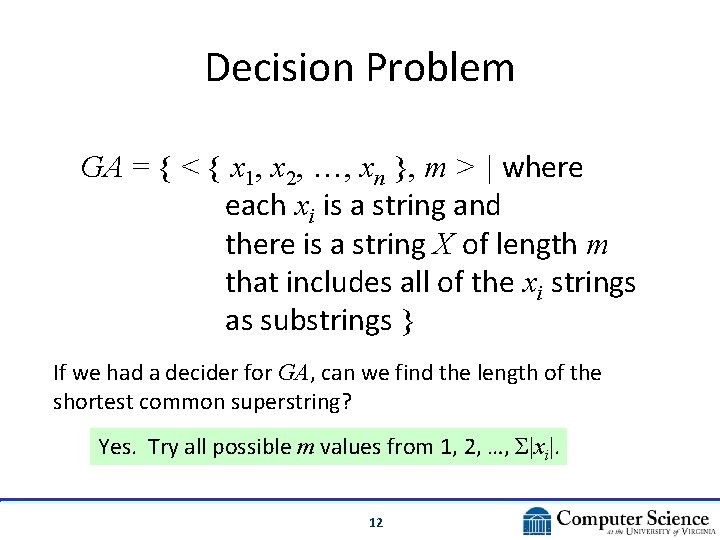
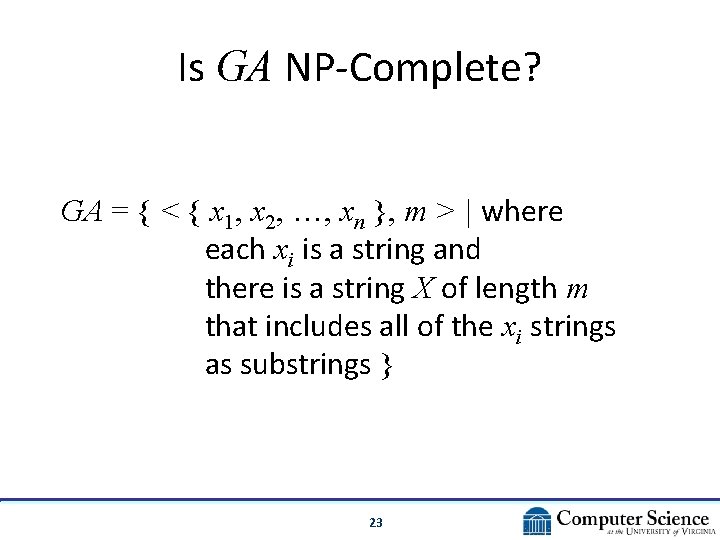
Decision Problem GA = { < { x 1, x 2, …, xn }, m > | where each xi is a string and there is a string X of length m that includes all of the xi strings as substrings } If we had a decider for GA, can we find the length of the shortest common superstring? Yes. Try all possible m values from 1, 2, …, Σ|xi|. 12
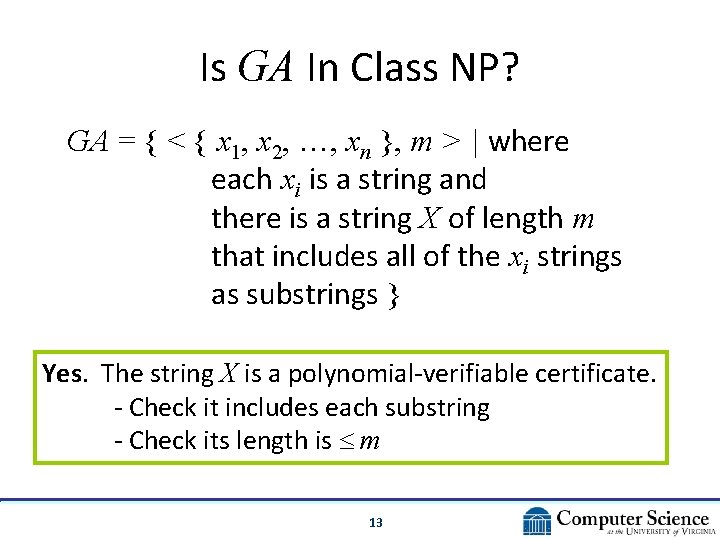
Is GA In Class NP? GA = { < { x 1, x 2, …, xn }, m > | where each xi is a string and there is a string X of length m that includes all of the xi strings as substrings } Yes. The string X is a polynomial-verifiable certificate. - Check it includes each substring - Check its length is m 13
Is GA NP-Complete? GA = { < { x 1, x 2, …, xn }, m > | where each xi is a string and there is a string X of length m that includes all of the xi strings as substrings } 14
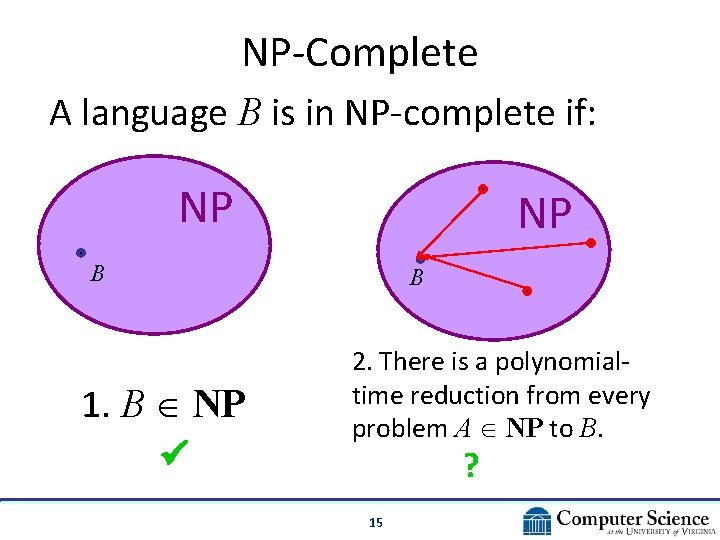
NP-Complete A language B is in NP-complete if: NP NP B B 1. B NP 2. There is a polynomialtime reduction from every problem A NP to B. ? 15
To Prove NP-Hardness • Pick some known NP-Complete problem X. • Show that a polynomial-time solver for Y could be used to build a polynomial-time solver for X. • This proves that there is no polynomial-time solver for Y (unless P = NP). 16
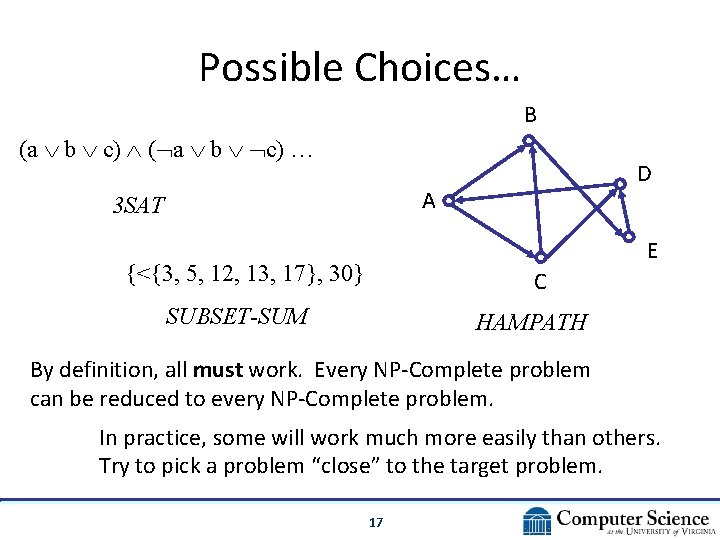
Possible Choices… B (a b c) ( a b c) … D A 3 SAT E {<{3, 5, 12, 13, 17}, 30} C SUBSET-SUM HAMPATH By definition, all must work. Every NP-Complete problem can be reduced to every NP-Complete problem. In practice, some will work much more easily than others. Try to pick a problem “close” to the target problem. 17
Busy Beaver Challenge Ruixin Yang 18
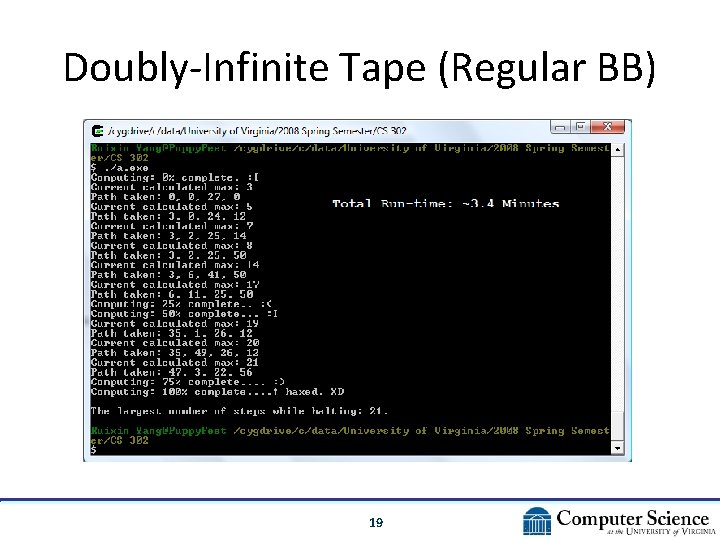
Doubly-Infinite Tape (Regular BB) 19
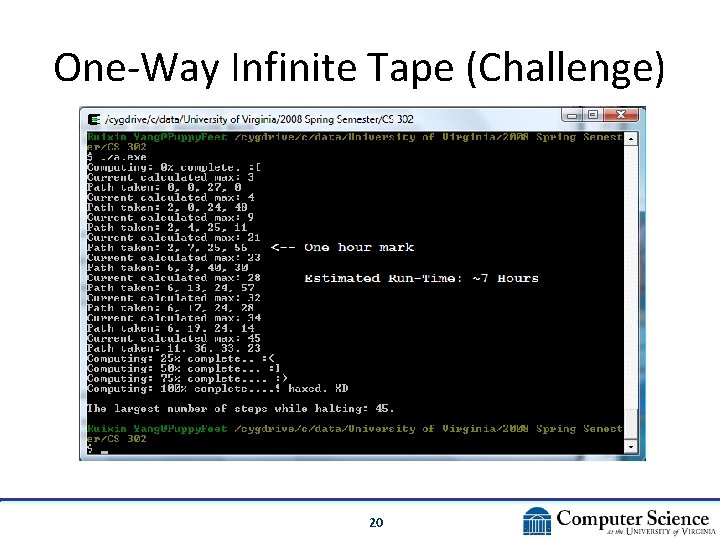
One-Way Infinite Tape (Challenge) 20
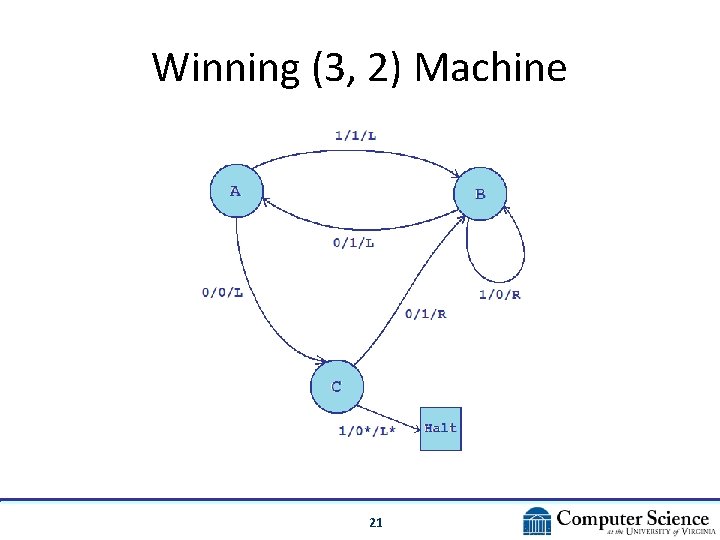
Winning (3, 2) Machine 21
Code Busy. Beaver. cpp Busy. Beaver 32. cpp 22
Is GA NP-Complete? GA = { < { x 1, x 2, …, xn }, m > | where each xi is a string and there is a string X of length m that includes all of the xi strings as substrings } 23
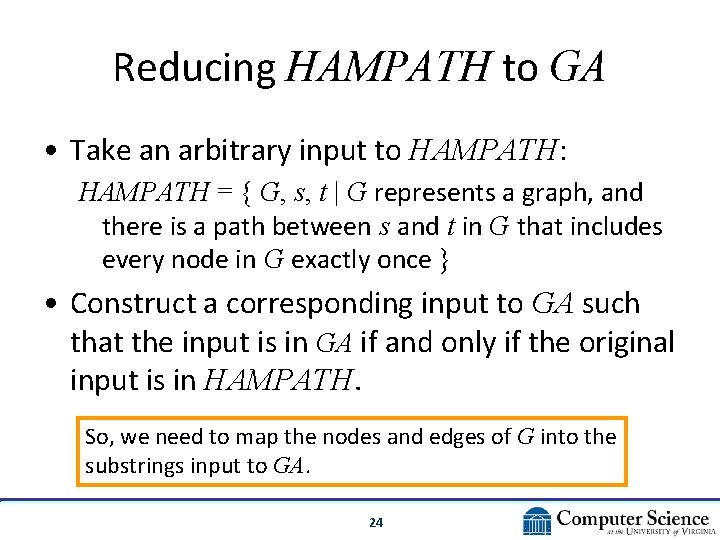
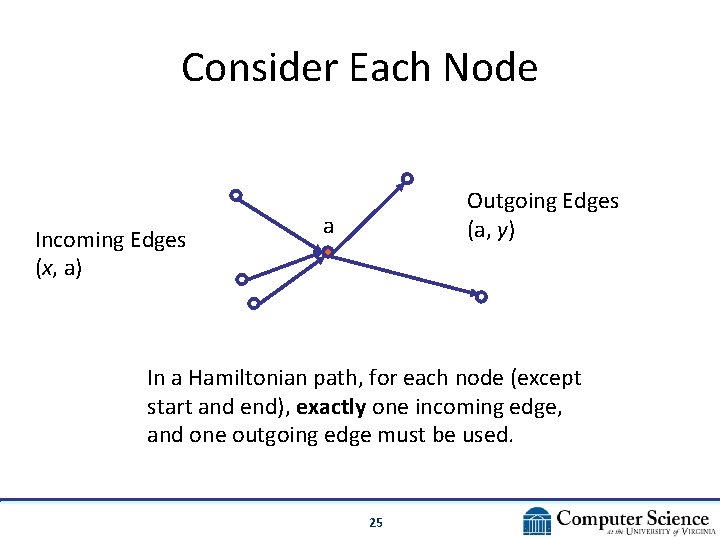
Reducing HAMPATH to GA • Take an arbitrary input to HAMPATH: HAMPATH = { G, s, t | G represents a graph, and there is a path between s and t in G that includes every node in G exactly once } • Construct a corresponding input to GA such that the input is in GA if and only if the original input is in HAMPATH. So, we need to map the nodes and edges of G into the substrings input to GA. 24
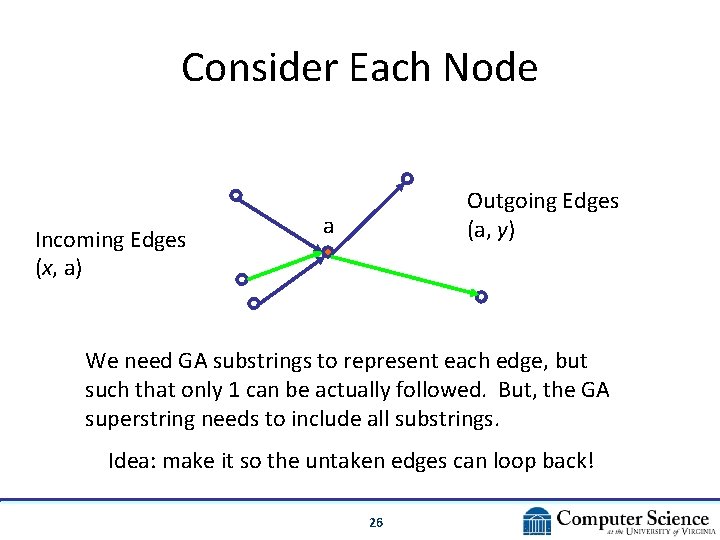
Consider Each Node Incoming Edges (x, a) Outgoing Edges (a, y) a In a Hamiltonian path, for each node (except start and end), exactly one incoming edge, and one outgoing edge must be used. 25
Consider Each Node Incoming Edges (x, a) Outgoing Edges (a, y) a We need GA substrings to represent each edge, but such that only 1 can be actually followed. But, the GA superstring needs to include all substrings. Idea: make it so the untaken edges can loop back! 26
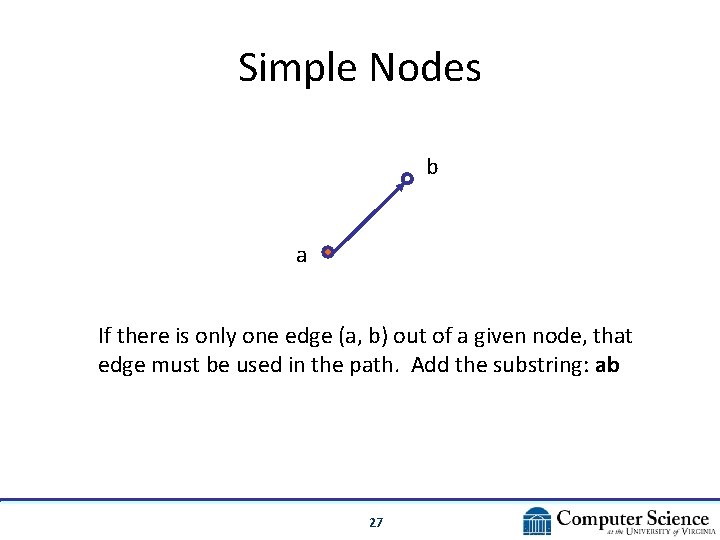
Simple Nodes b a If there is only one edge (a, b) out of a given node, that edge must be used in the path. Add the substring: ab 27
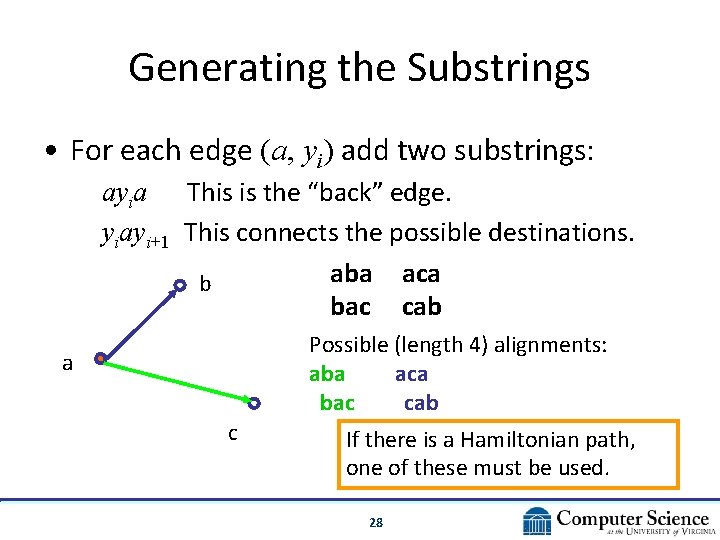
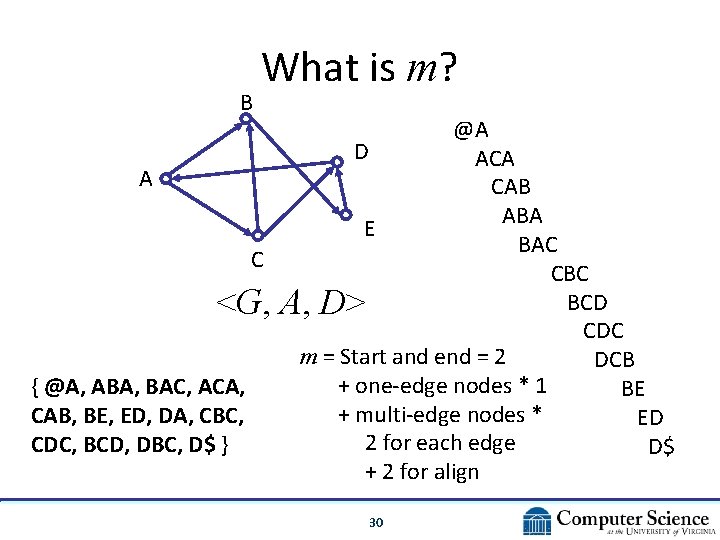
Generating the Substrings • For each edge (a, yi) add two substrings: ayia This is the “back” edge. yiayi+1 This connects the possible destinations. aba aca b bac cab Possible (length 4) alignments: aba aca bac cab a c If there is a Hamiltonian path, one of these must be used. 28
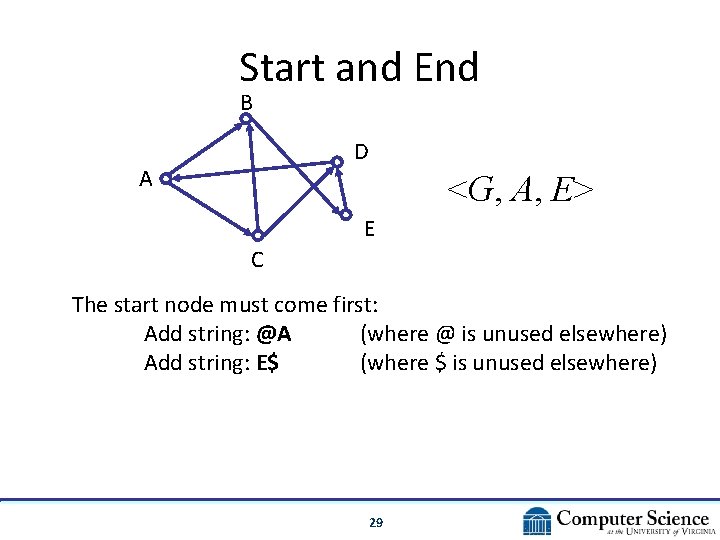
Start and End B D A <G, A, E> E C The start node must come first: Add string: @A (where @ is unused elsewhere) Add string: E$ (where $ is unused elsewhere) 29
B What is m? @A D ACA A CAB ABA E BAC C CBC BCD <G, A, D> CDC m = Start and end = 2 DCB + one-edge nodes * 1 { @A, ABA, BAC, ACA, BE + multi-edge nodes * CAB, BE, ED, DA, CBC, ED 2 for each edge CDC, BCD, DBC, D$ } D$ + 2 for align 30
Human Genome • • • 3 Billion base pairs 600 -700 bases per read ~8 X coverage required So, n 37 Million sequence fragments Celera used 27. 2 Million reads (but could get more than 700 bases per read) How can we solve an NP-Complete problem for such large n? 31
Approaches • Human Genome Project (Collins) – Start by producing a genome map (using biology, chemistry, etc) to have a framework for knowing where the fragments should go • Celera Solution (Venter) – Approximate: we can’t guarantee finding the shortest possible, but we can develop clever algorithms that get close most of the time 32
Result: Draw President Clinton announces Human Genome Sequence essentially complete (with Venter and Collins), June 26, 2000 But, Human Genome Project mostly adopted Venter’s approach. 33
Genomes Computing 34
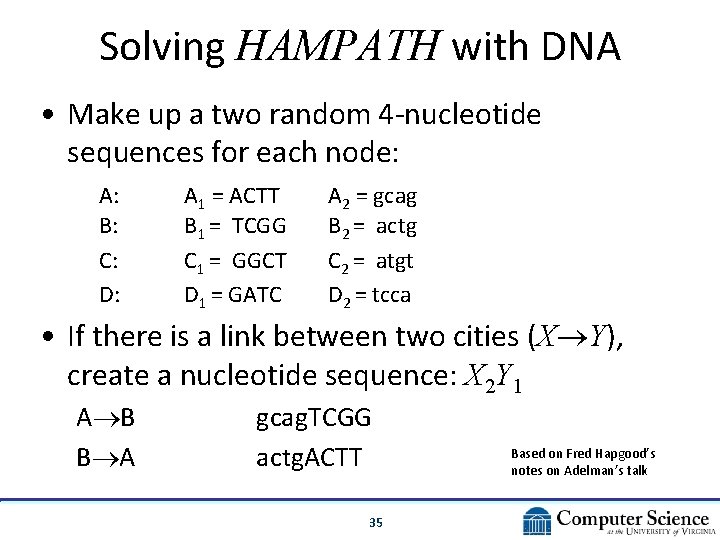
Solving HAMPATH with DNA • Make up a two random 4 -nucleotide sequences for each node: A: B: C: D: A 1 = ACTT B 1 = TCGG C 1 = GGCT D 1 = GATC A 2 = gcag B 2 = actg C 2 = atgt D 2 = tcca • If there is a link between two cities (X Y), create a nucleotide sequence: X 2 Y 1 A B B A gcag. TCGG actg. ACTT 35 Based on Fred Hapgood’s notes on Adelman’s talk
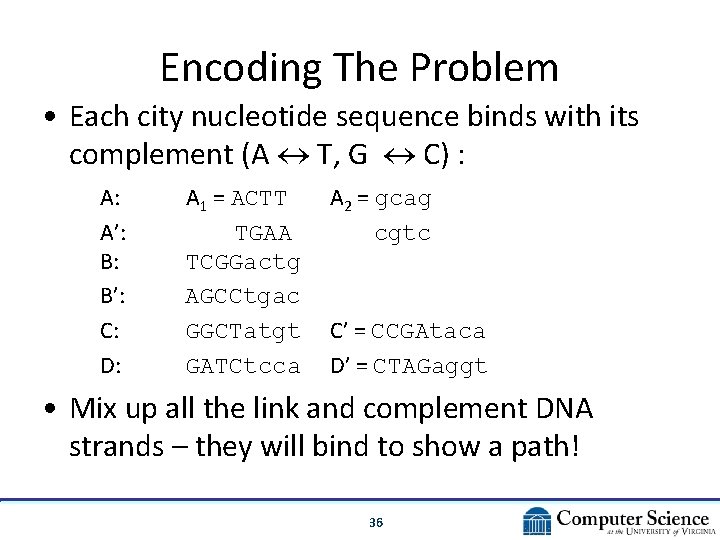
Encoding The Problem • Each city nucleotide sequence binds with its complement (A T, G C) : A: A’: B: B’: C: D: A 1 = ACTT TGAA TCGGactg AGCCtgac GGCTatgt GATCtcca A 2 = gcag cgtc C’ = CCGAtaca D’ = CTAGaggt • Mix up all the link and complement DNA strands – they will bind to show a path! 36
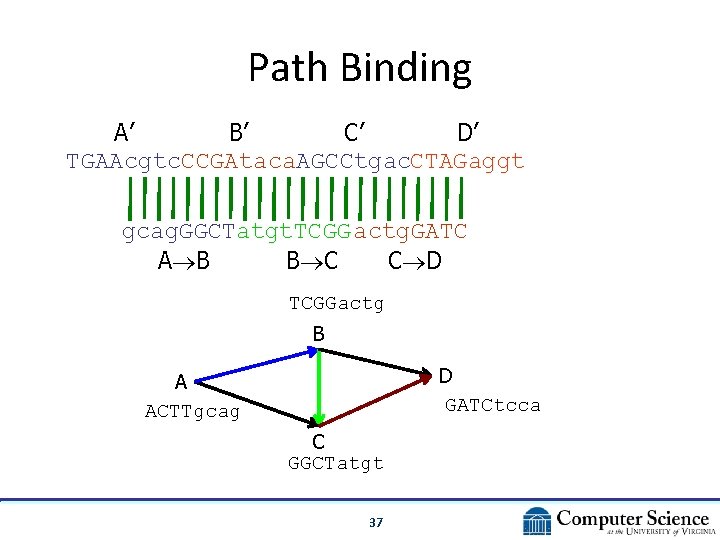
Path Binding A’ B’ C’ D’ TGAAcgtc. CCGAtaca. AGCCtgac. CTAGaggt gcag. GGCTatgt. TCGG actg. GATC A B B C C D TCGGactg B D GATCtcca A ACTTgcag C GGCTatgt 37
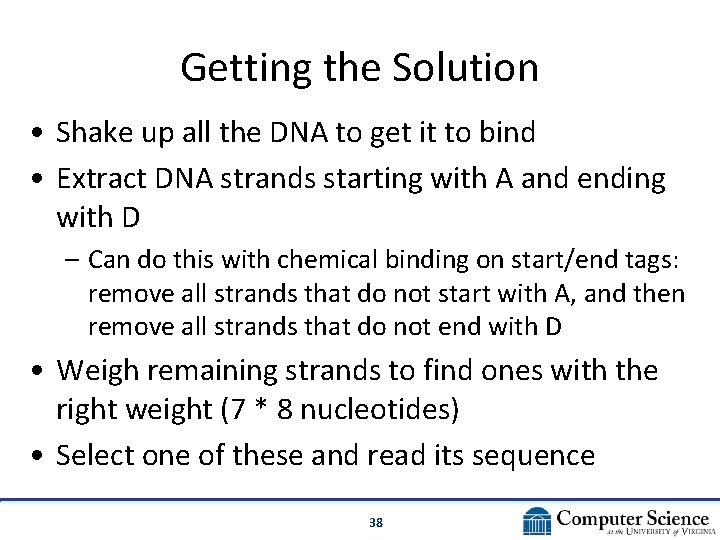
Getting the Solution • Shake up all the DNA to get it to bind • Extract DNA strands starting with A and ending with D – Can do this with chemical binding on start/end tags: remove all strands that do not start with A, and then remove all strands that do not end with D • Weigh remaining strands to find ones with the right weight (7 * 8 nucleotides) • Select one of these and read its sequence 38
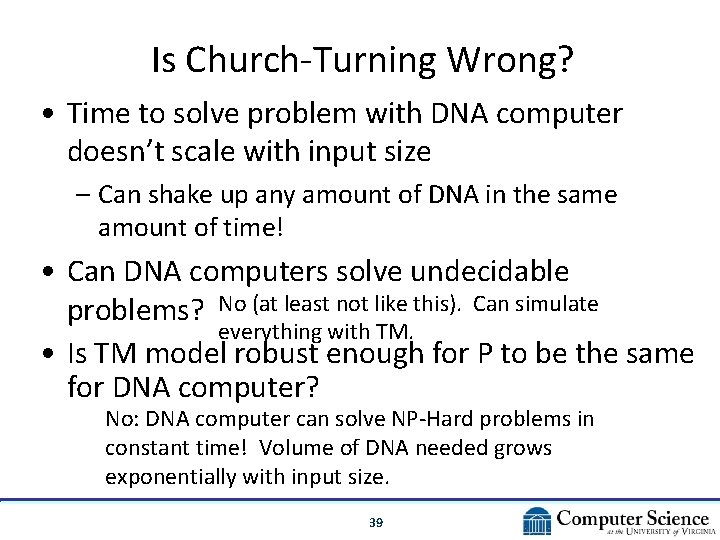
Is Church-Turning Wrong? • Time to solve problem with DNA computer doesn’t scale with input size – Can shake up any amount of DNA in the same amount of time! • Can DNA computers solve undecidable problems? No (at least not like this). Can simulate everything with TM. • Is TM model robust enough for P to be the same for DNA computer? No: DNA computer can solve NP-Hard problems in constant time! Volume of DNA needed grows exponentially with input size. 39
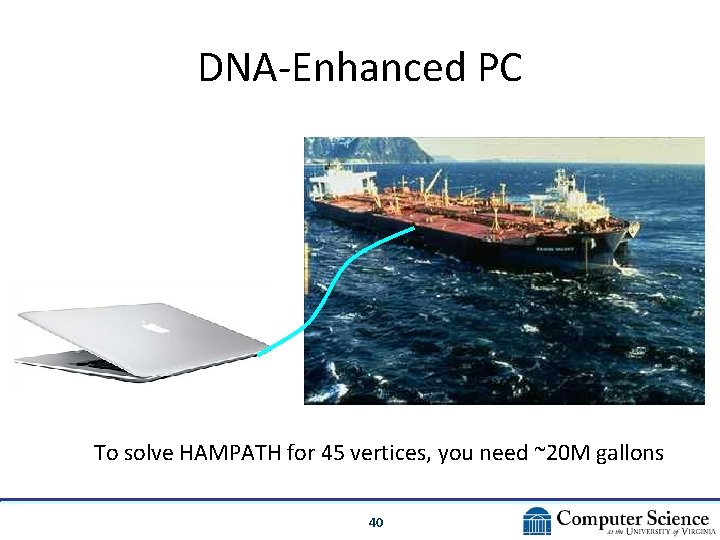
DNA-Enhanced PC To solve HAMPATH for 45 vertices, you need ~20 M gallons 40
Where to Go From Here • Talks today and tomorrow (both in new Library) – 4: 00 pm today: Curtis Wong – 3: 00 tomorrow: Bill Wulf • Security and Theory Lunch Groups – See handout for links • Courses: – CS 660: Graduate Theory of Computation – CS 432, MATH 450, PHIL 233, Cryptography 41
Thanks! 42