
Class 2 Monopoly pricing Uniform pricing two part

- Slides: 33
Class 2: Monopoly pricing Uniform pricing, two part tariffs, and price discrimination Multi-plant monopolist Durable goods and leasing
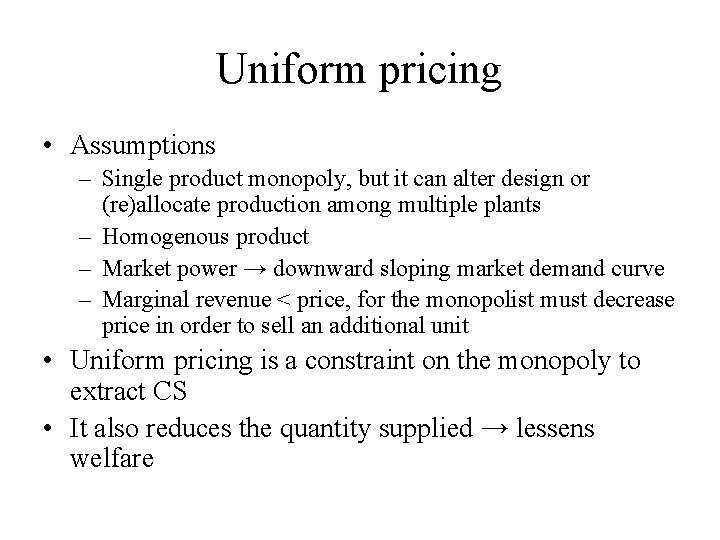
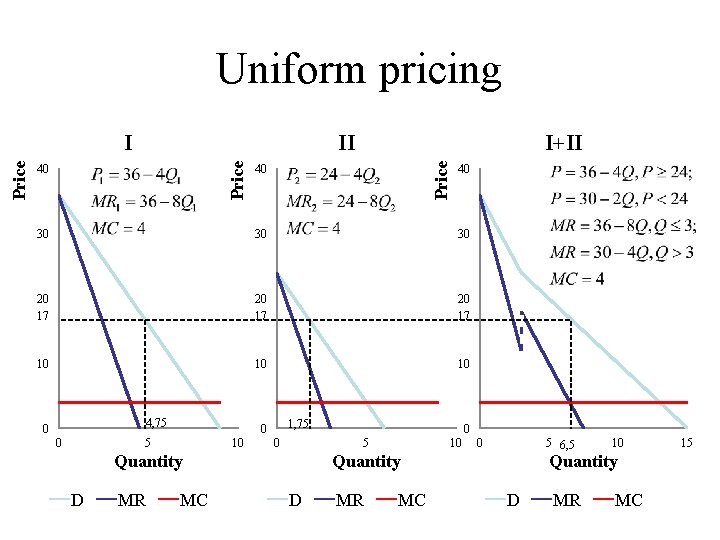
Uniform pricing • Assumptions – Single product monopoly, but it can alter design or (re)allocate production among multiple plants – Homogenous product – Market power → downward sloping market demand curve – Marginal revenue < price, for the monopolist must decrease price in order to sell an additional unit • Uniform pricing is a constraint on the monopoly to extract CS • It also reduces the quantity supplied → lessens welfare
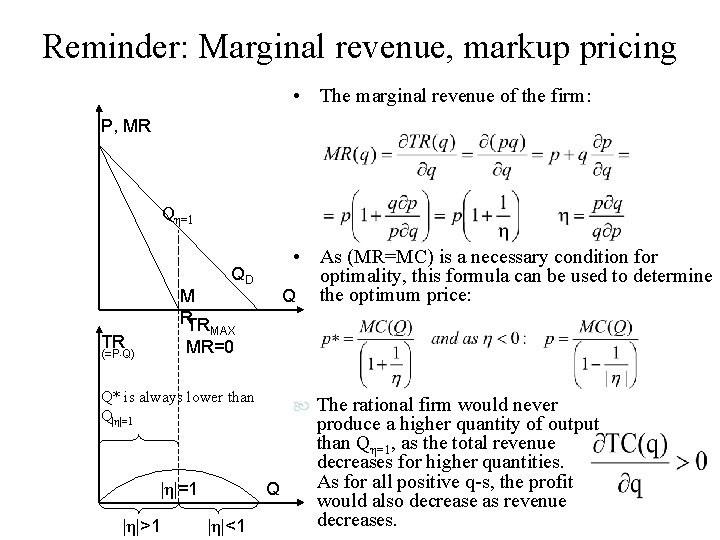
Reminder: Marginal revenue, markup pricing • The marginal revenue of the firm: P, MR Qη=1 TR (=P*Q) M RTR • As (MR=MC) is a necessary condition for optimality, this formula can be used to determine Q the optimum price: QD MAX MR=0 Q* is always lower than Q|η|=1 Q |η|=1 |η|>1 |η|<1 The rational firm would never produce a higher quantity of output than Qη=1, as the total revenue decreases for higher quantities. As for all positive q-s, the profit would also decrease as revenue decreases.
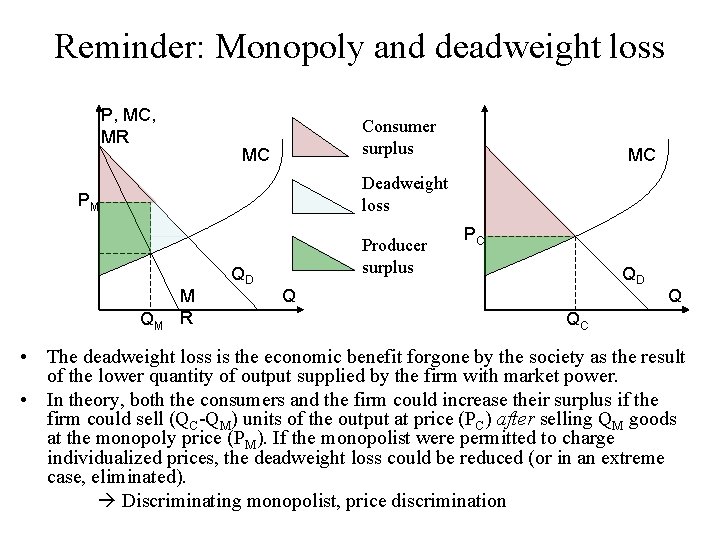
Reminder: Monopoly and deadweight loss P, MC, MR Consumer surplus MC MC Deadweight loss PM QM M R QD Producer surplus PC QD Q Q QC • The deadweight loss is the economic benefit forgone by the society as the result of the lower quantity of output supplied by the firm with market power. • In theory, both the consumers and the firm could increase their surplus if the firm could sell (QC-QM) units of the output at price (PC) after selling QM goods at the monopoly price (PM). If the monopolist were permitted to charge individualized prices, the deadweight loss could be reduced (or in an extreme case, eliminated). Discriminating monopolist, price discrimination
Price discrimination • Different prices for different customers – – • Monopoly may extract more CS (motivation) Efficiency and welfare may increase (side effects) Obstacles to price discrimination (1) Monopolist needs information about her customers (“who is who on the demand curve”) (2) Arbitrage must be excluded – Ad 1: demand curve is an ordering of the consumers by their reservation prices
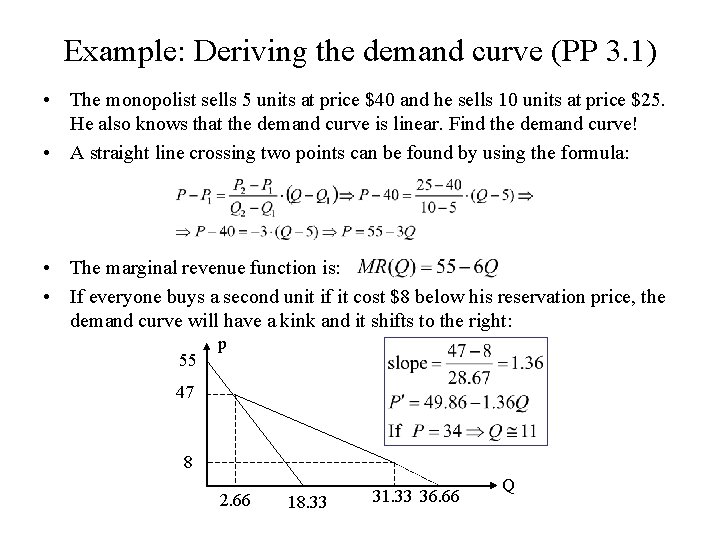
Example: Deriving the demand curve (PP 3. 1) • The monopolist sells 5 units at price $40 and he sells 10 units at price $25. He also knows that the demand curve is linear. Find the demand curve! • A straight line crossing two points can be found by using the formula: • The marginal revenue function is: • If everyone buys a second unit if it cost $8 below his reservation price, the demand curve will have a kink and it shifts to the right: 55 p 47 8 2. 66 18. 33 31. 33 36. 66 Q
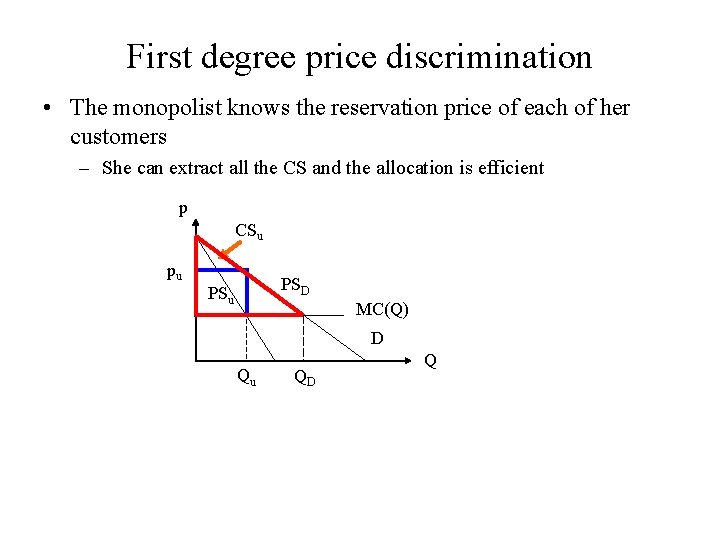
First degree price discrimination • The monopolist knows the reservation price of each of her customers – She can extract all the CS and the allocation is efficient p CSu pu PSD PSu MC(Q) D Qu QD Q
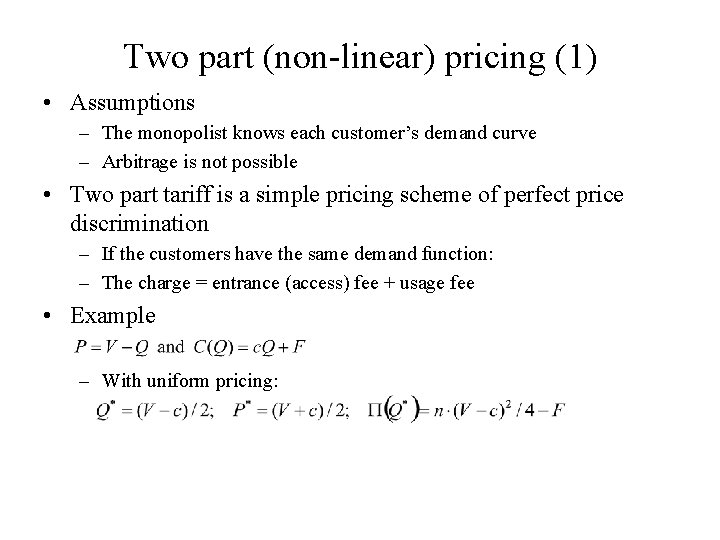
Two part (non-linear) pricing (1) • Assumptions – The monopolist knows each customer’s demand curve – Arbitrage is not possible • Two part tariff is a simple pricing scheme of perfect price discrimination – If the customers have the same demand function: – The charge = entrance (access) fee + usage fee • Example – With uniform pricing:
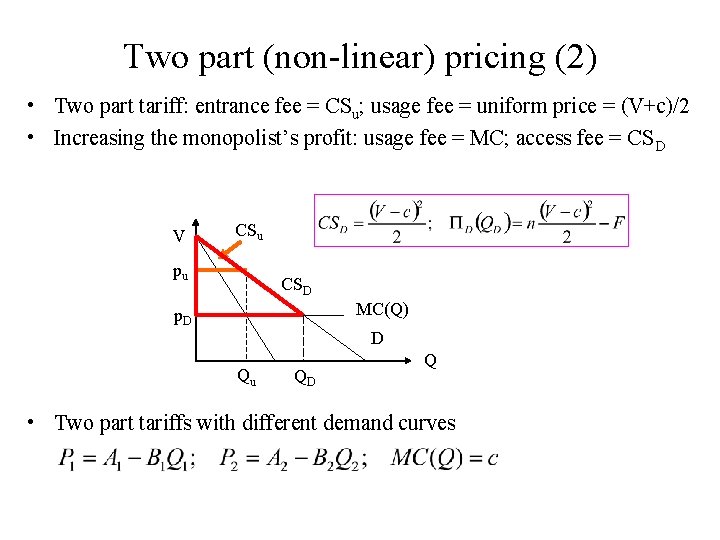
Two part (non-linear) pricing (2) • Two part tariff: entrance fee = CSu; usage fee = uniform price = (V+c)/2 • Increasing the monopolist’s profit: usage fee = MC; access fee = CSD V CSu pu CSD MC(Q) p. D D Qu QD Q • Two part tariffs with different demand curves
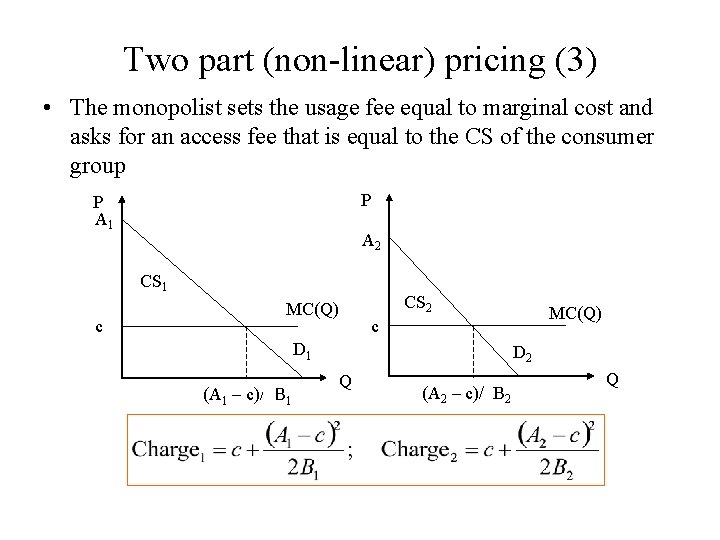
Two part (non-linear) pricing (3) • The monopolist sets the usage fee equal to marginal cost and asks for an access fee that is equal to the CS of the consumer group P P A 1 A 2 CS 1 c MC(Q) CS 2 c D 1 (A 1 – c)/2 B 1 MC(Q) D 2 Q (A 2 – c)/2 B 2 Q
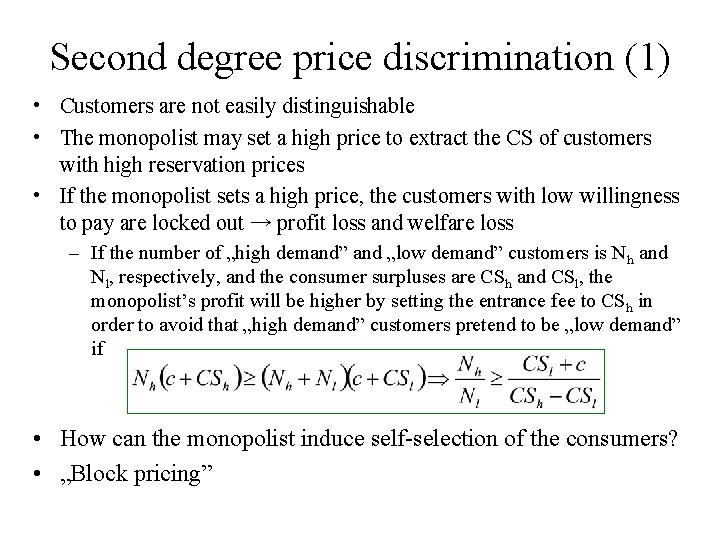
Second degree price discrimination (1) • Customers are not easily distinguishable • The monopolist may set a high price to extract the CS of customers with high reservation prices • If the monopolist sets a high price, the customers with low willingness to pay are locked out → profit loss and welfare loss – If the number of „high demand” and „low demand” customers is Nh and Nl, respectively, and the consumer surpluses are CSh and CSl, the monopolist’s profit will be higher by setting the entrance fee to CSh in order to avoid that „high demand” customers pretend to be „low demand” if • How can the monopolist induce self-selection of the consumers? • „Block pricing”
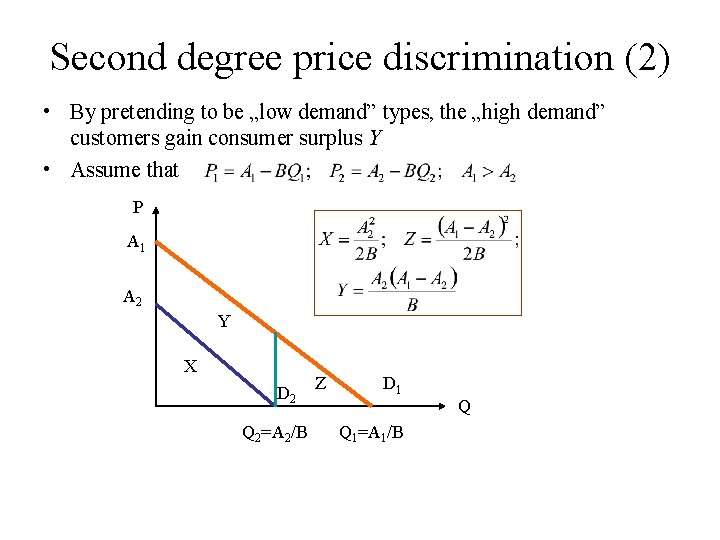
Second degree price discrimination (2) • By pretending to be „low demand” types, the „high demand” customers gain consumer surplus Y • Assume that P A 1 A 2 Y X D 2 Q 2=A 2/B Z D 1 Q 1=A 1/B Q
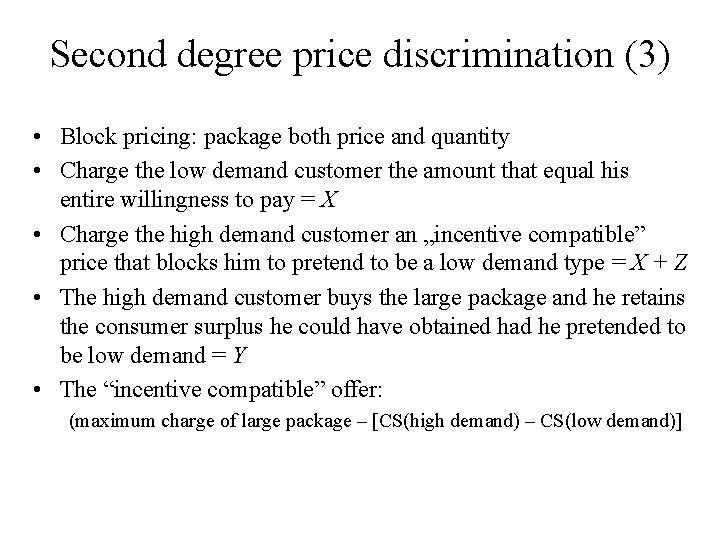
Second degree price discrimination (3) • Block pricing: package both price and quantity • Charge the low demand customer the amount that equal his entire willingness to pay = X • Charge the high demand customer an „incentive compatible” price that blocks him to pretend to be a low demand type = X + Z • The high demand customer buys the large package and he retains the consumer surplus he could have obtained had he pretended to be low demand = Y • The “incentive compatible” offer: (maximum charge of large package – [CS(high demand) – CS(low demand)]
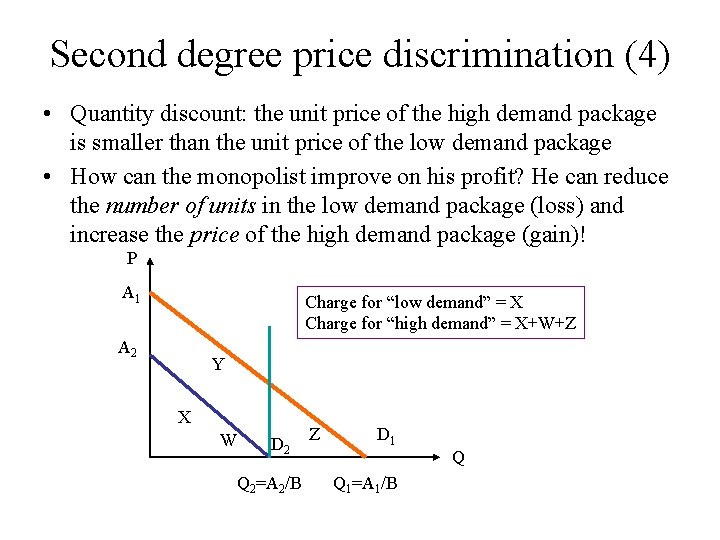
Second degree price discrimination (4) • Quantity discount: the unit price of the high demand package is smaller than the unit price of the low demand package • How can the monopolist improve on his profit? He can reduce the number of units in the low demand package (loss) and increase the price of the high demand package (gain)! P A 1 Charge for “low demand” = X Charge for “high demand” = X+W+Z A 2 Y X W D 2 Q 2=A 2/B Z D 1 Q 1=A 1/B Q
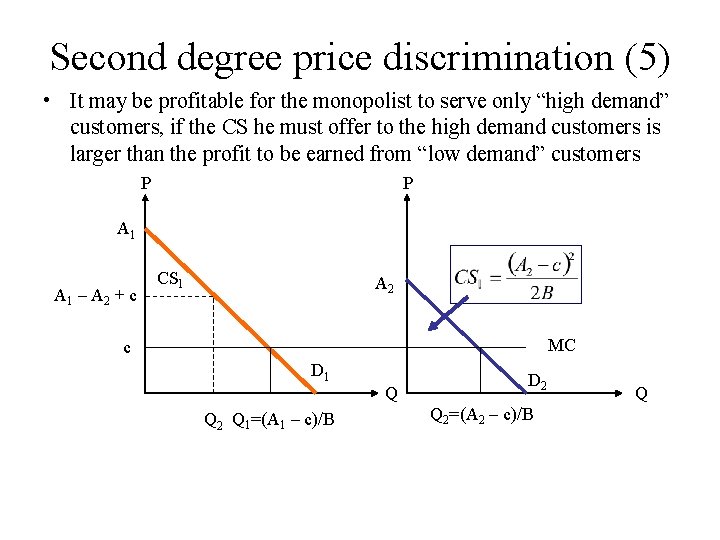
Second degree price discrimination (5) • It may be profitable for the monopolist to serve only “high demand” customers, if the CS he must offer to the high demand customers is larger than the profit to be earned from “low demand” customers P P A 1 – A 2 + c CSl A 2 MC c D 1 Q 2 Q 1=(A 1 – c)/B Q D 2 Q 2=(A 2 – c)/B Q
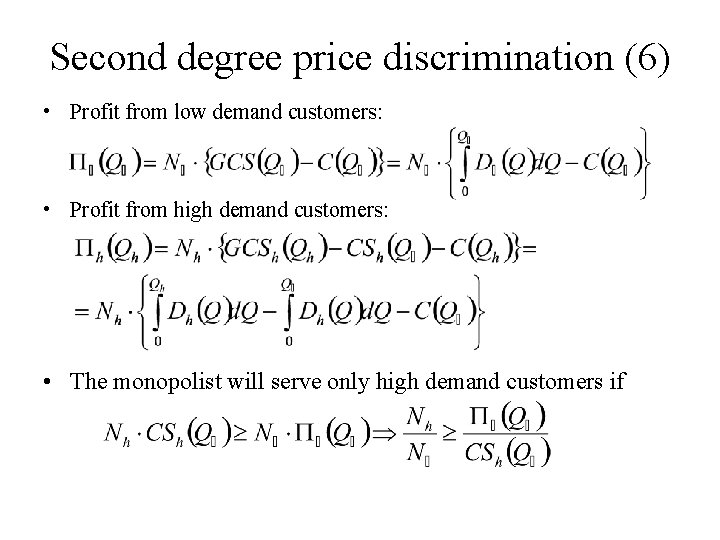
Second degree price discrimination (6) • Profit from low demand customers: • Profit from high demand customers: • The monopolist will serve only high demand customers if
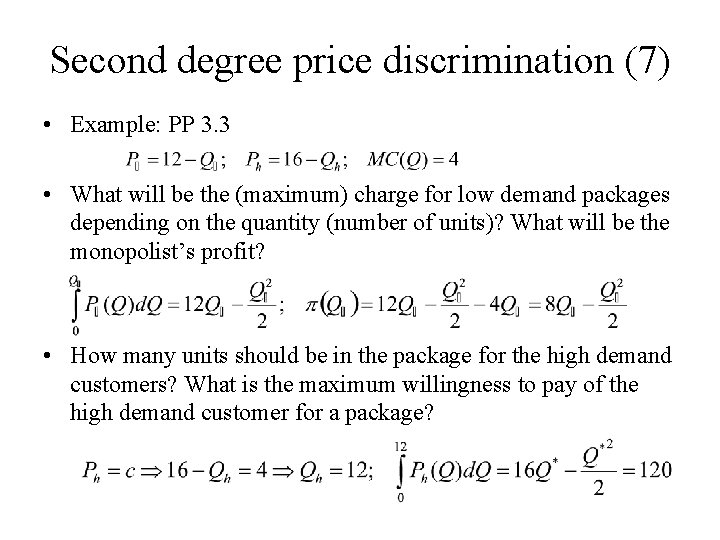
Second degree price discrimination (7) • Example: PP 3. 3 • What will be the (maximum) charge for low demand packages depending on the quantity (number of units)? What will be the monopolist’s profit? • How many units should be in the package for the high demand customers? What is the maximum willingness to pay of the high demand customer for a package?
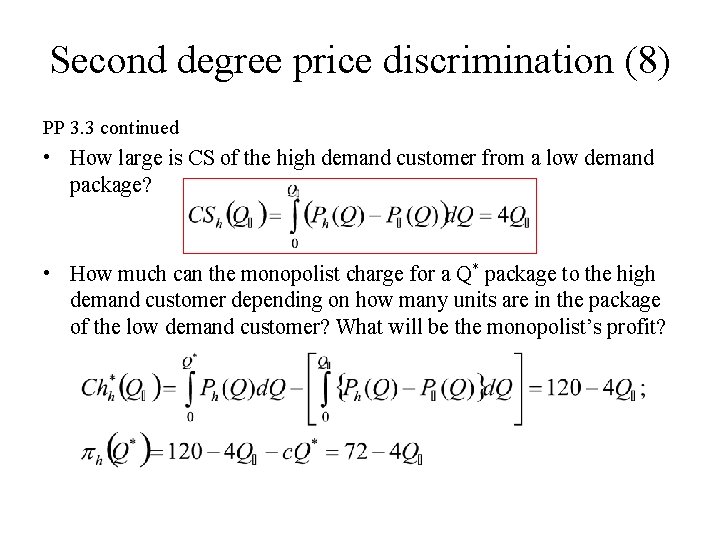
Second degree price discrimination (8) PP 3. 3 continued • How large is CS of the high demand customer from a low demand package? • How much can the monopolist charge for a Q* package to the high demand customer depending on how many units are in the package of the low demand customer? What will be the monopolist’s profit?
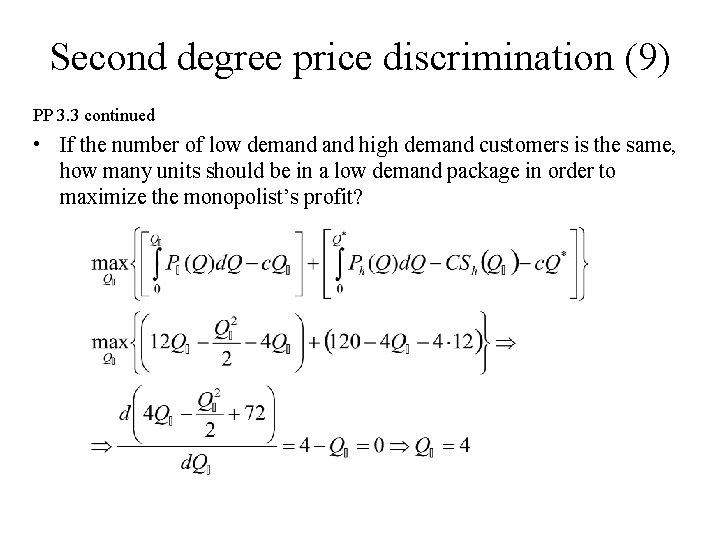
Second degree price discrimination (9) PP 3. 3 continued • If the number of low demand high demand customers is the same, how many units should be in a low demand package in order to maximize the monopolist’s profit?
Second degree price discrimination (10) PP 3. 3 continued • If the number of low demand high demand customers is Nl and Nh, respectively, how many units should be in a low demand package in order to maximize the monopolist’s profit?
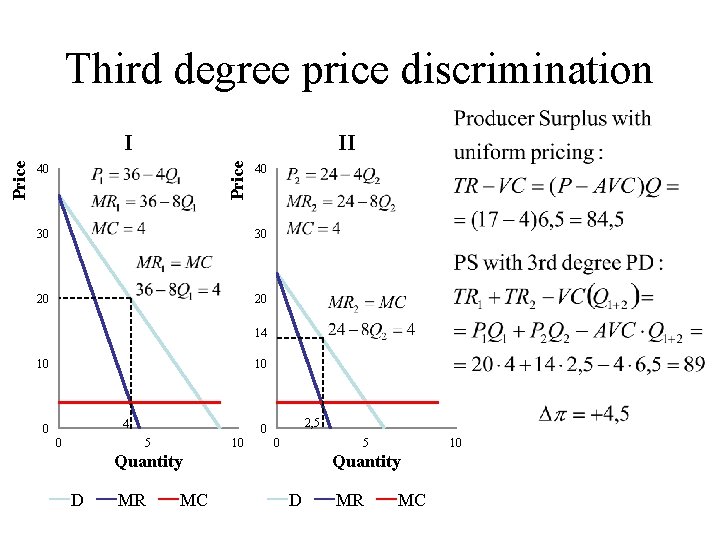
Third degree price discrimination (1) • The monopolist is able to observe the types of the different customer groups • Price discrimination without product differentiation • Assume that there are two groups with two different inverse demand functions • The marginal cost of supplying an additional unit is the same whether it is for the high demand or for low demand group • But the total marginal cost is affected by the number of goods sold in each market, if MC is not constant • The marginal revenue from the last units sold must be equal in each market, otherwise the monopolist could reallocate production and increase revenue → MR 1 = MR 2
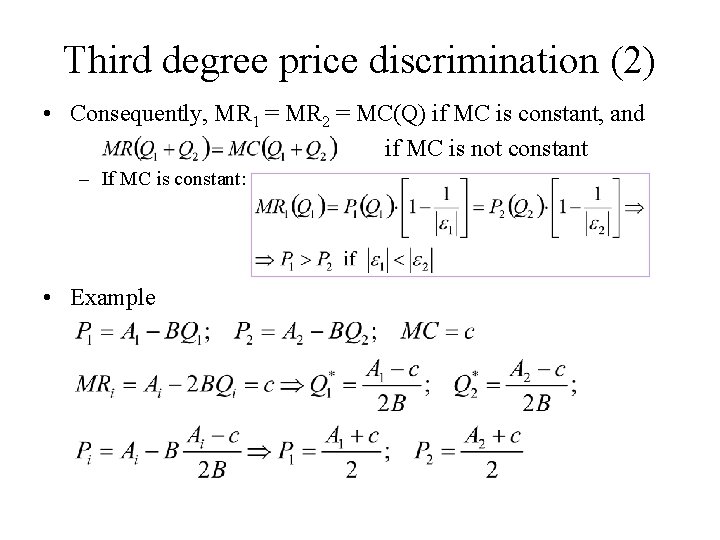
Third degree price discrimination (2) • Consequently, MR 1 = MR 2 = MC(Q) if MC is constant, and if MC is not constant – If MC is constant: • Example
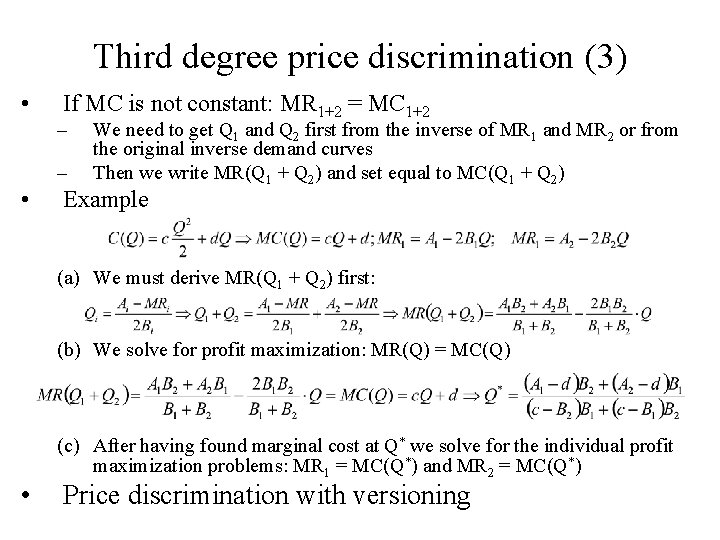
Third degree price discrimination (3) • If MC is not constant: MR 1+2 = MC 1+2 – – • We need to get Q 1 and Q 2 first from the inverse of MR 1 and MR 2 or from the original inverse demand curves Then we write MR(Q 1 + Q 2) and set equal to MC(Q 1 + Q 2) Example (a) We must derive MR(Q 1 + Q 2) first: (b) We solve for profit maximization: MR(Q) = MC(Q) • (c) After having found marginal cost at Q* we solve for the individual profit maximization problems: MR 1 = MC(Q*) and MR 2 = MC(Q*) Price discrimination with versioning
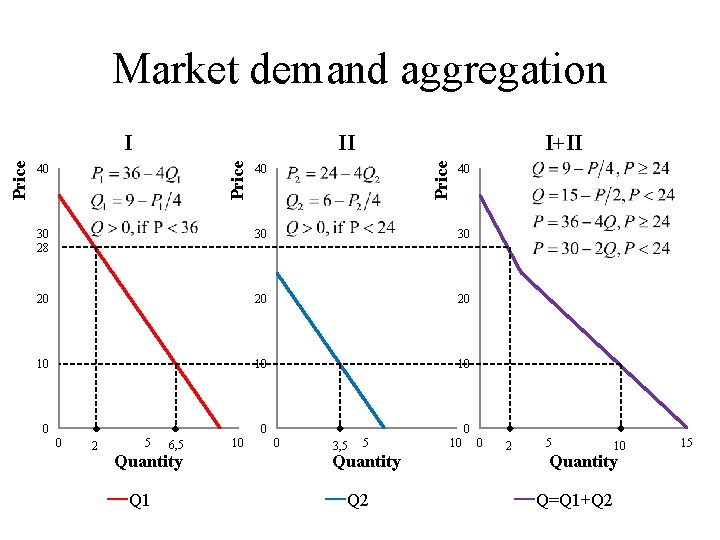
Market demand aggregation 40 I+II Price I 40 40 30 28 30 30 20 20 20 10 10 10 0 2 5 6, 5 Quantity Q 1 10 0 0 3, 5 5 Quantity Q 2 10 0 2 5 10 10 Quantity Q=Q 1+Q 2 15
Uniform pricing 40 I+II Price I 40 40 30 30 30 20 17 10 10 10 4, 75 0 0 1, 75 0 5 10 0 Quantity D MR MC 0 5 10 0 5 6, 5 Quantity D MR MC 10 Quantity D MR MC 15
Third degree price discrimination II Price I 40 40 30 30 20 20 14 10 10 4 0 0 2, 5 0 5 10 0 5 Quantity D MR MC 10 Quantity D MR MC
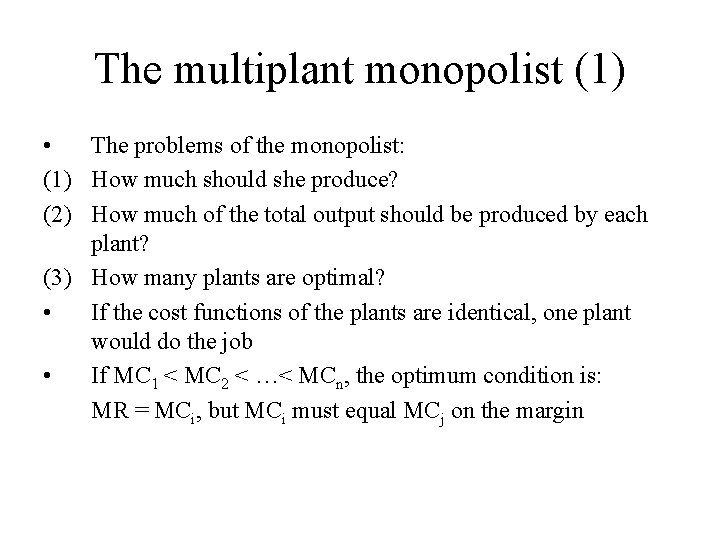
The multiplant monopolist (1) • The problems of the monopolist: (1) How much should she produce? (2) How much of the total output should be produced by each plant? (3) How many plants are optimal? • If the cost functions of the plants are identical, one plant would do the job • If MC 1 < MC 2 < …< MCn, the optimum condition is: MR = MCi, but MCi must equal MCj on the margin
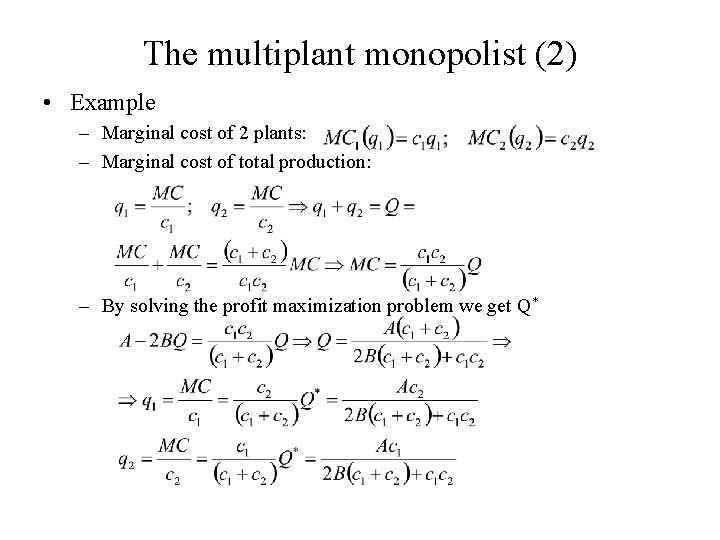
The multiplant monopolist (2) • Example – Marginal cost of 2 plants: – Marginal cost of total production: – By solving the profit maximization problem we get Q*
Price discrimination, social welfare and public policy • Is price discrimination always harmful to consumers? • Third degree pd may reduce efficiency, for it applies uniform pricing to different markets • Efficiency may be improved but income distribution may become more unequal • The Robinson-Patman Act and price discrimination
Bonus slides: Quality choice
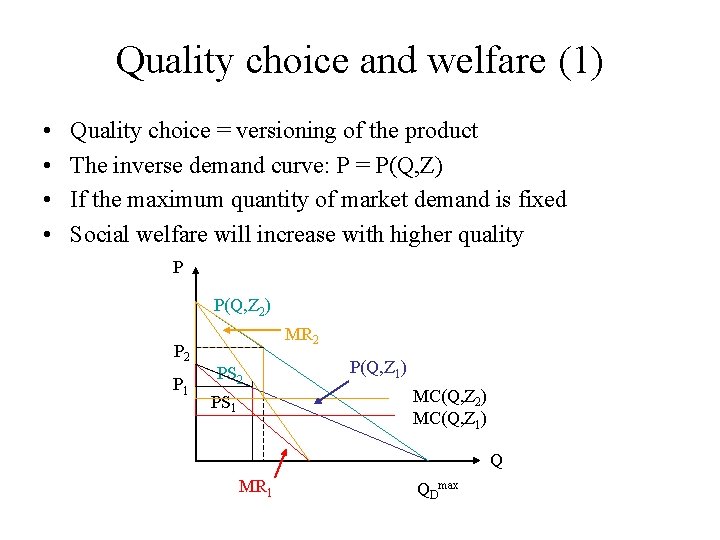
Quality choice and welfare (1) • • Quality choice = versioning of the product The inverse demand curve: P = P(Q, Z) If the maximum quantity of market demand is fixed Social welfare will increase with higher quality P P(Q, Z 2) P 2 P 1 MR 2 PS 1 P(Q, Z 1) MC(Q, Z 2) MC(Q, Z 1) Q MR 1 QDmax
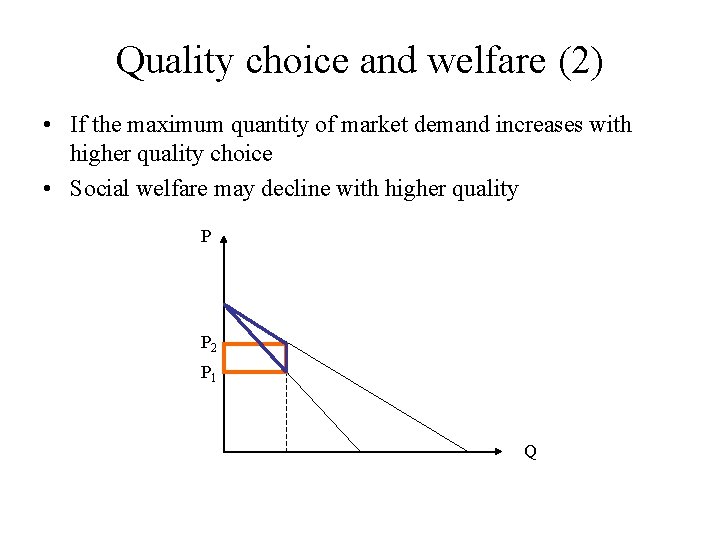
Quality choice and welfare (2) • If the maximum quantity of market demand increases with higher quality choice • Social welfare may decline with higher quality P P 2 P 1 Q
Quality choice and welfare (3) • Example: what is the optimum quantity of supply and the optimum level of quality?