
Class 11 November 21 Forget Me Not the
Class 11 – November 21 Forget Me Not? – the Right to Be Forgotten in Europe (and Canada? ) and Introduction to European Data Protection
Admin Crap / Announcements • • Office hours cancelled today Missing essay topic paragraphs Power. Point Slides Course evaluations on Minerva. Just do it! THE FUTURE OF TECH LAW AT THIS FACULTY DEPENDS ON IT FFS AUUUGHHHHHH!!!!111!!!! Class 11
In the News Pay. Pal court order update: UPON being satisfied that the conditions of paragraphs 231. 2(3)(a) and (b) of the ITA and paragraphs 289(3)(a) and (b) of the ETA for the issuance of the Unnamed Persons Requirement have been satisfied in that the Information on Oath establishes that: a) The persons or group of persons are ascertainable, as the unnamed persons are corporations and individuals holding a business account with Pay. Pal [Business Account] that have used Pay. Pal’s online payment platform in the course of their commercial activities during the period covering the calendar years 2014 to the date of service of the Unnamed Persons Requirement [Unnamed Persons]; and b) The Unnamed Persons Requirement is made to verify compliance by these Unnamed Persons with their duties and obligations under the ITA and the ETA; Class 11

In the News – to watch this week Washington Post FCC and net neutrality plans… “a central part of the effort will involve undoing the FCC's decision to declare Internet providers as telecommunications service providers” Class 11
In the News Jurisprudence R. v. Sim, 2017 ONCA 856, 2017 -11 -8 F – Sim set up a Yahoo! Group to talk about complainant Guilty of Criminal Harassment under s. 264 Good discussion of actus reus and mens rea – objective standard for a/r (“engaging in threatening conduct directed at the other person”): “Although an accused's threatening conduct may not affect every target of that conduct, in every conceivable situation, it could well instill fear in a reasonable person in the complainant’s specific situation” Class 11

In the News Presentation 1 Alexander Agnello Class 11
EUROPE! Class 11
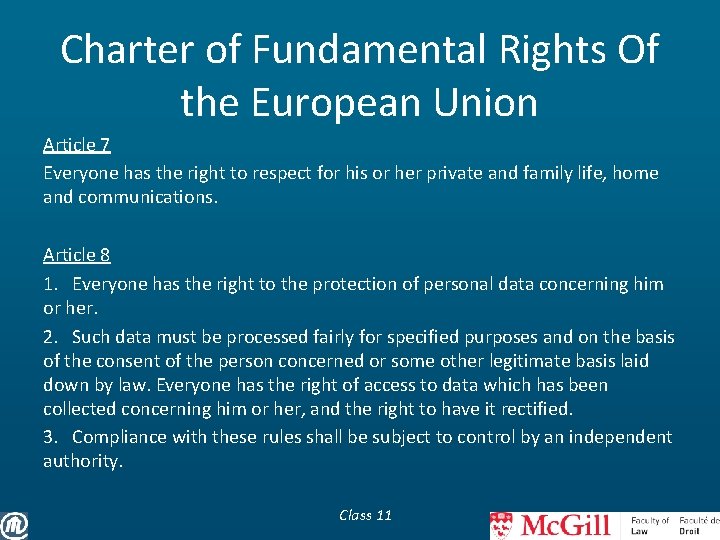
Charter of Fundamental Rights Of the European Union Article 7 Everyone has the right to respect for his or her private and family life, home and communications. Article 8 1. Everyone has the right to the protection of personal data concerning him or her. 2. Such data must be processed fairly for specified purposes and on the basis of the consent of the person concerned or some other legitimate basis laid down by law. Everyone has the right of access to data which has been collected concerning him or her, and the right to have it rectified. 3. Compliance with these rules shall be subject to control by an independent authority. Class 11
Directive 95/46/EC and the GDPR Ingo Borgdorf presentation Class 11
In the News Presentation 2 Teresa Giaccardi Class 11
Other EU Privacy laws • “EU Cookie Directive” 2009 • Amendment to 2002 Eprivacy Directive • Need consent to have cookies installed • Probably dead, new regs maybe in effect same day as GDPR, based on web browsers Class 11
WHY IN CANADA (OR ANYWHERE ELSE) SHOULD WE CARE ABOUT EU DATA PROTECTION LAW? Class 11
e. g. ’s of Canada vs. EU concepts PIPEDA 95/46/EU • PI – “information about an identifiable individual” • Consent (principle 3) • Identifying purposes (principle 2) • Access and amendment (principle 9) • Personal Data - “information relating to an identified or identifiable natural person • Consent (art. 7(a)) • specified , explicit and legitimate purposes (6) • Right of access and rectification (12) Class 11
Fact! PIPEDA was passed partially in response to 95/46/EC This is important b/c… Class 11
Transfer of PI (PD) to 3 rd countries Article 25 Principle 1 The Member States shall provide that the transfer to a third country of personal data which are undergoing processing or are intended for processing after transfer may take place only if, without prejudice to compliance with the national provisions adopted pursuant to the other provisions of this Directive, the third country in question ensures an adequate level of protection. Class 11
Transfer of PI (PD) to 3 rd countries Article 25 Principle 2 The adequacy of the level of protection afforded by a third country shall be assessed in the light of all the circumstances surrounding a data transfer operation or set of data transfer operations; particular consideration shall be given to the nature of the data, the purpose and duration of the proposed processing operation or operations, the country of origin and country of final destination, the rules of law, both general and sectoral, in force in the third country in question and the professional rules and security measures which are complied with in that country. Class 11
Transfer of PI (PD) to 3 rd countries Article 25 Principle 6 The Commission may find, …that a third country ensures an adequate level of protection within the meaning of paragraph 2 of this Article, by reason of its domestic law or of the international commitments it has entered into, … for the protection of the private lives and basic freedoms and rights of individuals. Class 11
Canada? 2002/2/EC: Commission Decision of 20 December 2001 pursuant to Directive 95/46/EC of the European Parliament and of the Council on the adequate protection of personal data provided by the Canadian Personal Information Protection and Electronic Documents Act “For the purposes of Article 25(2) of Directive 95/46/EC, Canada is considered as providing an adequate level of protection for personal data transferred from the Community to recipients subject to the Personal Information Protection and Electronic Documents Act” Class 11
Quebec? Opinion 7/2014 Article 29 Working Party, 2014 -6 -4 “The Working Party points out that its assessment of the adequacy of the data protection legislation into force in Quebec refers essentially to Articles 35 to 41 of the Quebec Civil Code and to the Act respecting the protection of personal information in the private sector as amended in 2000” “The Working Party therefore considers that it is necessary to clarify the territorial scope of the Quebec Act before any decision on its adequacy is taken by the European Commission. ” 7 things they want fixed before they will say there is an adequate level of protection Class 11
Other countries? Andorra, Argentina, Faeroe Islands, Guernsey, Israel, Isle of Man, Jersey, New Zealand, Switzerland Uruguay that’s it! United States? ? ? Facebook relationship status says “its complicated”… Class 11
Schrems v. Data Protection Commissioner Massimo Orsini presentation Class 11
Schrems Takeaway “…legislation permitting the public authorities to have access on a generalised basis to the content of electronic communications must be regarded as compromising the essence of the fundamental right to respect for private life, as guaranteed by Article 7 of the Charter” “Likewise, legislation not providing for any possibility for an individual to pursue legal remedies in order to have access to personal data relating to him, or to obtain the rectification or erasure of such data, does not respect. . ” “Consequently, without there being any need to examine the content of the safe harbour principles, it is to be concluded that Article 1 of Decision 2000/520 fails to comply with the requirements laid down in Article 25(6) of Directive 95/46, read in the light of the Charter, and that it is accordingly invalid. ” it is to be concluded that Decision 2000/520 is invalid” “Having regard to all the foregoing considerations, Class 11
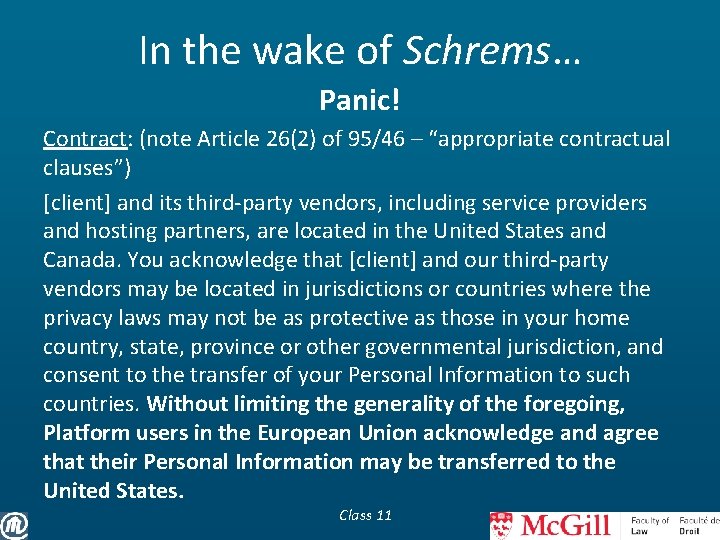
In the wake of Schrems… Panic! Contract: (note Article 26(2) of 95/46 – “appropriate contractual clauses”) [client] and its third-party vendors, including service providers and hosting partners, are located in the United States and Canada. You acknowledge that [client] and our third-party vendors may be located in jurisdictions or countries where the privacy laws may not be as protective as those in your home country, state, province or other governmental jurisdiction, and consent to the transfer of your Personal Information to such countries. Without limiting the generality of the foregoing, Platform users in the European Union acknowledge and agree that their Personal Information may be transferred to the United States. Class 11
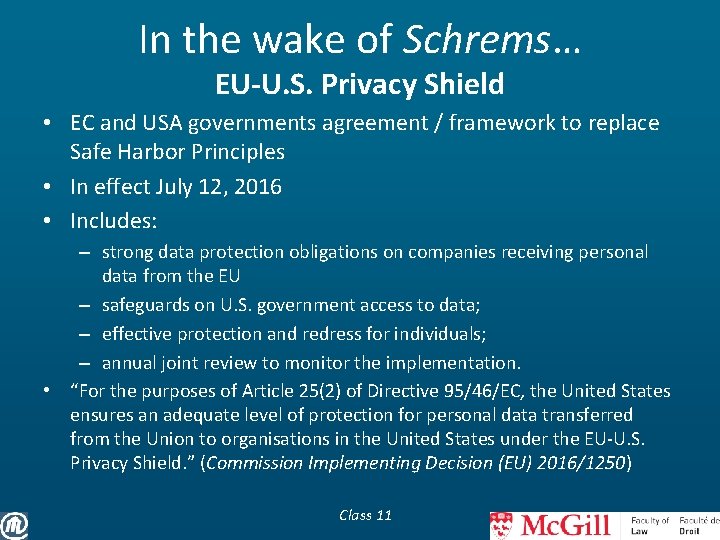
In the wake of Schrems… EU-U. S. Privacy Shield • EC and USA governments agreement / framework to replace Safe Harbor Principles • In effect July 12, 2016 • Includes: – strong data protection obligations on companies receiving personal data from the EU – safeguards on U. S. government access to data; – effective protection and redress for individuals; – annual joint review to monitor the implementation. • “For the purposes of Article 25(2) of Directive 95/46/EC, the United States ensures an adequate level of protection for personal data transferred from the Union to organisations in the United States under the EU-U. S. Privacy Shield. ” (Commission Implementing Decision (EU) 2016/1250) Class 11
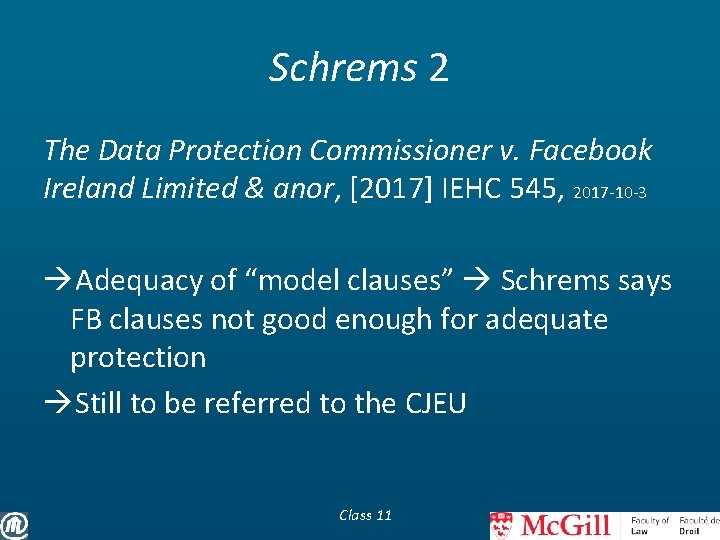
Schrems 2 The Data Protection Commissioner v. Facebook Ireland Limited & anor, [2017] IEHC 545, 2017 -10 -3 Adequacy of “model clauses” Schrems says FB clauses not good enough for adequate protection Still to be referred to the CJEU Class 11
SO WHAT IS THIS RIGHT TO BE FORGOTTEN I KEEP HEARING ABOUT? Class 11
Google v. AEPD and Gonzalez Sarah Sabina Montaldo presentation Class 11
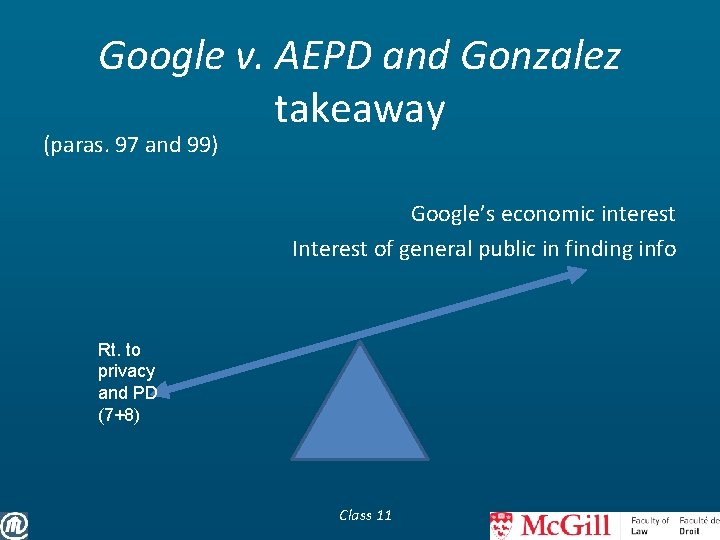
Google v. AEPD and Gonzalez takeaway (para 81) “… a fair balance should be sought in particular between that interest and the data subject’s fundamental rights under Articles 7 and 8… that balance may however depend, in specific cases, on the nature of the information in question and its sensitivity for the data subject’s private life and on the interest of the public in having that information” (para. 87) “inclusion in the list of results… appreciably easier for any internet user … it is liable to constitute a more significant interference with the data subject’s fundamental right to privacy than the publication on the web page” Class 11
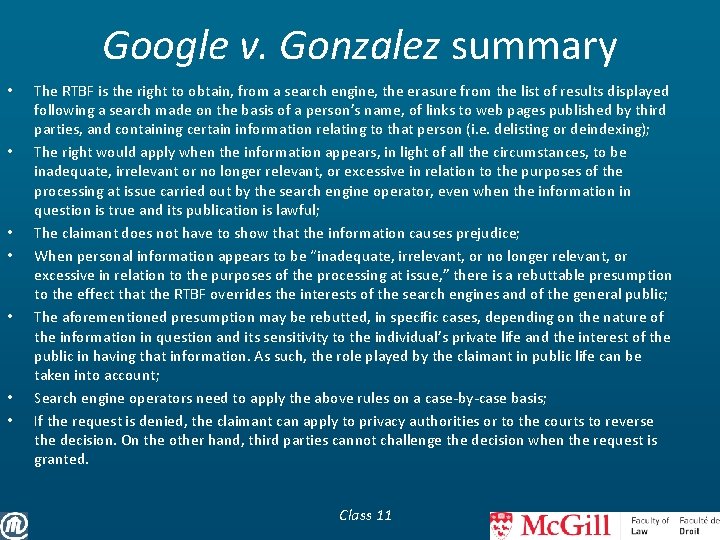
Google v. AEPD and Gonzalez takeaway (para. 88) “the first paragraph of Article 14 of Directive 95/46 are to be interpreted as meaning that, …the operator of a search engine is obliged to remove from the list of results displayed following a search made on the basis of a person’s name links to web pages, published by third parties and containing information relating to that person, also in a case where that name or information is not erased beforehand or simultaneously from those web pages, and even, as the case may be, when its publication in itself on those pages is lawful” Class 11
Google v. AEPD and Gonzalez takeaway (para. 92) “such incompatibility may result not only from the fact that such data are inaccurate but, in particular, also from the fact that they are inadequate, irrelevant or excessive in relation to the purposes of the processing, that they are not kept up to date, or that they are kept for longer than is necessary unless they are required to be kept for historical, statistical or scientific purposes” Class 11
Google v. AEPD and Gonzalez takeaway (paras. 97 and 99) Google’s economic interest Interest of general public in finding info Rt. to privacy and PD (7+8) Class 11
Google v. Gonzalez summary • • The RTBF is the right to obtain, from a search engine, the erasure from the list of results displayed following a search made on the basis of a person’s name, of links to web pages published by third parties, and containing certain information relating to that person (i. e. delisting or deindexing); The right would apply when the information appears, in light of all the circumstances, to be inadequate, irrelevant or no longer relevant, or excessive in relation to the purposes of the processing at issue carried out by the search engine operator, even when the information in question is true and its publication is lawful; The claimant does not have to show that the information causes prejudice; When personal information appears to be “inadequate, irrelevant, or no longer relevant, or excessive in relation to the purposes of the processing at issue, ” there is a rebuttable presumption to the effect that the RTBF overrides the interests of the search engines and of the general public; The aforementioned presumption may be rebutted, in specific cases, depending on the nature of the information in question and its sensitivity to the individual’s private life and the interest of the public in having that information. As such, the role played by the claimant in public life can be taken into account; Search engine operators need to apply the above rules on a case-by-case basis; If the request is denied, the claimant can apply to privacy authorities or to the courts to reverse the decision. On the other hand, third parties cannot challenge the decision when the request is granted. Class 11
RTBF IN CANADA? Class 11
RECALL: PIPEDA ~ DIRECTIVE 95/46 Class 11
Principle 9 PIPEDA Individual Access: …When an individual successfully demonstrates the inaccuracy or incompleteness of personal information, the organization shall amend the information as required. Depending upon the nature of the information challenged, amendment involves the correction, deletion, or addition of information. Where appropriate, the amended information shall be transmitted to third parties having access to the information in question. Class 11
C. L. v. BCF Avocats 2016 QCCAI 114 F – ex-employee of BCF wants info removed from website, Google links and Wayback Machine; and have Commission d’accès à l’information look into BCF’s actions Held – firm removed from website, that’s enough “Le droit d’une personne de faire rectifier dans un dossier qui la concerne des renseignements inexacts, incomplets ou équivoques n’est pas de l’ordre du « droit à l’oubli » qui vise à effacer des informations des espaces publics. D’ailleurs, il n’est pas certain que ce droit, reconnu en Europe, trouve application au Québec. » Class 11
Google Inc. v. Equustek Solutions Inc. 2017 SCC 34 Eric Wiebe presentation Class 11
Google v. Equustek takeaway “When a court has in personam jurisdiction, and where it is necessary to ensure the injunction’s effectiveness, it can grant an injunction enjoining that person’s conduct anywhere in the world. ” “The problem in this case is occurring online and globally. The Internet has no borders — its natural habitat is global. The only way to ensure that the interlocutory injunction attained its objective was to have it apply where Google operates — globally. ” Class 11
Google v. Equustek takeaway “Google’s argument that a global injunction violates international comity because it is possible that the order could not have been obtained in a foreign jurisdiction, or that to comply with it would result in Google violating the laws of that jurisdiction is, with respect, theoretical. As Fenlon J. noted, ‘Google acknowledges that most countries will likely recognize intellectual property rights and view the selling of pirated products as a legal wrong’” “We have not, to date, accepted that freedom of expression requires the facilitation of the unlawful sale of goods. ” Class 11
Google v. Equustek takeaway “And I have trouble seeing how this interferes with what Google refers to as its content neutral character. The injunction does not require Google to monitor content on the Internet, nor is it a finding of any sort of liability against Google for facilitating access to the impugned websites. ” Class 11
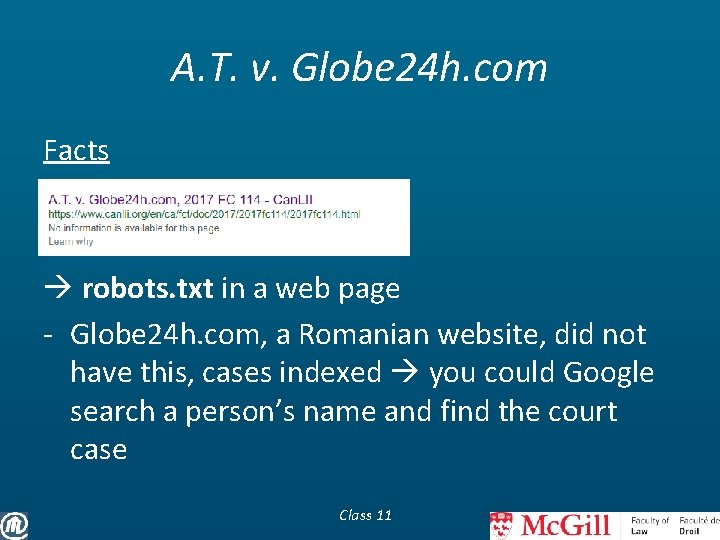
A. T. v. Globe 24 h. com Facts robots. txt in a web page - Globe 24 h. com, a Romanian website, did not have this, cases indexed you could Google search a person’s name and find the court case Class 11
A. T. v. Globe 24 h. com Facts (cont. ) - OPCC received 38 complaints about Globe 24 h - PI easily revealed divorce, health (e. g. HIV+), bankruptcy - Globe 24 h offered to remove… for a fee - OPCC report site violates PIPEDA Issues 1. PPIEDA extraterritoriality? 2. Website collection of PI “appropriate”? 3. “Publicly available” or journalistic exception of PIPEDA? 4. Remedies? Class 11
A. T. v. Globe 24 h. com Held / Ratio 1. Extraterritoriality Yes, applies in Romania, Real and Substantial Connection (see Tarriff-22 SCC case); cases stolen from Cdn site, Cdns visiting site, Cdns impacted by site Comity? It’s all cool, OPCC and Romanian equivalent cooperating 2. Collection of PI “appropriate”? It is a commercial activity, but no legitimate business interest in that PI Class 11
A. T. v. Globe 24 h. com Held / Ratio (cont. ) 3. “Publicly Available” / Journalistic Exception? “In my view, the respondent’s claimed purpose “to make law accessible for free on the Internet” on Globe 24 h. com cannot be considered “journalistic”. In this instance, there is no need to republish the decisions to make them accessible as they are already available on Canadian websites for free. The respondent adds no value to the publication by way of commentary, additional information or analysis. He exploits the content by demanding payment for its removal. ” Publicly available? (s. 7. ) No, website “serves to undermine the administration of justice by potentially causing harm to participants in the justice system” Class 11
A. T. v. Globe 24 h. com Held / Ratio (cont. ) 4. Remedies • Corrective order (remove decisions, don’t do it again) / Declaration that website violated PIPEDA. Why? “A declaration that the respondent has contravened PIPEDA, combined with a corrective order, would allow the applicant and other complainants to submit a request to Google or other search engines to remove links to decisions on Globe 24 h. com from their search results” • Damages “It is clear from the record that the respondent has commercially benefited from the breach through targeted advertising and by requiring a fee for removing the personal information of individuals contained in the decisions. The respondent has also acted in bad faith in failing to take responsibility and rectify the problem. In the circumstances, I consider that an award of $5000 would be appropriate. ” Class 11
Google v. Equustek USA United States District Court, Northern District of California Case # 5: 17 -cv-04207 -EJD, 2017 -11 -2 F: Google seeks “a declaratory judgment that the Canadian court’s order cannot be enforced in the United States and an order enjoining that enforcement”. They first ask for a preliminary injunction seeking same. Issue: Grant preliminary injunction? Held: Yes! Ratio: s. 230 Communications Decency Act is all over this… Class 11
Google v. Equustek USA “Google must show that (1) it is a “provider or user of an interactive computer service, ” (2) the information in question was “provided by another information content provider, ” and (3) the Canadian order would hold it liable as the “publisher or speaker” of that information” (to get s. 230 immunity) Here, Google satisfies all three elements” Likelihood of success on the merits, step 1 for preliminary injunction under U. S. law Class 11
Google v. Equustek USA Steps 2, 3, and 4 of the test for preliminary injunction – Irreparable Harm, Balance of the Equities, and the Public Interest “Google is harmed because the Canadian order restricts activity that Section 230 protects” “the balance of equities favors Google because the injunction would deprive it of the benefits of U. S. federal law” “An injunction would also serve the public interest. Congress recognized that free speech on the internet would be severely restricted if websites were to face tort liability for hosting usergenerated content” Class 11
Google v. Equustek USA The big finish: “The Canadian order would eliminate Section 230 immunity for service providers that link to third-party websites. By forcing intermediaries to remove links to third-party material, the Canadian order undermines the policy goals of Section 230 and threatens free speech on the global internet. ” Problems? Issues? Class 11
Issues 1. 230 CDA - (2) No effect on intellectual property law Nothing in this section shall be construed to limit or expand any law pertaining to intellectual property. 2. There is no liability! SCC said so! S. 230 is a defense 3. Comity? ? ? Class 11
Discussion Q Between A. T. v. Globe 24 h. com and Google v. Equustek (SCC), is there a RTBF in Canada? ? ? SHOULD THERE BE? ? ? Class 11
The Ottawa Citizen, 2017 -8 -6 The internet never forgets. But should it? That legal battle is raging in Canada and worldwide “There are two competing interests at the heart of almost everything that goes on online, ” says Montreal lawyer Allen Mendelsohn, an internet law specialist. “In the simplest terms: It’s your right to your reputation versus the other person’s right to freedom of expression. ” Class 11
The Ottawa Citizen, 2017 -8 -6 “I used to think, ‘If it’s truthful information, why should it be removed or delisted? ’” he says. “But having seen so many circumstances where individuals have real problems because of things on the internet, I’ve softened that stance a bit: I don’t think there should be some unlimited right to be forgotten where anything can be removed, but I do think something needs to be put in place. … There a lot of competing interests that make it a very complicated situation. But there are significant problems with some of the stuff that’s easily discoverable through Google. ” Class 11

FIN Class 11
- Slides: 54