
Class 1 Introduction CS 200 Computer Science University
- Slides: 31
Class 1: Introduction CS 200: Computer Science University of Virginia 14 January 2004 Computer Science David Evans http: //www. cs. virginia. edu/evans CS 200 Spring 2004
What is Computer Science? 14 January 2004 CS 200 Spring 2004 2
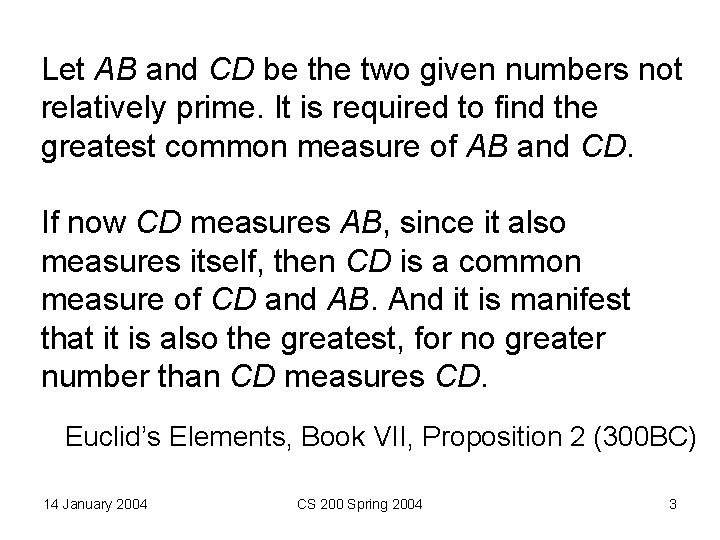
Let AB and CD be the two given numbers not relatively prime. It is required to find the greatest common measure of AB and CD. If now CD measures AB, since it also measures itself, then CD is a common measure of CD and AB. And it is manifest that it is also the greatest, for no greater number than CD measures CD. Euclid’s Elements, Book VII, Proposition 2 (300 BC) 14 January 2004 CS 200 Spring 2004 3
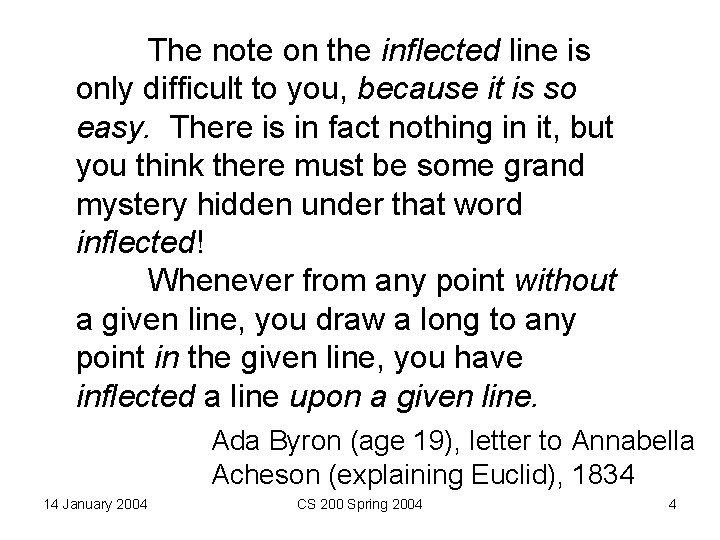
The note on the inflected line is only difficult to you, because it is so easy. There is in fact nothing in it, but you think there must be some grand mystery hidden under that word inflected! Whenever from any point without a given line, you draw a long to any point in the given line, you have inflected a line upon a given line. Ada Byron (age 19), letter to Annabella Acheson (explaining Euclid), 1834 14 January 2004 CS 200 Spring 2004 4
By the word operation, we mean any process which alters the mutual relation of two or more things, be this relation of what kind it may. This is the most general definition, and would include all subjects in the universe. . . Supposing, for instance, that the fundamental relations of pitched sounds in the science of harmony and of musical composition were susceptible of such expression and adaptations, the engine might compose elaborate and scientific pieces of music of any degree of complexity or extent. Ada Byron, 1843 14 January 2004 CS 200 Spring 2004 5
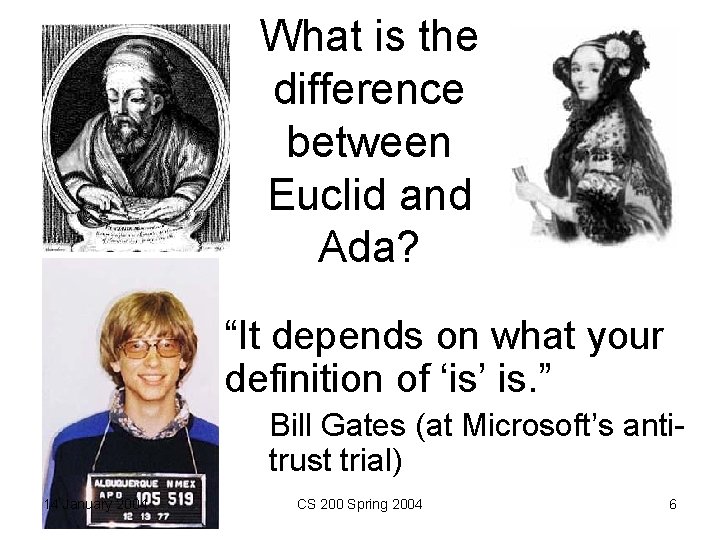
What is the difference between Euclid and Ada? “It depends on what your definition of ‘is’ is. ” Bill Gates (at Microsoft’s antitrust trial) 14 January 2004 CS 200 Spring 2004 6
Geometry vs. Computer Science • Geometry (mathematics) is about declarative knowledge: “what is” If now CD measures AB, since it also measures itself, then CD is a common measure of CD and AB • Computer Science is about imperative knowledge: “how to” Computer Science has nothing to do with beige (or translucent blue) boxes called “computers” and is not a science. 14 January 2004 CS 200 Spring 2004 7
Computer Science “How to” knowledge: • Ways of describing information processes (computations) Language • Ways of predicting properties of information processes Logic What kinds of things do we want to predict? 14 January 2004 CS 200 Spring 2004 8
Science, Engineering, Other? 14 January 2004 CS 200 Spring 2004 9
Science? • Understanding Nature through Observation – About real things like bowling balls, black holes, antimatter, electrons, comets, etc. • Math and Computer Science are about fake things like numbers, graphs, functions, lists, etc. – Computer Science is a useful tool for doing real science, but not a real science 14 January 2004 CS 200 Spring 2004 10
Engineering? “Engineering is design under constraint… Engineering is synthetic - it strives to create what can be, but it is constrained by nature, by cost, by concerns of safety, reliability, environmental impact, manufacturability, maintainability and many other such 'ilities. '. . . ” William Wulf 14 January 2004 CS 200 Spring 2004 11
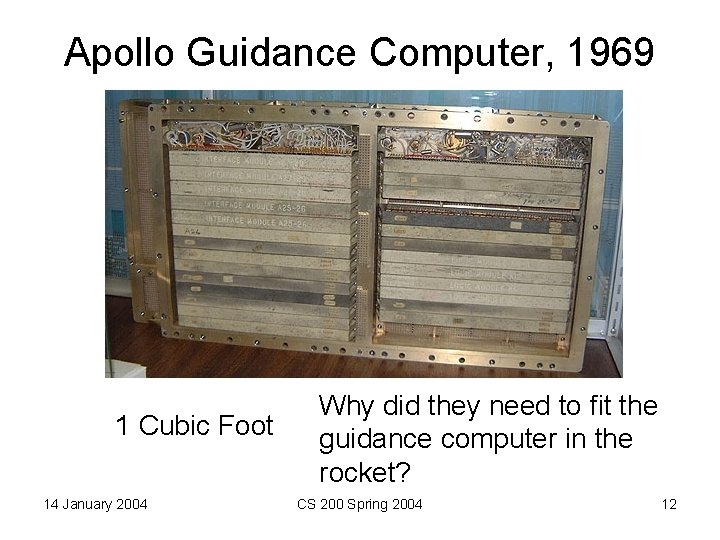
Apollo Guidance Computer, 1969 1 Cubic Foot 14 January 2004 Why did they need to fit the guidance computer in the rocket? CS 200 Spring 2004 12
Measuring Computers • 1 bit = smallest unit of information – True or False – 0 or 1 – If we start with 2 possible choices, and get 1 bit, we can eliminate one of the choices 14 January 2004 CS 200 Spring 2004 13
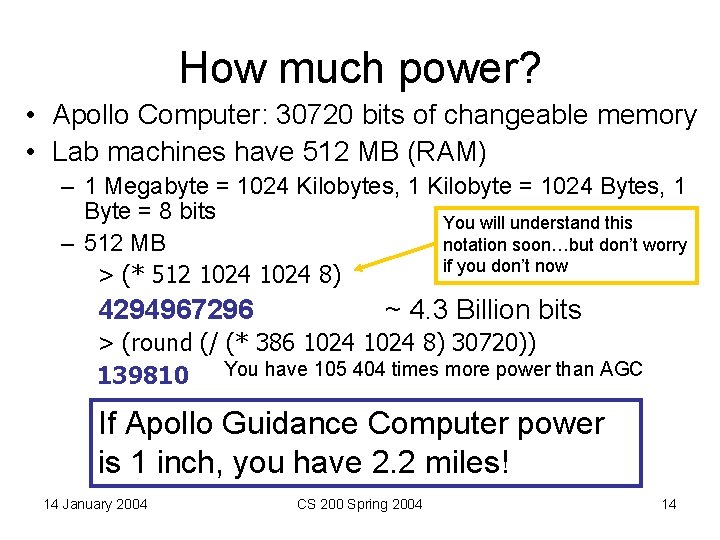
How much power? • Apollo Computer: 30720 bits of changeable memory • Lab machines have 512 MB (RAM) – 1 Megabyte = 1024 Kilobytes, 1 Kilobyte = 1024 Bytes, 1 Byte = 8 bits You will understand this notation soon…but don’t worry – 512 MB if you don’t now > (* 512 1024 8) 4294967296 ~ 4. 3 Billion bits > (round (/ (* 386 1024 8) 30720)) 139810 You have 105 404 times more power than AGC If Apollo Guidance Computer power is 1 inch, you have 2. 2 miles! 14 January 2004 CS 200 Spring 2004 14
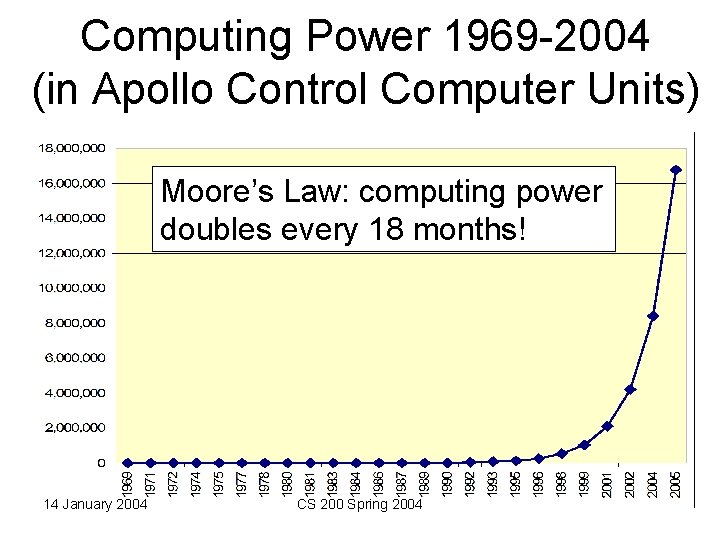
Computing Power 1969 -2004 (in Apollo Control Computer Units) Moore’s Law: computing power doubles every 18 months! 14 January 2004 CS 200 Spring 2004
Constraints Computer Scientists Face • Not like those for engineers: – Cost, weight, physics, etc. – If ~8 Million times what people had in 1969 isn’t enough for you, wait until 2006 and you will have 20 Million times… • More like those for Musicians and Poets: – Imagination and Creativity – Complexity of what we can understand 14 January 2004 CS 200 Spring 2004 16
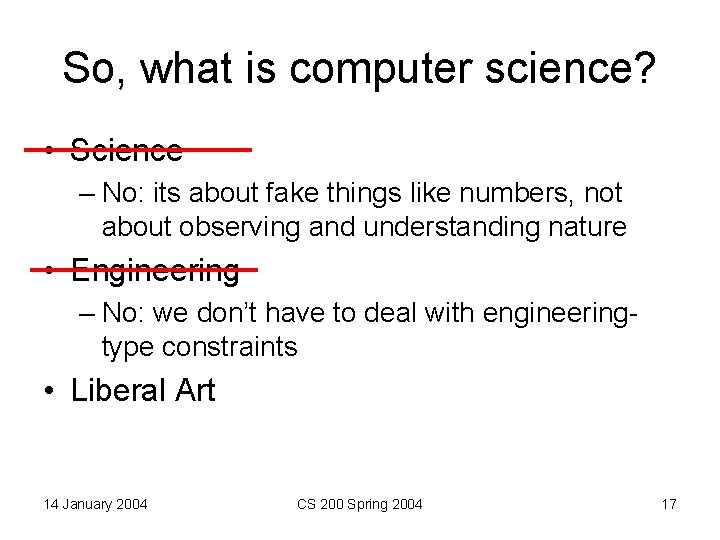
So, what is computer science? • Science – No: its about fake things like numbers, not about observing and understanding nature • Engineering – No: we don’t have to deal with engineeringtype constraints • Liberal Art 14 January 2004 CS 200 Spring 2004 17
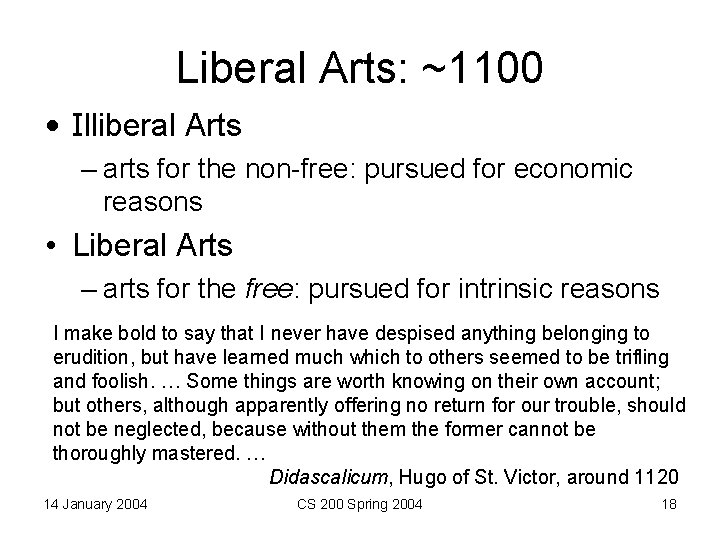
Liberal Arts: ~1100 • Illiberal Arts – arts for the non-free: pursued for economic reasons • Liberal Arts – arts for the free: pursued for intrinsic reasons I make bold to say that I never have despised anything belonging to erudition, but have learned much which to others seemed to be trifling and foolish. … Some things are worth knowing on their own account; but others, although apparently offering no return for our trouble, should not be neglected, because without them the former cannot be thoroughly mastered. … Didascalicum, Hugo of St. Victor, around 1120 14 January 2004 CS 200 Spring 2004 18
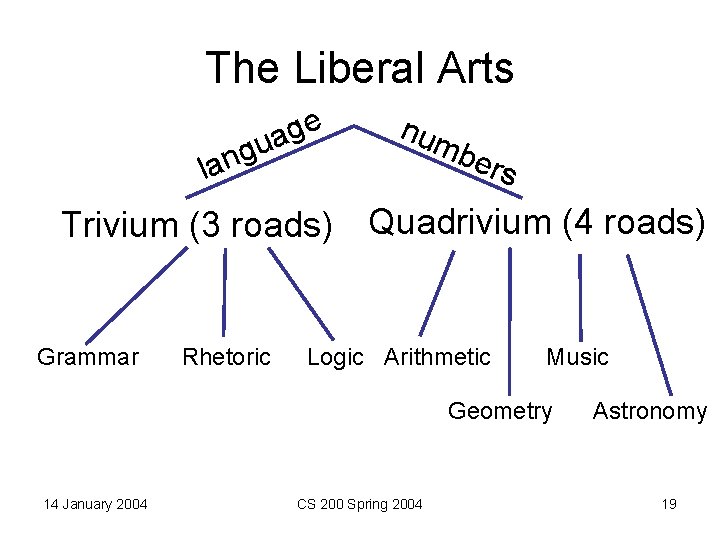
The Liberal Arts e g ua g n la num ber s Trivium (3 roads) Quadrivium (4 roads) Grammar Rhetoric Logic Arithmetic Music Geometry 14 January 2004 CS 200 Spring 2004 Astronomy 19
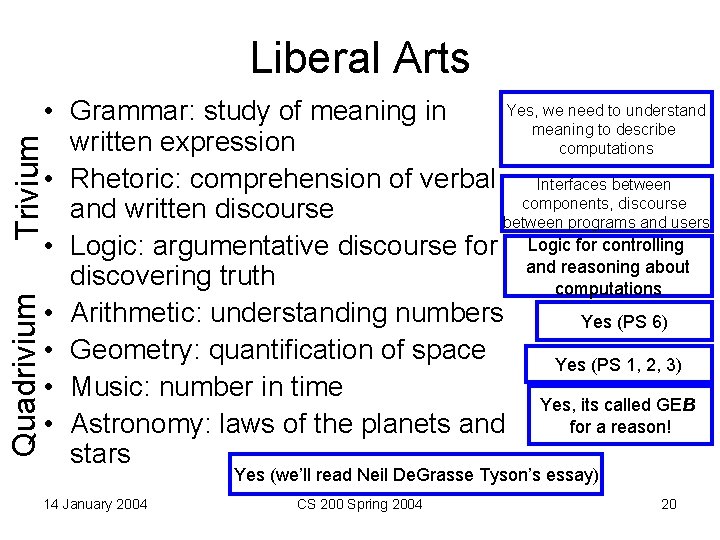
Liberal Arts Quadrivium Trivium Yes, we need to understand • Grammar: study of meaning in meaning to describe written expression computations • Rhetoric: comprehension of verbal Interfaces between components, discourse and written discourse between programs and users • Logic: argumentative discourse for Logic for controlling and reasoning about discovering truth computations • Arithmetic: understanding numbers Yes (PS 6) • Geometry: quantification of space Yes (PS 1, 2, 3) • Music: number in time Yes, its called GEB for a reason! • Astronomy: laws of the planets and stars Yes (we’ll read Neil De. Grasse Tyson’s essay) 14 January 2004 CS 200 Spring 2004 20
Bold (Possibly Untrue) Claim CS 200 is the most consistent with the original intent of a Liberal Arts education of any course offered at UVa this semester! 14 January 2004 CS 200 Spring 2004 21
College of Arts and Sciences? • What is the real name of the College? – Web site: “College of Arts and Sciences” – Then what does “CLAS” stand for? • Col-Lege of Arts and Sciences? – Why does it have Government, Math and Foreign Languages Departments? • My theory: – The “Liberal” is Silent 14 January 2004 CS 200 Spring 2004 22
First Main Theme: Recursive Definitions 14 January 2004 CS 200 Spring 2004 23
What is the longest word in the English language? 14 January 2004 CS 200 Spring 2004 24
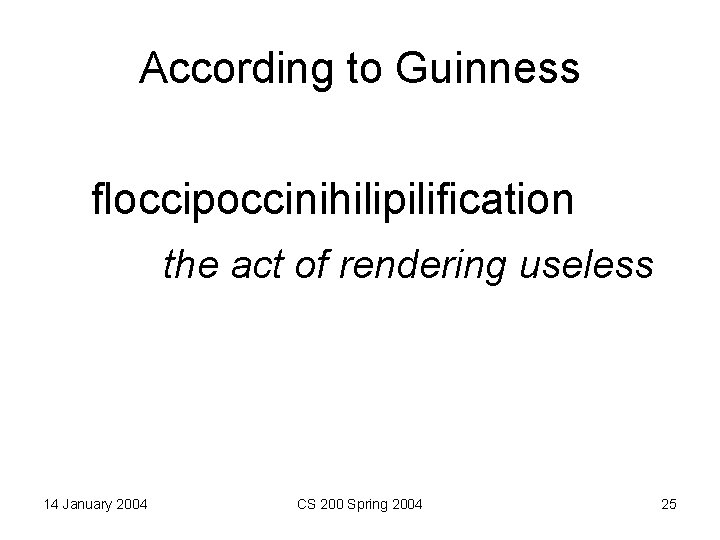
According to Guinness floccipoccinihilipilification the act of rendering useless 14 January 2004 CS 200 Spring 2004 25
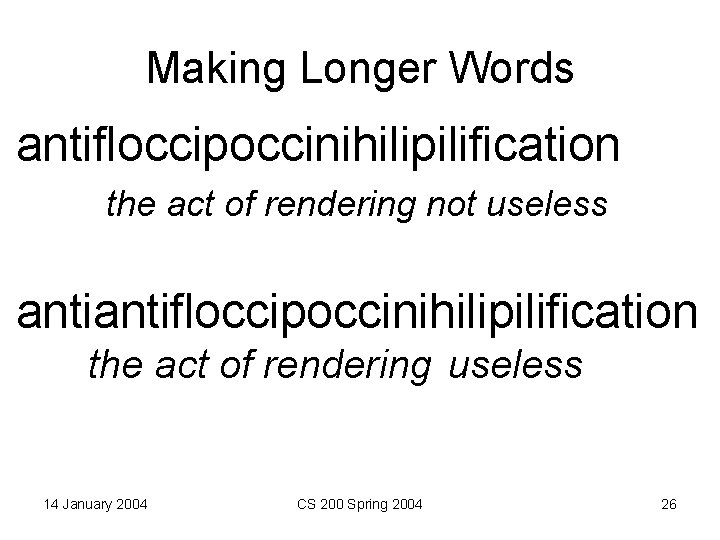
Making Longer Words antifloccipoccinihilipilification the act of rendering not useless antifloccipoccinihilipilification the act of rendering useless 14 January 2004 CS 200 Spring 2004 26
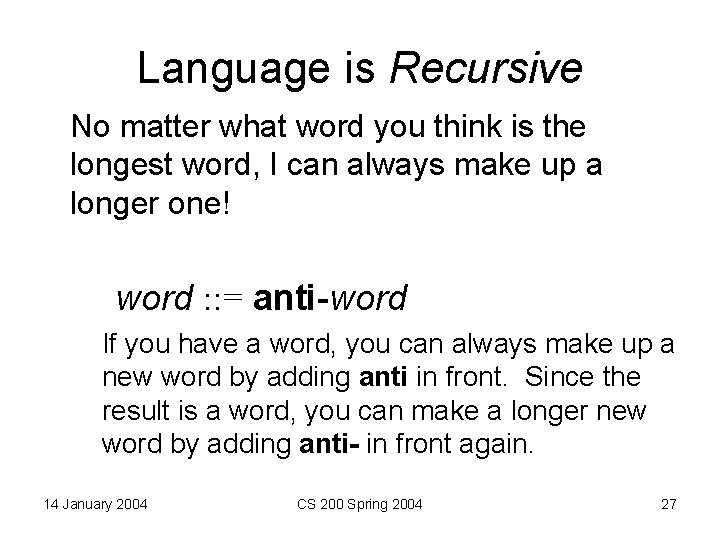
Language is Recursive No matter what word you think is the longest word, I can always make up a longer one! word : : = anti-word If you have a word, you can always make up a new word by adding anti in front. Since the result is a word, you can make a longer new word by adding anti- in front again. 14 January 2004 CS 200 Spring 2004 27
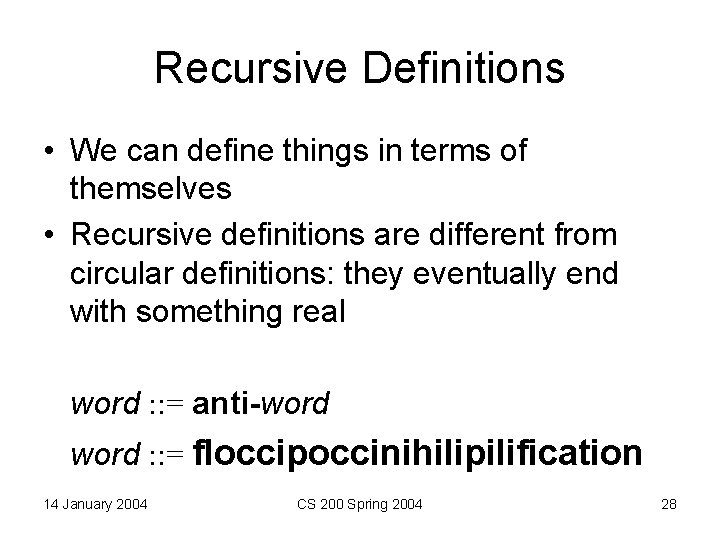
Recursive Definitions • We can define things in terms of themselves • Recursive definitions are different from circular definitions: they eventually end with something real word : : = anti-word : : = floccipoccinihilipilification 14 January 2004 CS 200 Spring 2004 28
Recursive Definitions Allow us to express infinitely many things starting with a few. This is powerful! We will see lots of examples in this course. 14 January 2004 CS 200 Spring 2004 29
Charge • Before 5 pm Thursday: – Registration survey (see course web site) • Before Friday: – Read and sign CS 200 Pledge – Read GEB p. 3 -41 • Anyone who can produce “MU”, gets an automatic A+ in the course • Don’t floccipoccinihilipilificate 14 January 2004 CS 200 Spring 2004 30
Thanks! • 2003 CS 200 students, 2002 CS 200 students, 2001 CS 655 students • 2002 Assistant Coaches: Jon Erdman, Dante Guanlao, Stephen Liang, Portman Wills • 2003 Assistant Coaches: Rachel Dada, Jacques Fournier, Spencer Stockdale, Katie Winstanley • 2004 Assistant Coaches: Sarah Bergkuist, Andrew Connors, Patrick Rooney, Katie Winstanley • Guest Speakers: Radhika Nagpal (2002), Tim Koogle (2003) • 6. 001 teachers: Gerry Sussman, Bob Berwick • CS Department: Jim Cohoon, Ginny Hilton, Anita Jones, John Knight, Worthy Martin, Chris Milner, Brenda Perkins, Gabe Robins, Jack Stankovic • Teaching Resource Center: Marva Barnett, Freda Fretwell • 2001 -2 UTF Fellows: Phoebe Crisman, John Lach, Debra Lyon, Emily Scida, Brian Smith, David Waldner; UTF Mentor: Judith Shatin • Anna Chefter, Chris Frost, Thad Hughes, Jerry Mc. Gann, Shawn O’Hargan, Mike Peck 14 January 2004 CS 200 Spring 2004 31