
CLASH Interactions P Christiansen Lund CLASH meeting January

- Slides: 40
CLASH: Interactions (P. Christiansen, Lund) CLASH meeting, January 30, 2019 https: //kraftly. com/product/thoughts-inprogress-a 5 -notebook-1461826391 siv 1
CLASH meeting, January 30, 2019 CLASH: Interactions (P. Christiansen, Lund) First quote: the high level question • “The theoretical picture of collective effects in heavy ion collisions is vastly different from the picture known from proton–proton (pp). Due to the very different geometry of the two system types, interactions in the final state of the collision become dominant in heavy ion collisions, while nearly absent in pp collisions. ” (C. Bierlich) • One thing we CLASH about! 2
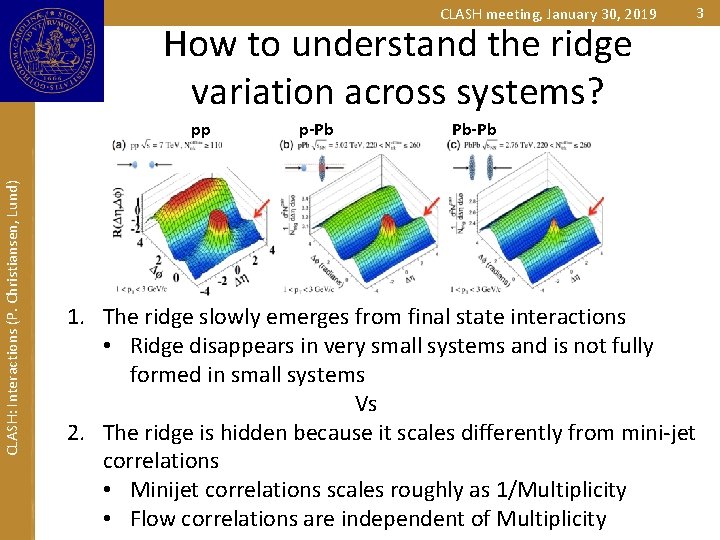
CLASH meeting, January 30, 2019 How to understand the ridge variation across systems? CLASH: Interactions (P. Christiansen, Lund) pp p-Pb 3 Pb-Pb 1. The ridge slowly emerges from final state interactions • Ridge disappears in very small systems and is not fully formed in small systems Vs 2. The ridge is hidden because it scales differently from mini-jet correlations • Minijet correlations scales roughly as 1/Multiplicity • Flow correlations are independent of Multiplicity
CLASH meeting, January 30, 2019 CLASH: Interactions (P. Christiansen, Lund) Second quote: the low level question • “If collectivity in small systems is due to final state interactions, it should be possible to also measure its effect on jets. ” (C. Bierlich) • Common assumption, but is it really true that hydrodynamic collective behavior implies significant jet quenching or could one expect a more complex relation? – Goal today: explore this – In what way does a QGP interact? 4
CLASH meeting, January 30, 2019 CLASH: Interactions (P. Christiansen, Lund) First comment • There are signs of other final state interactions in small systems – The strangeness enhancement is a clear indication for violation of jet universality implying final state interactions 5
CLASH meeting, January 30, 2019 Final state interactions in small systems CLASH: Interactions (P. Christiansen, Lund) • Plenty of ideas: – ”QCD” inspired: parton-parton – Angantyr: Color Reconnection/Ropes, Shoving • But isn’t even a string an interaction? – QGP: hydro, jet quenching, stat model interactions • Note also that even all systems are made of quarks and gluons the relevant degrees of freedom are quite different/unknown • Could a better understanding of final state interactions be the key to differentiate between different paradigms? 6
CLASH meeting, January 30, 2019 CLASH: Interactions (P. Christiansen, Lund) First model: kinetic theory • A model where collectivity requires jet quenching/modifications • Kinetic theory primer: https: //indico. cern. ch/event/353906/contributions/2223197/attachments/1330331/1998920/kurkela. pdf – Weakly coupled! – Classical (QM/QFT via cross sections) – Partonic (hard modes) – Advantage: can be applied out of equilibrium so it can bridge CGC to hydro (thermalization/hydrodynamization) 7
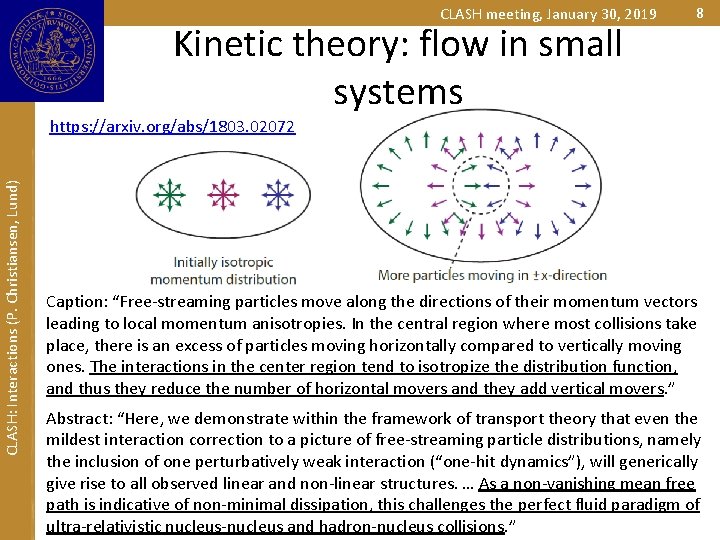
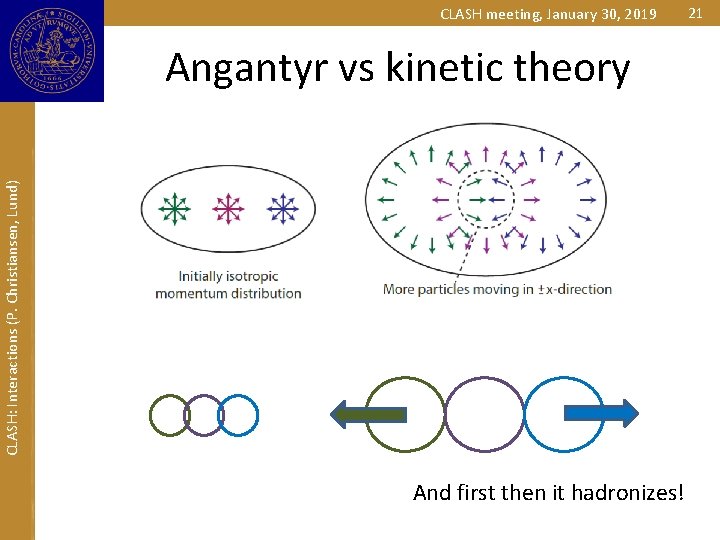
CLASH meeting, January 30, 2019 Kinetic theory: flow in small systems 8 CLASH: Interactions (P. Christiansen, Lund) https: //arxiv. org/abs/1803. 02072 Caption: “Free-streaming particles move along the directions of their momentum vectors leading to local momentum anisotropies. In the central region where most collisions take place, there is an excess of particles moving horizontally compared to vertically moving ones. The interactions in the center region tend to isotropize the distribution function, and thus they reduce the number of horizontal movers and they add vertical movers. ” Abstract: “Here, we demonstrate within the framework of transport theory that even the mildest interaction correction to a picture of free-streaming particle distributions, namely the inclusion of one perturbatively weak interaction (“one-hit dynamics”), will generically give rise to all observed linear and non-linear structures. … As a non-vanishing mean free path is indicative of non-minimal dissipation, this challenges the perfect fluid paradigm of ultra-relativistic nucleus-nucleus and hadron-nucleus collisions. ”
CLASH meeting, January 30, 2019 CLASH: Interactions (P. Christiansen, Lund) What does this model predict? What are its signatures? • Difficult because it is not quantitative (only collective effects) so these are my guesses! • Mini jet quenching – In particular when comparing near and away side jet! – Must be huge effect in larger systems • Entropy production – Needed for bottom-up thermalization – Clear if we want to average out fluctuations → must generate entropy 9
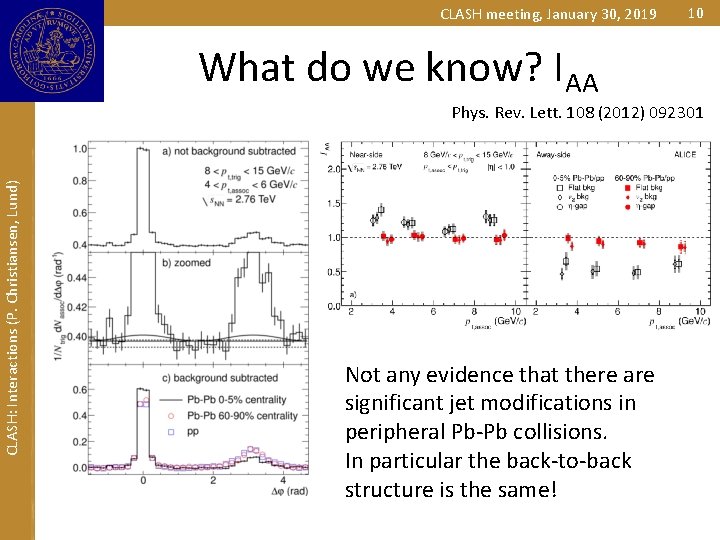
CLASH meeting, January 30, 2019 10 What do we know? IAA CLASH: Interactions (P. Christiansen, Lund) Phys. Rev. Lett. 108 (2012) 092301 Not any evidence that there are significant jet modifications in peripheral Pb-Pb collisions. In particular the back-to-back structure is the same!
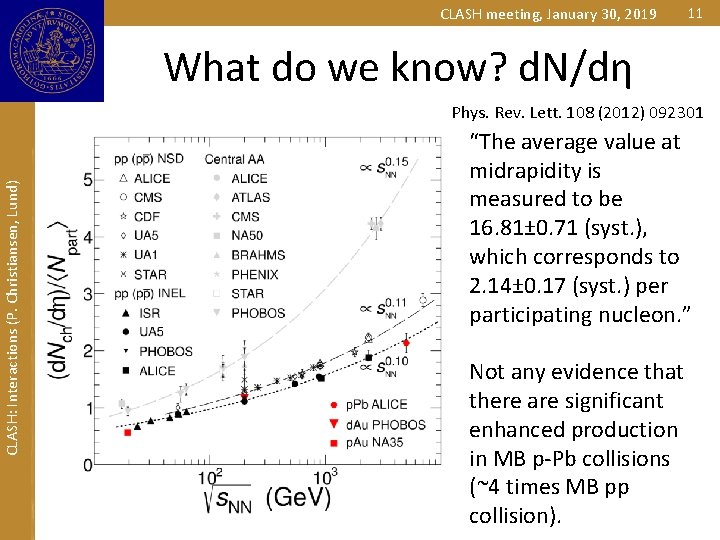
CLASH meeting, January 30, 2019 11 What do we know? d. N/dη CLASH: Interactions (P. Christiansen, Lund) Phys. Rev. Lett. 108 (2012) 092301 “The average value at midrapidity is measured to be 16. 81± 0. 71 (syst. ), which corresponds to 2. 14± 0. 17 (syst. ) per participating nucleon. ” Not any evidence that there are significant enhanced production in MB p-Pb collisions (~4 times MB pp collision).
CLASH meeting, January 30, 2019 CLASH: Interactions (P. Christiansen, Lund) Kinetic theory conclusion • Large effect → obvious mechanism • Small effect → obscure mechanism • My conclusion: Before kinetic theory can be considered as a serious candidate for nonequilibrium physics quantitative transparent estimates of (mini-)jet quenching and entropy production must be done in a way that it can be compared to experimental data 12
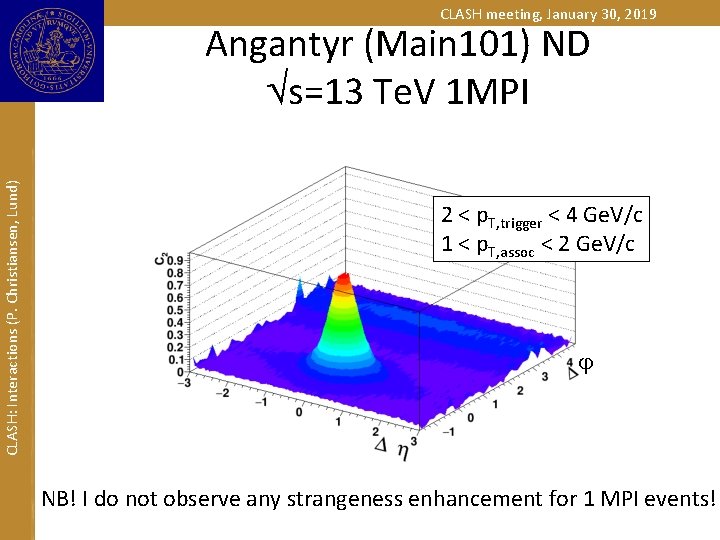
CLASH meeting, January 30, 2019 CLASH: Interactions (P. Christiansen, Lund) Second model: Angantyr • Angantyr can be used to study many interesting questions: – Is flow and jet quenching related? – Is flow a MPI effect? – How small a system can flow • Study 1 MPI system! • No classical geometry but there are 2 strings and radiation 13
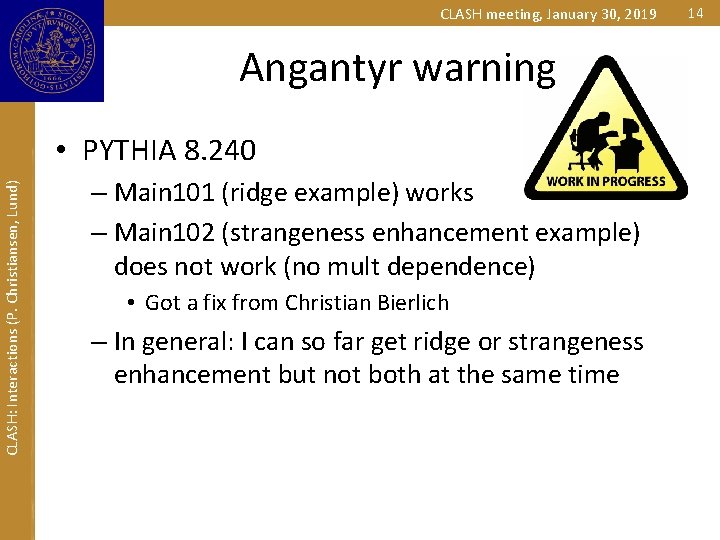
CLASH meeting, January 30, 2019 Angantyr warning CLASH: Interactions (P. Christiansen, Lund) • PYTHIA 8. 240 – Main 101 (ridge example) works – Main 102 (strangeness enhancement example) does not work (no mult dependence) • Got a fix from Christian Bierlich – In general: I can so far get ridge or strangeness enhancement but not both at the same time 14
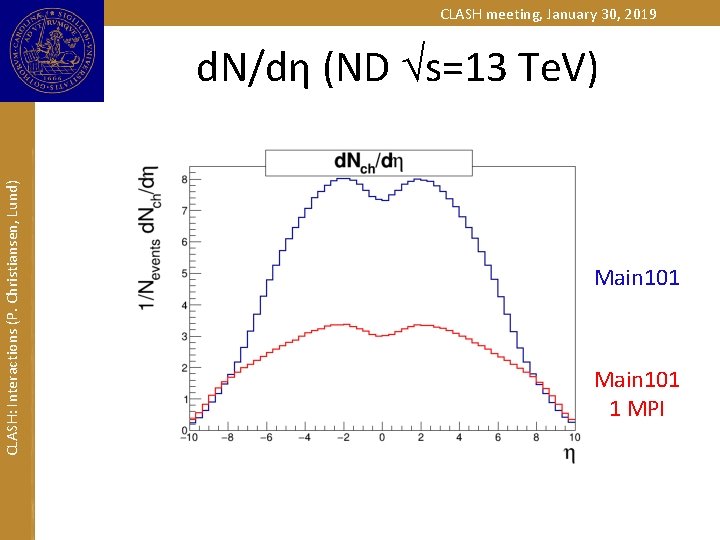
CLASH meeting, January 30, 2019 CLASH: Interactions (P. Christiansen, Lund) d. N/dη (ND s=13 Te. V) Main 101 1 MPI
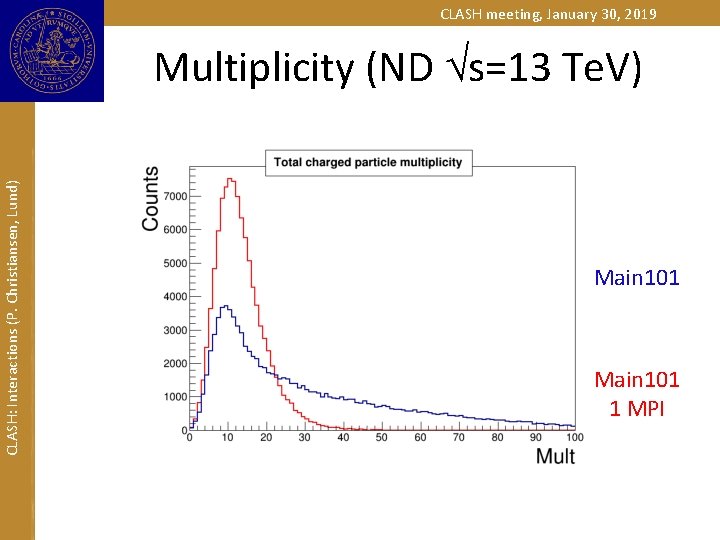
CLASH meeting, January 30, 2019 CLASH: Interactions (P. Christiansen, Lund) Multiplicity (ND s=13 Te. V) Main 101 1 MPI
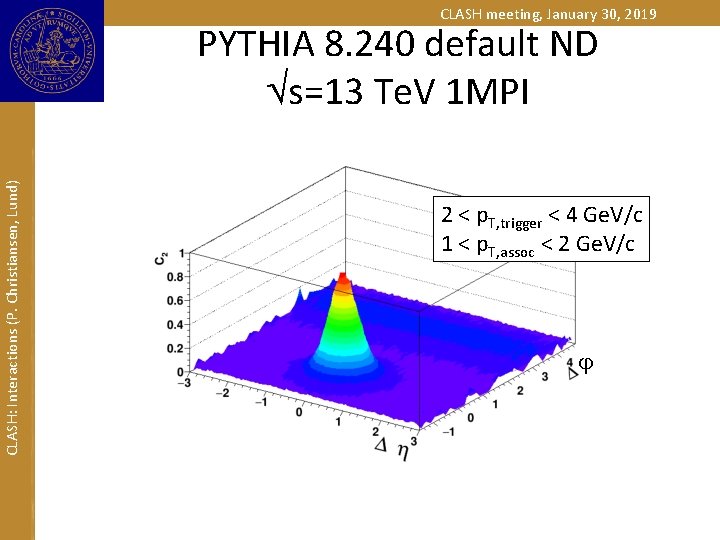
CLASH meeting, January 30, 2019 CLASH: Interactions (P. Christiansen, Lund) PYTHIA 8. 240 default ND s=13 Te. V 1 MPI 2 < p. T, trigger < 4 Ge. V/c 1 < p. T, assoc < 2 Ge. V/c
CLASH meeting, January 30, 2019 CLASH: Interactions (P. Christiansen, Lund) Angantyr (Main 101) ND s=13 Te. V 1 MPI 2 < p. T, trigger < 4 Ge. V/c 1 < p. T, assoc < 2 Ge. V/c NB! I do not observe any strangeness enhancement for 1 MPI events!
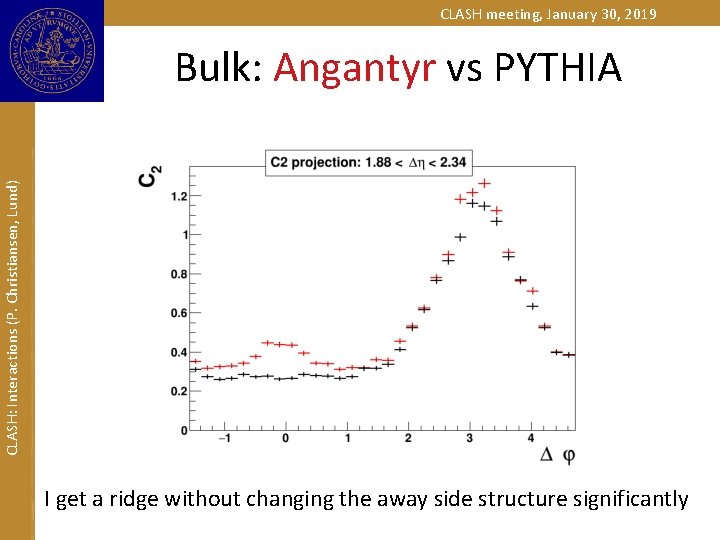
CLASH meeting, January 30, 2019 CLASH: Interactions (P. Christiansen, Lund) Bulk: Angantyr vs PYTHIA I get a ridge without changing the away side structure significantly
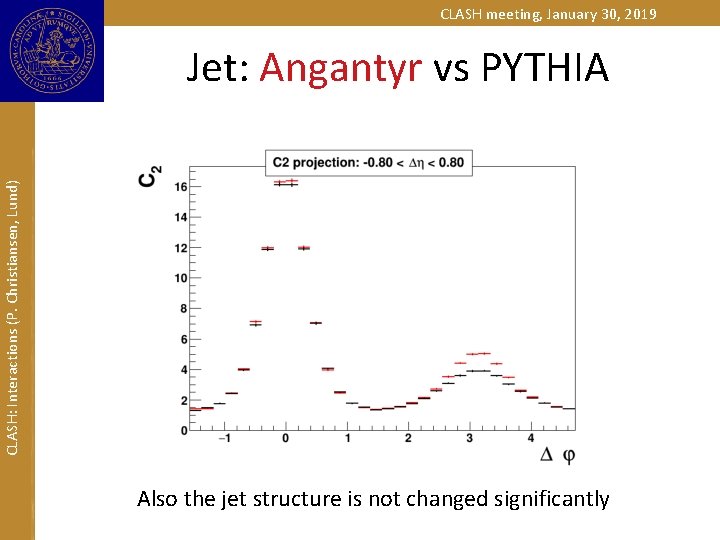
CLASH meeting, January 30, 2019 CLASH: Interactions (P. Christiansen, Lund) Jet: Angantyr vs PYTHIA Also the jet structure is not changed significantly
CLASH meeting, January 30, 2019 CLASH: Interactions (P. Christiansen, Lund) Angantyr vs kinetic theory And first then it hadronizes! 21
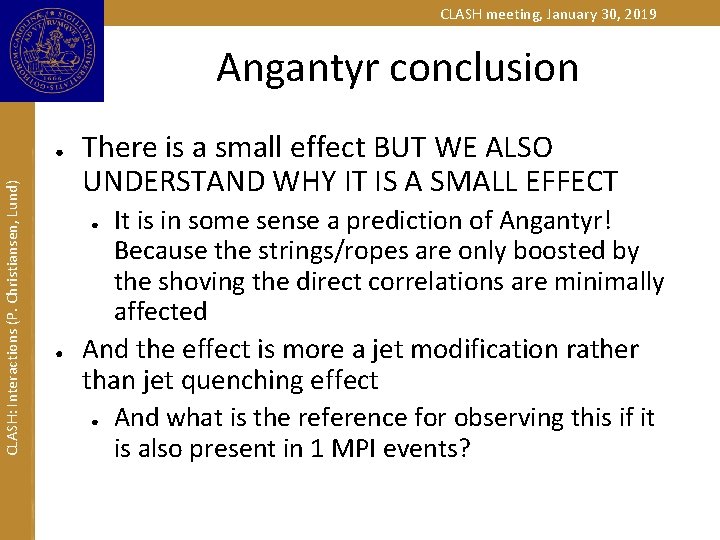
CLASH meeting, January 30, 2019 Angantyr conclusion CLASH: Interactions (P. Christiansen, Lund) ● There is a small effect BUT WE ALSO UNDERSTAND WHY IT IS A SMALL EFFECT It is in some sense a prediction of Angantyr! Because the strings/ropes are only boosted by the shoving the direct correlations are minimally affected And the effect is more a jet modification rather than jet quenching effect ● And what is the reference for observing this if it is also present in 1 MPI events? ● ●
CLASH meeting, January 30, 2019 CLASH: Interactions (P. Christiansen, Lund) What does that imply for Hydro? 23
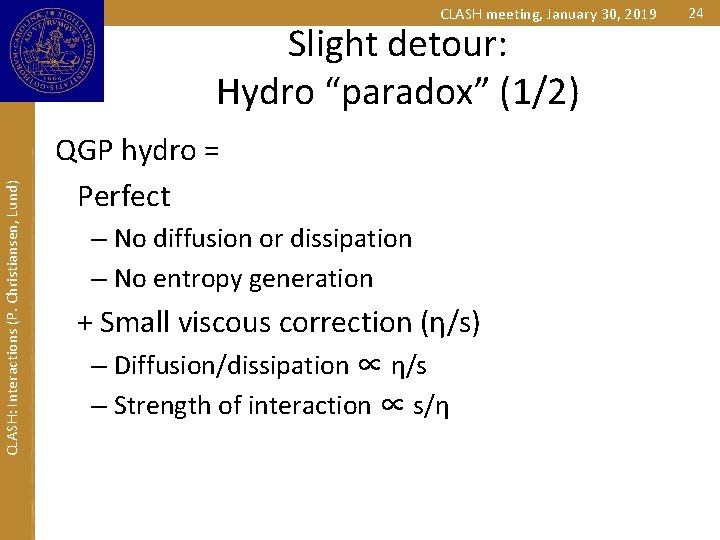
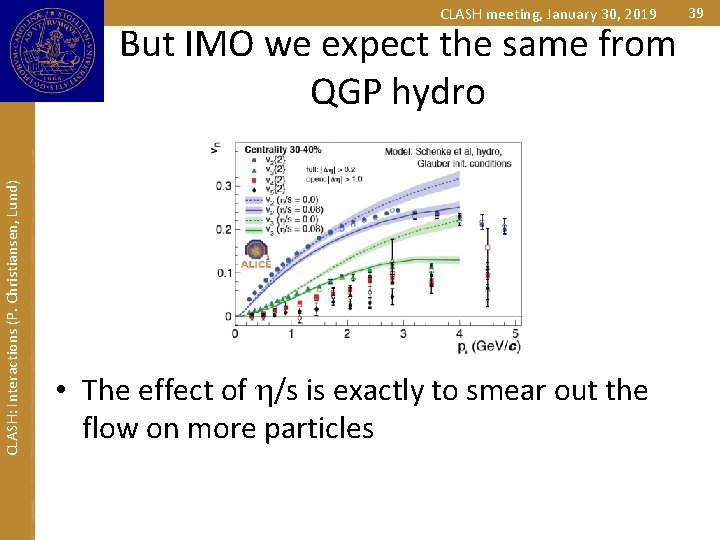
CLASH meeting, January 30, 2019 CLASH: Interactions (P. Christiansen, Lund) Slight detour: Hydro “paradox” (1/2) QGP hydro = Perfect – No diffusion or dissipation – No entropy generation + Small viscous correction (η/s) – Diffusion/dissipation ∝ η/s – Strength of interaction ∝ s/η 24
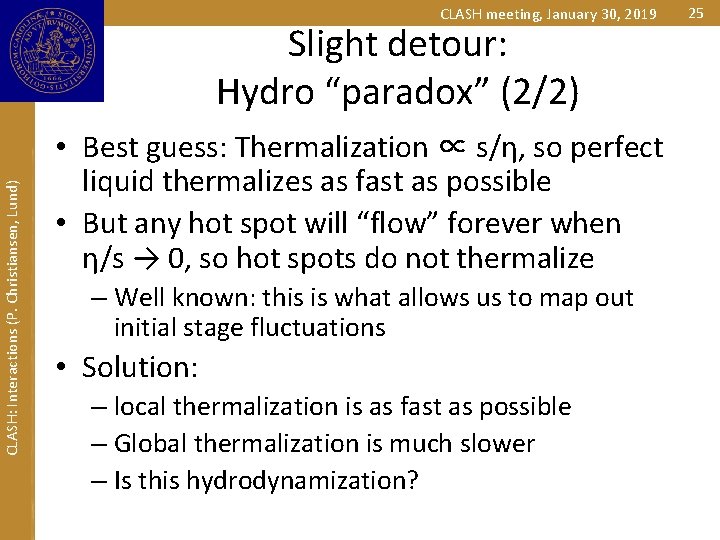
CLASH meeting, January 30, 2019 CLASH: Interactions (P. Christiansen, Lund) Slight detour: Hydro “paradox” (2/2) • Best guess: Thermalization ∝ s/η, so perfect liquid thermalizes as fast as possible • But any hot spot will “flow” forever when η/s → 0, so hot spots do not thermalize – Well known: this is what allows us to map out initial stage fluctuations • Solution: – local thermalization is as fast as possible – Global thermalization is much slower – Is this hydrodynamization? 25
CLASH meeting, January 30, 2019 CLASH: Interactions (P. Christiansen, Lund) What does this have to do with Angantyr? (weak statement) • Local fast thermalized physics degrees of freedom are the strings/ropes • Global thermalizaton proceeds slowly via shoving (~reversible) • So it seems likely that for this type of studies, the results Angantyr and QGP models would be similar 26
CLASH meeting, January 30, 2019 CLASH: Interactions (P. Christiansen, Lund) What does this have to do with Angantyr? (strong statement) • Fast local thermalization = strings/ropes • Slow global thermalization = shoving • What is important is that we have two different mechanisms/interactions • And that while they seem to me a bit ad hoc in Angantyr, perfect hydro suggests that they are fundamental aspects of the same property of the final state matter! 27
CLASH meeting, January 30, 2019 Are final state interactions absent in pp collisions? CLASH: Interactions (P. Christiansen, Lund) • They could be there – The perfect liquid nature (as small dissipation as possible) explains why they are hard to observe – Angantyr picture: the strings/ropes are shoved but they hadronize the same way • IMO: the Angantyr/perfect liquid is much more useful than the vanilla PYTHIA one 28
CLASH meeting, January 30, 2019 Conclusions CLASH: Interactions (P. Christiansen, Lund) • Weak (firm) – Large ridge signals does not imply significant jet quenching (even in hydro-like models) – The “guessable” signatures of kinetic theory seems at odds with what we know experimentally • Strong (suggestive) – The perfect liquid nature of the QGP suggests that • Jet quenching in small systems will be a small effect in agreement with experimental observations • Wild postulate: Jet quenching in general will be as small as possible – Kinetic theory seems at odds with the perfect liquid paradigm
CLASH: Interactions (P. Christiansen, Lund) CLASH meeting, January 30, 2019 Backup 30
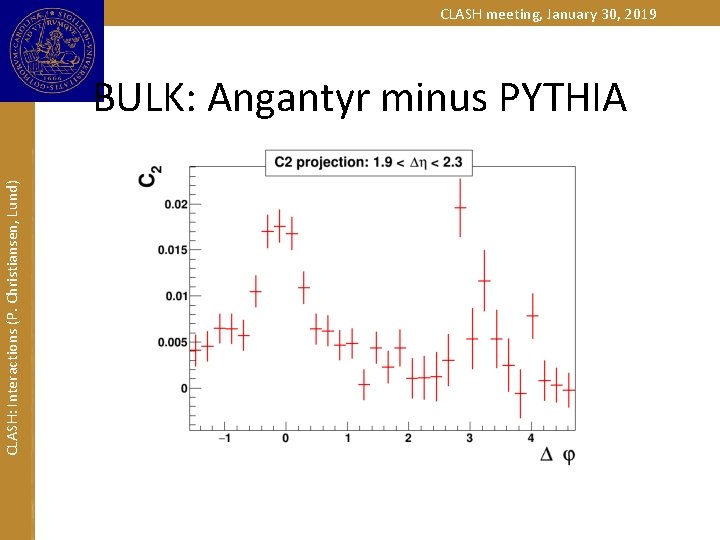
CLASH meeting, January 30, 2019 CLASH: Interactions (P. Christiansen, Lund) BULK: Angantyr minus PYTHIA
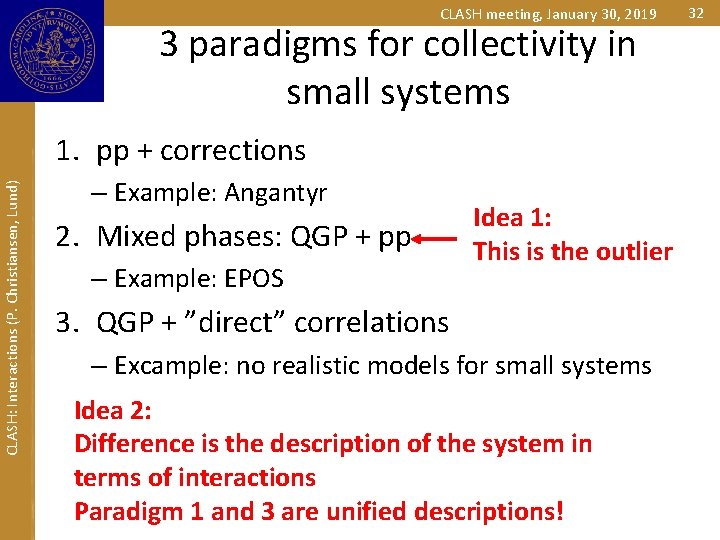
CLASH meeting, January 30, 2019 3 paradigms for collectivity in small systems CLASH: Interactions (P. Christiansen, Lund) 1. pp + corrections – Example: Angantyr 2. Mixed phases: QGP + pp – Example: EPOS Idea 1: This is the outlier 3. QGP + ”direct” correlations – Excample: no realistic models for small systems Idea 2: Difference is the description of the system in terms of interactions Paradigm 1 and 3 are unified descriptions! 32
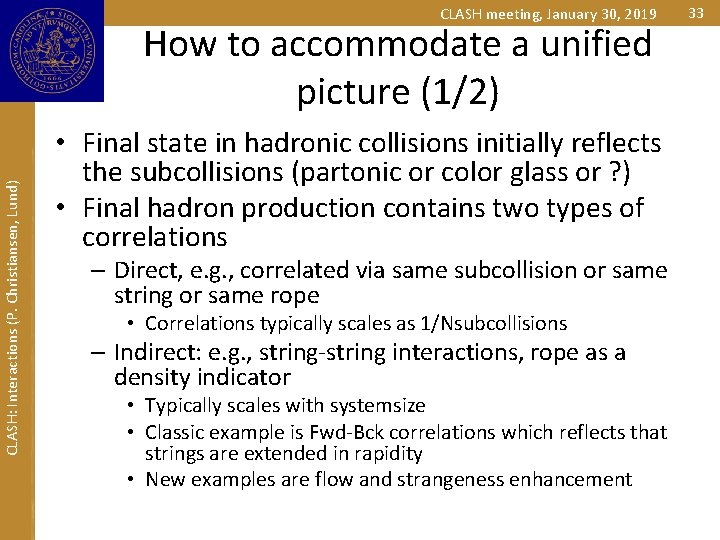
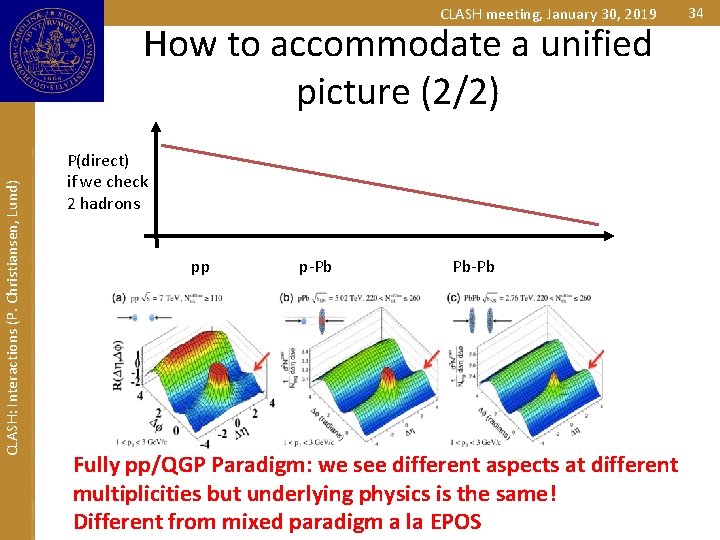
CLASH meeting, January 30, 2019 CLASH: Interactions (P. Christiansen, Lund) How to accommodate a unified picture (1/2) • Final state in hadronic collisions initially reflects the subcollisions (partonic or color glass or ? ) • Final hadron production contains two types of correlations – Direct, e. g. , correlated via same subcollision or same string or same rope • Correlations typically scales as 1/Nsubcollisions – Indirect: e. g. , string-string interactions, rope as a density indicator • Typically scales with systemsize • Classic example is Fwd-Bck correlations which reflects that strings are extended in rapidity • New examples are flow and strangeness enhancement 33
CLASH meeting, January 30, 2019 CLASH: Interactions (P. Christiansen, Lund) How to accommodate a unified picture (2/2) P(direct) if we check 2 hadrons pp p-Pb Pb-Pb Fully pp/QGP Paradigm: we see different aspects at different multiplicities but underlying physics is the same! Different from mixed paradigm a la EPOS 34
CLASH meeting, January 30, 2019 CLASH: Interactions (P. Christiansen, Lund) Hydro puzzle that has bothered me • QGP hydro is special: perfect (no diffusion/dissipation) + small viscous correction (smallest /s) • /s in some sense measures the strenght of the hydro • /s -> 0 is strongest => fastest thermalization (hydrodynamization) • BUT /s -> 0 also means that fluctuations lives longer (no global thermalization) 35
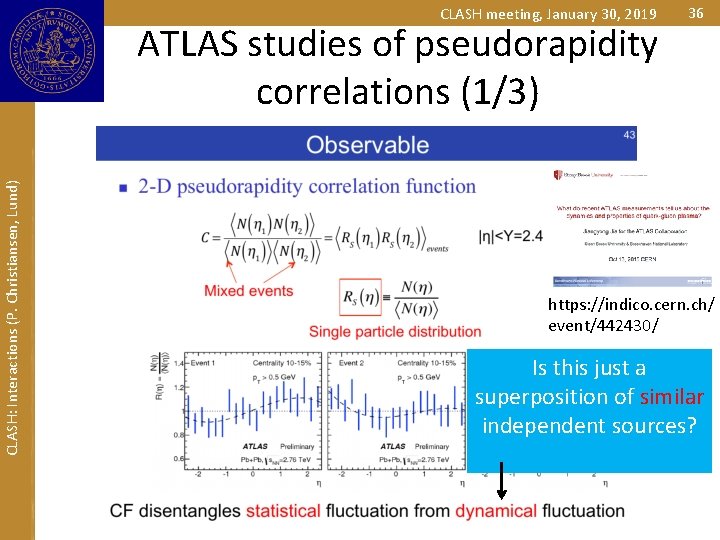
CLASH meeting, January 30, 2019 CLASH: Interactions (P. Christiansen, Lund) ATLAS studies of pseudorapidity correlations (1/3) 36 https: //indico. cern. ch/ event/442430/ Is this just a superposition of similar independent sources?
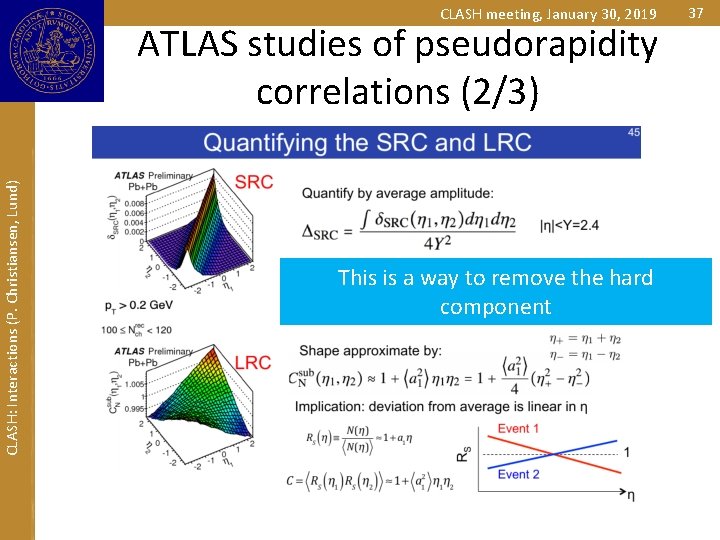
CLASH meeting, January 30, 2019 CLASH: Interactions (P. Christiansen, Lund) ATLAS studies of pseudorapidity correlations (2/3) This is a way to remove the hard component 37
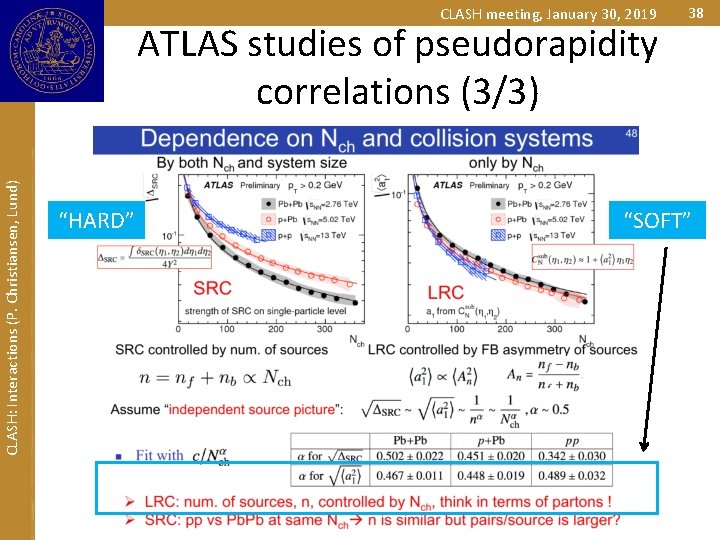
CLASH meeting, January 30, 2019 CLASH: Interactions (P. Christiansen, Lund) ATLAS studies of pseudorapidity correlations (3/3) “HARD” 38 “SOFT”
CLASH meeting, January 30, 2019 CLASH: Interactions (P. Christiansen, Lund) But IMO we expect the same from QGP hydro • The effect of /s is exactly to smear out the flow on more particles 39
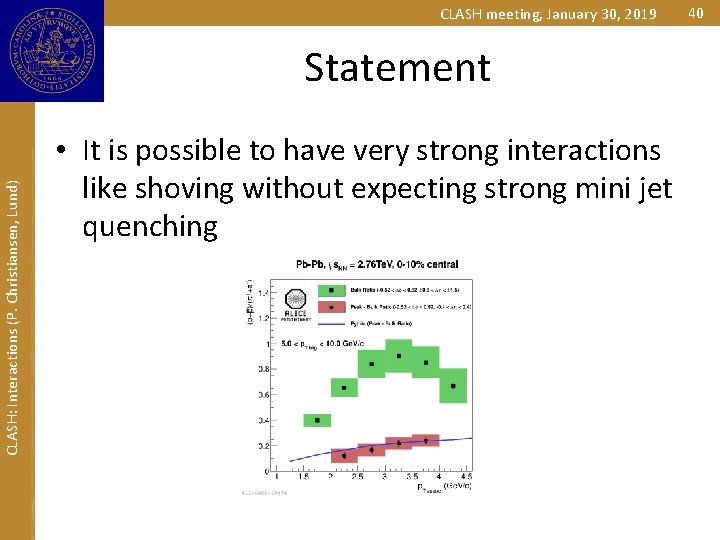
CLASH meeting, January 30, 2019 CLASH: Interactions (P. Christiansen, Lund) Statement • It is possible to have very strong interactions like shoving without expecting strong mini jet quenching 40