
Clash Detection Terminology Hard Clearance and Duplicate Clashes



- Slides: 9
Clash Detection Terminology Hard, Clearance and Duplicate Clashes This PPT explains what is Clash Detection, the types of Clash Detection and why it is required www. verveengineering. com | Email: teamengineering@vervetech. sg
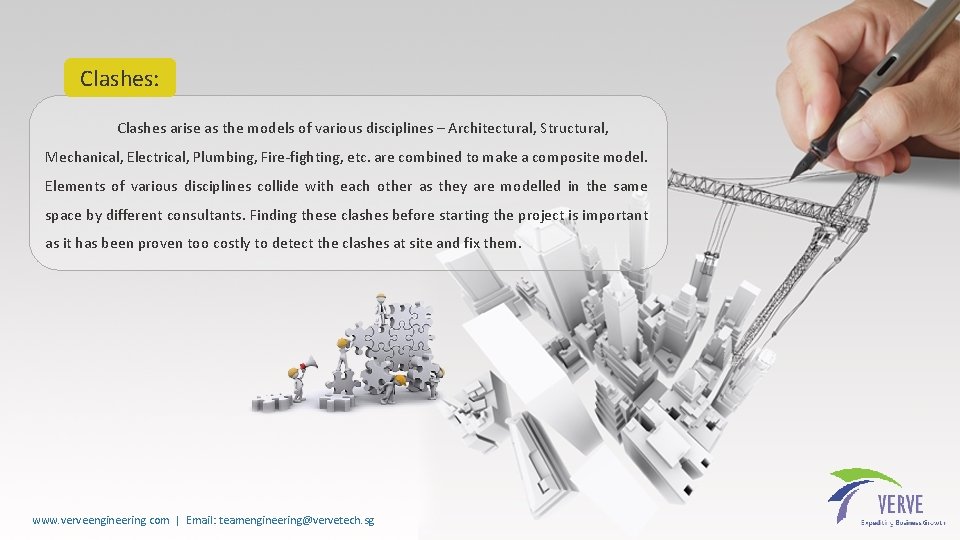
Clashes: Clashes arise as the models of various disciplines – Architectural, Structural, Mechanical, Electrical, Plumbing, Fire-fighting, etc. are combined to make a composite model. Elements of various disciplines collide with each other as they are modelled in the same space by different consultants. Finding these clashes before starting the project is important as it has been proven too costly to detect the clashes at site and fix them. www. verveengineering. com | Email: teamengineering@vervetech. sg
Hard Clash Clearance Clash Duplicate Clash A clash in which the geometry of A clash in which the geometry of selection A intersects that of selection A may or may not of selection A is the same as selection B by a distance of intersect that of selection B, but that of selection B, located more than the set tolerance. comes within a distance of less within a distance of between than the set tolerance. zero and the set tolerance. A tolerance of zero would therefore only detect duplicate geometry in exactly the same location. www. verveengineering. com | Email: teamengineering@vervetech. sg
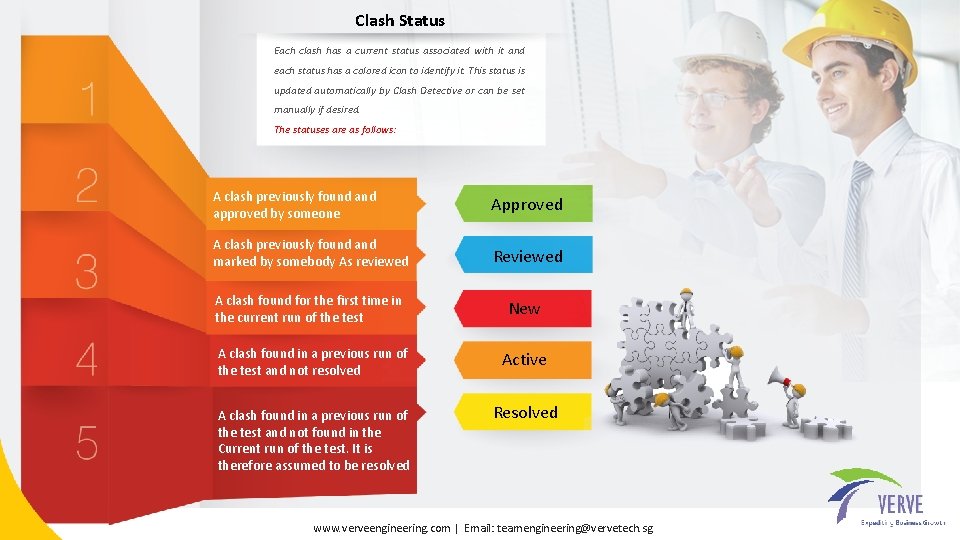
Clash Status Each clash has a current status associated with it and each status has a colored icon to identify it. This status is updated automatically by Clash Detective or can be set manually if desired. The statuses are as follows: A clash previously found approved by someone Approved A clash previously found and marked by somebody As reviewed Reviewed A clash found for the first time in the current run of the test New A clash found in a previous run of the test and not resolved Active A clash found in a previous run of the test and not found in the Current run of the test. It is therefore assumed to be resolved Resolved www. verveengineering. com | Email: teamengineering@vervetech. sg
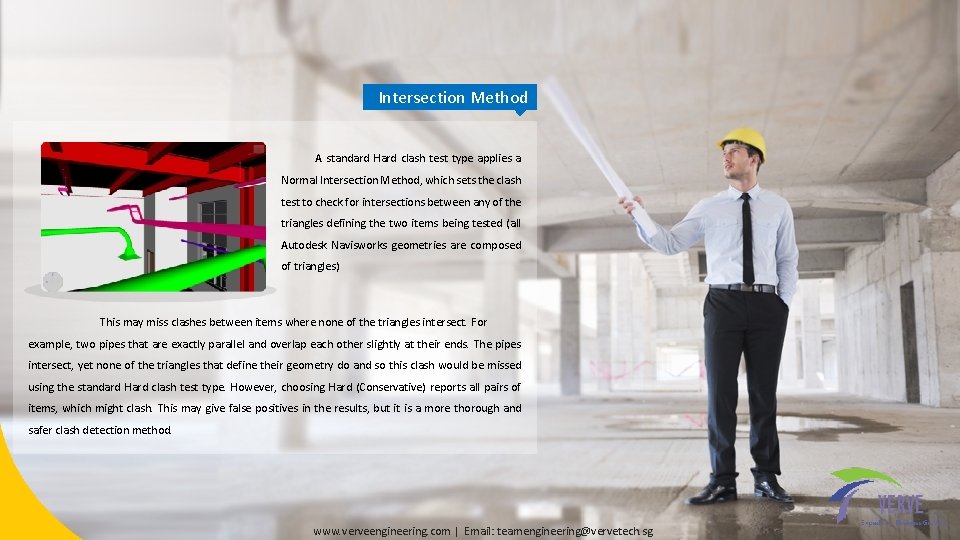
Intersection Method A standard Hard clash test type applies a Normal Intersection Method, which sets the clash test to check for intersections between any of the triangles defining the two items being tested (all Autodesk Navisworks geometries are composed of triangles) This may miss clashes between items where none of the triangles intersect. For example, two pipes that are exactly parallel and overlap each other slightly at their ends. The pipes intersect, yet none of the triangles that define their geometry do and so this clash would be missed using the standard Hard clash test type. However, choosing Hard (Conservative) reports all pairs of items, which might clash. This may give false positives in the results, but it is a more thorough and safer clash detection method. www. verveengineering. com | Email: teamengineering@vervetech. sg
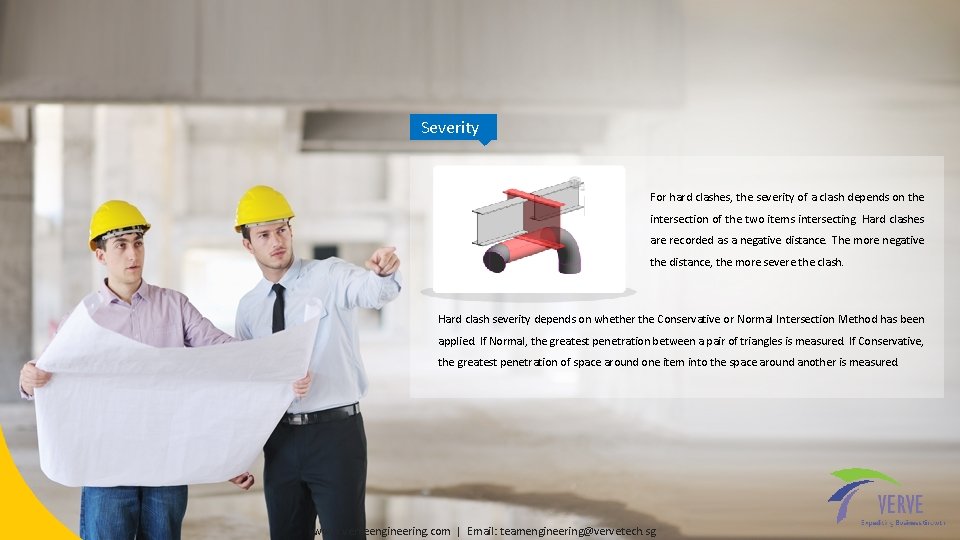
Severity For hard clashes, the severity of a clash depends on the intersection of the two items intersecting. Hard clashes are recorded as a negative distance. The more negative the distance, the more severe the clash. Hard clash severity depends on whether the Conservative or Normal Intersection Method has been applied. If Normal, the greatest penetration between a pair of triangles is measured. If Conservative, the greatest penetration of space around one item into the space around another is measured. www. verveengineering. com | Email: teamengineering@vervetech. sg
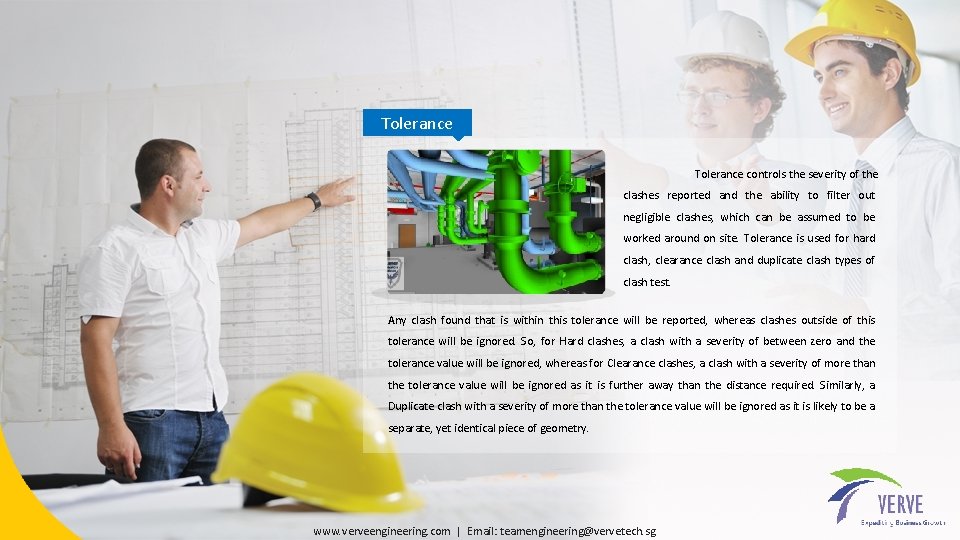
Tolerance controls the severity of the clashes reported and the ability to filter out negligible clashes, which can be assumed to be worked around on site. Tolerance is used for hard clash, clearance clash and duplicate clash types of clash test. Any clash found that is within this tolerance will be reported, whereas clashes outside of this tolerance will be ignored. So, for Hard clashes, a clash with a severity of between zero and the tolerance value will be ignored, whereas for Clearance clashes, a clash with a severity of more than the tolerance value will be ignored as it is further away than the distance required. Similarly, a Duplicate clash with a severity of more than the tolerance value will be ignored as it is likely to be a separate, yet identical piece of geometry. www. verveengineering. com | Email: teamengineering@vervetech. sg
Know Verve Founded with a vision to power up the efforts of AEC industry, Verve is an expert in BIM Services. Staffed with engineers, architects and software professionals, Verve answers all your needs with its suite of Architectural BIM Services, Structural BIM Services and MEP BIM Services. Through our various partnering models we have added immense value to our clients across ASPAC, Australia and Middle East. We have facilitated Construction Drawings of high accuracy and quality under very demanding timelines. To know more about us, visit us @: www. verveengineering. com (or) drop a line to : teamengineering@vervetech. sg www. verveengineering. com | Email: teamengineering@vervetech. sg
Verve Technology Services Pte Ltd 116, Changi Road, #04 – 11, WIS @Changi, SINGAPORE 419718 Email: teamengineering@vervetech. sg Tel: +65 6635 3444 www. verveengineering. com | Email: teamengineering@vervetech. sg