
CLARIN Centers for a Sustainable Infrastructure Daan Broeder
CLARIN Centers for a Sustainable Infrastructure Daan Broeder, MPI for Psycholinguistics Jan Odijk, Utrecht University
Content § The Problem: Stable Services in a Dynamic World § CLARIN foundations: we have a center based solution § CLARIN Centers, how is that working out? § Adjustments required? § Recommendations
CLARIN centers From the start centers played an important role in the services infrastructure architecture planning “a backbone of CLARIN centers” is a phrase that is often found in the early documents. Fundamental: many centers are sharing responsibility Strategy: § Explicit responsibility for services § Explicit contact point Centers can gain exposure: § Explicit acknowledgement after assessment of: § Organizational aspects (DSA) § Technical competence (services)
Center variety § Originally CLARIN centers are mainly research institutes, and university departments § … many differences both in research focus and size § The first national projects were CLARIN-D and NL with ample means and many candidate centers § … some competition was not thought as evil § In some other disciplines a single or a few centers are dominant in research infrastructures § Which depending on their funding situation can make the infrastructure very vulnerable § However “single/few center infrastructure” is a valid approach
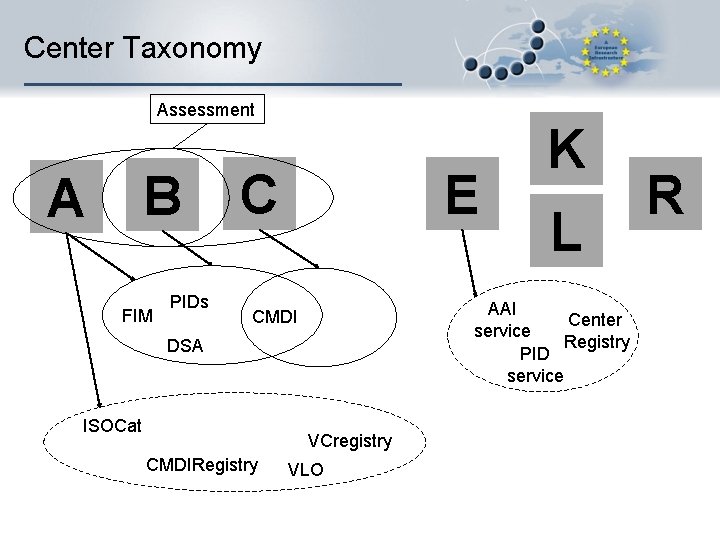
Center Taxonomy Assessment B A FIM PIDs E C DSA VCregistry CMDIRegistry L AAI Center service Registry PID service CMDI ISOCat K VLO R
Center infra evolution § Newer national CLARIN projects often have one single CLARIN center that is supported by several partners and serves the whole community § Consequence of smaller budget (compared with NL and D) § … or a smart way to save money? § One CLARIN center costs less and can represent many interests or organizations § However, is this stable? § ‘New’ trend: inclusion of broad data centers, libraries, … § Libraries participating in the core (No) … or still in the periphery (NL)
CLARIN Services sustainability § CLARIN services are not the core business for research institutes (and certainly not of general data centers) § Usually funded from the national project § … vulnerable for funding changes § Offering services and data should be seen as a important and funded from beyond CLARIN § … or better: services should be anchored in an institute’s own workflow § Nevertheless all may fail § So centers should accept take over services from others § Essential services can be doubled
How vulnerable are we? § Center downscaling § MPI has reconsidered its project strategy § A-services must be relocated § Loss of expert staff § Funding gaps § Research strategy changes
We need an Elastic Infrastructure What does that mean in a European context? § No dependence on a single national project § Certainly not dependent on one or a few centers § Coordinating parties are able to compensate for shrinking or disappearing centers § By: § § Enable moving services to other centers (and test this) Doubling of essential A-services Enable easy outsourcing of services to compute (E-)centers Fund software maintainers & developers and reserve adequate resources on national & EU level § Flag requirements to national & EU funders
Still need stable lynch-pins I § Assumption of long-term well funded stable researchinstitutes is perhaps not tenable § What is well-funded, stable and sustainable? § New developments as general data-centers, e-science organizations, EU data management infra projects etc. § Problems: too general approaches, motivation § Service specificity can be (partly) solved by § Careful integration of the specific with the general by modular policy based services. Will need some extra (shared) costs § Would mean CLARIN as a front-office for a general service provider
Still need stable lynch-pins II § libraries and national archives are attractive partners § These are obviously also getting their share of the national budgets § Nobody questions their sustainability § Problems: motivation, (old fashioned) practices, too general approaches. § Motivation will be solved e. g. libraries need to reposition themselves § Results vary per country countries, but in some libraries are already a core part of CLARIN national projects § Can expect the need for libraries to reposition will lead to useful modern data management practices § Service specificity could be (partly) solved by CLARIN (and others) collaborating and even partly integrating with them
Summing up to ‘Easy’ Recommendations § A CLARIN center should: § make providing (CLARIN compatible) services and data part of its mission § use those also for the center’s own research workflow § A-services must be built from the start with easy relocation in mind (and this should be tested) § Reserve adequate resources for outsourcing of services and funding of service development § Include broader multi-disciplinary institutes & service providers and see how to integrate with them § Starting with libraries and data centers & DM projects § Develop models in collaboration for building discipline specific services on top of general ones

THANK YOU FOR YOUR ATTENTION
- Slides: 13