
Clarifying WorkFamily Intervention Processes The Roles of WorkFamily

- Slides: 43
Clarifying Work-Family Intervention Processes: The Roles of Work-Family Conflict and Family. Supportive Supervisor Behaviors Leslie Hammer Professor, Department of Psychology, Portland State University Ellen Ernst Kossek Professor of Management and Research Director Center for Leadership, Krannert School of Management, Purdue University Thursday, October 10 th, 2013 1 pm-2 pm ET Hammer, L. B. , Kossek, E. E. , Anger, W. K. , Bodner, T. , & Zimmerman, K. L. (2011). Clarifying Work– Family Intervention Processes: The Roles of Work–Family Conflict and Family-Supportive Supervisor Behaviors. Journal of Applied Psychology 96(1): 134– 150. Boston College Center for Work and Family
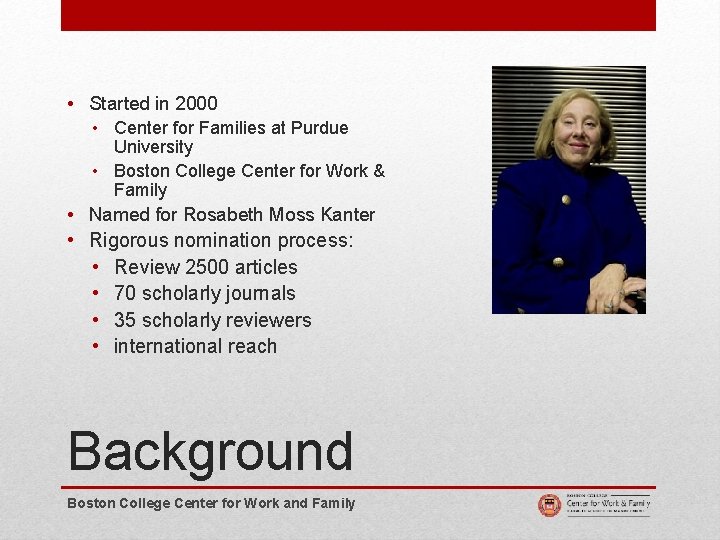
• Started in 2000 • Center for Families at Purdue University • Boston College Center for Work & Family • Named for Rosabeth Moss Kanter • Rigorous nomination process: • Review 2500 articles • 70 scholarly journals • 35 scholarly reviewers • international reach Background Boston College Center for Work and Family
• To find and promote the “best of the best” workfamily research • To increase the impact of research • To foster discussions about quality – of research and of programs Goals Boston College Center for Work and Family
Abbott Allstate Insurance Company American Express Astra. Zeneca Pharmaceuticals Baxter Healthcare Corp. Bristol-Myers Squibb Cardinal Health, Inc. Chevron Corporation Chubb & Son Insurance Deere & Company Deloitte LLP Eli Lilly and Company EMC 2 Corporation F. Hoffmann-La. Roche AG FM Global, Inc. Genentech IBM Intel Johnson & Johnson KPMG-LLP Kraft Foods LA Metro Transit Lockheed Martin Marriott International Merck & Company, Inc. Met. Life Mondelez Global National Security Agency Northern Trust Corporation Northrop Grumman ES Novartis Pearson Inc. Pricewaterhouse. Coopers Prudential Financial Raytheon Company Sanofi-aventis Sodexo The Mc. Graw-Hill Companies Toyota Motor Sales USA, Inc. United Parcel Service University of Kentucky US Navy Thank You to our Sponsors! Boston College Center for Work and Family
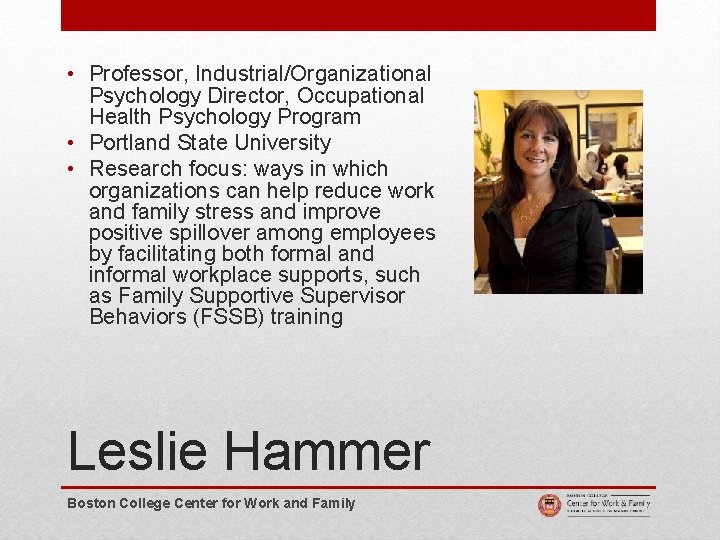
• Professor, Industrial/Organizational Psychology Director, Occupational Health Psychology Program • Portland State University • Research focus: ways in which organizations can help reduce work and family stress and improve positive spillover among employees by facilitating both formal and informal workplace supports, such as Family Supportive Supervisor Behaviors (FSSB) training Leslie Hammer Boston College Center for Work and Family
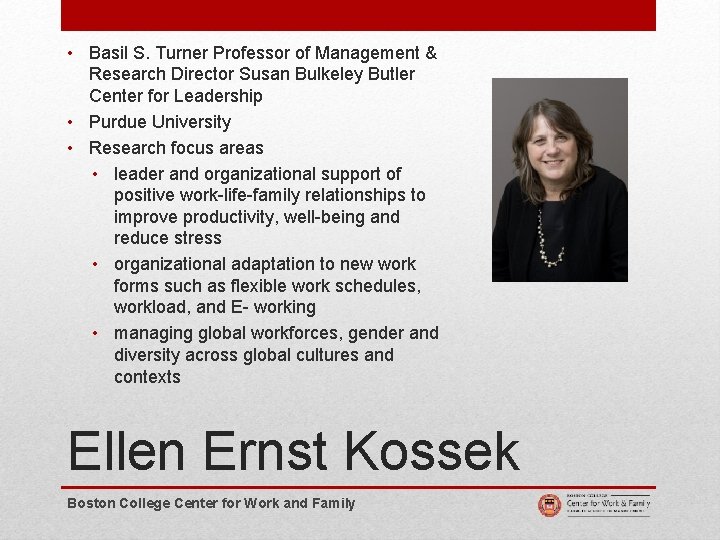
• Basil S. Turner Professor of Management & Research Director Susan Bulkeley Butler Center for Leadership • Purdue University • Research focus areas • leader and organizational support of positive work-life-family relationships to improve productivity, well-being and reduce stress • organizational adaptation to new work forms such as flexible work schedules, workload, and E- working • managing global workforces, gender and diversity across global cultures and contexts Ellen Ernst Kossek Boston College Center for Work and Family
Clarifying Work-Family Intervention Processes: The Roles of Work-Family © 2009 | WORK, FAMILY & HEALTH NETWORK
What is the WFH Network? - Multi disciplinary & Multi- Institution ■ Portland State University ■ Purdue University ■ University of Minnesota ■ Pennsylvania State University ■ Harvard University ■ Kaiser Permanente’s Center for Health Research ■ RTI, Inc. ■ Funding from the National Institutes of Health (NIH) and the Centers for Disease Control and Prevention (CDC)
Goal #1 of the Work, Family & Health Network ■ Work-life conflict affects health and wellbeing ■ Impact on employees ■ Impact on families ■ Impact on employers ■ Work-life issues are a public health concern
Goal #2 of the Work, Family & Health Network ■ Interested employers Tested solutions ■ Concrete changes, initiatives ■ Goals of improving health by reducing worklife conflicts ■ ROI: neutral or positive for organization ■ Rigorously tested
Lessons from Occupational Health World ■ Characteristics of work can affect a worker’s physical and mental health ■ Amount of decision latitude, demands of the job (physical and psychological) ■ Support received from supervisors and coworkers, recognition ■ Effects seen on health and well-being such as cardiovascular disease risk, depression, burnout, accidents at work ■ Also link to risky behaviors such as smoking and alcohol consumption
Shifting Lens from the Individual to the Organization § Moving work-life from the margins to the mainstream (Kossek, Hammer, Lewis, 2010) § Occupational health psychology is an integration of the individual, the organization, and the work-family interface § Work-life field is shifting the lens from the individual focus to the organizational focus
Occupational health field moving this way… ■ Total Worker Health Initiative - NIOSH “Total Worker Health™ is a strategy integrating occupational safety and health protection with health promotion to prevent worker injury and illness and to advance health and well-being. ”
Work-life Conflict Reduction Interventions and Health Behaviors ■ Work-family interventions should target changing the work environment to reduce psychosocial stressors and increase psychological resources, ultimately leading to improved health and safety behaviors ■ The Work, Family and Health Network has been the largest national effort to support organization-level work-life intervention studies that lead to improved health behaviors, and ultimately health of workers ■ Initial pilot studies are the first to provide evidence of work-life intervention effects on health (i. e. , Hammer, Kossek, et al. , 2011) and health behaviors (Moen et al. , 2013; Moen et al. , 2011)
Work-Family Conflict Causes ■ Work-Related Causes ■ Hours worked (+) ■ Job Stress (+) ■ Work Family Culture (-) ■ Work Supports (-) ■ Family Supportive Supervisory Behaviors (-)
Work-Family Conflict Outcomes ■ Absenteeism (+) ■ family stress (+) ■ turnover intentions (+) ■ substance abuse (+) ■ family, marital, job, and life satisfaction (-) ■ organizational commitment (-) ■ performance (-) ■ Health and well-being (-) ■ Safety (-)
How to Alleviate Work-Family Conflict Formal & Informal Supports • Child/elder care resource & referral services, flexible work scheduling, job sharing, perceived managerial support, work-family climate for sharing ■ Family-Friendly Culture ■ If the overarching org. philosophy is sensitive to the family needs of employees ■ Managerial Work-Family Training
Workplace Culture and Supervisory Support ■ Cutting edge research is now demonstrating that informal supports are as and sometimes even more important than formal supports— e. g. , World at Work recent report ■ Future research needs to focus on understanding how to improve the informal supports in organizations
New Direction in Work and Family Primary Preventions that impact the Work -Family Culture ■ Providing supervisor support for work and family can improve work-family outcomes for those high in workfamily conflict (Hammer, Kossek, et al. , 2007; Kossek, & Hammer, 2008; Hammer, Kossek et al. , 2009; Hammer, Kossek et al. , 2011; Kossek et al. , 2011)
Overall Project Goals 1. To identify critical family-supportive supervisor behaviors – to develop an assessment of family supportive supervisory behaviors (FSSB) and to provide manager’s with management tools 2. Develop an evidence-based training and self-monitoring intervention for supervisors to increase their family supportive supervisor behaviors 3. To examine the effects of training supervisors in familysupportive behaviors on worker health, safety, family, and work-related outcomes
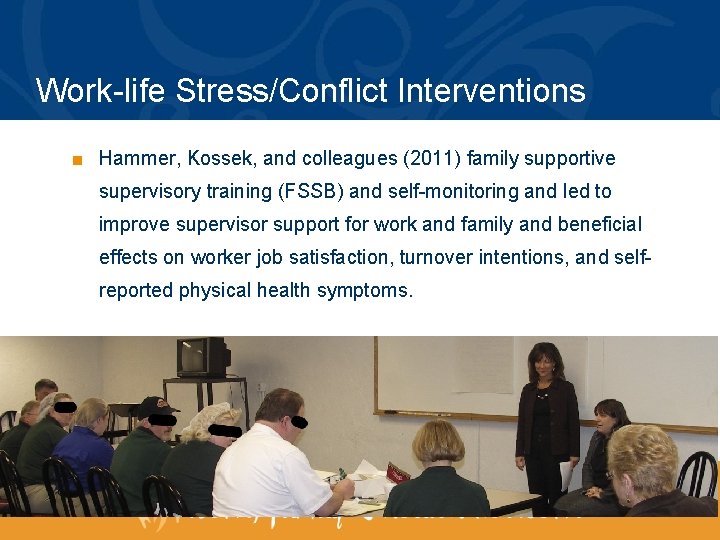
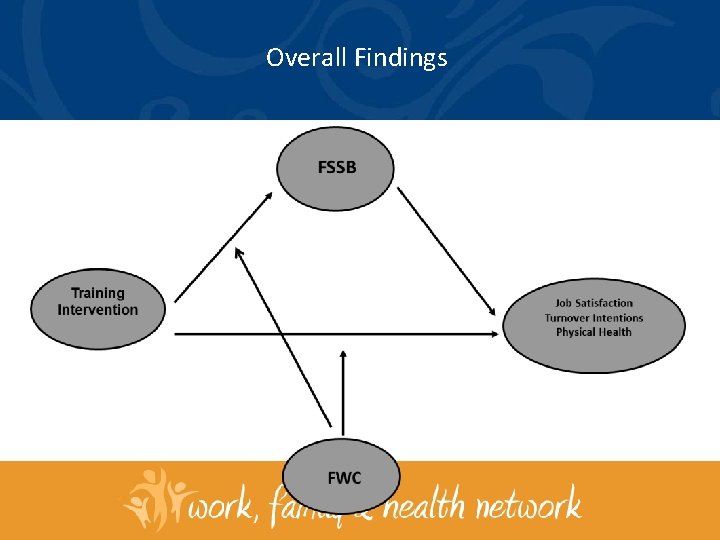
Work-life Stress/Conflict Interventions ■ Hammer, Kossek, and colleagues (2011) family supportive supervisory training (FSSB) and self-monitoring and led to improve supervisor support for work and family and beneficial effects on worker job satisfaction, turnover intentions, and selfreported physical health symptoms.
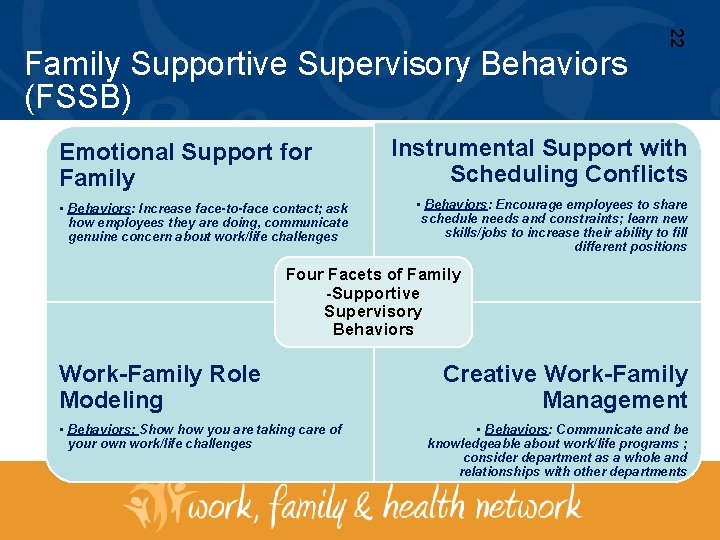
Emotional Support for Family • Behaviors: Increase face-to-face contact; ask how employees they are doing, communicate genuine concern about work/life challenges 22 Family Supportive Supervisory Behaviors (FSSB) Instrumental Support with Scheduling Conflicts • Behaviors: Encourage employees to share schedule needs and constraints; learn new skills/jobs to increase their ability to fill different positions Four Facets of Family -Supportive Supervisory Behaviors Work-Family Role Modeling • Behaviors: Show you are taking care of your own work/life challenges Creative Work-Family Management • Behaviors: Communicate and be knowledgeable about work/life programs ; consider department as a whole and relationships with other departments
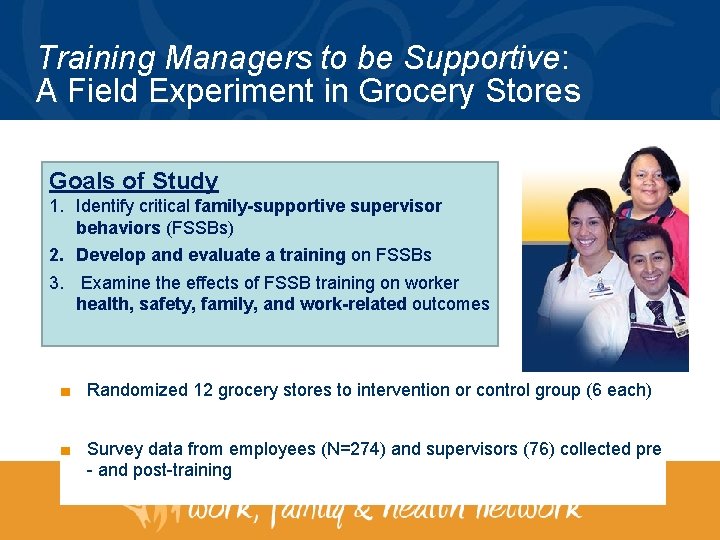
Training Managers to be Supportive: A Field Experiment in Grocery Stores Goals of Study 1. Identify critical family-supportive supervisor behaviors (FSSBs) 2. Develop and evaluate a training on FSSBs 3. Examine the effects of FSSB training on worker health, safety, family, and work-related outcomes ■ Randomized 12 grocery stores to intervention or control group (6 each) ■ Survey data from employees (N=274) and supervisors (76) collected pre - and post-training
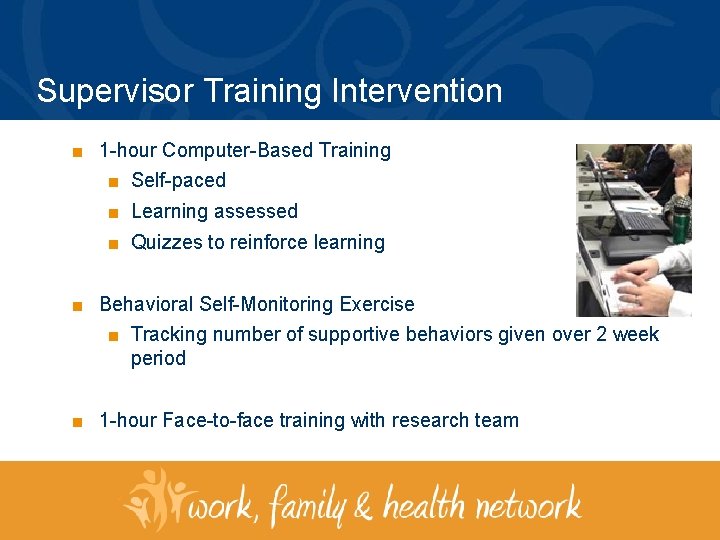
Supervisor Training Intervention ■ 1 -hour Computer-Based Training ■ Self-paced ■ Learning assessed ■ Quizzes to reinforce learning ■ Behavioral Self-Monitoring Exercise ■ Tracking number of supportive behaviors given over 2 week period ■ 1 -hour Face-to-face training with research team
Findings Baseline Survey: workers who are supervised by family-supportive managers are more likely to experience: ■ ■ lower levels of work and family conflict ■ higher job satisfaction ■ lower intentions to turnover ■ higher reports of physical health
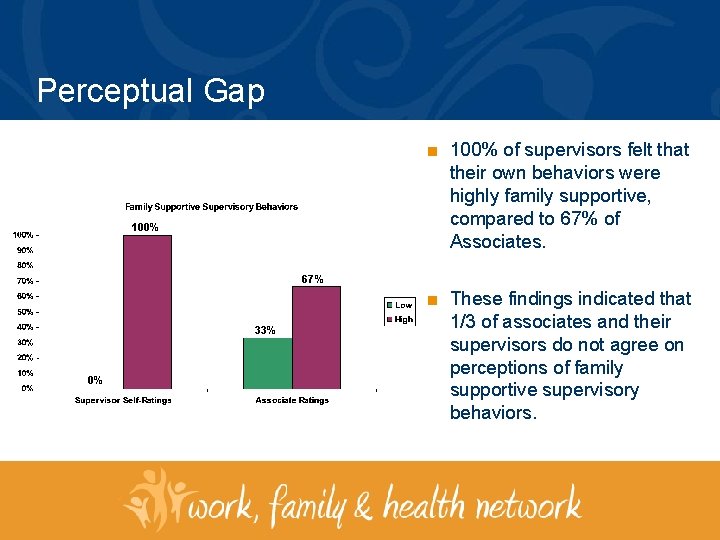
Perceptual Gap ■ 100% of supervisors felt that their own behaviors were highly family supportive, compared to 67% of Associates. 100% 67% 33% 0% ■ These findings indicated that 1/3 of associates and their supervisors do not agree on perceptions of family supportive supervisory behaviors.
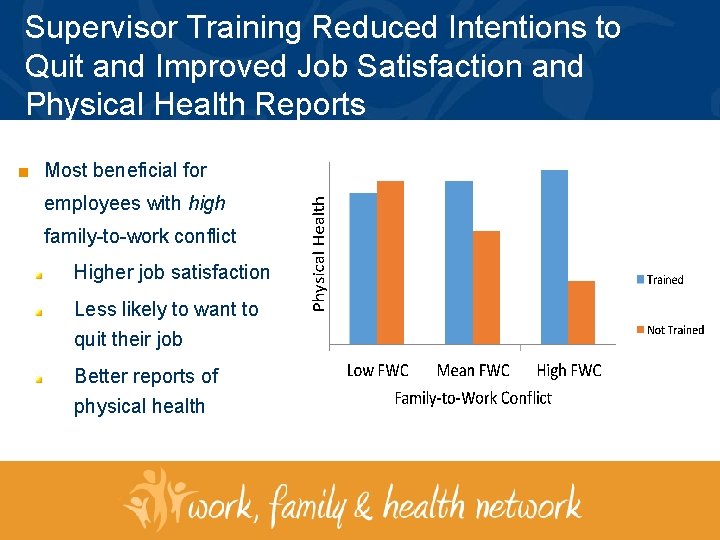
Supervisor Training Reduced Intentions to Quit and Improved Job Satisfaction and Physical Health Reports ■ Most beneficial for employees with high family-to-work conflict Higher job satisfaction Less likely to want to quit their job Better reports of physical health
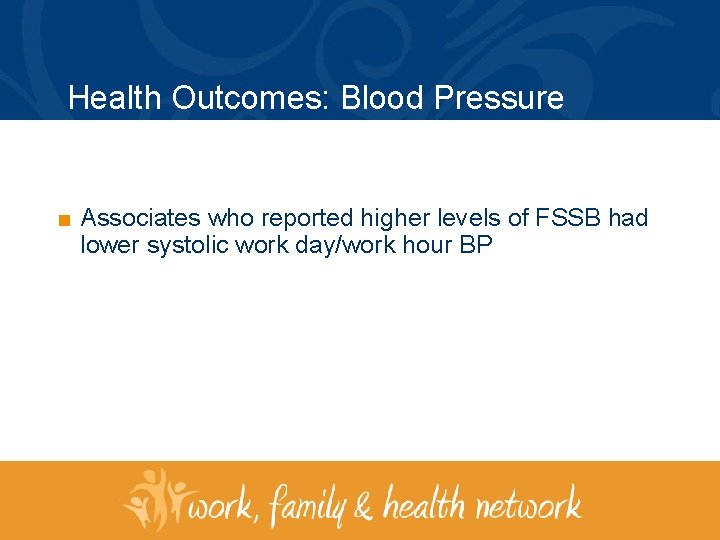
Health Outcomes: Blood Pressure ■ Associates who reported higher levels of FSSB had lower systolic work day/work hour BP
Safety Outcomes: Safety Participation and FSSB ■ Safety Participation Associates who reported family supportive behaviors from their supervisor were also more likely to participate in the company’s safety program. Note: Similar findings with safely compliance.
Overall Findings
Discussion ■ One of only a few work-family intervention studies that exist (e. g. , Kelly et al. , 2008) ■ First study to identify how supervisors can provide FSSB ■ training supervisors to be more family-supportive can improve reported health, job satisfaction, and reduce turnover intentions of their employees with high FWC
Discussion cont. ■ demonstrated the critical importance of supervisors in the work-family system ■ Supervisors are linking pins in implementation of work-family supports ■ findings are especially critical in a time when formal provision of family-friendly supports may be difficult or costly to implement
WFHN Phase II Sneak Peak: Intervention Overview ■ Supervisory training and behavioral goal setting: Provide information, motivation, skills & tools to supervisors for supporting employees and facilitating employees’ increased control over work hours ■ Participatory work redesign process: Empower employees to ask: How can we accomplish our objectives while having maximum control over work hours?
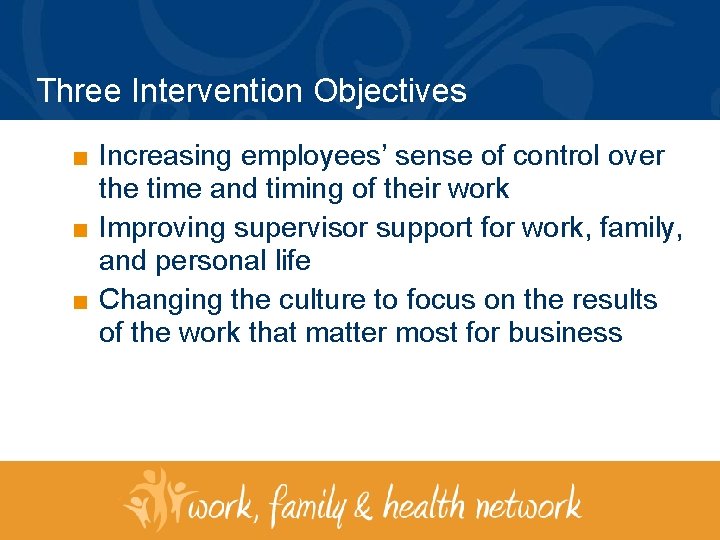
Three Intervention Objectives ■ Increasing employees’ sense of control over the time and timing of their work ■ Improving supervisor support for work, family, and personal life ■ Changing the culture to focus on the results of the work that matter most for business
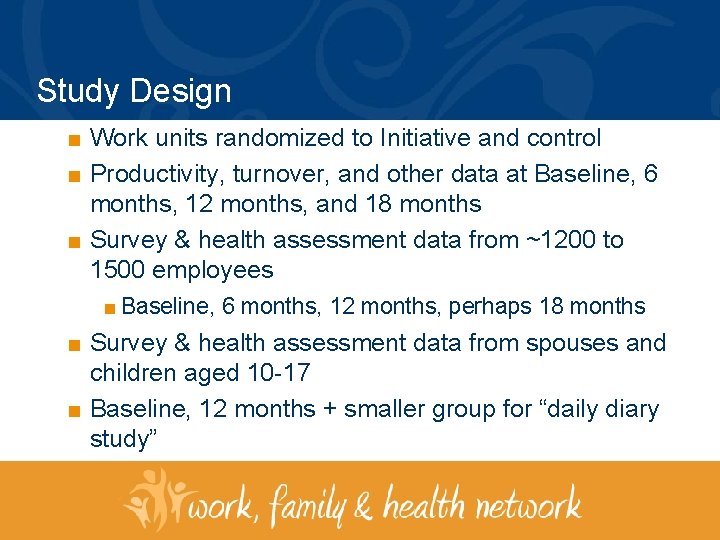
Study Design ■ Work units randomized to Initiative and control ■ Productivity, turnover, and other data at Baseline, 6 months, 12 months, and 18 months ■ Survey & health assessment data from ~1200 to 1500 employees ■ Baseline, 6 months, 12 months, perhaps 18 months ■ Survey & health assessment data from spouses and children aged 10 -17 ■ Baseline, 12 months + smaller group for “daily diary study”
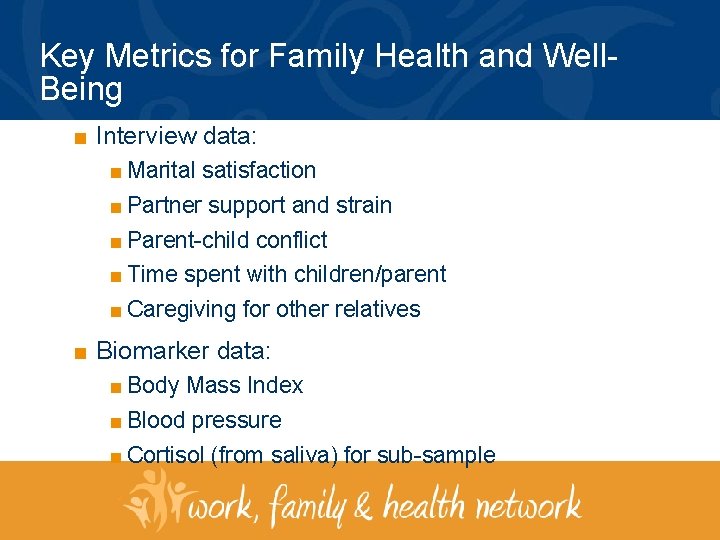
Key Metrics for Family Health and Well. Being ■ Interview data: ■ Marital satisfaction ■ Partner support and strain ■ Parent-child conflict ■ Time spent with children/parent ■ Caregiving for other relatives ■ Biomarker data: ■ Body Mass Index ■ Blood pressure ■ Cortisol (from saliva) for sub-sample
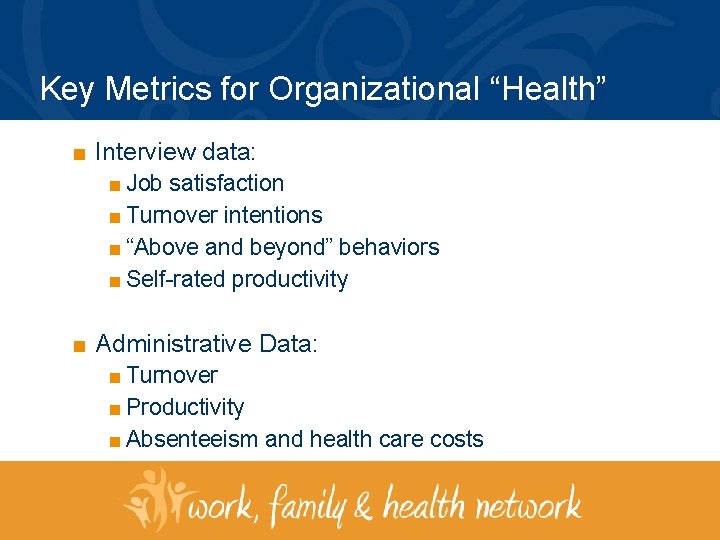
Key Metrics for Organizational “Health” ■ Interview data: ■ Job satisfaction ■ Turnover intentions ■ “Above and beyond” behaviors ■ Self-rated productivity ■ Administrative Data: ■ Turnover ■ Productivity ■ Absenteeism and health care costs
Study Recommendations ■ training supervisors to be more familysupportive can improve reported health, job satisfaction, and reduce turnover intentions of their employees with high FWC
Study Recommendations ■ demonstrated the critical importance of supervisors in the work-family system ■ Supervisors are linking pins in implementation of work-family supports ■ findings are especially critical in a time when formal provision of family-friendly supports may be difficult or costly to implement
Overall Recommendations ■ Training managers and supervisors to be more supportive of work and family. ■ Giving workers more control over their work hours. Increased control over when, where, and how work gets done is related to improved health behaviors. ■ Creating a resource guide for employees and their families. ■ Being a role model. Take some time off to be with your own family to show your employees you know this should be a priority for them as well. ■ Encouraging and supporting flexible schedules.
Summary Work and family are two of the most important areas in adult lives, and the more that is known about the difficulties integrating these two roles, the more progress can be made towards reducing the negative outcomes on safety and health of workers
This research was conducted as part of the Work, Family and Health Network (www. Work. Family. Health. Network. org), which is funded by a cooperative agreement through the National Institutes of Health and the Centers for Disease Control and Prevention: Eunice Kennedy Shriver National Institute of Child Health and Human Development (Grant # U 01 HD 051217, U 01 HD 051218, U 01 HD 051256, U 01 HD 051276), National Institute on Aging (Grant # U 01 AG 027669), Office of Behavioral and Sciences Research, the National Heart, Lung and Blood Institute (R 01 HL 107240), and National Institute for Occupational Safety and Health (Grant # U 01 OH 008788, U 01 HD 059773). Grants from the William T. Grant Foundation, Alfred P Sloan Foundation, and the Administration for Children and Families have provided additional funding.
Contact Information Leslie B. Hammer, Ph. D. hammer. L@pdx. edu Ellen Ernst Kossek, Ph. D. ekossek@purdue. edu WFHN Video: http: //www. kpchr. org/workfamilyhealthnetwork/public/news. Content. aspx? &primarypageid=75&secondarypageid=31 Websites with tools going live next week: www. worklifehelp. org www. workfamilyhealthnetwork. org