
Clarifications on Demilitarization Polices and Procedures for National
- Slides: 15
Clarifications on Demilitarization Polices and Procedures for National Academy of Sciences October 2017 John F. Mc. Fassel PD Demil (973) 724 -8759 john. f. mcfassel. civ@mail. mil
Purpose Ø Provide Clarification on Items provided previously to the study group Ø Describe Demil procedures used to specify which munitions will be demilitarized Ø Describe Demilitarization process for selected munition 2
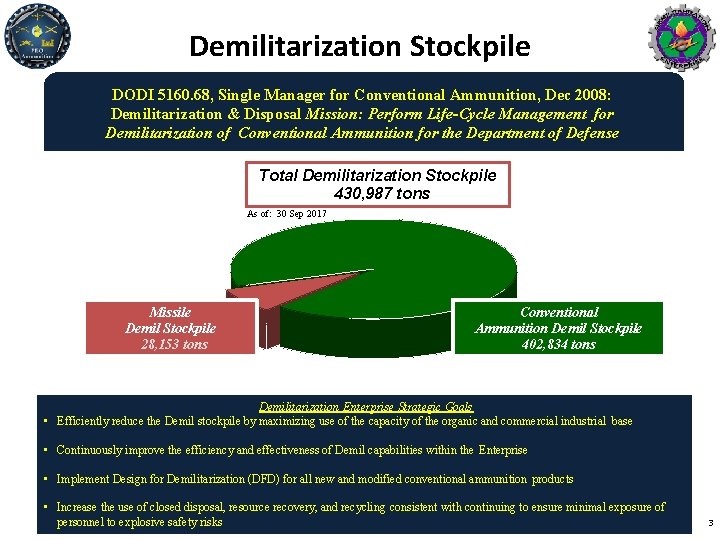
Demilitarization Stockpile DODI 5160. 68, Single Manager for Conventional Ammunition, Dec 2008: Demilitarization & Disposal Mission: Perform Life-Cycle Management for Demilitarization of Conventional Ammunition for the Department of Defense Total Demilitarization Stockpile 430, 987 tons As of: 30 Sep 2017 Missile Demil Stockpile 28, 153 tons Conventional Ammunition Demil Stockpile 402, 834 tons Demilitarization Enterprise Strategic Goals • Efficiently reduce the Demil stockpile by maximizing use of the capacity of the organic and commercial industrial base • Continuously improve the efficiency and effectiveness of Demil capabilities within the Enterprise • Implement Design for Demilitarization (DFD) for all new and modified conventional ammunition products • Increase the use of closed disposal, resource recovery, and recycling consistent with continuing to ensure minimal exposure of personnel to explosive safety risks 3
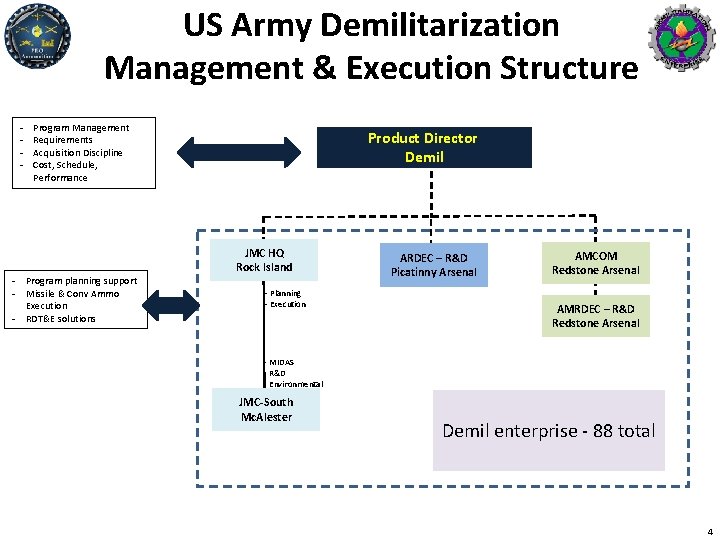
US Army Demilitarization Management & Execution Structure - Program Management Requirements Acquisition Discipline Cost, Schedule, Performance - Program planning support - Missile & Conv Ammo Execution - RDT&E solutions Product Director Demil JMC HQ Rock Island - Planning - Execution ARDEC – R&D Picatinny Arsenal AMCOM Redstone Arsenal AMRDEC – R&D Redstone Arsenal - MIDAS - R&D - Environmental JMC-South Mc. Alester Demil enterprise - 88 total 4
Obsolete, Excess, Unserviceable Ø Obsolete - Weapon system that fired that munition is no longer in service (example 8” artillery rounds) or if improved ammunition has been developed and fielded in sufficient quantities and the older ammunition is no longer required (example is new tank rounds make existing rounds obsolete) Ø Excess - There is more of the item in inventory than required for current training or operational plan needs. The Army expresses this need in the Total Army Munitions Requirement (TAMR). If there is more of an item in storage than required by the TAMR, the overage is considered excess. Considerable inventory of select munitions may be retained in field service accounts for training needs. Other Services have similar process. Ø Unserviceable - Current definition of unserviceable for the Army is items which are in a condition code other than A-E. CC: E is defined as limited expense or effort to restore. The Air Force and Navy separate definitions for what they consider serviceable, but they are still based on condition codes. Condition Codes are determined and assigned by Quality Assurance Specialist (Ammunition Surveillance) (QASAS) personnel. Ø An individual munition could simultaneously meet multiple categories 5
Cluster Munitions Ø There is no official written policy on delaying the demilitarization Ø Ø of cluster munitions. The Product Director for Demilitarization office has been contacted by the Army G-3/5/7 requesting we prioritize the demilitarization of unserviceable cluster munitions first and that we inform them of the demilitarization of any serviceable cluster munitions before actually demilitarizing them. The Air Force and Navy Designated Disposal Authorities have made similar requests for Cluster Bomb Units (CBU). We expect the Department of Defense will provide revised guidance on cluster munitions stockage levels in the near future. The Demilitarization Enterprise continues to demilitarize munitions that are considered unserviceable. 6
Capability Gaps Ø Listing a particular item as a capability gap means we have not yet demonstrated an approved method for demilitarizing that item at either a government or a contractor site Ø This designation mainly focuses our prioritization for our RDT&E resources. It does not necessarily mean the items are significantly more difficult to demilitarize than other items, but it does mean either the government or a contractor will need to expend some time and effort to develop and prove out a method for demilitarizing that item Ø Our goal is to eliminate these capability gaps over time. Several of our ongoing RDT&E projects are aimed at eliminating capability gaps Ø Unaddressed capability gaps lead to additional resource expenditure and storage facilities to maintain, monitor and continually ensure safety to human health and the environment during munitions life cycle management activities. 7
Capability Gaps Ø CS Riot Control Gas: 5 DODICs, ongoing RDTE effort is addressing Ø Ø Ø thermal processing of CS Gas. Rocket Motors: 7 DODICS, consists of DODICS V 284, V 878, V 186, V 298, VG 31, V 929 and V 923. Majority of these contain a composite rocket motor grain that contains Ammonium Perchlorate, and there is a current RDTE effort for a closed disposal capability at LEMC. Planned for Future Commercial contracts; 11 DODICs, DODIC E 506 Filler to be used for Donor Material for open detonation of other items DODICS C 870, H 519, E 820, H 181, HA 06 and LA 19 are planned for near or mid-term RDTE projects Other Capability Gaps Requiring further assessment; 4, 470 Tons; 8
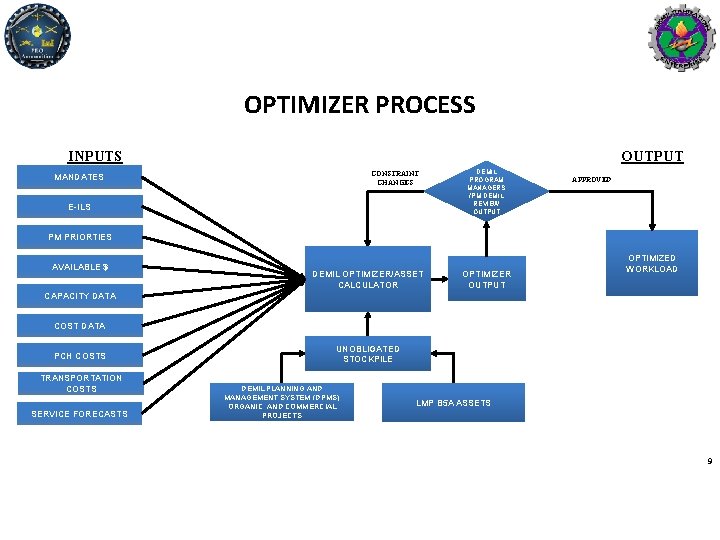
OPTIMIZER PROCESS OUTPUT INPUTS CONSTRAINT CHANGES MANDATES E-ILS DEMIL PROGRAM MANAGERS /PM DEMIL REVIEW OUTPUT APPROVED PM PRIORTIES AVAILABLE $ DEMIL OPTIMIZER/ASSET CALCULATOR OPTIMIZER OUTPUT OPTIMIZED WORKLOAD CAPACITY DATA COST DATA PCH COSTS TRANSPORTATION COSTS SERVICE FORECASTS UNOBLIGATED STOCKPILE DEMIL PLANNING AND MANAGEMENT SYSTEM (DPMS) ORGANIC AND COMMERCIAL PROJECTS LMP B 5 A ASSETS 9
Munitions Demilitarized Ø We have not yet demilitarized most of the top 400 items in the stockpile by tonnage mainly due to limitations on funding, other missions at the depots and requirement to characterize munitions before demilitarization Ø Conducted Open Burning/Open Detonation of 38 Conventional Ammunition items Ø Static Fired 7 missiles Ø Treated 19 munitions by other methods mostly APE 1236 Ø Additional 80 items demilitarized by commercial contract (over 100, 000 tons since FY 13) 10
Accidents Ø Two accidents experienced during Open Burning or Open Detonation Operations ü One premature detonation – minor ear injury ü One detonation of buried munition – serious injury Ø Over a dozen incidents since 2005 with development or operation of closed disposal technologies. Most have only resulted in equipment damage, but there have been injuries and two deaths 11
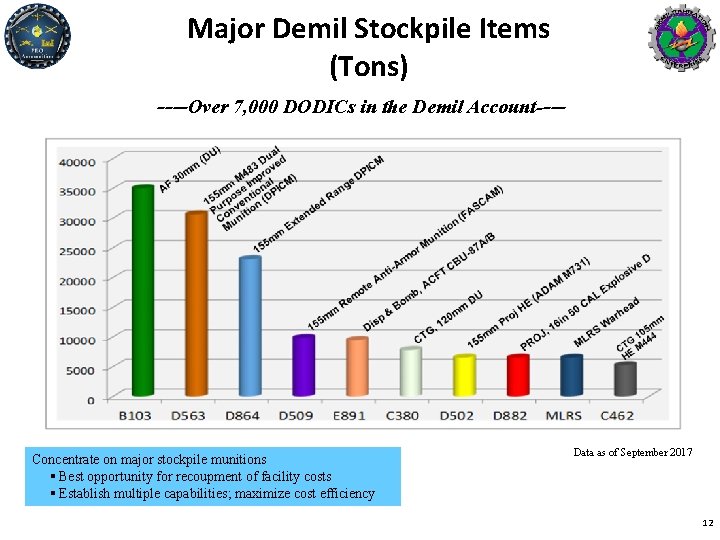
Major Demil Stockpile Items (Tons) ----Over 7, 000 DODICs in the Demil Account---- Concentrate on major stockpile munitions § Best opportunity for recoupment of facility costs § Establish multiple capabilities; maximize cost efficiency Data as of September 2017 12
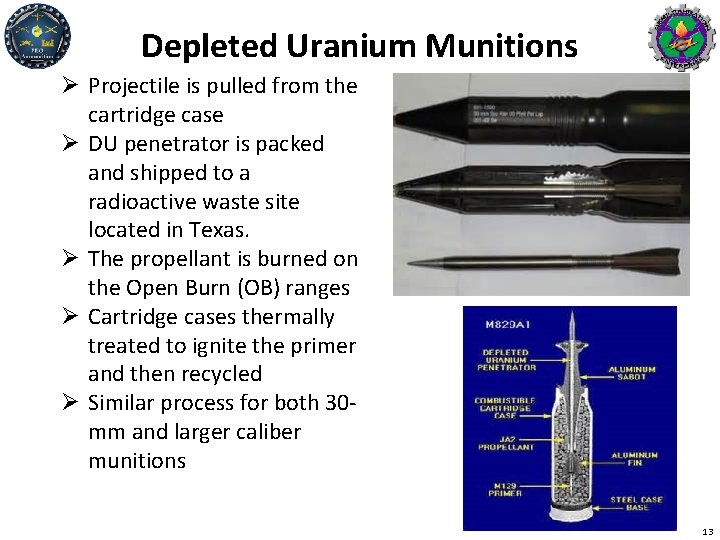
Depleted Uranium Munitions Ø Projectile is pulled from the cartridge case Ø DU penetrator is packed and shipped to a radioactive waste site located in Texas. Ø The propellant is burned on the Open Burn (OB) ranges Ø Cartridge cases thermally treated to ignite the primer and then recycled Ø Similar process for both 30 mm and larger caliber munitions 13
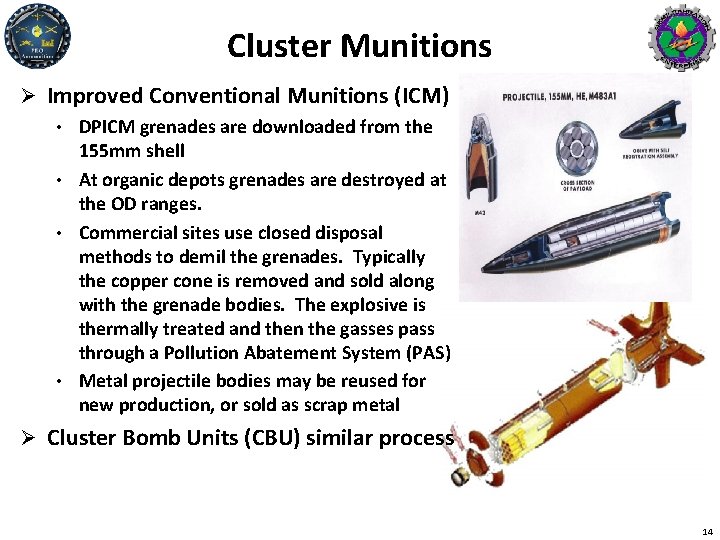
Cluster Munitions Ø Improved Conventional Munitions (ICM) • DPICM grenades are downloaded from the 155 mm shell • At organic depots grenades are destroyed at the OD ranges. • Commercial sites use closed disposal methods to demil the grenades. Typically the copper cone is removed and sold along with the grenade bodies. The explosive is thermally treated and then the gasses pass through a Pollution Abatement System (PAS) • Metal projectile bodies may be reused for new production, or sold as scrap metal Ø Cluster Bomb Units (CBU) similar process 14
Summary Ø Demilitarization Enterprise consists of multiple organizations committed to ensuring the protection of human health and the environment while efficiently eliminating the stockpile in support of sustaining Army combat readiness. Ø Demilitarization Enterprise is continuously researching methods for safe and compliant handling of new munitions Ø Open Burning and Open Detonation are compliant within regulated permit limits and only used when safe alternatives are not available Ø RDT&E, APE and R 3 Efforts provide Important new Capabilities 15