
Clare as a Crossroad Character in Michelle Cliffs
- Slides: 32
Clare as a Crossroad Character in Michelle Cliff’s Abeng Consequences of Crossing Over at Crossroads Stories of Growth: Caribbean Women Writers (3)
Outline • Michelle Cliff: Introd. • Abeng Chap 15 -17 1. hunting scene and its reasons; 2. bathing scene and what it reveals –gender and race 3. the issue of languages • Quiz
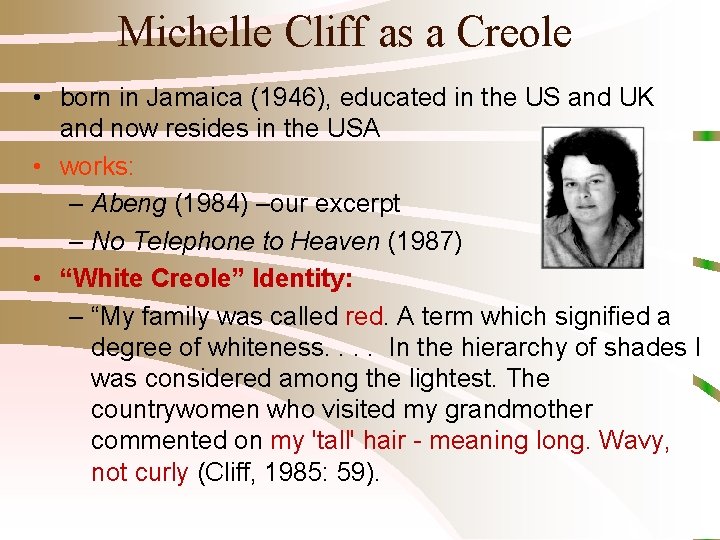
Michelle Cliff as a Creole • born in Jamaica (1946), educated in the US and UK and now resides in the USA • works: – Abeng (1984) –our excerpt – No Telephone to Heaven (1987) • “White Creole” Identity: – “My family was called red. A term which signified a degree of whiteness. . In the hierarchy of shades I was considered among the lightest. The countrywomen who visited my grandmother commented on my 'tall' hair - meaning long. Wavy, not curly (Cliff, 1985: 59).
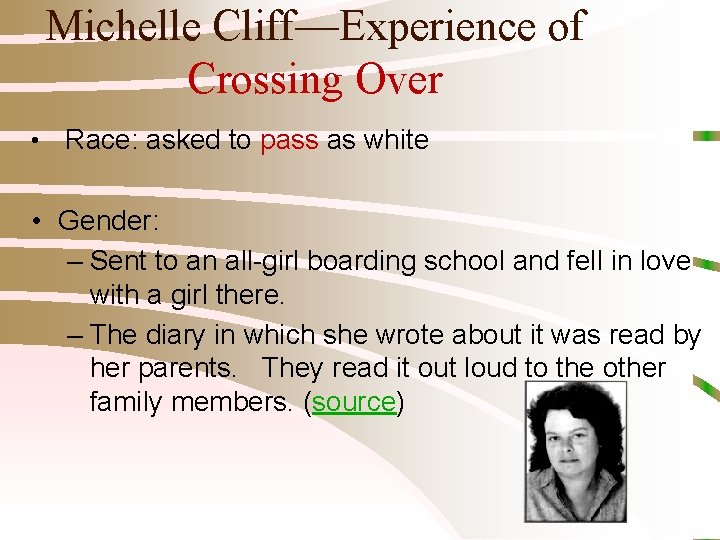
Michelle Cliff—Experience of Crossing Over • Race: asked to pass as white • Gender: – Sent to an all-girl boarding school and fell in love with a girl there. – The diary in which she wrote about it was read by her parents. They read it out loud to the other family members. (source)
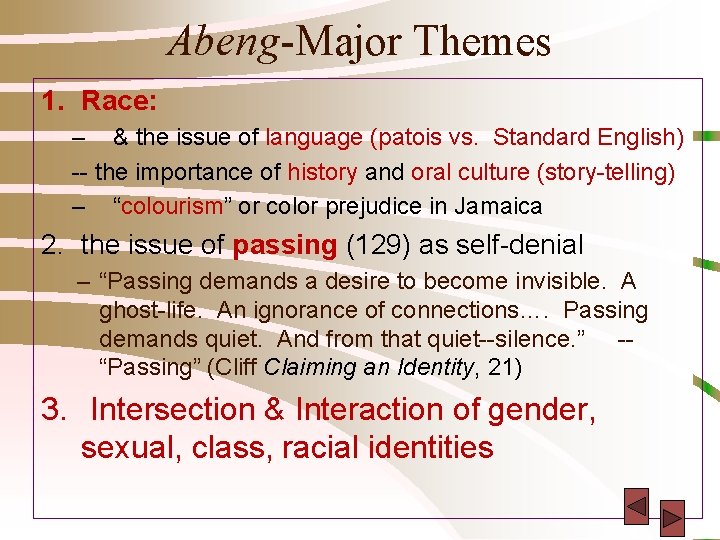
Abeng-Major Themes 1. Race: – & the issue of language (patois vs. Standard English) -- the importance of history and oral culture (story-telling) – “colourism” or color prejudice in Jamaica 2. the issue of passing (129) as self-denial – “Passing demands a desire to become invisible. A ghost-life. An ignorance of connections…. Passing demands quiet. And from that quiet--silence. ” -“Passing” (Cliff Claiming an Identity, 21) 3. Intersection & Interaction of gender, sexual, class, racial identities
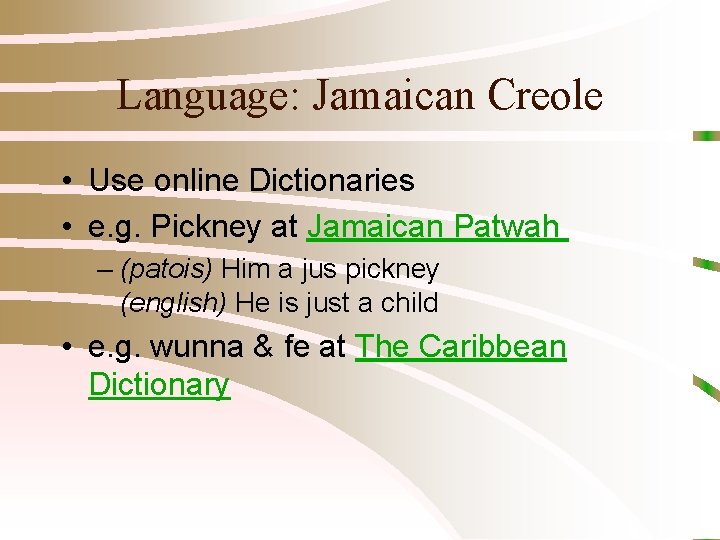
Language: Jamaican Creole • Use online Dictionaries • e. g. Pickney at Jamaican Patwah – (patois) Him a jus pickney (english) He is just a child • e. g. wunna & fe at The Caribbean Dictionary
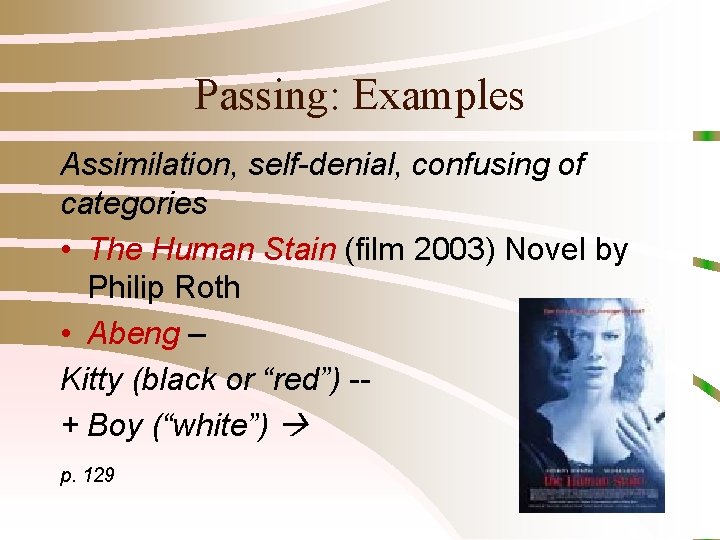
Passing: Examples Assimilation, self-denial, confusing of categories • The Human Stain (film 2003) Novel by Philip Roth • Abeng – Kitty (black or “red”) -+ Boy (“white”) p. 129
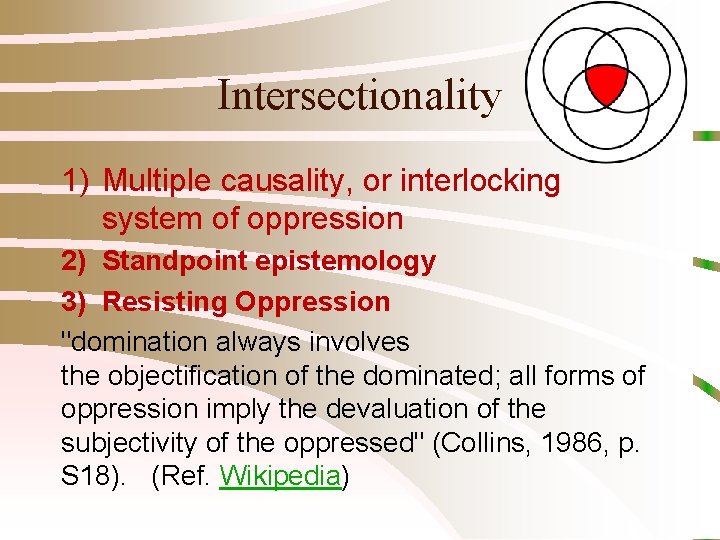
Intersectionality 1) Multiple causality, or interlocking system of oppression 2) Standpoint epistemology 3) Resisting Oppression "domination always involves the objectification of the dominated; all forms of oppression imply the devaluation of the subjectivity of the oppressed" (Collins, 1986, p. S 18). (Ref. Wikipedia)
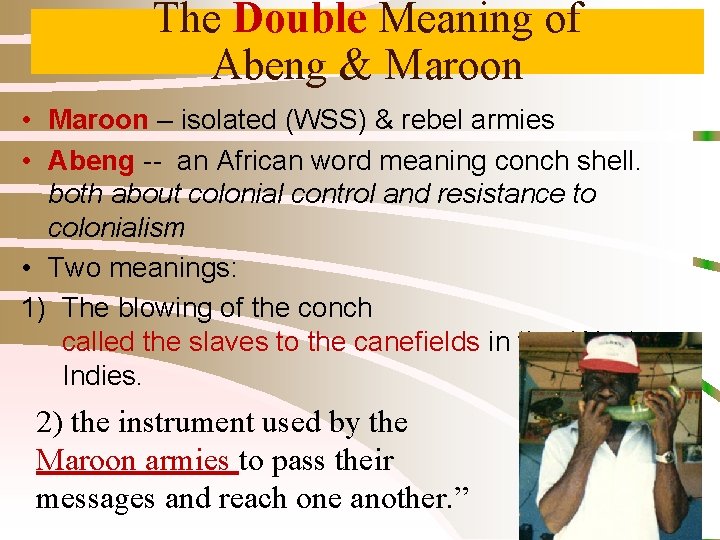
The Double Meaning of Abeng & Maroon • Maroon – isolated (WSS) & rebel armies • Abeng -- an African word meaning conch shell. both about colonial control and resistance to colonialism • Two meanings: 1) The blowing of the conch called the slaves to the canefields in the West Indies. 2) the instrument used by the Maroon armies to pass their messages and reach one another. ”
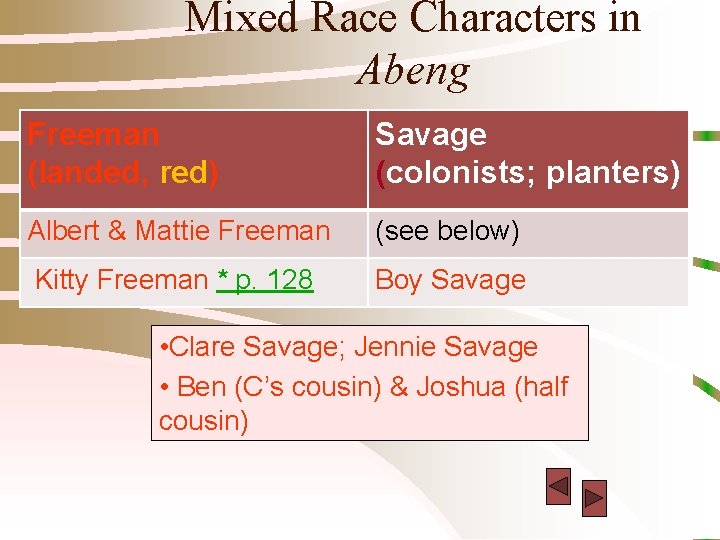
Mixed Race Characters in Abeng Freeman (landed, red) Savage (colonists; planters) Albert & Mattie Freeman (see below) Kitty Freeman * p. 128 Boy Savage • Clare Savage; Jennie Savage • Ben (C’s cousin) & Joshua (half cousin)
Characters in Abeng (2): Underclasses • Miss Ruthie (squatter, black) Zoe • the cane-cutter • Mass Cudjoe (the pig) * • Old Joe (the bull)
The Savages • Judge (Clare’s great-grandfather) -- burned his slaves alive on the eve of emancipation • “His mind was on a 'higher' plane--he was concerned about the survival of his race. He was fearful of the mixing that was sure to follow freedom--in which the white seed would be diluted and the race impoverished”(38). • “…He was not to blame. These people were slaves and would not know how to behave in freedom. They would have been miserable. . . . At that moment these people were his property, and they were therefore his to burn” (39 -40)
Irony: The Savages—not all whites • The Savages defined themselves according to "color, class, and religion, and over the years a carefully contrived mythology was constructed, which they used to protect their identities. When they were poor, and not all of them white, the mythology persisted" (Abeng 29).
Kitty Freeman • "Kitty's mother was both Black and white, and her father's origins were unknown—but both had brown skin and a wave to their hair. • . . Her people were called 'red' and they knew that this was what they were. . The Freemans did not question this structure…” • [cause] “. . . a settling of blood as some lighter skins crossed over one or other of the darker ones--keeping guard, though, over a base of darkness. And a trickle of white people …made the island whiter than it actually was" (54).
Ironies in the Freeman’s • Ms. Mattie -- Against Clare’s being with Zoe • Kitty: locking her blackness deep inside
Cliff on Clare Savage • Clare Savage "is an amalgam of myself and others, who eventually becomes herself alone. Bertha Rochester is her ancestor. Her name, obviously, is significant and is intended to represent her as a crossroads character, with her feet (and head) in (at least) two worlds. • Clare: a light-skinned female who has been removed from her homeland in a variety of ways and whose life is a movement back, ragged, interrupted, uncertain, to that homeland. She is fragmented, damaged, incomplete. “ (e. g. her missing her mother)
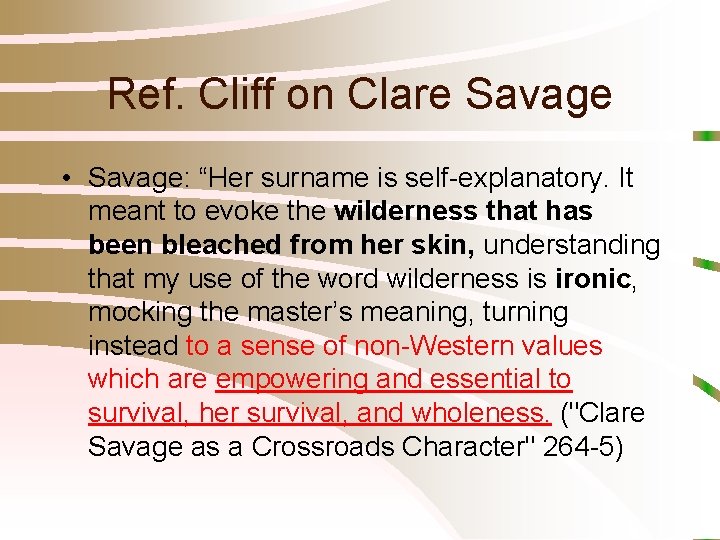
Ref. Cliff on Clare Savage • Savage: “Her surname is self-explanatory. It meant to evoke the wilderness that has been bleached from her skin, understanding that my use of the word wilderness is ironic, mocking the master’s meaning, turning instead to a sense of non-Western values which are empowering and essential to survival, her survival, and wholeness. ("Clare Savage as a Crossroads Character" 264 -5)
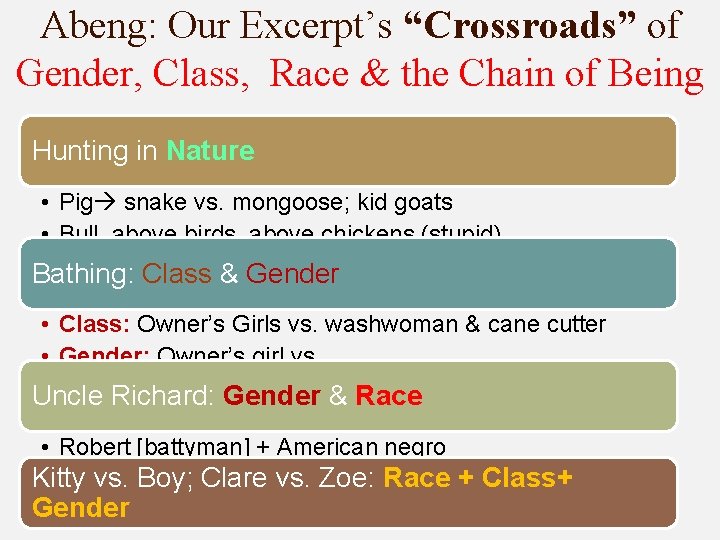
Abeng: Our Excerpt’s “Crossroads” of Gender, Class, Race & the Chain of Being Hunting in Nature • Pig snake vs. mongoose; kid goats • Bull, above birds, above chickens (stupid) Bathing: Class & Gender • Class: Owner’s Girls vs. washwoman & cane cutter • Gender: Owner’s girl vs. Uncle Richard: Gender & Race • Robert [battyman] + American negro Kitty vs. Boy; Clare vs. Zoe: Race + Class+ Gender
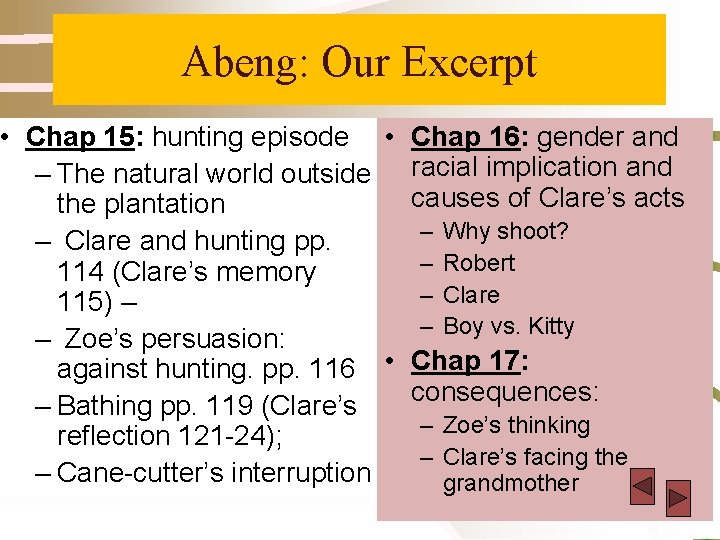
Abeng: Our Excerpt • Chap 15: hunting episode • – The natural world outside the plantation – Clare and hunting pp. 114 (Clare’s memory 115) – – Zoe’s persuasion: against hunting. pp. 116 • – Bathing pp. 119 (Clare’s reflection 121 -24); – Cane-cutter’s interruption Chap 16: gender and racial implication and causes of Clare’s acts – – Why shoot? Robert Clare Boy vs. Kitty Chap 17: consequences: – Zoe’s thinking – Clare’s facing the grandmother
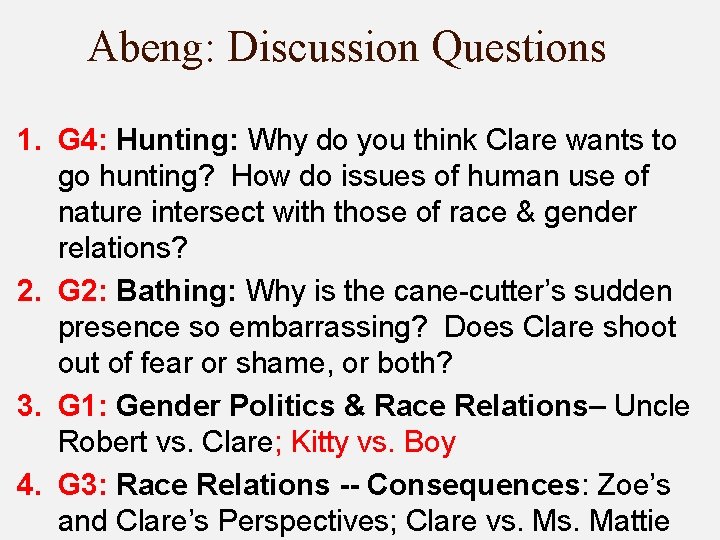
Abeng: Discussion Questions 1. G 4: Hunting: Why do you think Clare wants to go hunting? How do issues of human use of nature intersect with those of race & gender relations? 2. G 2: Bathing: Why is the cane-cutter’s sudden presence so embarrassing? Does Clare shoot out of fear or shame, or both? 3. G 1: Gender Politics & Race Relations– Uncle Robert vs. Clare; Kitty vs. Boy 4. G 3: Race Relations -- Consequences: Zoe’s and Clare’s Perspectives; Clare vs. Mattie
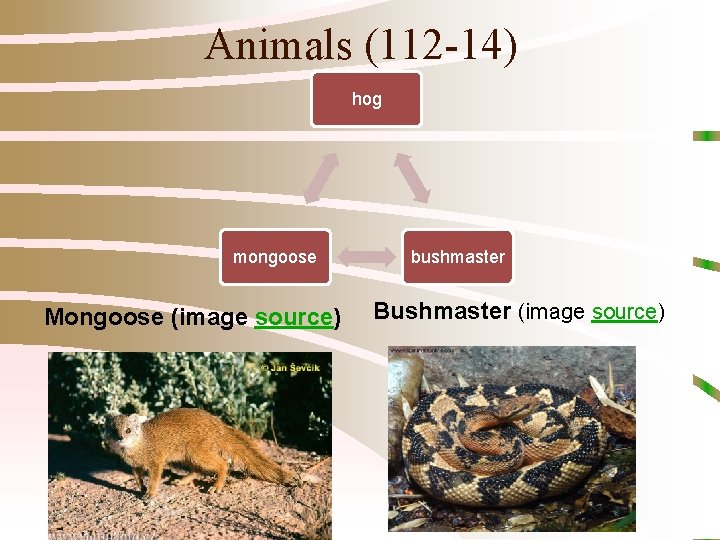
The Hunting Episode in Context 1. – – – The history of natural lives//colonialism pp. 112 the origin of the pig--the native of the island the Maroon ritual and gender differences the mongoose • • from India (112) “the true survivor” (113) symbolic meaning—about hunting and survival; how the natural habitat has been changed by colonial practices Does Clare enjoy killing wild animals? What is the symbolic meaning of this hunting for Clare? pp. 114, 115,
Animals (112 -14) hog mongoose Mongoose (image source) bushmaster Bushmaster (image source)
Clare’s motivation • She does not enjoy hunting (e. g. experience of eating goat and roasted birds); • Wanting to eat the pig’s testicles and penis (to increase masculinity or power over it)? • Proving herself to Her mother Kitty: Kitty Hart, Anne Frank, Doreen Paxton • Imitating her cousins--Joshua and Ben and their shooting birds and hunting for a pig.
Clare and Zoe • What are the differences between Zoe and Clare? ( WSS -- Antoinette and Tia)? • Zoe: – calls Clare “town gal” class difference – is afraid of being thought of as “Guinea warrior, not gal pickney. ” (117 -118) gender limitation • Clare – split; “limited” (119); – recognize her “selfishness”; her lack of understanding of property and ownership (121) —Clare’s alienation from the native code; unconscious of her own class privilege
Zoe & Clare (2): bathing scene • What is the significance of the bathing scene (119120, 124) in the episode? Is the relation between the two girls lesbian? • Why is Clare so afraid of being seen by the canecutter? • Why does Cliff follows it with a narration of “battyman” in Ch. 16? • How does the family describe the “battyman” Robert (125 -126)? What has happened to him? What is the connection of Robert’s story with the relationship between Clare and Zoe? • What divides Clare and Zoe?
Zoe & Clare (2): bathing scene • Clare: Self-definition & Communication p. 120; • 121 (the space between them) Clare starts to understand decides not be selfish again (124) –respecting class boundaries, but crossing gender-race ones. • 122 Cane-cutter • Chap 16: Gender boundaries--Robert and the American negro (124 -26)// • Chap 16: racial boundaries crossed by Clare and Zoe (: someone darker than herself” p. 127)
Clare’s Split Racial Identities • Boy’s teaching of “race and color and lightening” (127) • Kitty’s influences: – Kitty’s cherish of darkness (127 -128)—”keep darkness locked inside” (129)—melancholic – Kitty’s dream of setting up a local school (129130)--her distrust of British education and love of black culture--“Daffodils” vs the Maroon Girl (129) – Kitty’s preference for the darker daughter Jennie (129) and Clare’s sense of alienation from the mother (128) Clare’s love for Zoe (131) – Thinks Clare likes passing (129)
Languages--English and Patois • What kind of language does Zoe use? What is the significance of different languages in the novel? (e. g. Clare to Zoe, to the cane-cutter, and to Ms. Mattie) (122, 134).
Note: Pig Cudjoe • In Jamaica, the growing strength and frequency of attacks by these Maroon groups between the 1650 s and 1680 s erupted into a full-blown war--known as Cudjoe's War, after its Akan leader--by 1690. In 1739, the British empire sued for peace and signed a historic treaty—Cudjoe’s Treaty --giving the once-enslaved Africans autonomy and recognition as free people.
Note 2: Resisting Women in Jamaican history • (p. 128) • Nanny -- the legendary Maroon leader, famed both for her strategic prowess and for her ability catch a bullet between her buttocks and thereby return it whence it came (the novel p. 14) • Inez-- the descendant of Maroon and Miskito Indian parents; – imprisoned and raped by Clare's great-grandfather the judge and turned into his concubine, she capitalizes on his absence to escape, and in doing so takes pains to aid a group of rebellious slaves acquire a piece of land where they can live undisturbed – She aborts the fetus she carries with the help of Mma Alli, the sorceress
Self-Testing 1. What is passing? Who wants Clare to do it? 20% 2. What does “speaking buckra” mean? How about “gal smaddy”? 20% 3. Explain the significance of one of the following scenes/characters in 3 sentences? 60% 1. 2. 3. 4. The hunting scene The bathing scene Clare’s memory of her uncle Robert Clare’s relations with her mother Kitty
References • Cliff, Michelle. "Clare Savage as a Corssroads Character. " Caribbean Women Writers: Essays from the First International Conference. Ed. Selwyn R. Cudjoe. Wellesley, MA: Calaloux, 1990. 263 -68. • Michelle Cliff http: //www. answers. com/topic/michelle-cliff