
Clang v s LLVM Moonzoo Kim Software Testing
![An Example of LLVM’s Use Cases (2/3) • The array subscription expression ++a[x++] has](https://slidetodoc.com/presentation_image/c0fb0cf7aa05ba43ef371007b80c63cf/image-5.jpg "An Example of LLVM’s Use Cases (2/3) • The array subscription expression ++a[x++] has")
- Slides: 6
Clang v. s. LLVM Moonzoo Kim Software Testing and Verificaton (SWTV) group CS Dept. KAIST 2020 -10 -03 1
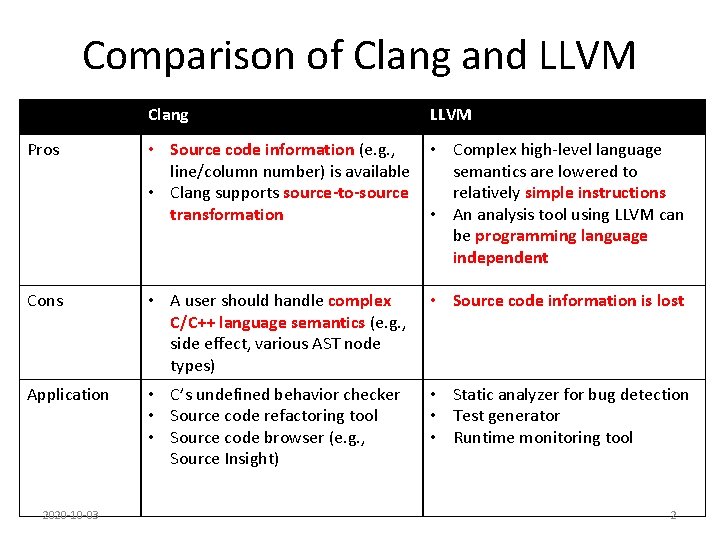
Comparison of Clang and LLVM Clang LLVM Pros • Source code information (e. g. , line/column number) is available • Clang supports source-to-source transformation • Complex high-level language semantics are lowered to relatively simple instructions • An analysis tool using LLVM can be programming language independent Cons • A user should handle complex C/C++ language semantics (e. g. , side effect, various AST node types) • Source code information is lost Application • C’s undefined behavior checker • Source code refactoring tool • Source code browser (e. g. , Source Insight) • Static analyzer for bug detection • Test generator • Runtime monitoring tool 2020 -10 -03 2
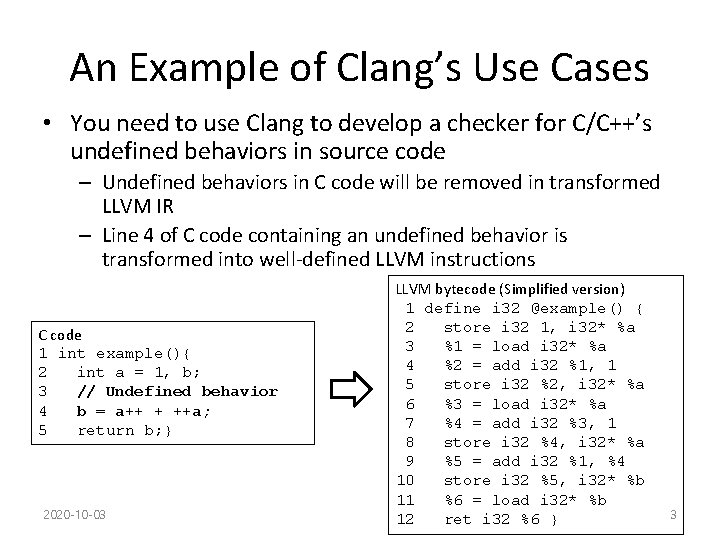
An Example of Clang’s Use Cases • You need to use Clang to develop a checker for C/C++’s undefined behaviors in source code – Undefined behaviors in C code will be removed in transformed LLVM IR – Line 4 of C code containing an undefined behavior is transformed into well-defined LLVM instructions C code 1 int example(){ 2 int a = 1, b; 3 // Undefined behavior 4 b = a++ + ++a; 5 return b; } 2020 -10 -03 LLVM bytecode (Simplified version) 1 define i 32 @example() { 2 store i 32 1, i 32* %a 3 %1 = load i 32* %a 4 %2 = add i 32 %1, 1 5 store i 32 %2, i 32* %a 6 %3 = load i 32* %a 7 %4 = add i 32 %3, 1 8 store i 32 %4, i 32* %a 9 %5 = add i 32 %1, %4 10 store i 32 %5, i 32* %b 11 %6 = load i 32* %b 12 ret i 32 %6 } 3
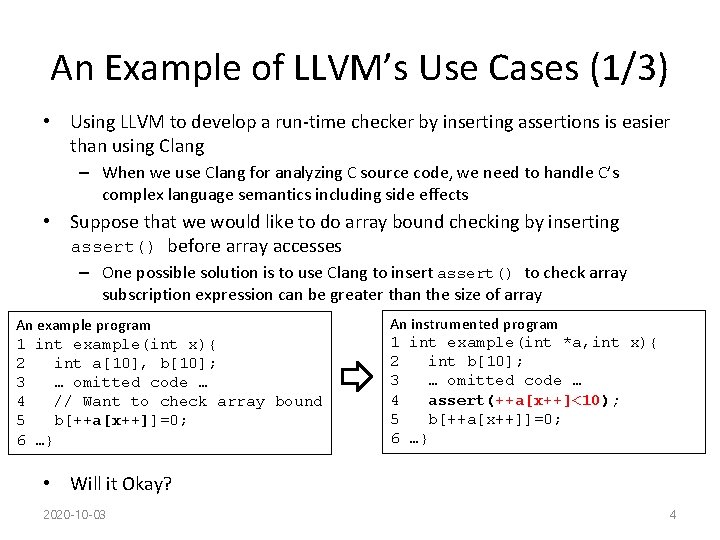
An Example of LLVM’s Use Cases (1/3) • Using LLVM to develop a run-time checker by inserting assertions is easier than using Clang – When we use Clang for analyzing C source code, we need to handle C’s complex language semantics including side effects • Suppose that we would like to do array bound checking by inserting assert() before array accesses – One possible solution is to use Clang to insert assert() to check array subscription expression can be greater than the size of array An example program 1 int example(int x){ 2 int a[10], b[10]; 3 … omitted code … 4 // Want to check array bound 5 b[++a[x++]]=0; 6 …} An instrumented program 1 int example(int *a, int x){ 2 int b[10]; 3 … omitted code … 4 assert(++a[x++]<10); 5 b[++a[x++]]=0; 6 …} • Will it Okay? 2020 -10 -03 4
An Example of LLVM’s Use Cases (2/3) • The array subscription expression ++a[x++] has side effects – Executing assert(++a[x++]) changes the value of x and a[x] – We should execute the array subscription expression once and store the result to use both assert() and array access • In addition, we should do array bound check for the array subscription expression ++a[x++] itself. • If we choose Clang to develop a run-time checker to insert assert(), we should consider such complex semantics of C program code An example program 1 int example(int x){ 2 int a[10], b[10]; 3 … omitted code … 4 // Want to check array bound 5 b[++a[x++]]=0; 6 …} 2020 -10 -03 An instrumented program rev. 2 1 int example(int *a, int x){ 2 int b[10]; 3 … omitted code … 4 int tmp 1=x++; 5 assert(tmp 1<10); 6 int tmp 2=++a[tmp 1] 7 assert(tmp 2<10); 9 b[tmp 2]=0; 10 …} 5
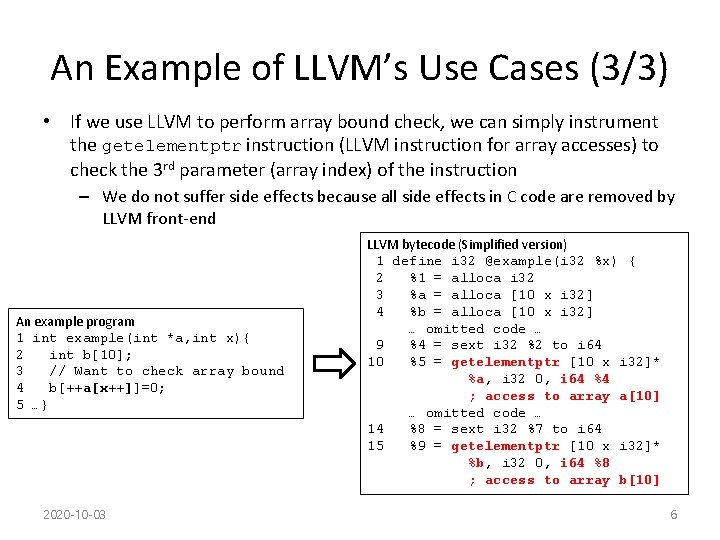
An Example of LLVM’s Use Cases (3/3) • If we use LLVM to perform array bound check, we can simply instrument the getelementptr instruction (LLVM instruction for array accesses) to check the 3 rd parameter (array index) of the instruction – We do not suffer side effects because all side effects in C code are removed by LLVM front-end An example program 1 int example(int *a, int x){ 2 int b[10]; 3 // Want to check array bound 4 b[++a[x++]]=0; 5 …} 2020 -10 -03 LLVM bytecode (Simplified version) 1 define i 32 @example(i 32 %x) { 2 %1 = alloca i 32 3 %a = alloca [10 x i 32] 4 %b = alloca [10 x i 32] … omitted code … 9 %4 = sext i 32 %2 to i 64 10 %5 = getelementptr [10 x i 32]* %a, i 32 0, i 64 %4 ; access to array a[10] … omitted code … 14 %8 = sext i 32 %7 to i 64 15 %9 = getelementptr [10 x i 32]* %b, i 32 0, i 64 %8 ; access to array b[10] 6