
Claims Authentication with Membership Reboot A Claimsaware Library
Claims Authentication with Membership. Reboot A Claims-aware Library for Authentication
Presenter David Rogers . NET Developer Web: http: //davidrogers. id. au Blog: http: //davidrogers. id. au/wp
Outline Membership Providers Claims – what are they? History etc. Membership. Reboot - what is it and why do we want it? configuration and setup (with Demo) password strength requirements hashing iterations tracing cookie decision custom notification templates Brief look at Authorization with Identity. Model
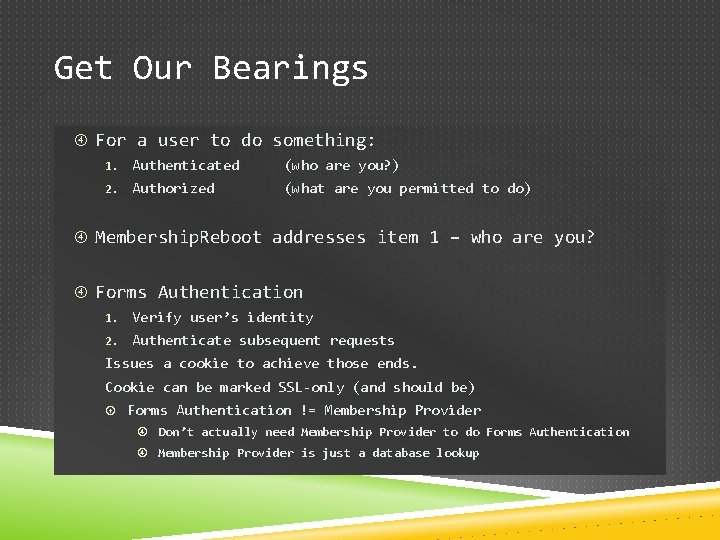
Get Our Bearings For a user to do something: 1. Authenticated (who are you? ) 2. Authorized (what are you permitted to do) Membership. Reboot addresses item 1 – who are you? Forms Authentication 1. Verify user’s identity 2. Authenticate subsequent requests Issues a cookie to achieve those ends. Cookie can be marked SSL-only (and should be) Forms Authentication != Membership Provider Don’t actually need Membership Provider to do Forms Authentication Membership Provider is just a database lookup
Membership Providers Membership providers – have shortfallings Ancient Built with a forum in mind – e. g. Get. Number. Of. Users. Online Leaky abstraction e. g. Un. Lock. User, but where’s the Lock. User Violates SRP – logic of membership should be decoupled from the logic which does the CRUD stuff. Does EVERYTHING. Note: with new Crypto class, can write own password management logic (hashing etc. ). Simple. Membership? Build on top of house of cards. ASP. NET Identity (a review by Brock) His response – extensions via Identity. Reboot Read Brock’s disdain for more details
Claims Definition: A claim is a statement that one subject makes about itself or another subject. The statement can be about a name, identity, key, group, privilege, or capability, for example. Claims are issued by a provider, and they are given one or more values and then packaged in security tokens that are issued by an issuer, commonly known as a security token service (STS). (taken from P&P Guide to Claims-Based Identity)
Advantages of Claims True key/value pairs. E. g. dave has the email dave@dave. com is more expressive than some true/false construct Abstracts away security implementation Common ground cobble together disparate systems Simply more information. Windows. Identity only has the Name property to identify it Claims. Identity has a whole Claims. Collection
Claims by Issuers If you try to determine what the different authentication mechanisms have in common, you can abstract the individual elements of identity and access control into two parts: 1. a single, general notion of claims, and 2. the concept of an issuer or an authority A powerful abstraction. Involve an explicit trust relationship with an issuer. Your application believes a claim about the current user only if it trusts the entity that issued the claim.
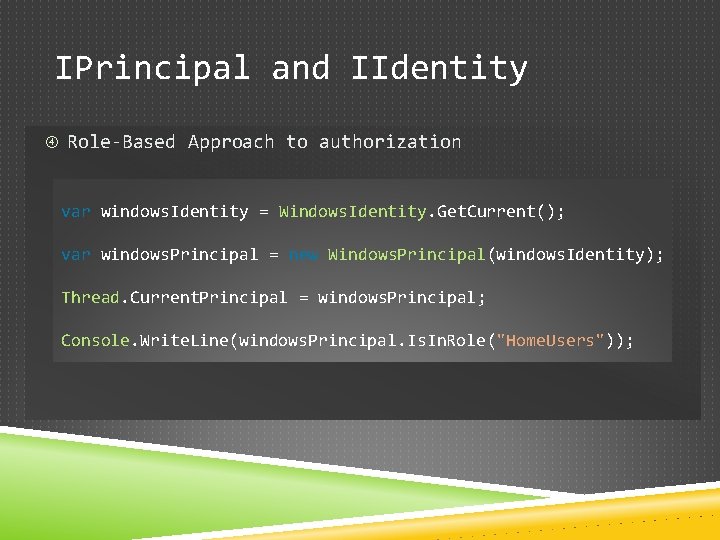
IPrincipal and IIdentity Role-Based Approach to authorization var windows. Identity = Windows. Identity. Get. Current(); var windows. Principal = new Windows. Principal(windows. Identity); Thread. Current. Principal = windows. Principal; Console. Write. Line(windows. Principal. Is. In. Role("Home. Users"));
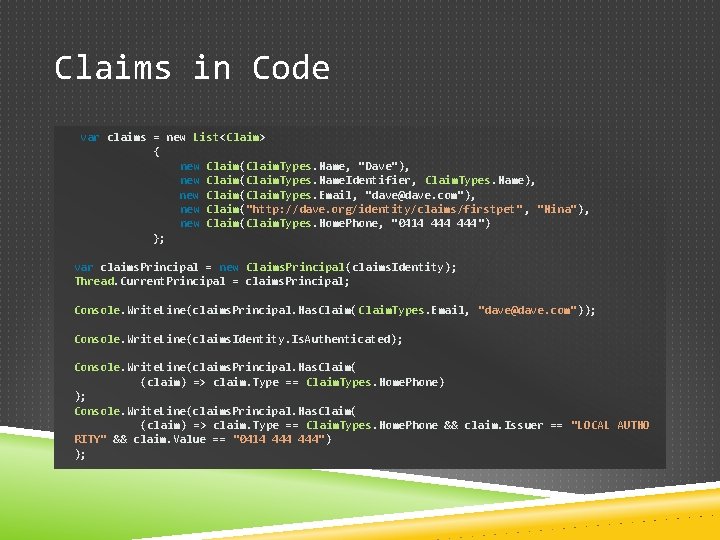
Claims in Code var claims = new List<Claim> { new Claim(Claim. Types. Name, "Dave"), new Claim(Claim. Types. Name. Identifier, Claim. Types. Name), new Claim(Claim. Types. Email, "dave@dave. com"), new Claim("http: //dave. org/identity/claims/firstpet" , "Nina"), new Claim(Claim. Types. Home. Phone, "0414 444") }; var claims. Principal = new Claims. Principal(claims. Identity); Thread. Current. Principal = claims. Principal; Console. Write. Line(claims. Principal. Has. Claim( Claim. Types. Email, "dave@dave. com")); Console. Write. Line(claims. Identity. Is. Authenticated); Console. Write. Line(claims. Principal. Has. Claim( (claim) => claim. Type == Claim. Types. Home. Phone) ); Console. Write. Line(claims. Principal. Has. Claim( (claim) => claim. Type == Claim. Types. Home. Phone && claim. Issuer == "LOCAL AUTHO RITY" && claim. Value == "0414 444") );
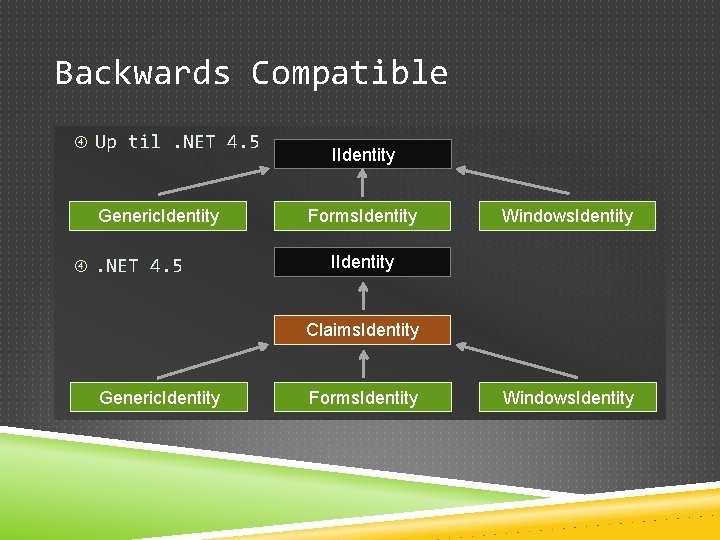
Backwards Compatible Up til. NET 4. 5 Generic. Identity . NET 4. 5 IIdentity Forms. Identity Windows. Identity IIdentity Claims. Identity Generic. Identity Forms. Identity Windows. Identity
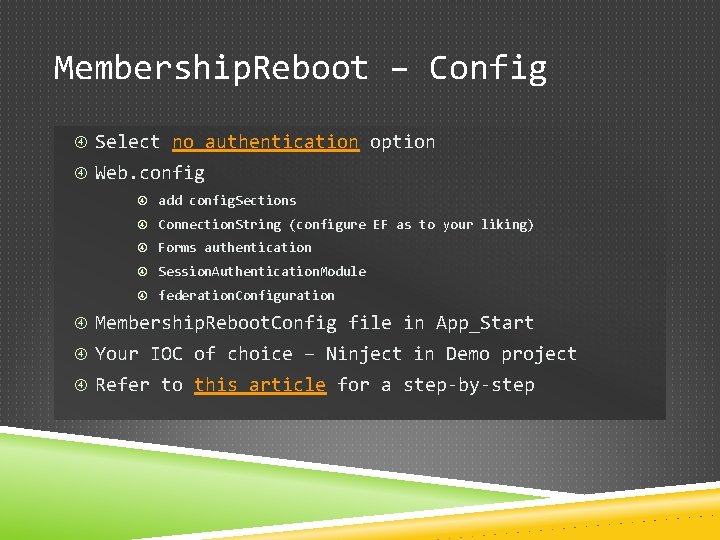
Membership. Reboot – Config Select no authentication option Web. config add config. Sections Connection. String (configure EF as to your liking) Forms authentication Session. Authentication. Module federation. Configuration Membership. Reboot. Config file in App_Start Your IOC of choice – Ninject in Demo project Refer to this article for a step-by-step
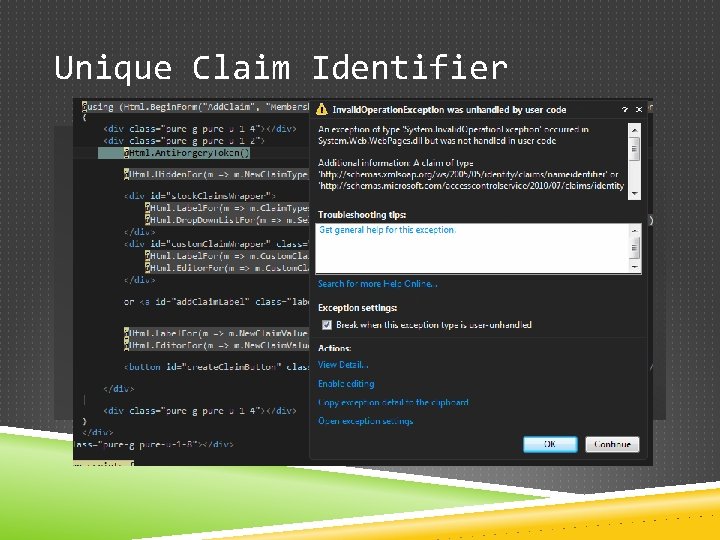
Unique Claim Identifier In Global. asax. cs in Application_Start: Anti. Forgery. Config. Unique. Claim. Type. Identifier = Claim. Types. Email; OR, you can add Name. Identifier and Identity. Provider Claim. Types to your claims: List<Claim> _claims = new List<Claim>(); _claims. Add. Range(new List<Claim> { new Claim(Claim. Types. Name. Identifier , _user. Email)), new Claim("http: //schemas. microsoft. com/accesscontrolservice/2010/07/claims/identityprovide r", _user. Email) });
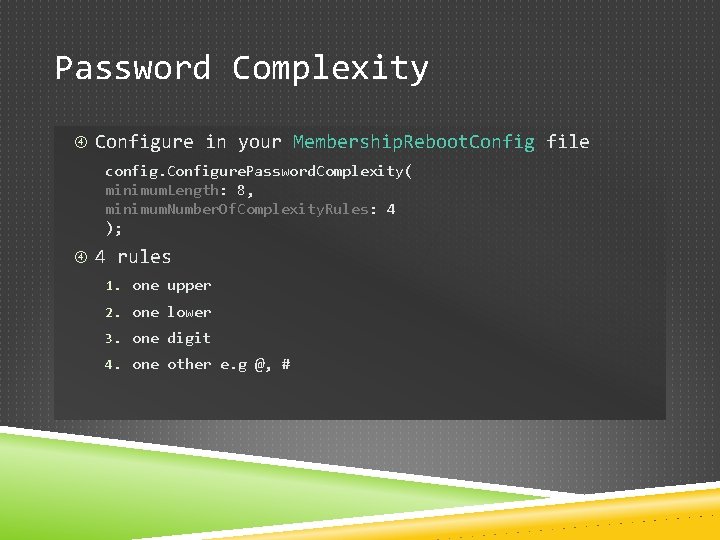
Password Complexity Configure in your Membership. Reboot. Config file config. Configure. Password. Complexity( minimum. Length: 8, minimum. Number. Of. Complexity. Rules: 4 ); 4 rules 1. one upper 2. one lower 3. one digit 4. one other e. g @, #
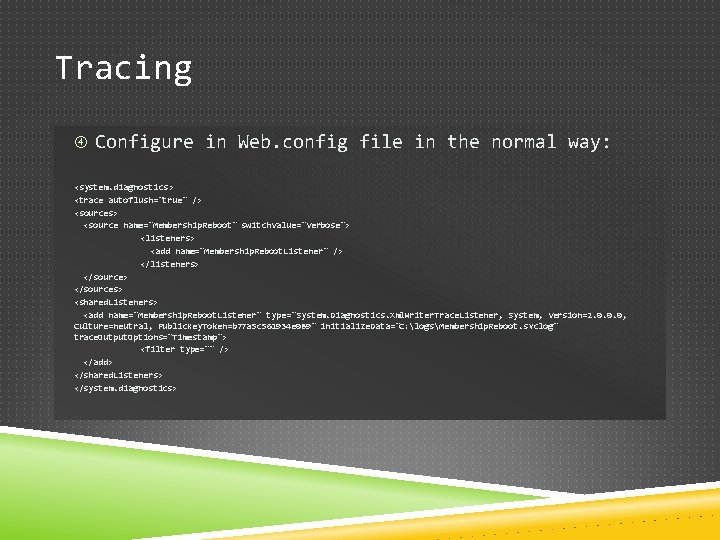
Tracing Configure in Web. config file in the normal way: <system. diagnostics > <trace autoflush="true" /> <sources> <source name="Membership. Reboot" switch. Value="Verbose"> <listeners> <add name="Membership. Reboot. Listener" /> </listeners> </sources> <shared. Listeners> <add name="Membership. Reboot. Listener" type="System. Diagnostics. Xml. Writer. Trace. Listener, System, Version=2. 0. 0. 0, Culture=neutral, Public. Key. Token=b 77 a 5 c 561934 e 089" initialize. Data="C: logsMembership. Reboot. svclog" trace. Output. Options="Timestamp"> <filter type="" /> </add> </shared. Listeners> </system. diagnostics>
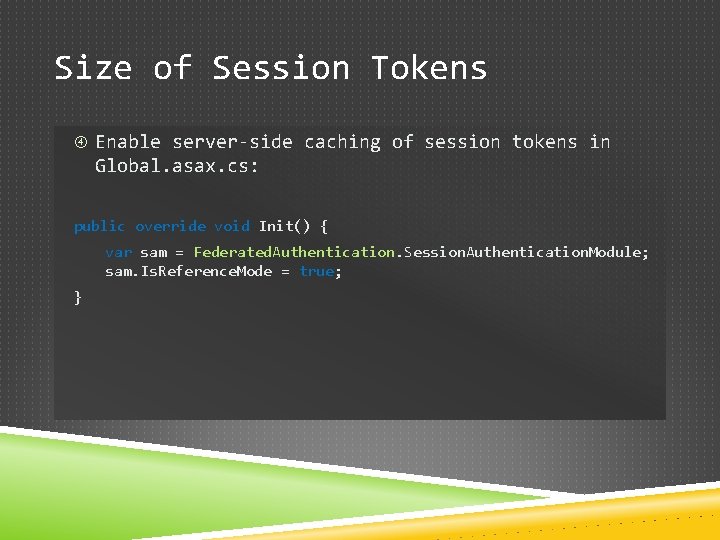
Size of Session Tokens Enable server-side caching of session tokens in Global. asax. cs: public override void Init() { var sam = Federated. Authentication. Session. Authentication. Module; sam. Is. Reference. Mode = true; }
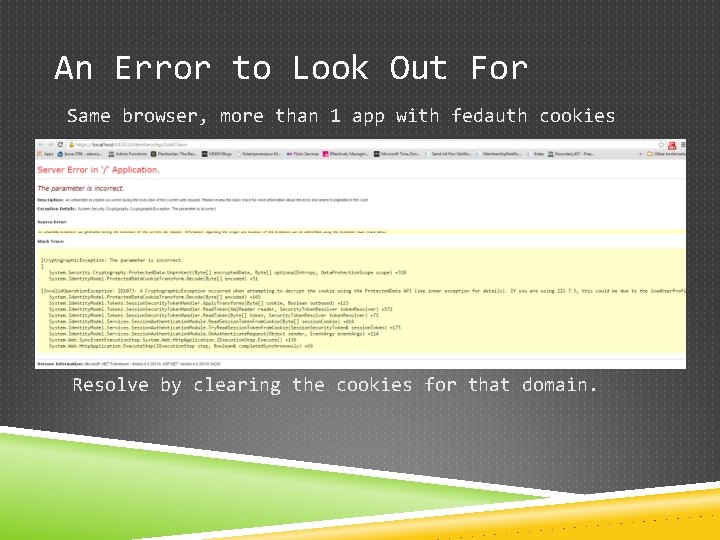
An Error to Look Out For Same browser, more than 1 app with fedauth cookies Resolve by clearing the cookies for that domain.
Brock Allen References http: //brockallen. com/2012/09/02/think-twice-about using-membershipprovider-and-simplemembership/ http: //brockallen. com/2012/06/04/membership-is-notthe-same-as-forms-authentication/ http: //brockallen. com/2014/02/09/how-membershipreboot -stores-passwords-properly/ http: //brockallen. com/2014/02/11/introducingidentityreboot/ http: //brockallen. com/2012/07/08/mvc-4 antiforgerytoken-and-claims/ http: //brockallen. com/2013/02/10/beware-settingproperties-or-registering-events-on-the-sam-and-fam/
General References http: //stackoverflow. com/a/14050719/540156 - Advantage of Claims over Roles http: //www. codeproject. com/Articles/639458/Claims- Based-Authentication-and-Authorization - step-bystep article https: //davidrogersdev@bitbucket. org/davidrogersde v/adnugdemo 1. git - uri for source code for demo
ASP. NET Identity References Dino Esposito series in MSDN Magazine: http: //msdn. microsoft. com/en-gb/magazine/dn 605872. aspx http: //msdn. microsoft. com/en-gb/magazine/dn 745860. aspx http: //msdn. microsoft. com/en-us/magazine/dn 818488. aspx Chapters from Adam Freeman book http: //www. apress. com/files/extra/ASP_NET_Identity_Chapters. pdf
Book References for Identity Patterns & Practices Book http: //msdn. microsoft. com/en-au/library/ff 423674. aspx
- Slides: 21