
CLAIMS AGAINST DESIGN PROFESSIONALS Economic Loss Doctrine Limitations
- Slides: 26
CLAIMS AGAINST DESIGN PROFESSIONALS Economic Loss Doctrine Limitations of Liability David K. Eckberg
The “economic loss doctrine” • ELD originally a creation of consumer product laws. Later it was applied in construction law cases. • The ELD marks the fundamental boundary between the law of contracts, which is designed to enforce expectations created by agreement, and the law of torts which is designed to protect citizens and their property by imposing a duty of reasonable care on others. • In the construction context, ELD bars a third party, such as a contractor or subcontractor, from suing the owner’s design professional in tort when the only damages sustained are “economic losses. ” • “Economic loss” was originally defined as a “diminution in the value of a particular product caused by the product itself or by the failure of the product to function as represented; in other words, to fail economic expectations. ” Wausau Paper Mills Co. v. Charles T. Main, Inc. , 789 F. Supp. 968, 971 (1992).
The “economic loss doctrine” • Damages for delay, remediation, repair and diminution in value are economic losses. East River Steamship Corp. v. Transamerica Delaval, Inc. , 476 U. S. 858, 870 (1986) (economic losses include lost profits, repair costs and decreased value). • Tort law traditionally redressed injuries properly classified as physical harm. • Berschauer/Phillips Contr. Co. v. Seattle School Dist. No. 1, 124 Wn. 2 d 816, 881 P. 2 d 986 (1994) held that tort claim by contractor vs. design professional is barred when damages claimed are purely economic. • Griffith v. Centex Real Estate Corp. , 93 Wn. App. 202, (1998) held that tort claims are not available to any party, including owners in contractual privity with the design professional, when the only loss sustained is economic in nature.
The “economic loss doctrine” • Exception to ELD: when the plaintiff has suffered economic damage caused by a “sudden and dangerous” event as described in Touchet Valley Grain Growers, Inc. v. Opp & Seibold Constr. , Inc. 119 Wn. 2 d 334 (1992) • The Touchet court held that in cases in which the harm arises out of a “sudden and dangerous” or “calamitous” event, a plaintiff will be allowed to seek damages in tort for damages otherwise defined as economic losses. • Touchet rationale: “sudden and dangerous” events are most likely to result in bodily injury and property damage, and that the availability of a tort remedy, even when the plaintiff has only suffered economic losses, provides an important incentive for defendants to exercise reasonable care whenever there is potential for this kind of damage.
Limitation of Liability Clauses Courts often examine LOL clauses in the context of “riskshifting” and therefore scrutinize them closely. Only applies to the contracting parties. Represents a negotiated level of risk based on a number of factors including design professional’s fees and upside potential of owner.
Limitation of Liability Clauses • More and more jurisdictions have been willing to hold LOL clauses enforceable, but given the opportunity to refuse enforceability, or limit the effect of the clause, many courts will follow that path. • No published cases in Washington – many Superior Court rulings upholding LOL. • Recent Condominium Law authorizes use of LOL clauses.
Case 1 Planned 35 -unit luxury condominium development in the heart of an old, established neighborhood in Seattle. First-time commercial developer. Under-financed and ill prepared for the inevitable complications that are inherent to such a project.
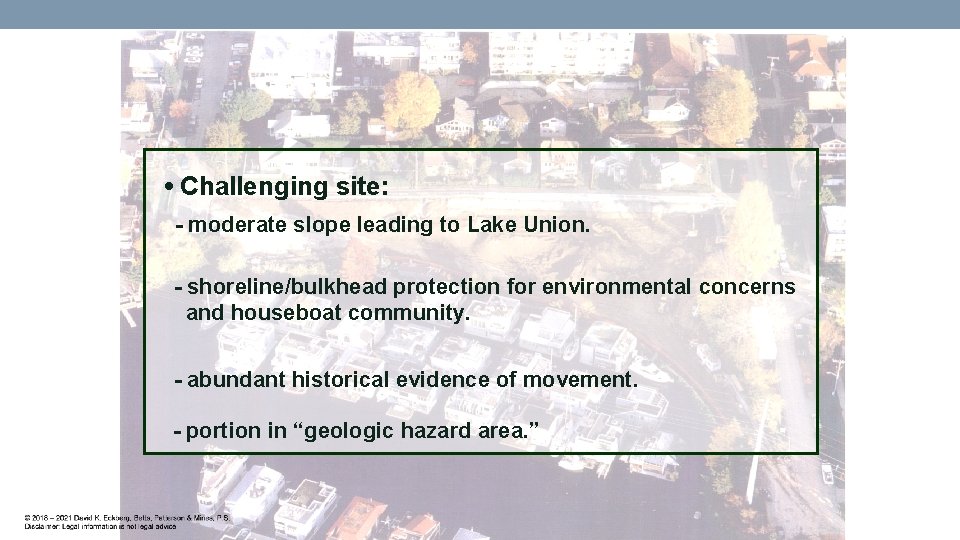
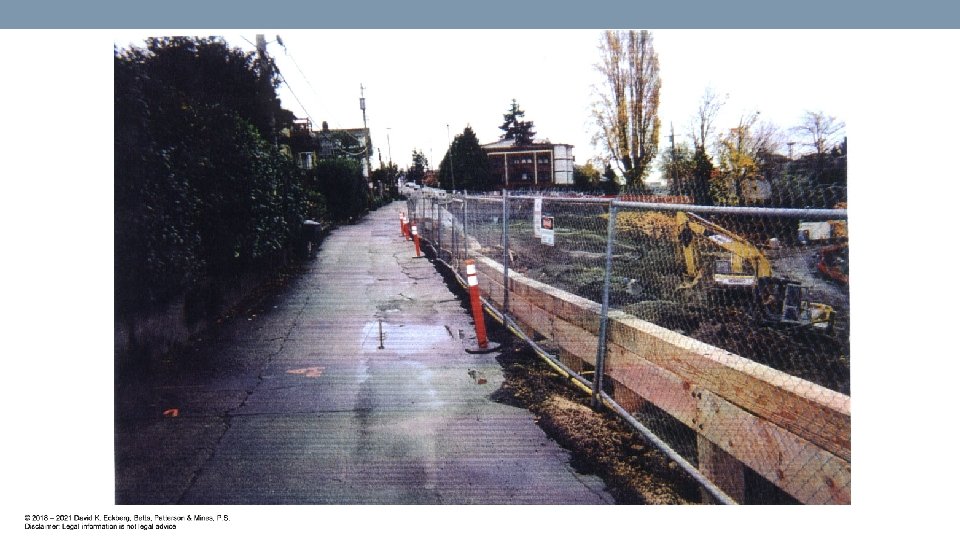
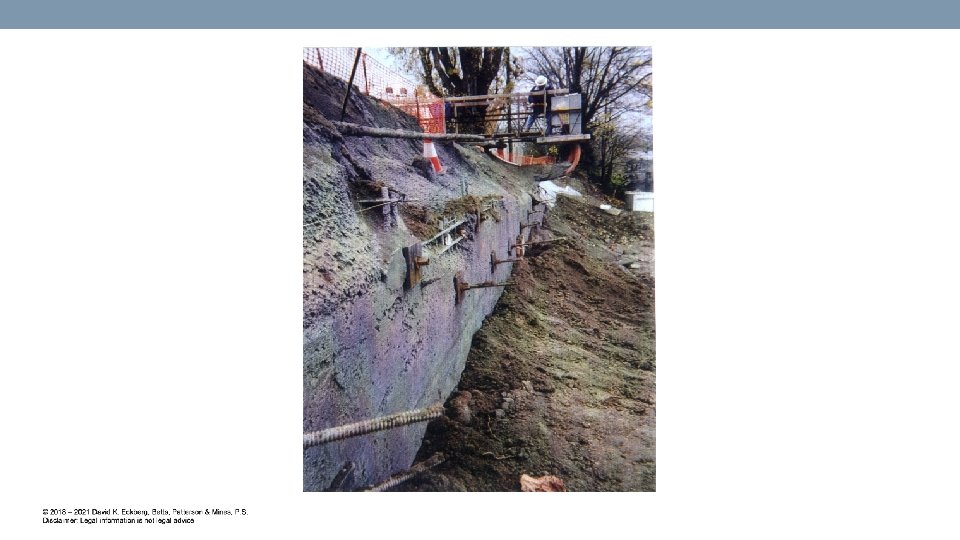
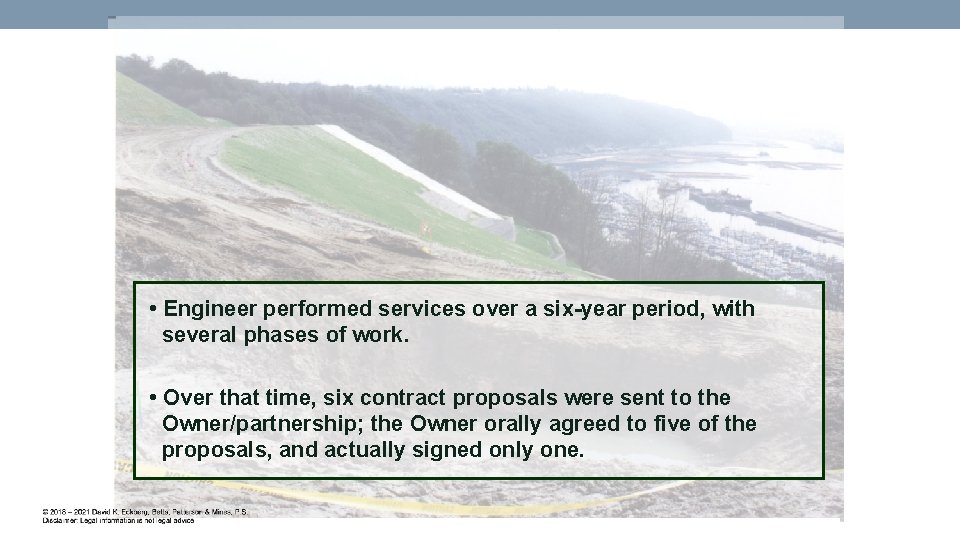
• Challenging site: - moderate slope leading to Lake Union. - shoreline/bulkhead protection for environmental concerns and houseboat community. - abundant historical evidence of movement. - portion in “geologic hazard area. ”
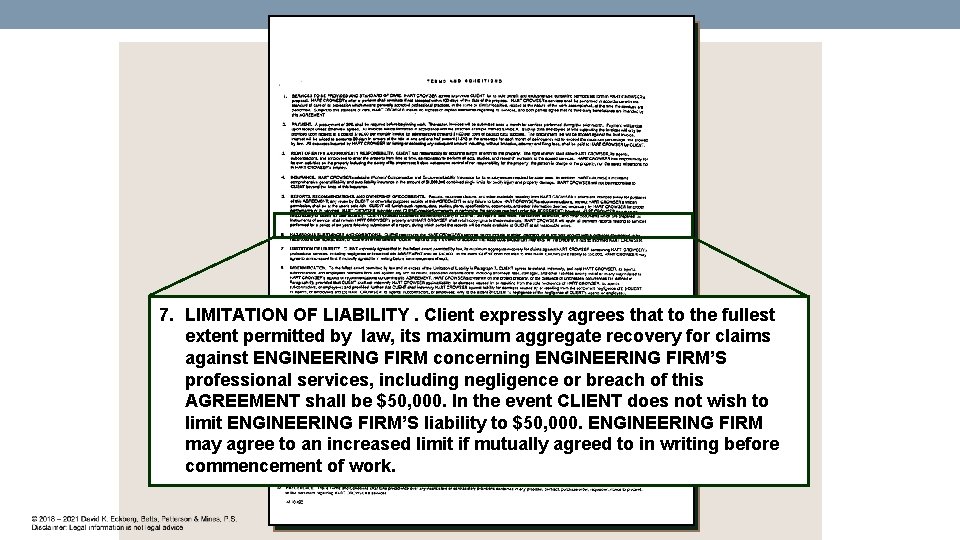
7. LIMITATION OF LIABILITY. Client expressly agrees that to the fullest extent permitted by law, its maximum aggregate recovery for claims against ENGINEERING FIRM concerning ENGINEERING FIRM’S professional services, including negligence or breach of this AGREEMENT shall be $50, 000. In the event CLIENT does not wish to limit ENGINEERING FIRM’S liability to $50, 000. ENGINEERING FIRM may agree to an increased limit if mutually agreed to in writing before commencement of work.
• Original contract, with attached terms and conditions, executed in 1990. • Over next eight years, five amendments for various scopes of service, including geotechnical investigation and remediation and construction observation. • Some amendments referred back to the original agreement, others did not; some were submitted with a copy of the terms and conditions, others were not.
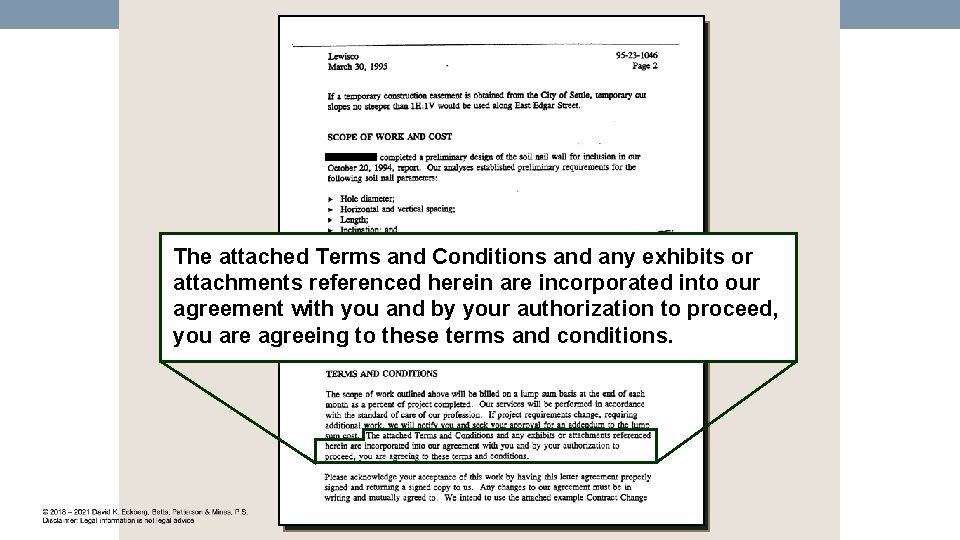
The attached Terms and Conditions and any exhibits or attachments referenced herein are incorporated into our agreement with you and by your authorization to proceed, you are agreeing to these terms and conditions.
• Owner brought negligence claims against both design firm and two individual project engineers. • Owners sought to have the LOL clause defeated with a variety of claims: - exculpatory clause - unsophisticated Owner “taken in” by engineer - clause does not apply to amendments - alternatively, each amendment has its own LOL, which stack upon each other - LOL clause does not apply to the individual project engineers
• Court enforced the LOL clause, BUT: - Ruled that four separate contracts existed, each with a separate LOL clause. - Ruled that no LOL clause applied to the individual project engineers - Rejected application of economic loss doctrine due to Touchet Valley exception.
Case 2 • Partnership sought to build a number of luxury view homes on a steep slope overlooking Puget Sound. • Engineer retained to perform soils studies and make recommendations on suitability of site. • Engineer reported that although no deep-seated slide zone could be detected, it was nonetheless a risky project due to an unstable surface mantle. • Another geotechnical engineering firm retained by uphill property owners validated Engineer’s findings.
• Engineer performed services over a six-year period, with several phases of work. • Over that time, six contract proposals were sent to the Owner/partnership; the Owner orally agreed to five of the proposals, and actually signed only one.
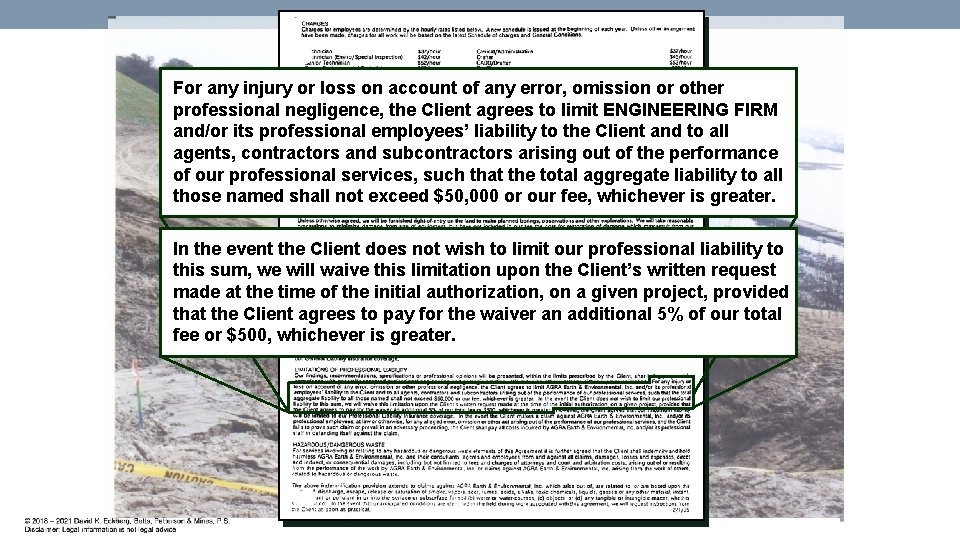
For any injury or loss on account of any error, omission or other professional negligence, the Client agrees to limit ENGINEERING FIRM and/or its professional employees’ liability to the Client and to all agents, contractors and subcontractors arising out of the performance of our professional services, such that the total aggregate liability to all those named shall not exceed $50, 000 or our fee, whichever is greater. In the event the Client does not wish to limit our professional liability to this sum, we will waive this limitation upon the Client’s written request made at the time of the initial authorization, on a given project, provided that the Client agrees to pay for the waiver an additional 5% of our total fee or $500, whichever is greater.
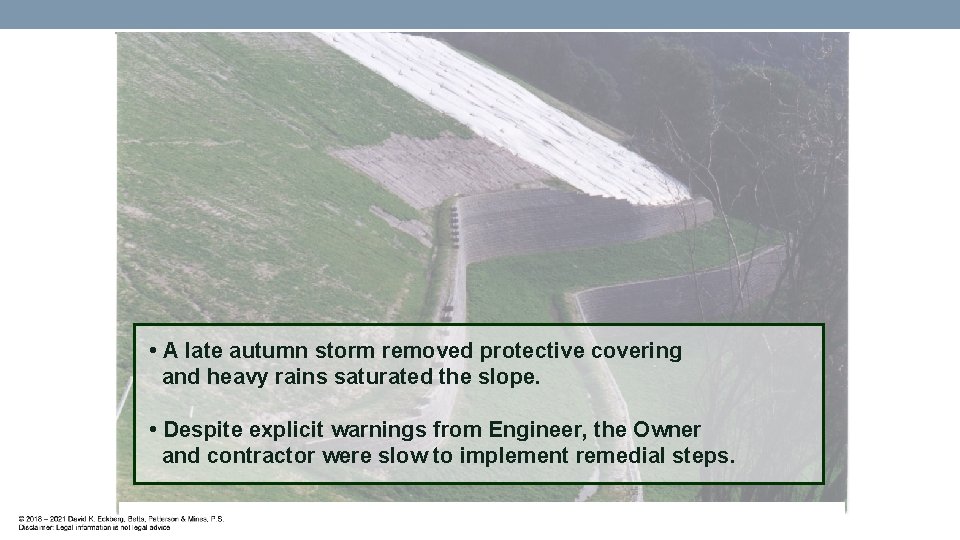
• A late autumn storm removed protective covering and heavy rains saturated the slope. • Despite explicit warnings from Engineer, the Owner and contractor were slow to implement remedial steps.
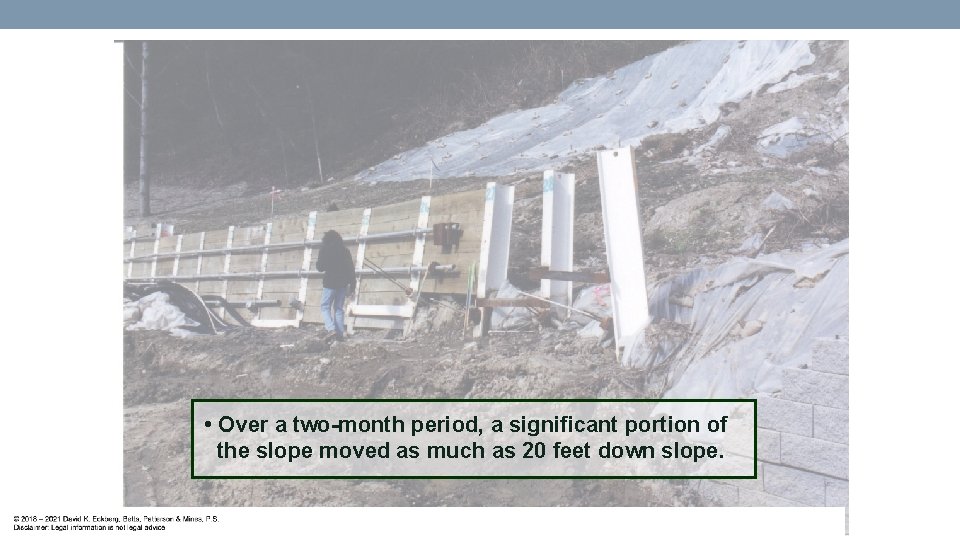
• Over a two-month period, a significant portion of the slope moved as much as 20 feet down slope.
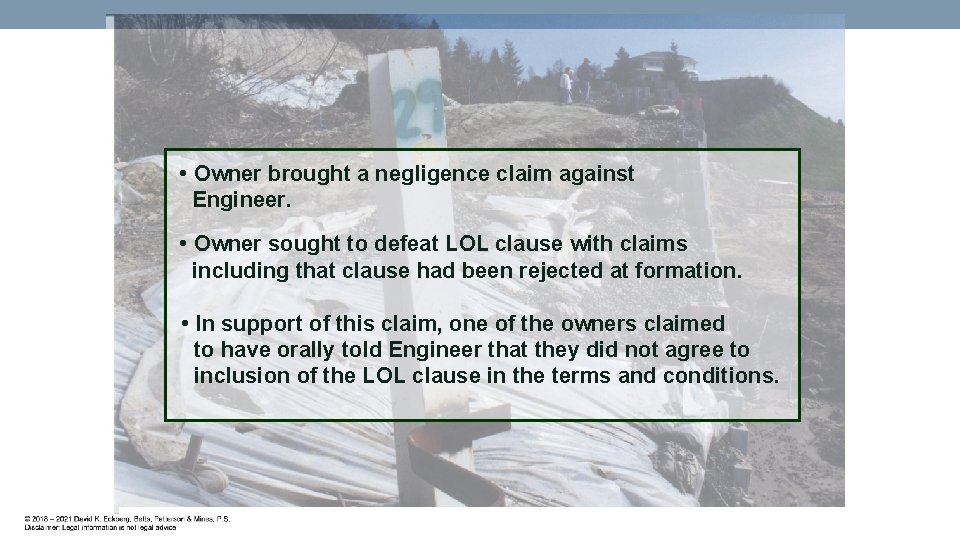
• Owner brought a negligence claim against Engineer. • Owner sought to defeat LOL clause with claims including that clause had been rejected at formation. • In support of this claim, one of the owners claimed to have orally told Engineer that they did not agree to inclusion of the LOL clause in the terms and conditions.
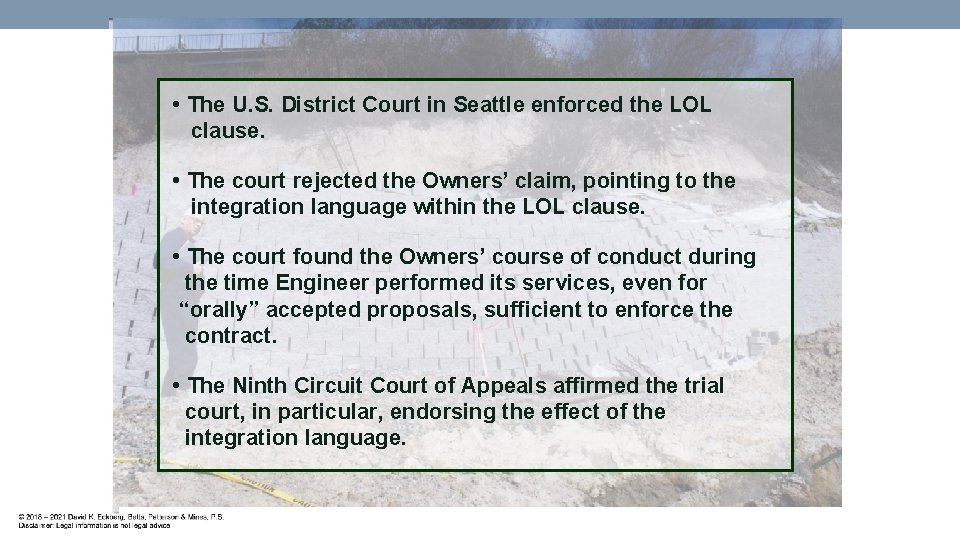
• The U. S. District Court in Seattle enforced the LOL clause. • The court rejected the Owners’ claim, pointing to the integration language within the LOL clause. • The court found the Owners’ course of conduct during the time Engineer performed its services, even for “orally” accepted proposals, sufficient to enforce the contract. • The Ninth Circuit Court of Appeals affirmed the trial court, in particular, endorsing the effect of the integration language.
Drafting Recommendations • Proposals for design professional services should be accepted in writing. Work should not commence unless a written acceptance has been obtained. • Make certain that the LOL clause, and indeed all key portions of the terms and conditions, are set out clearly and distinctly. • The terms and conditions should contain both a general integration clause and a specific integration clause within the body of the limitation of liability provision. The client should be allowed to increase the limitation of liability only by following a proscribed procedure in the contract.
Drafting Recommendations • Indemnity provisions should be separately stated from limitation of liability provisions to avoid the confusion about these very different legal concepts. • The LOL clause should expressly apply to claims against the firm and all employees of the firm.
Drafting Recommendations • The contract terms and conditions should expressly apply to subsequent work assignments on the same project unless a new contract is proposed and accepted for subsequent work. • The limitation of liability (remedies) clause should expressly apply to all types of claims that could be brought.
One Convention Place, 701 Pike Street, Suite 1400, Seattle, WA 98101