
Claim Counterclaim Assessment of your ability to build
Claim / Counterclaim Assessment of your ability to build and support an argument
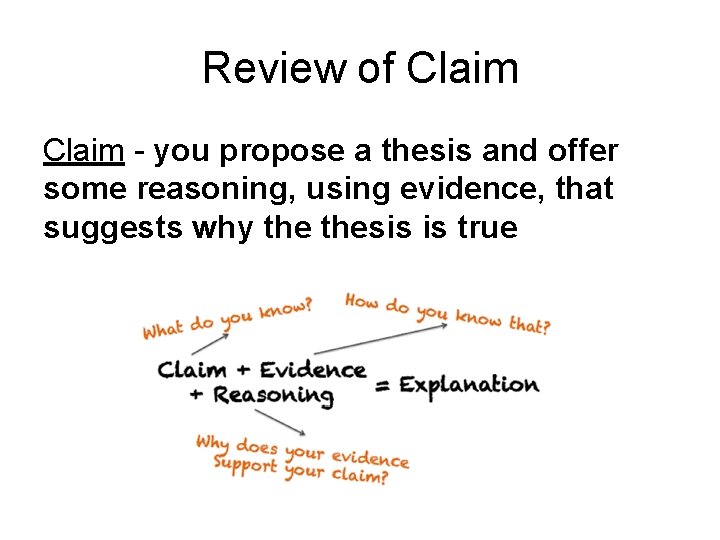
Review of Claim - you propose a thesis and offer some reasoning, using evidence, that suggests why thesis is true
Review Counterclaim Counter-claim - you consider a possible argument against your thesis or some aspect of your reasoning. WHY use a counter-claim? • It’s a good way to test your ideas • In an essay, it allows you to anticipate doubts and pre-empt objections that a skeptical reader might have • It presents you as the kind of person who weighs alternatives before arguing for one and one who confronts difficulties instead of sweeping them under the rug
Ways to use Counterclaim • You first imagine a skeptical reader who might resist your argument by pointing out a problem with your thesis…then you think about… – a different conclusion could be drawn from the same facts or an alternative explanation that makes more sense – one or more disadvantages or practical drawbacks to what you propose
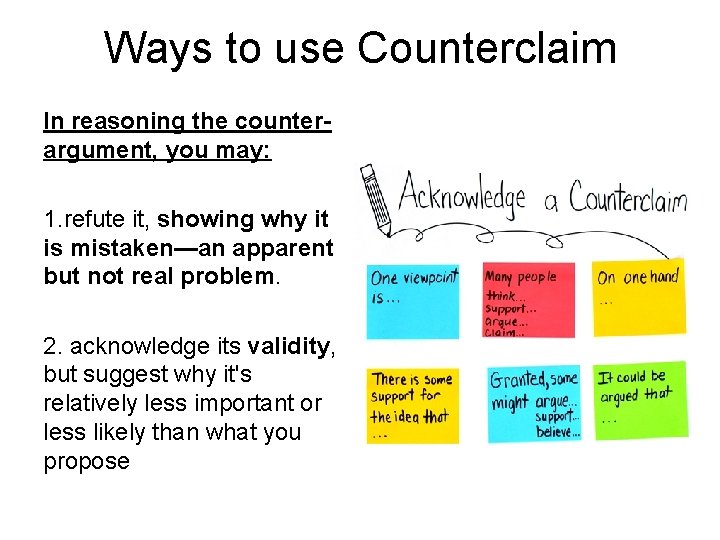
Ways to use Counterclaim In reasoning the counterargument, you may: 1. refute it, showing why it is mistaken—an apparent but not real problem. 2. acknowledge its validity, but suggest why it's relatively less important or less likely than what you propose
Ways to use Counterclaim You introduce the counter-claim with a phrase like: • • • One might object here that. . . It might seem that. . . It's true that. . . Admittedly, . . . Of course, . . . THEN… you state the case against yourself as briefly but as clearly and forcefully as you can, pointing to evidence where possible. (An obviously lame, underdeveloped, or neglected counter-argument does more harm than good. )
![More ways to intro counter-claims • Many people [believe/argue/feel/think/suppose/etc. ] that [state the counter-argument](http://slidetodoc.com/presentation_image_h2/04bcd59c9b02a2715e987dd41e03e178/image-7.jpg "More ways to intro counter-claims • Many people [believe/argue/feel/think/suppose/etc. ] that [state the counter-argument")
More ways to intro counter-claims • Many people [believe/argue/feel/think/suppose/etc. ] that [state the counter-argument here] • It is often [thought/imagined/supposed/etc. ] that [state the counter-argument here] • [It would be easy to/One could easily] [think/believe/imagine/suppose/etc. ] that [state the counter-argument here] • It might [seem/appear/look/etc. ] as if [state the counterargument here] • On the other hand, Manson argues that. . . • However, Manson has written, . . . • Manson takes the position that. . .
Where to Put a Counter-claim • A paragraph just after your introduction where you lay out the expected reaction before turning away to develop your own • Warning: don't overdo it. A counterclaim here and there will sharpen and energize your essay, but many will have the reverse effect by obscuring your main idea or suggesting that you're ambivalent. VIDEO: “Both Sides of the Story” – Shmoop: https: //www. youtube. com/ watch? v=5 d. KAIUyt. I 1 s
Getting back to your Assertion • Your return to your own argument—which you announce with a: but, yet, however, nevertheless or still — must still involve careful reasoning
Getting back to your assertion (cont). • How should the rebuttal be introduced? • What this argument [overlooks/fails to consider/does not take into account] is. . . • This view [seems/looks/sounds/etc. ] [convincing/plausible/persuasive/etc. ] at first, but. . . • While this position is popular, it is [not supported by the facts/not logical/impractical/etc. ]
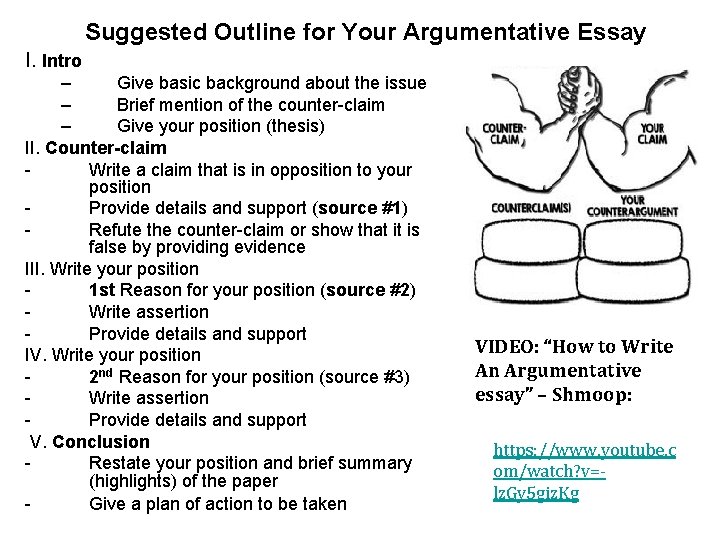
Suggested Outline for Your Argumentative Essay I. Intro – Give basic background about the issue – Brief mention of the counter-claim – Give your position (thesis) II. Counter-claim Write a claim that is in opposition to your position Provide details and support (source #1) Refute the counter-claim or show that it is false by providing evidence III. Write your position 1 st Reason for your position (source #2) Write assertion Provide details and support IV. Write your position 2 nd Reason for your position (source #3) Write assertion Provide details and support V. Conclusion Restate your position and brief summary (highlights) of the paper Give a plan of action to be taken VIDEO: “How to Write An Argumentative essay” – Shmoop: https: //www. youtube. c om/watch? v=lz. Gy 5 giz. Kg
- Slides: 11