
CJML Customer journey modelling language Introduction and overview



- Slides: 39
CJML - Customer journey modelling language Introduction and overview SINTEF Digital | Software and service innovation June 2020
Customer Journey Modelling Language Customer journey User journey Employee journey Citizen journey Patient journey A visual language dedicated to modelling of human behaviour and digital service processes
Content • Readers guide § Who can use this material? § Where do I find examples and tools? • Introducing CJML § Key facts § Target group and development process § User experience • Theoretical foundation and modelling approach § Planned and actual journeys § Journey types and examples § Touchpoint typology and delineation of steps • Diagram types 3
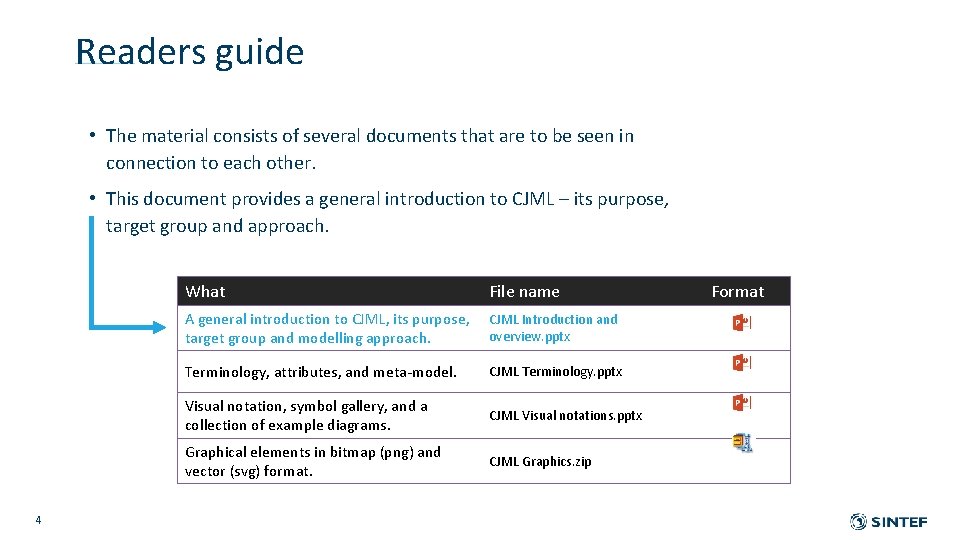
Readers guide • The material consists of several documents that are to be seen in connection to each other. • This document provides a general introduction to CJML – its purpose, target group and approach. What File name A general introduction to CJML, its purpose, CJML Introduction and overview. pptx target group and modelling approach. 4 Terminology, attributes, and meta-model. CJML Terminology. pptx Visual notation, symbol gallery, and a collection of example diagrams. CJML Visual notations. pptx Graphical elements in bitmap (png) and vector (svg) format. CJML Graphics. zip Format
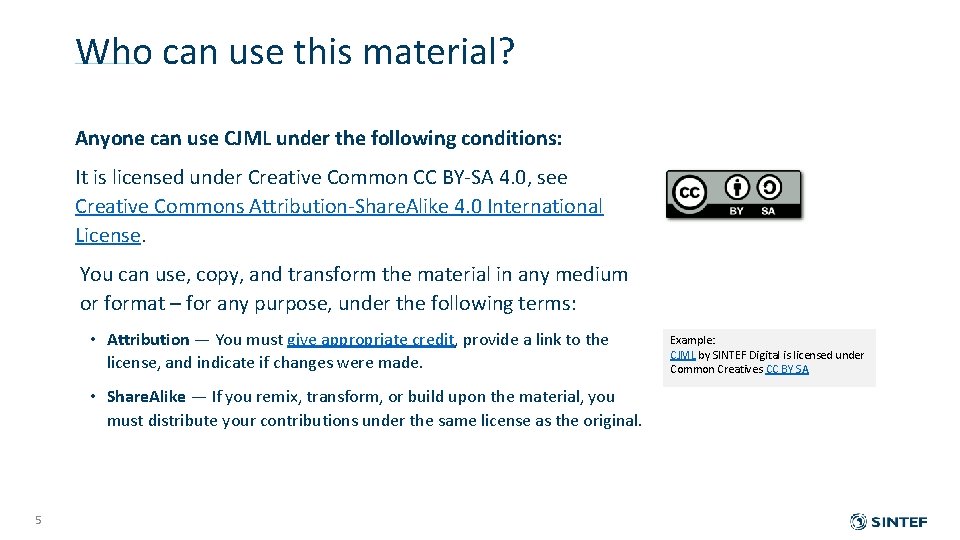
Who can use this material? Anyone can use CJML under the following conditions: It is licensed under Creative Common CC BY-SA 4. 0, see Creative Commons Attribution-Share. Alike 4. 0 International License. You can use, copy, and transform the material in any medium or format – for any purpose, under the following terms: • Attribution — You must give appropriate credit, provide a link to the license, and indicate if changes were made. • Share. Alike — If you remix, transform, or build upon the material, you must distribute your contributions under the same license as the original. 5 Example: CJML by SINTEF Digital is licensed under Common Creatives CC BY SA
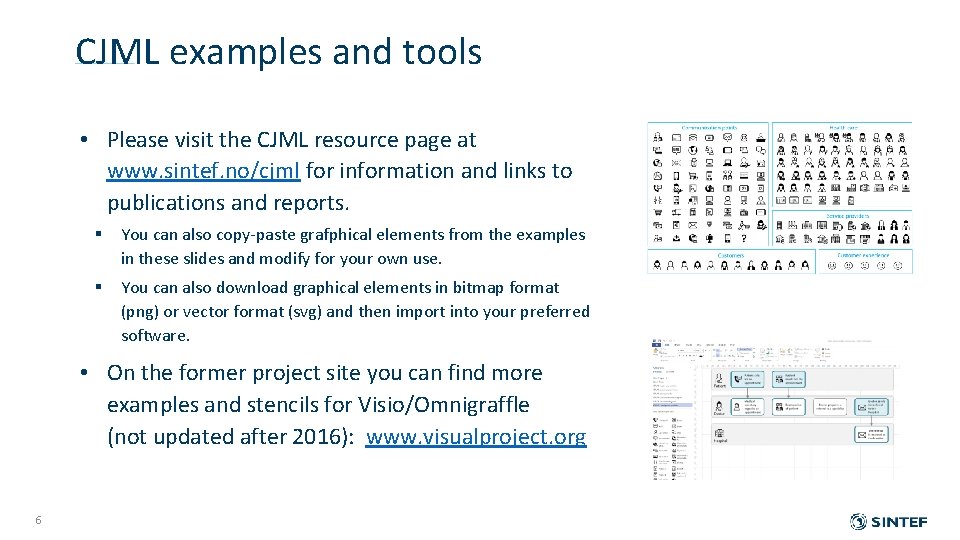
CJML examples and tools • Please visit the CJML resource page at www. sintef. no/cjml for information and links to publications and reports. § You can also copy-paste grafphical elements from the examples in these slides and modify for your own use. § You can also download graphical elements in bitmap format (png) or vector format (svg) and then import into your preferred software. • On the former project site you can find more examples and stencils for Visio/Omnigraffle (not updated after 2016): www. visualproject. org 6
INTRODUCING CJML Key facts Target group and development process User experience
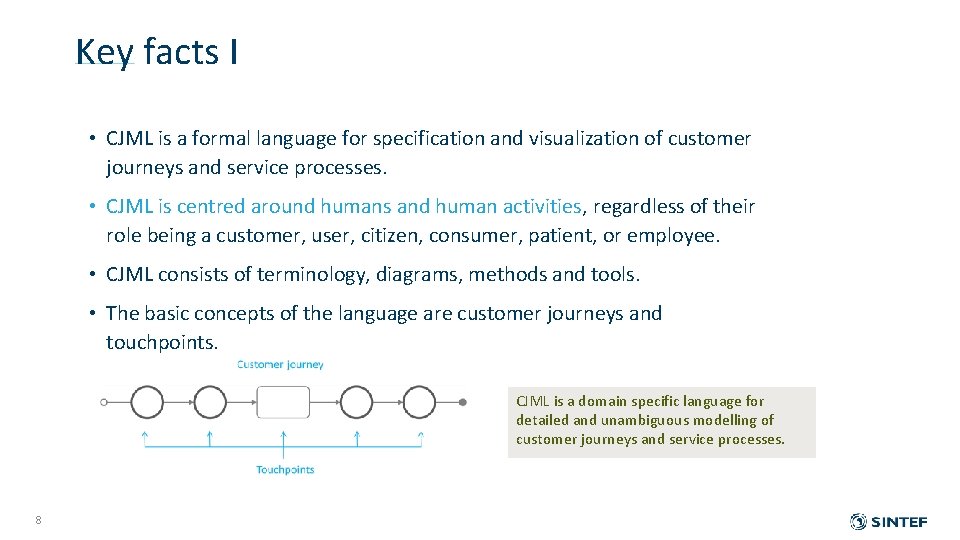
Key facts I • CJML is a formal language for specification and visualization of customer journeys and service processes. • CJML is centred around humans and human activities, regardless of their role being a customer, user, citizen, consumer, patient, or employee. • CJML consists of terminology, diagrams, methods and tools. • The basic concepts of the language are customer journeys and touchpoints. CJML is a domain specific language for detailed and unambiguous modelling of customer journeys and service processes. 8
Key facts II • CJML differs from other diagrammatic languages in two principal ways: § It models the service process from the customer's point of view § It aims at being intuitive for all users, and does not require a technical background • CJML targets service processes that are technology driven, standardized, and repeated in high volumes. • CJML is well suited for service processes that extends over time and mediated by different communication channels. • CJML should appeal to people working with service delivery, service design or service innovation, independent of their role and background. 9
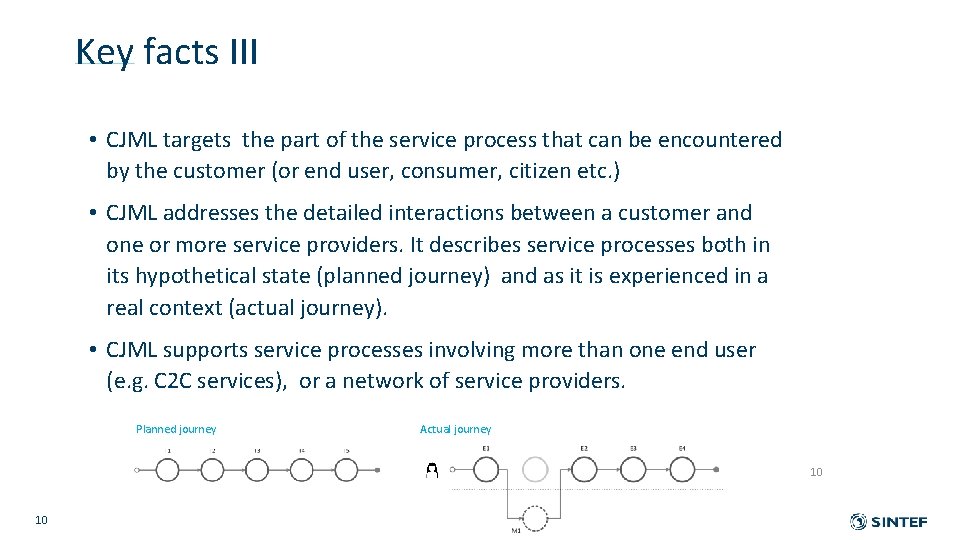
Key facts III • CJML targets the part of the service process that can be encountered by the customer (or end user, consumer, citizen etc. ) • CJML addresses the detailed interactions between a customer and one or more service providers. It describes service processes both in its hypothetical state (planned journey) and as it is experienced in a real context (actual journey). • CJML supports service processes involving more than one end user (e. g. C 2 C services), or a network of service providers. Planned journey Actual journey 10 10
Target group • The core of CJML targets a wide user group, in principle "everyone" in a service providing organization • The more advanced features targets service owners, business developers, analysts, and technologists. • CJML is particularly targeting service processes that are: § Technology-driven, standardized, and repeated in high volumes § Service processes extending over time, being mediated by different communication channels • CJML is less appropriate for modelling in-session sequences of interaction with a system.
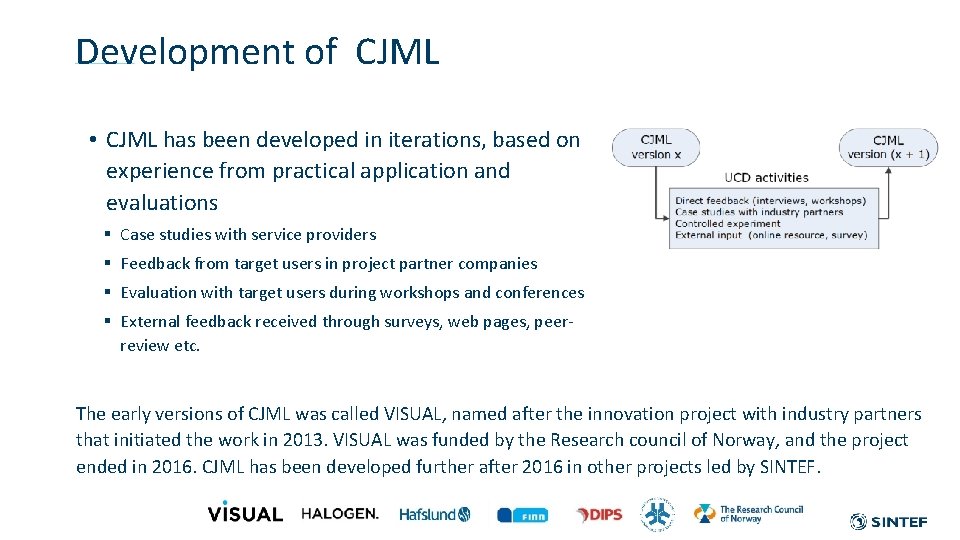
Development of CJML • CJML has been developed in iterations, based on experience from practical application and evaluations § Case studies with service providers § Feedback from target users in project partner companies § Evaluation with target users during workshops and conferences § External feedback received through surveys, web pages, peerreview etc. The early versions of CJML was called VISUAL, named after the innovation project with industry partners that initiated the work in 2013. VISUAL was funded by the Research council of Norway, and the project ended in 2016. CJML has been developed further after 2016 in other projects led by SINTEF.
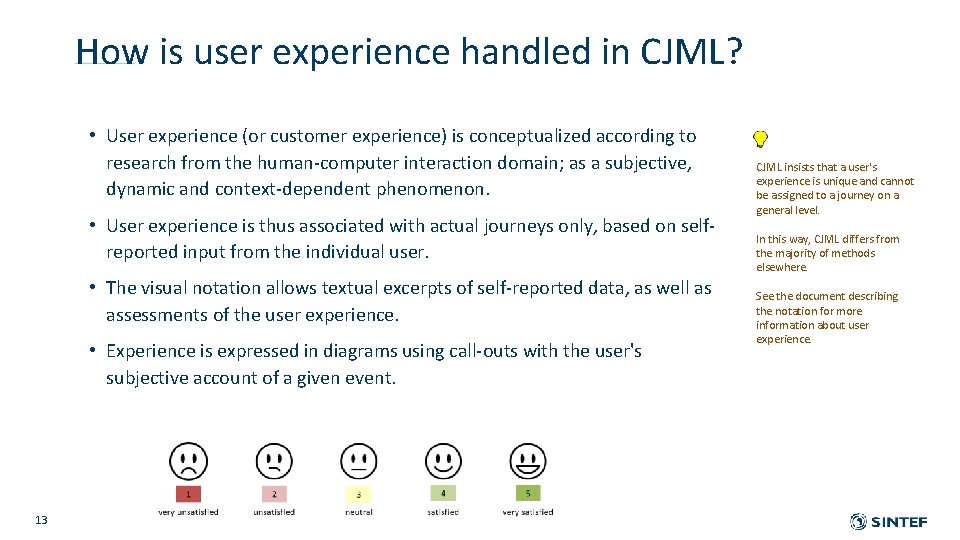
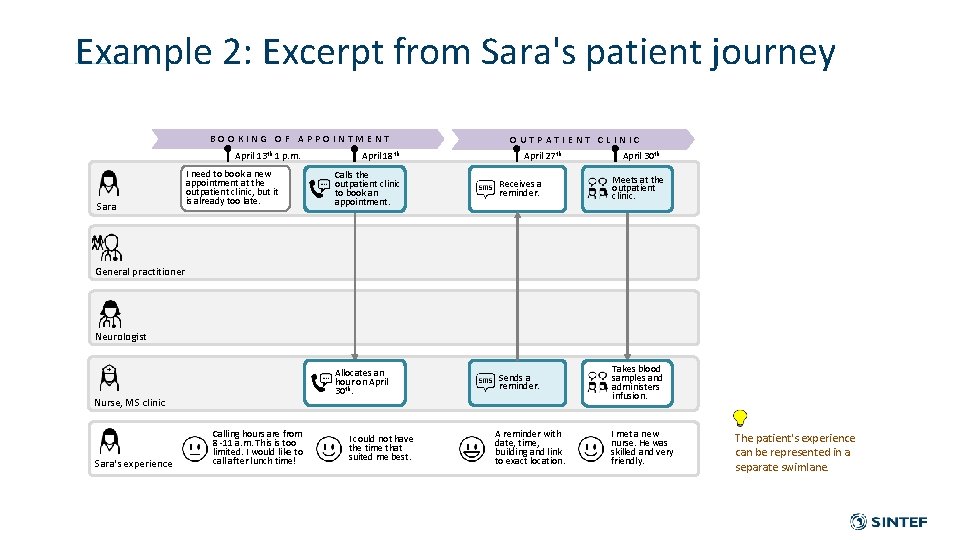
How is user experience handled in CJML? • User experience (or customer experience) is conceptualized according to research from the human-computer interaction domain; as a subjective, dynamic and context-dependent phenomenon. • User experience is thus associated with actual journeys only, based on selfreported input from the individual user. • The visual notation allows textual excerpts of self-reported data, as well as assessments of the user experience. • Experience is expressed in diagrams using call-outs with the user's subjective account of a given event. 13 CJML insists that a user's experience is unique and cannot be assigned to a journey on a general level. In this way, CJML differs from the majority of methods elsewhere. See the document describing the notation for more information about user experience.
THEORETICAL FOUNDATION AND MODELLING APPROACH Planned and actual journeys Types of touchpoints and visual representation Definitions and examples Touchpoint typology and delineation of steps
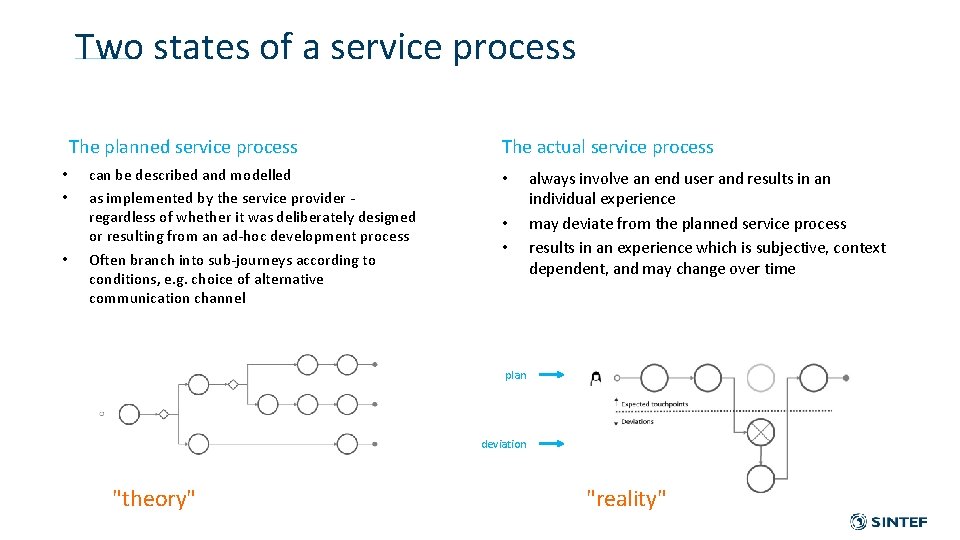
Two states of a service process The planned service process • • • can be described and modelled as implemented by the service provider - regardless of whether it was deliberately designed or resulting from an ad-hoc development process Often branch into sub-journeys according to conditions, e. g. choice of alternative communication channel The actual service process • • • always involve an end user and results in an individual experience may deviate from the planned service process results in an experience which is subjective, context dependent, and may change over time plan deviation "theory" "reality"
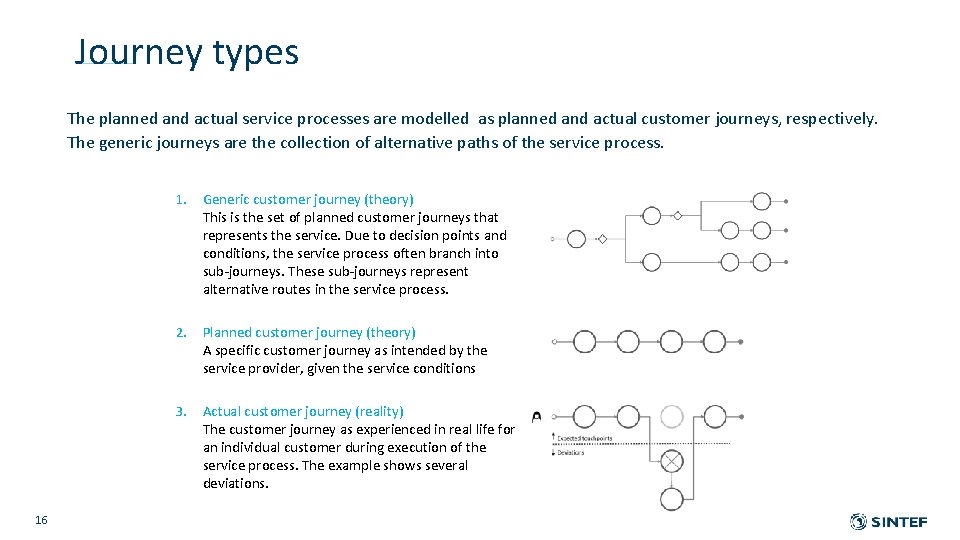
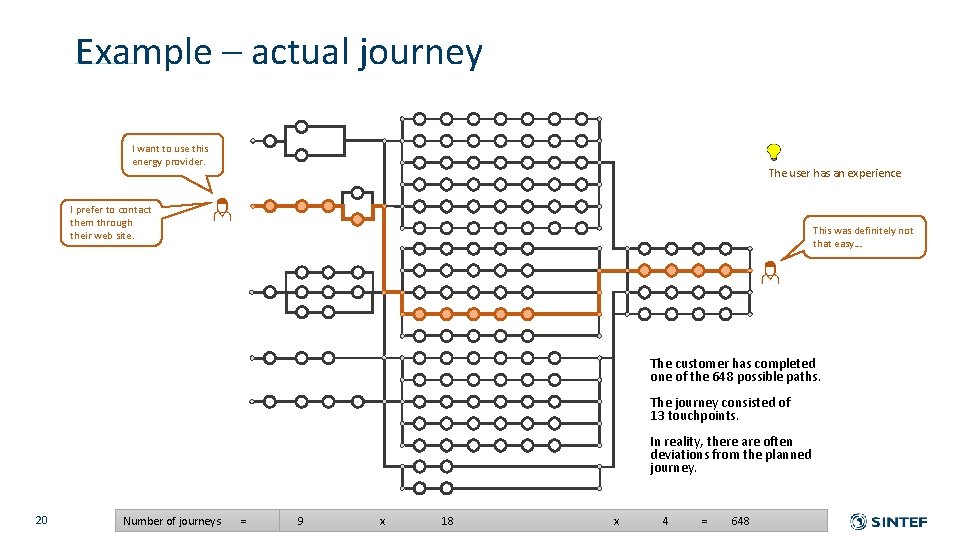
Journey types The planned and actual service processes are modelled as planned and actual customer journeys, respectively. The generic journeys are the collection of alternative paths of the service process. 1. Generic customer journey (theory) This is the set of planned customer journeys that represents the service. Due to decision points and conditions, the service process often branch into sub-journeys. These sub-journeys represent alternative routes in the service process. 2. Planned customer journey (theory) A specific customer journey as intended by the service provider, given the service conditions 3. Actual customer journey (reality) The customer journey as experienced in real life for an individual customer during execution of the service process. The example shows several deviations. 16
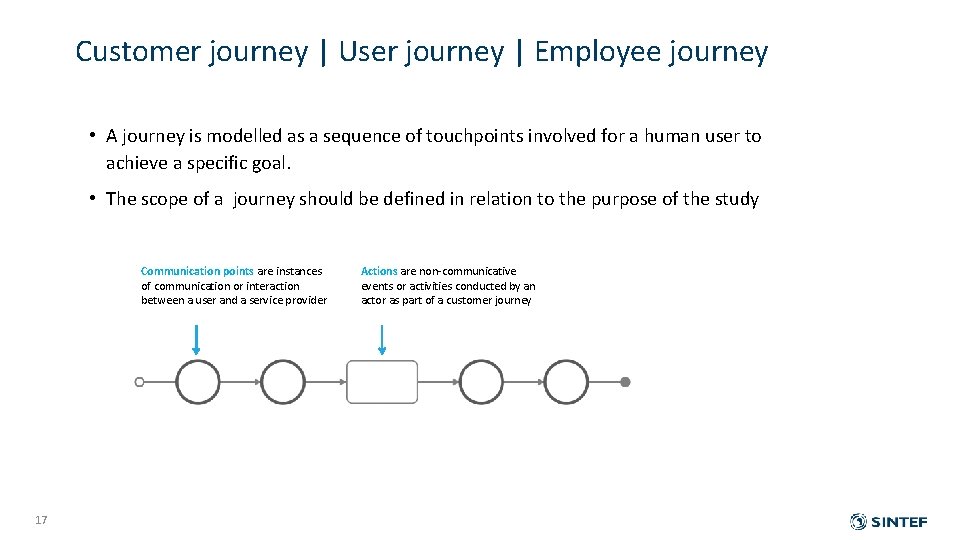
Customer journey | User journey | Employee journey • A journey is modelled as a sequence of touchpoints involved for a human user to achieve a specific goal. • The scope of a journey should be defined in relation to the purpose of the study Communication points are instances of communication or interaction between a user and a service provider 17 Actions are non-communicative events or activities conducted by an actor as part of a customer journey
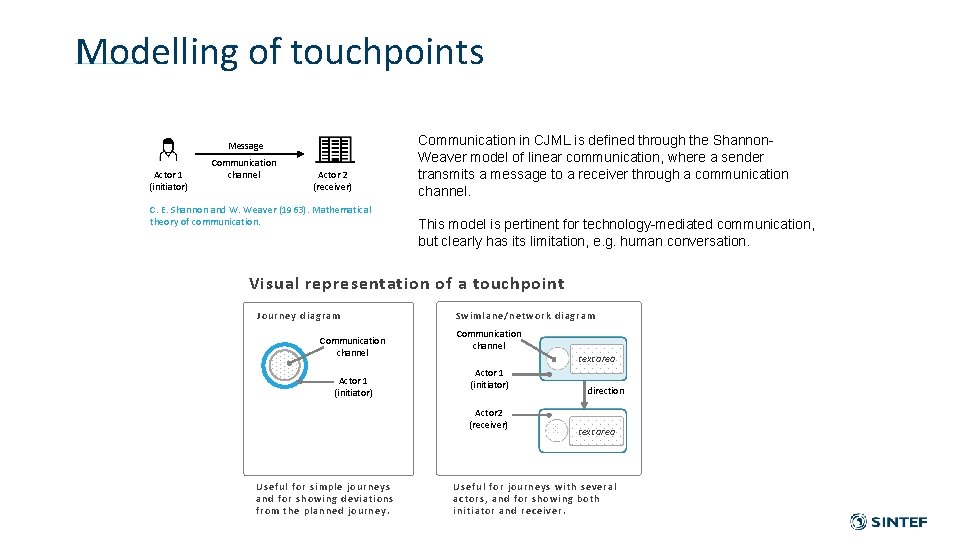
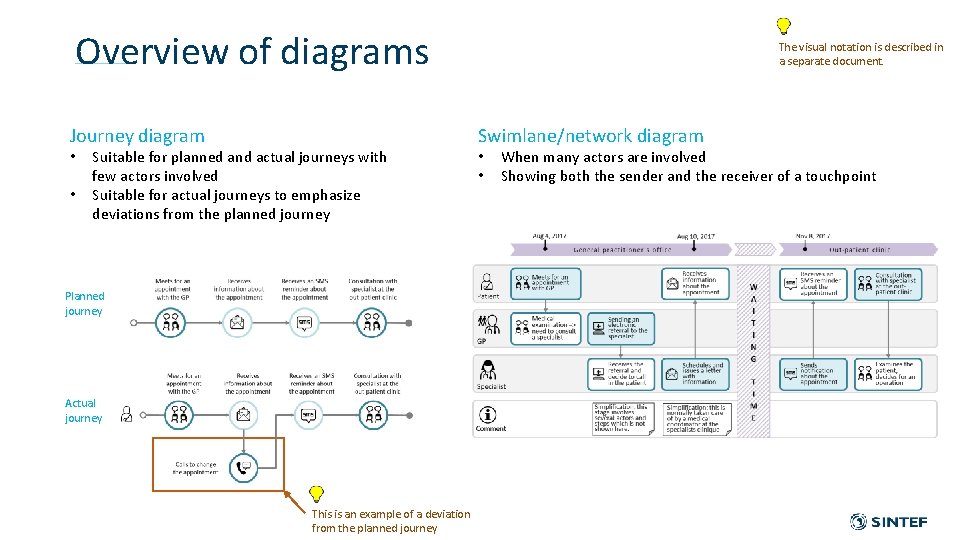
Modelling of touchpoints Message Actor 1 (initiator) Communication channel Actor 2 (receiver) C. E. Shannon and W. Weaver (1963). Mathematical theory of communication. Communication in CJML is defined through the Shannon. Weaver model of linear communication, where a sender transmits a message to a receiver through a communication channel. This model is pertinent for technology-mediated communication, but clearly has its limitation, e. g. human conversation. Visual representation of a touchpoint Journe y di agram Communication channel Actor 1 (initiator) Swimlane/networ k diagra m Communication channel text area Actor 1 (initiator) Actor 2 (receiver) Use ful for si mple journe ys and for showing devi at ions from the planned journe y. direction text area Useful for journeys with sever al actors, and for showing both init iator and r ece iver.
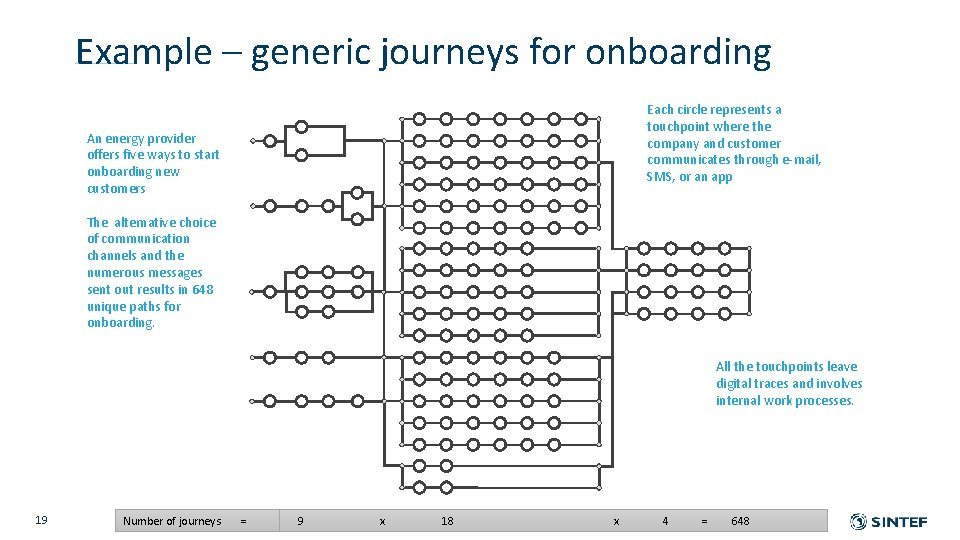
Example – generic journeys for onboarding An energy provider offers five ways to start onboarding new customers Each circle represents a touchpoint where the company and customer communicates through e-mail, SMS, or an app The alternative choice of communication channels and the numerous messages sent out results in 648 unique paths for onboarding. All the touchpoints leave digital traces and involves internal work processes. 19 Number of journeys = 9 x 18 x 4 = 648
Example – actual journey I want to use this energy provider. The user has an experience I prefer to contact them through their web site. This was definitely not that easy… The customer has completed one of the 648 possible paths. The journey consisted of 13 touchpoints. In reality, there are often deviations from the planned journey. 20 Number of journeys = 9 x 18 x 4 = 648
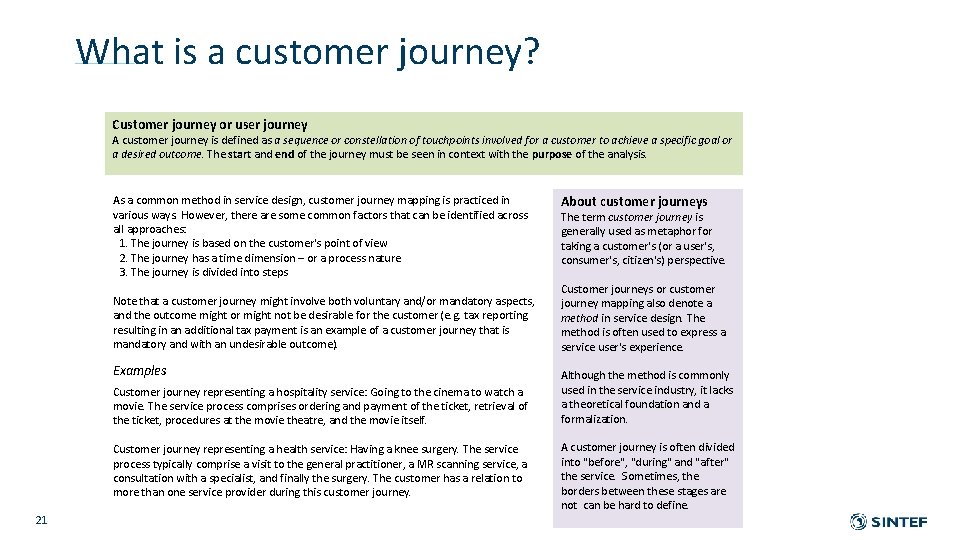
What is a customer journey? Customer journey or user journey A customer journey is defined as a sequence or constellation of touchpoints involved for a customer to achieve a specific goal or a desired outcome. The start and end of the journey must be seen in context with the purpose of the analysis. As a common method in service design, customer journey mapping is practiced in various ways. However, there are some common factors that can be identified across all approaches: 1. The journey is based on the customer's point of view 2. The journey has a time dimension – or a process nature 3. The journey is divided into steps Note that a customer journey might involve both voluntary and/or mandatory aspects, and the outcome might or might not be desirable for the customer (e. g. tax reporting resulting in an additional tax payment is an example of a customer journey that is mandatory and with an undesirable outcome). Examples Customer journey representing a hospitality service: Going to the cinema to watch a movie. The service process comprises ordering and payment of the ticket, retrieval of the ticket, procedures at the movie theatre, and the movie itself. Customer journey representing a health service: Having a knee surgery. The service process typically comprise a visit to the general practitioner, a MR scanning service, a consultation with a specialist, and finally the surgery. The customer has a relation to more than one service provider during this customer journey. 21 About customer journeys The term customer journey is generally used as metaphor for taking a customer's (or a user's, consumer's, citizen's) perspective. Customer journeys or customer journey mapping also denote a method in service design. The method is often used to express a service user's experience. Although the method is commonly used in the service industry, it lacks a theoretical foundation and a formalization. A customer journey is often divided into "before", "during" and "after" the service. Sometimes, the borders between these stages are not can be hard to define.
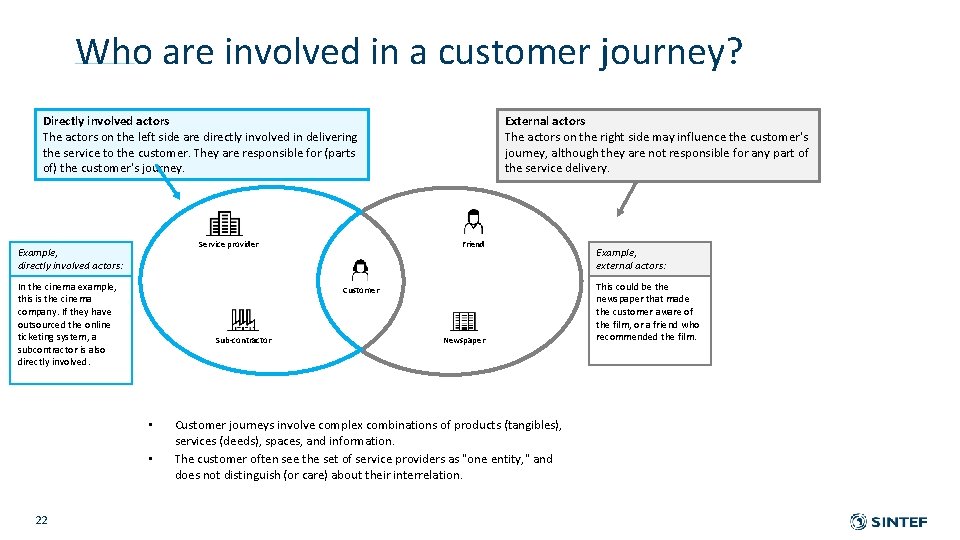
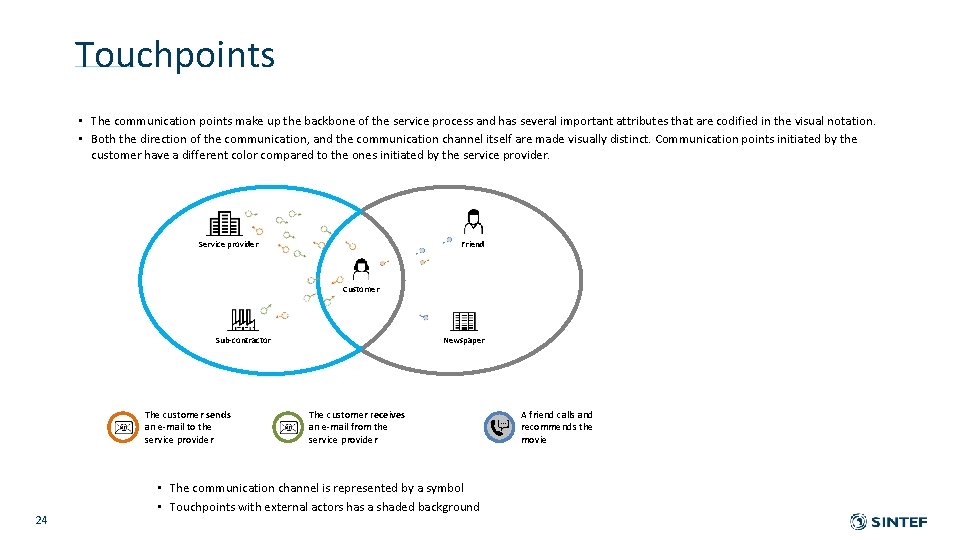
Who are involved in a customer journey? External actors The actors on the right side may influence the customer's journey, although they are not responsible for any part of the service delivery. Directly involved actors The actors on the left side are directly involved in delivering the service to the customer. They are responsible for (parts of) the customer's journey. In the cinema example, this is the cinema company. If they have outsourced the online ticketing system, a subcontractor is also directly involved. Customer Sub-contractor • • 22 Friend Service provider Example, directly involved actors: Newspaper Customer journeys involve complex combinations of products (tangibles), services (deeds), spaces, and information. The customer often see the set of service providers as "one entity, " and does not distinguish (or care) about their interrelation. Example, external actors: This could be the newspaper that made the customer aware of the film, or a friend who recommended the film.
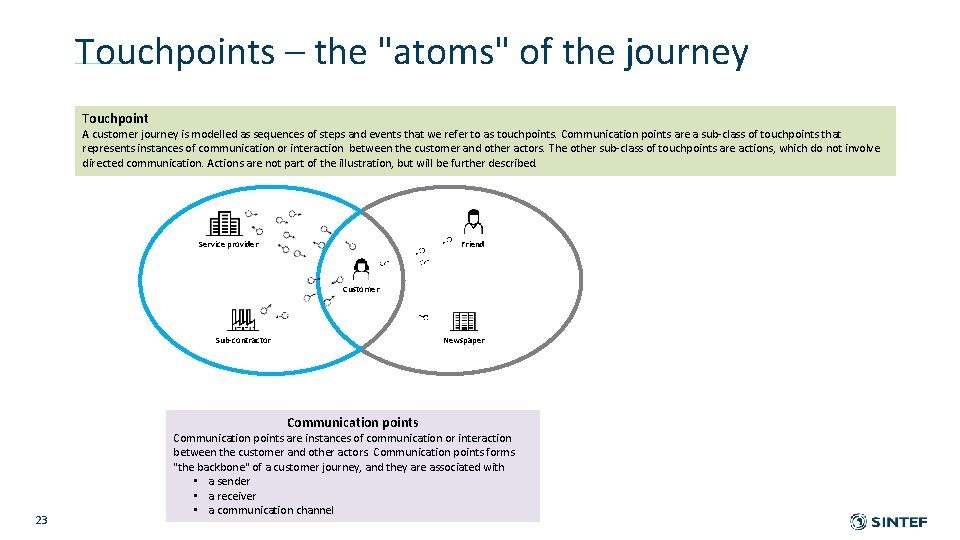
Touchpoints – the "atoms" of the journey Touchpoint A customer journey is modelled as sequences of steps and events that we refer to as touchpoints. Communication points are a sub-class of touchpoints that represents instances of communication or interaction between the customer and other actors. The other sub-class of touchpoints are actions, which do not involve directed communication. Actions are not part of the illustration, but will be further described. Friend Service provider Customer Sub-contractor Newspaper Communication points 23 Communication points are instances of communication or interaction between the customer and other actors. Communication points forms "the backbone" of a customer journey, and they are associated with • a sender • a receiver • a communication channel
Touchpoints • The communication points make up the backbone of the service process and has several important attributes that are codified in the visual notation. • Both the direction of the communication, and the communication channel itself are made visually distinct. Communication points initiated by the customer have a different color compared to the ones initiated by the service provider. Friend Service provider Customer Sub-contractor 24 The customer sends an e-mail to the service provider Newspaper The customer receives an e-mail from the service provider • The communication channel is represented by a symbol • Touchpoints with external actors has a shaded background A friend calls and recommends the movie
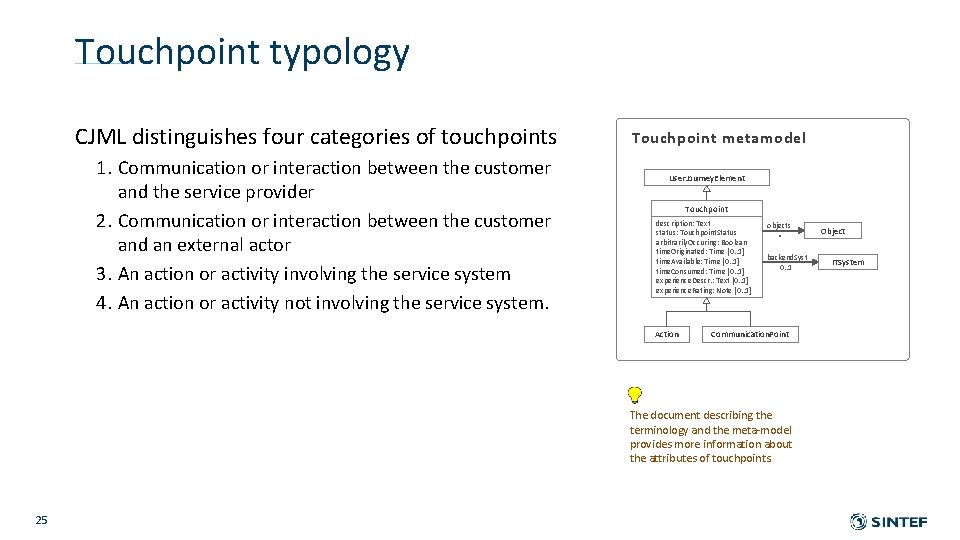
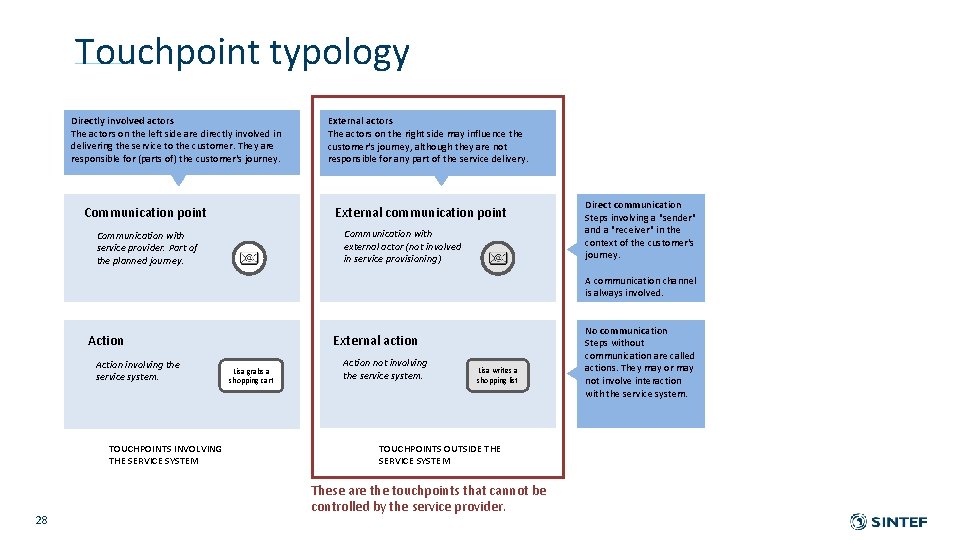
Touchpoint typology CJML distinguishes four categories of touchpoints 1. Communication or interaction between the customer and the service provider 2. Communication or interaction between the customer and an external actor 3. An action or activity involving the service system 4. An action or activity not involving the service system. Touchpoint metamodel User. Journey. Element Touchpoint description: Text status: Touchpoint. Status arbitrarily. Occuring: Boolean time. Originated: Time [0. . 1] time. Available: Time [0. . 1] time. Consumed: Time [0. . 1] experience. Descr. : Text [0. . 1] experience. Rating: Note [0. . 1] Action objects * backend. Syst 0. . 1 Communication. Point The document describing the terminology and the meta-model provides more information about the attributes of touchpoints. 25 Object ITSystem
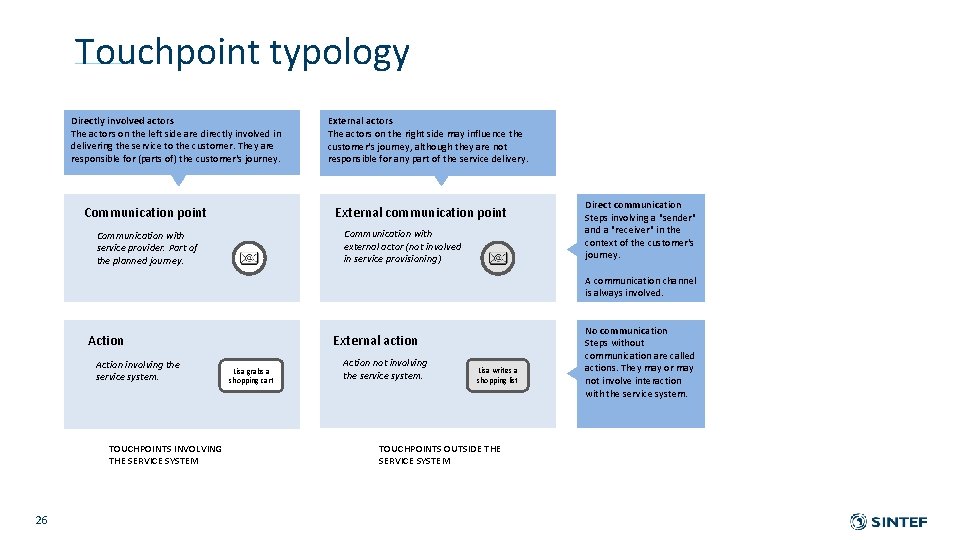
Touchpoint typology Directly involved actors The actors on the left side are directly involved in delivering the service to the customer. They are responsible for (parts of) the customer's journey. Communication point External actors The actors on the right side may influence the customer's journey, although they are not responsible for any part of the service delivery. External communication point Communication with external actor (not involved in service provisioning) Communication with service provider. Part of the planned journey. Direct communication Steps involving a "sender" and a "receiver" in the context of the customer's journey. A communication channel is always involved. External action Action involving the service system. TOUCHPOINTS INVOLVING THE SERVICE SYSTEM 26 Lisa grabs a shopping cart Action not involving the service system. Lisa writes a shopping list TOUCHPOINTS OUTSIDE THE SERVICE SYSTEM No communication Steps without communication are called actions. They may or may not involve interaction with the service system.
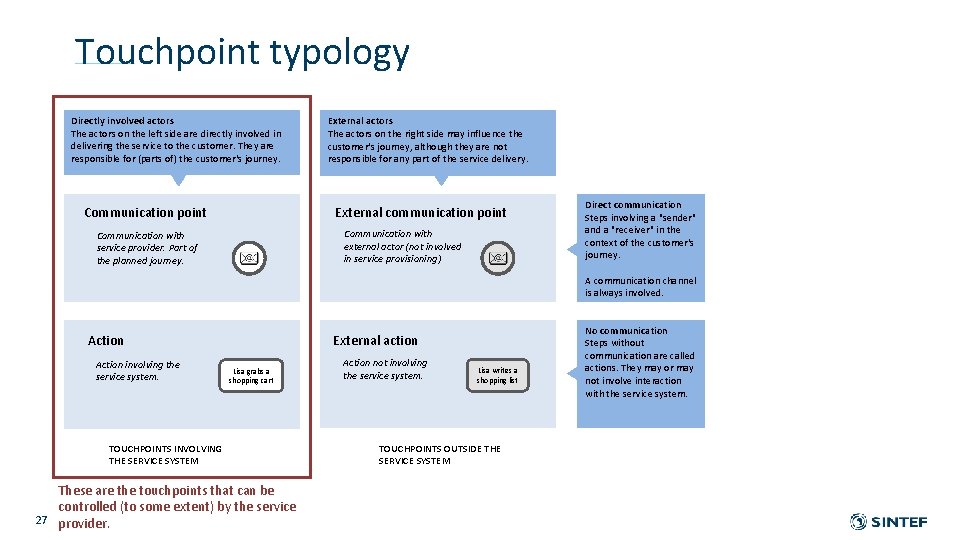
Touchpoint typology Directly involved actors The actors on the left side are directly involved in delivering the service to the customer. They are responsible for (parts of) the customer's journey. Communication point External actors The actors on the right side may influence the customer's journey, although they are not responsible for any part of the service delivery. External communication point Communication with external actor (not involved in service provisioning) Communication with service provider. Part of the planned journey. Direct communication Steps involving a "sender" and a "receiver" in the context of the customer's journey. A communication channel is always involved. External action Action involving the service system. Lisa grabs a shopping cart TOUCHPOINTS INVOLVING THE SERVICE SYSTEM These are the touchpoints that can be controlled (to some extent) by the service 27 provider. Action not involving the service system. Lisa writes a shopping list TOUCHPOINTS OUTSIDE THE SERVICE SYSTEM No communication Steps without communication are called actions. They may or may not involve interaction with the service system.
Touchpoint typology Directly involved actors The actors on the left side are directly involved in delivering the service to the customer. They are responsible for (parts of) the customer's journey. Communication point External actors The actors on the right side may influence the customer's journey, although they are not responsible for any part of the service delivery. External communication point Communication with external actor (not involved in service provisioning) Communication with service provider. Part of the planned journey. Direct communication Steps involving a "sender" and a "receiver" in the context of the customer's journey. A communication channel is always involved. External action Action involving the service system. TOUCHPOINTS INVOLVING THE SERVICE SYSTEM 28 Lisa grabs a shopping cart Action not involving the service system. Lisa writes a shopping list TOUCHPOINTS OUTSIDE THE SERVICE SYSTEM These are the touchpoints that cannot be controlled by the service provider. No communication Steps without communication are called actions. They may or may not involve interaction with the service system.
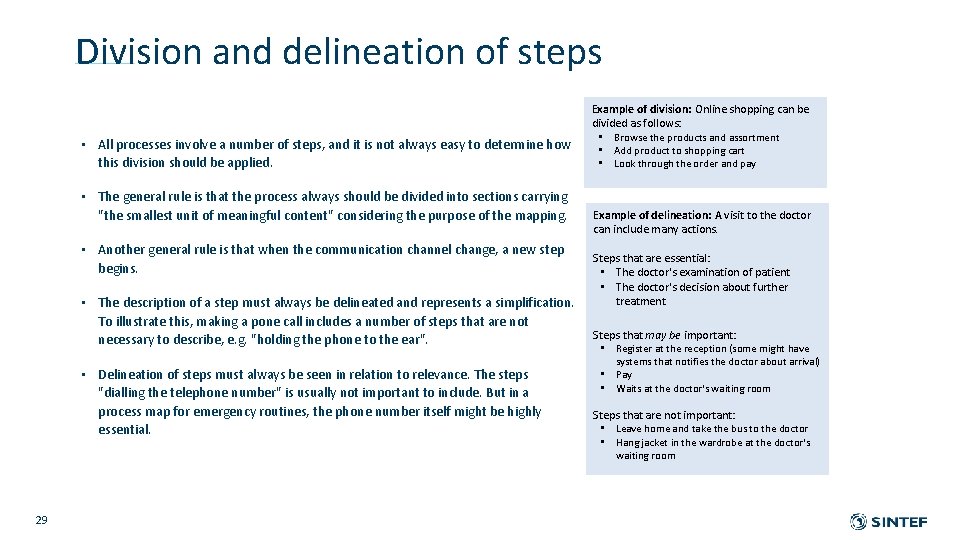
Division and delineation of steps • All processes involve a number of steps, and it is not always easy to determine how this division should be applied. • The general rule is that the process always should be divided into sections carrying "the smallest unit of meaningful content" considering the purpose of the mapping. • Another general rule is that when the communication channel change, a new step begins. • The description of a step must always be delineated and represents a simplification. To illustrate this, making a pone call includes a number of steps that are not necessary to describe, e. g. "holding the phone to the ear". • Delineation of steps must always be seen in relation to relevance. The steps "dialling the telephone number" is usually not important to include. But in a process map for emergency routines, the phone number itself might be highly essential. Example of division: Online shopping can be divided as follows: • Browse the products and assortment • Add product to shopping cart • Look through the order and pay Example of delineation: A visit to the doctor can include many actions. Steps that are essential: • The doctor's examination of patient • The doctor's decision about further treatment Steps that may be important: • Register at the reception (some might have systems that notifies the doctor about arrival) • Pay • Waits at the doctor's waiting room Steps that are not important: • Leave home and take the bus to the doctor • Hang jacket in the wardrobe at the doctor's waiting room 29
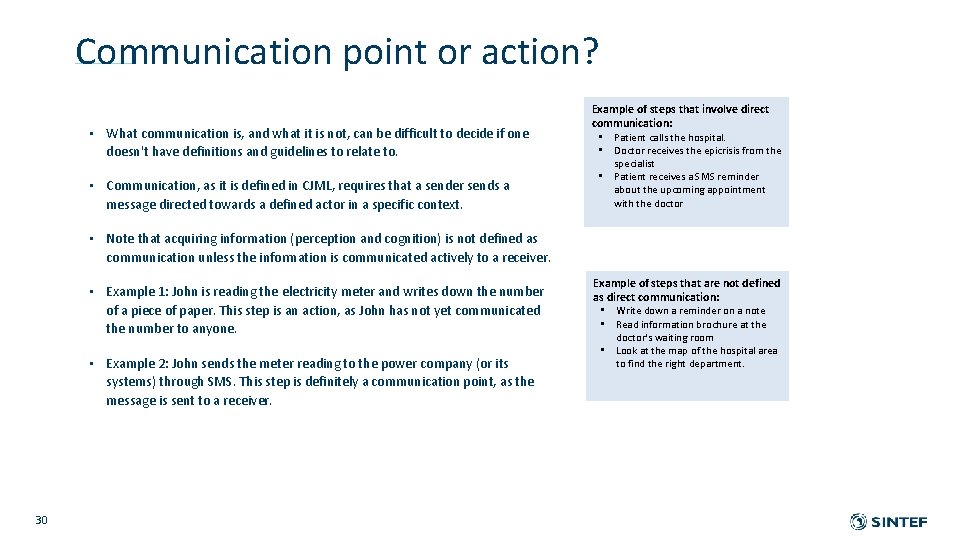
Communication point or action? • What communication is, and what it is not, can be difficult to decide if one doesn't have definitions and guidelines to relate to. • Communication, as it is defined in CJML, requires that a sender sends a message directed towards a defined actor in a specific context. Example of steps that involve direct communication: • Patient calls the hospital. • Doctor receives the epicrisis from the • specialist Patient receives a SMS reminder about the upcoming appointment with the doctor • Note that acquiring information (perception and cognition) is not defined as communication unless the information is communicated actively to a receiver. • Example 1: John is reading the electricity meter and writes down the number of a piece of paper. This step is an action, as John has not yet communicated the number to anyone. • Example 2: John sends the meter reading to the power company (or its systems) through SMS. This step is definitely a communication point, as the message is sent to a receiver. 30 Example of steps that are not defined as direct communication: • Write down a reminder on a note • Read information brochure at the doctor's waiting room • Look at the map of the hospital area to find the right department.
DIAGRAMS AND SUPPORT FOR VISUALIZATION
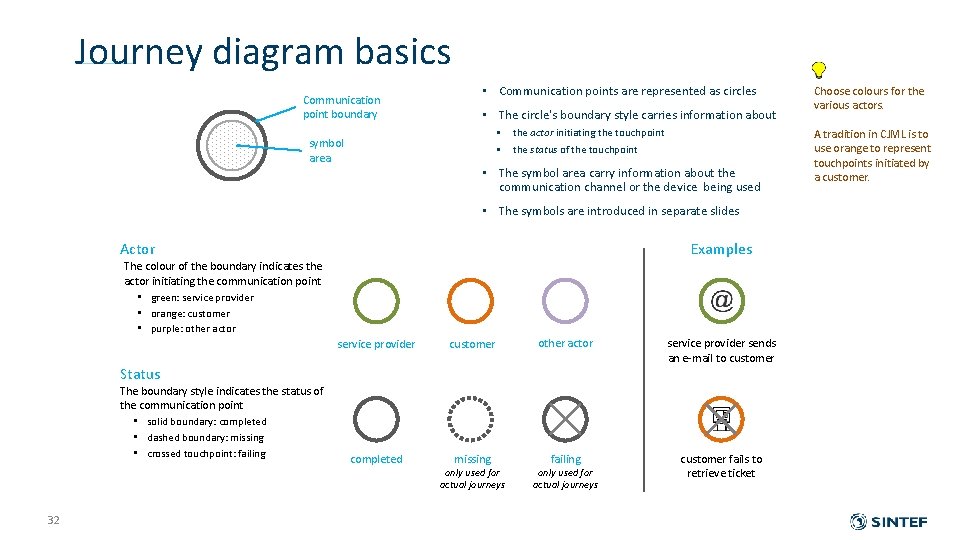
Journey diagram basics Communication point boundary • Communication points are represented as circles • The circle's boundary style carries information about § § symbol area the actor initiating the touchpoint the status of the touchpoint • The symbol area carry information about the communication channel or the device being used • The symbols are introduced in separate slides Actor Examples The colour of the boundary indicates the actor initiating the communication point • green: service provider • orange: customer • purple: other actor service provider customer other actor service provider sends an e-mail to customer failing customer fails to retrieve ticket Status The boundary style indicates the status of the communication point • solid boundary: completed • dashed boundary: missing • crossed touchpoint: failing 32 completed missing only used for actual journeys Choose colours for the various actors. A tradition in CJML is to use orange to represent touchpoints initiated by a customer.
Overview of diagrams Journey diagram • • Suitable for planned and actual journeys with few actors involved Suitable for actual journeys to emphasize deviations from the planned journey Planned journey Actual journey This is an example of a deviation from the planned journey The visual notation is described in a separate document. Swimlane/network diagram • • When many actors are involved Showing both the sender and the receiver of a touchpoint
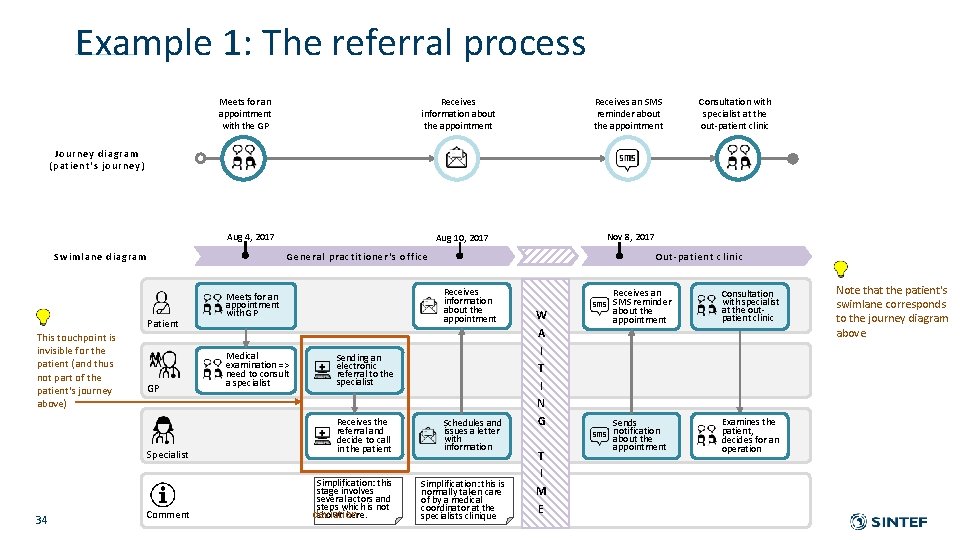
Example 1: The referral process Meets for an appointment with the GP Receives information about the appointment Receives an SMS reminder about the appointment Aug 10, 2017 Nov 8, 2017 Consultation with specialist at the out-patient clinic Jour ney diagram (patient' s journ ey ) Aug 4, 2017 Patient This touchpoint is invisible for the patient (and thus not part of the patient's journey above) GP Specialist 34 Out- patient clini c General practitio ner' s of fice Swi mlan e d iag ram Comment Receives information about the appointment Meets for an appointment with GP Medical examination => need to consult a specialist Sending an electronic referral to the specialist Receives the referral and decide to call in the patient Schedules and issues a letter with information Simplification: this stage involves several actors and steps which is not deviation shown here. Simplification: this is normally taken care of by a medical coordinator at the specialists clinique W A I T I N G T I M E Receives an SMS reminder about the appointment Consultation with specialist at the outpatient clinic Sends notification about the appointment Examines the patient, decides for an operation Note that the patient's swimlane corresponds to the journey diagram above
Example 2: Excerpt from Sara's patient journey BOOKING OF APPOINTMENT April 13 th 1 p. m. Sara I need to book a new appointment at the outpatient clinic, but it is already too late. April 18 th OUTPATIENT CLINIC April 27 th April 30 th Calls the outpatient clinic to book an appointment. Receives a reminder. Meets at the outpatient clinic. Allocates an hour on April 30 th. Sends a reminder. Takes blood samples and administers infusion. General practitioner Neurologist Nurse, MS clinic Sara's experience Calling hours are from 8 -11 a. m. This is too limited. I would like to call after lunch time! I could not have the time that suited me best. A reminder with date, time, building and link to exact location. I met a new nurse. He was skilled and very friendly. The patient's experience can be represented in a separate swimlane.
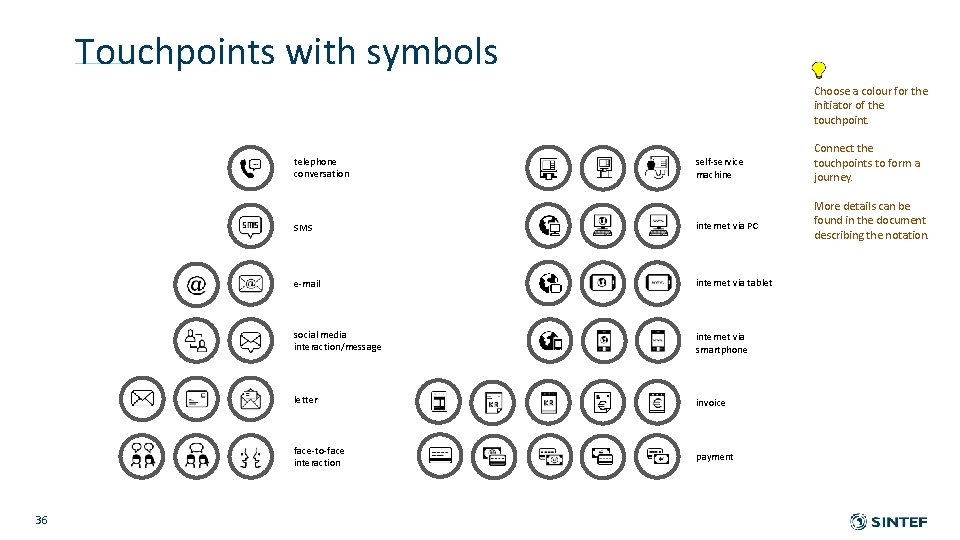
Touchpoints with symbols Choose a colour for the initiator of the touchpoint. telephone conversation 36 self-service machine SMS internet via PC e-mail internet via tablet social media interaction/message internet via smartphone letter invoice face-to-face interaction payment Connect the touchpoints to form a journey. More details can be found in the document describing the notation.
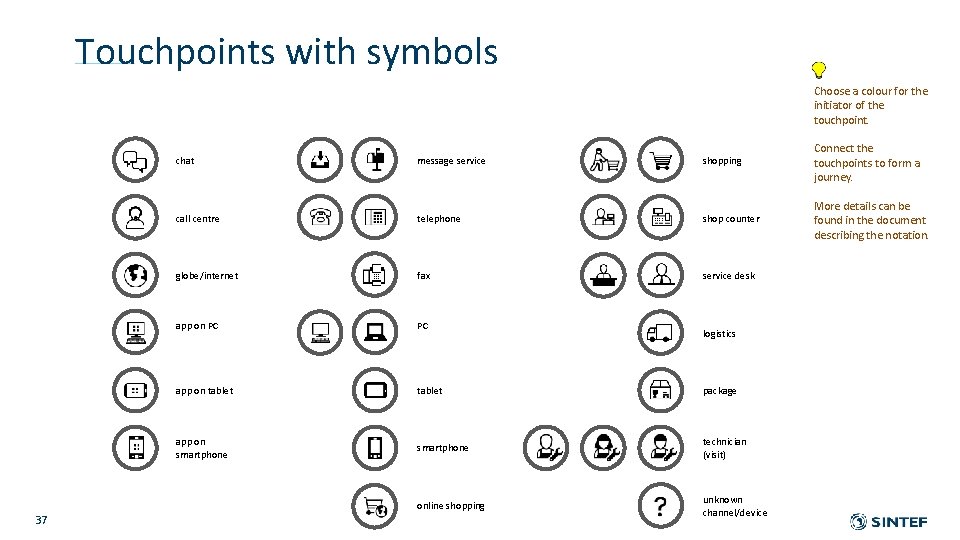
Touchpoints with symbols Choose a colour for the initiator of the touchpoint. 37 chat message service shopping Connect the touchpoints to form a journey. call centre telephone shop counter More details can be found in the document describing the notation. globe/internet fax service desk app on PC PC app on tablet package app on smartphone technician (visit) online shopping unknown channel/device logistics
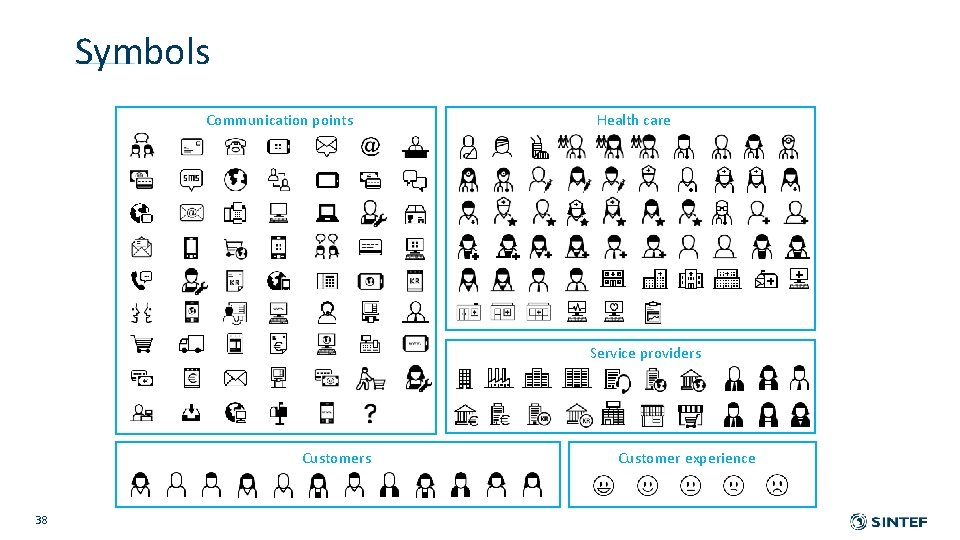
Symbols Communication points Health care Service providers Customers 38 Customer experience
Technology for a better society