
Civil Rights Training Special Supplemental Nutrition Program for

- Slides: 36
Civil Rights Training Special Supplemental Nutrition Program for Women, Infants and Children (WIC) Civil Rights Division USDA Food and Nutrition Service
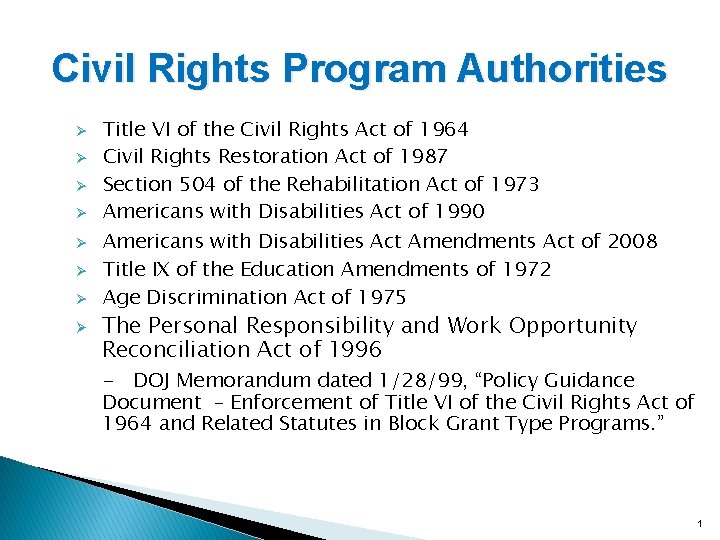
Civil Rights Program Authorities Ø Ø Ø Ø Title VI of the Civil Rights Act of 1964 Civil Rights Restoration Act of 1987 Section 504 of the Rehabilitation Act of 1973 Americans with Disabilities Act of 1990 Americans with Disabilities Act Amendments Act of 2008 Title IX of the Education Amendments of 1972 Age Discrimination Act of 1975 The Personal Responsibility and Work Opportunity Reconciliation Act of 1996 - DOJ Memorandum dated 1/28/99, “Policy Guidance Document – Enforcement of Title VI of the Civil Rights Act of 1964 and Related Statutes in Block Grant Type Programs. ” 1
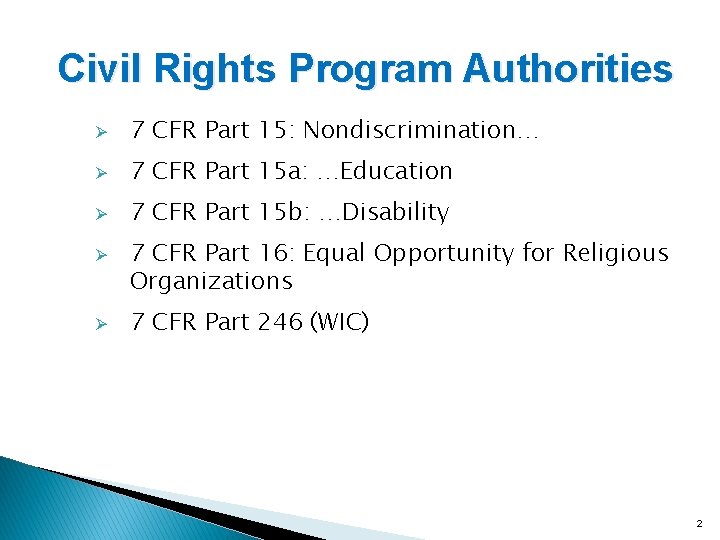
Civil Rights Program Authorities Ø 7 CFR Part 15: Nondiscrimination… Ø 7 CFR Part 15 a: …Education Ø 7 CFR Part 15 b: …Disability Ø Ø 7 CFR Part 16: Equal Opportunity for Religious Organizations 7 CFR Part 246 (WIC) 2
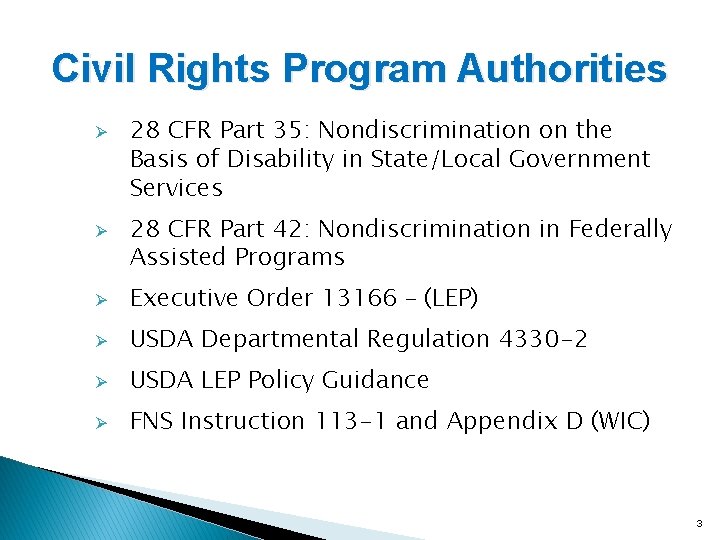
Civil Rights Program Authorities Ø Ø 28 CFR Part 35: Nondiscrimination on the Basis of Disability in State/Local Government Services 28 CFR Part 42: Nondiscrimination in Federally Assisted Programs Ø Executive Order 13166 – (LEP) Ø USDA Departmental Regulation 4330 -2 Ø USDA LEP Policy Guidance Ø FNS Instruction 113 -1 and Appendix D (WIC) 3
What is Discrimination? Different treatment which makes a distinction of one person or a group of persons from others; either intentionally, by neglect, or by the actions or lack of actions based on a protected class. 4
Assurances Ø “To qualify for Federal financial assistance, an application that the entity to receive financial assistance will be operated in compliance with all nondiscrimination laws, regulations, instructions, policies, and guidelines. ” Ø A Civil Rights assurance statement must be incorporated in all agreements between Federal & WIC State agencies (FNS Form 339), WIC State & local agencies, and local agencies & subrecipients (if applicable). (FNS Instruction 113 -1, Section X) 8
Public Notification All FNS programs must include a public notification system. 9
Elements of Public Notification Ø Program Availability Inform applicants and potentially eligible persons of the availability of the program and the steps necessary for participation. Ø Rights and Responsibilities Inform applicants, participants, and potentially eligible persons of their program rights and responsibilities. Ø Complaint Information Advise applicants and participants at the service delivery point of their right to file a complaint, how to file a complaint, and the complaint procedures. Ø Nondiscrimination Statement All information materials and sources, including Web sites, used by FNS, State agencies, or other subrecipients to inform the public about FNS programs must contain a nondiscrimination statement. The statement is not required to be included on every page of the program Web site. At a minimum, the nondiscrimination statement or a link to it must be included on the home page of the program information. 10
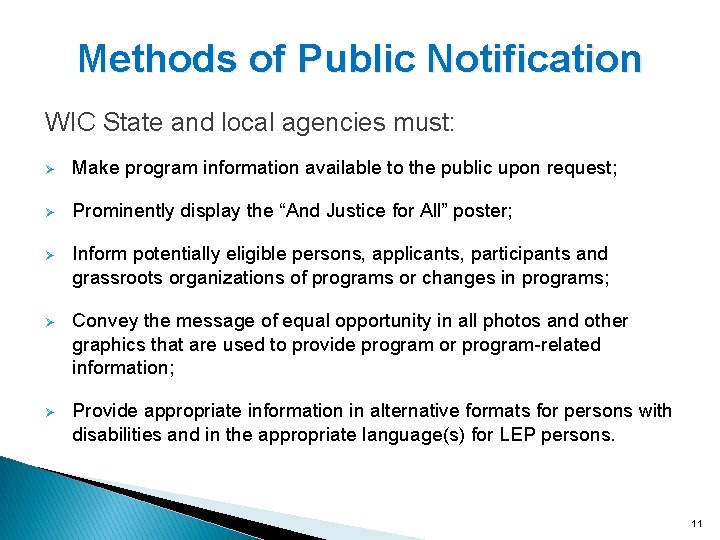
Methods of Public Notification WIC State and local agencies must: Ø Make program information available to the public upon request; Ø Prominently display the “And Justice for All” poster; Ø Inform potentially eligible persons, applicants, participants and grassroots organizations of programs or changes in programs; Ø Convey the message of equal opportunity in all photos and other graphics that are used to provide program or program-related information; Ø Provide appropriate information in alternative formats for persons with disabilities and in the appropriate language(s) for LEP persons. 11
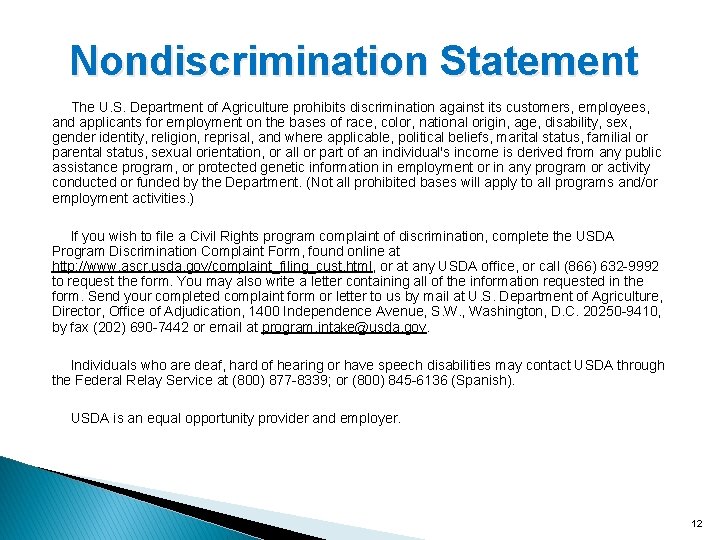
Nondiscrimination Statement The U. S. Department of Agriculture prohibits discrimination against its customers, employees, and applicants for employment on the bases of race, color, national origin, age, disability, sex, gender identity, religion, reprisal, and where applicable, political beliefs, marital status, familial or parental status, sexual orientation, or all or part of an individual's income is derived from any public assistance program, or protected genetic information in employment or in any program or activity conducted or funded by the Department. (Not all prohibited bases will apply to all programs and/or employment activities. ) If you wish to file a Civil Rights program complaint of discrimination, complete the USDA Program Discrimination Complaint Form, found online at http: //www. ascr. usda. gov/complaint_filing_cust. html, or at any USDA office, or call (866) 632 -9992 to request the form. You may also write a letter containing all of the information requested in the form. Send your completed complaint form or letter to us by mail at U. S. Department of Agriculture, Director, Office of Adjudication, 1400 Independence Avenue, S. W. , Washington, D. C. 20250 -9410, by fax (202) 690 -7442 or email at program. intake@usda. gov. Individuals who are deaf, hard of hearing or have speech disabilities may contact USDA through the Federal Relay Service at (800) 877 -8339; or (800) 845 -6136 (Spanish). USDA is an equal opportunity provider and employer. 12
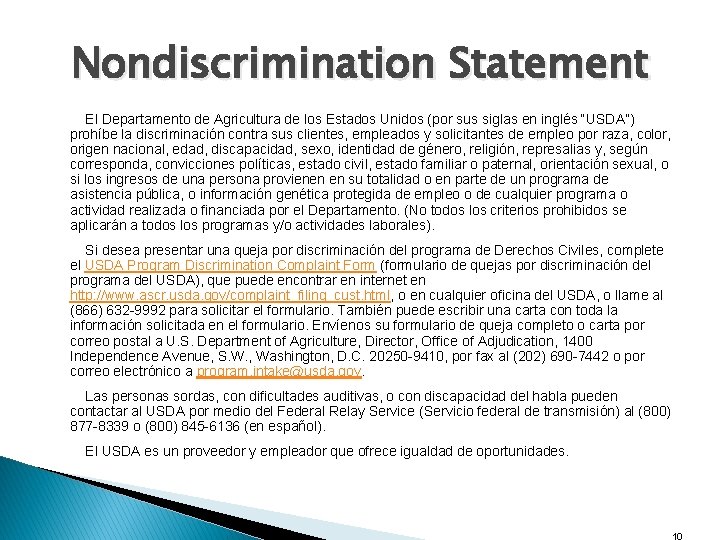
Nondiscrimination Statement El Departamento de Agricultura de los Estados Unidos (por sus siglas en inglés “USDA”) prohíbe la discriminación contra sus clientes, empleados y solicitantes de empleo por raza, color, origen nacional, edad, discapacidad, sexo, identidad de género, religión, represalias y, según corresponda, convicciones políticas, estado civil, estado familiar o paternal, orientación sexual, o si los ingresos de una persona provienen en su totalidad o en parte de un programa de asistencia pública, o información genética protegida de empleo o de cualquier programa o actividad realizada o financiada por el Departamento. (No todos los criterios prohibidos se aplicarán a todos los programas y/o actividades laborales). Si desea presentar una queja por discriminación del programa de Derechos Civiles, complete el USDA Program Discrimination Complaint Form (formulario de quejas por discriminación del programa del USDA), que puede encontrar en internet en http: //www. ascr. usda. gov/complaint_filing_cust. html, o en cualquier oficina del USDA, o llame al (866) 632 -9992 para solicitar el formulario. También puede escribir una carta con toda la información solicitada en el formulario. Envíenos su formulario de queja completo o carta por correo postal a U. S. Department of Agriculture, Director, Office of Adjudication, 1400 Independence Avenue, S. W. , Washington, D. C. 20250 -9410, por fax al (202) 690 -7442 o por correo electrónico a program. intake@usda. gov. Las personas sordas, con dificultades auditivas, o con discapacidad del habla pueden contactar al USDA por medio del Federal Relay Service (Servicio federal de transmisión) al (800) 877 -8339 o (800) 845 -6136 (en español). El USDA es un proveedor y empleador que ofrece igualdad de oportunidades.
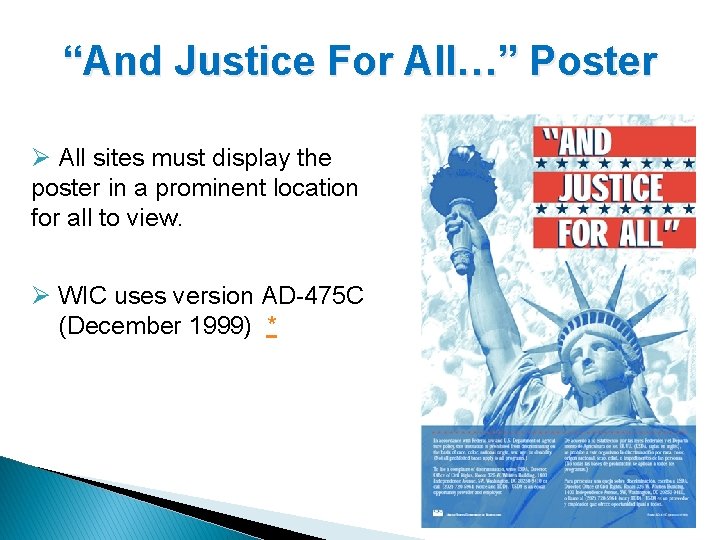
“And Justice For All…” Poster Ø All sites must display the poster in a prominent location for all to view. Ø WIC uses version AD-475 C (December 1999) *
Racial/Ethnic Data Collection Ø As a means of monitoring civil rights compliance, State agencies shall establish a system for the collection of racial/ethnic data of each person applying for and receiving benefits. Ø Applicants shall be assured that the information is required for and used for statistical purposes only and has no effect on eligibility criteria. Ø Data should be collected at the point of application and retained at the service delivery area.
Racial/Ethnic Data Collection Ø State and local agencies should compare their participant data with potentially eligible persons within their service areas. • If disparities or areas of underrepresentation occur, it will be necessary to investigate the causes for it; • • Provide additional outreach as needed; Assist with selection of compliance reviews.
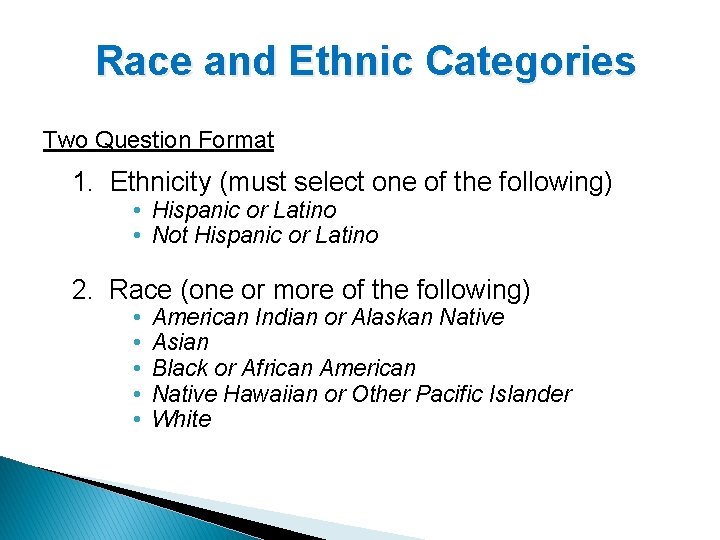
Race and Ethnic Categories Two Question Format 1. Ethnicity (must select one of the following) • Hispanic or Latino • Not Hispanic or Latino 2. Race (one or more of the following) • • • American Indian or Alaskan Native Asian Black or African American Native Hawaiian or Other Pacific Islander White
LEP and Bilingual Requirements Title VI, 7 CFR 246. 8(c) of WIC Regulations, Section VII of FNS Instruction 113 -1, Executive Order 13166, and their implementing regulations require State agencies, local agencies, or other subrecipients to take reasonable steps to assure “meaningful” access to their programs and activities by persons with Limited English Proficiency (LEP).
LEP and Bilingual Requirements Factors to consider in addressing LEP: 1. Number or proportion of LEP persons served or encountered in the eligible population; 2. Frequency with which LEP individuals come in contact with the program; 3. Nature and importance of the program, activity, or service provided by the program; 4. Resources available and their costs.
LEP and Bilingual Requirements Population data sources ▪ US Census Data ✓ http: //www. census. gov/2010 census/data/ ▪ American Community Survey ✓ http: //www. census. gov/acs/ ▪ Migration Policy Institute’s National Center on Immigrant Integration Policy ✓ http: //www. migrationpolicy. org/
Disability Discrimination What is the definition of “disability? ” • A person who has a physical or mental impairment which substantially limits one or more major life activities, has a record of such an impairment, or is regarded as having such an impairment. • Major life activity means functions such as caring for one’s self, performing manual tasks, walking, seeing, hearing, speaking, breathing, learning and working. * functions of the immune system, normal cell growth, digestive, bowel, bladder, neurological, brain, respiratory, circulatory, cardiovascular, endocrine, and reproductive functions. (ADA Amendments Act of 2008)
Disability Discrimination Ø Sections 504 and 508 of the Rehabilitation Act of 1973 - prohibit discrimination based on disability in programs or activities receiving Federal financial assistance. Ø Americans with Disabilities Act (ADA), 28 CFR Part 35, Title II, Subtitle A - prohibits discrimination on the basis of disability in all services, programs and activities provided to the public by State and local governments. Ø These Civil Rights laws protect persons with disabilities who apply for or participate in all FNS-funded programs.
Disability Discrimination Ø As programs and offices modernize, it is imperative that websites, including State and local agency websites, and online application systems are readily accessible to and useable by persons with visual impairments and other disabilities. Ø In addition, programs must ensure physical accessibility for buildings and facilities, particularly to persons in wheelchairs and with mobility disabilities. Ø Women, infants or children must be accommodated if medically or nutritionally warranted (7 CFR 246. 10(c) - Nutrition tailoring).
Equal Opportunity for Religious Organizations 7 CFR Part 16: Ensures a level playing field for the participation of faith-based organizations and other community organizations in USDA programs.
Verification of Citizenship or Immigration Status This issue should never give rise to discrimination.
Compliance Reviews Ø Examine the activities of State agencies and subrecipients to determine Civil Rights compliance; Ø FNS Civil Rights and Program staff review State agencies. - FNS staff and State agencies review local agencies. Local agencies review their subrecipients, if applicable. Ø Significant findings must be provided in writing to the reviewed entity and to FNS.
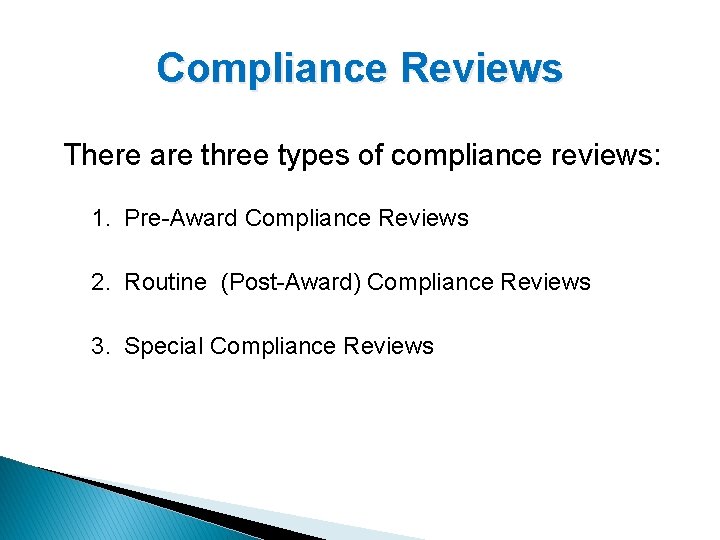
Compliance Reviews There are three types of compliance reviews: 1. Pre-Award Compliance Reviews 2. Routine (Post-Award) Compliance Reviews 3. Special Compliance Reviews
Pre-Award/Pre-Approval Compliance Reviews WIC State agencies, local agencies, and other subrecipients must be in compliance with Civil Rights requirements prior to approval for Federal financial assistance.
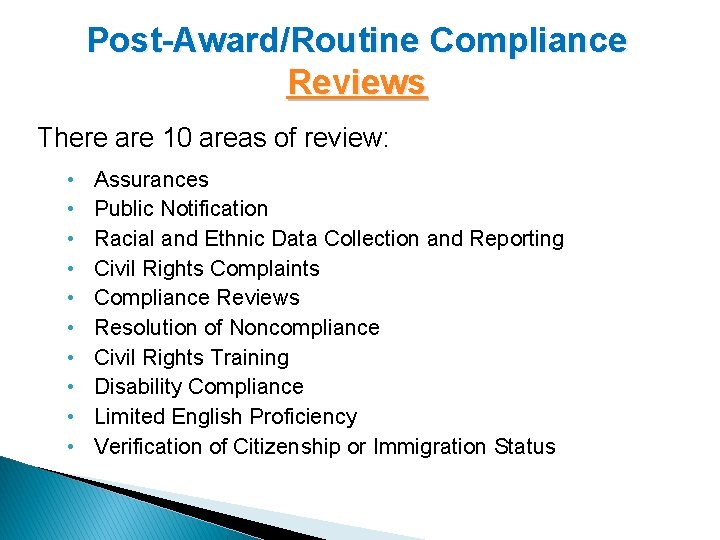
Post-Award/Routine Compliance Reviews There are 10 areas of review: • • • Assurances Public Notification Racial and Ethnic Data Collection and Reporting Civil Rights Complaints Compliance Reviews Resolution of Noncompliance Civil Rights Training Disability Compliance Limited English Proficiency Verification of Citizenship or Immigration Status
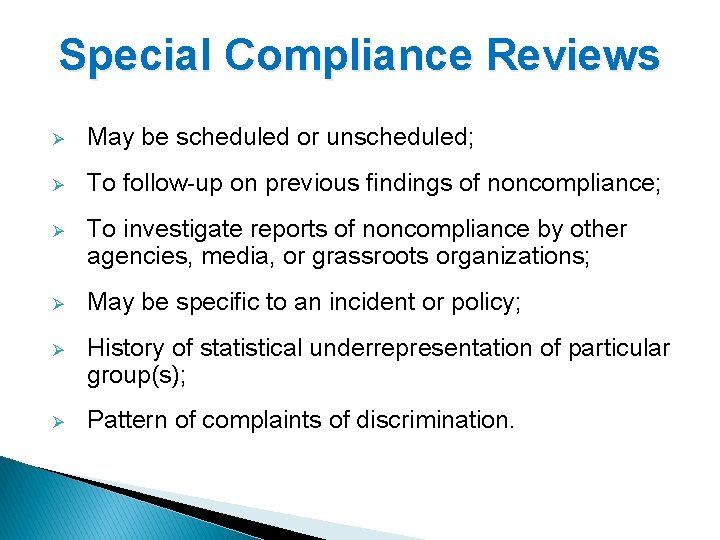
Special Compliance Reviews Ø May be scheduled or unscheduled; Ø To follow-up on previous findings of noncompliance; Ø To investigate reports of noncompliance by other agencies, media, or grassroots organizations; Ø May be specific to an incident or policy; Ø History of statistical underrepresentation of particular group(s); Ø Pattern of complaints of discrimination.
Resolution of Noncompliance Ø A factual finding that any civil rights requirement, as provided by law, regulation, policy, instruction, or guidelines, is not being adhered to by a State agency, local agency, or other subrecipient. Ø Steps must be taken immediately to obtain voluntary compliance. Ø A finding’s effective date is the date of written notice to the reviewed entity.
Complaints of Discrimination Applicants or participants allege different treatment based on protected class(es). � � • • • Protected classes WIC: Race Color National origin Age Sex Disability 29
Complaints of Discrimination Ø Complaints shall be accepted and forwarded to USDA; Ø Complaints must be filed within 180 days from the alleged act of discrimination; Ø Complaints may be written, verbal, or anonymous; Ø State agencies or local agencies may develop their own complaint forms, but the use of such forms cannot be a prerequisite for acceptance; Ø A separate Civil Rights complaint log shall be maintained by the State, local agencies, or subrecipients (if applicable); Ø Confidentiality is extremely important and must be maintained.
The Civil Rights Complaints Process Complaints should include: Ø Name, address, and telephone number of the complainant; Ø The location and name of the organization or office where the alleged incident occurred; Ø The nature of the incident or action; Ø The names, titles, and business addresses of persons who may have knowledge of the discriminatory action; Ø The date(s) during which the alleged discriminatory actions occurred; Ø The basis for the alleged discrimination.
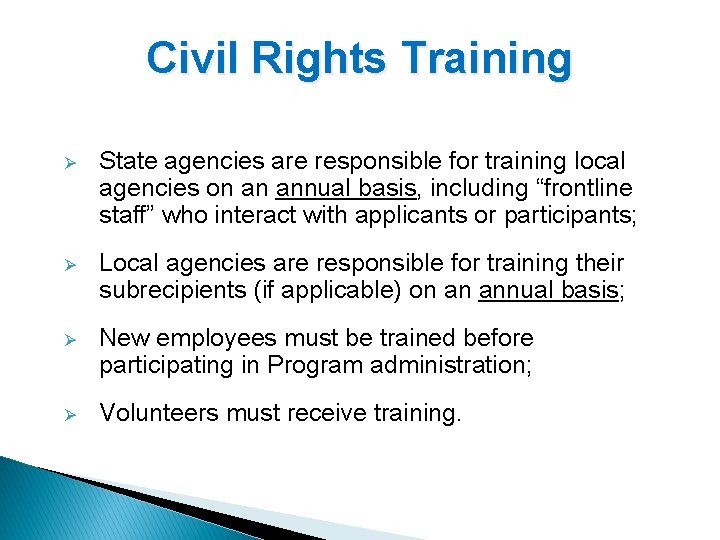
Civil Rights Training Ø State agencies are responsible for training local agencies on an annual basis, including “frontline staff” who interact with applicants or participants; Ø Local agencies are responsible for training their subrecipients (if applicable) on an annual basis; Ø New employees must be trained before participating in Program administration; Ø Volunteers must receive training.
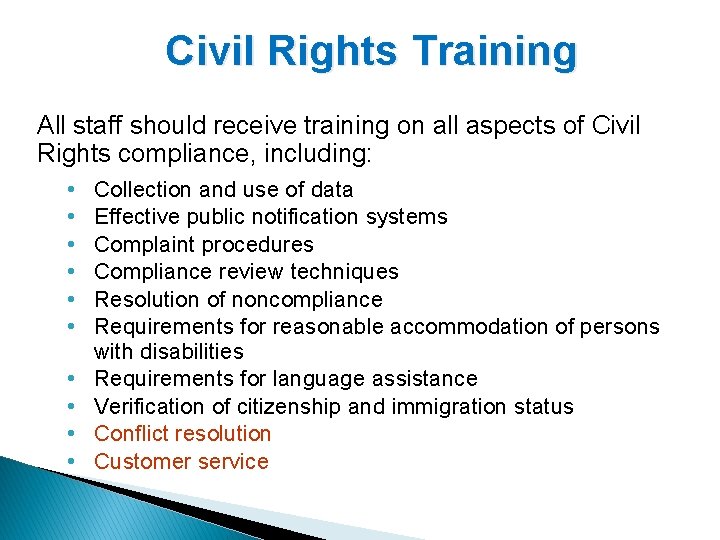
Civil Rights Training All staff should receive training on all aspects of Civil Rights compliance, including: • • • Collection and use of data Effective public notification systems Complaint procedures Compliance review techniques Resolution of noncompliance Requirements for reasonable accommodation of persons with disabilities Requirements for language assistance Verification of citizenship and immigration status Conflict resolution Customer service
Questions?
Contact Information For more information contact: Gail A. Hoffman Civil Rights Director, Southeast Regional Office Food and Nutrition Service 61 Forsyth Street, SW Room 8 T 36 Atlanta, GA 30303 Gail. Hoffman@fns. usda. gov (404) 562 -7033 https: //www. surveymonkey. com/s/MCQXNMY 35