
Civil Rights Movement Segregation Segregation was an attempt


- Slides: 53
Civil Rights Movement
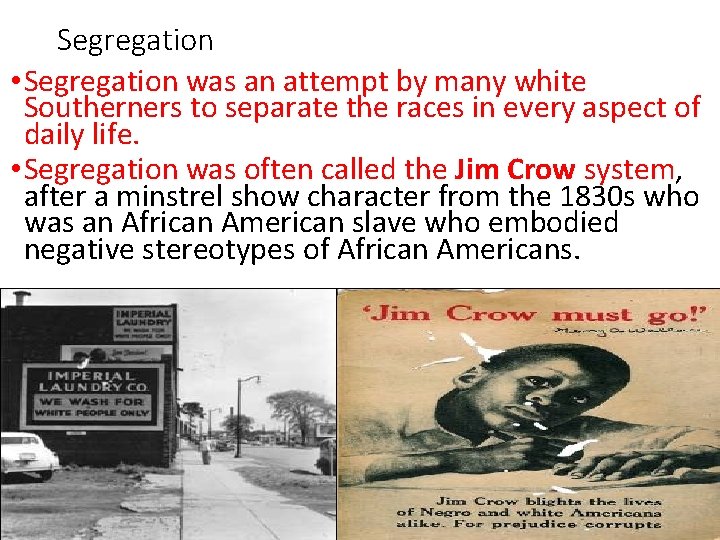
Segregation • Segregation was an attempt by many white Southerners to separate the races in every aspect of daily life. • Segregation was often called the Jim Crow system, after a minstrel show character from the 1830 s who was an African American slave who embodied negative stereotypes of African Americans.
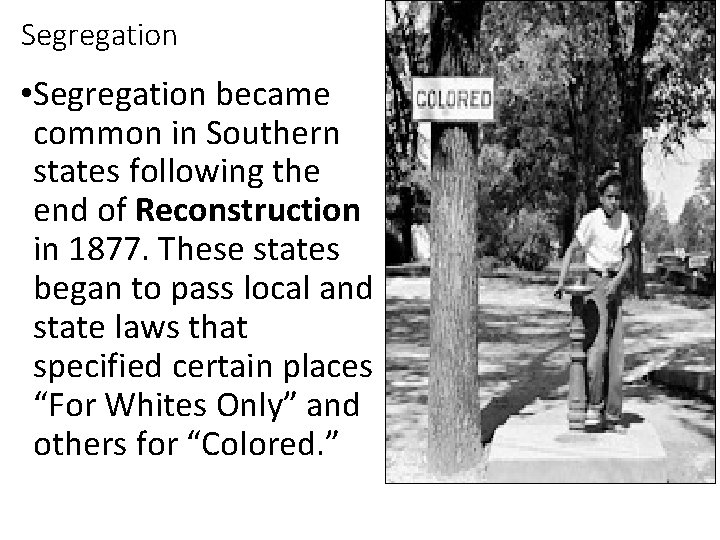
Segregation • Segregation became common in Southern states following the end of Reconstruction in 1877. These states began to pass local and state laws that specified certain places “For Whites Only” and others for “Colored. ”
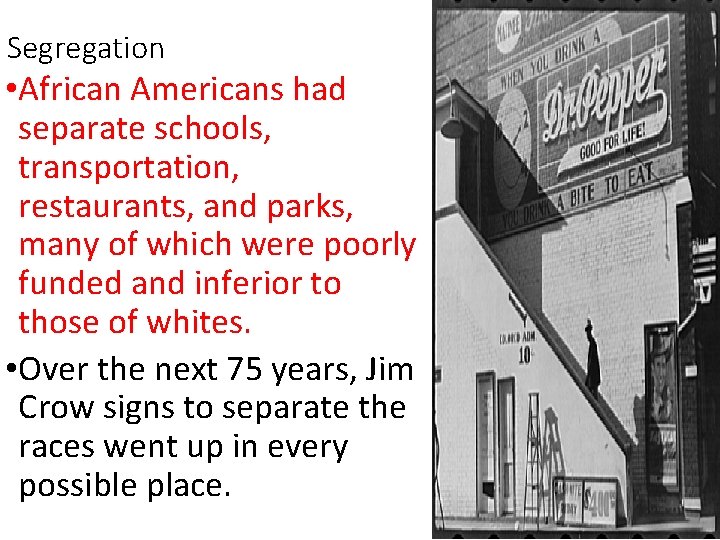
Segregation • African Americans had separate schools, transportation, restaurants, and parks, many of which were poorly funded and inferior to those of whites. • Over the next 75 years, Jim Crow signs to separate the races went up in every possible place.
Segregation • The system of segregation also included the denial of voting rights, known as disenfranchisement. • Between 1890 and 1910, all Southern states passed laws imposing requirements for voting. These were used to prevent African Americans from voting, in spite of the 15 th Amendment, which had been designed to protect African American voting rights.
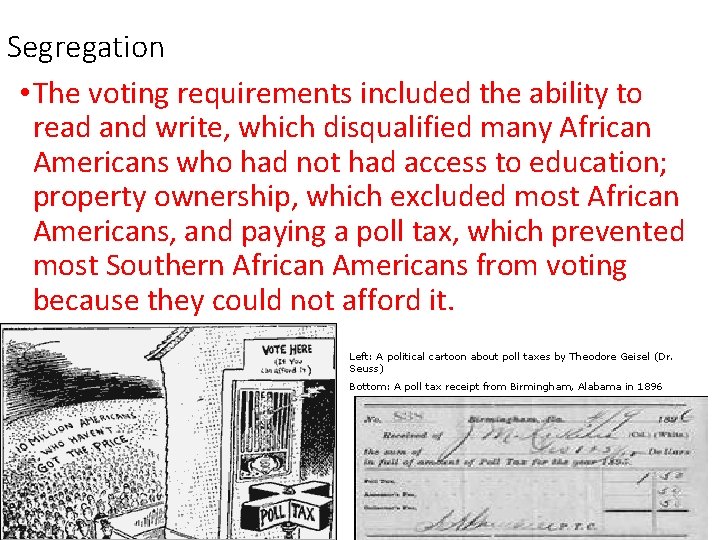
Segregation • The voting requirements included the ability to read and write, which disqualified many African Americans who had not had access to education; property ownership, which excluded most African Americans, and paying a poll tax, which prevented most Southern African Americans from voting because they could not afford it. Left: A political cartoon about poll taxes by Theodore Geisel (Dr. Seuss) Bottom: A poll tax receipt from Birmingham, Alabama in 1896
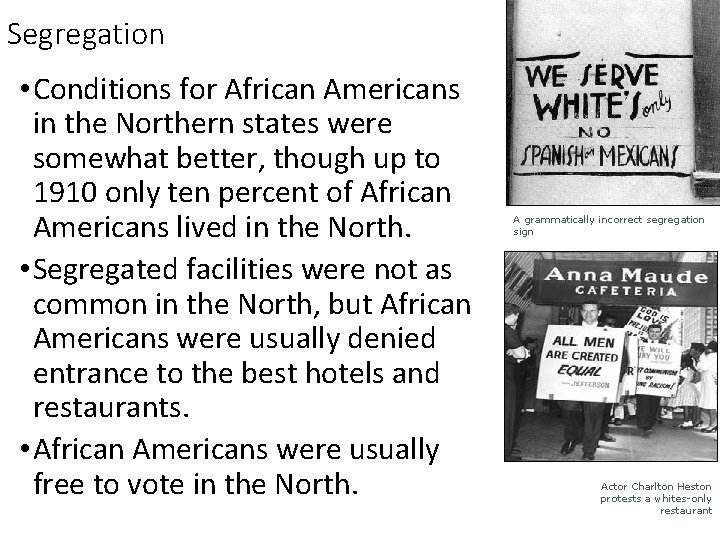
Segregation • Conditions for African Americans in the Northern states were somewhat better, though up to 1910 only ten percent of African Americans lived in the North. • Segregated facilities were not as common in the North, but African Americans were usually denied entrance to the best hotels and restaurants. • African Americans were usually free to vote in the North. A grammatically incorrect segregation sign Actor Charlton Heston protests a whites-only restaurant
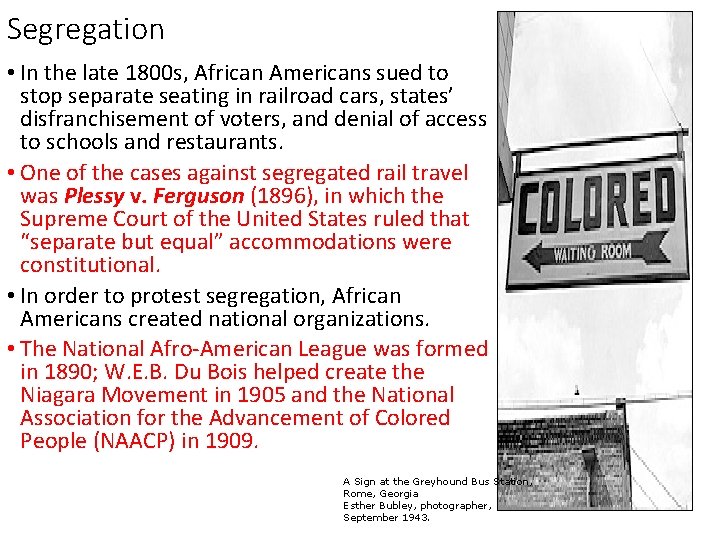
Segregation • In the late 1800 s, African Americans sued to stop separate seating in railroad cars, states’ disfranchisement of voters, and denial of access to schools and restaurants. • One of the cases against segregated rail travel was Plessy v. Ferguson (1896), in which the Supreme Court of the United States ruled that “separate but equal” accommodations were constitutional. • In order to protest segregation, African Americans created national organizations. • The National Afro-American League was formed in 1890; W. E. B. Du Bois helped create the Niagara Movement in 1905 and the National Association for the Advancement of Colored People (NAACP) in 1909. A Sign at the Greyhound Bus Station, Rome, Georgia Esther Bubley, photographer, September 1943.
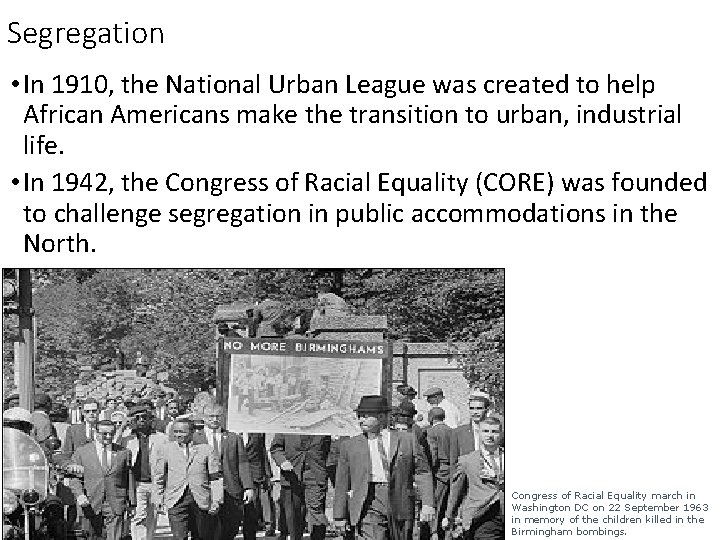
Segregation • In 1910, the National Urban League was created to help African Americans make the transition to urban, industrial life. • In 1942, the Congress of Racial Equality (CORE) was founded to challenge segregation in public accommodations in the North. Congress of Racial Equality march in Washington DC on 22 September 1963 in memory of the children killed in the Birmingham bombings.
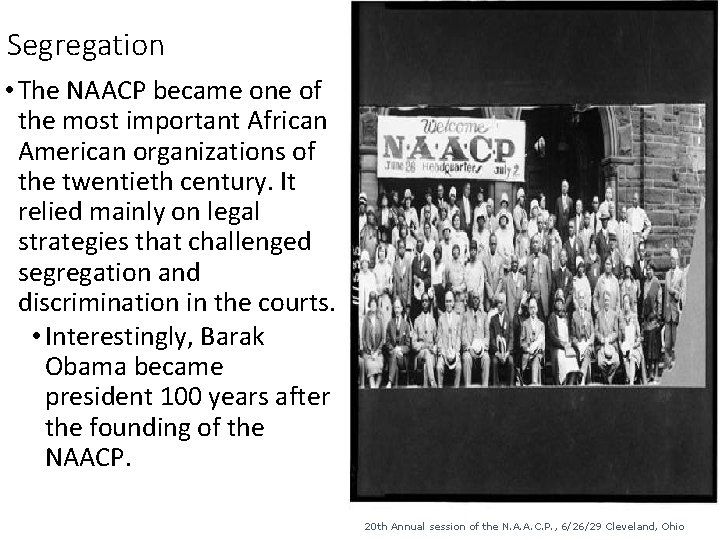
Segregation • The NAACP became one of the most important African American organizations of the twentieth century. It relied mainly on legal strategies that challenged segregation and discrimination in the courts. • Interestingly, Barak Obama became president 100 years after the founding of the NAACP. 20 th Annual session of the N. A. A. C. P. , 6/26/29 Cleveland, Ohio
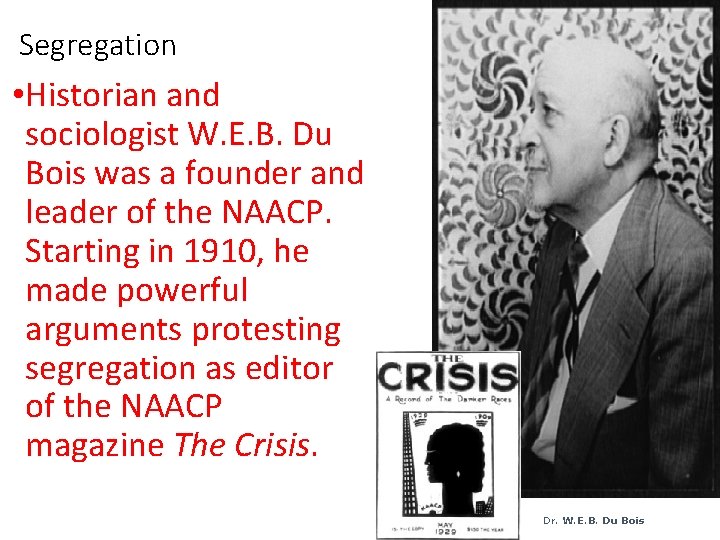
Segregation • Historian and sociologist W. E. B. Du Bois was a founder and leader of the NAACP. Starting in 1910, he made powerful arguments protesting segregation as editor of the NAACP magazine The Crisis. Dr. W. E. B. Du Bois
Eisenhower years… • Believed that • Was forced into desegregation the limelight by should be a Brown v. Board natural, slow of Education process and (Topeka, not forced. Kansas) in 1954.
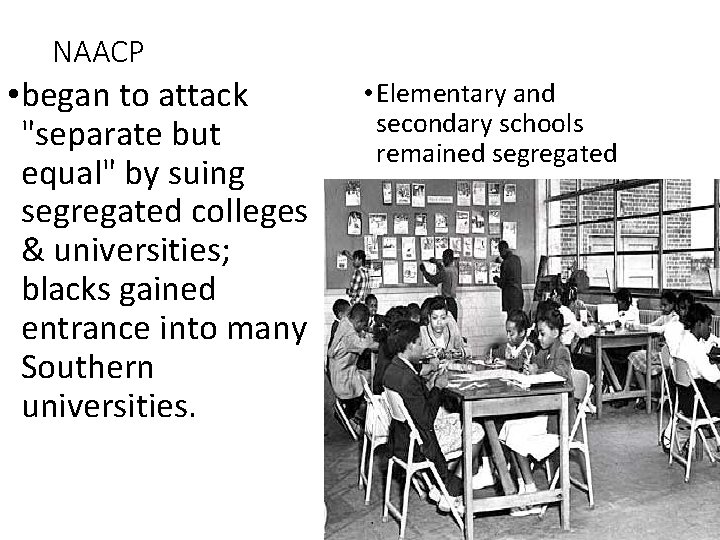
NAACP • began to attack "separate but equal" by suing segregated colleges & universities; blacks gained entrance into many Southern universities. • Elementary and secondary schools remained segregated
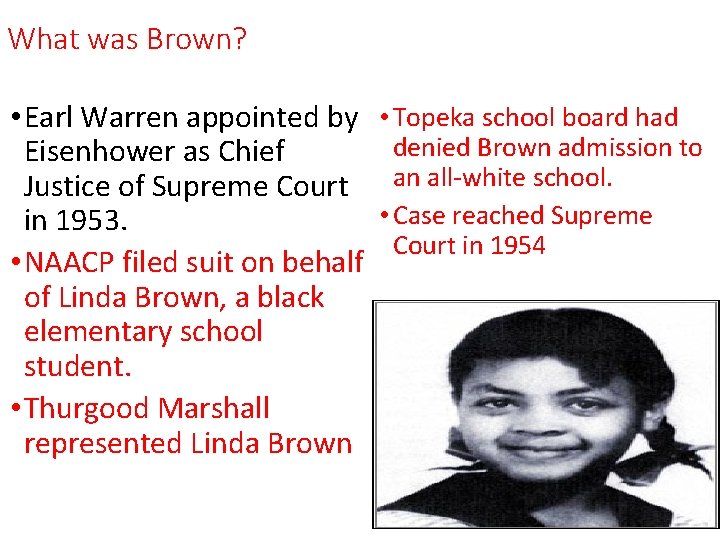
What was Brown? • Earl Warren appointed by Eisenhower as Chief Justice of Supreme Court in 1953. • NAACP filed suit on behalf of Linda Brown, a black elementary school student. • Thurgood Marshall represented Linda Brown • Topeka school board had denied Brown admission to an all-white school. • Case reached Supreme Court in 1954
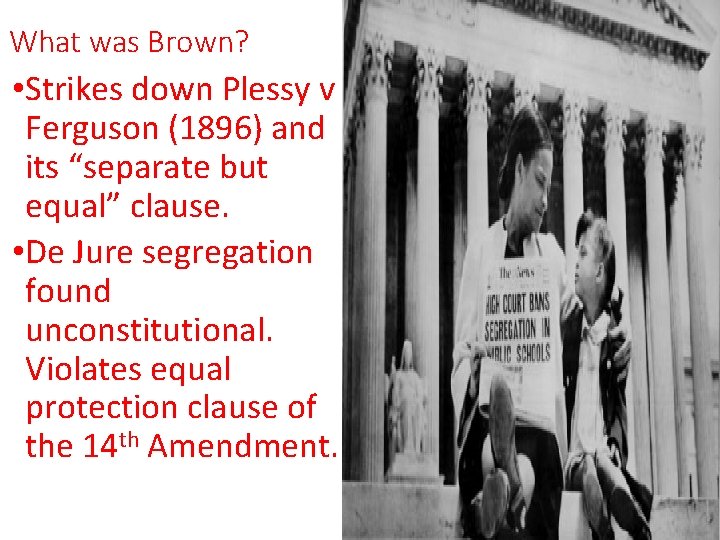
What was Brown? • Strikes down Plessy v Ferguson (1896) and its “separate but equal” clause. • De Jure segregation found unconstitutional. Violates equal protection clause of the 14 th Amendment.
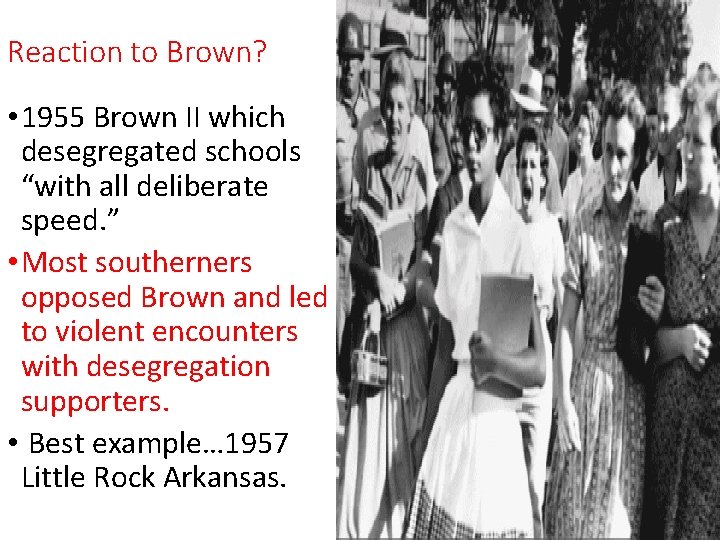
Reaction to Brown? • 1955 Brown II which desegregated schools “with all deliberate speed. ” • Most southerners opposed Brown and led to violent encounters with desegregation supporters. • Best example… 1957 Little Rock Arkansas.
Little Rock Nine • 1957 Little Rock Arkansas Central High School • Gov. Orval Fabus refused entrance. National Guard called in.
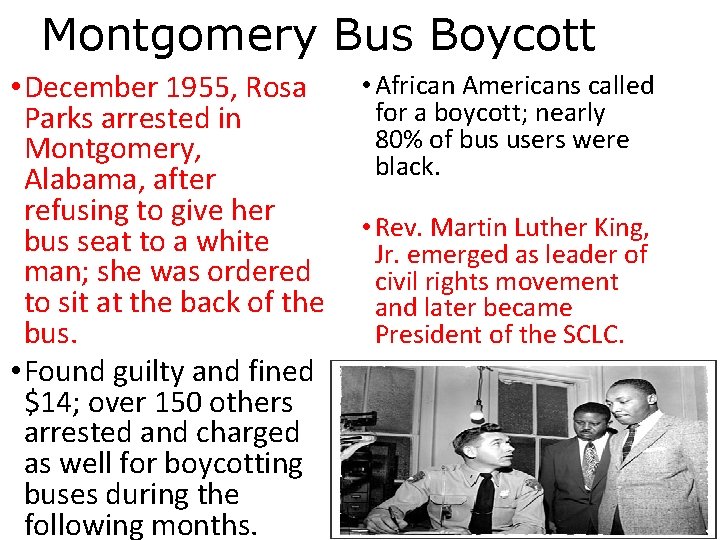
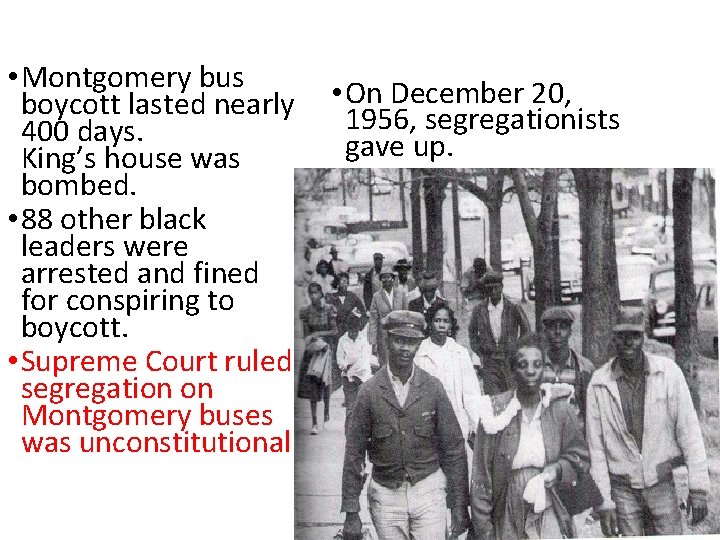
Montgomery Bus Boycott • December 1955, Rosa Parks arrested in Montgomery, Alabama, after refusing to give her bus seat to a white man; she was ordered to sit at the back of the bus. • Found guilty and fined $14; over 150 others arrested and charged as well for boycotting buses during the following months. • African Americans called for a boycott; nearly 80% of bus users were black. • Rev. Martin Luther King, Jr. emerged as leader of civil rights movement and later became President of the SCLC.
• Montgomery bus December 20, boycott lasted nearly • On 1956, segregationists 400 days. gave up. King’s house was bombed. • 88 other black leaders were arrested and fined for conspiring to boycott. • Supreme Court ruled segregation on Montgomery buses was unconstitutional.
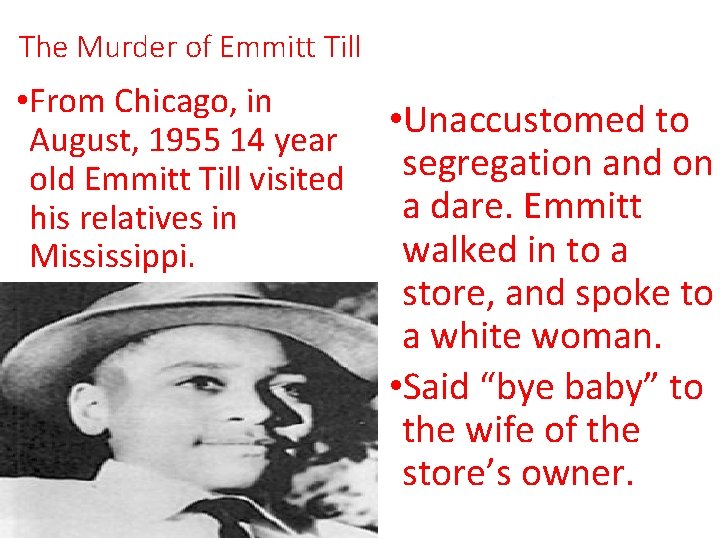
The Murder of Emmitt Till • From Chicago, in August, 1955 14 year old Emmitt Till visited his relatives in Mississippi. • Unaccustomed to segregation and on a dare. Emmitt walked in to a store, and spoke to a white woman. • Said “bye baby” to the wife of the store’s owner.
The Murder… • A few days later, two men in the middle of the night took Emmitt and killed him. • Three days later, Emmett Till's body was found in a River. One eye was gouged out, and his crushed-in head had a bullet in it. • Emmitt’s mother insisted on an open casket funeral.
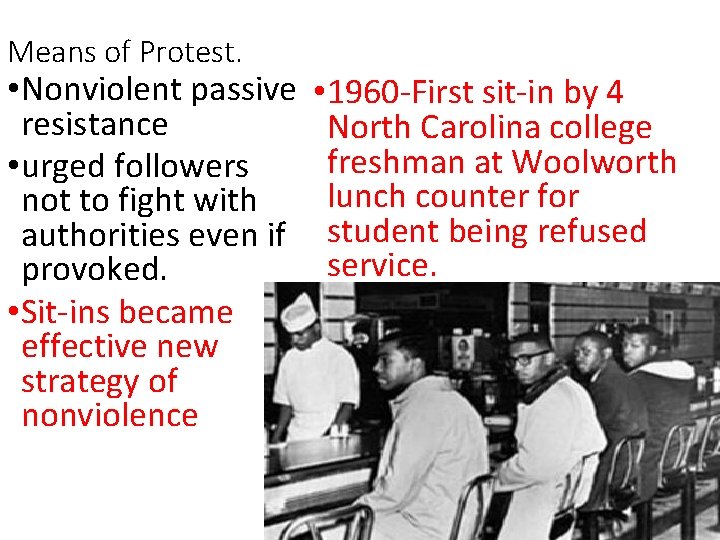
Means of Protest. • Nonviolent passive resistance • urged followers not to fight with authorities even if provoked. • Sit-ins became effective new strategy of nonviolence • 1960 -First sit-in by 4 North Carolina college freshman at Woolworth lunch counter for student being refused service.
During the Kennedy Years… • Did nothing during his first two years because he tried to avoid losing either white or black southern vote. • Civil rights groups forced his hand. • SNCC and CORE
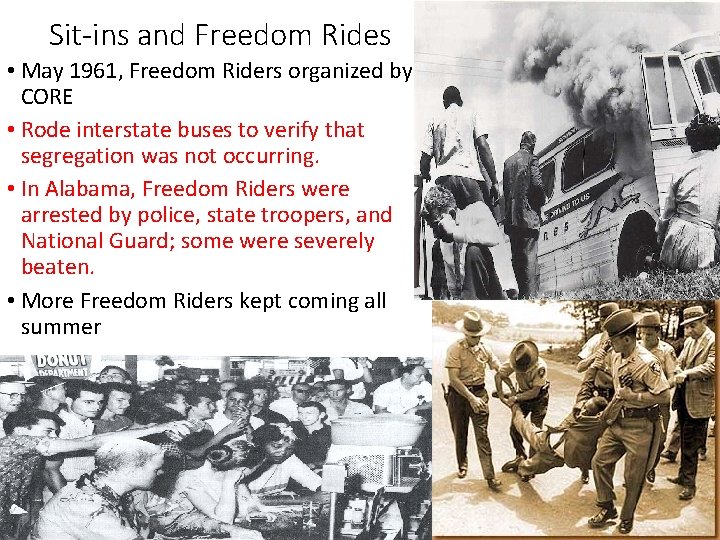
Sit-ins and Freedom Rides • May 1961, Freedom Riders organized by CORE • Rode interstate buses to verify that segregation was not occurring. • In Alabama, Freedom Riders were arrested by police, state troopers, and National Guard; some were severely beaten. • More Freedom Riders kept coming all summer
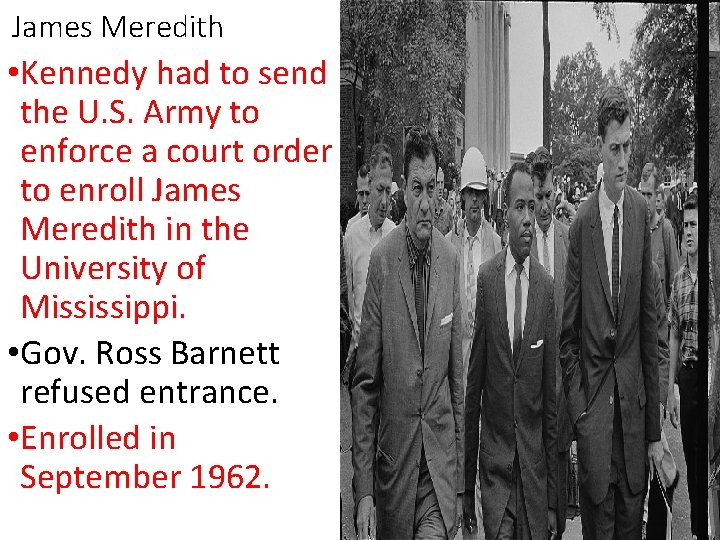
James Meredith • Kennedy had to send the U. S. Army to enforce a court order to enroll James Meredith in the University of Mississippi. • Gov. Ross Barnett refused entrance. • Enrolled in September 1962.
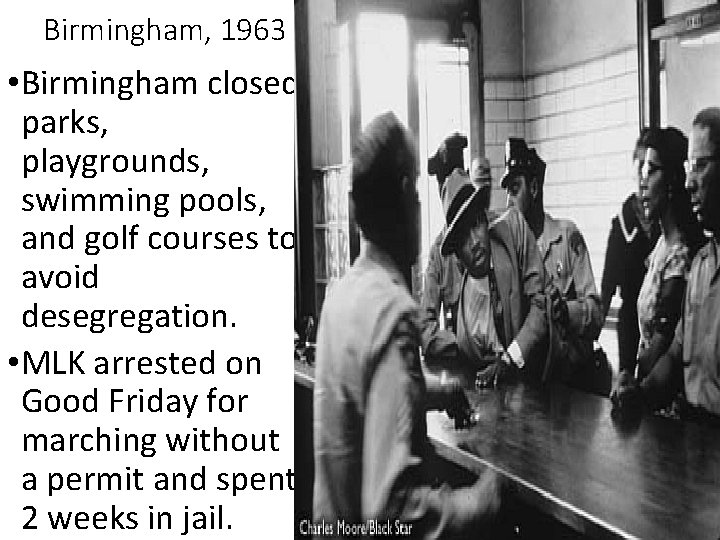
Birmingham, 1963 • Birmingham closed parks, playgrounds, swimming pools, and golf courses to avoid desegregation. • MLK arrested on Good Friday for marching without a permit and spent 2 weeks in jail.
Letter from the Birmingham Jail… Please read but you don’t have to copy this down. • "We know through painful experience that freedom is never voluntarily given by the oppressor; it must be demanded by the oppressed. Frankly, I have yet to engage in a direct-action campaign that was ‘well-timed’ in the view of those who have not suffered unduly from the disease of segregation. For years now I have heard the word "Wait!" It rings in the ear of every Negro with piercing familiarity. This "Wait" has almost always meant "Never. " We must come to see, with one of our distinguished jurists, that justice too long delayed is justice denied. "
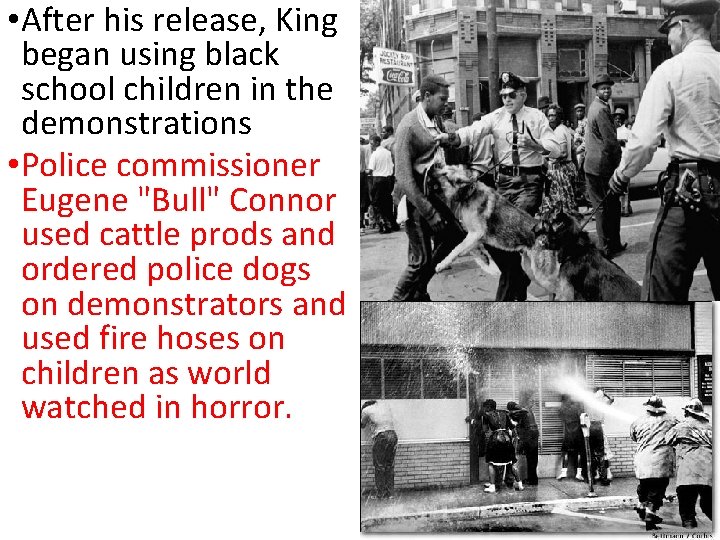
• After his release, King began using black school children in the demonstrations • Police commissioner Eugene "Bull" Connor used cattle prods and ordered police dogs on demonstrators and used fire hoses on children as world watched in horror.
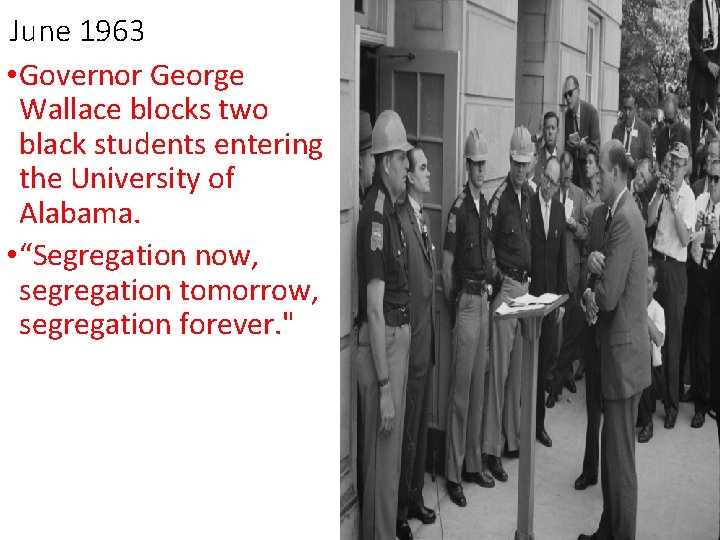
June 1963 • Governor George Wallace blocks two black students entering the University of Alabama. • “Segregation now, segregation tomorrow, segregation forever. "
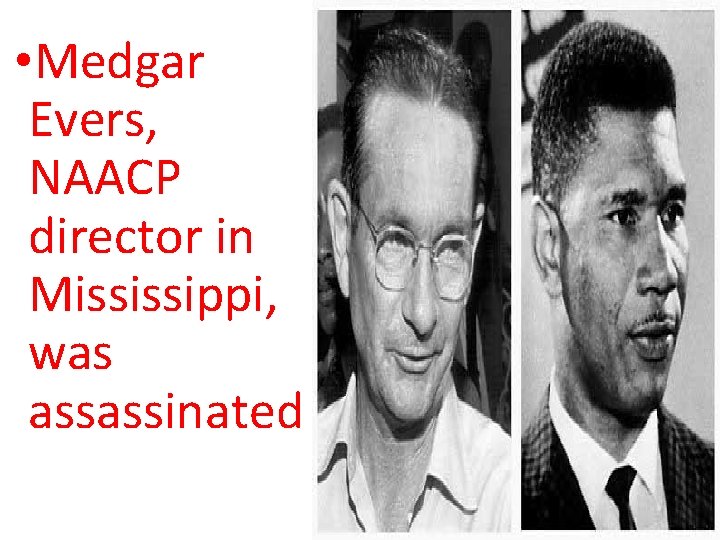
• Medgar Evers, NAACP director in Mississippi, was assassinated
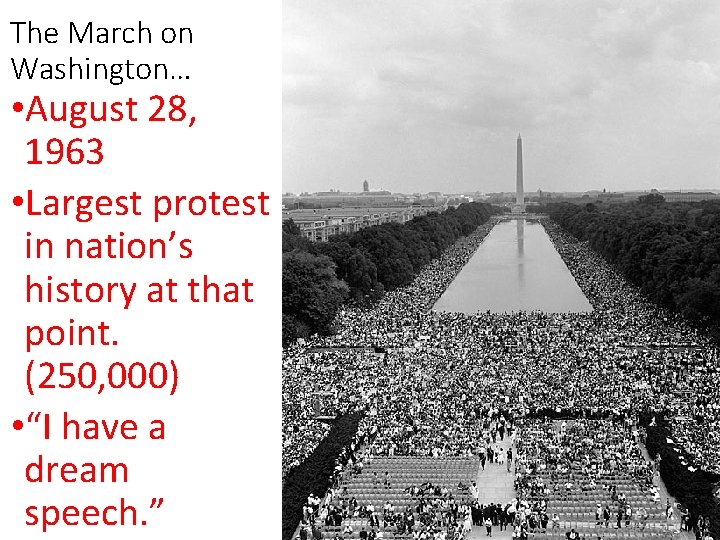
The March on Washington… • August 28, 1963 • Largest protest in nation’s history at that point. (250, 000) • “I have a dream speech. ”
Johnson and Civil Rights… • 24 th Amendment abolished the poll tax in federal elections. • Desegregate businesses • Equal Employment Opportunity Commission created to enforce the law. • Title VII: Discrimination based • Civil Rights Bill on race, religion gender and national of 1964 origin was illegal.
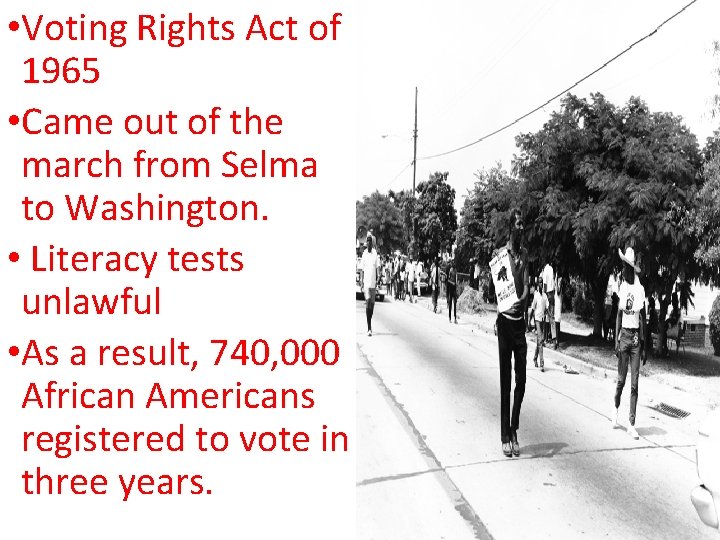
• Voting Rights Act of 1965 • Came out of the march from Selma to Washington. • Literacy tests unlawful • As a result, 740, 000 African Americans registered to vote in three years.
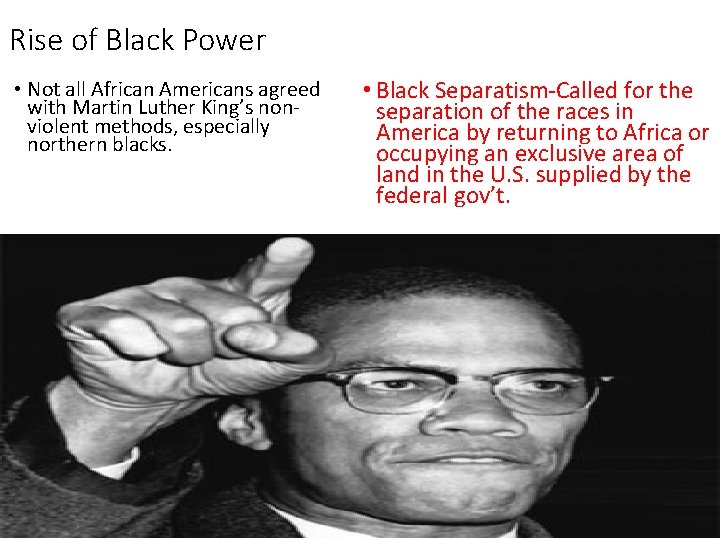
Rise of Black Power • Not all African Americans agreed with Martin Luther King’s nonviolent methods, especially northern blacks. • Black Separatism-Called for the separation of the races in America by returning to Africa or occupying an exclusive area of land in the U. S. supplied by the federal gov’t.
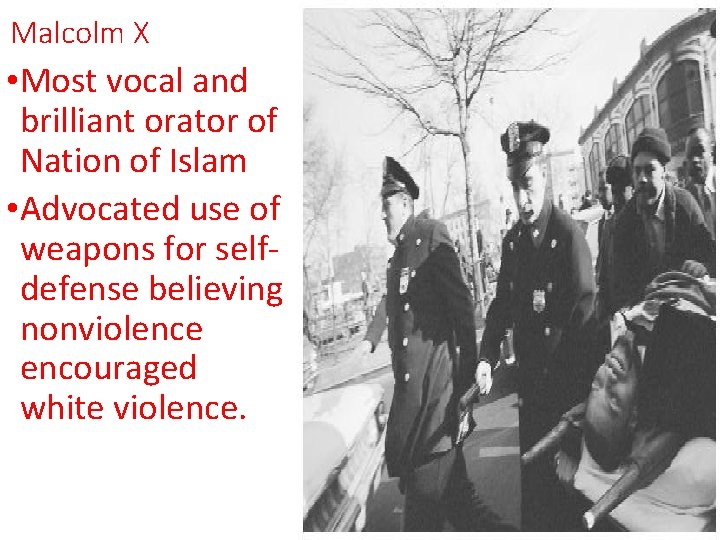
Malcolm X • Most vocal and brilliant orator of Nation of Islam • Advocated use of weapons for selfdefense believing nonviolence encouraged white violence.
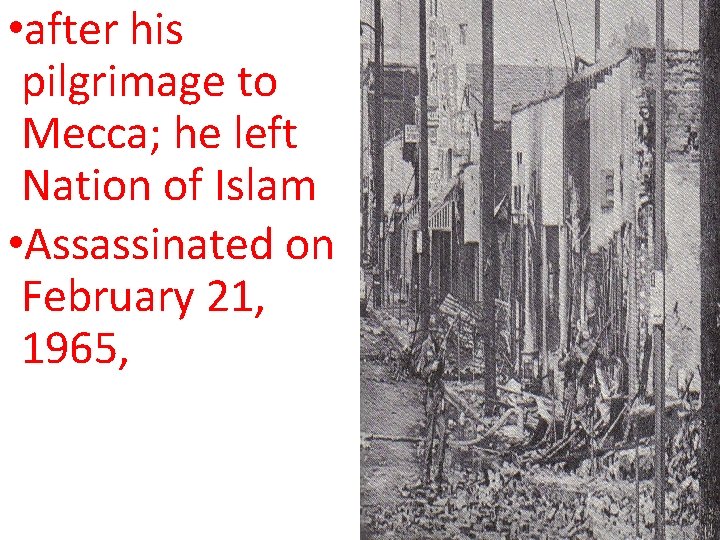
• after his pilgrimage to Mecca; he left Nation of Islam • Assassinated on February 21, 1965,
Racial Violence • SNCC becomes radical • Watts Riots, Los Angeles, August 11 • Black Panther party 16, 1965 formed. • 34 people dead, 1, 072 • Poverty, injured, 4, 000 unemployment, & arrested, 1, 000 racial discrimination buildings destroyed, common in major property loss nearly inner-cities. $40 million.
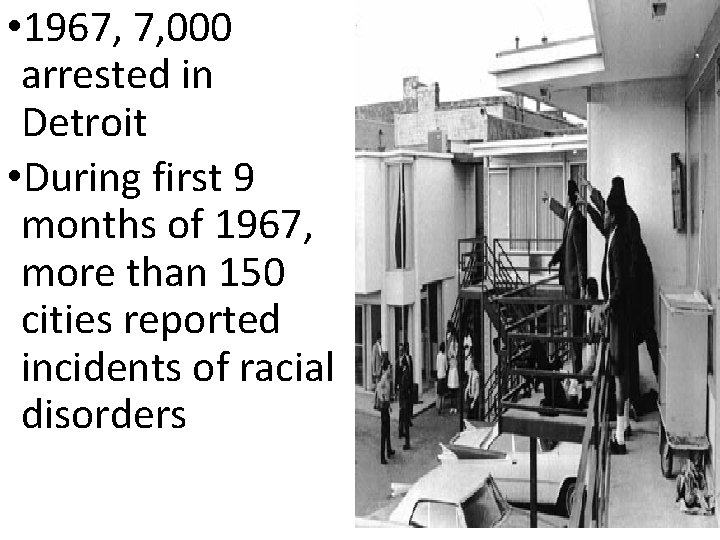
• 1967, 7, 000 arrested in Detroit • During first 9 months of 1967, more than 150 cities reported incidents of racial disorders
MLK, 1968 Please read but you don’t have to copy it down. • "It is not enough for me to stand before you tonight and condemn riots. It would be morally irresponsible for me to do that without, at the same time, condemning the contingent, intolerable conditions that exist in our society. These conditions are things that cause individuals to feel that they have no other alternative than to engage in violent rebellions to get attention. And I must say tonight that a riot is the language of the unheard. "
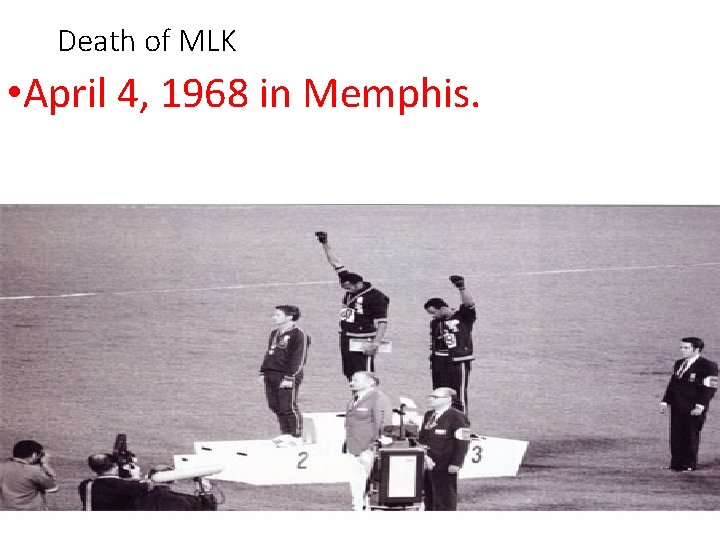
Death of MLK • April 4, 1968 in Memphis.
Social Protests of the 1960 s & 1970 s
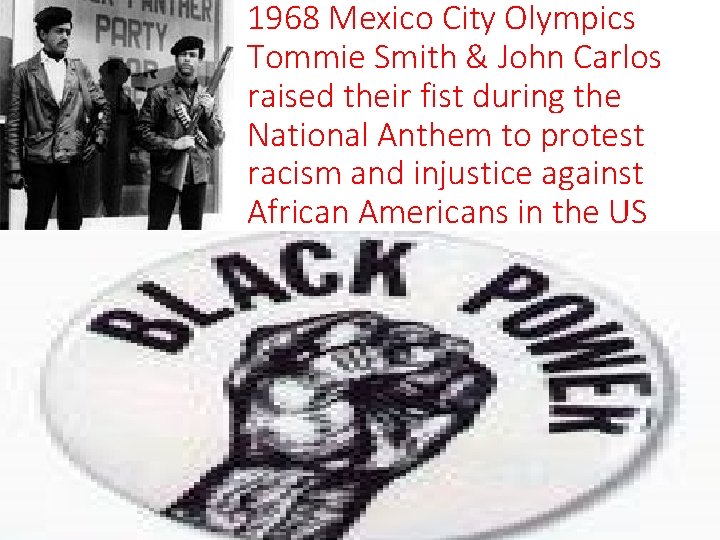
"Black Power" In the late 1960 s, civil rights from political to economic equality (more than 50% of northern blacks lived in poverty) Leadership shifted from MLK’s nonviolent protest to militancy Civil rights began to reflect the overt embrace of black culture & pride: rejection of “slave names, ” & the “black is beautiful” motto
1968 Mexico City Olympics Tommie Smith & John Carlos raised their fist during the National Anthem to protest racism and injustice against African Americans in the US
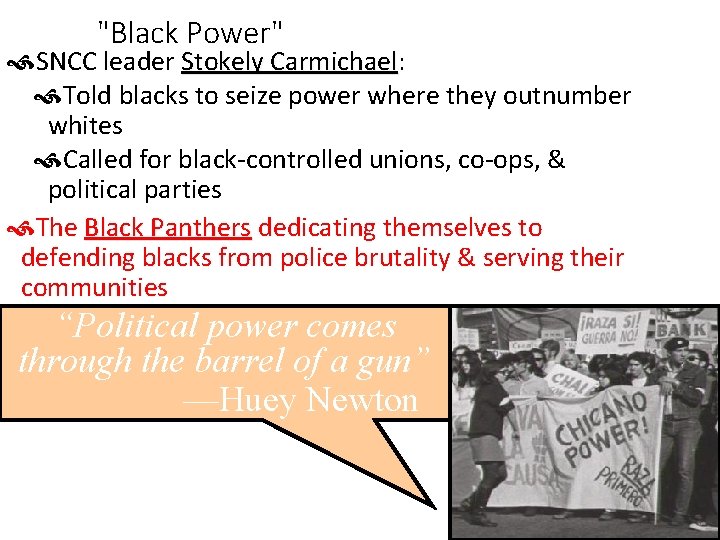
"Black Power" SNCC leader Stokely Carmichael: Carmichael Told blacks to seize power where they outnumber whites Called for black-controlled unions, co-ops, & political parties The Black Panthers dedicating themselves to defending blacks from police brutality & serving their communities “Political power comes through the barrel of a gun” —Huey Newton
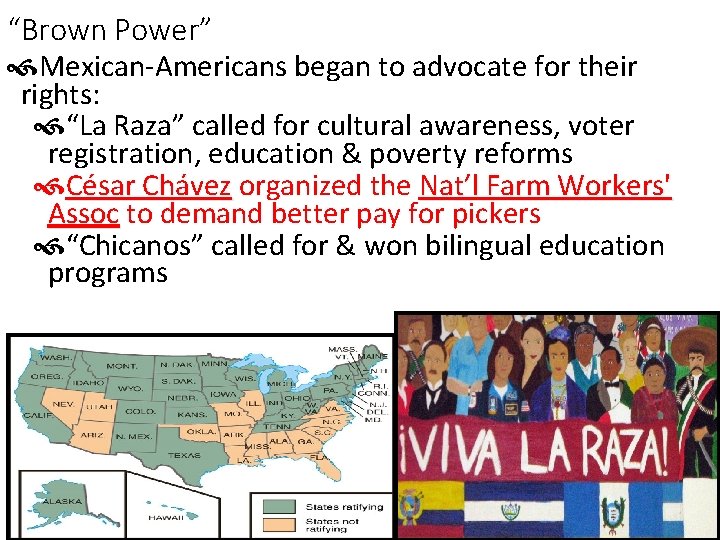
“Brown Power” Mexican-Americans began to advocate for their rights: “La Raza” called for cultural awareness, voter registration, education & poverty reforms César Chávez organized the Nat’l Farm Workers' Assoc to demand better pay for pickers “Chicanos” called for & won bilingual education programs
Feminist Movement • Arose during Civil Rights Movement • Betty Friedan: credited with inspiring the start of the modern women’s liberation movement • 1963, The Feminine Mystique, which explores the idea of women finding fulfillment beyond traditional roles • Co-founded the National Organization for Women in 1966, and served as its first president • NOW worked for rights of women • 1968 In November, NOW member Shirley Chisholm becomes the first Black woman elected to the U. S. House of Representatives. (runs for president in 1972)
Congress and Female Rights • Civil Rights Act of 1964: Title VII prohibits discrimination in employment on the basis of race, color, sex, national origin and religion • Congress passed "Title IX" (1972) which prohibited sex discrimination in any federally-funded educational program. This was best seen in the rise of girls' sports to equal boys'. • The proposed "Equal Rights Amendment" (ERA) passed Congress in 1972. ERA sought to legislate equality by stating equal rights can't be denied due to gender. • The leader against ERA was Phyllis Schlafly. She traveled the country advocating "STOP ERA" and advocating traditional roles for women. ERA failed in 1982, 3 states short of the needed 38.
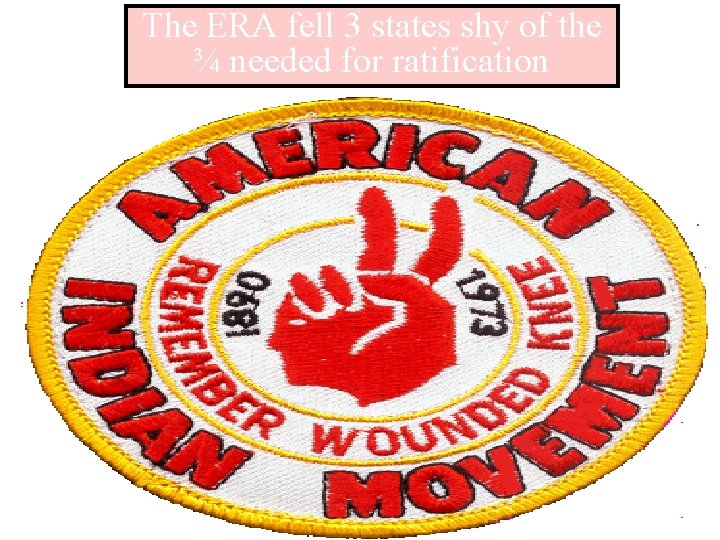
The. Voting ERA fell states State on 3 the ERAshy of the ¾ needed for ratification
Women began breaking important barriers • Sally Ride: first female astronaut in early 1980 s • Sandra Day O’Connor: first female Supreme Court justice (appointed by Reagan in 1981) • Geraldine Ferraro: first female vice presidential candidate for a major party (Democratic party in 1984)
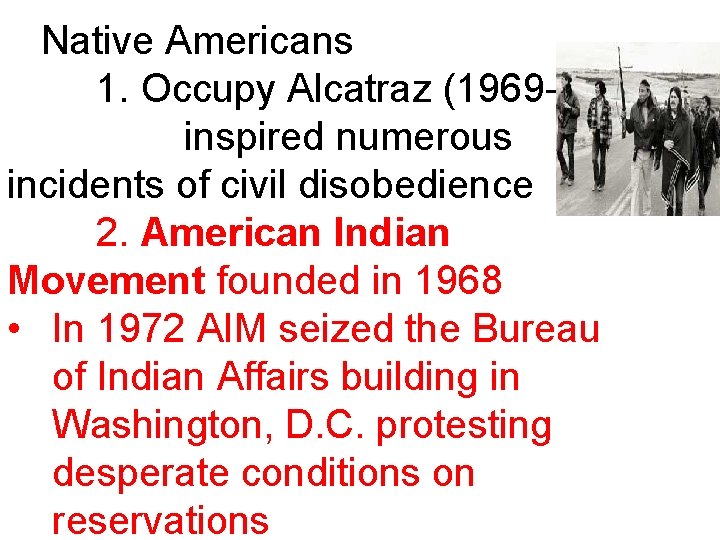
Native Americans 1. Occupy Alcatraz (1969 -71) inspired numerous incidents of civil disobedience 2. American Indian Movement founded in 1968 • In 1972 AIM seized the Bureau of Indian Affairs building in Washington, D. C. protesting desperate conditions on reservations
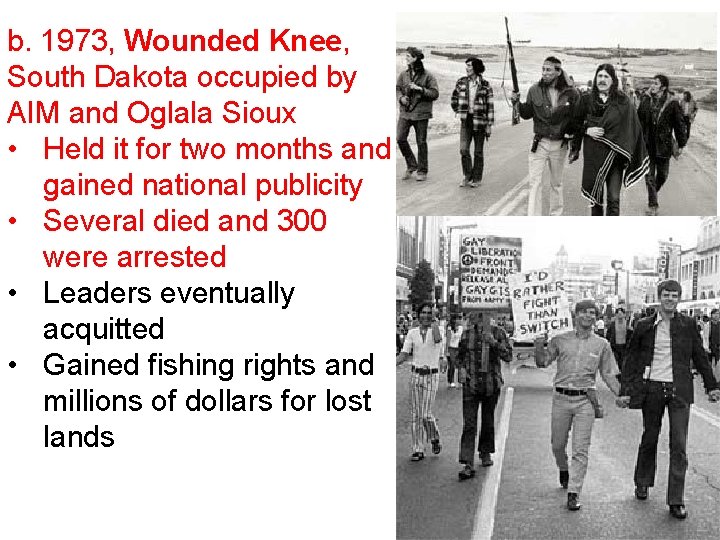
b. 1973, Wounded Knee, South Dakota occupied by AIM and Oglala Sioux • Held it for two months and gained national publicity • Several died and 300 were arrested • Leaders eventually acquitted • Gained fishing rights and millions of dollars for lost lands
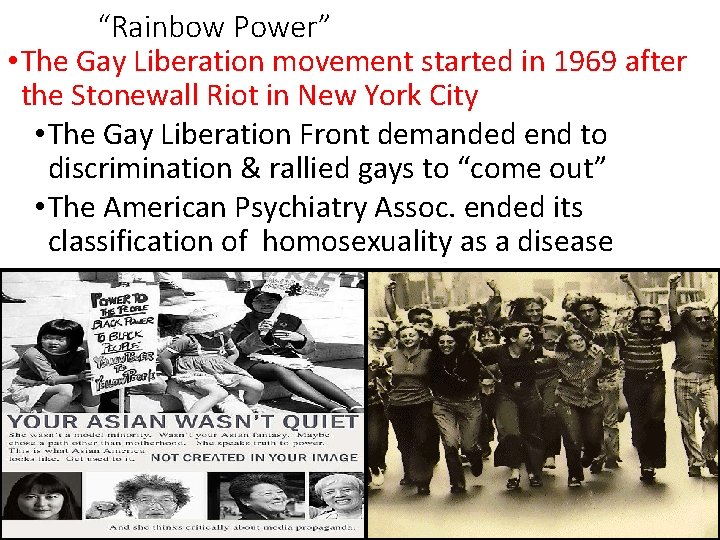
“Rainbow Power” • The Gay Liberation movement started in 1969 after the Stonewall Riot in New York City • The Gay Liberation Front demanded end to discrimination & rallied gays to “come out” • The American Psychiatry Assoc. ended its classification of homosexuality as a disease
“Yellow Power” • The Asian-American movement began with the formation of the Asian American Political Alliance: • Protested U. S. involvement in Vietnam & use of term “gooks” • Called for & received Asian-American studies in colleges, health services in Asian communities, & reparations for interned Japanese-Americans