
Civil Rights Movement Martin Luther King Jr Civil
- Slides: 16
Civil Rights Movement & Martin Luther King Jr
Civil Rights movement
Background • Political movement aiming to ensure equal rights for everyone, equal protection by the law for everyone • Started by Afro Americans, frustrated by inequalities between black and white citizens • Slavery was stopped by Civil War, still segregation and racism in America • Policies ensuring rights for Black people fail, resulting in the movement
Who was involved? • Martin Luther King Jr (held speeches, led peaceful protests, formed an organisation to get equal rights for black people) • Frederik Douglass • Jesse Jackson • Malcolm X were leaders of the civil rights movement
Duration • Started in 1954 • Ended in 1968 • 14 years long
Key events • Montgomery Bus Boycott December 1, 1955 • Little Rock Nine September 3, 1957 (nine black students in a school, had to be escorted by federal troops to enter the school) • Civil Rights Act September 9, 1957 (signed by Eisenhower; federal prosecution of anyone who tried to prevent someone form voting; commission to investigate voter fraud) • Woolworths Lunch Counter February 1, 1960 (Four students weren't served in Greensboro, North Carolina, resisted; peaceful resistance with hundreds of people over the next days)
Was it successful? • In many ways successful, end in segregation in transport, mainly buses; segregation in schools is illegal; increase in Civil Rights movement acts; Voting law passed in 1965; Interracial marriages legal in 1967; Fair Housing Act 1968 made racial discrimination in housing illegal; still a lot of discrimination against black people afterwards; hugely impacted racial equality and gave a lot more rights to black people
Martin Luther King
• Original name: Michael King, Jr • Born January 15, 1929 (Atlanta, Georgia) • Died April 4, 1968 (Memphis, Tennessee) He was a Bapist minister and social activist who led the civil rights movement in the Unite States from the mid-1950 s until his death from assassination in 1968.
The Montgomery Bus Boycott • The King family had only been living in Montgomery for less than a year when the segregated city became the epicentre of struggle for civil rights in America, Supported by the Brown v Board of Education of 1954. On 1 st December, 1955, Rosa Parks refused to give up her seat to a white passenger (on a Montgomery Bus) and was arrested. Local activists organised a bus boycott that would continue for 381 days. This boycott inflicted a severe economic strain on the public transport system and local business owners. Martin Luther King, Jr was chosen as the protests leader and spokesman. In November of 1956, the Supreme Court ruled segregated seating on public buses as unconstitutional and Martin Luther King had become nationally recognised an inspirational figure for organised, nonviolent resistance. Kings protests led to him becoming the target of many white supremacists and was the victim of many hate crimes, such as when white supremacists firebombed his family home.
Izola Ware Curry • On September 20, 1958, Izola Ware Curry walked into a store where King was signing books and asked, "are you Martin Luther King? " Once he identified himself, She stabbed him in the chest with a knife. Fortunately, King survived the attempted assassination of which reinforced his dedication to nonviolence. Later that week, King said " The experience of these Last few days has deepened my faith in the relevance of the spirit of nonviolence, if necessary social change is peacefully to take place".
Southern Christian Leadership Conference • Encouraged by the success of the Bus Boycott, King and other civil rights activists founded the Southern Christian Leadership Conference (SCLC), a group committed to achieving equality for African Americans through nonviolent protests. The motto: "Not one hair of one head of one person should be harmed". King remained an active member his entire life until death. As the SCLC president, King travelled around the world giving lectures on nonviolent protest and civil rights as well as meeting with political figures, activists and political leaders. During a trip to India, he met the family members and followers of Gandhi, the man he described as "the guiding light of our technique of nonviolent social change".
March On Washington • In 1963, King worked with a number of civil rights and religious groups to organise the March On Washington for Jobs and Freedom. It was a peaceful rally designed to shed light on the lack of equality for African Americans. It was held on 28 th of August and was attended by 200, 000 to 300, 000 people, the well-known event is widely regarded as a key historical event of the American Civil Rights Movement. The March presented us with the famous speech known as the "I have a dream" speech. In his speech he shared his vision of a future, "This nation will rise up and live out the true meaning of its creed: 'We hold these truths to be self-evident, that all men are created equal. '" The march and the speech cemented Kings reputation locally and globally. Later that year he was named the "Man of the Year by Time Magazine and became the youngest person to ever win a Nobel Peace Prize in 1964. In 1965, Kings elevated profile drew international attention to the violence that erupted between white segregationists and peaceful demonstrators in Selma, Alabama, where the SCLC and SNCC had organised a voter registration campaign. The scene was captured on television and outraged many Americans and inspired supporters to gather in Alabama and take part in the Selma to Montgomery March. That August, Congress passed the Voting Rights Act, which guaranteed the right to vote to all African Americans.
Assassination • - As more militant black leaders such as Stokely Carmichael rose to prominence, King Broadened the scope of his activism to address issues such as the Vietnam War and poverty among Americans of all races. King and the SCLC created an ambitious program known as the Poor Peoples Campaign, which was to include a massive march on the capital. On the evening of April 4, 1968, Martin Luther King was fatally shot while standing on the balcony of a motel in Memphis, where he had travelled to support a sanitation workers' strike. In wake of his death, riots swept major cities across the country and President Johnson declared a national day of mourning. James Earl Ray, an escaped convict and known racist, pleaded guilty to the murder and was sentenced to 99 years in prison. He later renounced his confession and gained several advocates, including members of the king family.
MLK Day • After years of activists campaigning, members of the congress and Coretta Scott King, among others, in 1983 President Ronald Reagan signed a bill creating U. S federal holiday in honour of Martin Luther King day takes place on the third Monday of January. MLK day was first celebrated in 1986.
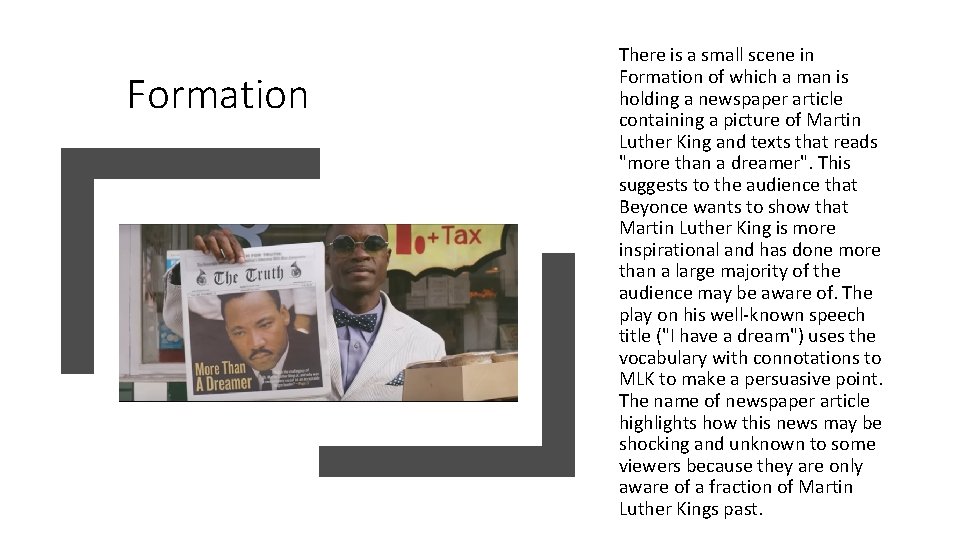
Formation There is a small scene in Formation of which a man is holding a newspaper article containing a picture of Martin Luther King and texts that reads "more than a dreamer". This suggests to the audience that Beyonce wants to show that Martin Luther King is more inspirational and has done more than a large majority of the audience may be aware of. The play on his well-known speech title ("I have a dream") uses the vocabulary with connotations to MLK to make a persuasive point. The name of newspaper article highlights how this news may be shocking and unknown to some viewers because they are only aware of a fraction of Martin Luther Kings past.