
Civil Rights Movement Jim Crow Laws Segregation laws
- Slides: 44
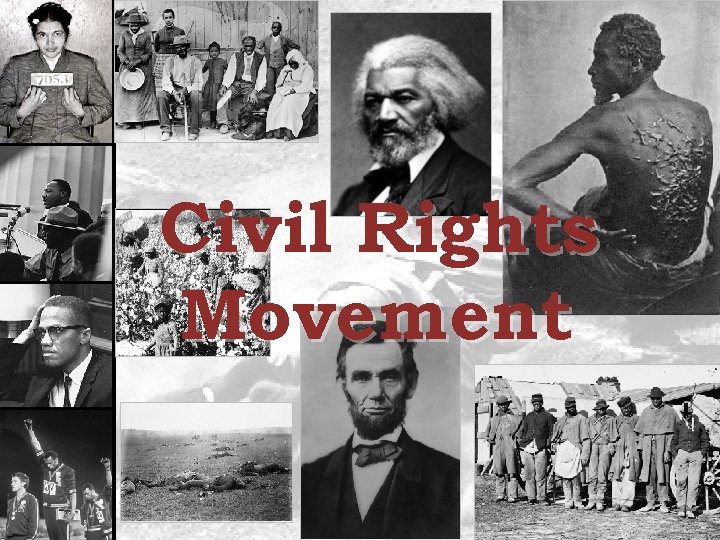
Civil Rights Movement
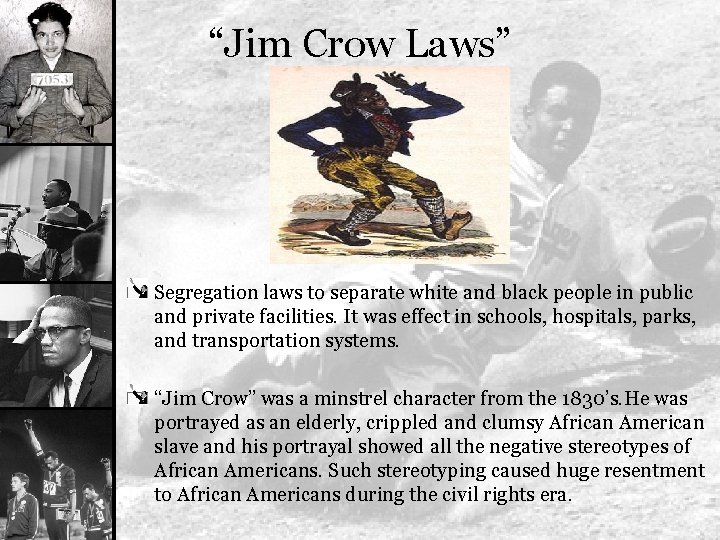
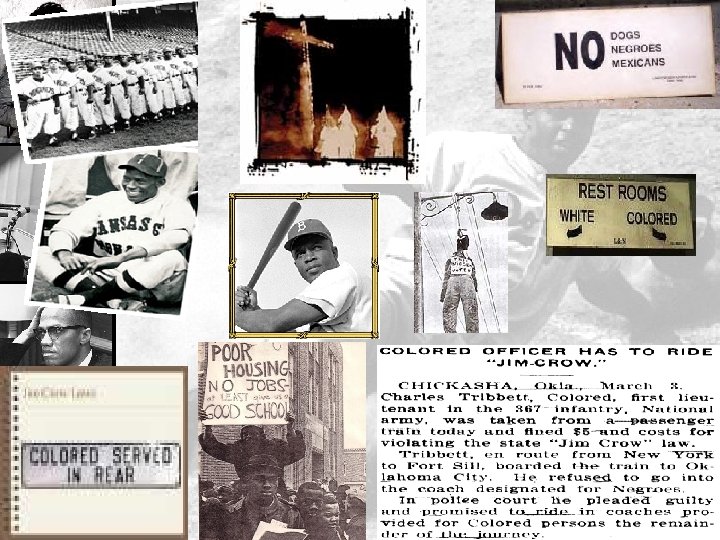
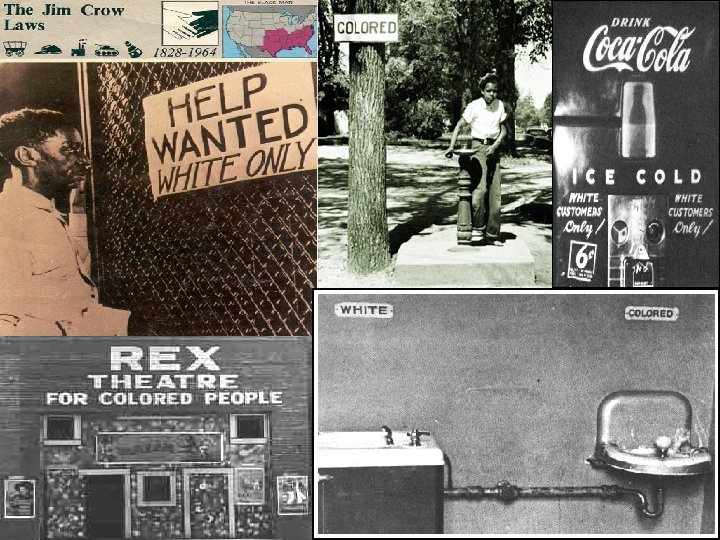
“Jim Crow Laws” Segregation laws to separate white and black people in public and private facilities. It was effect in schools, hospitals, parks, and transportation systems. “Jim Crow” was a minstrel character from the 1830’s. He was portrayed as an elderly, crippled and clumsy African American slave and his portrayal showed all the negative stereotypes of African Americans. Such stereotyping caused huge resentment to African Americans during the civil rights era.
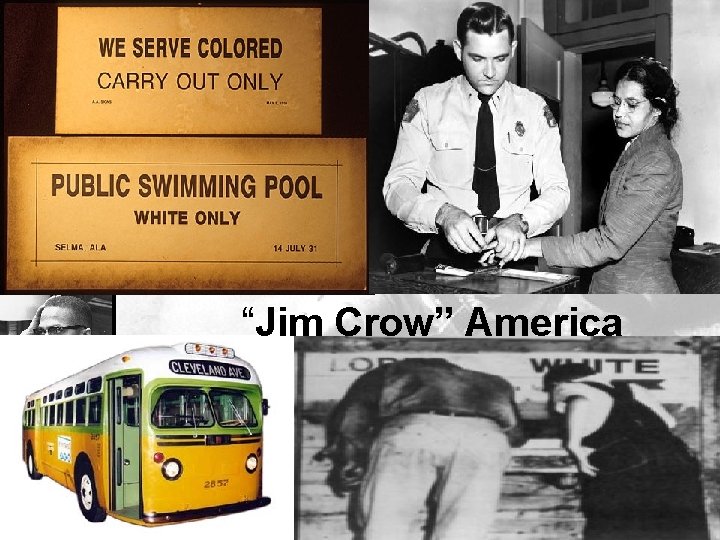
“Jim Crow” America
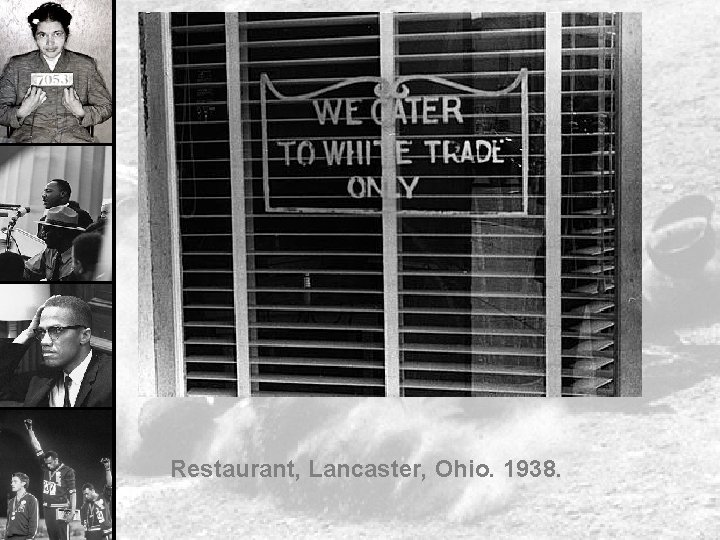
Restaurant, Lancaster, Ohio. 1938.
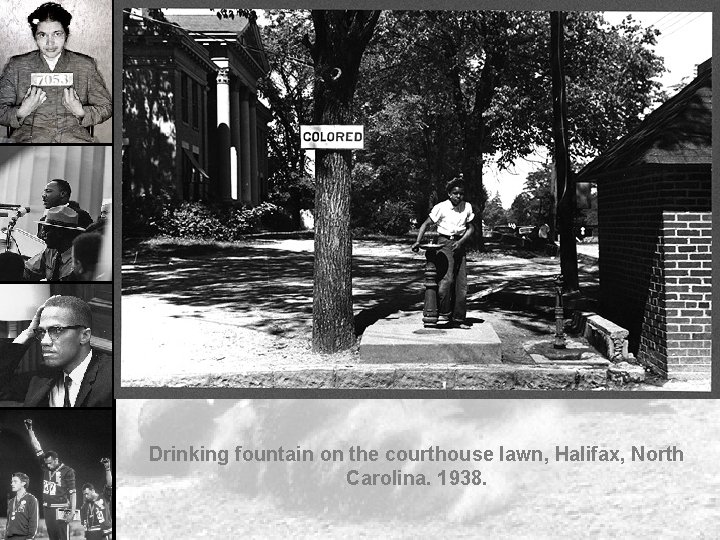
Drinking fountain on the courthouse lawn, Halifax, North Carolina. 1938.
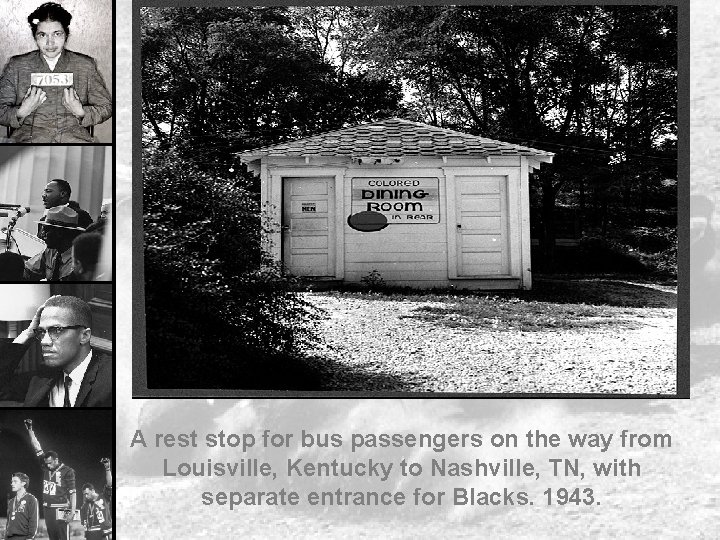
A rest stop for bus passengers on the way from Louisville, Kentucky to Nashville, TN, with separate entrance for Blacks. 1943.
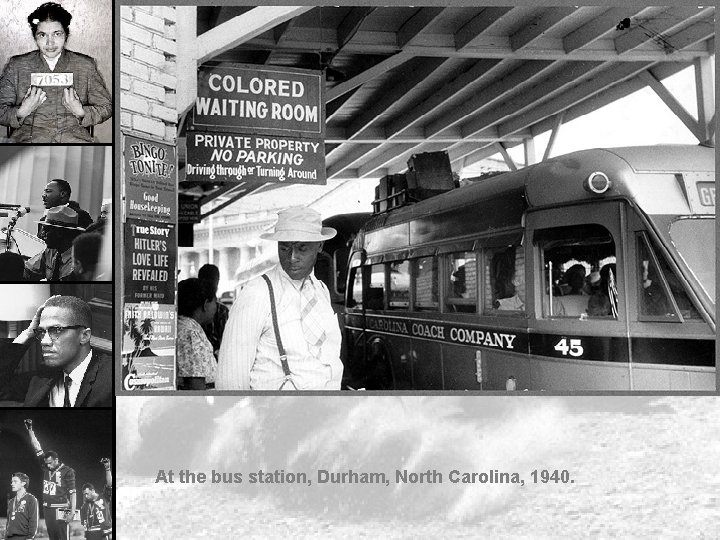
At the bus station, Durham, North Carolina, 1940.
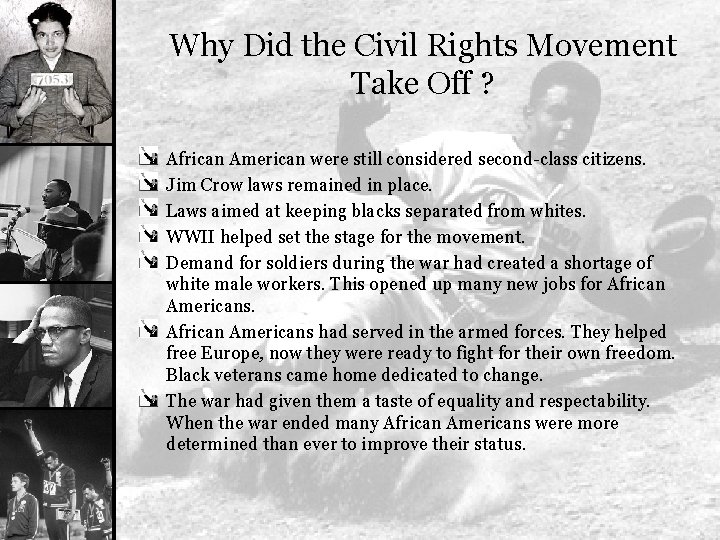
Why Did the Civil Rights Movement Take Off ? African American were still considered second-class citizens. Jim Crow laws remained in place. Laws aimed at keeping blacks separated from whites. WWII helped set the stage for the movement. Demand for soldiers during the war had created a shortage of white male workers. This opened up many new jobs for African Americans had served in the armed forces. They helped free Europe, now they were ready to fight for their own freedom. Black veterans came home dedicated to change. The war had given them a taste of equality and respectability. When the war ended many African Americans were more determined than ever to improve their status.
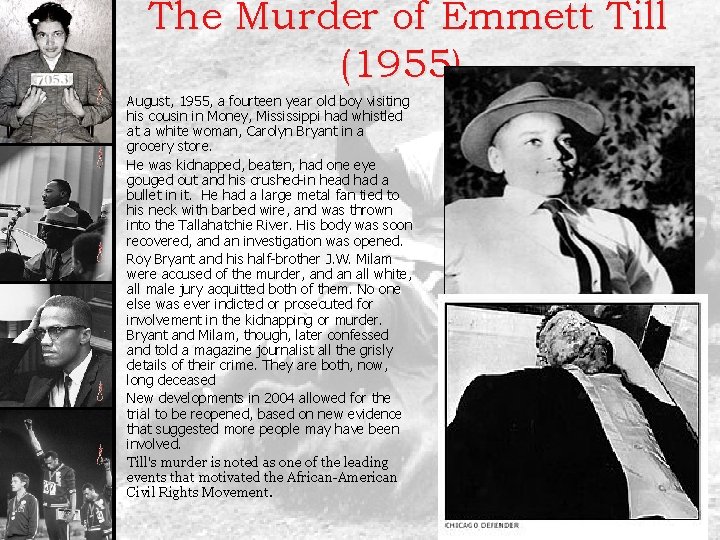
The Murder of Emmett Till (1955) August, 1955, a fourteen year old boy visiting his cousin in Money, Mississippi had whistled at a white woman, Carolyn Bryant in a grocery store. He was kidnapped, beaten, had one eye gouged out and his crushed-in head had a bullet in it. He had a large metal fan tied to his neck with barbed wire, and was thrown into the Tallahatchie River. His body was soon recovered, and an investigation was opened. Roy Bryant and his half-brother J. W. Milam were accused of the murder, and an all white, all male jury acquitted both of them. No one else was ever indicted or prosecuted for involvement in the kidnapping or murder. Bryant and Milam, though, later confessed and told a magazine journalist all the grisly details of their crime. They are both, now, long deceased New developments in 2004 allowed for the trial to be reopened, based on new evidence that suggested more people may have been involved. Till's murder is noted as one of the leading events that motivated the African-American Civil Rights Movement.
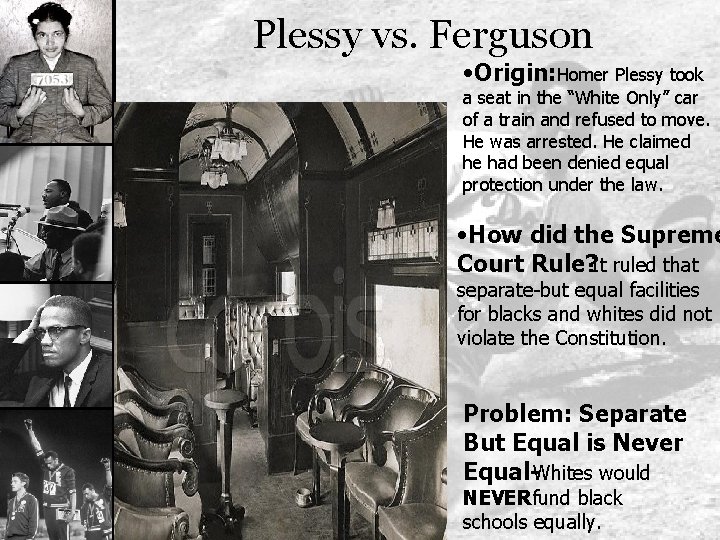
Plessy vs. Ferguson • Origin: Homer Plessy took a seat in the “White Only” car of a train and refused to move. He was arrested. He claimed he had been denied equal protection under the law. • How did the Supreme Court Rule? It ruled that separate-but equal facilities for blacks and whites did not violate the Constitution. Problem: Separate But Equal is Never Equal-Whites would NEVERfund black schools equally.
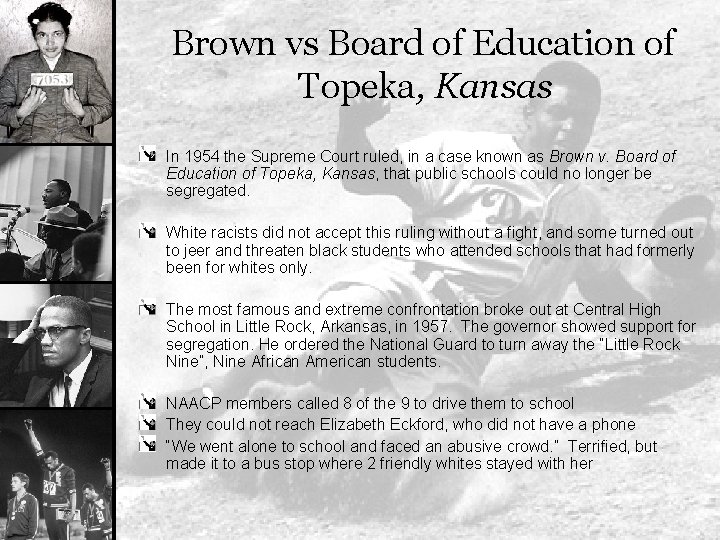
Brown vs Board of Education of Topeka, Kansas In 1954 the Supreme Court ruled, in a case known as Brown v. Board of Education of Topeka, Kansas, that public schools could no longer be segregated. White racists did not accept this ruling without a fight, and some turned out to jeer and threaten black students who attended schools that had formerly been for whites only. The most famous and extreme confrontation broke out at Central High School in Little Rock, Arkansas, in 1957. The governor showed support for segregation. He ordered the National Guard to turn away the “Little Rock Nine”, Nine African American students. NAACP members called 8 of the 9 to drive them to school They could not reach Elizabeth Eckford, who did not have a phone “We went alone to school and faced an abusive crowd. ” Terrified, but made it to a bus stop where 2 friendly whites stayed with her
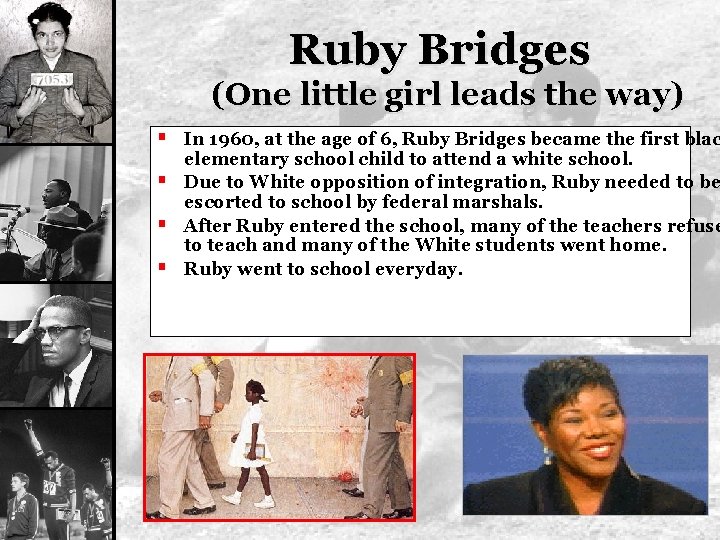
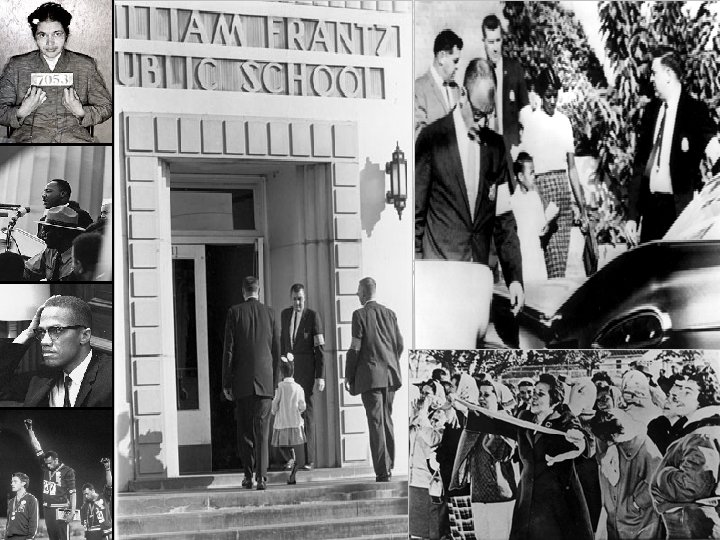
Ruby Bridges (One little girl leads the way) § In 1960, at the age of 6, Ruby Bridges became the first blac § § § elementary school child to attend a white school. Due to White opposition of integration, Ruby needed to be escorted to school by federal marshals. After Ruby entered the school, many of the teachers refuse to teach and many of the White students went home. Ruby went to school everyday.
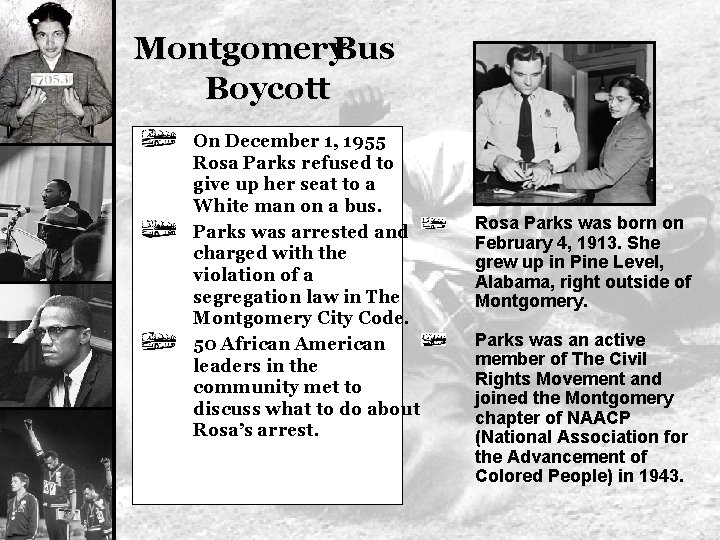
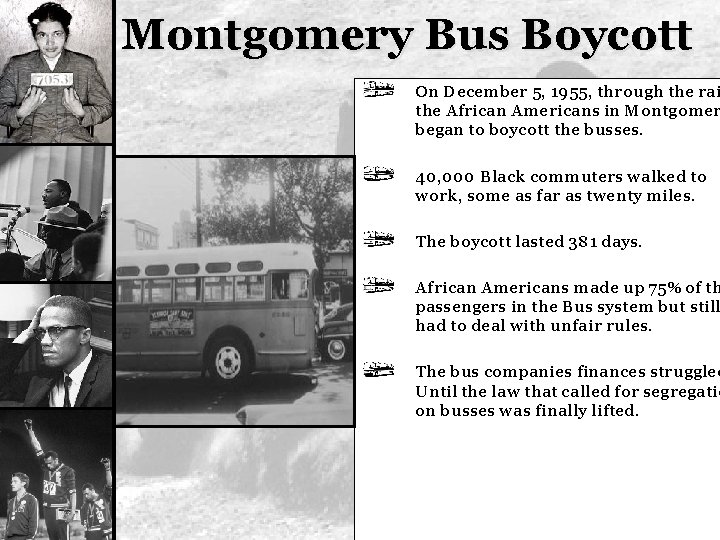
Montgomery. Bus Boycott On December 1, 1955 Rosa Parks refused to give up her seat to a White man on a bus. Parks was arrested and charged with the violation of a segregation law in The Montgomery City Code. 50 African American leaders in the community met to discuss what to do about Rosa’s arrest. Rosa Parks was born on February 4, 1913. She grew up in Pine Level, Alabama, right outside of Montgomery. Parks was an active member of The Civil Rights Movement and joined the Montgomery chapter of NAACP (National Association for the Advancement of Colored People) in 1943.
Montgomery Bus Boycott On December 5, 1955, through the rai the African Americans in Montgomer began to boycott the busses. 40, 000 Black commuters walked to work, some as far as twenty miles. The boycott lasted 381 days. African Americans made up 75% of th passengers in the Bus system but still had to deal with unfair rules. The bus companies finances struggled Until the law that called for segregatio on busses was finally lifted.
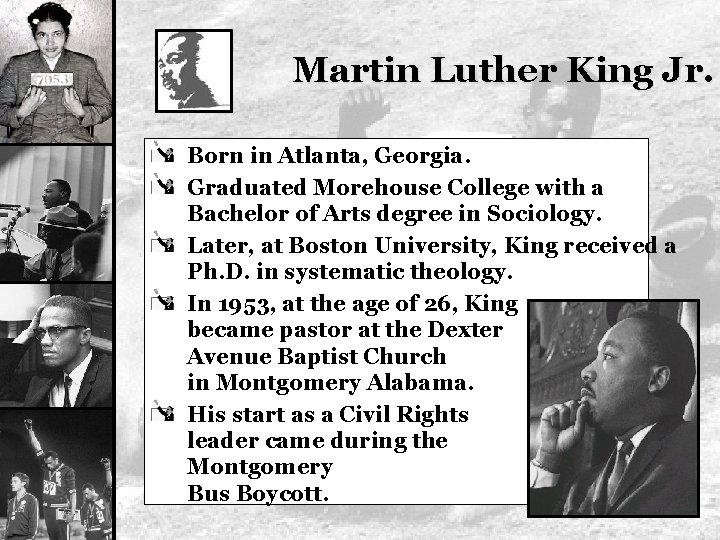
Martin Luther King Jr. Born in Atlanta, Georgia. Graduated Morehouse College with a Bachelor of Arts degree in Sociology. Later, at Boston University, King received a Ph. D. in systematic theology. In 1953, at the age of 26, King became pastor at the Dexter Avenue Baptist Church in Montgomery Alabama. His start as a Civil Rights leader came during the Montgomery Bus Boycott.
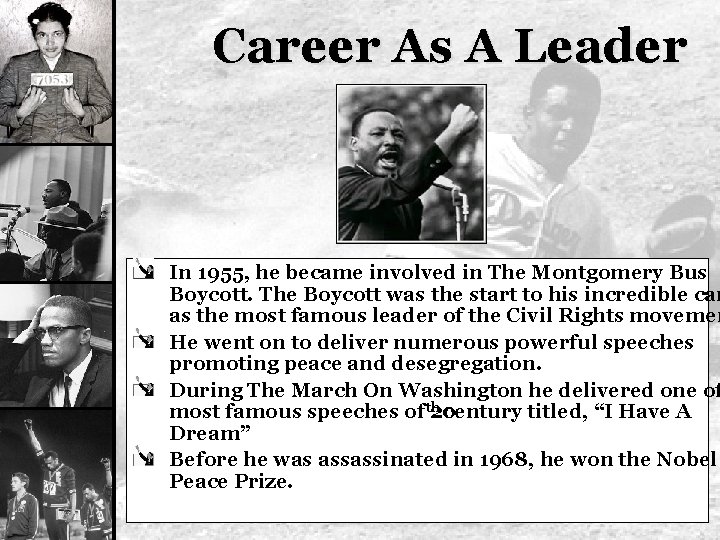
Career As A Leader In 1955, he became involved in The Montgomery Bus Boycott. The Boycott was the start to his incredible car as the most famous leader of the Civil Rights movemen He went on to deliver numerous powerful speeches promoting peace and desegregation. During The March On Washington he delivered one of most famous speeches of th 20 century titled, “I Have A Dream” Before he was assassinated in 1968, he won the Nobel Peace Prize.
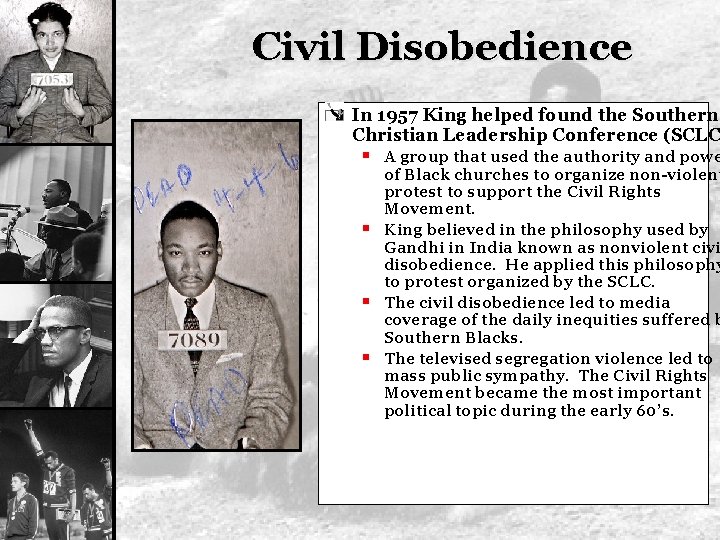
Civil Disobedience In 1957 King helped found the Southern Christian Leadership Conference (SCLC § A group that used the authority and powe § § § of Black churches to organize non-violent protest to support the Civil Rights Movement. King believed in the philosophy used by Gandhi in India known as nonviolent civi disobedience. He applied this philosophy to protest organized by the SCLC. The civil disobedience led to media coverage of the daily inequities suffered b Southern Blacks. The televised segregation violence led to mass public sympathy. The Civil Rights Movement became the most important political topic during the early 60’s.
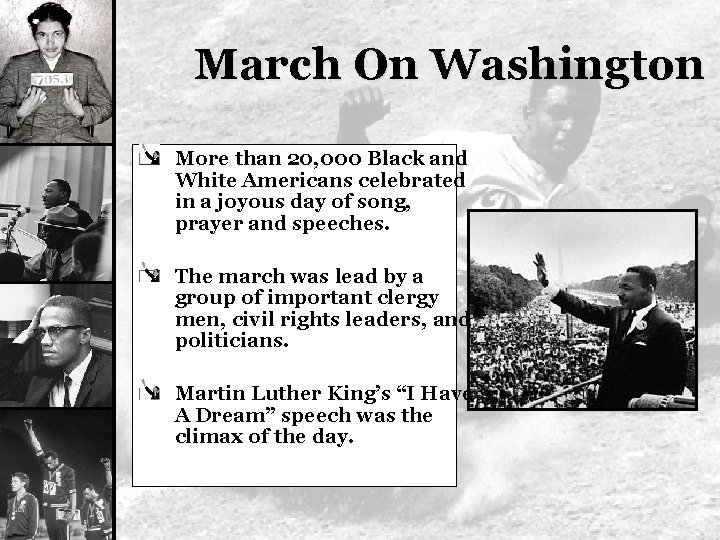
March On Washington More than 20, 000 Black and White Americans celebrated in a joyous day of song, prayer and speeches. The march was lead by a group of important clergy men, civil rights leaders, and politicians. Martin Luther King’s “I Have A Dream” speech was the climax of the day.
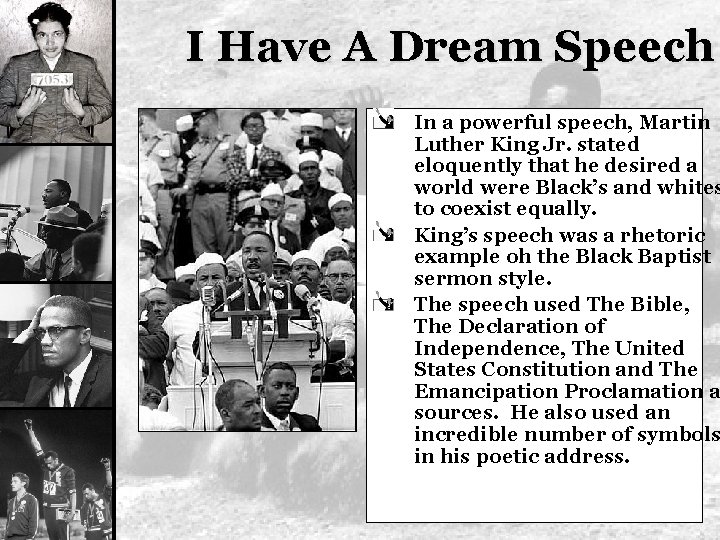
I Have A Dream Speech In a powerful speech, Martin Luther King Jr. stated eloquently that he desired a world were Black’s and whites to coexist equally. King’s speech was a rhetoric example oh the Black Baptist sermon style. The speech used The Bible, The Declaration of Independence, The United States Constitution and The Emancipation Proclamation a sources. He also used an incredible number of symbols in his poetic address.
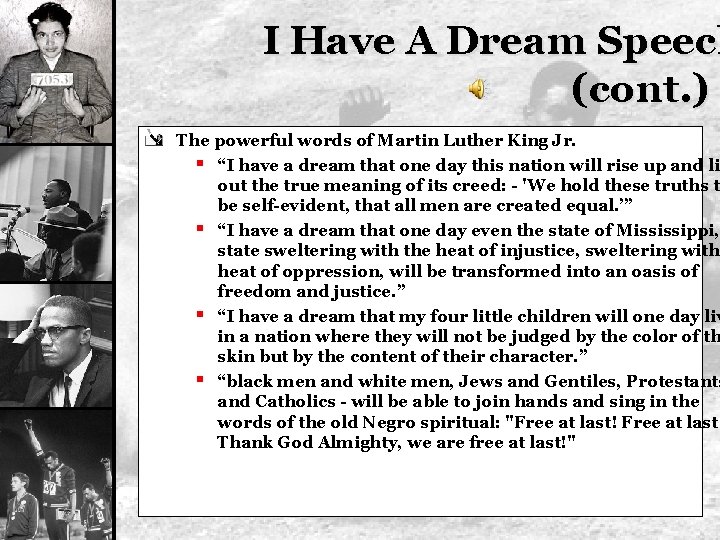
I Have A Dream Speech (cont. ) The powerful words of Martin Luther King Jr. § “I have a dream that one day this nation will rise up and liv out the true meaning of its creed: - 'We hold these truths to be self-evident, that all men are created equal. ’” § “I have a dream that one day even the state of Mississippi, state sweltering with the heat of injustice, sweltering with heat of oppression, will be transformed into an oasis of freedom and justice. ” § “I have a dream that my four little children will one day liv in a nation where they will not be judged by the color of th skin but by the content of their character. ” § “black men and white men, Jews and Gentiles, Protestants and Catholics - will be able to join hands and sing in the words of the old Negro spiritual: "Free at last! Thank God Almighty, we are free at last!"
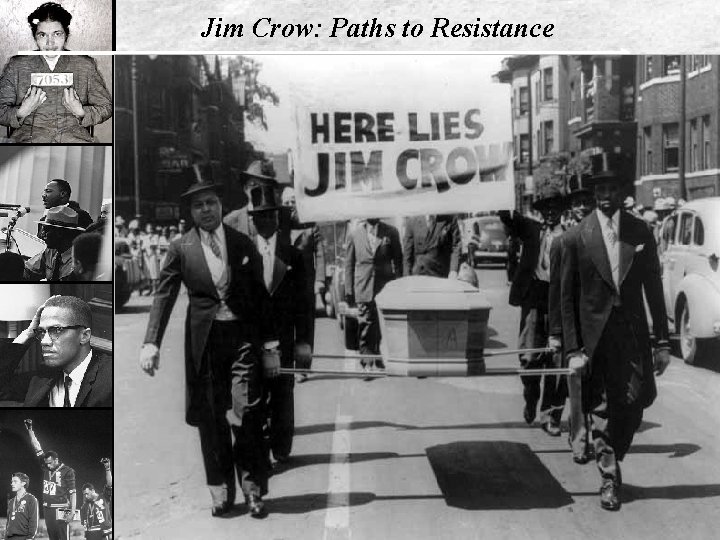
Jim Crow: Paths to Resistance
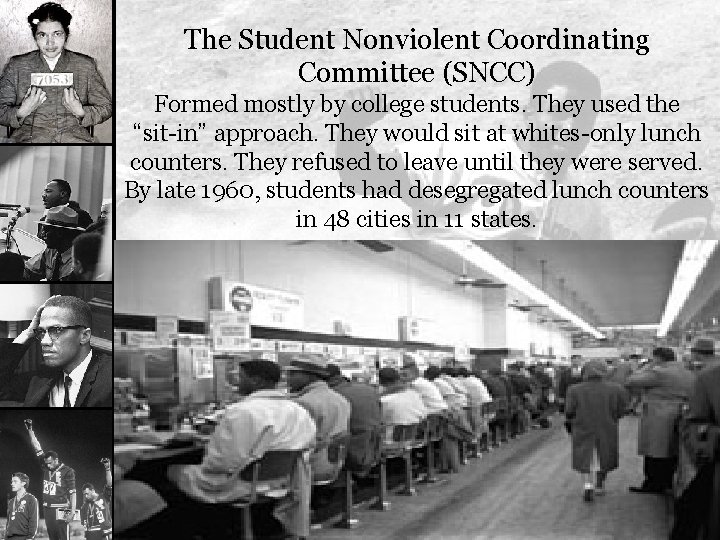
The Student Nonviolent Coordinating Committee (SNCC) Formed mostly by college students. They used the “sit-in” approach. They would sit at whites-only lunch counters. They refused to leave until they were served. By late 1960, students had desegregated lunch counters in 48 cities in 11 states.
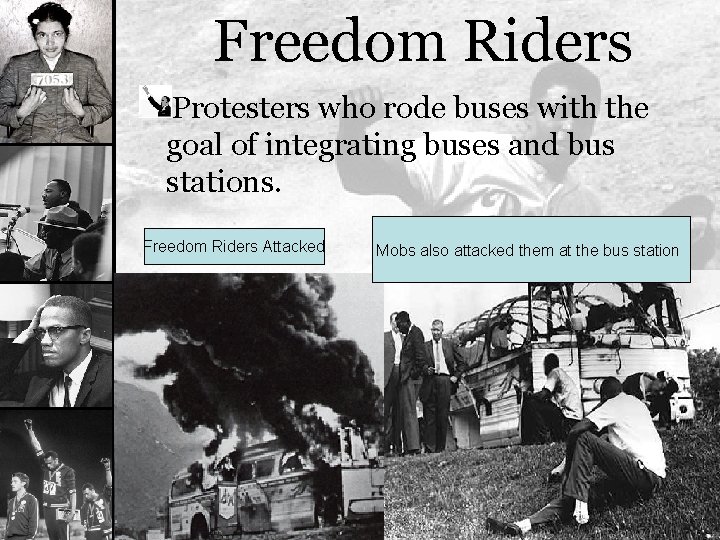
Freedom Riders Protesters who rode buses with the goal of integrating buses and bus stations. Freedom Riders Attacked Mobs also attacked them at the bus station
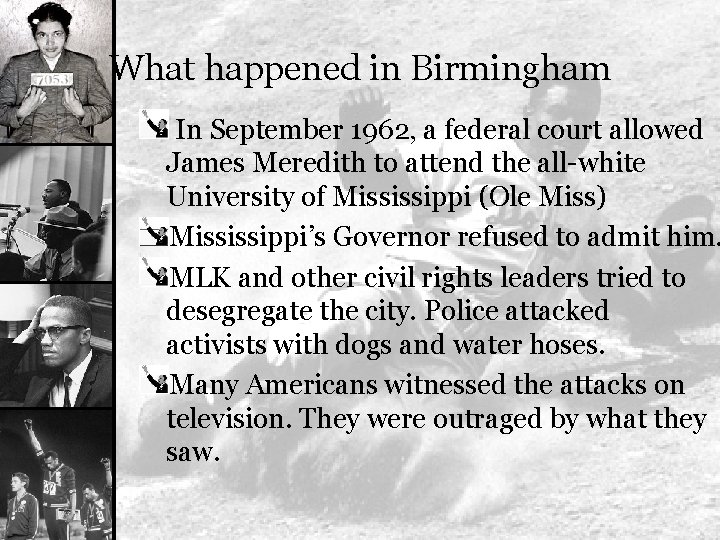
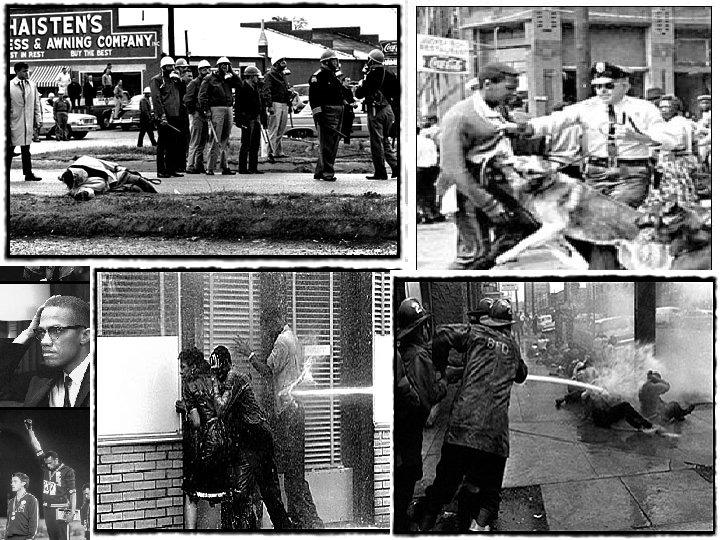
What happened in Birmingham In September 1962, a federal court allowed James Meredith to attend the all-white University of Mississippi (Ole Miss) Mississippi’s Governor refused to admit him. MLK and other civil rights leaders tried to desegregate the city. Police attacked activists with dogs and water hoses. Many Americans witnessed the attacks on television. They were outraged by what they saw.
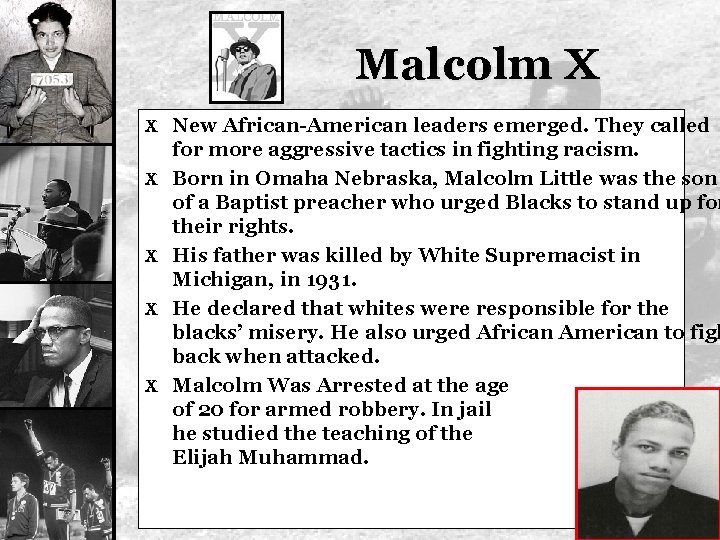
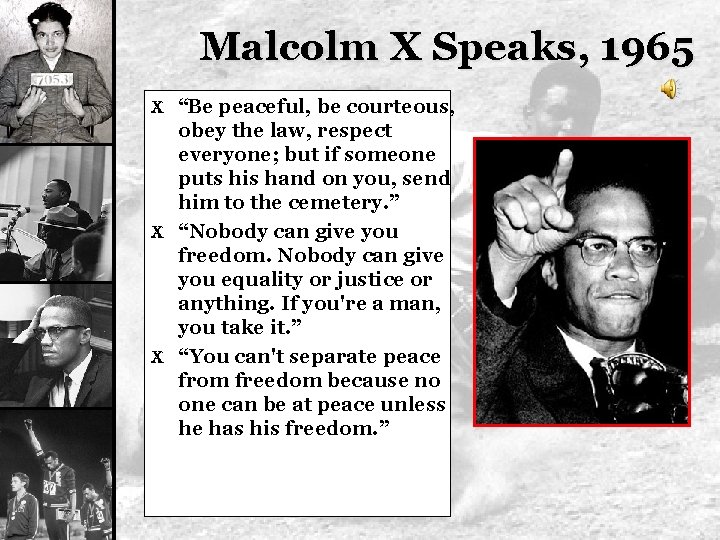
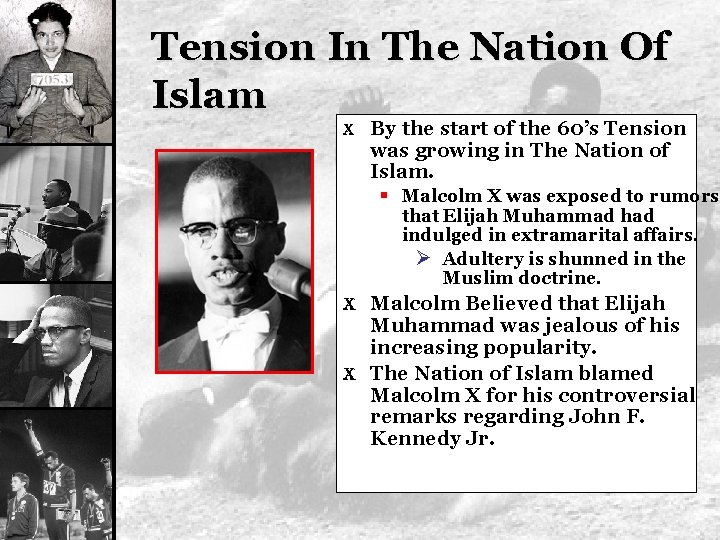
Malcolm X X New African-American leaders emerged. They called X X for more aggressive tactics in fighting racism. Born in Omaha Nebraska, Malcolm Little was the son of a Baptist preacher who urged Blacks to stand up for their rights. His father was killed by White Supremacist in Michigan, in 1931. He declared that whites were responsible for the blacks’ misery. He also urged African American to figh back when attacked. Malcolm Was Arrested at the age of 20 for armed robbery. In jail he studied the teaching of the Elijah Muhammad.
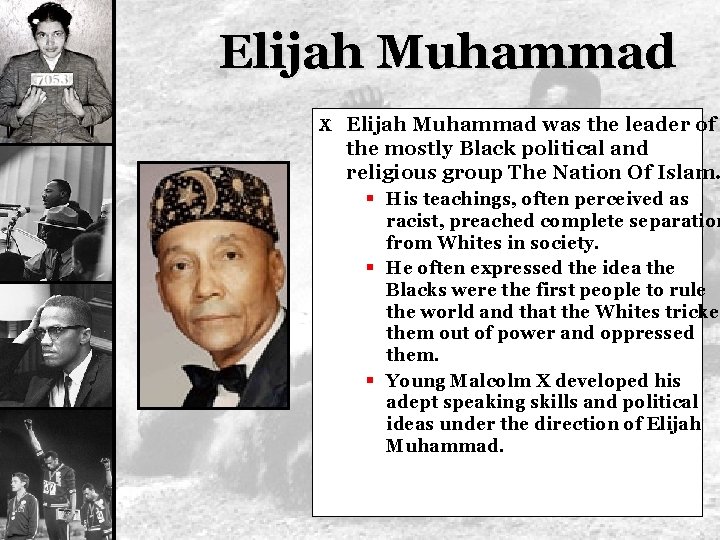
Elijah Muhammad X Elijah Muhammad was the leader of the mostly Black political and religious group The Nation Of Islam. § His teachings, often perceived as racist, preached complete separation from Whites in society. § He often expressed the idea the Blacks were the first people to rule the world and that the Whites tricked them out of power and oppressed them. § Young Malcolm X developed his adept speaking skills and political ideas under the direction of Elijah Muhammad.
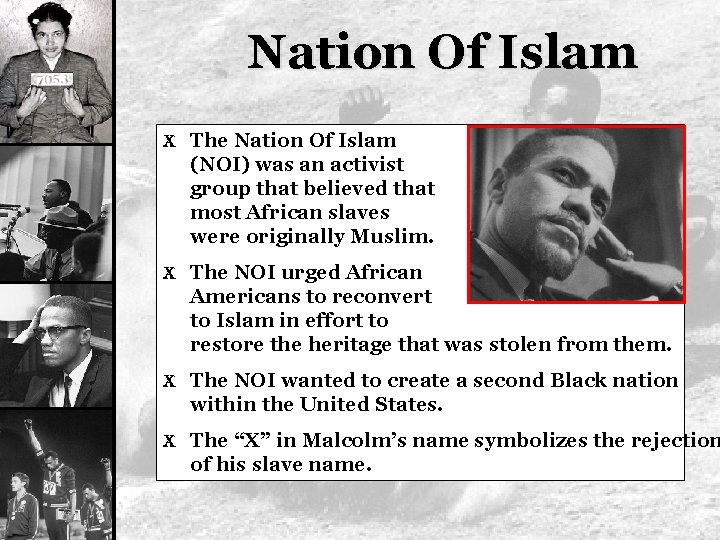
Nation Of Islam X The Nation Of Islam (NOI) was an activist group that believed that most African slaves were originally Muslim. X The NOI urged African Americans to reconvert to Islam in effort to restore the heritage that was stolen from them. X The NOI wanted to create a second Black nation within the United States. X The “X” in Malcolm’s name symbolizes the rejection of his slave name.
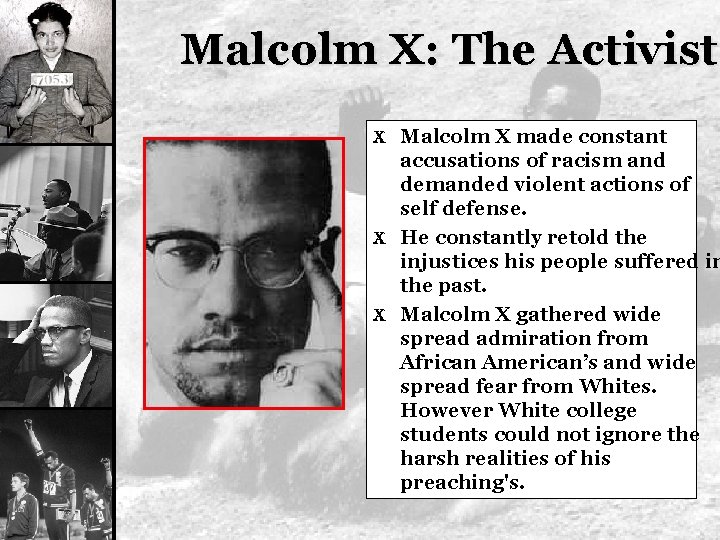
Malcolm X: The Activist X Malcolm X made constant accusations of racism and demanded violent actions of self defense. X He constantly retold the injustices his people suffered in the past. X Malcolm X gathered wide spread admiration from African American’s and wide spread fear from Whites. However White college students could not ignore the harsh realities of his preaching's.
Malcolm X Speaks, 1965 X “Be peaceful, be courteous, obey the law, respect everyone; but if someone puts his hand on you, send him to the cemetery. ” X “Nobody can give you freedom. Nobody can give you equality or justice or anything. If you're a man, you take it. ” X “You can't separate peace from freedom because no one can be at peace unless he has his freedom. ”
Tension In The Nation Of Islam X By the start of the 60’s Tension was growing in The Nation of Islam. § Malcolm X was exposed to rumors that Elijah Muhammad had indulged in extramarital affairs. Ø Adultery is shunned in the Muslim doctrine. X Malcolm Believed that Elijah Muhammad was jealous of his increasing popularity. X The Nation of Islam blamed Malcolm X for his controversial remarks regarding John F. Kennedy Jr.
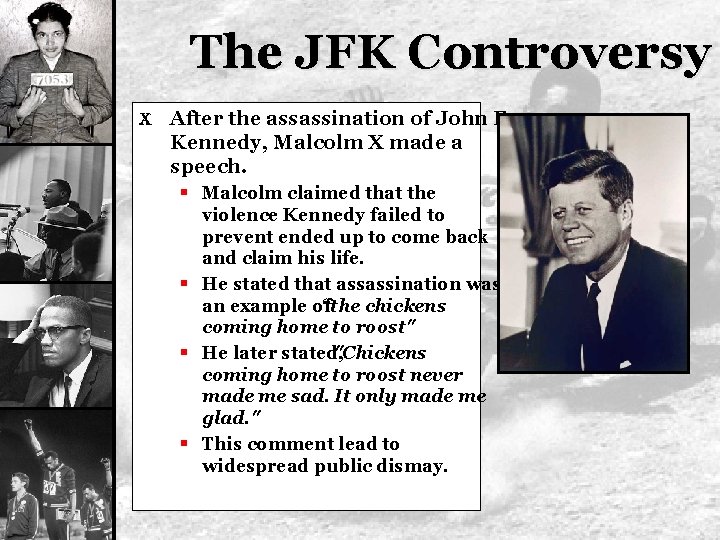
The JFK Controversy X After the assassination of John F. Kennedy, Malcolm X made a speech. § Malcolm claimed that the violence Kennedy failed to prevent ended up to come back and claim his life. § He stated that assassination was an example of “the chickens coming home to roost" § He later stated, "Chickens coming home to roost never made me sad. It only made me glad. " § This comment lead to widespread public dismay.
Pilgrimage to Mecca X In 1964, during a pilgrimage to Mecca, Malcolm discovered that orthodox Muslims preach equality among races. X Malcolm’s new knowledge and growing distrust with the NOI, caused him to desert his argument that all Whites are the devil. X Malcolm X never abandoned his theory that Racism had destroyed the nation and that only Blacks could free themselves. X In 1965, Malcolm X was assassinated by a Black Muslim at a New York City rally.
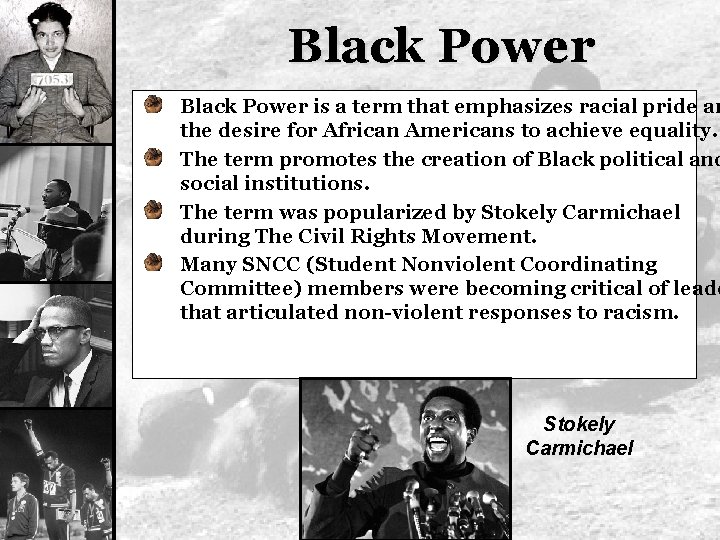
Black Power is a term that emphasizes racial pride an the desire for African Americans to achieve equality. The term promotes the creation of Black political and social institutions. The term was popularized by Stokely Carmichael during The Civil Rights Movement. Many SNCC (Student Nonviolent Coordinating Committee) members were becoming critical of leade that articulated non-violent responses to racism. Stokely Carmichael
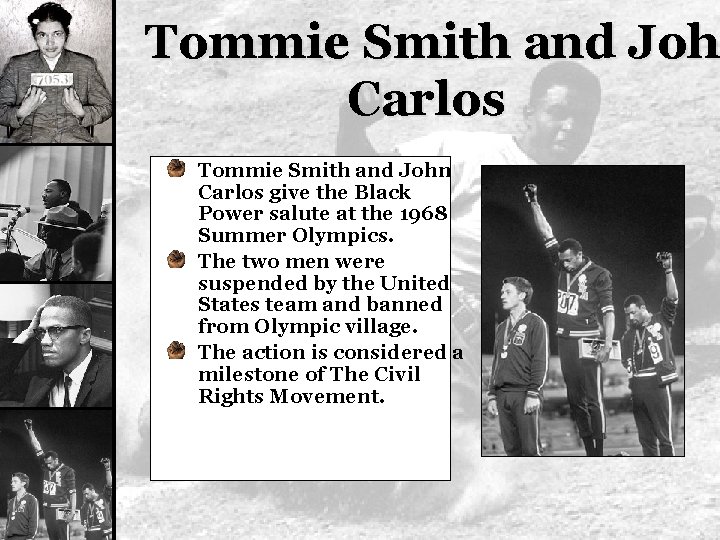
Tommie Smith and John Joh Carlos Tommie Smith and John Carlos give the Black Power salute at the 1968 Summer Olympics. The two men were suspended by the United States team and banned from Olympic village. The action is considered a milestone of The Civil Rights Movement.
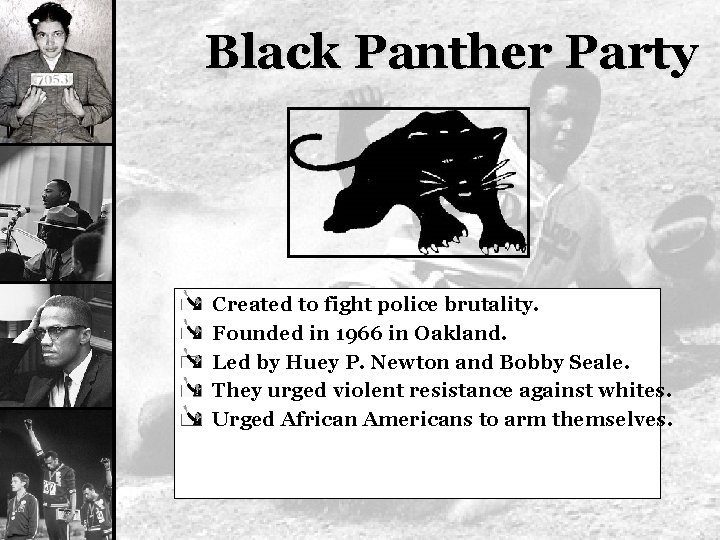
Black Panther Party Created to fight police brutality. Founded in 1966 in Oakland. Led by Huey P. Newton and Bobby Seale. They urged violent resistance against whites. Urged African Americans to arm themselves.
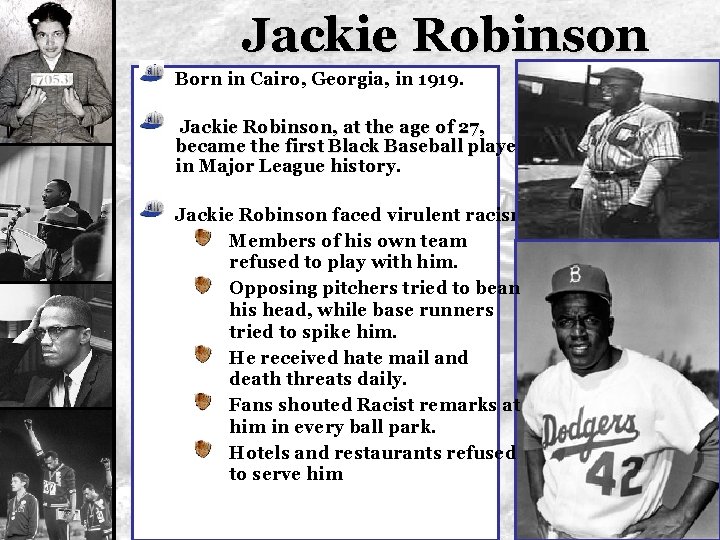
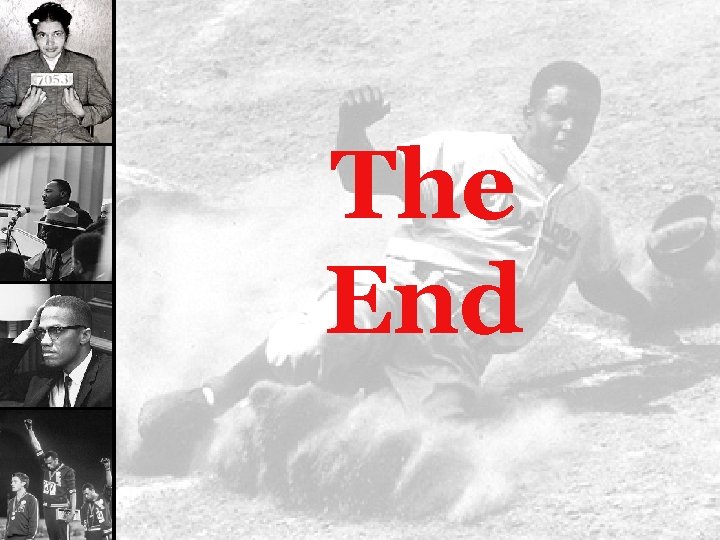
Jackie Robinson Born in Cairo, Georgia, in 1919. Jackie Robinson, at the age of 27, became the first Black Baseball player in Major League history. Jackie Robinson faced virulent racism. Members of his own team refused to play with him. Opposing pitchers tried to bean his head, while base runners tried to spike him. He received hate mail and death threats daily. Fans shouted Racist remarks at him in every ball park. Hotels and restaurants refused to serve him
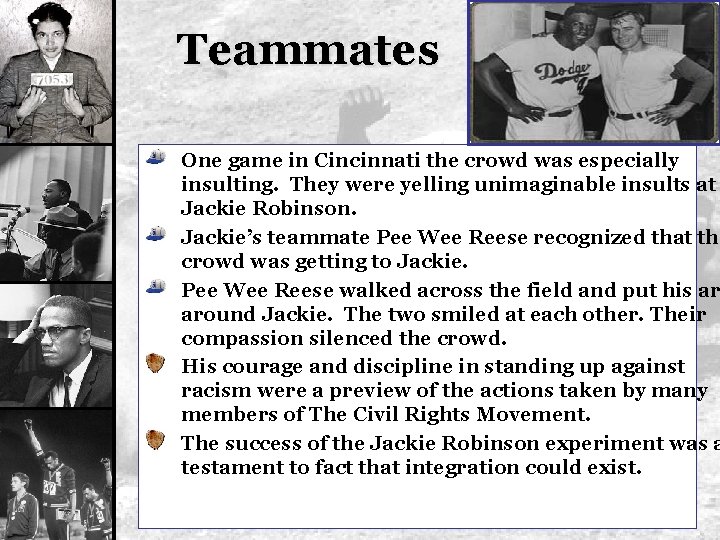
Teammates One game in Cincinnati the crowd was especially insulting. They were yelling unimaginable insults at Jackie Robinson. Jackie’s teammate Pee Wee Reese recognized that the crowd was getting to Jackie. Pee Wee Reese walked across the field and put his ar around Jackie. The two smiled at each other. Their compassion silenced the crowd. His courage and discipline in standing up against racism were a preview of the actions taken by many members of The Civil Rights Movement. The success of the Jackie Robinson experiment was a testament to fact that integration could exist.
Conclusion During The American Civil Rights Movement many different and unique leaders and groups came to power. Some preached violence, some preached peace, som preached protest and some preached resilience. However, every leader had one thing in common. They all wanted freedom and they all wanted equali for their race. Today we celebrate the leaders struggles because it was there work that got us to the point we are at today. Now, not everything is completely equal. But it is clear that we have come a long way since Martin Luther King Jr. marched in Washington and cried out, “I Have A Dream”
AMAZING GRACE Amazing Grace! How sweet the sound That saved a wretch like me I once was lost but now am found, Wa blind but now I see. 'Twas Grace that taught my heart to fear And Grace m fears relieved How precious did that grace appear Th hour I first believed. Through many dangers, toils and snares I have alread come 'Tis Grace has brought me safe thus far And Gra will lead me home. The Lord has promised good to me His word my hop secures; He will my shield and portion be, As long as li endures. Yet, when this flesh and heart shall fail, And mortal li shall cease, I shall possess within the veil, A life of joy and peace. When we've been there ten thousand years Bright shining as the sun, We've no less days to sing God's praise Than when we've first begun
The End