
Civil Rights Civil Rights Def a civil right
- Slides: 38
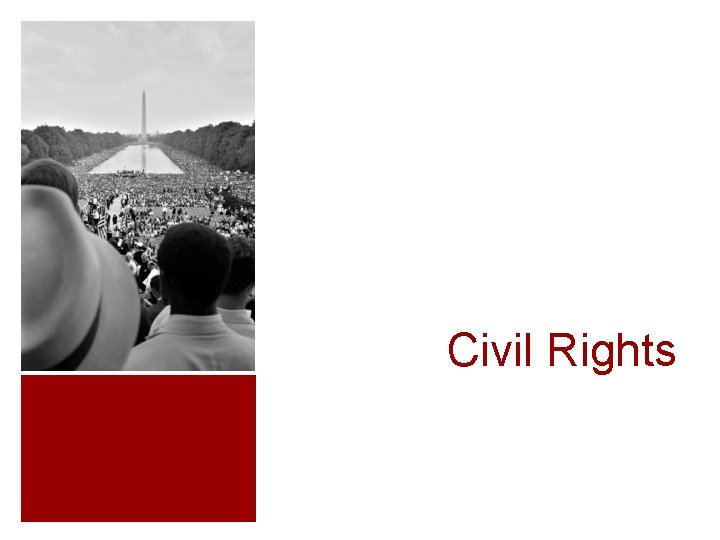
Civil Rights
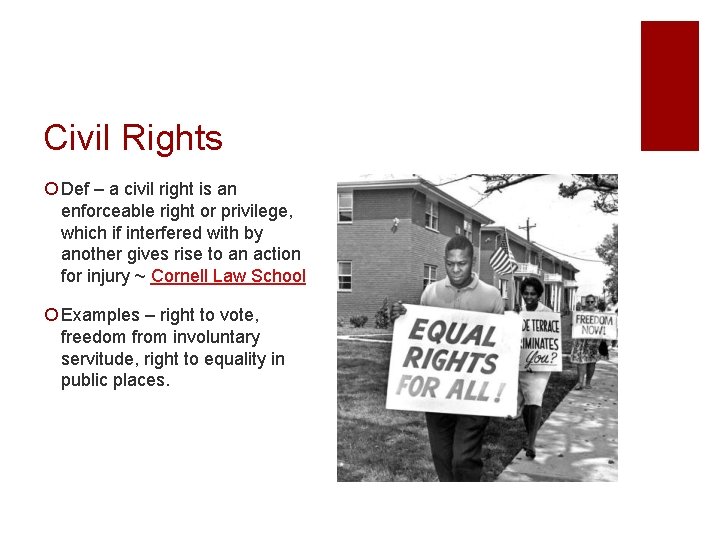
Civil Rights ¡ Def – a civil right is an enforceable right or privilege, which if interfered with by another gives rise to an action for injury ~ Cornell Law School ¡ Examples – right to vote, freedom from involuntary servitude, right to equality in public places.
Civil Rights Issues ¡A group is denied access to facilities, opportunities, or services available to other groups, usually along ethnic or racial lines. ¡Issue is whether differences in treatment are “reasonable” ¡ Some differences are “reasonable” – progressive taxes have been held to this standard. ¡ Some are not – classification by race whatsoever is subject to “strict scrutiny”. Example having a quota of black masters candidates.
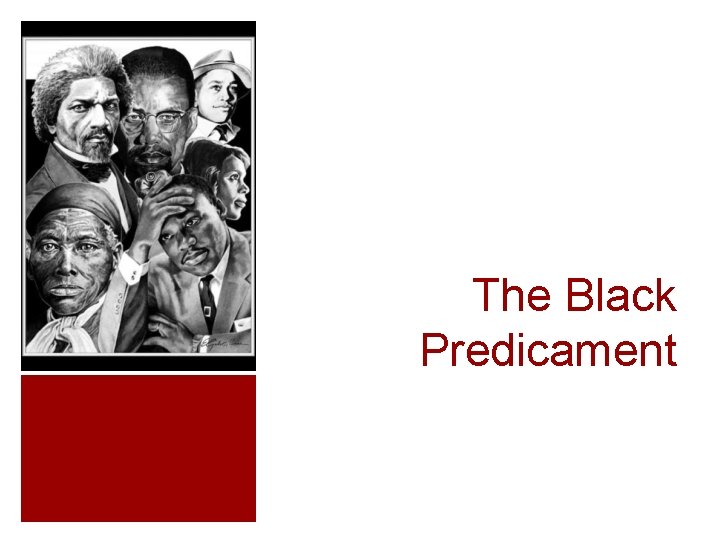
The Black Predicament
Perceived costs of granting blacks rights ¡African Americans make up 13. 6% of the population (2010 census). ¡ Fear in the South that these small communities would gain power at the cost of white elites. ¡ In the North where there were some political gains…it was perceived to be at the cost of lower class whites ¡=‘s fear and resentment.
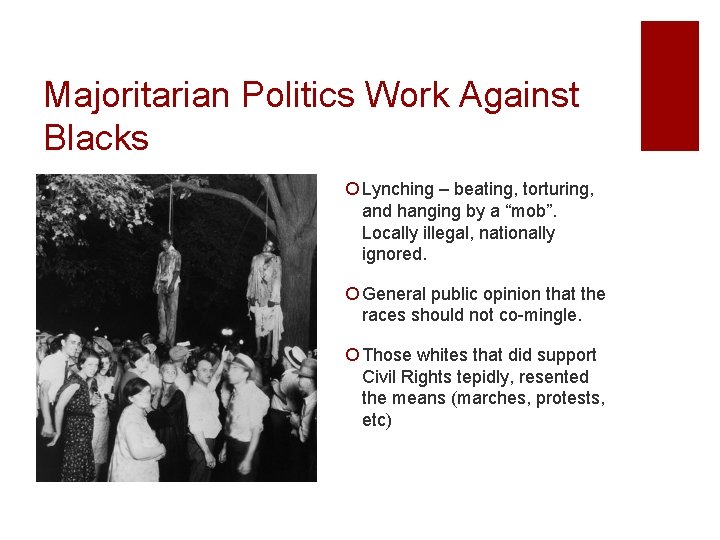
Majoritarian Politics Work Against Blacks ¡ Lynching – beating, torturing, and hanging by a “mob”. Locally illegal, nationally ignored. ¡ General public opinion that the races should not co-mingle. ¡ Those whites that did support Civil Rights tepidly, resented the means (marches, protests, etc)
Progress and Affect ¡Progress depended on… ¡ Finding white allies ¡ Shifting policy making arenas ¡Affect – Civil Rights movement both ¡ broadened the base of supporters by publicizing grievances. ¡ Moved the legal struggle from Congress to the courts.
The Campaign in the Courts
14 th Amendment ¡ “No state shall make or enforce any law which shall abridge the privileges or immunities of citizens of the US; nor shall any state deprive any person of life, liberty, or property, without due process of law, nor deny any person within its jurisdiction the equal protection of the laws” ¡ Pre- Brown v. Bd. Of Ed 1954 ¡ Broad Interpretation – the Constitution is color blind. ¡ Narrow Interpretation – blacks and whites have equal legal rights but not social rights.
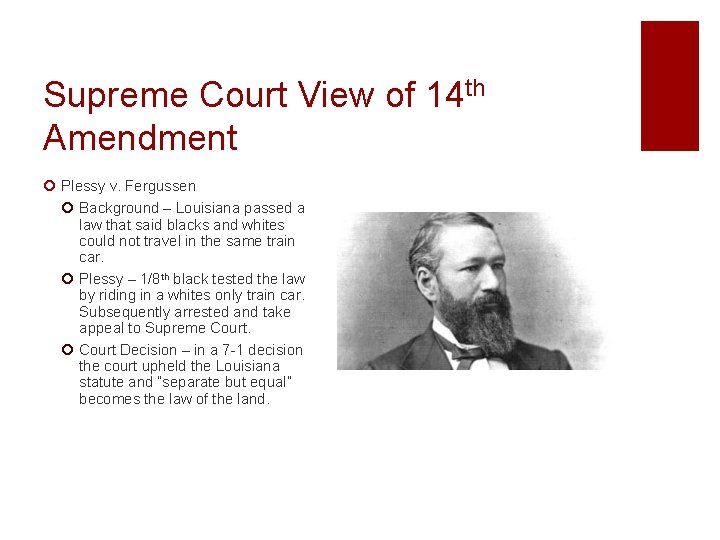
Supreme Court View of 14 th Amendment ¡ Plessy v. Fergussen ¡ Background – Louisiana passed a law that said blacks and whites could not travel in the same train car. ¡ Plessy – 1/8 th black tested the law by riding in a whites only train car. Subsequently arrested and take appeal to Supreme Court. ¡ Court Decision – in a 7 -1 decision the court upheld the Louisiana statute and “separate but equal” becomes the law of the land.
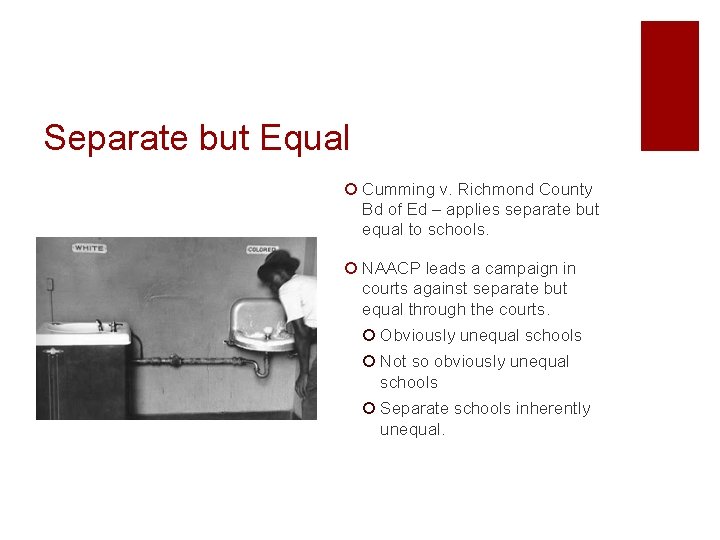
Separate but Equal ¡ Cumming v. Richmond County Bd of Ed – applies separate but equal to schools. ¡ NAACP leads a campaign in courts against separate but equal through the courts. ¡ Obviously unequal schools ¡ Not so obviously unequal schools ¡ Separate schools inherently unequal.
Can separate schools be equal? ¡Step 1: obvious inequalities ¡ Lloyd Gaines – 1938 ¡ Ada Lois Sipuel – 1948 ¡Step 2: less obvious inequalities ¡ Heman Sweat – 1950 ¡ George Mc. Laurin – 1950 ¡Step 3: Making separation inherently unequal ¡ Climax to the fight to integrate schools. Begins with Linda Brown and her decision to enroll in the all white high school in Topeka, KS. ¡ High risk strategy…
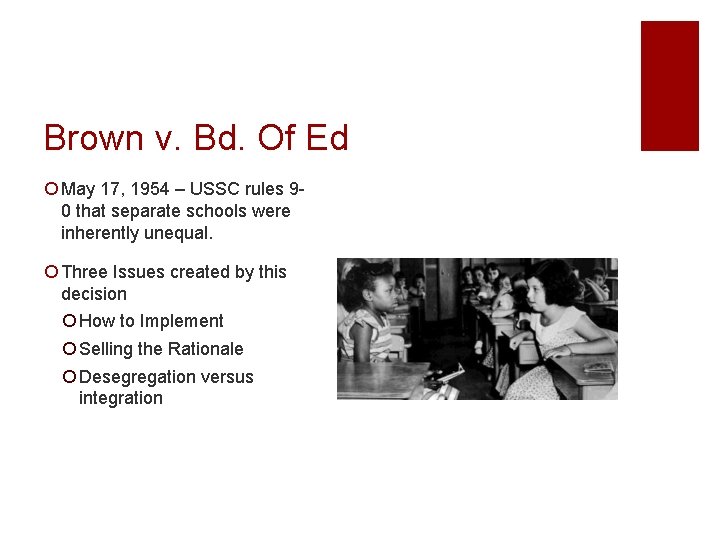
Brown v. Bd. Of Ed ¡ May 17, 1954 – USSC rules 90 that separate schools were inherently unequal. ¡ Three Issues created by this decision ¡ How to Implement ¡ Selling the Rationale ¡ Desegregation versus integration
Brown v. Bd. Of Ed ¡ Implementation ¡ Class-action law suit – this means that the suit and decision applied to all black children not just Brown. ¡ What does that mean? ¡ “All Deliberate Speed” – USSC ruled that schools should integrate with all deliberate speed. However, this was left up to the districts in charge…in the South this was done at a snails pace! ¡ Southern Manifesto – 100 Southern Congressmen signed this pledge to overturn the Brown decision. ¡ National Gaurdsmen were required to escort black students to formerly all white schools…Little Rock ¡ Result – 1970 14% of southern black children still attended all black schools.
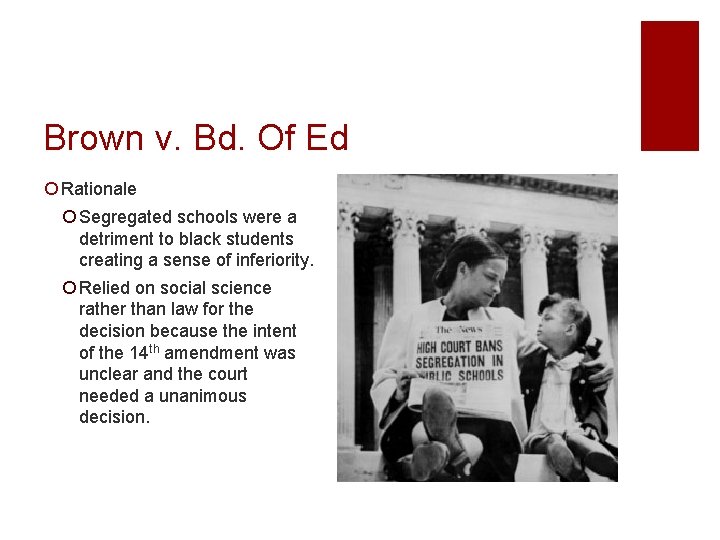
Brown v. Bd. Of Ed ¡ Rationale ¡ Segregated schools were a detriment to black students creating a sense of inferiority. ¡ Relied on social science rather than law for the decision because the intent of the 14 th amendment was unclear and the court needed a unanimous decision.
Brown v. Bd. Of Ed ¡Desegregation versus integration ¡ The decision of Brown was ambiguous at best…did separate being inherently unequal mean unrestricted choice (desegregation) or forced integration was necessary? ¡ De Jure and de facto segregation… ¡ Freedom of Choice Plan -1968 Court rejects the idea that students could “choose” a school…thus falling on the side of forced integration. ¡ Swann v. Charlotte-Mecklenburg Board of Education …see 12 th edition pages 132 -133.
Check Point ¡ 1. In the past, de jure segregation usually resulted from… ¡ A) Housing patterns ¡ B) court decisions ¡ C) state and local laws or actions and regulations ¡ D) National laws and regulations ¡ E) actions by civil rights interest groups ¡ 2. The decision issued by the Supreme Court in Brown v Board of Education of Topeka in 1954 led mostly to ¡ A) the establishment of “separate but equal” doctrine ¡ B) a great decline in the de facto school segregation ¡ C) equal opportunities for blacks in employment ¡ D) a great decline in de jure school segregation ¡ E) greater access to school vouchers in poor urban communities
Check Point ¡ Which of the follow was a successful method used by the NAACP in order to gain civil rights? ¡ A) litigating cases in federal court ¡ Lobbying state legislatures ¡ Pressuring for executive orders ¡ Litigating cases in state courts ¡ Pressuring foreign governments ¡ This 1978 case set precedents for later rulings on reverse discrimination. ¡ A) Lawrence v Texas ¡ B)Bakke v California Board of Regents ¡ C) Hardwick v Georgia ¡ Rostker v Goldberg ¡ Brown v Topeka
The Campaign in Congress
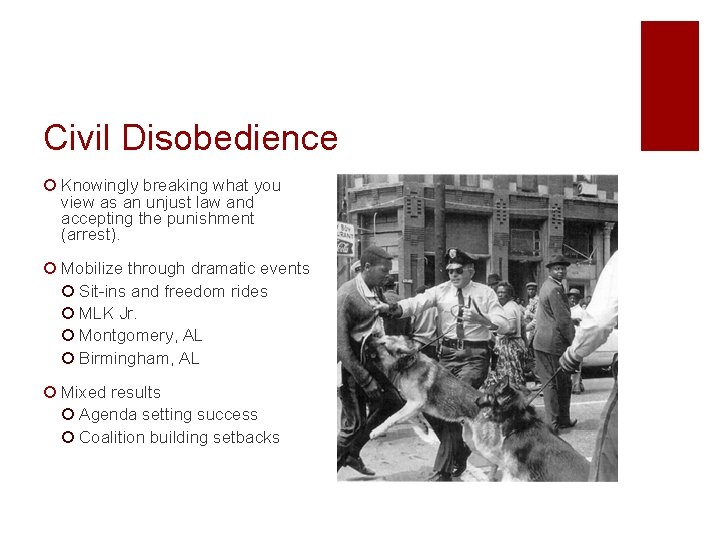
Civil Disobedience ¡ Knowingly breaking what you view as an unjust law and accepting the punishment (arrest). ¡ Mobilize through dramatic events ¡ Sit-ins and freedom rides ¡ MLK Jr. ¡ Montgomery, AL ¡ Birmingham, AL ¡ Mixed results ¡ Agenda setting success ¡ Coalition building setbacks
Legislative Politics ¡Opponents Defensive Positions ¡ Senate Judiciary Committee controlled by southern Democrats ¡ House Rules Committee controlled by Howard Smith (staunch opponent of Civil Rights) ¡ Senate Filibuster threat ¡ President Kennedy Reluctant to propose strong Civil Rights Bills
Legislative Politics ¡Four developments break the legislative deadlock ¡ Changing public opinion – white parents were more inclined to be ok with integration. ¡ Violent reaction to civil rights demonstrators saturated the news ¡ Kennedy Assassination – coupled with LBJ’s reelection buoyed major Civil Rights legislation. ¡ 1964 Democratic landslide – brought more northern Democrats into office that countered southern Democrats
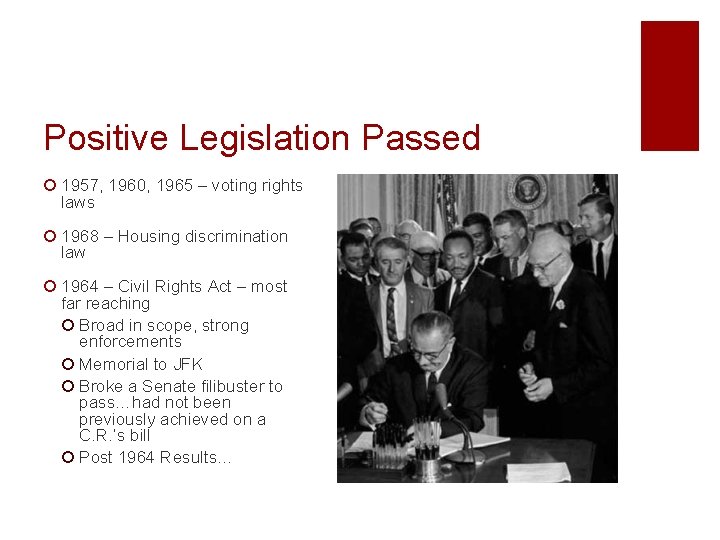
Positive Legislation Passed ¡ 1957, 1960, 1965 – voting rights laws ¡ 1968 – Housing discrimination law ¡ 1964 – Civil Rights Act – most far reaching ¡ Broad in scope, strong enforcements ¡ Memorial to JFK ¡ Broke a Senate filibuster to pass…had not been previously achieved on a C. R. ’s bill ¡ Post 1964 Results…
Racial Profiling ¡ Def – police stopping, questioning, etc one ethnicity based on the belief that they commit more crime ¡ Getting stopped for “driving while black”. ¡ Condemned by Clinton, Bush, and Congress ¡ Complex issue…what if one group does commit more crime than another? ¡ Cost/Benefit ¡ Does it increase legit arrests? ¡ When is it justified? ¡ What’s the impact on innocent Americans
Women and Equal Rights
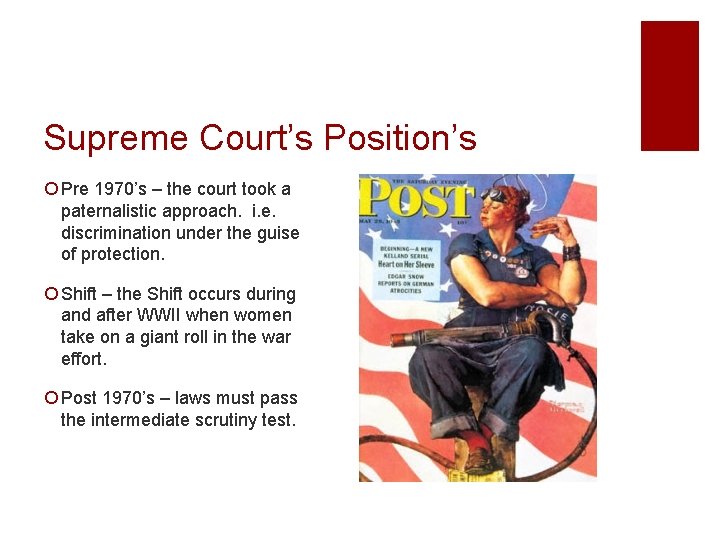
Supreme Court’s Position’s ¡ Pre 1970’s – the court took a paternalistic approach. i. e. discrimination under the guise of protection. ¡ Shift – the Shift occurs during and after WWII when women take on a giant roll in the war effort. ¡ Post 1970’s – laws must pass the intermediate scrutiny test.
Gender-based differences ¡ Prohibited ¡ Age of adulthood ¡ Drinking age ¡ Arbitrary employee heightweight requirements ¡ Mandatory pregnancy leaves ¡ Little league exclusions ¡ Jaycees exclusion ¡ Unequal retirement benefits ¡ Allowed ¡ All-boys/ all-girls schools ¡ Widows’ property tax exemption ¡ Delayed promotions in Navy ¡ Statutory rape.
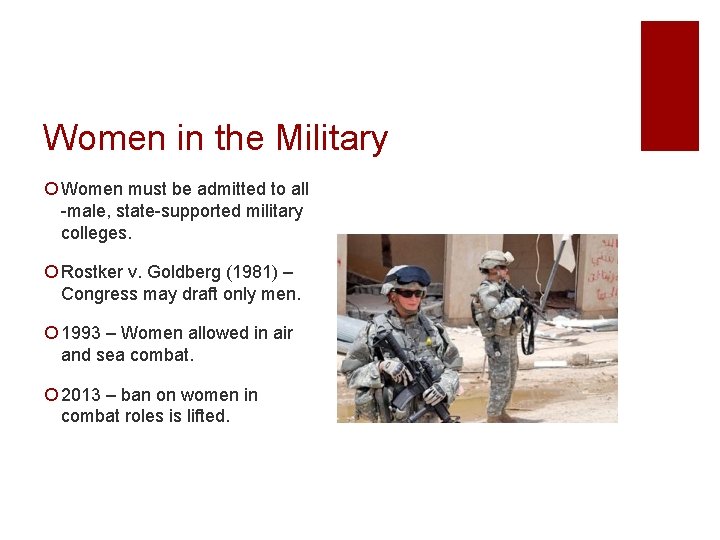
Women in the Military ¡ Women must be admitted to all -male, state-supported military colleges. ¡ Rostker v. Goldberg (1981) – Congress may draft only men. ¡ 1993 – Women allowed in air and sea combat. ¡ 2013 – ban on women in combat roles is lifted.
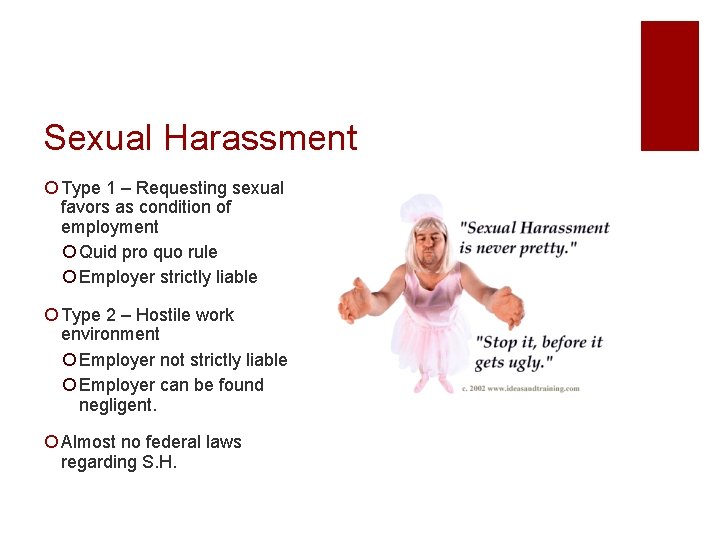
Sexual Harassment ¡ Type 1 – Requesting sexual favors as condition of employment ¡ Quid pro quo rule ¡ Employer strictly liable ¡ Type 2 – Hostile work environment ¡ Employer not strictly liable ¡ Employer can be found negligent. ¡ Almost no federal laws regarding S. H.
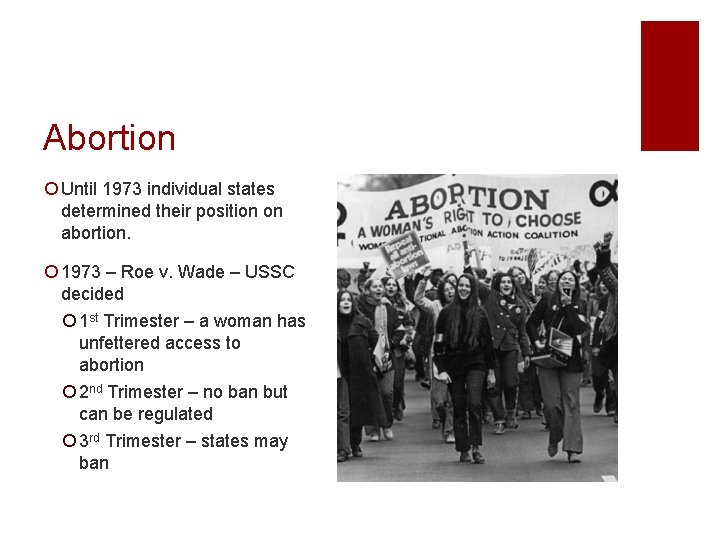
Abortion ¡ Until 1973 individual states determined their position on abortion. ¡ 1973 – Roe v. Wade – USSC decided ¡ 1 st Trimester – a woman has unfettered access to abortion ¡ 2 nd Trimester – no ban but can be regulated ¡ 3 rd Trimester – states may ban
Abortion ¡Critics claim life begins as conception ¡ Unborn child entitled to equal protections ¡Supporters claim no one can say when life begins ¡Pro-life versus pro-choice ¡Hyde Amendment – 1976 – federal dollars can not be used for abortions (until the Affordable Health Care Act…now is federally funded) ¡ 1973 -1989 – Supreme Court upholds the Roe on several occasions.
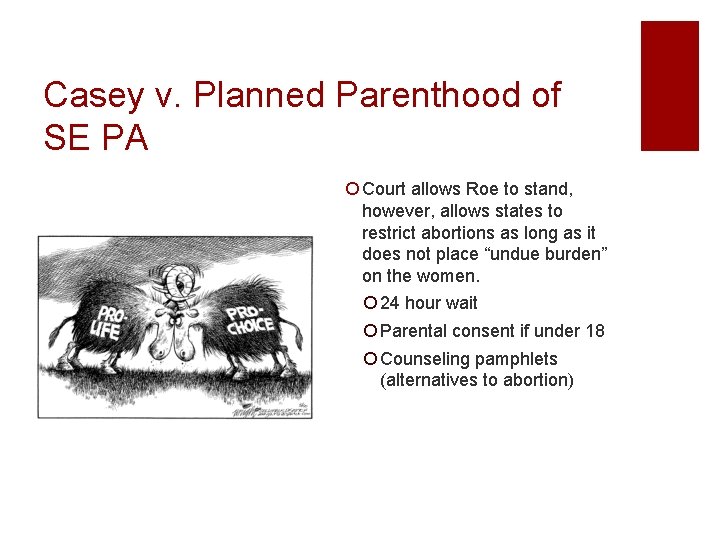
Casey v. Planned Parenthood of SE PA ¡ Court allows Roe to stand, however, allows states to restrict abortions as long as it does not place “undue burden” on the women. ¡ 24 hour wait ¡ Parental consent if under 18 ¡ Counseling pamphlets (alternatives to abortion)
Affirmative Action
Affirmative Action ¡ Definition – preferential hiring practices must be used to find and hire women, blacks, and other minorities. ¡ Equality of results (camp #1) ¡ Racism and sexism overcome only by taking them into account designing remedies ¡ Equal rights not enough; people need benefits ¡ Affirmative action should be used in hiring. ¡ Equality of opportunity (camp #2) ¡ Reverse discrimination to use race or sex as preferential treatment ¡ Laws should be color-blind and sex neutral ¡ Government should only eliminate barriers.
Targets or Quotas? ¡Issue fought out in courts ¡ No clear definition in Supreme court decisions ¡ Court is deeply divided; affected by conservative Reagan appointees ¡ Law complex and confusing ¡ Bakke v. California 1978 – USSC says that colleges can not explicitly use a numerical quota on admissions but can take race into account. ¡ Subsequent court decisions were less strict on quotas however.
Emerging Standards for Quotas ¡Must be “compelling justification ¡Must correct a pattern of discrimination ¡Must involve practices that discriminate ¡Federal quotas are to be given deference ¡Voluntary preference systems are easier to justify ¡Not likely to apply to who gets laid off
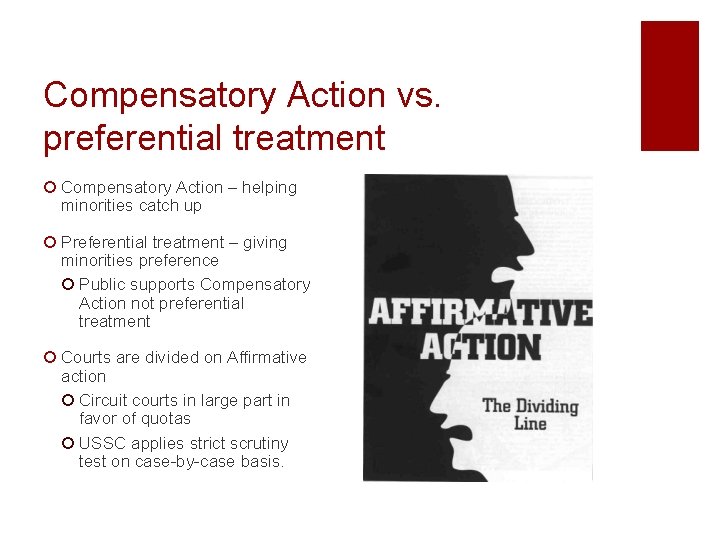
Compensatory Action vs. preferential treatment ¡ Compensatory Action – helping minorities catch up ¡ Preferential treatment – giving minorities preference ¡ Public supports Compensatory Action not preferential treatment ¡ Courts are divided on Affirmative action ¡ Circuit courts in large part in favor of quotas ¡ USSC applies strict scrutiny test on case-by-case basis.
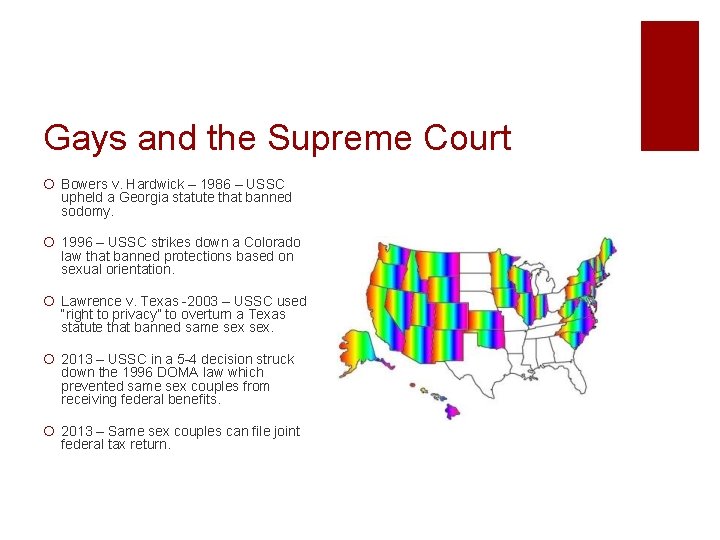
Gays and the Supreme Court ¡ Bowers v. Hardwick – 1986 – USSC upheld a Georgia statute that banned sodomy. ¡ 1996 – USSC strikes down a Colorado law that banned protections based on sexual orientation. ¡ Lawrence v. Texas -2003 – USSC used “right to privacy” to overturn a Texas statute that banned same sex. ¡ 2013 – USSC in a 5 -4 decision struck down the 1996 DOMA law which prevented same sex couples from receiving federal benefits. ¡ 2013 – Same sex couples can file joint federal tax return.