
Civil Rights Ch 5 Historical Meaning of Civil
- Slides: 14
Civil Rights Ch 5
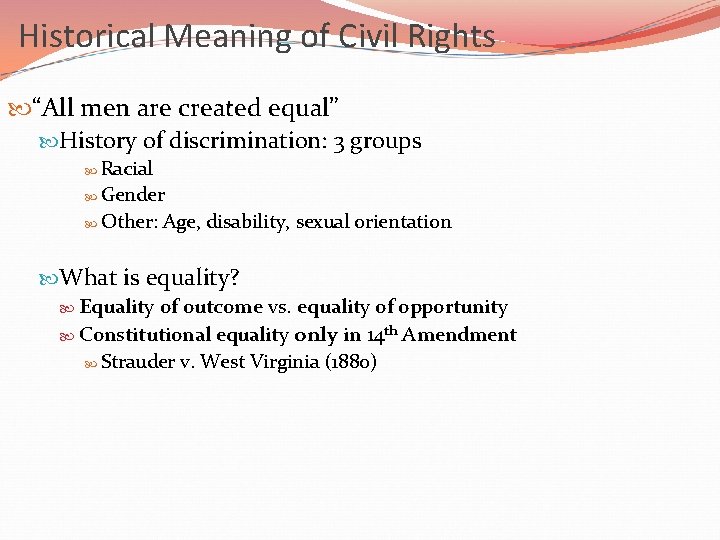
Historical Meaning of Civil Rights “All men are created equal” History of discrimination: 3 groups Racial Gender Other: Age, disability, sexual orientation What is equality? Equality of outcome vs. equality of opportunity Constitutional equality only in 14 th Amendment Strauder v. West Virginia (1880)
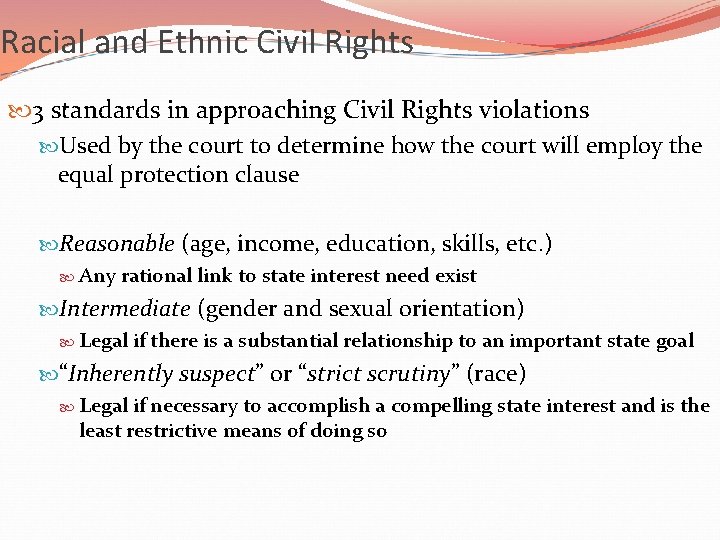
Racial and Ethnic Civil Rights 3 standards in approaching Civil Rights violations Used by the court to determine how the court will employ the equal protection clause Reasonable (age, income, education, skills, etc. ) Any rational link to state interest need exist Intermediate (gender and sexual orientation) Legal if there is a substantial relationship to an important state goal “Inherently suspect” or “strict scrutiny” (race) Legal if necessary to accomplish a compelling state interest and is the least restrictive means of doing so
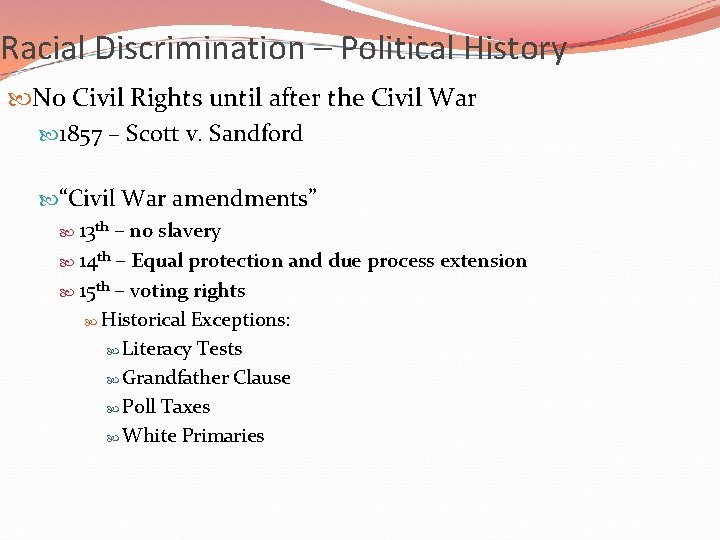
Racial Discrimination – Political History No Civil Rights until after the Civil War 1857 – Scott v. Sandford “Civil War amendments” 13 th – no slavery 14 th – Equal protection and due process extension 15 th – voting rights Historical Exceptions: Literacy Tests Grandfather Clause Poll Taxes White Primaries
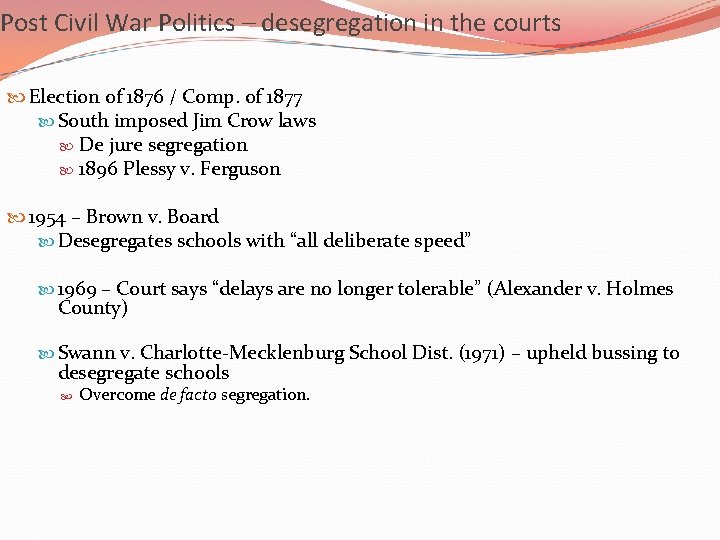
Post Civil War Politics – desegregation in the courts Election of 1876 / Comp. of 1877 South imposed Jim Crow laws De jure segregation 1896 Plessy v. Ferguson 1954 – Brown v. Board Desegregates schools with “all deliberate speed” 1969 – Court says “delays are no longer tolerable” (Alexander v. Holmes County) Swann v. Charlotte-Mecklenburg School Dist. (1971) – upheld bussing to desegregate schools Overcome de facto segregation.
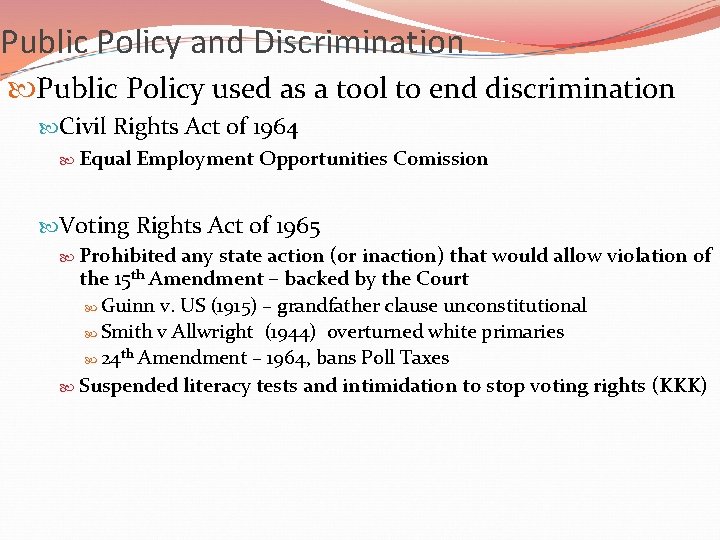
Public Policy and Discrimination Public Policy used as a tool to end discrimination Civil Rights Act of 1964 Equal Employment Opportunities Comission Voting Rights Act of 1965 Prohibited any state action (or inaction) that would allow violation of the 15 th Amendment – backed by the Court Guinn v. US (1915) – grandfather clause unconstitutional Smith v Allwright (1944) overturned white primaries 24 th Amendment – 1964, bans Poll Taxes Suspended literacy tests and intimidation to stop voting rights (KKK)
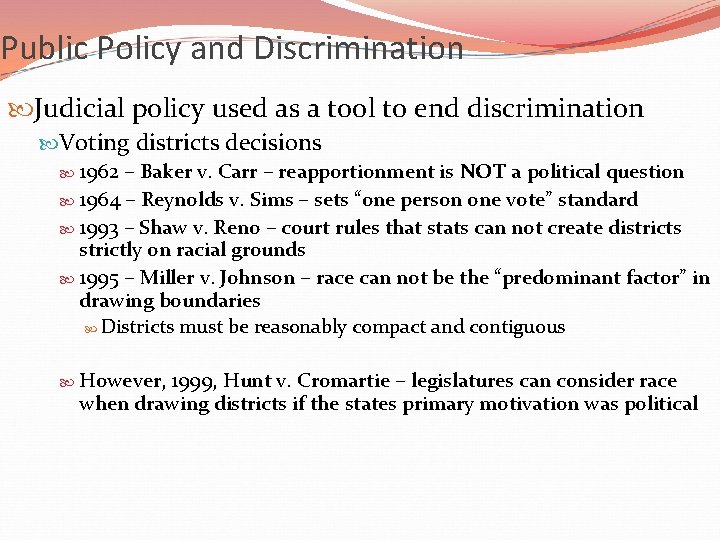
Public Policy and Discrimination Judicial policy used as a tool to end discrimination Voting districts decisions 1962 – Baker v. Carr – reapportionment is NOT a political question 1964 – Reynolds v. Sims – sets “one person one vote” standard 1993 – Shaw v. Reno – court rules that stats can not create districts strictly on racial grounds 1995 – Miller v. Johnson – race can not be the “predominant factor” in drawing boundaries Districts must be reasonably compact and contiguous However, 1999, Hunt v. Cromartie – legislatures can consider race when drawing districts if the states primary motivation was political
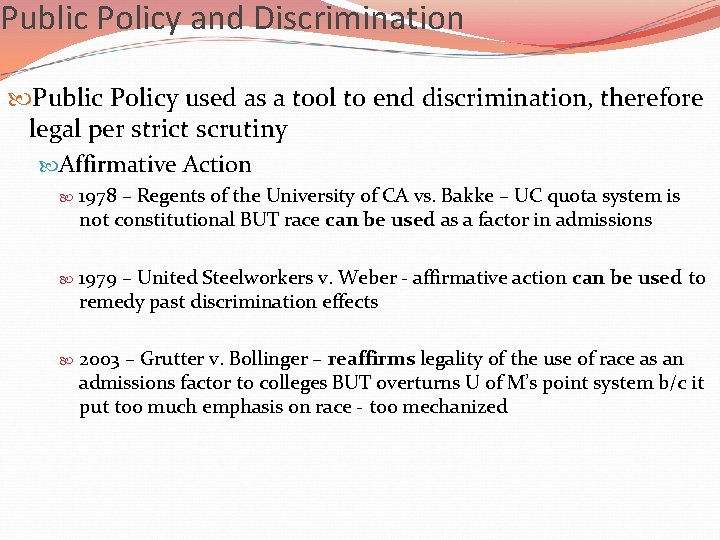
Public Policy and Discrimination Public Policy used as a tool to end discrimination, therefore legal per strict scrutiny Affirmative Action 1978 – Regents of the University of CA vs. Bakke – UC quota system is not constitutional BUT race can be used as a factor in admissions 1979 – United Steelworkers v. Weber - affirmative action can be used to remedy past discrimination effects 2003 – Grutter v. Bollinger – reaffirms legality of the use of race as an admissions factor to colleges BUT overturns U of M’s point system b/c it put too much emphasis on race - too mechanized
Native Americans Initial policy of isolation Reservation system Dawes Act of 1887 Assimilation, removal, and cultural realignment Indian Citizenship Act of 1924 Indian Reorganization Act - 1934 1978 - Santa Clara Pueblo v. Martinez – strengthens right of self-government & tribal power
Women Seneca Falls Conference – 1848 19 th Amendment Neo-Feminism – 1960’s NOW and NWPC – women’s civil rights organizations Reed v Reed (1971) – struck down arbitrary gender based laws Craig v Boren (1976) – intermediate scrutiny test begins Discrimination in the workplace falls under 1964 Civil Rights Act Title IX – 1972 – no gender discrimination in federally funded education (including athletics) Equal Pay: Equal Pay Act of 1963 2009 Lilly Ledbetter Fair Pay Restoration Act April 2014 executive orders
Women in the Military and Sexual Harassment • 1981 - Rostker v Goldberg - Male only draft is constitutional • 2013 – Pentagon announced plans to allow women to serve in front line ground combat units (2016) • Sexual harassment is gender discrimination if it creates a “hostile or abusive work environment” – 1998 - Faragher v. City of Boca Raton – employer is responsible for prevention and removal of sexual harassment regardless of whether or not it is sanctioned by the employer – 1998 - Burlington Industries v. Ellerth - Sexual harassment does not need to have job related negative effects for victims to sue – 1999 - Davis v. Monroe County School Dist. – sexual harassment of students in school (even by other students) is the responsibility of the school/district if it deprives the victim of “access to the educational opportunities or benefits provided by the school”
Current Civil Rights Issues • Age discrimination • Americans with Disabilities Act - 1990 – Preceded by 1973 Rehabilitation Act – added disabled persons to those protected from discrimination – Requires public facilities to make “reasonable accommodations” and prevents discrimination in employment when feasible
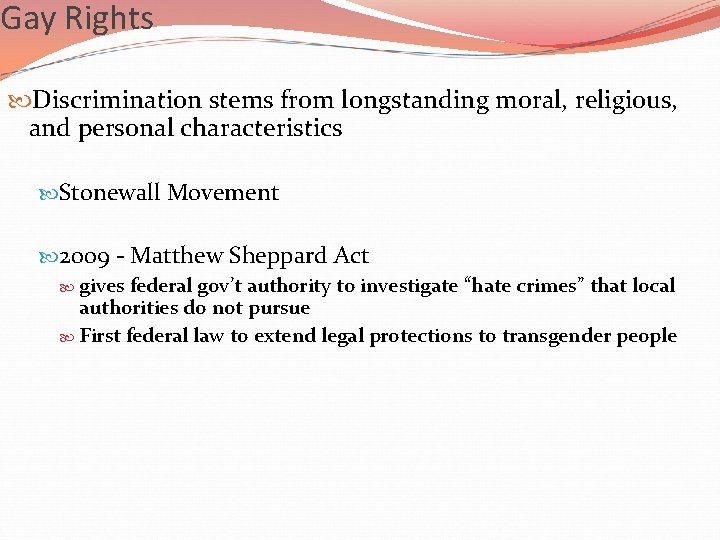
Gay Rights Discrimination stems from longstanding moral, religious, and personal characteristics Stonewall Movement 2009 - Matthew Sheppard Act gives federal gov’t authority to investigate “hate crimes” that local authorities do not pursue First federal law to extend legal protections to transgender people
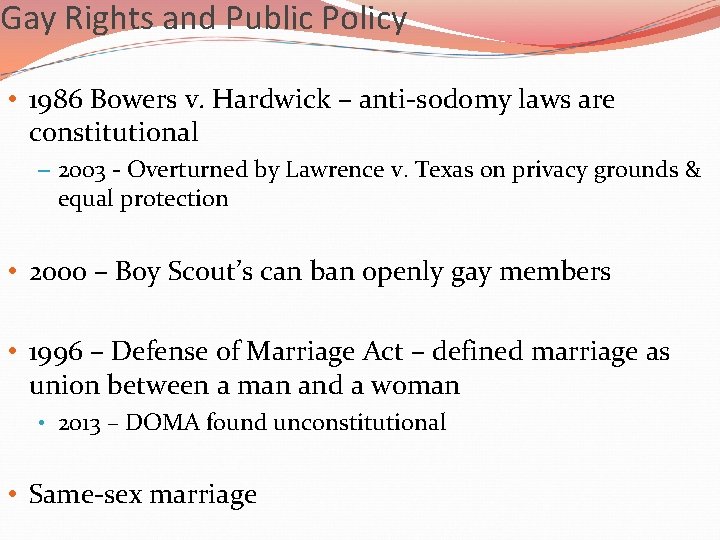
Gay Rights and Public Policy • 1986 Bowers v. Hardwick – anti-sodomy laws are constitutional – 2003 - Overturned by Lawrence v. Texas on privacy grounds & equal protection • 2000 – Boy Scout’s can ban openly gay members • 1996 – Defense of Marriage Act – defined marriage as union between a man and a woman • 2013 – DOMA found unconstitutional • Same-sex marriage