
Civil Rights Art Present and Past Learning Target
- Slides: 6
Civil Rights Art: Present and Past Learning Target: I can use the art of Brian Washington and David Hammons as inspiration to create my own expressive artwork. Agenda: 1. Watch Video- link is on the next slide. 2. Read through the powerpoint. 3. Answer questions on a blank sheet of paper (turn in today) 4. Homework due next Friday
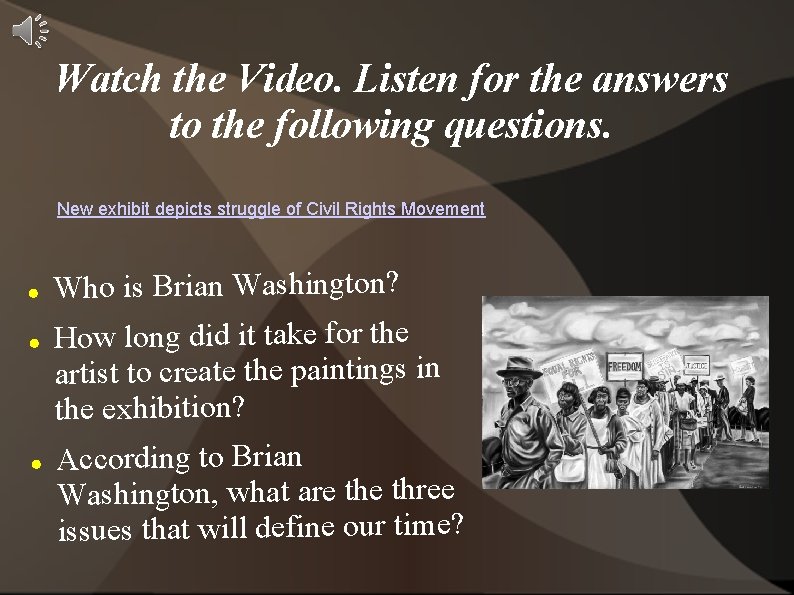
Watch the Video. Listen for the answers to the following questions. New exhibit depicts struggle of Civil Rights Movement Who is Brian Washington? How long did it take for the artist to create the paintings in the exhibition? According to Brian Washington, what are three issues that will define our time?
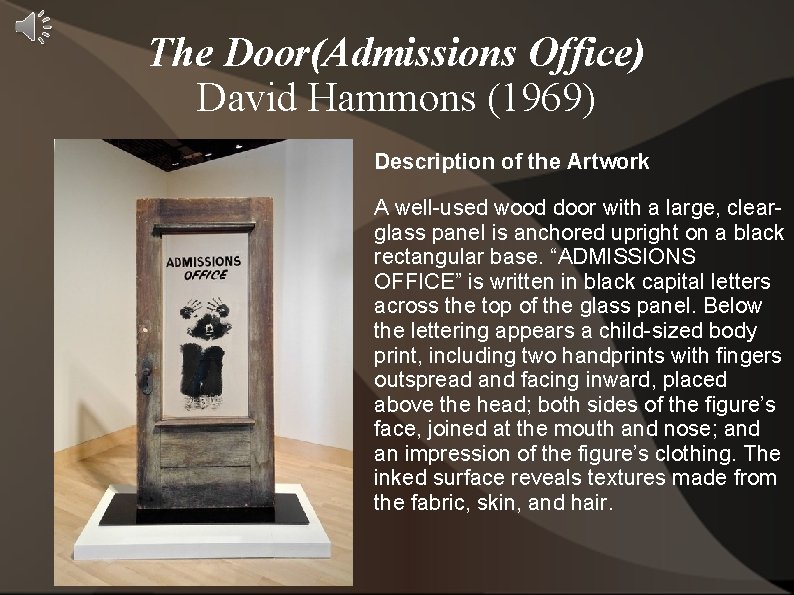
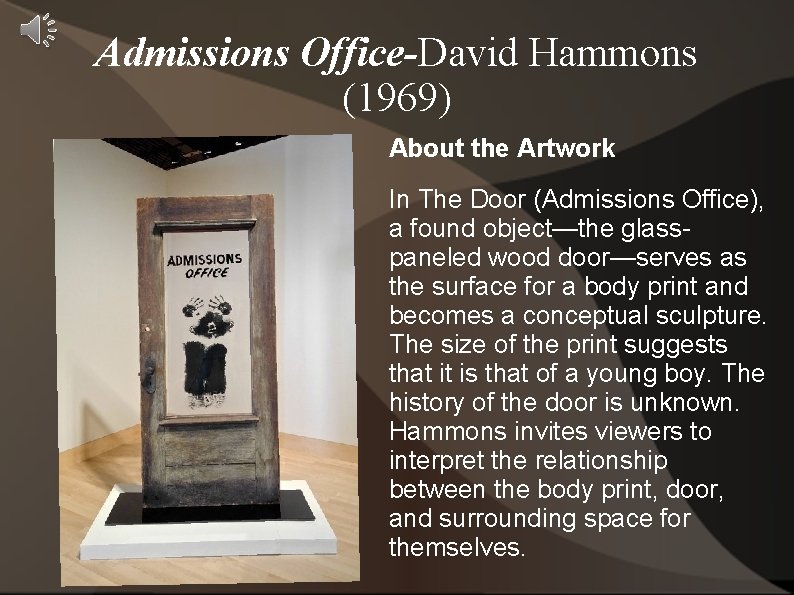
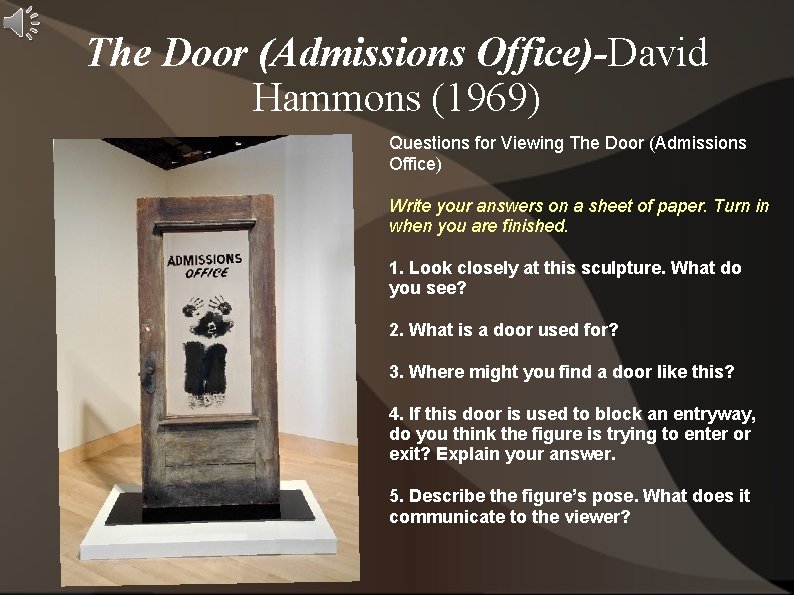
The Door(Admissions Office) David Hammons (1969) Description of the Artwork A well-used wood door with a large, clearglass panel is anchored upright on a black rectangular base. “ADMISSIONS OFFICE” is written in black capital letters across the top of the glass panel. Below the lettering appears a child-sized body print, including two handprints with fingers outspread and facing inward, placed above the head; both sides of the figure’s face, joined at the mouth and nose; and an impression of the figure’s clothing. The inked surface reveals textures made from the fabric, skin, and hair.
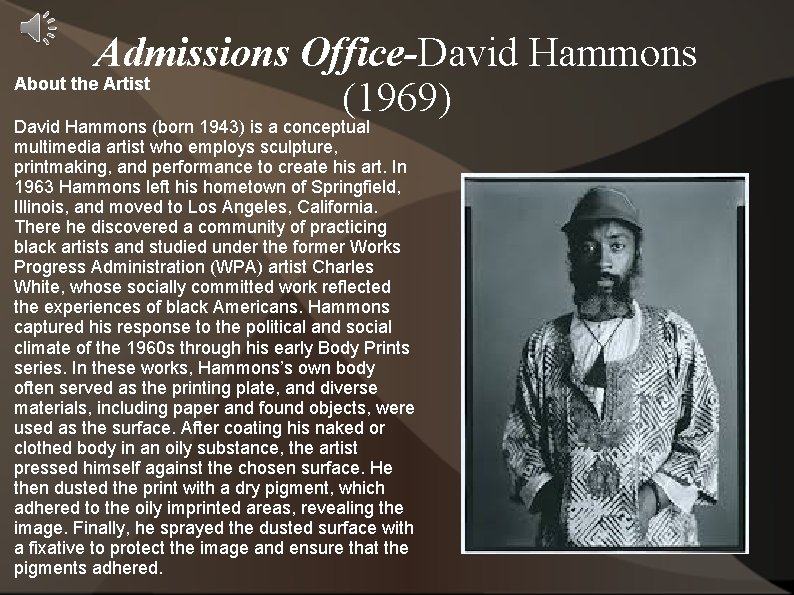
Admissions Office-David Hammons About the Artist (1969) David Hammons (born 1943) is a conceptual multimedia artist who employs sculpture, printmaking, and performance to create his art. In 1963 Hammons left his hometown of Springfield, Illinois, and moved to Los Angeles, California. There he discovered a community of practicing black artists and studied under the former Works Progress Administration (WPA) artist Charles White, whose socially committed work reflected the experiences of black Americans. Hammons captured his response to the political and social climate of the 1960 s through his early Body Prints series. In these works, Hammons’s own body often served as the printing plate, and diverse materials, including paper and found objects, were used as the surface. After coating his naked or clothed body in an oily substance, the artist pressed himself against the chosen surface. He then dusted the print with a dry pigment, which adhered to the oily imprinted areas, revealing the image. Finally, he sprayed the dusted surface with a fixative to protect the image and ensure that the pigments adhered.
Admissions Office-David Hammons (1969) About the Artwork In The Door (Admissions Office), a found object—the glasspaneled wood door—serves as the surface for a body print and becomes a conceptual sculpture. The size of the print suggests that it is that of a young boy. The history of the door is unknown. Hammons invites viewers to interpret the relationship between the body print, door, and surrounding space for themselves.
The Door (Admissions Office)-David Hammons (1969) Questions for Viewing The Door (Admissions Office) Write your answers on a sheet of paper. Turn in when you are finished. 1. Look closely at this sculpture. What do you see? 2. What is a door used for? 3. Where might you find a door like this? 4. If this door is used to block an entryway, do you think the figure is trying to enter or exit? Explain your answer. 5. Describe the figure’s pose. What does it communicate to the viewer?