
Civil and Criminal Law Table of Contents TABLE
Civil and Criminal Law Table of Contents

TABLE OF CONTENTS Civil and Criminal Law Lessons 1. Criminal Law Go 2. Civil Law and Torts Go 3. Civil Law and Contracts Go Table of Contents
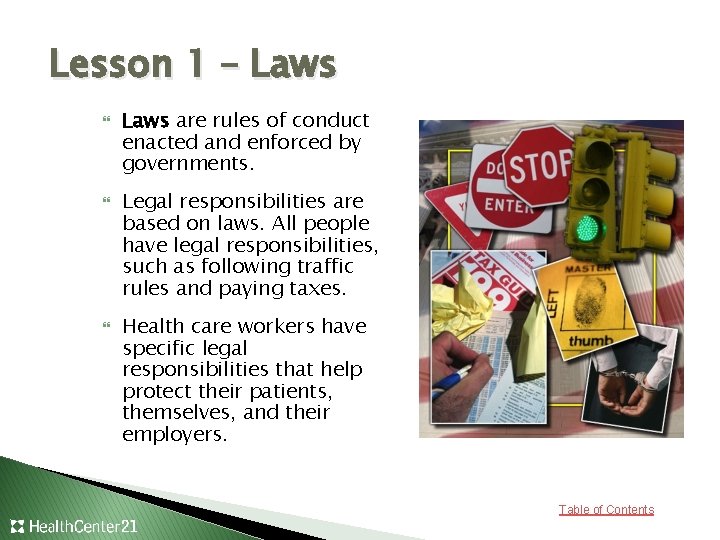
Lesson 1 – Laws are rules of conduct enacted and enforced by governments. Legal responsibilities are based on laws. All people have legal responsibilities, such as following traffic rules and paying taxes. Health care workers have specific legal responsibilities that help protect their patients, themselves, and their employers. Table of Contents
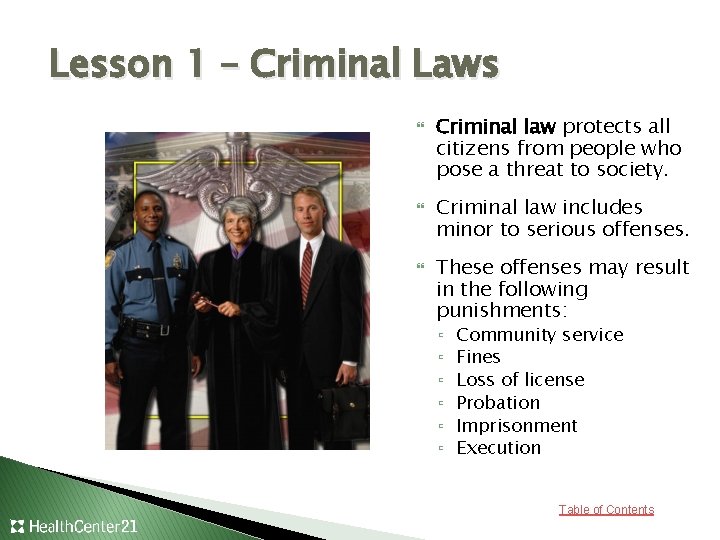
Lesson 1 – Criminal Laws Criminal law protects all citizens from people who pose a threat to society. Criminal law includes minor to serious offenses. These offenses may result in the following punishments: ▫ ▫ ▫ Community service Fines Loss of license Probation Imprisonment Execution Table of Contents
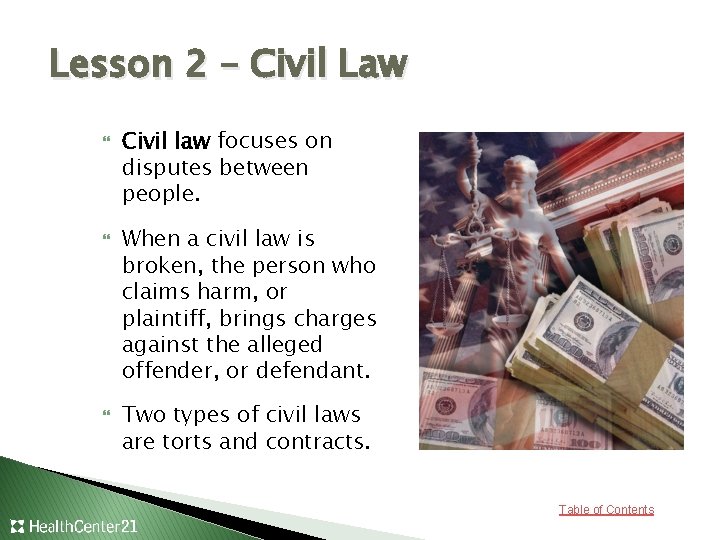
Lesson 2 – Civil Law Civil law focuses on disputes between people. When a civil law is broken, the person who claims harm, or plaintiff, brings charges against the alleged offender, or defendant. Two types of civil laws are torts and contracts. Table of Contents
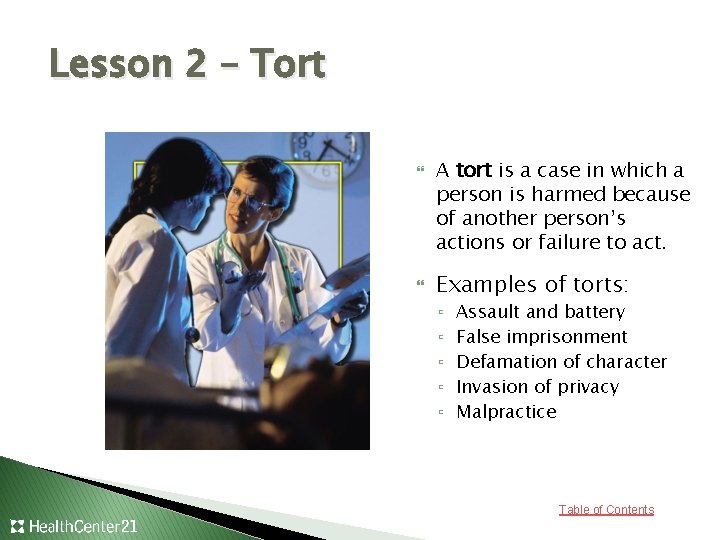
Lesson 2 – Tort A tort is a case in which a person is harmed because of another person’s actions or failure to act. Examples of torts: ▫ ▫ ▫ Assault and battery False imprisonment Defamation of character Invasion of privacy Malpractice Table of Contents
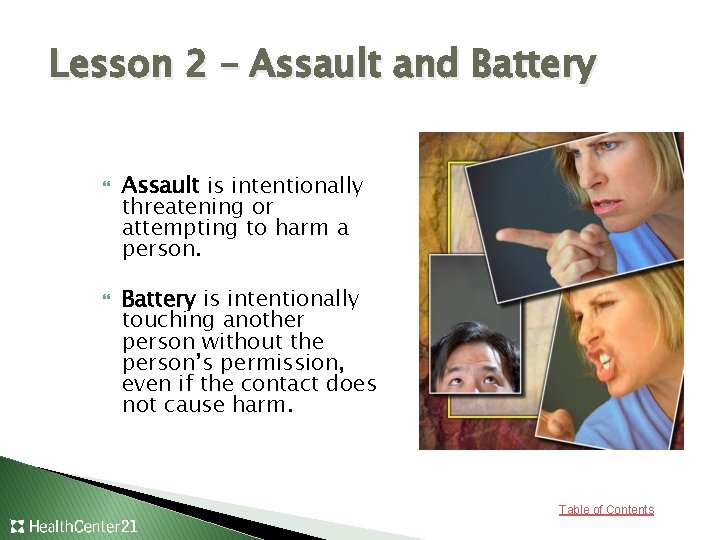
Lesson 2 – Assault and Battery Assault is intentionally threatening or attempting to harm a person. Battery is intentionally touching another person without the person’s permission, even if the contact does not cause harm. Table of Contents
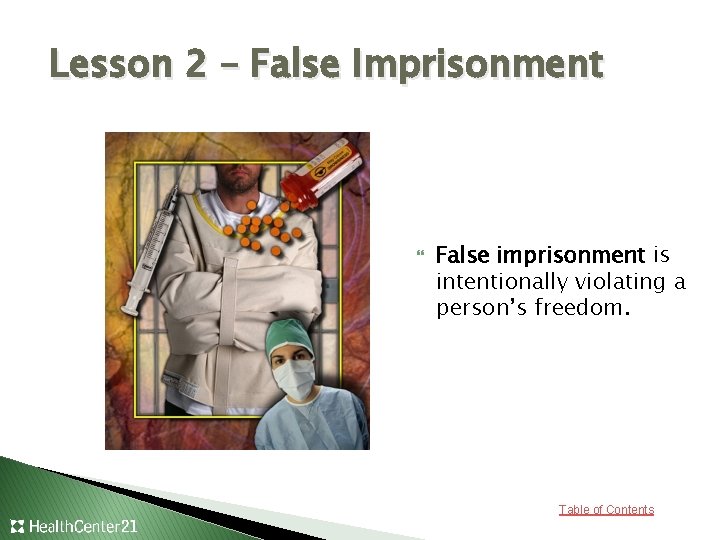
Lesson 2 – False Imprisonment False imprisonment is intentionally violating a person’s freedom. Table of Contents
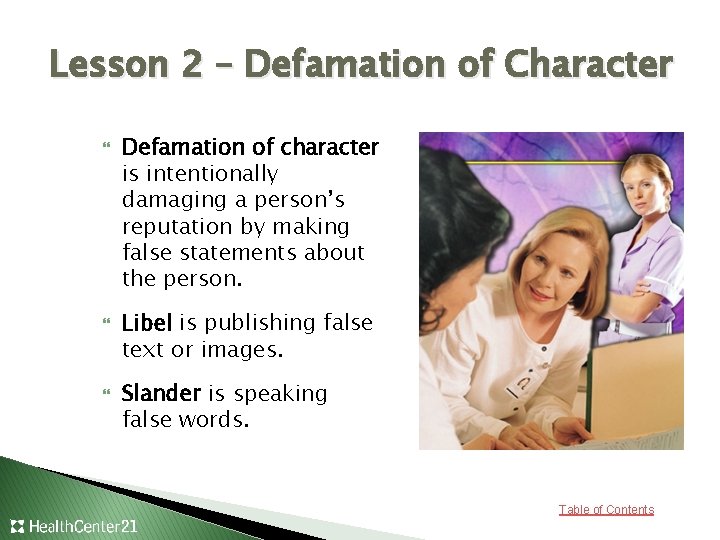
Lesson 2 – Defamation of Character Defamation of character is intentionally damaging a person’s reputation by making false statements about the person. Libel is publishing false text or images. Slander is speaking false words. Table of Contents
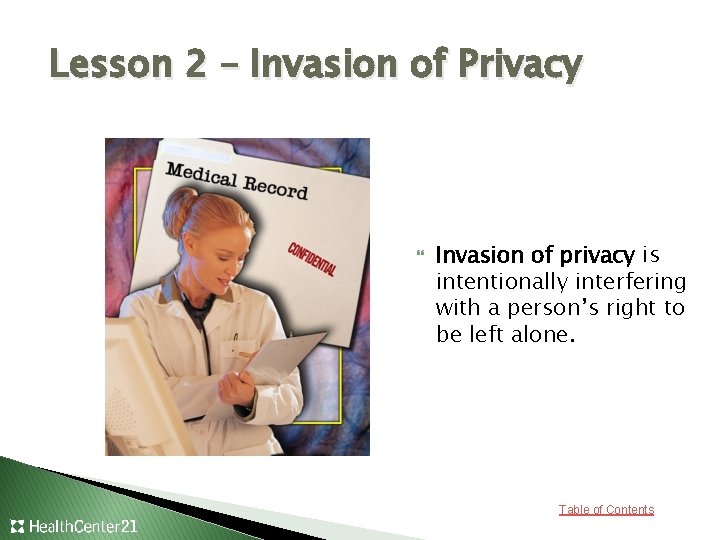
Lesson 2 – Invasion of Privacy Invasion of privacy is intentionally interfering with a person’s right to be left alone. Table of Contents
Lesson 2 – Malpractice and Scope of Practice Negligence is unintentionally harming a person by acting in an improper way Malpractice is professional negligence. Scope of practice is what health care workers should and should not do according to their profession. Table of Contents
Lesson 2 – Malpractice Lawsuits Legal action can be the results of malpractice. Legal action can be against any person or facility involved in the care of the patient. Healthcare providers and facilities take certain steps to try and protect themselves against malpractice lawsuits. Some complain malpractice lawsuits disproportionately add amount to the rise in health care cost. Others disagree. Table of Contents
Lesson 3 – Contract A contract is a voluntary agreement between two or more people. A contract has three parts: ▫ Offer ▫ Acceptance ▫ Consideration If a contract is not performed according to the agreement, the contract is breached. Two types of contracts are implied and expressed. Table of Contents

Lesson 3 – Implied Contract An implied contract is an agreement that is understood without being stated in words or writing. Table of Contents
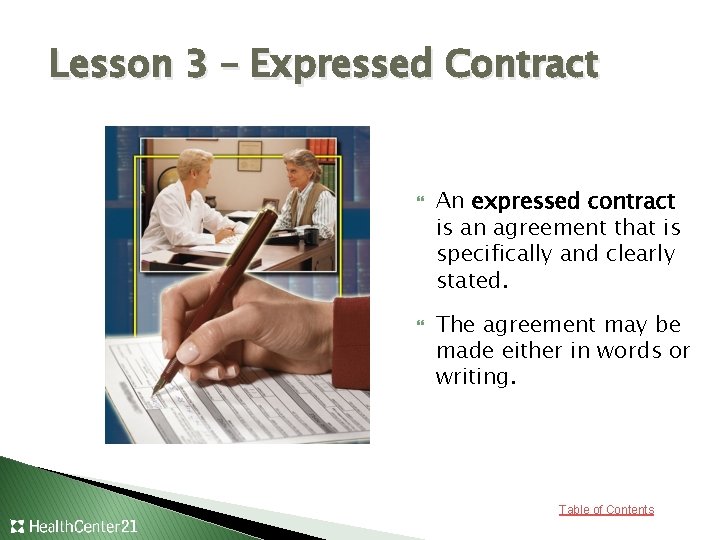
Lesson 3 – Expressed Contract An expressed contract is an agreement that is specifically and clearly stated. The agreement may be made either in words or writing. Table of Contents
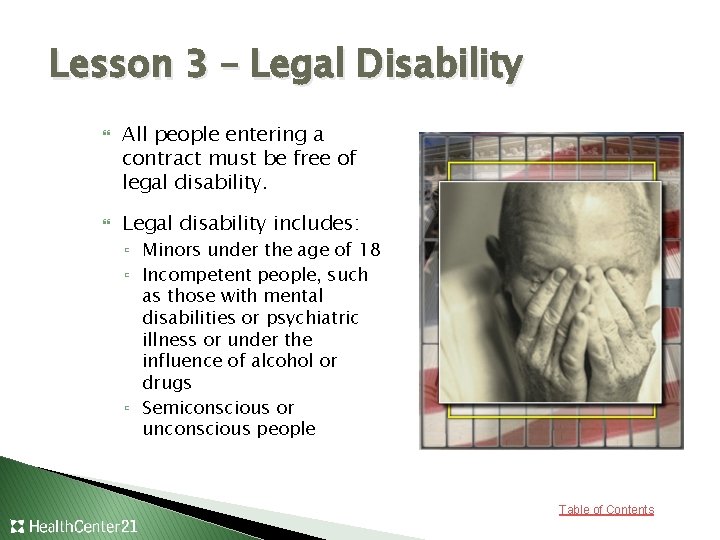
Lesson 3 – Legal Disability All people entering a contract must be free of legal disability. Legal disability includes: ▫ Minors under the age of 18 ▫ Incompetent people, such as those with mental disabilities or psychiatric illness or under the influence of alcohol or drugs ▫ Semiconscious or unconscious people Table of Contents
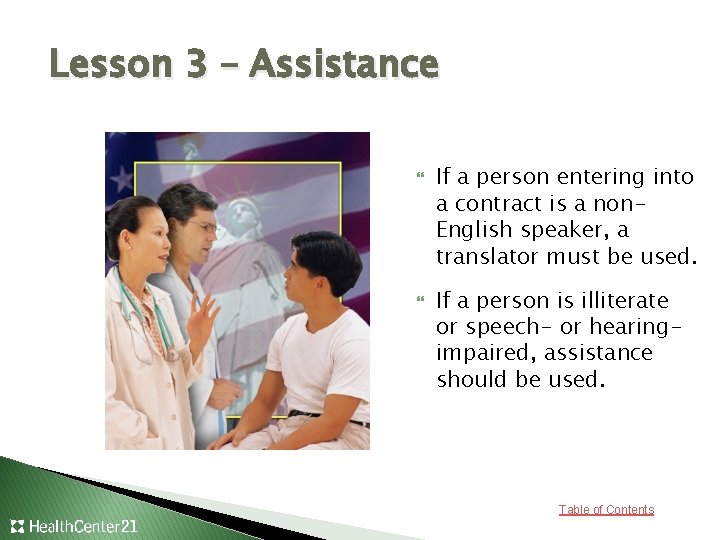
Lesson 3 – Assistance If a person entering into a contract is a non. English speaker, a translator must be used. If a person is illiterate or speech- or hearingimpaired, assistance should be used. Table of Contents
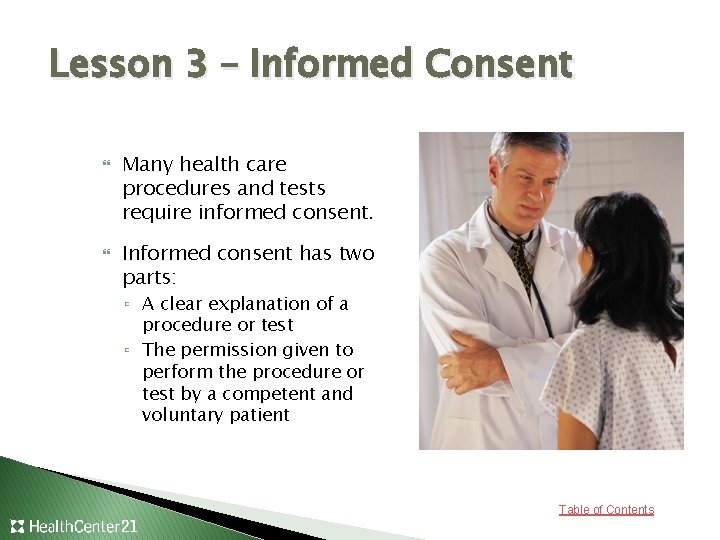
Lesson 3 – Informed Consent Many health care procedures and tests require informed consent. Informed consent has two parts: ▫ A clear explanation of a procedure or test ▫ The permission given to perform the procedure or test by a competent and voluntary patient Table of Contents
Lesson 3 – Exceptions to Informed Consent Emergency situations Minor procedures and simple tests with minimal risk States may differ in their exceptions to informed consent. Health care workers must comply with the laws in their state. Table of Contents
- Slides: 19