
Civil and criminal courts Contents Hierarchy of courts

- Slides: 24
Civil and criminal courts
Contents � Hierarchy of courts of England Wales � Civil courts and civil procedure � Criminal courts and criminal procedure
Civil courts � County Courts � High Court of Justice � The Court of Appeal (Civil Division) � The Supreme Court
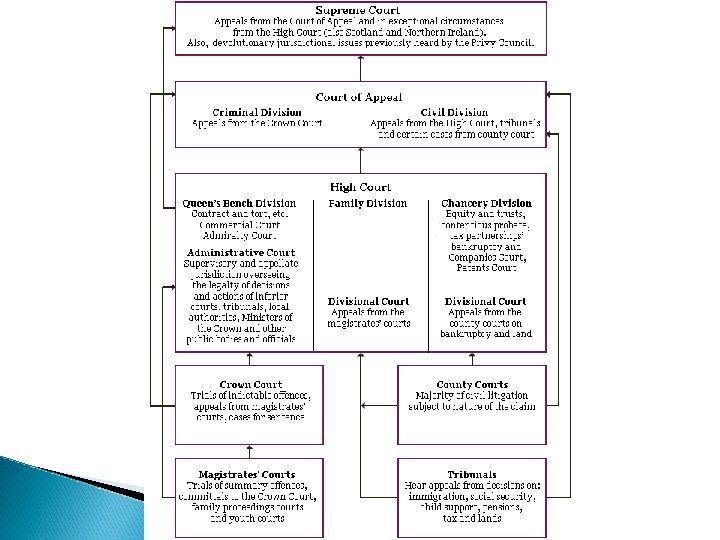
County courts � In England, simple civil actions are normally heard in either the Magistrates’ Courts or the County Courts � Family cases may go on appeal from the Magistrates’ Court to the County Court � The County Court hears complex first instance civil cases, such as contract disputes, compensation claims, consumer complaints and bankruptcy cases
Claimants � Formerly called plaintiffs � They seek legal remedy for some harm or injury they have suffered � Juries are now rare in civil actions, so the judge usually considers both law and fact
High Court of Justice � More complex cases are heard in the High Court of Justice � It is divided in three divisions: Family, Chancery and Queen’s Bench � The Court has both original and appelate jurisdiction
High Court Divisions � Family Division – for family-related disputes, wardship cases and cases relating to children under the Children Act 1989 � Chancery Division – equity and trust, mortgages, copyrights and patents � Queen’s Bench Division – contract and tort claims
The Court of Appeal � From the High Court cases may go on appeal to the civil division of the Court of Appeal, which can reverse or uphold a decision of the lower courts � Its decision binds all the lower civil courts
The Supreme Court � The final appeal hearings and judgments of the House of Lords took place on 30 July 2009. The judicial role of the House of Lords as the highest appeal court in the UK has ended. � From 1 October 2009, the Supreme Court of the United Kingdom assumes jurisdiction on points of law for all civil law cases in the UK and all criminal cases in England Wales and Northern Ireland.
Civil Procedure Rules � All cases concerning goods, property, debt repayment and breach of contract are subject to Civil Procedure Rules. � The Rules came into force in 1999 in England Wales and changed the civil process in the County Court and the High Court
The three tracks � 1. 2. 3. All cases are defended and allocated to one of three tracks: Small claims track (most cases under £ 5, 000) Fast track cases (claims between £ 5, 000 and 15, 000) Multi-track cases (claims over £ 15, 000)
Criminal courts and criminal procedure
Criminal courts � The Magistrates’ Court � The Crown Court � The Court of Appeal (Criminal Division) � The Supreme Court
Magistrates’ Courts � About 95% of all criminal cases in England Wales are tried in the Magistrates’ Courts, which deal with summary offences (less serious ones) � In certain circumstances, the court may commit an accused person to the Crown Court for more severe punishment
Magistrates � One stipendiary magistrate (full-time paid magistrate who has qualified as a lawyer) or three lay magistrates (unpaid, established members of the community) � Decide without a jury
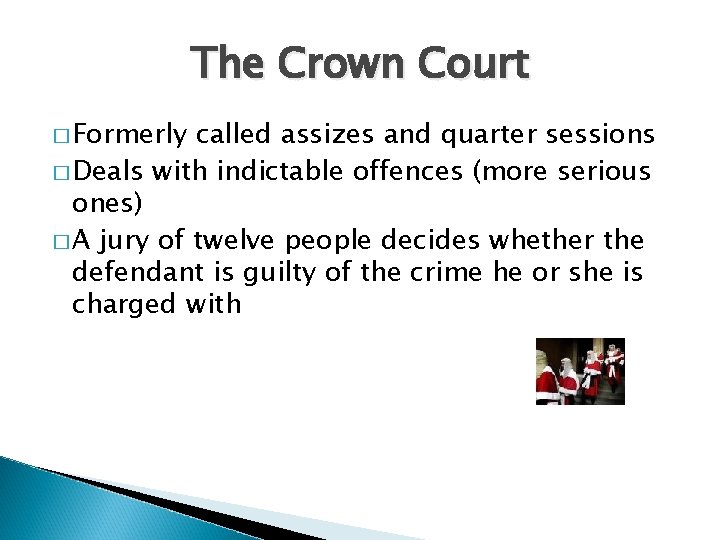
The Crown Court � Formerly called assizes and quarter sessions � Deals with indictable offences (more serious ones) � A jury of twelve people decides whether the defendant is guilty of the crime he or she is charged with
The Court of Appeal � From the Crown Court, appeal against conviction or sentence goes to the Criminal Division of the Court of Appeal
Criminal justice � The state prosecutes those charged with a crime and may apprehend suspects and detain them in custody � If the police decide that an offender should be prosecuted, a file on the case is sent to the Crown Prosecuting Service (CPS)
The CPS � The CPS must consider whethere is enough evidence for a realistic prospect of conviction, and if so, whether the public interest requires a prosecution � Criminal proceedings can be initiated either by the serving of a summons or, in more serious cases, by a warrant of arrest issued by a Magistrates’ Court
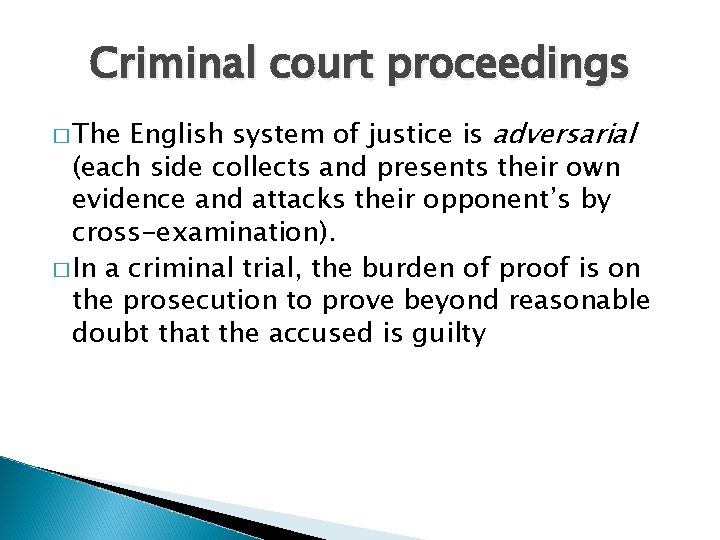
Criminal court proceedings English system of justice is adversarial (each side collects and presents their own evidence and attacks their opponent’s by cross-examination). � In a criminal trial, the burden of proof is on the prosecution to prove beyond reasonable doubt that the accused is guilty � The
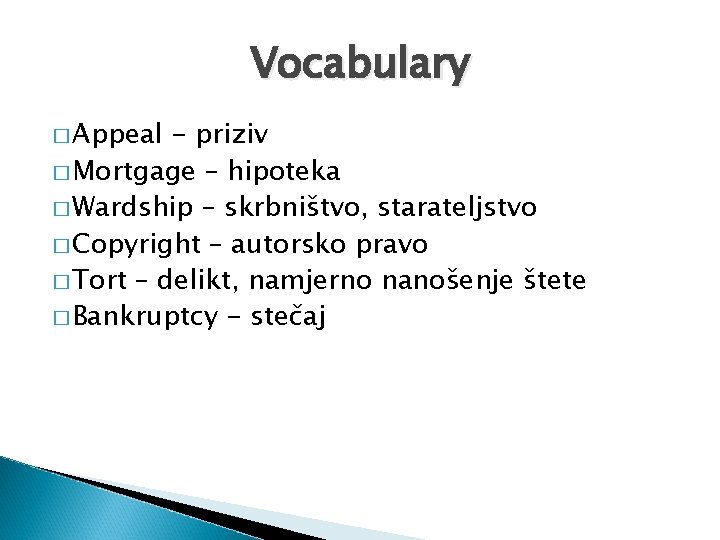
Vocabulary � Appeal - priziv � Mortgage – hipoteka � Wardship – skrbništvo, starateljstvo � Copyright – autorsko pravo � Tort – delikt, namjerno nanošenje štete � Bankruptcy - stečaj
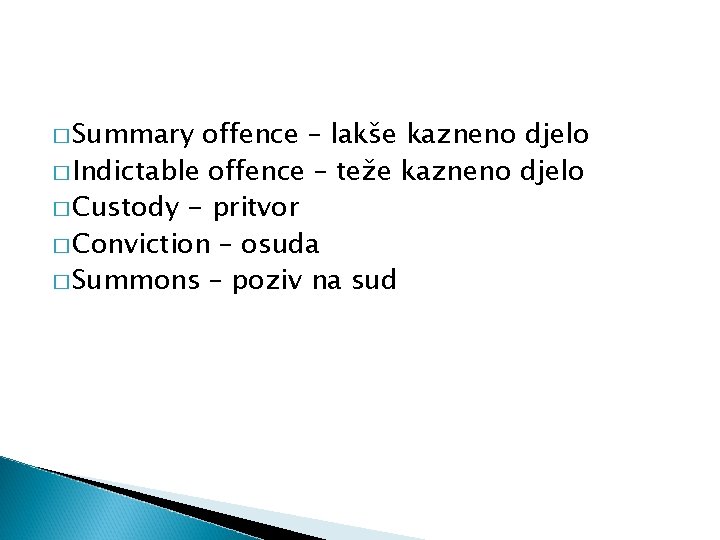
� Summary offence – lakše kazneno djelo � Indictable offence – teže kazneno djelo � Custody - pritvor � Conviction – osuda � Summons – poziv na sud
Thank you for your attention!