
Civil Air Patrol Introduction to Health Services Lt

- Slides: 24
Civil Air Patrol Introduction to Health Services Lt Col Tom Janisko, CAP Senior Program Manager Health Services tjanisko@cap. gov Lt Col Stephen Leighton, CAP Deputy Senior Program Manager Health Services sleighton@cap. gov ONE CIVIL AIR PATROL, EXCELLING IN SERVICE TO OUR NATION AND OUR MEMBERS!
Health Services - Directions • Each Commander or Activity Director shall meet with their health services officer(s) and ensure a common understanding for the health services officer(s) position and tasks.
Health Services - Purpose • SUPPORT THE THREE MISSIONS by bringing professional skills and CAP-specific training to all echelons of CAP, enhancing the Cadet Program, serving the ES mission, and supporting our Aerospace Education Activities and cadre. • PURSUE THE STRATEGIC PLAN, and the commander’s intent to align our efforts for maximum effect. • 2016 Annex - Goal 5. 2: Take care of our members
Health Services – Description • TRUSTED ADVISOR to the Commander (or designee), Activity Director, Incident Commander, Team Leader, and Safety Officer on all matters that involve the health of the force. • NOT A DECISION MAKER, but a skilled and trained presenter of multiple courses of action that meet the requirements of maintaining the health of the force and meeting the CAP missions.
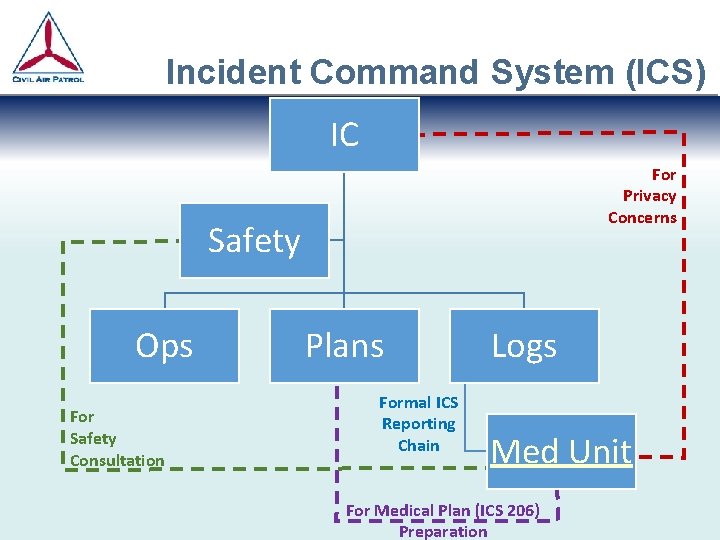
Health Services – Description • Remember: • Unit/Wing/Region Commanders, Activity Directors, Incident Commanders, and Team Leaders (e. g. , “the leadership”) assume risk. Health Services Officers and Safety Officers identify risks and advise decision makers on courses of action to mitigate risk. • Issues of privacy should be handled discreetly and reported directly to a Commander, Activity Director, Incident Commander, or Team Leader. • As a reminder, ensuring privacy is a central tenet of your position as a Health Services Officer.
Health Services – Description • CAP is not a health care provider; members are not permitted to act in the role of health care providers during official CAP duties. Emergency first-aid care is always appropriate but ensure that EMS is called. • CAP members are not permitted to be in any role that would permit the administration and dispensing of drugs or medications (this is discussed with CAPF 79 -1). • Medical care within CAP is limited to emergency first aid and may be provided only by members with appropriate training and experience. Such care shall continue only until professional medical care can be obtained. CAPR 79 -1 – CAP Health Services Regulation
Health Services – Description • Should any CAP member be required by law to render aid by virtue of his or her professional credential or state license, such CAP member in complying with his or her legal obligations shall be deemed to be doing so either as the agent of his or her employer or as an agent of the state agency that issued his or her license, but in no event as the agent of CAPR 79 -1 – CAP Health Services Regulation
Health Services – Organizational Location • Varies by mission and the specific organizational location is less important; the goal is to ensure that the HSO can perform their primary functions: • Advising the leadership (or designee) on all health issues; • Ability to report directly to the leadership when privacy is required; • Ability to assess, write, and present an accurate medical plan; there is a CAP Medical Planners Course to teach you how to do this. • Ability to present aeromedical information in accordance with “Fit For Flying” curricula. • Ability to present standard information on wellness, physical fitness, and nutrition IAW USAF and CDC recommendations; there is a CAP website loaded with presentations. • Ability to teach first-aid and blood-borne pathogen training.
Incident Command System (ICS) IC For Privacy Concerns Safety Ops For Safety Consultation Plans Formal ICS Reporting Chain Logs Med Unit For Medical Plan (ICS 206) Preparation
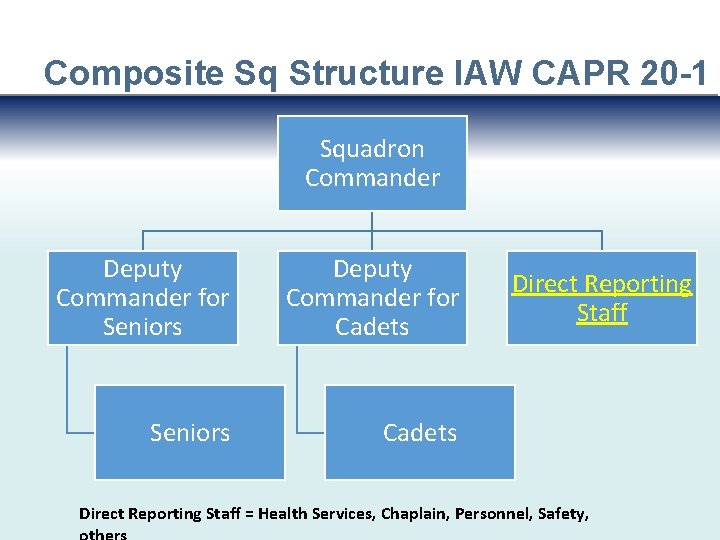
Composite Sq Structure IAW CAPR 20 -1 Squadron Commander Deputy Commander for Seniors Deputy Commander for Cadets Seniors Cadets Direct Reporting Staff = Health Services, Chaplain, Personnel, Safety,
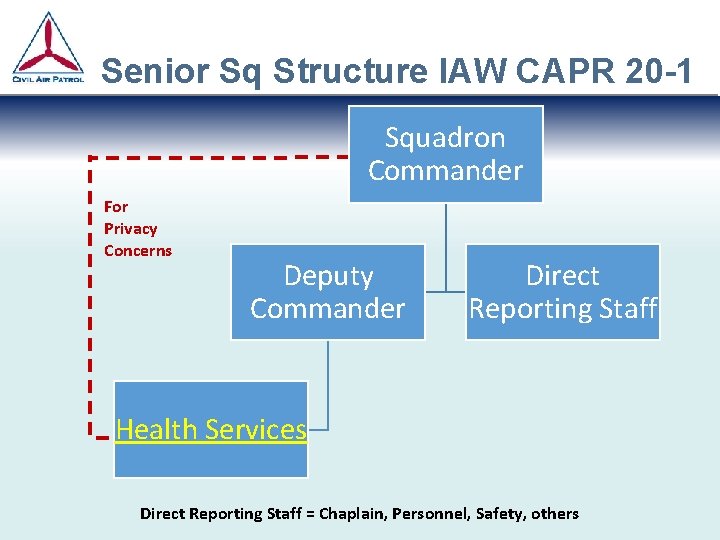
Senior Sq Structure IAW CAPR 20 -1 Squadron Commander For Privacy Concerns Deputy Commander Direct Reporting Staff Health Services Direct Reporting Staff = Chaplain, Personnel, Safety, others
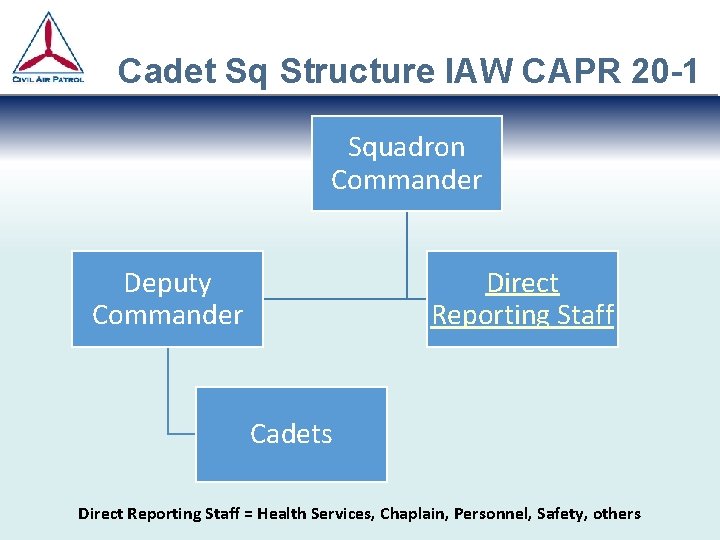
Cadet Sq Structure IAW CAPR 20 -1 Squadron Commander Deputy Commander Direct Reporting Staff Cadets Direct Reporting Staff = Health Services, Chaplain, Personnel, Safety, others
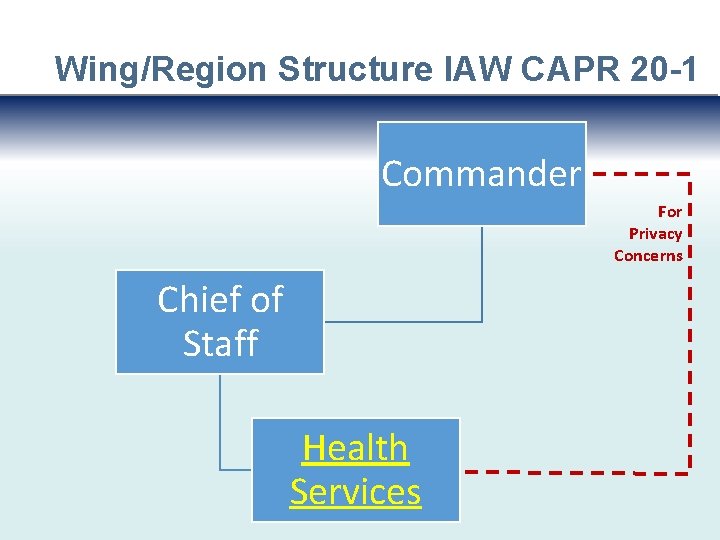
Wing/Region Structure IAW CAPR 20 -1 Commander For Privacy Concerns Chief of Staff Health Services
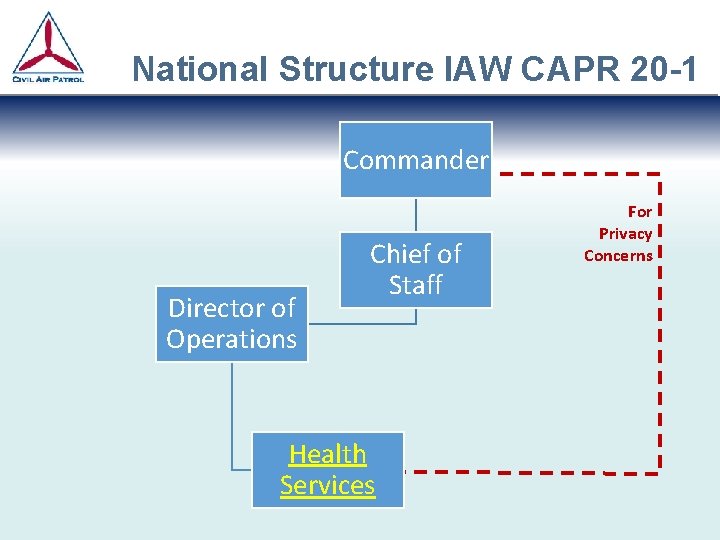
National Structure IAW CAPR 20 -1 Commander Director of Operations Chief of Staff Health Services For Privacy Concerns
Privacy Concerns • When addressing issues of privacy or confidentiality in their capacity as Health Services Officers, we should only discuss these issues directly with Commanders (unit, wing, region, etc), Activity Directors, or Incident Commanders. • This ability to bypass the standard chain of command must be approved by the Commander prior to engaging. • This topic is something that you must speak to your Commander about early on in your tenure as a Health Services Officer.
Prescription Medications • The taking of prescription medication is the responsibility of the individual member for whom the medication was prescribed or, if the member is a minor, the member’s parent or guardian. • Except in extraordinary circumstances, CAP members, regardless of age, will be responsible for transporting, storing, and taking their own medications, including inhalers and epinephrine pens. • When in doubt consult your Wing / Region Health Services Officer. CAPR 79 -1 – CAP Health Services Regulation
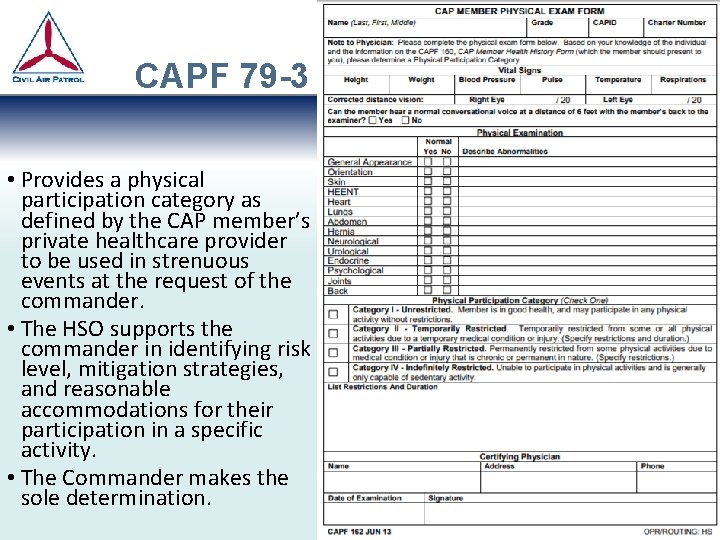
CAPF 79 -3 • Provides a physical participation category as defined by the CAP member’s private healthcare provider to be used in strenuous events at the request of the commander. • The HSO supports the commander in identifying risk level, mitigation strategies, and reasonable accommodations for their participation in a specific activity. • The Commander makes the sole determination.
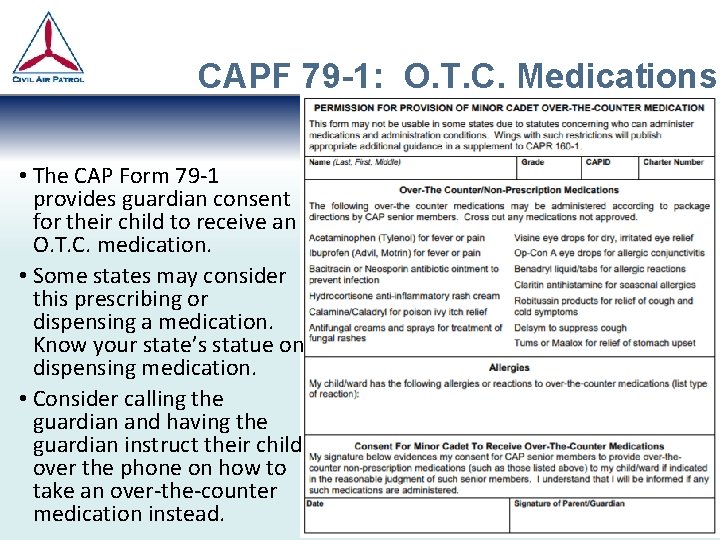
CAPF 79 -1: O. T. C. Medications • The CAP Form 79 -1 provides guardian consent for their child to receive an O. T. C. medication. • Some states may consider this prescribing or dispensing a medication. Know your state’s statue on dispensing medication. • Consider calling the guardian and having the guardian instruct their child over the phone on how to take an over-the-counter medication instead.
Communication - Cadet Guardians • When a Cadet is provided a over-the-counter medication that was approved by their guardian using a CAP 79 -1, the guardian shall be contacted to ensure that they are informed. • At no time shall a Health Services Officer impede the Cadet from contacting their guardian/parent; this is contrary to enabling well-informed guardians. • Additionally, when a CAP member presents with a condition that is unable to be fully managed with first-aid, that CAP member must be referred to a higher level of care by calling EMS/911 or if unable, transporting to a healthcare facility.
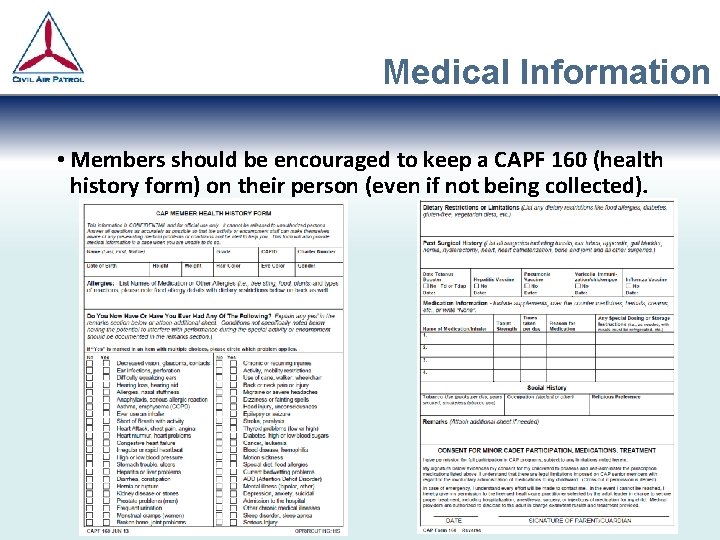
Medical Information • Members should be encouraged to keep a CAPF 160 (health history form) on their person (even if not being collected).
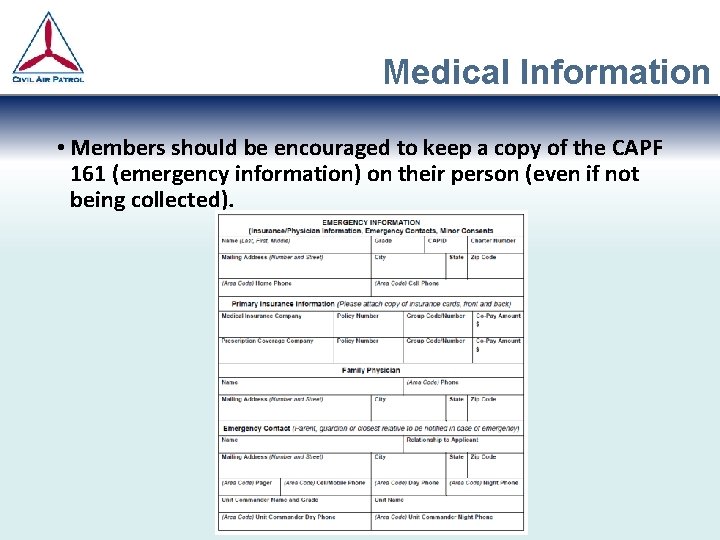
Medical Information • Members should be encouraged to keep a copy of the CAPF 161 (emergency information) on their person (even if not being collected).
Medical Information Collection • Limit Medical Information Collection. Health information should be collected only when that information might make a difference in the safe participation of the member(s). • The decision to collect this information rests with the commander of the activity, in consultation with the activity or wing HSO and, if controversial, higher authorities.
Medical Information Collection • Collection of information is rarely needed for a short duration activities. However, longer duration activity that may be conducted in the field, or for activities that involve physical exertion, pre-screening may be needed to ensure safe participation. • Health information may also be collected on members involved in field trips or overnight activities where medications may need to be administered or medical conditions may affect activities.
Storage of Health Information • Record Storage. When CAP 160 series forms are not in active use, they will be stored separately in a locked container accessible only to senior members who are authorized by the Commander/Activity Director/Incident Commander. • When health information is stored on a computer, it will not be accessible to unauthorized members. • Ultimately information must be destroyed at the end of the activity or event unless needed for legal or insurance purposes.