
Civics Chapter 4 Instruction to find notes MCPSS




















- Slides: 173
Civics Chapter 4
Instruction to find notes: • MCPSS • Our Schools • Middle • Causey Website • News and Events • School Staff • Chapman • Forms • Civics 1 Notes • Download
4 -1 Enter room, and take assigned seat quietly. Put your name, date, and period on the top right-hand side of a piece of paper. Do NOT write in red. At the end of the period, turn your paper into tray #1 on your way out of the room.
4 -1 Enter room, and take assigned seat quietly. Put your name, date, and period on the top right-hand side of a piece of paper. Do NOT write in red. At the end of the period, turn your paper into tray #1 on your way out of the room.
Civics Chapter 4 Lesson 1 Bell Ringer Copy questions and underline answers.
• 1. _________ is the idea that power lies with the people. 93
• 2. _________ is the division of government power among different branches. 94
• 3. One _________ of Congress stated in the Constitution is the power to coin money. 96
• 4. The ________ is the highest law in the nation. 97
• 5. _______ means that the legislature is divided into two parts or houses. 73
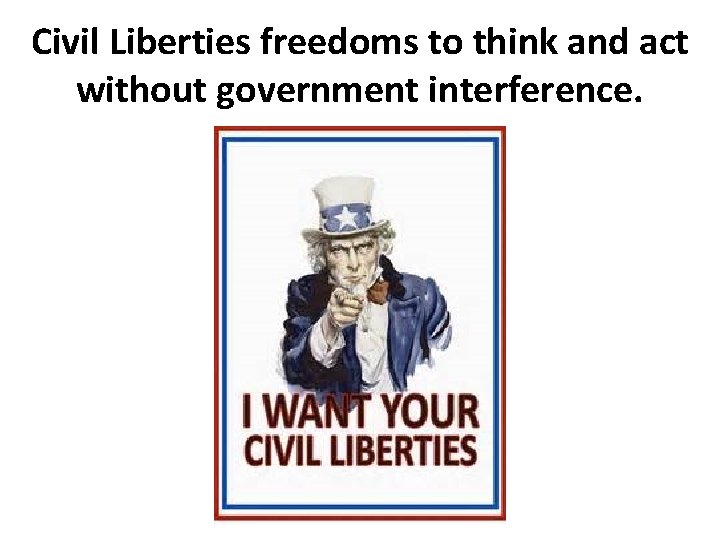
Civil Liberties freedoms to think and act without government interference.
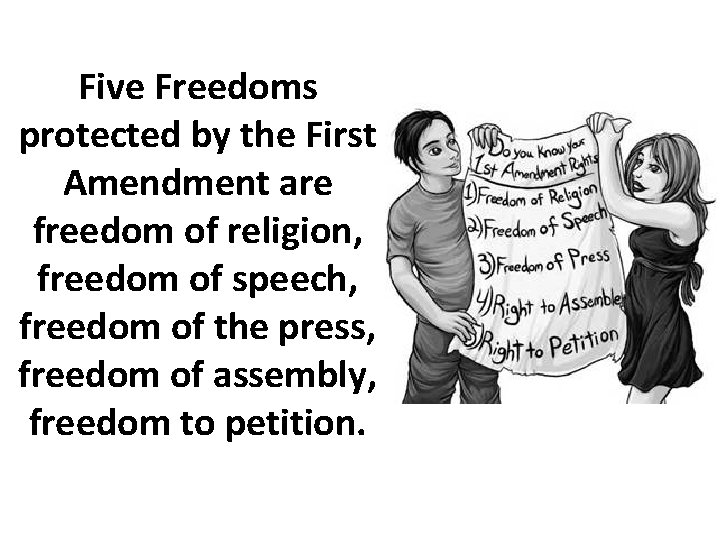
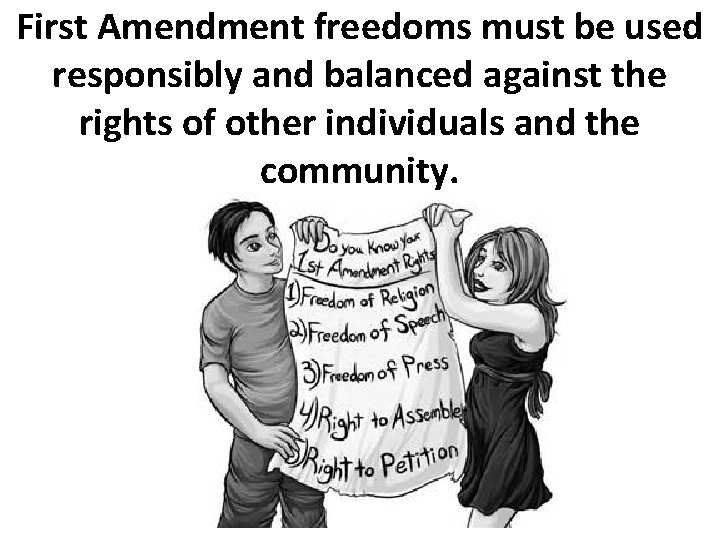
Five Freedoms protected by the First Amendment are freedom of religion, freedom of speech, freedom of the press, freedom of assembly, freedom to petition.
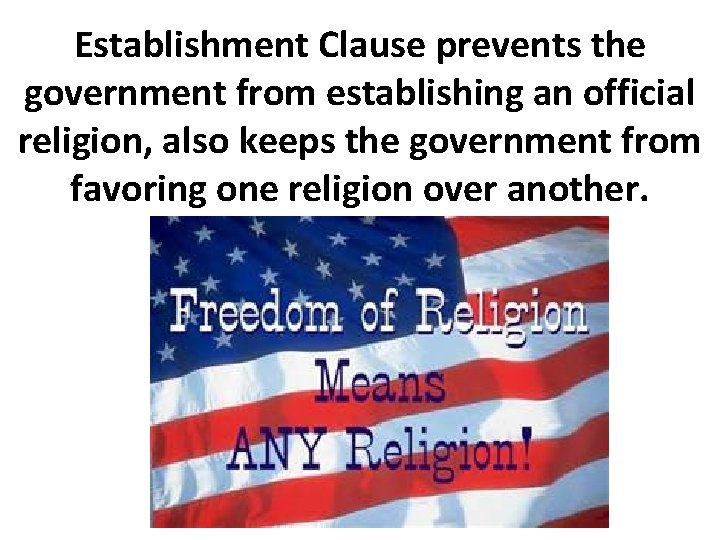
Establishment Clause prevents the government from establishing an official religion, also keeps the government from favoring one religion over another.
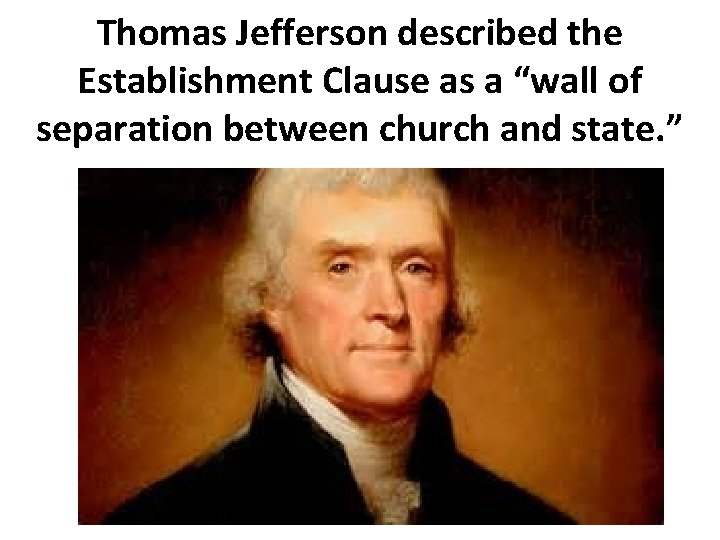
Thomas Jefferson described the Establishment Clause as a “wall of separation between church and state. ”
Freedom of speech and freedom of the press help strengthen democracy in the United States
Freedom of Speech allows people to speak out, for or against the policies of the government and members of the government
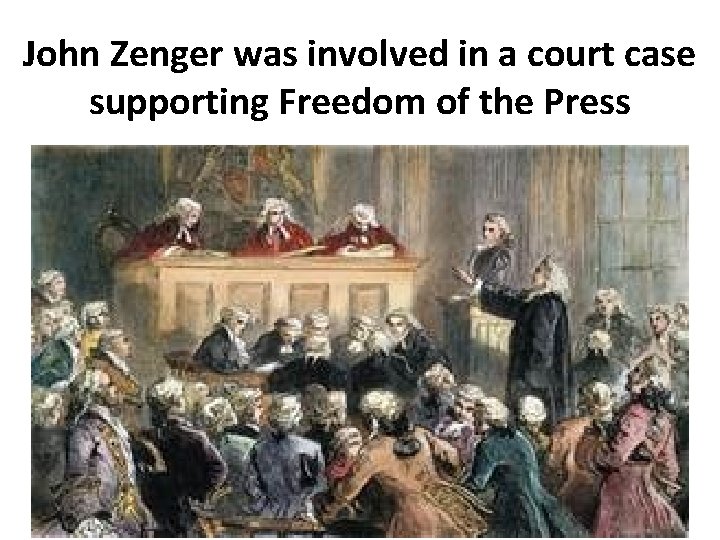
John Zenger was involved in a court case supporting Freedom of the Press
An article describing crimes that a politician has committed is legal for a newspaper to print.
First Amendment, the phrase “petition the Government” means citizens may request the government to act on a specific matter.
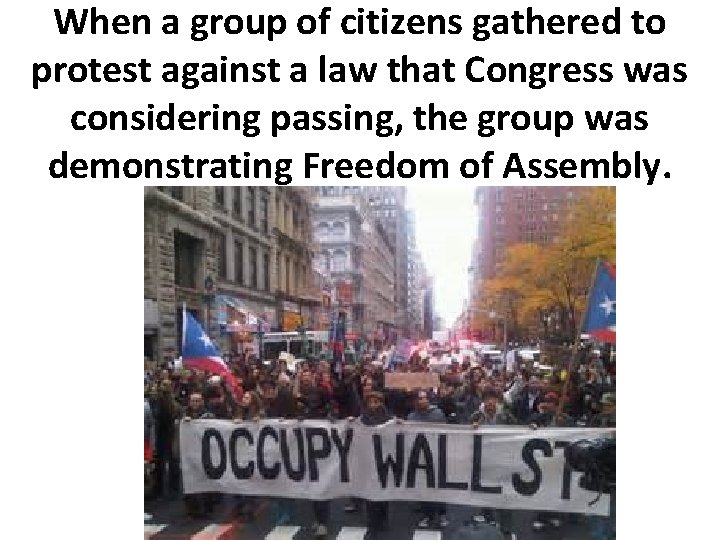
When a group of citizens gathered to protest against a law that Congress was considering passing, the group was demonstrating Freedom of Assembly.
First Amendment freedoms must be used responsibly and balanced against the rights of other individuals and the community.
Slander or Libel - crime of printing lies in order to hurt a person’s reputation.
Examples; people cannot say or print lies to hurt someone else’s reputation, directly lead to criminal acts or to overthrowing the government.
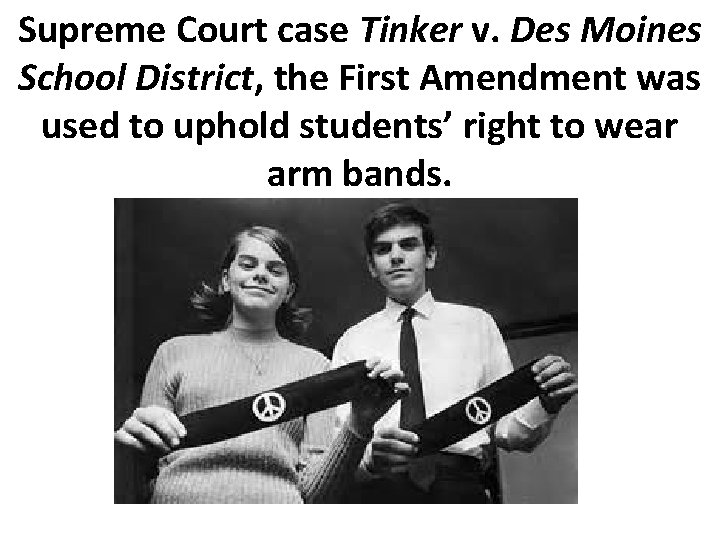
Supreme Court case Tinker v. Des Moines School District, the First Amendment was used to uphold students’ right to wear arm bands.
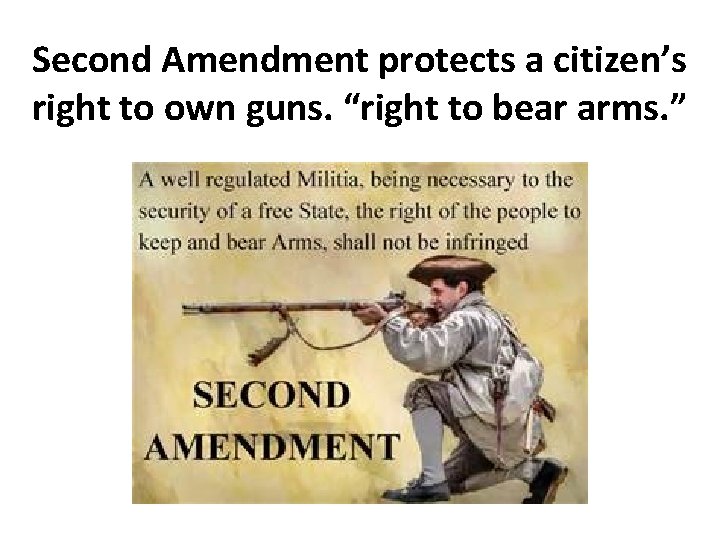
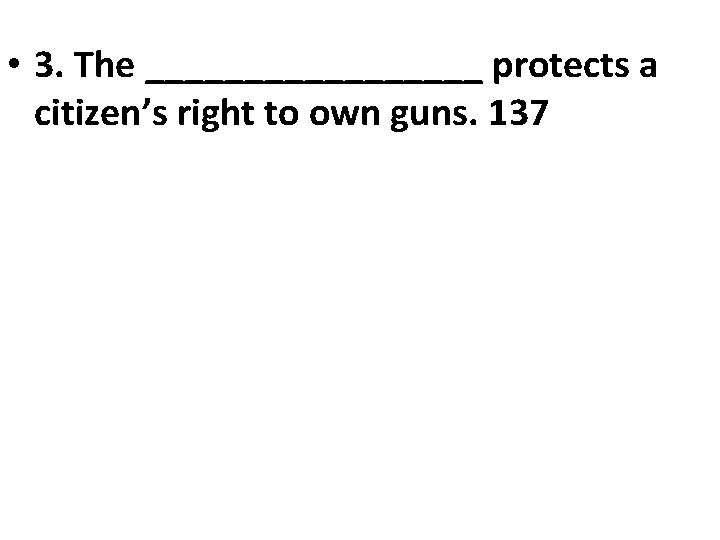
Second Amendment protects a citizen’s right to own guns. “right to bear arms. ”
Civics Chapter 4 Lesson 1 Independent Practice Write answers in complete sentences. If you do not copy last question, you will receive a zero.
• 6. How does freedom of speech and press help Democracy? 129
• 7. In the First Amendment, what does the phrase “petition the Government” mean? . 131
• 8. List limits on your First Amendment freedoms. 132
• 9. Give an example of a group demonstrating freedom of assembly. 131
• 10. ________ was involved in a court case supporting freedom of the press. 130
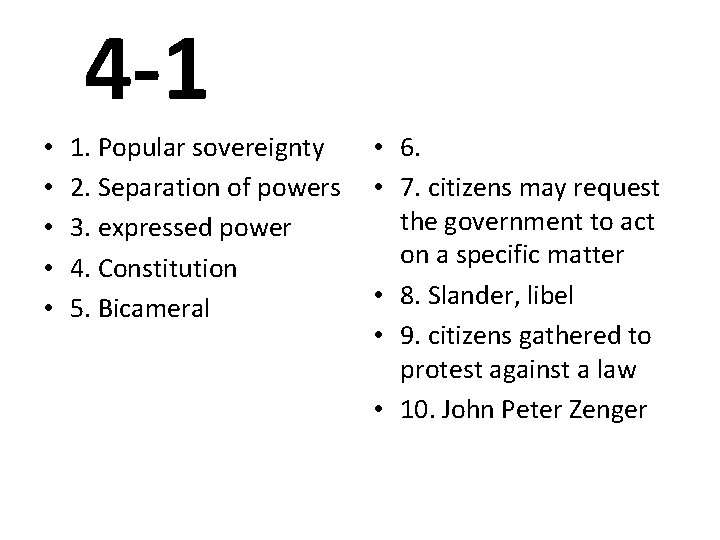
4 -1 • • • 1. Popular sovereignty 2. Separation of powers 3. expressed power 4. Constitution 5. Bicameral • 6. • 7. citizens may request the government to act on a specific matter • 8. Slander, libel • 9. citizens gathered to protest against a law • 10. John Peter Zenger
C 4 -2 Enter room, and take assigned seat quietly. Put your name, date, and period on the top right-hand side of a piece of paper. Do NOT write in red. At the end of the period, turn your paper into tray #1 on your way out of the room.
C 4 -2 Enter room, and take assigned seat quietly. Put your name, date, and period on the top right-hand side of a piece of paper. Do NOT write in red. At the end of the period, turn your paper into tray #1 on your way out of the room.
Civics Chapter 4 Lesson 2 Bell Ringer Copy questions and underline answers.
• 1. List the five freedoms protected by the First Amendment. 129
• 2. The right to practice one’s religion freely is protected by the _________. 129
• 3. ________ described the establishment clause as a “wall of separation between church and state. ” 129
• 4. _____ is the crime of printing lies in order to hurt a person’s reputation. 132
• 5. ________ are freedoms to think and act without government interference. 128
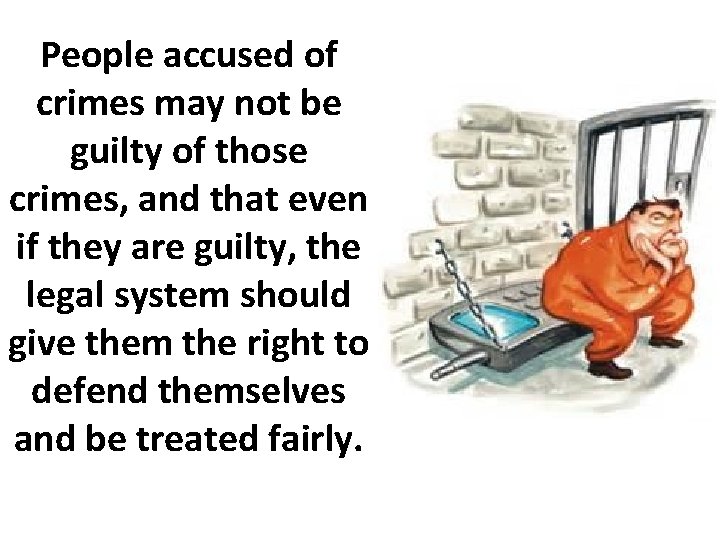
People accused of crimes may not be guilty of those crimes, and that even if they are guilty, the legal system should give them the right to defend themselves and be treated fairly.
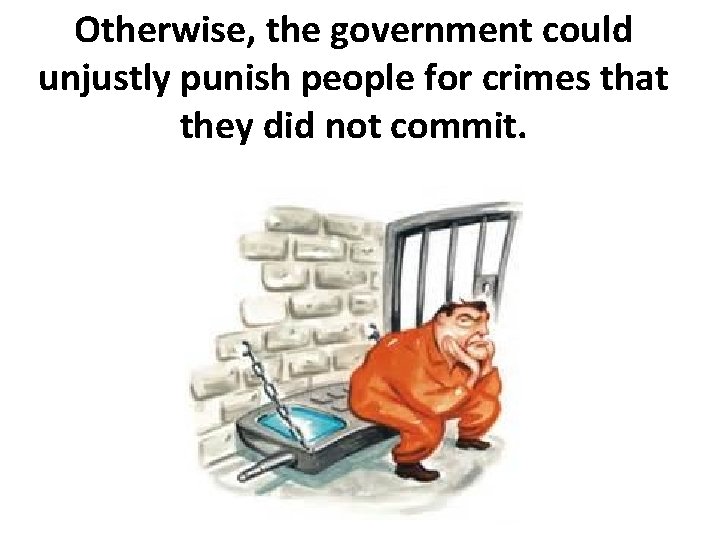
Otherwise, the government could unjustly punish people for crimes that they did not commit.
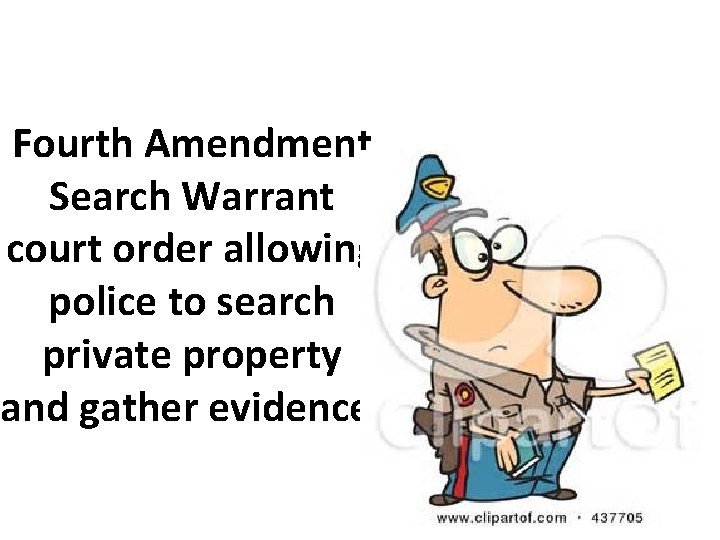
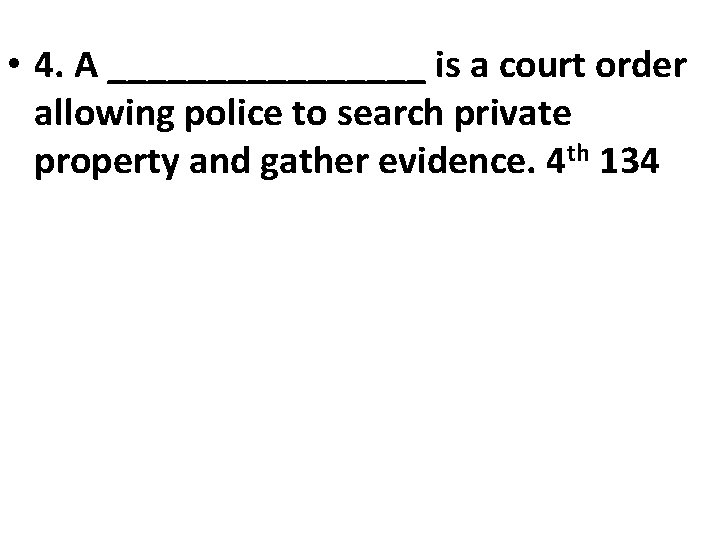
Fourth Amendment Search Warrant court order allowing police to search private property and gather evidence.
Fourth Amendment Unreasonable searches and seizures are prohibited
If a police officer wanted to search your home to find evidence of a crime, you would be able to say that the officer needed to get a search warrant because of the Fourth Amendment.
Some people worried that the Patriot Act, which was passed as a response to the terrorist attack of September 11, 2001, was a violation of the Fourth Amendment.
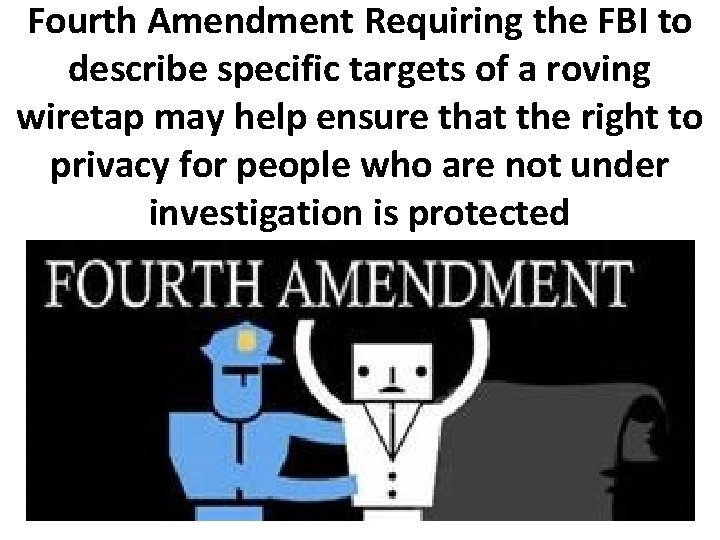
Fourth Amendment Requiring the FBI to describe specific targets of a roving wiretap may help ensure that the right to privacy for people who are not under investigation is protected
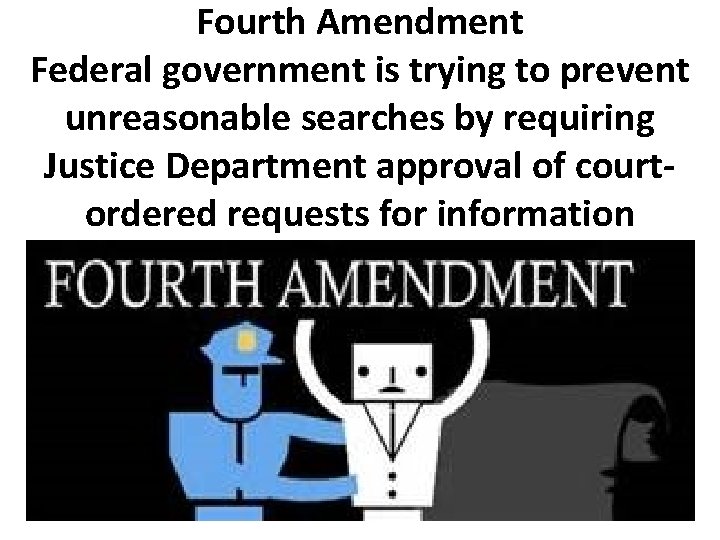
Fourth Amendment Federal government is trying to prevent unreasonable searches by requiring Justice Department approval of courtordered requests for information
Fifth Amendment Right to have a trial by jury and to call witnesses in one’s defense are examples of due process
Fifth Amendment Self-Incrimination right to remain silent
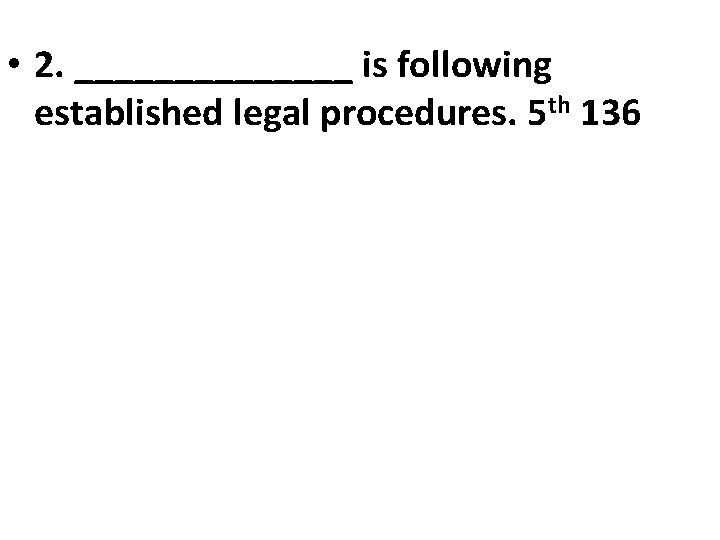
Fifth Amendment Due Process is following established legal procedures
Fifth Amendment Double Jeopardy is being tried twice for the same crime
Fifth Amendment A person who is indicted for a particular crime will be put on trial for that crime
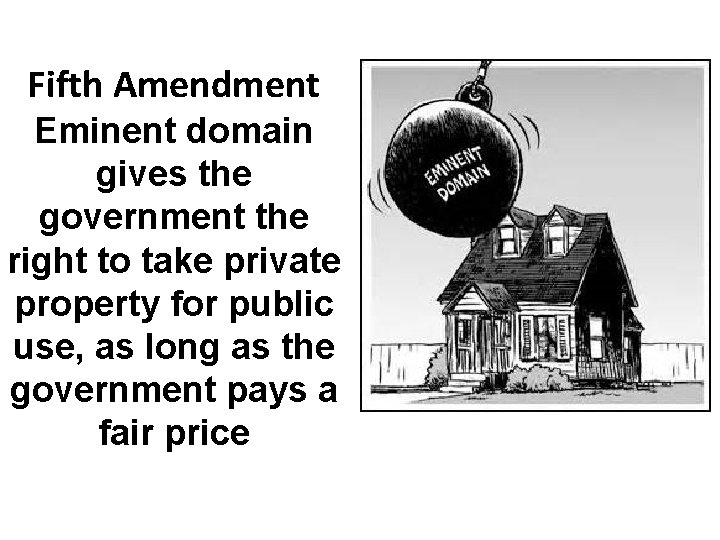
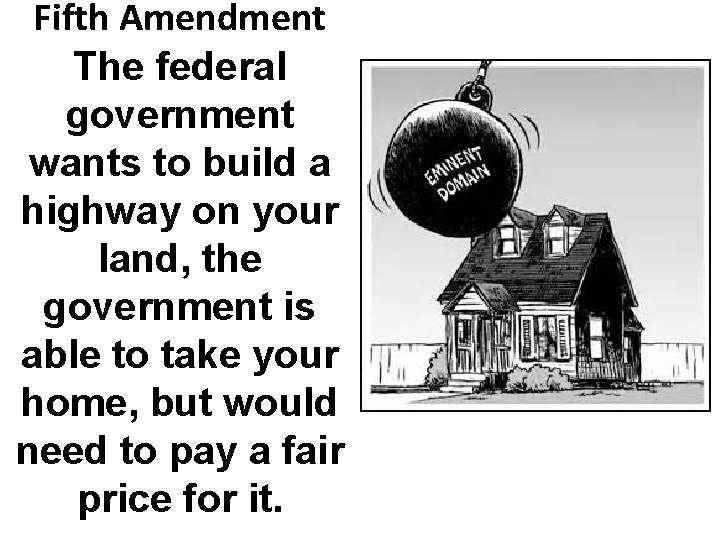
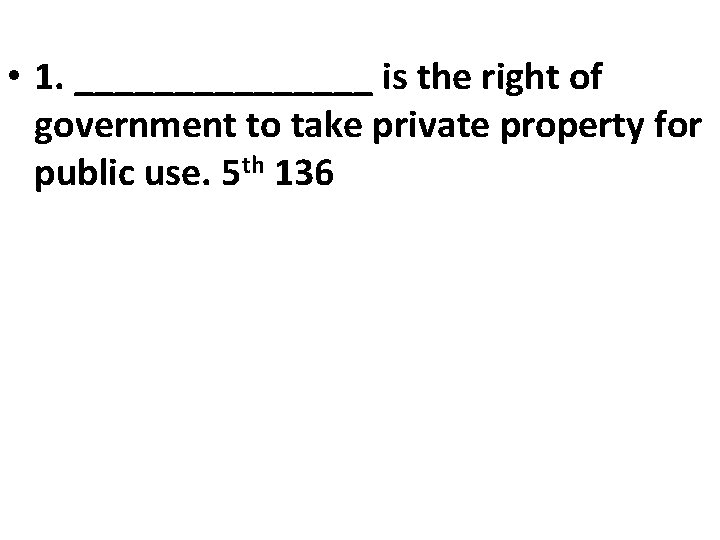
Fifth Amendment Eminent domain gives the government the right to take private property for public use, as long as the government pays a fair price
Fifth Amendment The federal government wants to build a highway on your land, the government is able to take your home, but would need to pay a fair price for it.
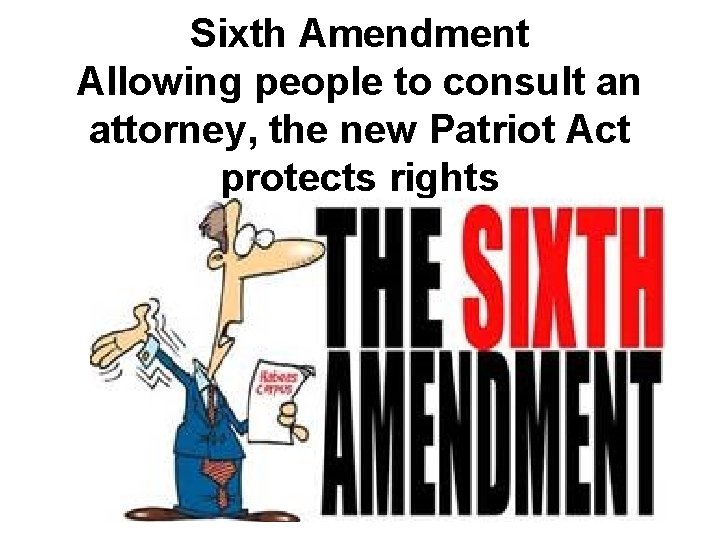
Sixth Amendment Allowing people to consult an attorney, the new Patriot Act protects rights
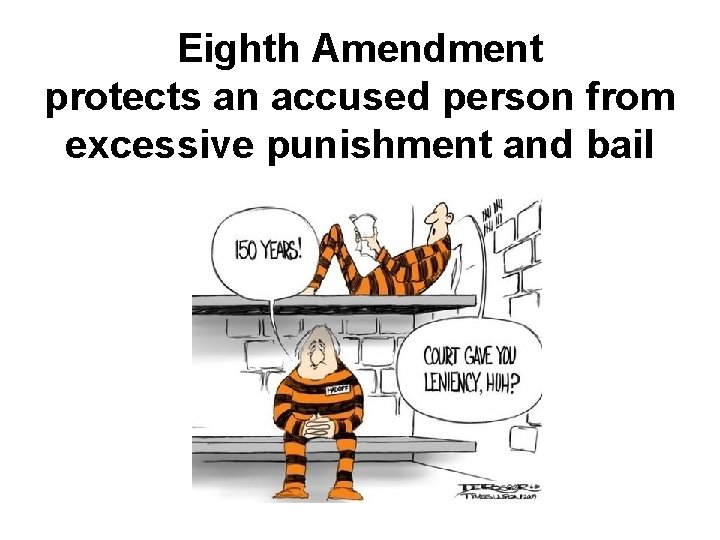
Eighth Amendment protects an accused person from excessive punishment and bail
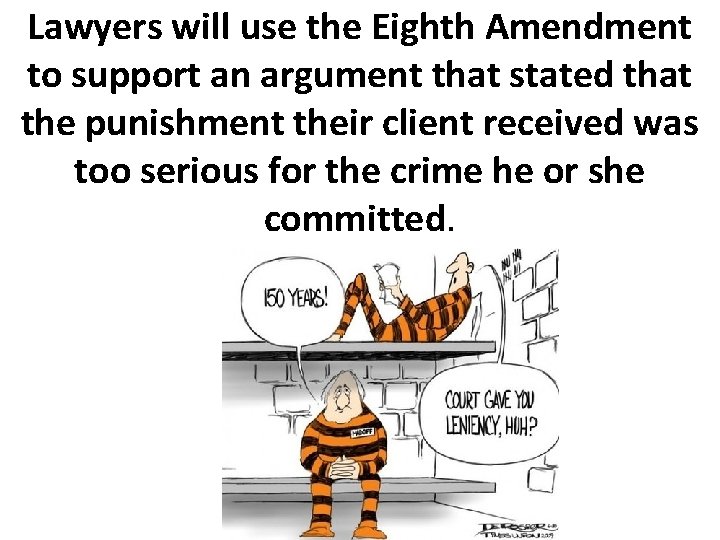
Lawyers will use the Eighth Amendment to support an argument that stated that the punishment their client received was too serious for the crime he or she committed.
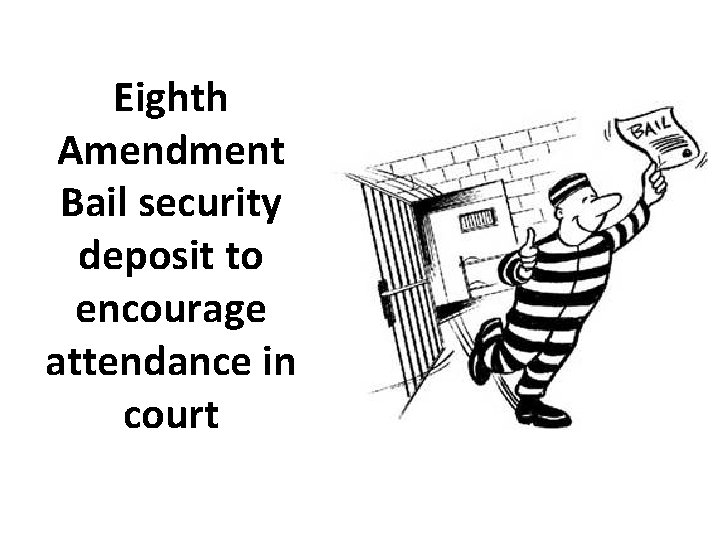
Eighth Amendment Bail security deposit to encourage attendance in court
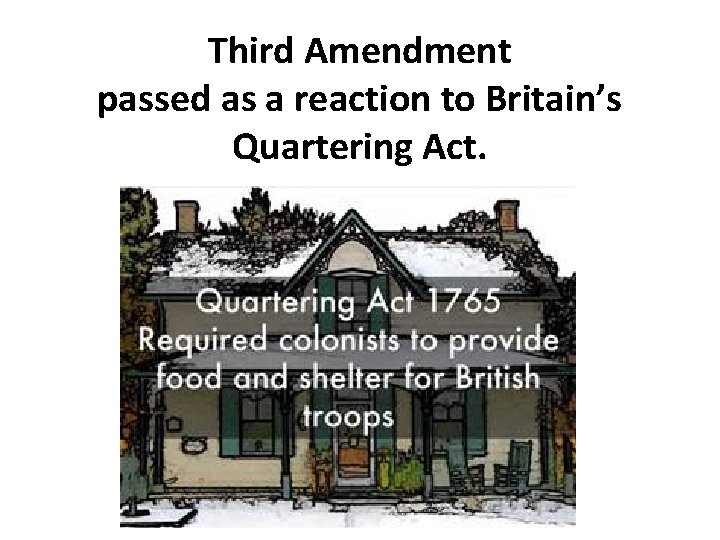
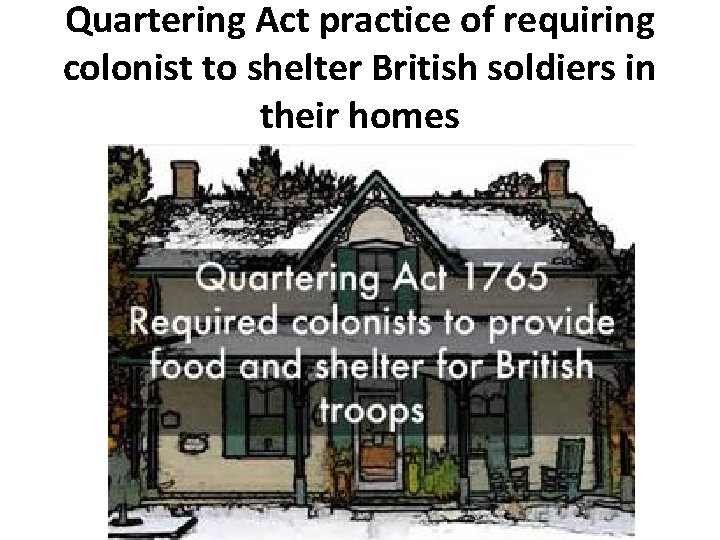
Third Amendment passed as a reaction to Britain’s Quartering Act.
Quartering Act practice of requiring colonist to shelter British soldiers in their homes
Civics Chapter 4 Lesson 2 Independent Practice Write answers in complete sentences. If you do not copy last question, you will receive a zero.
• 6. Describe Eminent domain. 5 th 136
• 7. Why was the Third Amendment passed? 138
• 8. The ________ says that no one can be tried for a serious crime without an indictment. 135
• 9. Lawyers will use the _______ to support an argument that stated that the punishment their client received was too serious for the crime he or she committed. 136
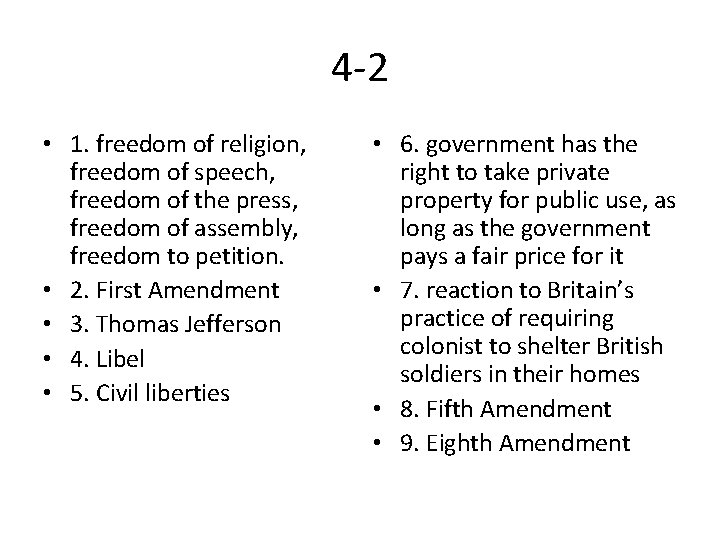
4 -2 • 1. freedom of religion, freedom of speech, freedom of the press, freedom of assembly, freedom to petition. • 2. First Amendment • 3. Thomas Jefferson • 4. Libel • 5. Civil liberties • 6. government has the right to take private property for public use, as long as the government pays a fair price for it • 7. reaction to Britain’s practice of requiring colonist to shelter British soldiers in their homes • 8. Fifth Amendment • 9. Eighth Amendment
C 4 -3 Enter room, and take assigned seat quietly. Put your name, date, and period on the top right-hand side of a piece of paper. Do NOT write in red. At the end of the period, turn your paper into tray #1 on your way out of the room.
C 4 -3 Enter room, and take assigned seat quietly. Put your name, date, and period on the top right-hand side of a piece of paper. Do NOT write in red. At the end of the period, turn your paper into tray #1 on your way out of the room.
Civics Chapter 4 Lesson 3 Bell Ringer Copy questions and underline answers.
• 1. ________ is the right of government to take private property for public use. 5 th 136
• 2. _______ is following established legal procedures. 5 th 136
• 3. The _________ protects a citizen’s right to own guns. 137
• 4. A ________ is a court order allowing police to search private property and gather evidence. 4 th 134
• 5. __________ is being tried twice for the same crime. 5 th 135
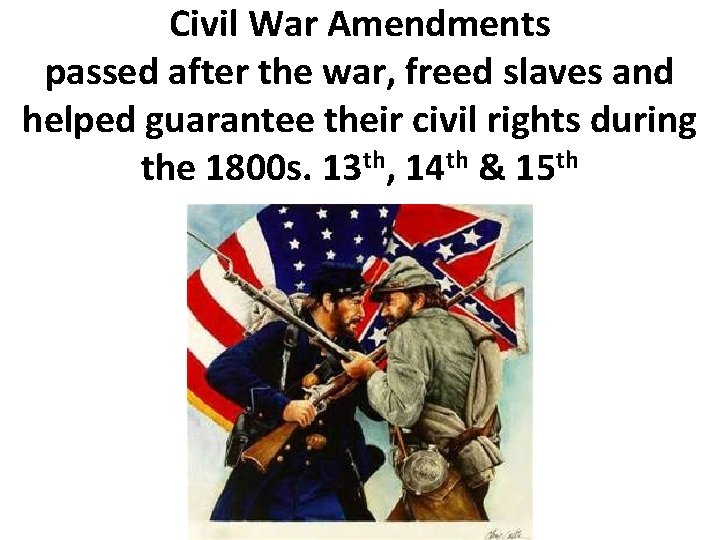
Civil War Amendments passed after the war, freed slaves and helped guarantee their civil rights during the 1800 s. 13 th, 14 th & 15 th
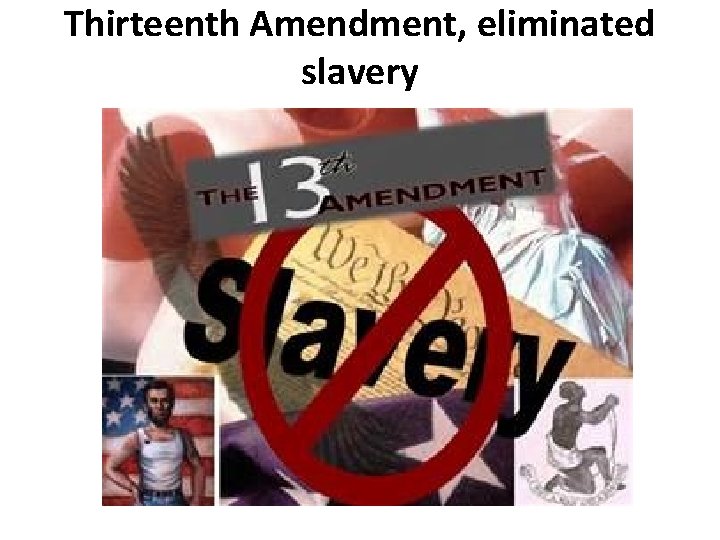
Thirteenth Amendment, eliminated slavery
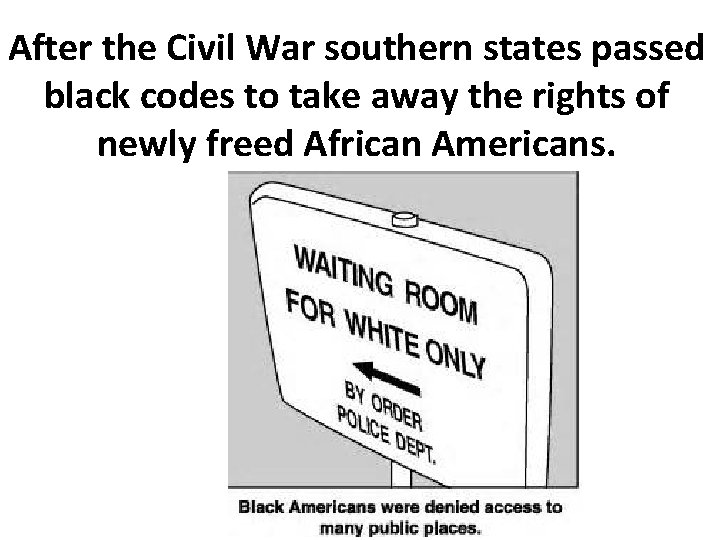
After the Civil War southern states passed black codes to take away the rights of newly freed African Americans.
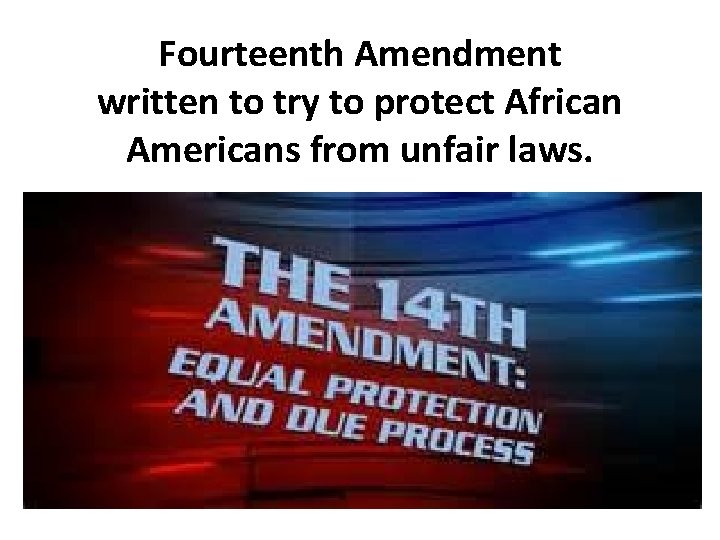
Fourteenth Amendment written to try to protect African Americans from unfair laws.
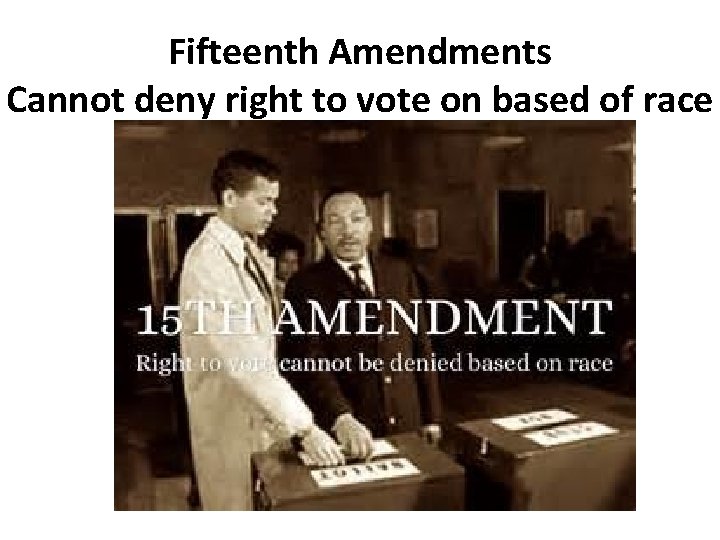
Fifteenth Amendments Cannot deny right to vote on based of race
Seventeenth Amendment gave Americans a greater voice in their government by allowing people to directly elect senators.
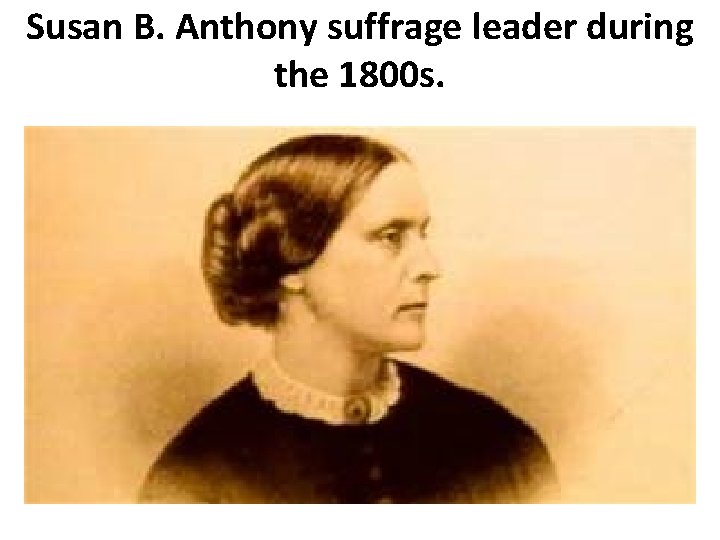
Susan B. Anthony suffrage leader during the 1800 s.
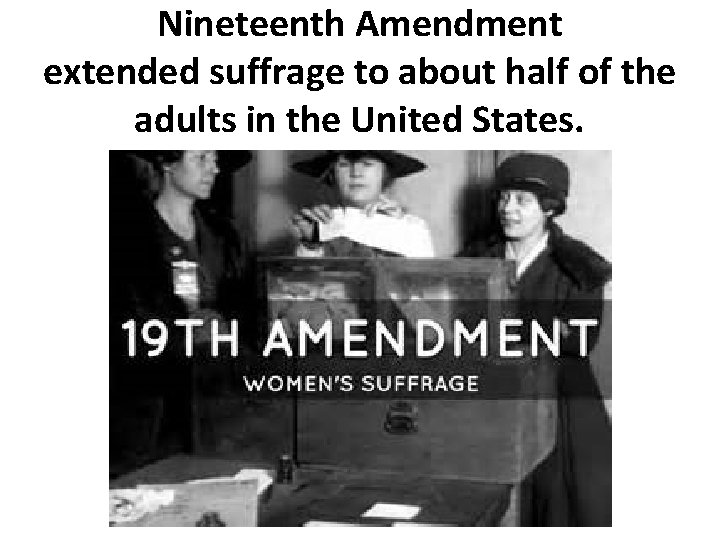
Nineteenth Amendment extended suffrage to about half of the adults in the United States.
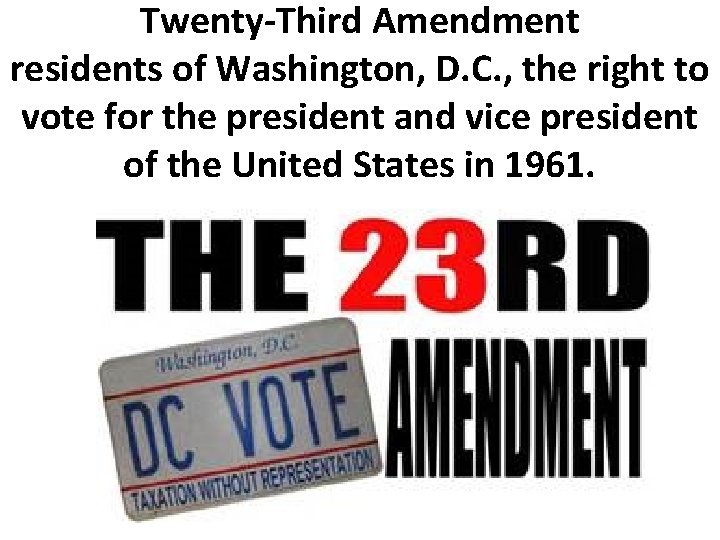
Twenty-Third Amendment residents of Washington, D. C. , the right to vote for the president and vice president of the United States in 1961.
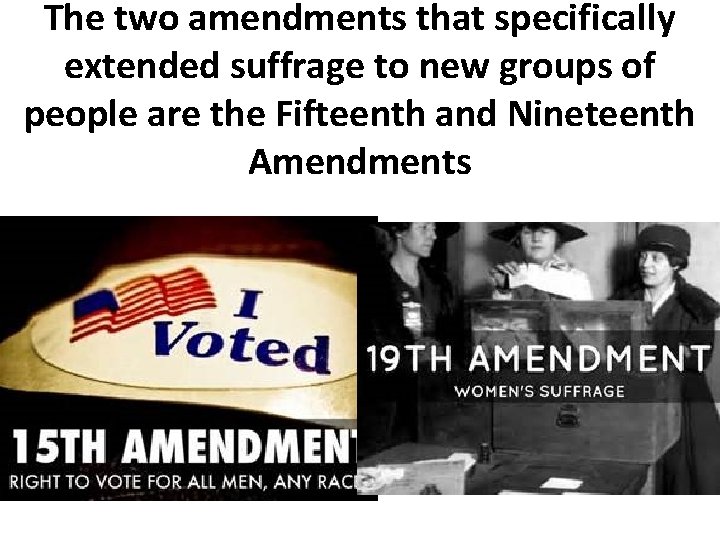
The two amendments that specifically extended suffrage to new groups of people are the Fifteenth and Nineteenth Amendments
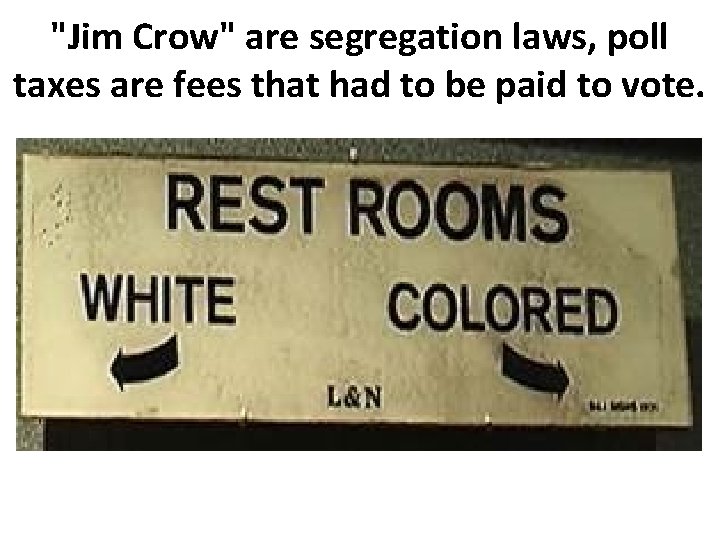
"Jim Crow" are segregation laws, poll taxes are fees that had to be paid to vote.
Twenty-Fourth Amendment outlawed Toll Taxes used to prevent African Americans from voting.
Vietnam War highlighted the problem of young soldiers who were considered old enough to go to war but too young to vote for the leaders sending them into battle. Twenty-Sixth Amendment
The order for voting rights for the following groups protected by the Constitution? African Americans; Women; Washington, D. C. Residents, young adults 18 and older.
Civics Chapter 4 Lesson 3 Independent Practice Write answers in complete sentences. If you do not copy last question, you will receive a zero.
• 6. What is the Thirteenth Amendment?
• 7. What is the Fourteenth Amendment? 142
• 8. What is the Twenty-third Amendment? 144
• 9. What is the Twenty-sixth Amendment? 145
4 -3 • • • 1. Eminent Domain 2. Due Process 3. Second Amendment 4. search warrant 5. Double Jeopardy • 6. ended slavery • 7. required states to grant all citizens “equal protection under the law. ” • 8. gives residents of Washington, D. C. , the right to vote for the president • 9. old enough to go to war but too young to vote
C 4 -4 Enter room, and take assigned seat quietly. Put your name, date, and period on the top right-hand side of a piece of paper. Do NOT write in red. At the end of the period, turn your paper into tray #1 on your way out of the room.
C 4 -4 Enter room, and take assigned seat quietly. Put your name, date, and period on the top right-hand side of a piece of paper. Do NOT write in red. At the end of the period, turn your paper into tray #1 on your way out of the room.
Civics Chapter 4 Lesson 4 Bell Ringer Copy questions and underline answers.
• 1. The _________ Amendment gave Americans a greater voice in their government by allowing people to directly elect senators. 143
• 2. _________ is a city whose residents did not have the right to vote for the president until 1961. 23 rd 144
• 3. The ________ Amendment guarantees women the right to vote. 144
• 4. The two amendments that specifically extended suffrage to new groups of people are the _______ and _______ Amendments. 144
• 5. Throughout much of the 1900 s, _______, a fee paid in order to vote, were used to prevent African Americans from voting, . 145 24 th
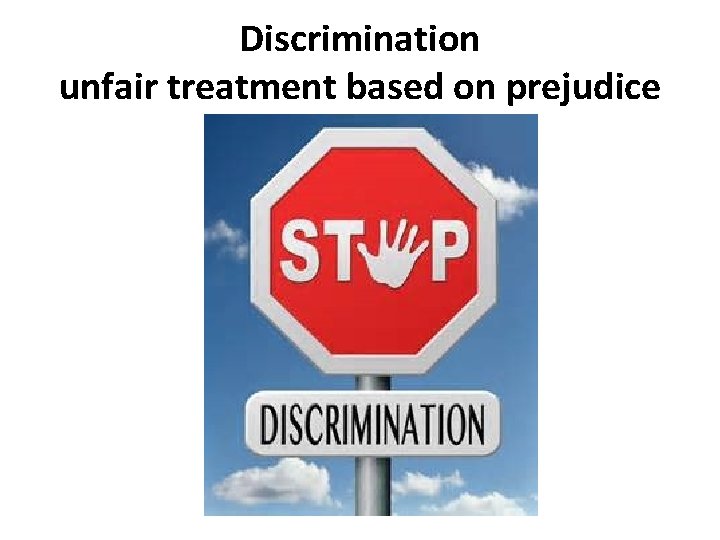
Discrimination unfair treatment based on prejudice
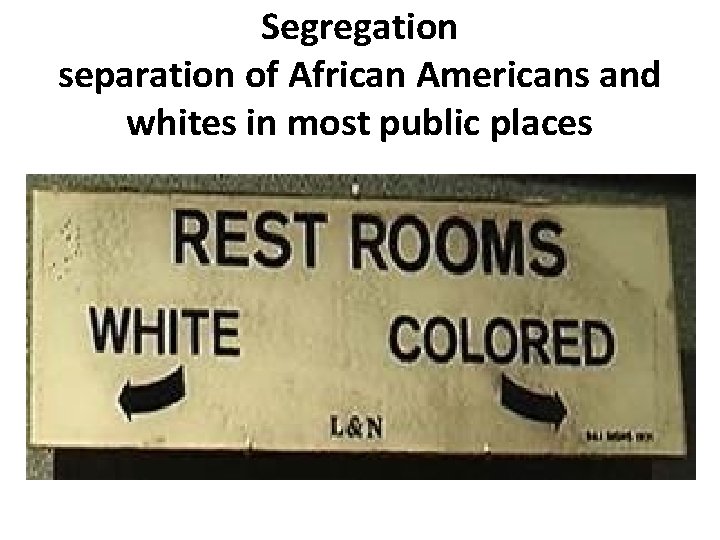
Segregation separation of African Americans and whites in most public places
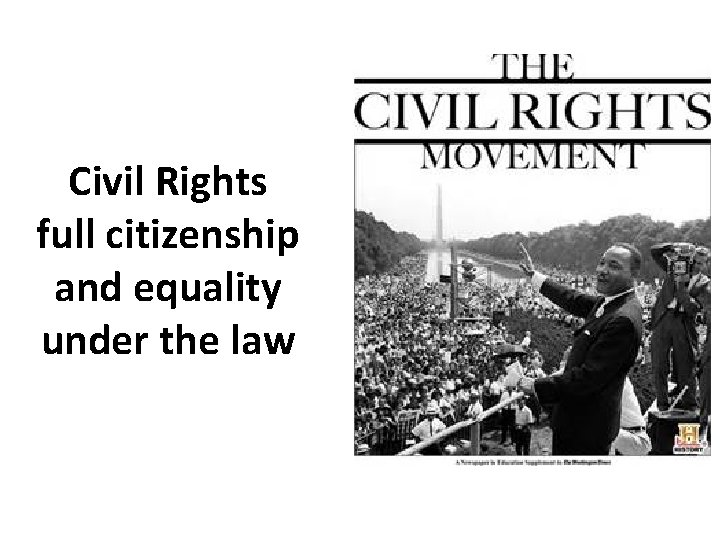
Civil Rights full citizenship and equality under the law
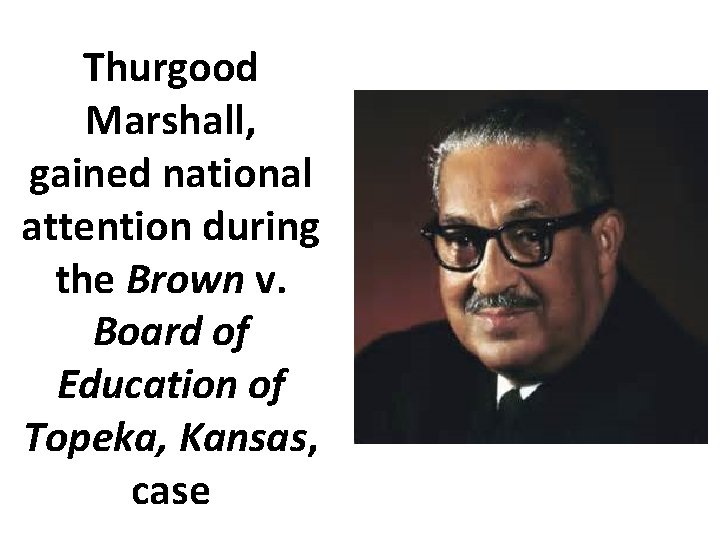
Thurgood Marshall, gained national attention during the Brown v. Board of Education of Topeka, Kansas, case
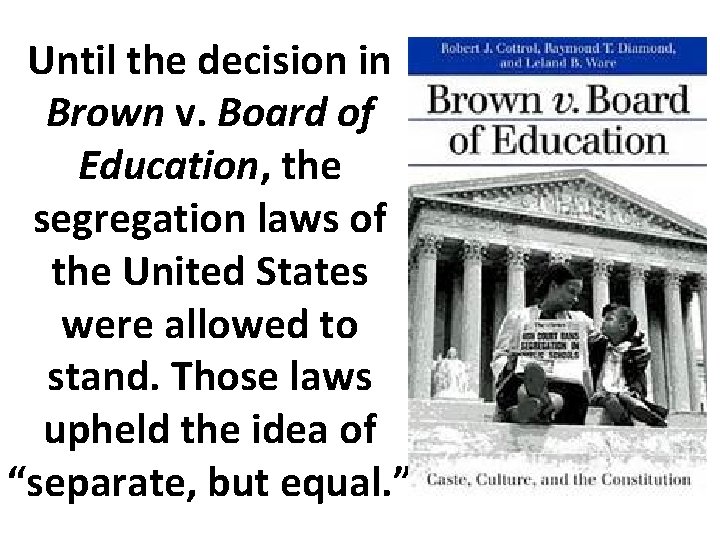
Until the decision in Brown v. Board of Education, the segregation laws of the United States were allowed to stand. Those laws upheld the idea of “separate, but equal. ”
Linda Brown’s family sued the school system in their town, they wanted Linda to be able to attend a nearby school.
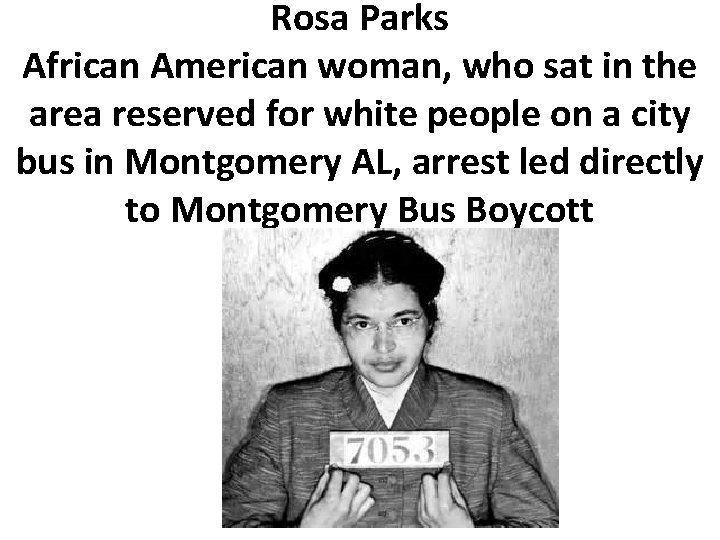
Rosa Parks African American woman, who sat in the area reserved for white people on a city bus in Montgomery AL, arrest led directly to Montgomery Bus Boycott
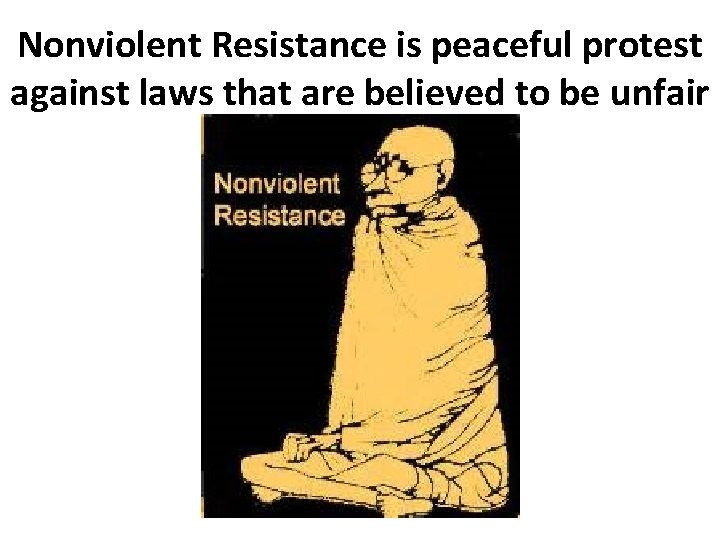
Nonviolent Resistance is peaceful protest against laws that are believed to be unfair
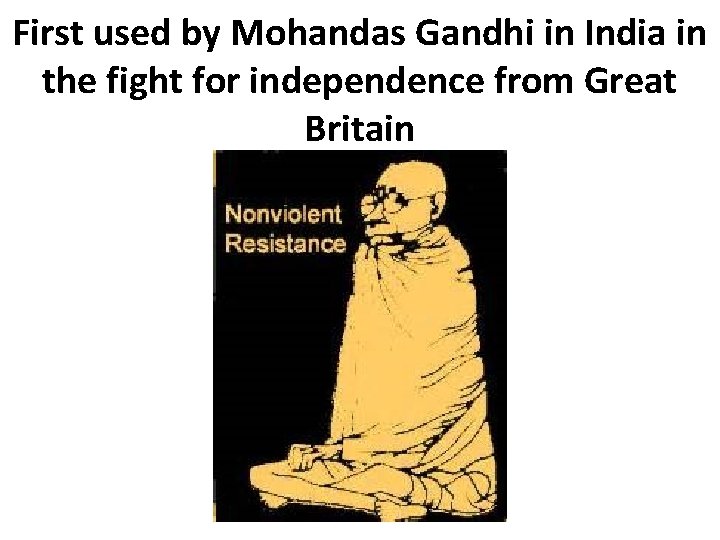
First used by Mohandas Gandhi in India in the fight for independence from Great Britain
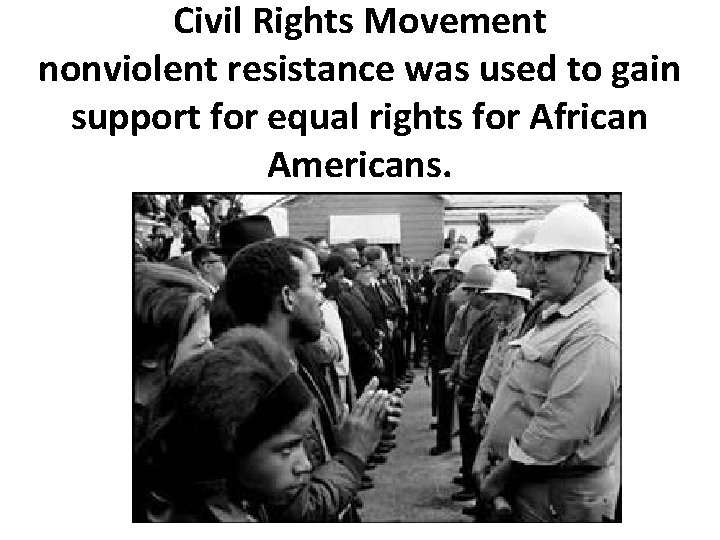
Civil Rights Movement nonviolent resistance was used to gain support for equal rights for African Americans.
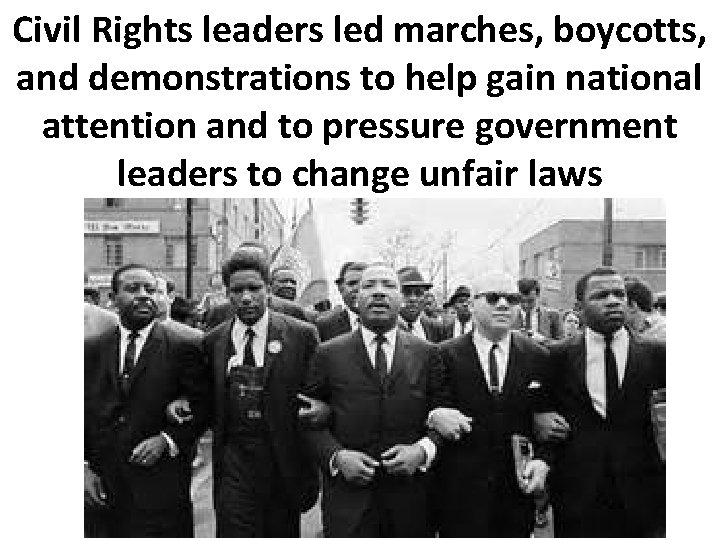
Civil Rights leaders led marches, boycotts, and demonstrations to help gain national attention and to pressure government leaders to change unfair laws
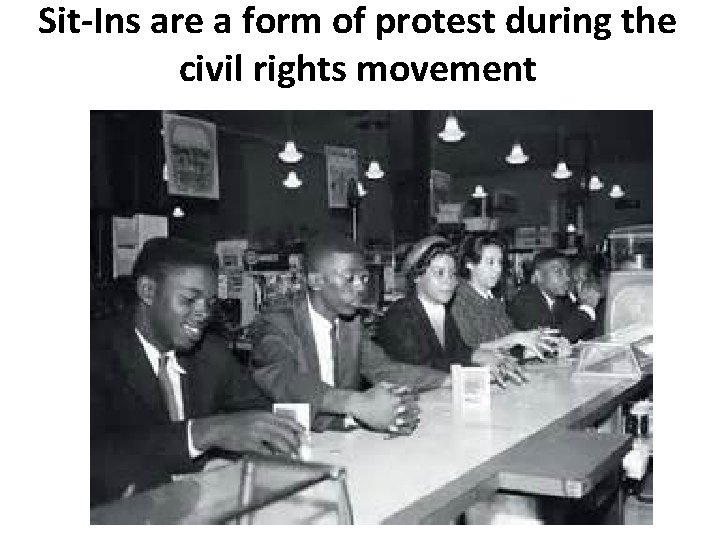
Sit-Ins are a form of protest during the civil rights movement
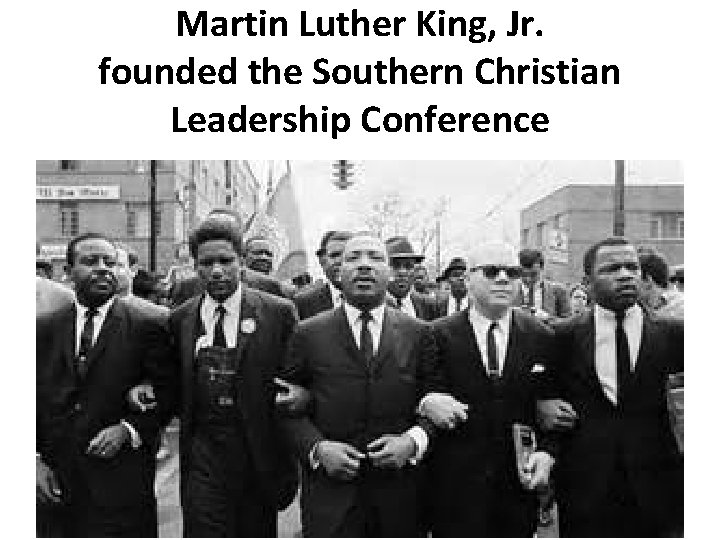
Martin Luther King, Jr. founded the Southern Christian Leadership Conference
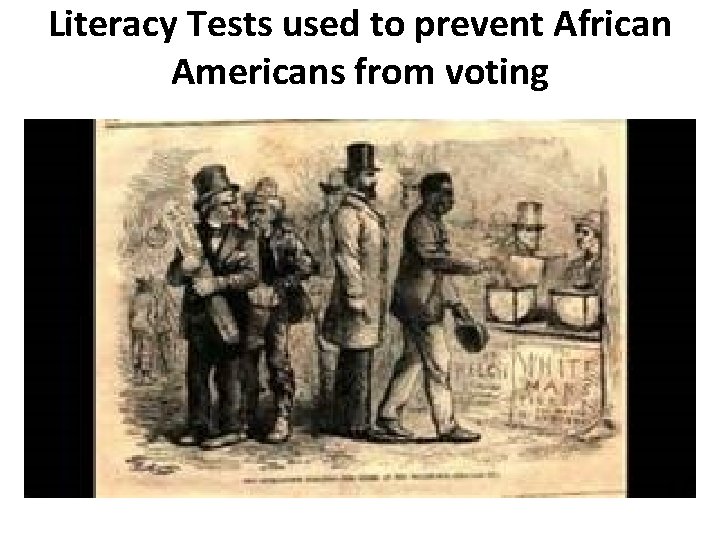
Literacy Tests used to prevent African Americans from voting
Hate Crimes violent acts against people because of a group that they belong
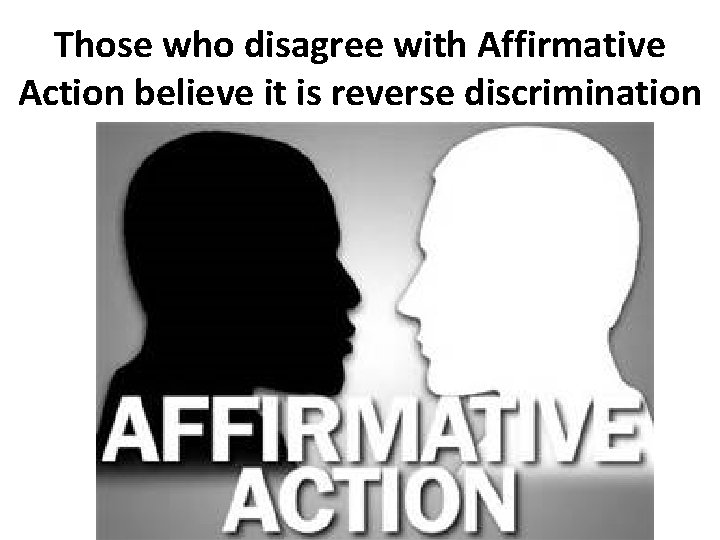
Those who disagree with Affirmative Action believe it is reverse discrimination
American Indian Movement worked to improve the lives of Native Americans, many of whom were poor
American Indian Movement worked to protect the rights granted to Native American peoples by treaties. It has also tried to keep native culture alive.
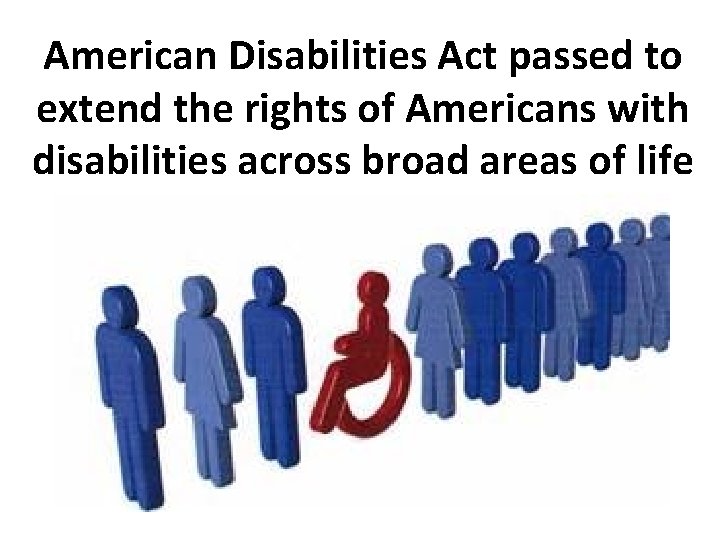
American Disabilities Act passed to extend the rights of Americans with disabilities across broad areas of life
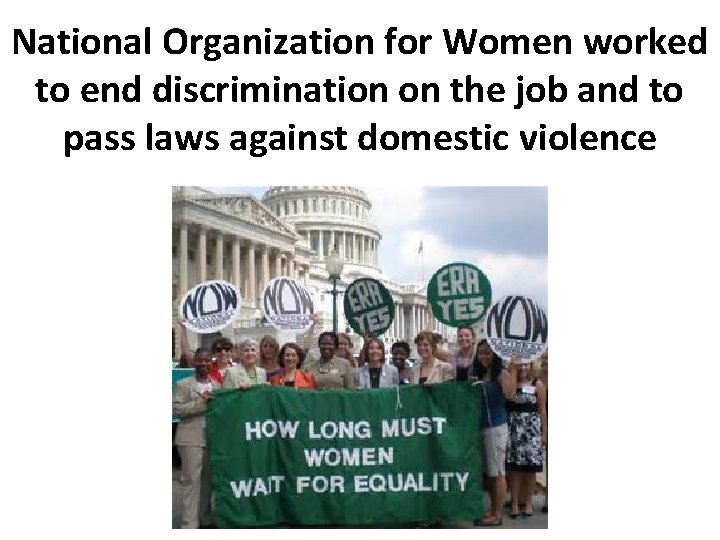
National Organization for Women worked to end discrimination on the job and to pass laws against domestic violence
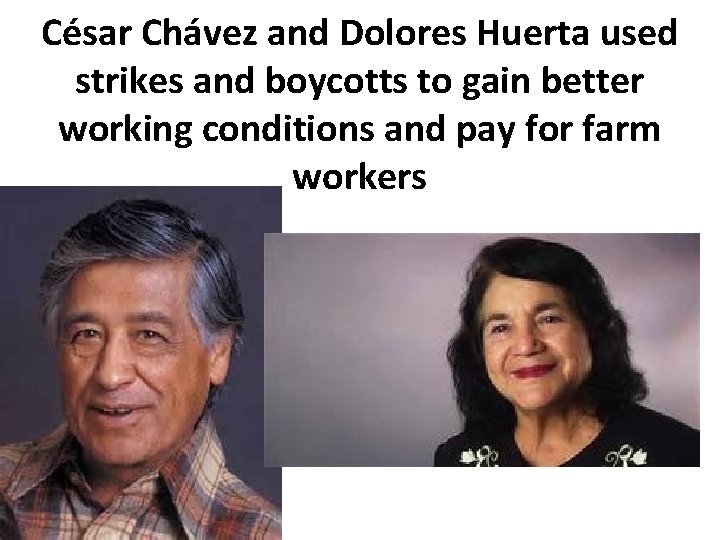
César Chávez and Dolores Huerta used strikes and boycotts to gain better working conditions and pay for farm workers
Civics Chapter 4 Lesson 4 Independent Practice Write answers in complete sentences. If you do not copy last question, you will receive a zero.
• 6. What led to the Montgomery Bus Boycott. 148
• 7. Describe Discrimination. 146
• 8. Describe Segregation. 146
• 9. What are Hate crimes are? 150
• 10. What is the National Organization for Women? 151
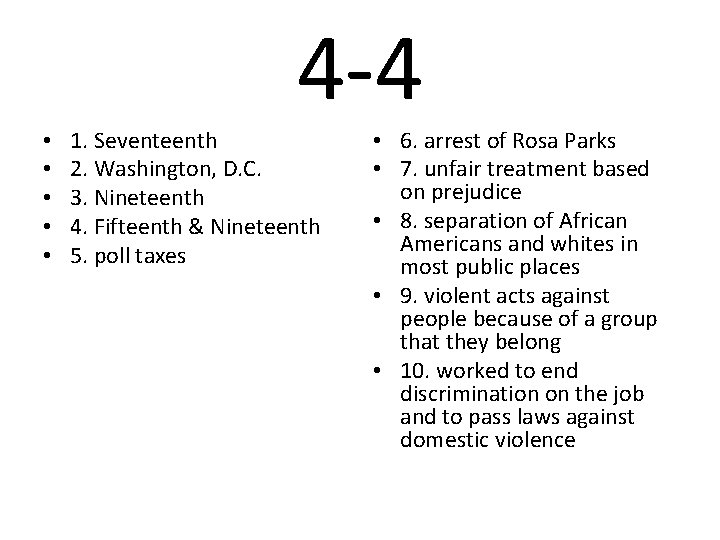
4 -4 • • • 1. Seventeenth 2. Washington, D. C. 3. Nineteenth 4. Fifteenth & Nineteenth 5. poll taxes • 6. arrest of Rosa Parks • 7. unfair treatment based on prejudice • 8. separation of African Americans and whites in most public places • 9. violent acts against people because of a group that they belong • 10. worked to end discrimination on the job and to pass laws against domestic violence
Enter room, and take assigned seat quietly. Put your name, date, and period on the top right -hand side of a piece of paper. Do NOT write in red. At the end of the period, turn your paper into tray #1 on your way out of the room.
Civics Chapter 4 Review Bell Ringer Copy questions and underline answers.
• 1. List the five freedoms protected by the First Amendment. 129
• 2. _____ is the crime of printing lies in order to hurt a person’s reputation. 132
• 3. The _________ Amendment gave Americans a greater voice in their government by allowing people to directly elect senators. 143
• 4. _______ is following established legal procedures. 5 th 136
• 5. ________ are freedoms to think and act without government interference. 128
Civics 4 Illustration Enter room, and take assigned seat quietly. At the end of the period, turn your drawing into tray #1 on your way out of the room.
Civics 4 Illustration Enter room, and take assigned seat quietly. At the end of the period, turn your drawing into tray #1 on your way out of the room.
Civics-4 Illustration Illustrate a person fulfilling a right from the Bill of Rights (first 10 amendments). The illustration must have color and cover the entire page. Under the illustration answer the following questions: 1)What Amendment? 2)What right? 3)What is the person doing? 128 -139
• Writing must be visible from a distance • Color • Cover entire page
Civics 1 Test Enter room, and take assigned seat quietly. Put your name, date, and period on the top right-hand side of a piece of paper. Do NOT write in red. After completion, place Test in Tray #2 and answer document in Tray #1.
Civics 1 Test Enter room, and take assigned seat quietly. Put your name, date, and period on the top right-hand side of a piece of paper. Do NOT write in red. After completion, place Test in Tray #2 and answer document in Tray #1.
• • • • • 1. 16. Name 2. 17. Date 3. 18. Period 4. 19. Civics 4 Test 5. 20. 6. 21. 7. 22. 8. 9. 10. 11. 12. 13. 14. 15. 24. Open Ended 25. Open Ended Do not write on test.
C 4 -Video Enter room, and take assigned seat quietly. Put your name, date, and period on the top right-hand side of a piece of paper. Do NOT write in red. At the end of the period, turn your paper into tray #1 on your way out of the room. 10 facts from each video
C 4 -Video Enter room, and take assigned seat quietly. Put your name, date, and period on the top right-hand side of a piece of paper. Do NOT write in red. At the end of the period, turn your paper into tray #1 on your way out of the room. 10 facts from each video
• Future Fright 24: 00**** • Just the Facts: The Constitution: The Bill of Rights and Constitutional Amendments 51: 53 • On Common Ground: Rules of the Game 29: 03
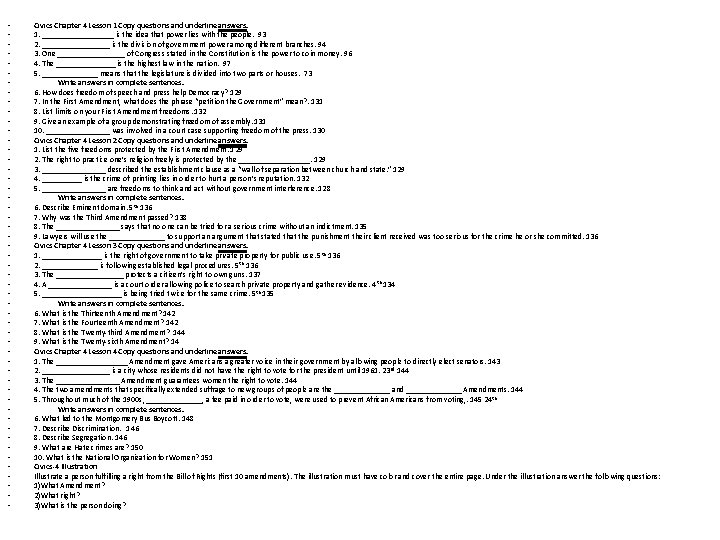
• • • • • • • • • • • • • Civics Chapter 4 Lesson 1 Copy questions and underline answers. 1. _________ is the idea that power lies with the people. 93 2. _________ is the division of government power among different branches. 94 3. One _________ of Congress stated in the Constitution is the power to coin money. 96 4. The ________ is the highest law in the nation. 97 5. _______ means that the legislature is divided into two parts or houses. 73 Write answers in complete sentences. 6. How does freedom of speech and press help Democracy? 129 7. In the First Amendment, what does the phrase “petition the Government” mean? . 131 8. List limits on your First Amendment freedoms. 132 9. Give an example of a group demonstrating freedom of assembly. 131 10. ________ was involved in a court case supporting freedom of the press. 130 Civics Chapter 4 Lesson 2 Copy questions and underline answers. 1. List the five freedoms protected by the First Amendment. 129 2. The right to practice one’s religion freely is protected by the _________. 129 3. ________ described the establishment clause as a “wall of separation between church and state. ” 129 4. _____ is the crime of printing lies in order to hurt a person’s reputation. 132 5. ________ are freedoms to think and act without government interference. 128 Write answers in complete sentences. 6. Describe Eminent domain. 5 th 136 7. Why was the Third Amendment passed? 138 8. The ________ says that no one can be tried for a serious crime without an indictment. 135 9. Lawyers will use the _______ to support an argument that stated that the punishment their client received was too serious for the crime he or she committed. 136 Civics Chapter 4 Lesson 3 Copy questions and underline answers. 1. ________ is the right of government to take private property for public use. 5 th 136 2. _______ is following established legal procedures. 5 th 136 3. The _________ protects a citizen’s right to own guns. 137 4. A ________ is a court order allowing police to search private property and gather evidence. 4 th 134 5. __________ is being tried twice for the same crime. 5 th 135 Write answers in complete sentences. 6. What is the Thirteenth Amendment? 142 7. What is the Fourteenth Amendment? 142 8. What is the Twenty-third Amendment? 144 9. What is the Twenty-sixth Amendment? 14 Civics Chapter 4 Lesson 4 Copy questions and underline answers. 1. The _________ Amendment gave Americans a greater voice in their government by allowing people to directly elect senators. 143 2. _________ is a city whose residents did not have the right to vote for the president until 1961. 23 rd 144 3. The ________ Amendment guarantees women the right to vote. 144 4. The two amendments that specifically extended suffrage to new groups of people are the _______ and _______ Amendments. 144 5. Throughout much of the 1900 s, _______, a fee paid in order to vote, were used to prevent African Americans from voting, . 145 24 th Write answers in complete sentences. 6. What led to the Montgomery Bus Boycott. 148 7. Describe Discrimination. 146 8. Describe Segregation. 146 9. What are Hate crimes are? 150 10. What is the National Organization for Women? 151 Civics-4 Illustration Illustrate a person fulfilling a right from the Bill of Rights (first 10 amendments). The illustration must have color and cover the entire page. Under the illustration answer the following questions: 1)What Amendment? 2)What right? 3)What is the person doing?