
City of Redlands Municipal Utilities Engineering Department Wastewater


- Slides: 33
City of Redlands Municipal Utilities & Engineering Department Wastewater Treatment & Disposal Facility Ammonia Based Aeration Control
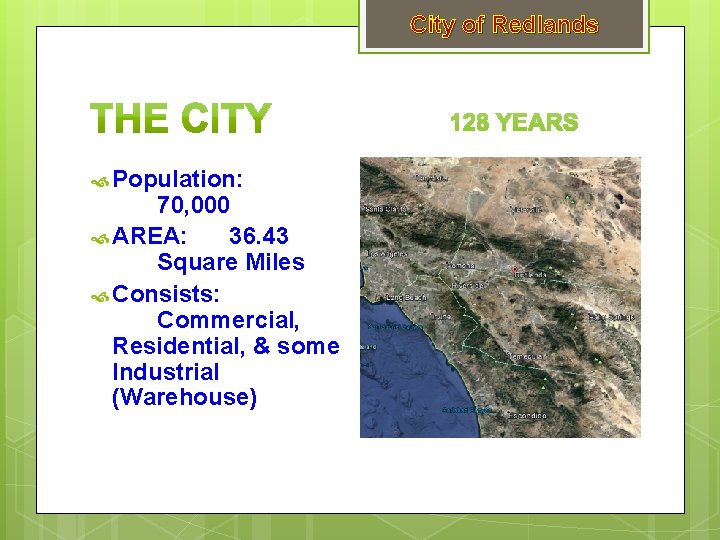
City of Redlands Population: 70, 000 AREA: 36. 43 Square Miles Consists: Commercial, Residential, & some Industrial (Warehouse)
City of Redlands Designed Capacity: 9. 6 MGD Current Average Flow: 5. 8 MGD MBR Daily Avg. Flow: 4. 6 MGD Conventional DAF: 1. 2 MGD Last upgrade: 2003 (MBR) 2006 (MBR)
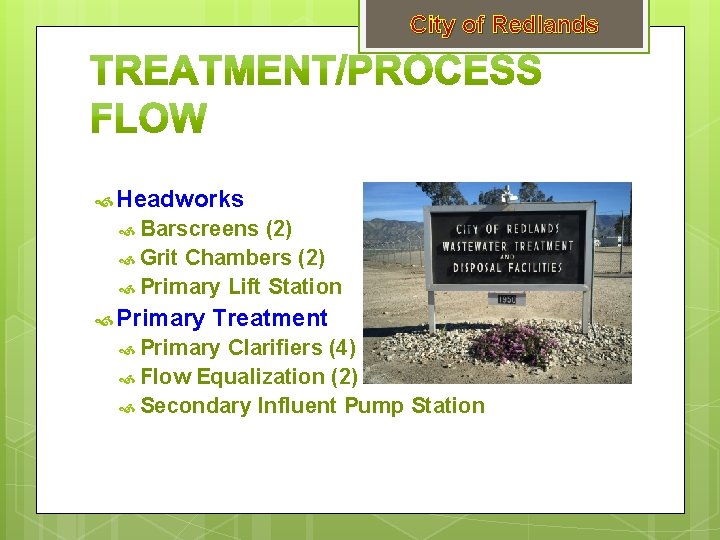
City of Redlands Headworks Barscreens (2) Grit Chambers (2) Primary Lift Station Primary Treatment Primary Clarifiers (4) Flow Equalization (2) Secondary Influent Pump Station
City of Redlands Secondary Treatment MBR Treatment Conventional Treatment
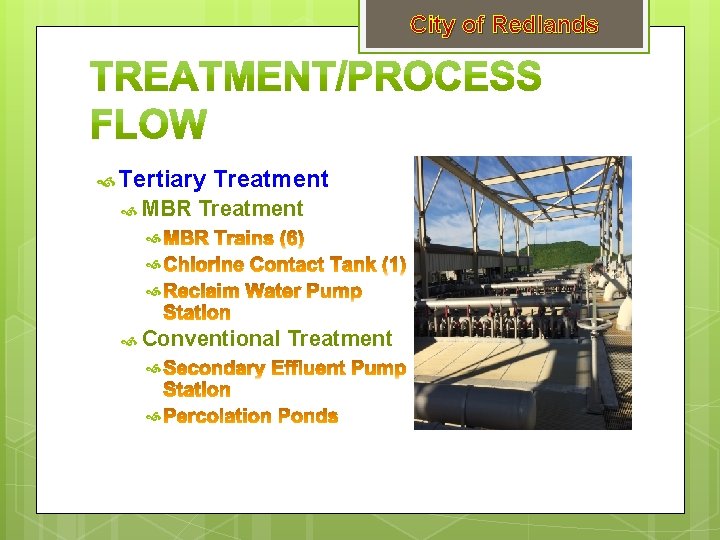
City of Redlands Tertiary Treatment MBR Treatment Conventional Treatment
City of Redlands Reclaim Effluent TIN Turbidity CT / Residual Chlorine Conventional Effluent TIN BOD/TSS Removal
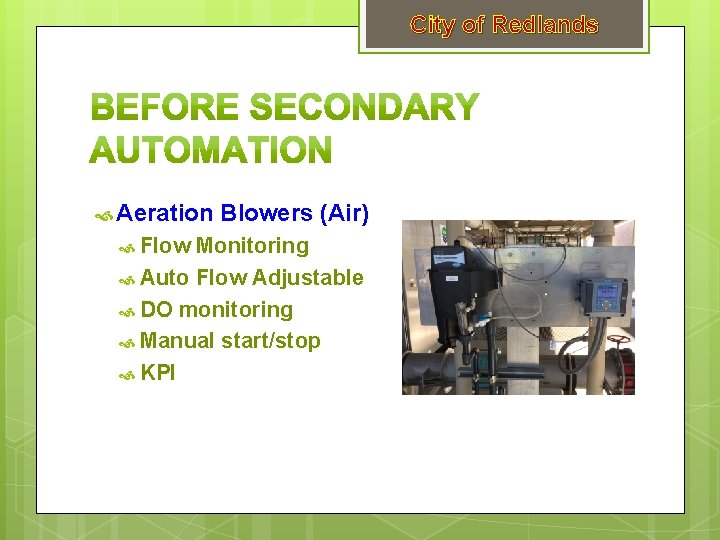
City of Redlands Aeration Blowers (Air) Flow Monitoring Auto Flow Adjustable DO monitoring Manual start/stop KPI
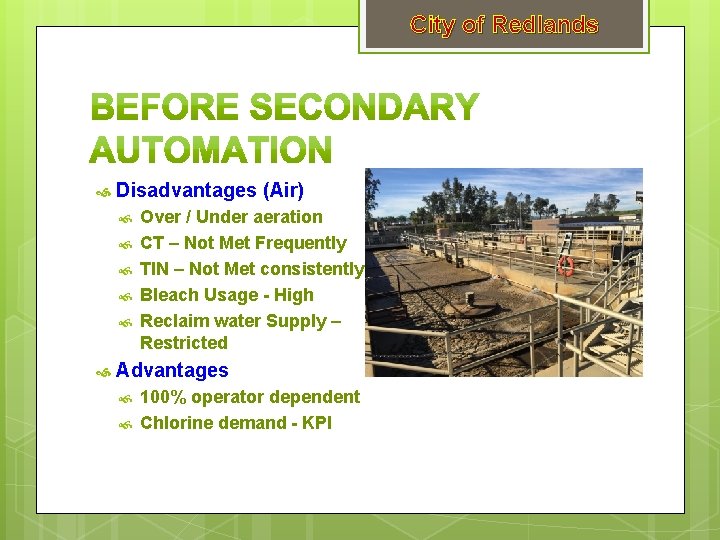
City of Redlands Disadvantages (Air) Over / Under aeration CT – Not Met Frequently TIN – Not Met consistently Bleach Usage - High Reclaim water Supply – Restricted Advantages 100% operator dependent Chlorine demand - KPI
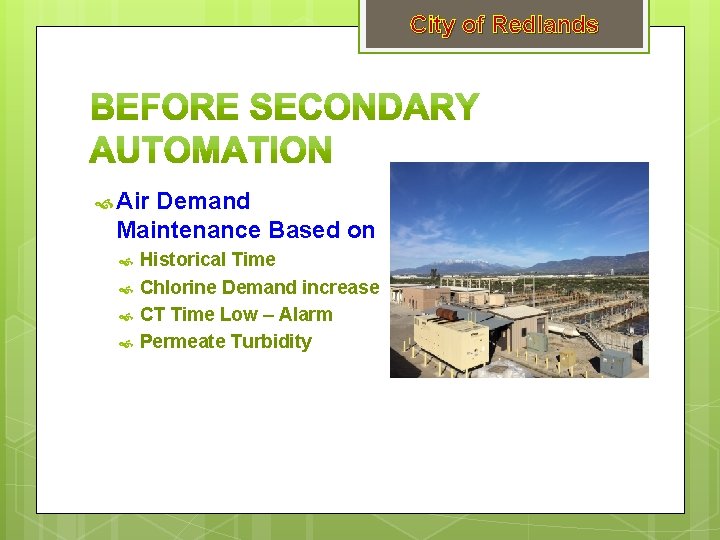
City of Redlands Air Demand Maintenance Based on Historical Time Chlorine Demand increase CT Time Low – Alarm Permeate Turbidity
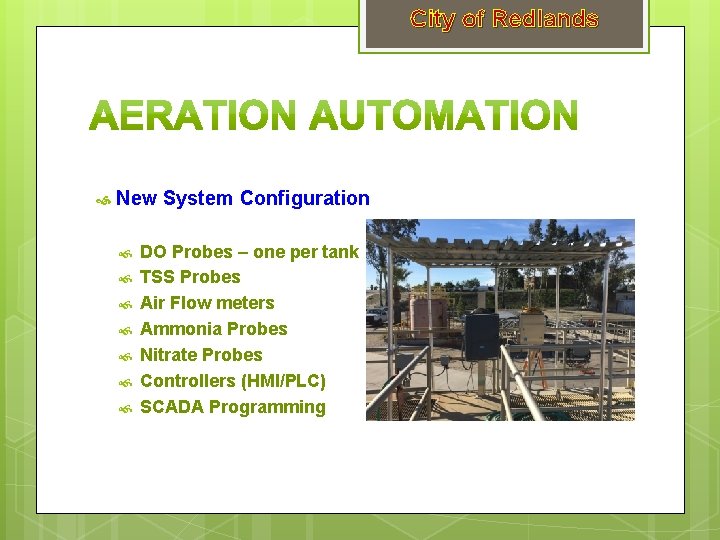
City of Redlands New System Configuration DO Probes – one per tank TSS Probes Air Flow meters Ammonia Probes Nitrate Probes Controllers (HMI/PLC) SCADA Programming
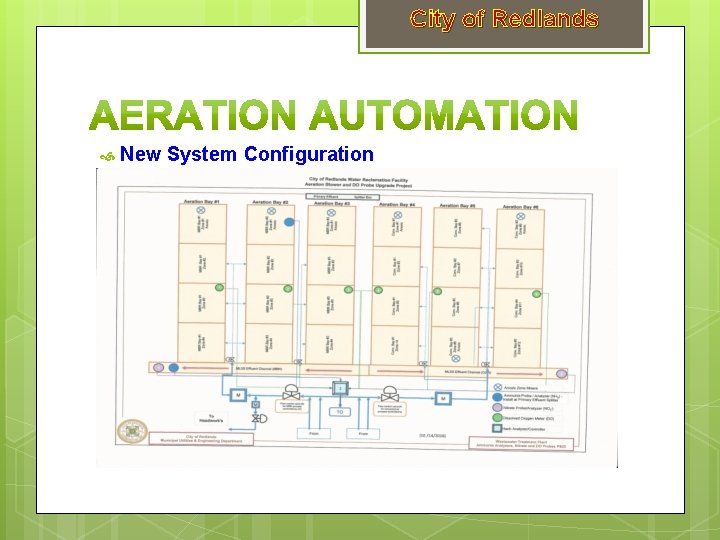
City of Redlands New System Configuration
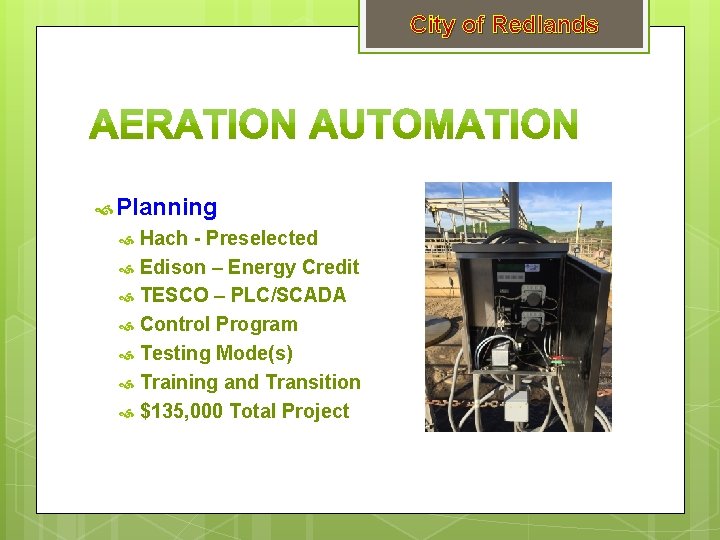
City of Redlands Planning Hach - Preselected Edison – Energy Credit TESCO – PLC/SCADA Control Program Testing Mode(s) Training and Transition $135, 000 Total Project
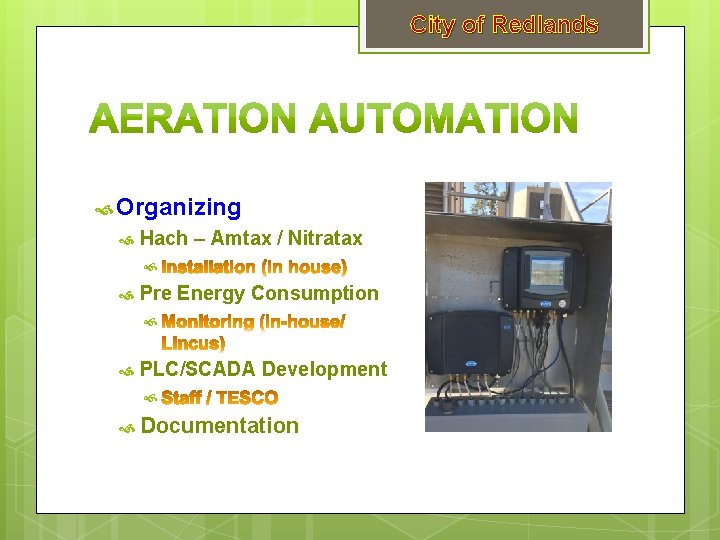
City of Redlands Organizing Hach – Amtax / Nitratax Pre Energy Consumption PLC/SCADA Development Documentation
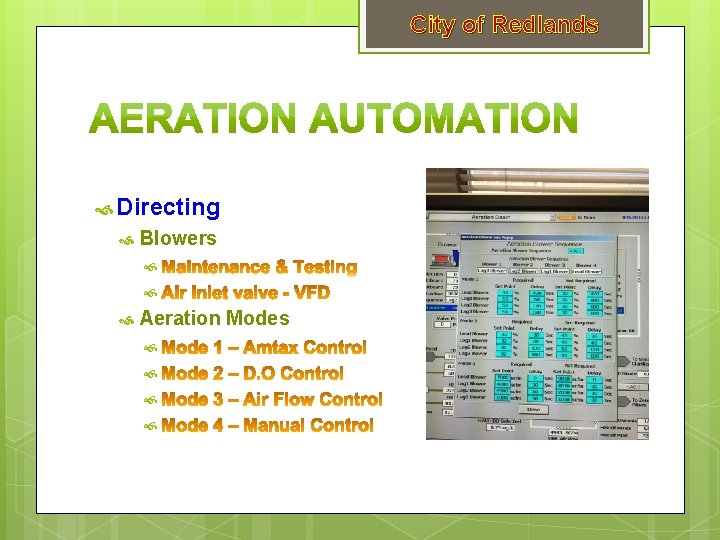
City of Redlands Directing Blowers Aeration Modes
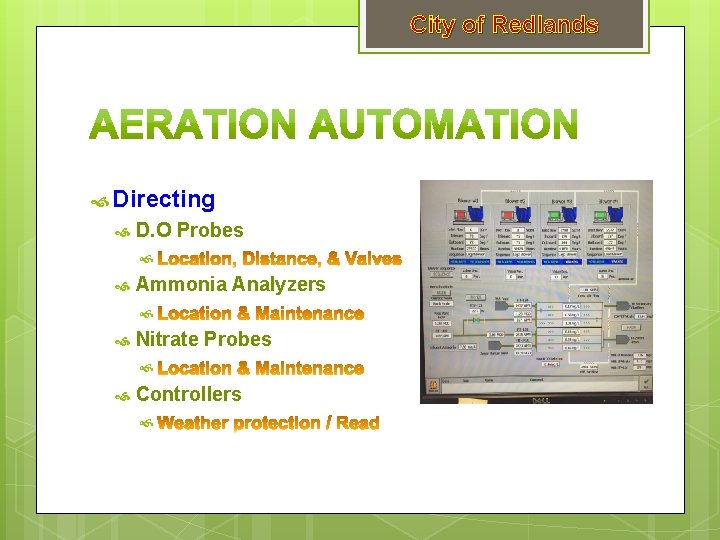
City of Redlands Directing D. O Probes Ammonia Analyzers Nitrate Probes Controllers
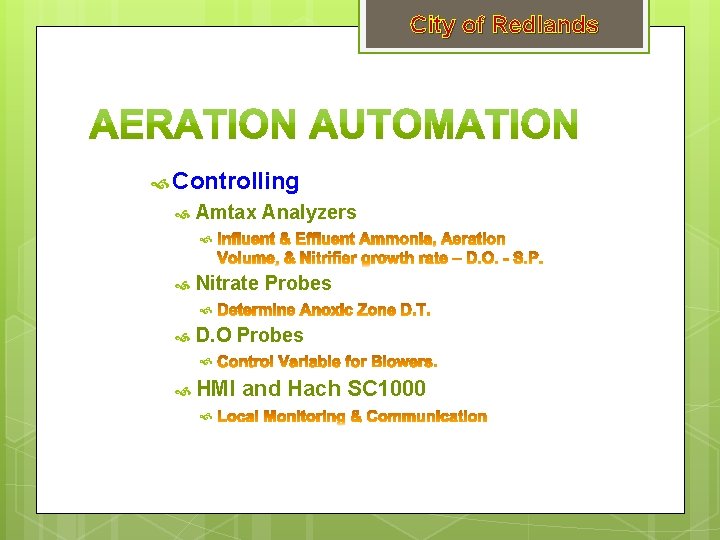
City of Redlands Controlling Amtax Analyzers Nitrate Probes D. O Probes HMI and Hach SC 1000
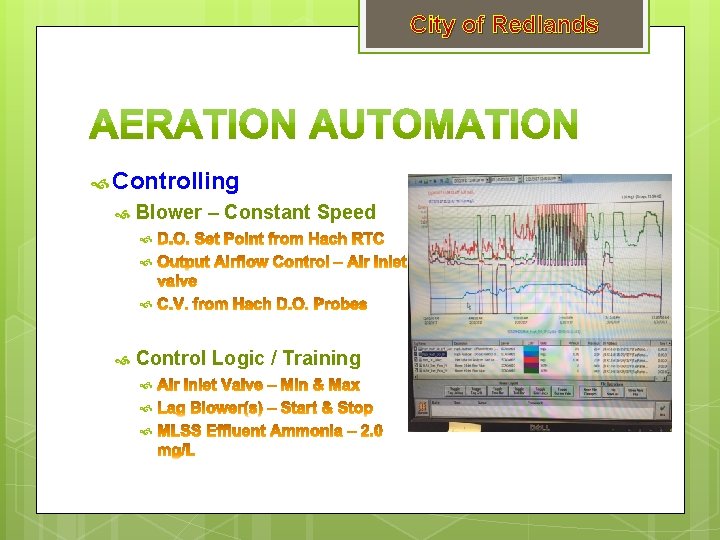
City of Redlands Controlling Blower – Constant Speed Control Logic / Training
City of Redlands Typical Aeration Control D. O Set Point Disadvantages
City of Redlands Oxygen Requirements 1. 5 mg/L O 2 / 1 mg/L BOD 4. 6 mg/L O 2 / 1 mg/L NH 3 to NO 3 -N 3. 4 mg/L O 2 / 1 mg/L NH 3 to NO 2 -N Amtax – D. O. Mode
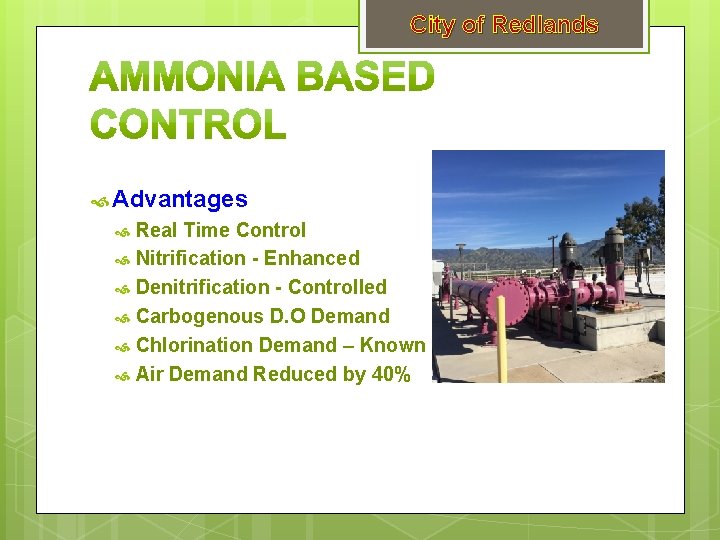
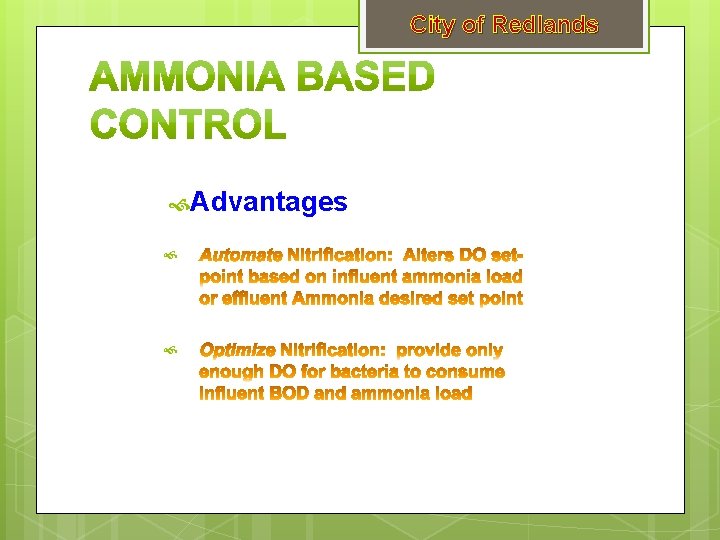
City of Redlands Advantages Real Time Control Nitrification - Enhanced Denitrification - Controlled Carbogenous D. O Demand Chlorination Demand – Known Air Demand Reduced by 40%
City of Redlands Advantages
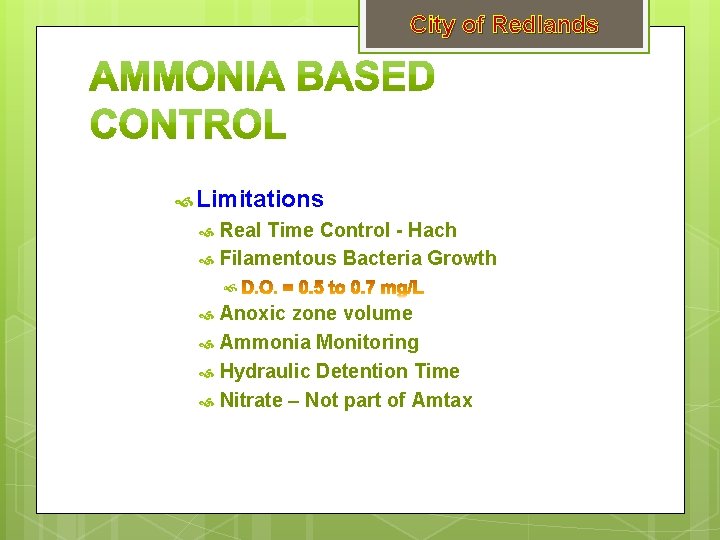
City of Redlands Limitations Real Time Control - Hach Filamentous Bacteria Growth Anoxic zone volume Ammonia Monitoring Hydraulic Detention Time Nitrate – Not part of Amtax
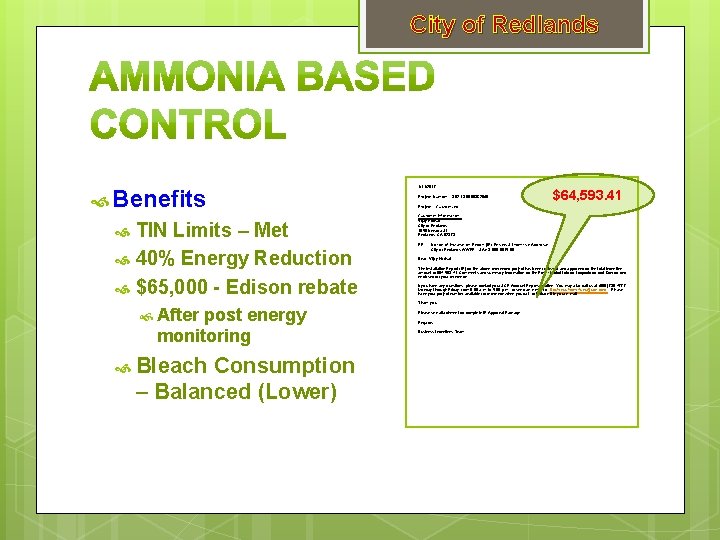
City of Redlands Benefits TIN Limits – Met 40% Energy Reduction $65, 000 - Edison rebate After post energy monitoring Bleach Consumption – Balanced (Lower) 1/11/2017 Project Number: 352 -13 -0500362045 Project: Customized Customer Information: Vijay Korisal City of Redlands 1950 Nevada St. Redlands, CA 92373 RE: Notice of Installation Report (IR) Review & Incentive Approval City of Redlands-WWEP – SA# 3 -000 -0015 -86 Dear: Vijay Korisal, The Installation Report (IR) for the above referenced project has been reviewed and approved for the total incentive amount of $64, 593. 41. Comments and summary information for the Post ‑Installation Inspection and Review are enclosed for your reference. If you have any questions, please contact your SCE Account Representative. You may also call us at (800) 736 -4777 Monday through Friday, from 8: 00 a. m. to 5: 00 p. m. , or send an e-mail to Business. Incentives@sce. com. Please have your project number available for reference when you call, or include it in your e-mail. Thank you. Please see attachment for complete IR Approval Package. Regards, Business Incentives Team $64, 593. 41
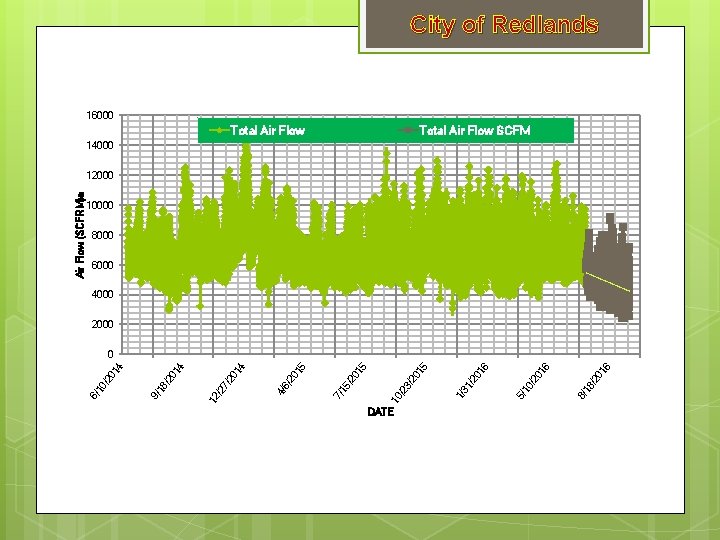
DATE 6 01 /2 18 8/ 6 01 /2 10 5/ 6 01 /2 31 Air Flow (SCFRM)e Total Air Flow 1/ 5 3/ 20 1 10 /2 5 01 /2 15 7/ 15 20 6/ 4/ 4 7/ 20 1 12 /2 4 01 /2 18 9/ 4 01 /2 10 6/ City of Redlands 16000 Total Air Flow SCFM 14000 12000 10000 8000 6000 4000 2000 0
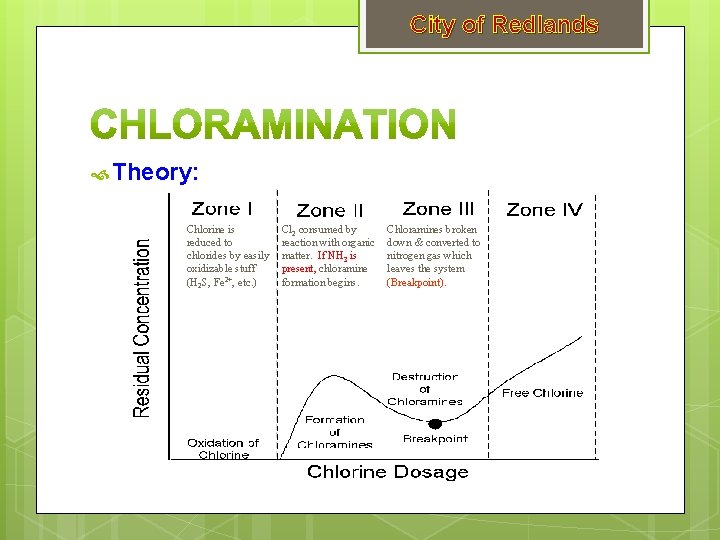
City of Redlands Theory: Chlorine is reduced to chlorides by easily oxidizable stuff (H 2 S, Fe 2+, etc. ) Cl 2 consumed by reaction with organic matter. If NH 3 is present, chloramine formation begins. Chloramines broken down & converted to nitrogen gas which leaves the system (Breakpoint).
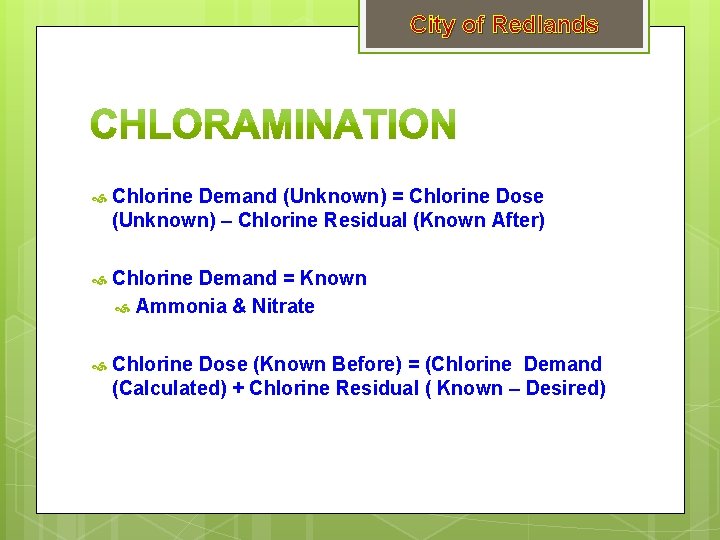
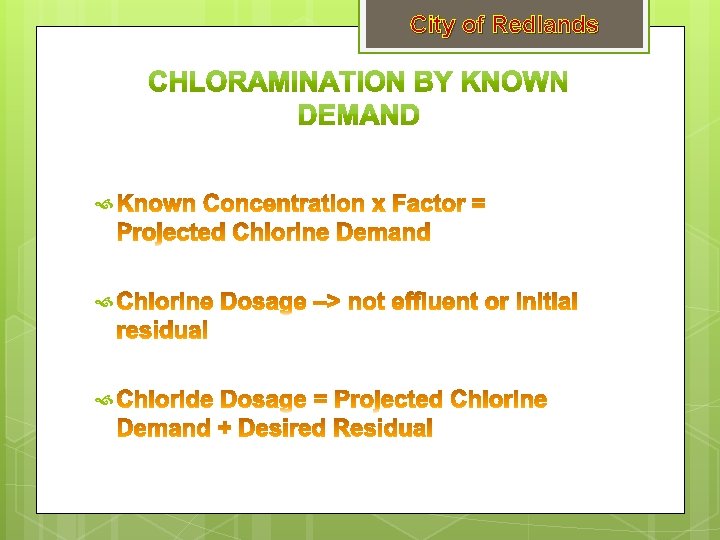
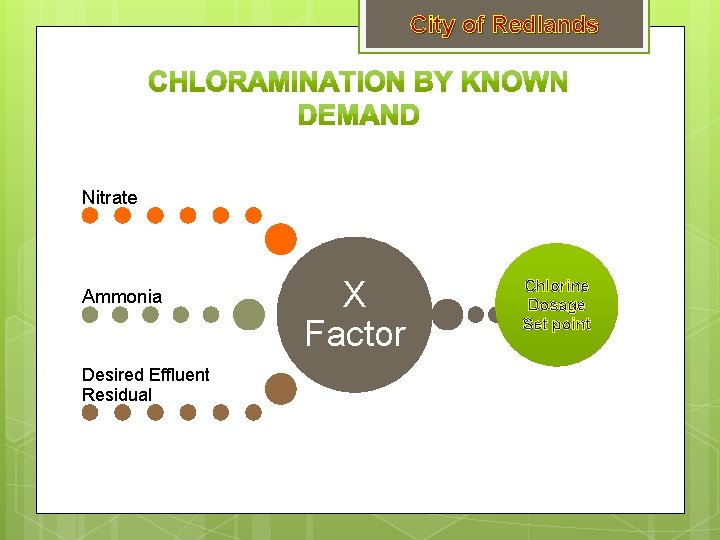
City of Redlands Chlorine Demand (Unknown) = Chlorine Dose (Unknown) – Chlorine Residual (Known After) Chlorine Demand = Known Ammonia & Nitrate Chlorine Dose (Known Before) = (Chlorine Demand (Calculated) + Chlorine Residual ( Known – Desired)
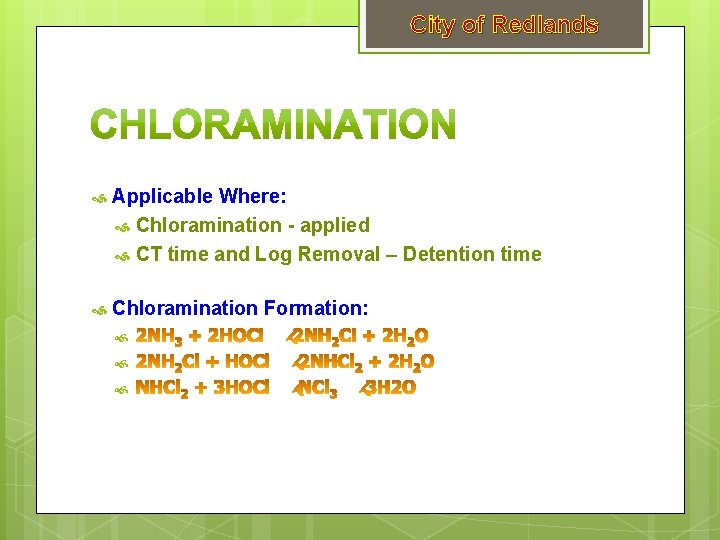
City of Redlands Applicable Where: Chloramination - applied CT time and Log Removal – Detention time Chloramination Formation:
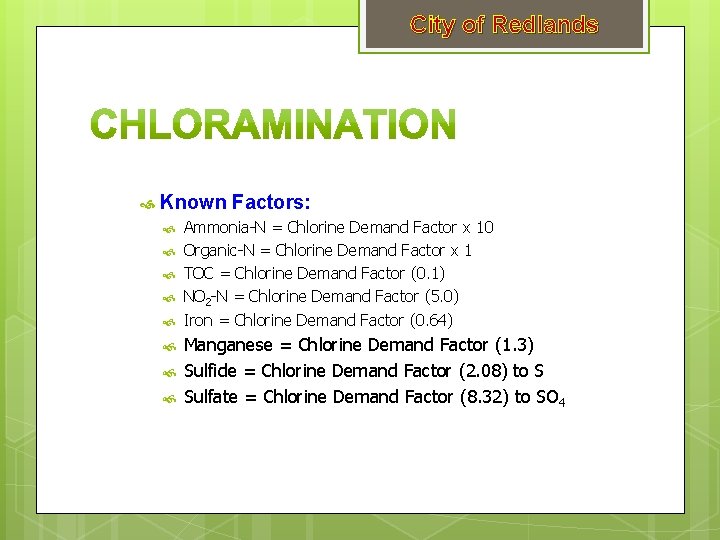
City of Redlands Known Factors: Ammonia-N = Chlorine Demand Factor x 10 Organic-N = Chlorine Demand Factor x 1 TOC = Chlorine Demand Factor (0. 1) NO 2 -N = Chlorine Demand Factor (5. 0) Iron = Chlorine Demand Factor (0. 64) Manganese = Chlorine Demand Factor (1. 3) Sulfide = Chlorine Demand Factor (2. 08) to S Sulfate = Chlorine Demand Factor (8. 32) to SO 4
City of Redlands
City of Redlands Nitrate Ammonia Desired Effluent Residual X Factor Chlorine Dosage Set point
City of Redlands vijaykorisal@cityofredlands. org
Ammonia Based Aeration Control References Connell, G. F. , 1996. The Chlorination/ Chloramination Handbook. American Water Works Association. Water Disinfection Series. Fundamentals and Control of Nitrification in Chloraminated Drinking Water Systems. 2006. American Water Works Association. Manual of Water Supply Practices, M 56. 1 st ed.