
City of Greensboros T Z Osborne WWTP SOC
City of Greensboro’s T. Z. Osborne WWTP SOC EMC Commission Meeting March 11, 2021 Department of Environmental Quality
Purpose of Coming Before the EMC • Per G. S. § 143 -215. 2. Special orders. o (a) Issuance. - The Commission may […] issue […] a special order […] to any person whom it finds responsible for causing or contributing to any pollution of the waters of the State within the area for which standards have been established. […] • When a public hearing is held for a Special Order by Consent (SOC), as for the T. Z. Osborne WWTP, the EMC is the designated approval authority, therefore DEQ is requesting the EMC approve this proposed SOC. 2
What is a Special Order by Consent (SOC)? • May be an appropriate action if a facility is unable to consistently comply with the terms, conditions, or limitations in an NPDES permit • A negotiated agreement between a permittee and the EMC • A tool used to help facilities achieve compliance • Allows time for a facility to make necessary improvements or changes 3
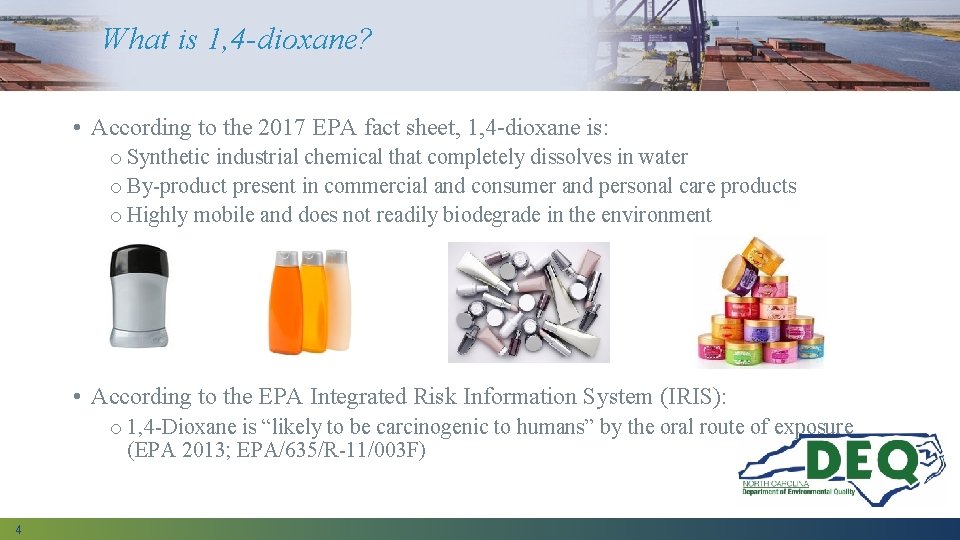
What is 1, 4 -dioxane? • According to the 2017 EPA fact sheet, 1, 4 -dioxane is: o Synthetic industrial chemical that completely dissolves in water o By-product present in commercial and consumer and personal care products o Highly mobile and does not readily biodegrade in the environment • According to the EPA Integrated Risk Information System (IRIS): o 1, 4 -Dioxane is “likely to be carcinogenic to humans” by the oral route of exposure (EPA 2013; EPA/635/R-11/003 F) 4
1, 4 -dioxane in the Environment • 1, 4 -dioxane enters a WWTP from industrial and domestic wastewater. o Most municipal WWTPs are not designed to remove 1, 4 -dioxane so it enters surface waters with the effluent discharge o Most drinking water treatment processes are unable to remove 1, 4 -dioxane from surface waters, so treated water may contain levels of 1, 4 -dioxane • 2018: EPA issued a non-enforceable drinking water Health Advisory as “not to exceed 35 µg/L” o Health Advisories are designed to prevent an occurrence of 1 additional case of cancer in a population of 10, 000 over a lifetime of exposure (1 in 10, 000 cancer risk) • 15 A NCAC 02 B. 0208 requires use of a 1 in 1, 000 cancer risk, resulting in an In-stream Target Value of 0. 35 µg/L for water supplies (WS) and 80 µg/L for fish consumption only (Class C) 5
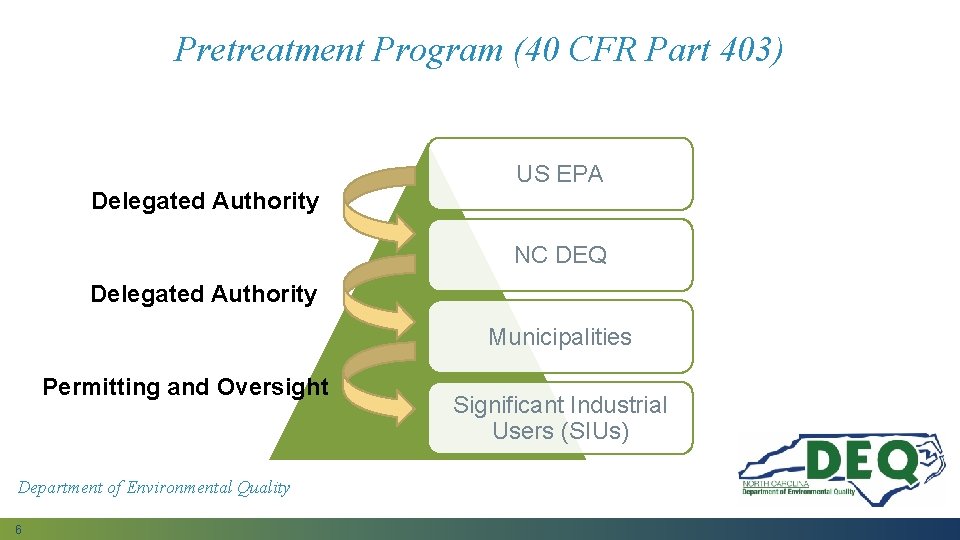
Pretreatment Program (40 CFR Part 403) US EPA Delegated Authority NC DEQ Delegated Authority Municipalities Permitting and Oversight Department of Environmental Quality 6 Significant Industrial Users (SIUs)
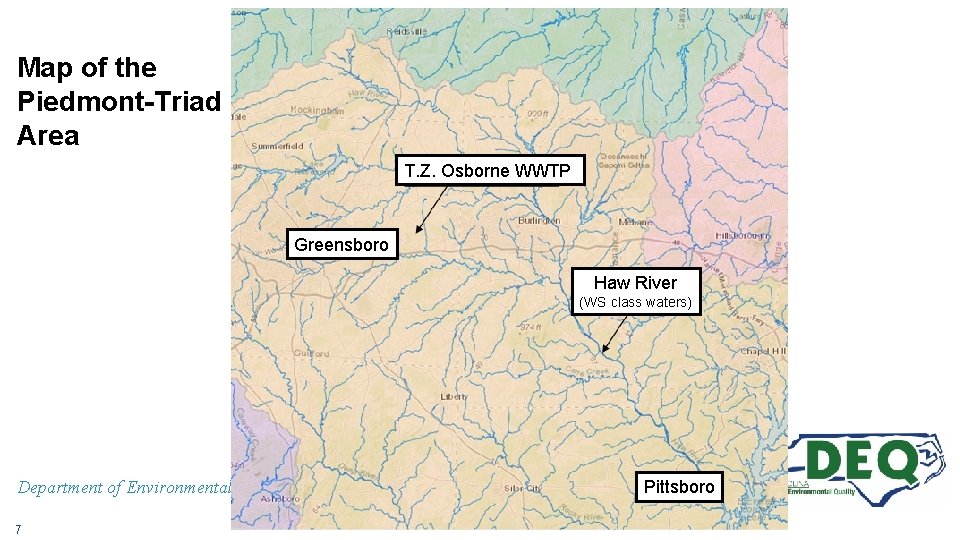
Map of the Piedmont-Triad Area T. Z. Osborne WWTP Greensboro Haw River (WS class waters) Department of Environmental Quality 7 Pittsboro
City of Greensboro’s 1, 4 -dioxane History • 2013 - 2015: EPA UCMR 3 o Analytical results from several Cape Fear River Basin public water supply systems indicated 1, 4 -dioxane in the finished drinking water. • Starting October 2014, DEQ ambient surface water quality studies found detectable concentrations downstream of the T. Z. Osborne WWTP discharge. • 2015: City voluntarily started 1, 4 -dioxane source identification and reduction plan. • By October 2015, City identified 1 industry as a quantifiable source of 1, 4 -dioxane to the WWTP o The industry voluntarily agreed to conduct its own source reduction plan. o February 2020: Industry installed experimental treatment technology to treat its waste stream prior to discharge into the City’s collection system. • Since 2016, discharge of 1, 4 -dioxane from T. Z. Osborne WWTP has decreased by over 50%. 8
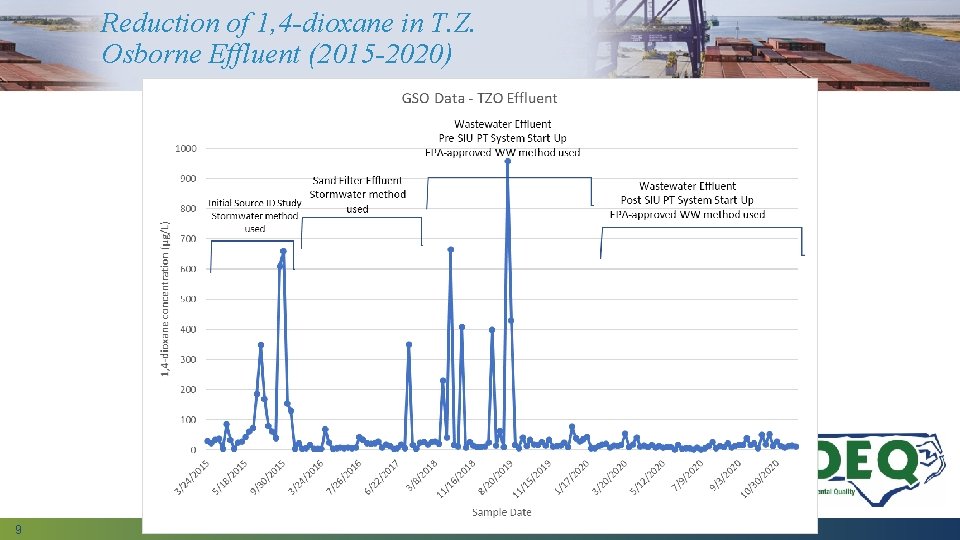
Reduction of 1, 4 -dioxane in T. Z. Osborne Effluent (2015 -2020) 9
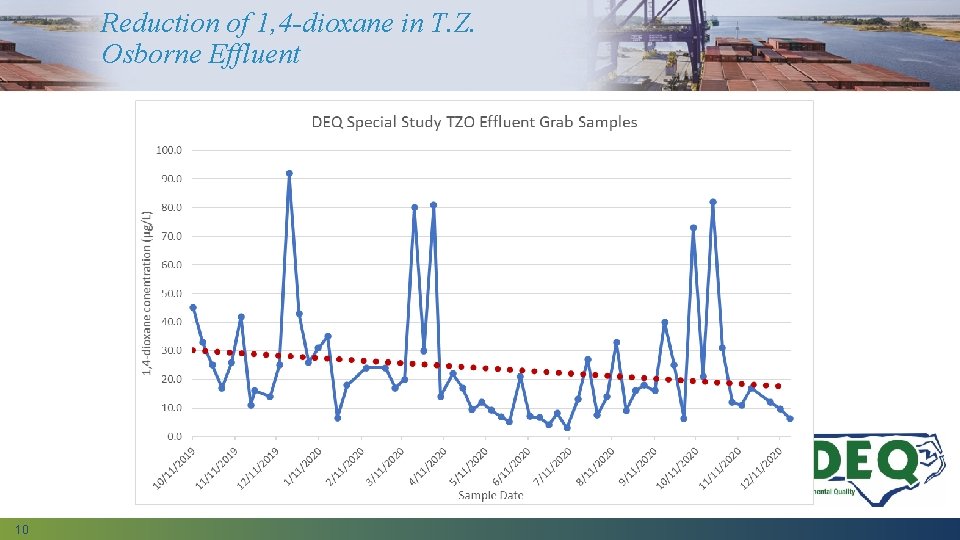
Reduction of 1, 4 -dioxane in T. Z. Osborne Effluent 10
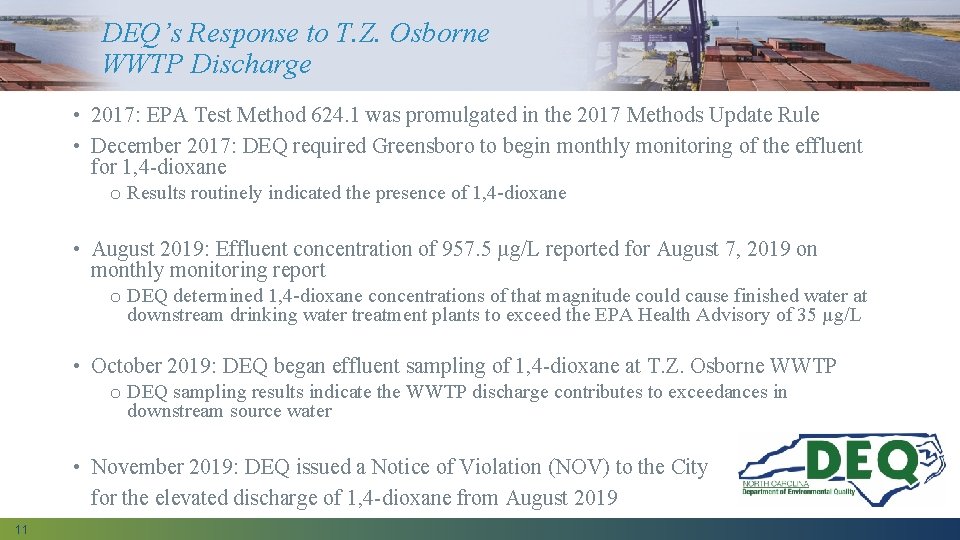
DEQ’s Response to T. Z. Osborne WWTP Discharge • 2017: EPA Test Method 624. 1 was promulgated in the 2017 Methods Update Rule • December 2017: DEQ required Greensboro to begin monthly monitoring of the effluent for 1, 4 -dioxane o Results routinely indicated the presence of 1, 4 -dioxane • August 2019: Effluent concentration of 957. 5 µg/L reported for August 7, 2019 on monthly monitoring report o DEQ determined 1, 4 -dioxane concentrations of that magnitude could cause finished water at downstream drinking water treatment plants to exceed the EPA Health Advisory of 35 µg/L • October 2019: DEQ began effluent sampling of 1, 4 -dioxane at T. Z. Osborne WWTP o DEQ sampling results indicate the WWTP discharge contributes to exceedances in downstream source water • November 2019: DEQ issued a Notice of Violation (NOV) to the City for the elevated discharge of 1, 4 -dioxane from August 2019 11
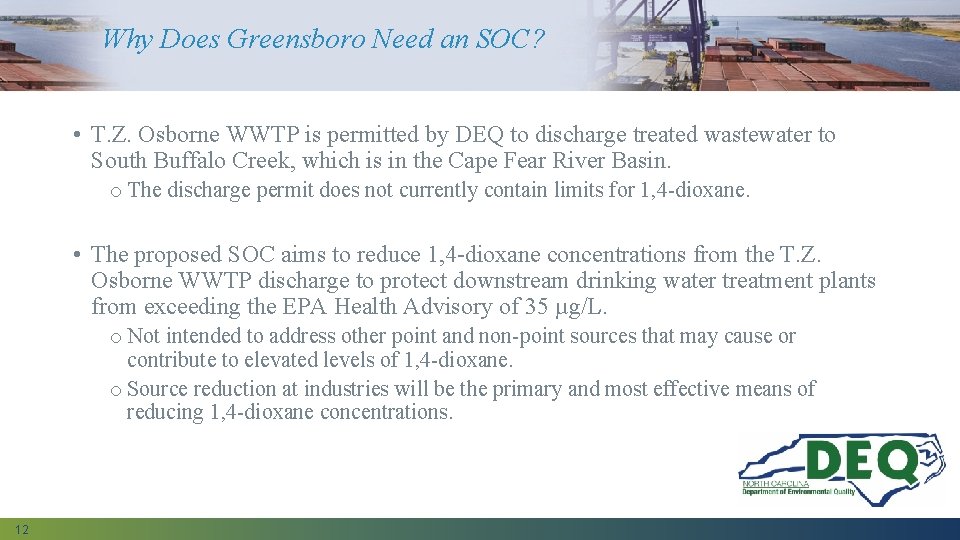
Why Does Greensboro Need an SOC? • T. Z. Osborne WWTP is permitted by DEQ to discharge treated wastewater to South Buffalo Creek, which is in the Cape Fear River Basin. o The discharge permit does not currently contain limits for 1, 4 -dioxane. • The proposed SOC aims to reduce 1, 4 -dioxane concentrations from the T. Z. Osborne WWTP discharge to protect downstream drinking water treatment plants from exceeding the EPA Health Advisory of 35 µg/L. o Not intended to address other point and non-point sources that may cause or contribute to elevated levels of 1, 4 -dioxane. o Source reduction at industries will be the primary and most effective means of reducing 1, 4 -dioxane concentrations. 12
T. Z. Osborne WWTP SOC Timeline • Initial Draft SOC Public Notice: June 22, 2020 – July 24, 2020 • DEQ revised the proposed SOC based on comments received that included: o Reduced SOC Year One effluent compliance value from 60 µg/L to 50 µg/L o Development of FAQ document to answer questions received • Updated SOC and Public Hearing Public Notice: November 6, 2020 o Comment deadline: December 14, 2020 • Public Hearing: December 9, 2020 Department of Environmental Quality 13
T. Z. Osborne WWTP Public Hearing • Comments received: o 3 oral comments received during the public hearing o 5 written comments received after the public hearing prior to the submission deadline o Full comments available in appendices of Hearing Officer’s Report of Proceedings • Primary comments: o Current compliance values are too lenient - values should be lowered for both years o Transparency concerns - request City and DEQ activities/documents be publicly available o Require downstream drinking water users be notified of any potential spikes of 1, 4 dioxane as soon as possible o Increase SIU monitoring frequency to ensure appropriate pretreatment program supervision Department of Environmental Quality 14
Revisions to SOC Following Public Hearing • Reduce compliance values in SOC Years One and Two from 50 µg/L and 35 µg/L to 45 µg/L and 33 µg/L, respectively. • Require certain SOC documents to be put on the City’s website to increase transparency of data and information. • Increase inspection frequency of select SIUs (those discharging > 100 µg/L of 1, 4 dioxane) from two times per year to three times per year. • As required in Year One, require the City to meet with DEQ during Year Two on a quarterly basis to present progress updates and provide a written meeting summary. 15
Actions to be Undertaken in the Proposed SOC for the T. Z. Osborne WWTP Department of Environmental Quality 16
SOC Year One • Not exceed the effluent Year One SOC compliance value of 45 µg/l to protect downstream drinking water intakes • Increases 1, 4 -dioxane effluent monitoring frequency to weekly • Develop and implement an ongoing 1, 4 -dioxane public education outreach plan • Contact, interview, and survey indirect dischargers with identifiable, contributing 1, 4 -dioxane concentrations of > 100 µg/l • Modify SIU permits or develop other pretreatment program mechanisms as necessary Department of Environmental Quality 17
SOC Year One (cont. ) • Determine contributions to the collection system and investigate further as concentrations or loadings warrant • Investigate and determine background levels of 1, 4 -dioxane that include: o Industrial o Domestic o Commercial o Drinking water o Surface intake water contributions • Meet with DEQ on a quarterly basis to present progress updates and provide a written meeting summary Department of Environmental Quality 18
SOC Year One (cont. ) • Report to DEQ within 24 hours after receiving any data indicating an effluent 1, 4 -dioxane concentration ≥ 45 µg/l and follow up within 5 business days with a written report. • Require analyses of all new industrial flows and commercial flows to the collection system prior to the City’s acceptance of the wastewater. • Continue collaboration and oversight of 1, 4 -dioxane industrial dischargers to the WWTP: o Identify SIUs that are indirect sources of 1, 4 -dioxane o Develop a source reduction program o Review slug control plans and update if necessary o Increase inspection of selected SIUs to three times per year • Submit annual report summarizing actions taken within 45 days of the end of Year One Department of Environmental Quality 19
SOC Year Two • Continue actions from SOC Year One • Not exceed effluent Year Two compliance value of 33 µg/l to protect downstream drinking water intakes • Calculate effluent 1, 4 -dioxane mass balance using all data (industrial, domestic, commercial, drinking water, collection system) • Report to DEQ within 24 hours after receiving any data indicating an effluent 1, 4 dioxane concentration ≥ 33 µg/l and follow up within 5 business days with a written report • Submit annual report summarizing actions taken in the SOC year Department of Environmental Quality 20
Additional Requirements If ≥ 25% of e. DMR data exceeds 45 µg/L at the end of SOC Year One, the City shall: 1. Submit to DEQ for approval a report that investigates: − Alternate/additional treatment processes for removal of 1, 4 -dioxane at major industrial sources − Feasibility of treatment technologies for removal of 1, 4 -dioxane at WWTPs and drinking water treatment facilities 2. Following the investigations, a draft Best Management Practices/1, 4 -dioxane Minimization Plan, which will include an implementation schedule approved by DEQ. 21
SOC Stipulated Penalties • City will pay an upfront penalty in the amount of $5, 000. 00 as settlement of the alleged violations • City will pay stipulated penalties for failure to meet the deadlines and requirements of the proposed SOC. Department of Environmental Quality 22
What Other Future Actions Can Be Taken? • Technological advances in large-scale treatment technology are needed to remove 1, 4 -dioxane at municipal WWTPs. • SIUs in North Carolina are just now beginning to install treatment technologies for 1, 4 -dioxane. • Elimination or substitution of 1, 4 -dioxane from commercial and consumer products may prevent and/or reduce its presence in the environment. 23
Recommendation to the EMC The Hearing Officer recommends that the Environmental Management Commission approve the proposed SOC, which has been signed by the City of Greensboro, and that the Chairman’s signature be affixed to the document to effect its complete execution. 24
- Slides: 24