
Citrus Introduction Origin South East Asia Family Rutaceae

- Slides: 58
Citrus
Introduction • • Origin: South East Asia Family: Rutaceae A prized fruit of Pakistan Ranks 1 st among all fruits Shares 34% in total fruit production Shares one-third of total value of fruit’s exports 95 % kinnow Produced in Punjab
Classification • Swingle (1943) divided the genus citrus into 3 independent genera: 1. Citrus included 16 species 2. Poncirus include 1 species 3. Fortunella include 4 species • Hodgson (1961) divided citrus into 36 species. • Mostly Swingle classification is followed with some modifications suggested by Hodgson.
• • Family: Rutaceae Sub Family: Aurantioideae Sub family consists of 2 tribes: Clausenae and Citreae has 33 genera including Citrus (Sweet orange, mandarin, grapefruit, lime and lemons) Poncirus (kumquat) Fortunella (trifoliate orange)
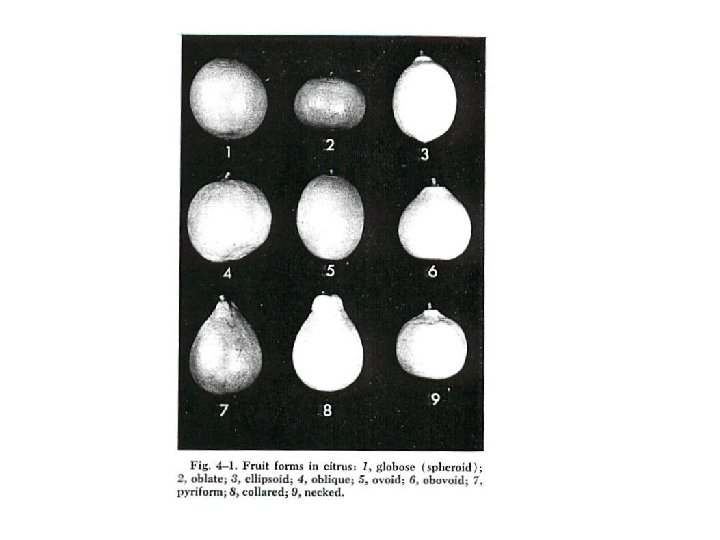
Distinguishing features of 3 genera Genus Citrus: • Unifoliate • Ovary has 8 or more cells • Evergreen trees and shrubs • Spiny with thick, leathery leaves and winged petioles • Flowers are white or in some species pink on the outside, Pentamerous, axillary and scented. • They have small calyxes, hard sepals and thick petals with densely spaced oil cells. • The stamens are numerous (15 -60) and the ovary superior with 8 -15 carpels containing few to several ovules • Fruit has thick leathery rind, botanically it is a special type of berry called a hesperidium. • Fruit is globose, sub-globose or elliptical filled with juice sacs or vesicles. • Fruit contain few to many white or light green seeds, which are generally polyembryonic.
Distinguishing features of 3 genera Genus Citrus: is divided into two sub-genera 1. Eucitrus: all edible citrus species 2. Papeda: contain acrid oil droplets in the juice vesicles and are inedible
Distinguishing features of 3 genera Few important commercial citrus species are: Citrus sinensis (L) Osbeck----Sweet Orange Citrus reticulate Blance----Mandarin Citrus paradisi Macf. Grapefruit----(Pomelo) Citrus grandis (L) Osbeck Chakotra---(Pummelo) Citrus limettioides Tan. ----Sweet lime Citrus aurantifolia Swing----Kaghzi Lime Citrus limonia (L)----Lemon Citrus medica (L)----Citron Citrus aurantium (L)----Sour orange Citrus jambheri Lush----Rough Lemon
Distinguishing features of 3 genera Genus Poncirus: • It has only one species P. trifoliate Raf. , • Compound leaves with three leaflets • Deciduous • Tree is small and spiny • Flowers are sessile, and borne on previous-year wood in the axils of spines. They open wide and flat and are creamy white. • The inedible, pubescent fruit has 6 -8 segments, is filled with smooth seeds and is orange-yellow at maturity. • Poncirus is generally used as a rootstock in colder regions and for growing dwarf trees.
Distinguishing features of 3 genera Genus Fortunella: • It has four species, of which the commercially important ones are F. margarita Swing. (oval kumquat) and F. japonica Swing. (round kumquat). • The trees are small with small green leaves paler on the other side. • The flowers are white and smaller than those of citrus • Fruit is small, orange colored, 3 -6 celled, acidic and juicy but with a sweet and edible rind. The other species are F. crassifolia Swing and F. hindsii Swing.
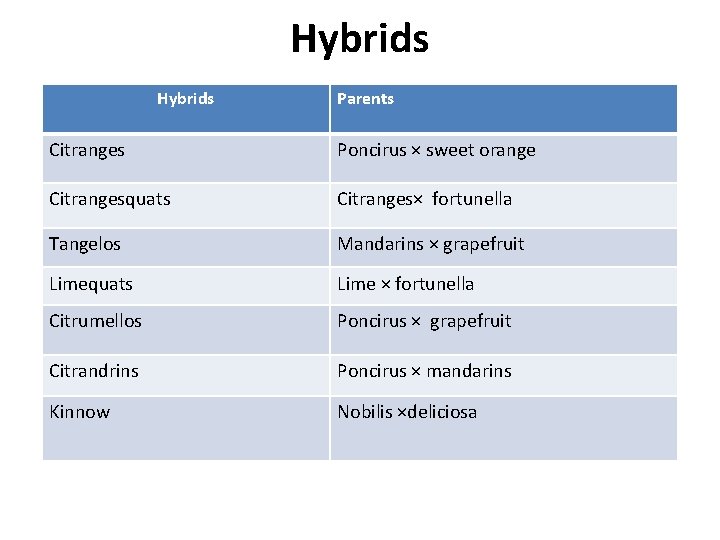
Hybrids Parents Citranges Poncirus × sweet orange Citrangesquats Citranges× fortunella Tangelos Mandarins × grapefruit Limequats Lime × fortunella Citrumellos Poncirus × grapefruit Citrandrins Poncirus × mandarins Kinnow Nobilis ×deliciosa
Soil • Deep sandy loam, loam and clay loam • p. H: 5. 5 -8. 5 • Subsoil should be free from hard pan, sticky clay and water logged conditions • Poor soils with high p. H are not suitable • Soil requirements depend upon the type of rootstock used for various species and varieties. • Rough lemon is a good rootstock for dry, sandy loam soils of Punjab, whereas sour orange performs better on the moist and heavy soil of NWFP.
Climate • Tropical and Sub Tropical • Up to 450 -750 m elevation • Temperature is an important factor. In cool regions, vegetative growth is less, fruit growth is slow, ripening is delayed and fruit is acidic. In colder regions, pigmented cultivars like Red Blood sweet orange develop excellent quality. • Temperature range: 13 -40°C • Can endure 0 -2°C without injury, depending on the cultivar and duration of cold period. • Grapefruit is the high temperature resistant citrus sp. • Extreme cold and frost can burn flowers and young twigs.
Climate • Species appear to resist frost in the following descending manner • Mandarin, sour orange, sweet orange, chakotra, grape fruit, sweet lime, lemon, kaghzi lime and citron. • In hotter regions, trees produce more growth and fruit grows faster and ripens earlier but fruit may suffer from sunburn • In Pakistan, the central divisions of Punjab– Sargodha, Faisalabad, Lahore and Multan---produce excellent citrus. • In NWFP, Peshawar, D. I. Khan and Dir are important citrus producing areas.
Temperature Requirement • Seed Germination: 15 -30°C • Vegetative Growth: Optimum shoot growth: 25 -31°C Optimum root growth: 25 -26 °C
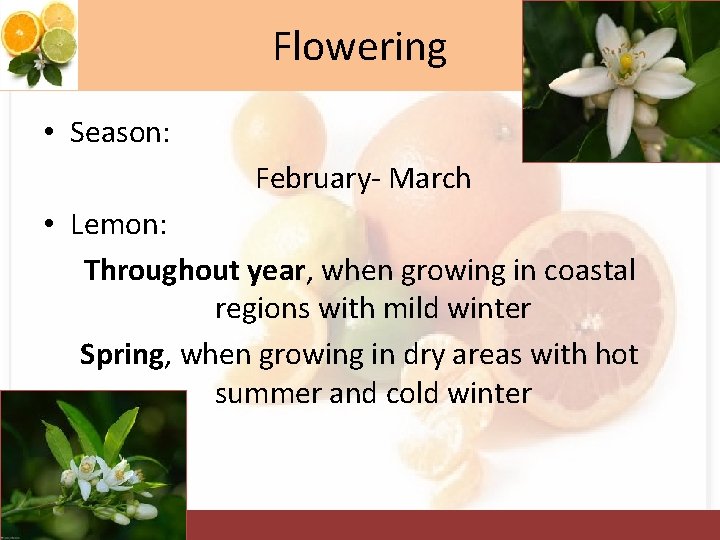
Flowering • Season: February- March • Lemon: Throughout year, when growing in coastal regions with mild winter Spring, when growing in dry areas with hot summer and cold winter
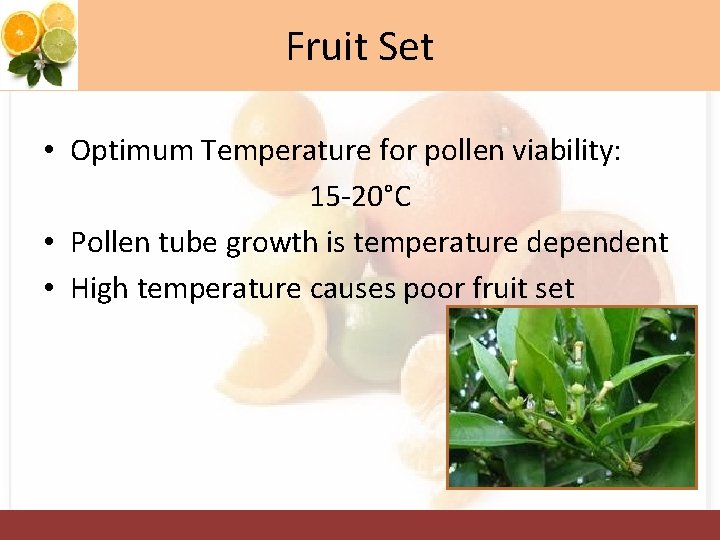
Fruit Set • Optimum Temperature for pollen viability: 15 -20°C • Pollen tube growth is temperature dependent • High temperature causes poor fruit set
Propagation • Sexual: Seeds • Asexual: Budding Layering Grafting
Planting Seasons • Spring February- March • Autumn September-October
Citrus Nursery • Extraction of seeds • August- September • Storage of seeds • Preparation of seed bed Ø Length 5 -6 ft Ø Width 3 ft Ø Height 6 -9 inch Ø Distance from seed to seed 4 -6 inch Ø Use fungicides and depth of seed should be 1 cm
• • • Transplantation of seedling: Seedling should be transplanted after 6 -12 month Plant to plant distance 6 -9 inch Row to row distance same as plant to plant distance Please left some space empty after four lines Care of seedlings Budding and grafting of seedlings Selection of scion wood, preparation of rootstock Aftercare of budded/grafted plants
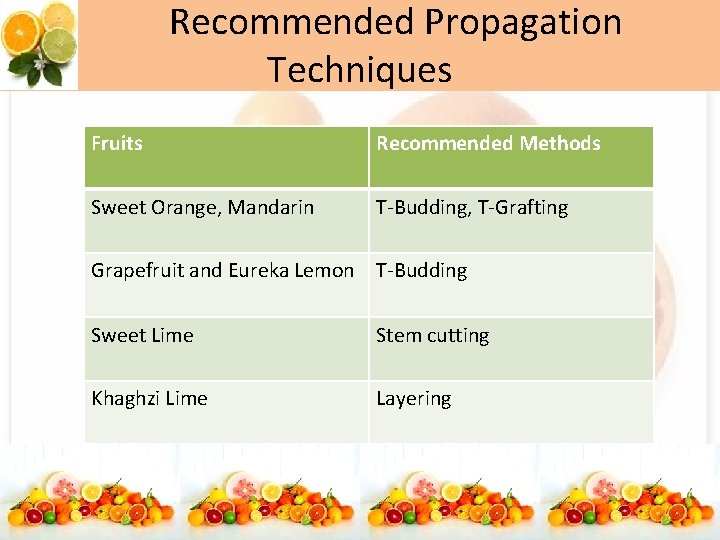
Recommended Propagation Techniques Fruits Recommended Methods Sweet Orange, Mandarin T-Budding, T-Grafting Grapefruit and Eureka Lemon T-Budding Sweet Lime Stem cutting Khaghzi Lime Layering
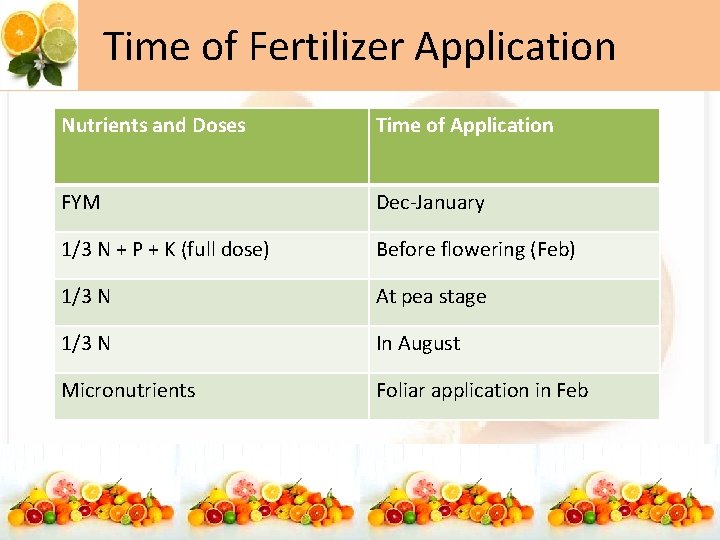
Time of Fertilizer Application Nutrients and Doses Time of Application FYM Dec-January 1/3 N + P + K (full dose) Before flowering (Feb) 1/3 N At pea stage 1/3 N In August Micronutrients Foliar application in Feb
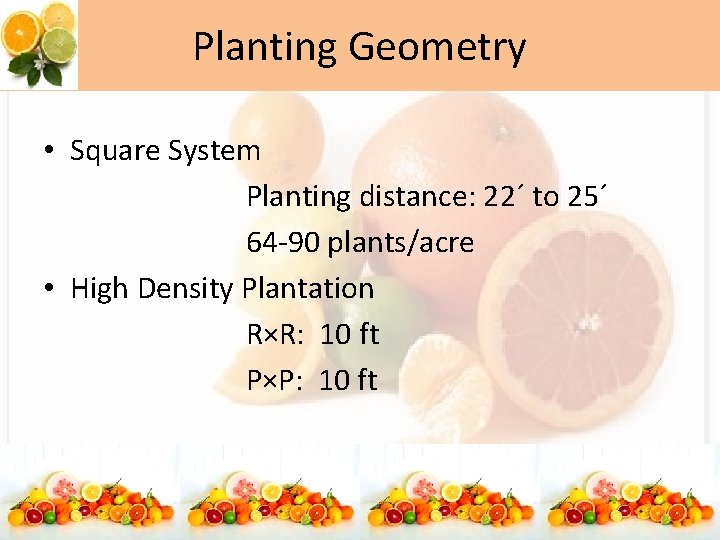
Planting Geometry • Square System Planting distance: 22´ to 25´ 64 -90 plants/acre • High Density Plantation R×R: 10 ft P×P: 10 ft
Intercropping • From 1 -6 yrs of age: short stature crops with shallow root system are allowed to grow Mung, Mash, Masoor, Peas • Exhaustive crops with deep root system are not allowed to grow Sugarcane, Cotton, Wheat • Afterwards clean cultivation is recommended • No hoeing or cultivation except once in a year to kill the weeds.
Irrigation Over irrigation is more injurious than under irrigation in citrus • Surface irrigation 1. Basin system 2. Modified basin system 3. Flood irrigation • Sprinkler irrigation • Drip irrigation
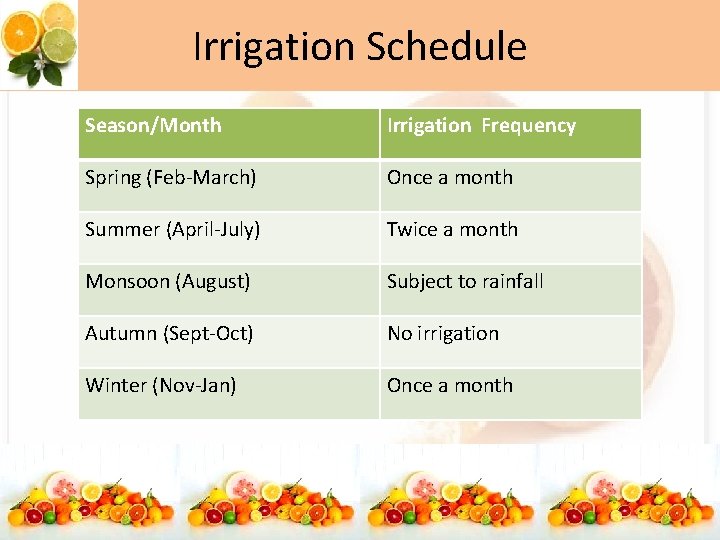
Irrigation Schedule Season/Month Irrigation Frequency Spring (Feb-March) Once a month Summer (April-July) Twice a month Monsoon (August) Subject to rainfall Autumn (Sept-Oct) No irrigation Winter (Nov-Jan) Once a month
Precautions in Applying Irrigation • Irrigation water may not be allowed to touch directly to the stem of citrus tree • Field and water channels should be precisely leveled • Stop irrigation at flowering time • Stop irrigation two weeks before harvesting • Restrict irrigation in Oct-Nov • Light irrigation during frosty nights
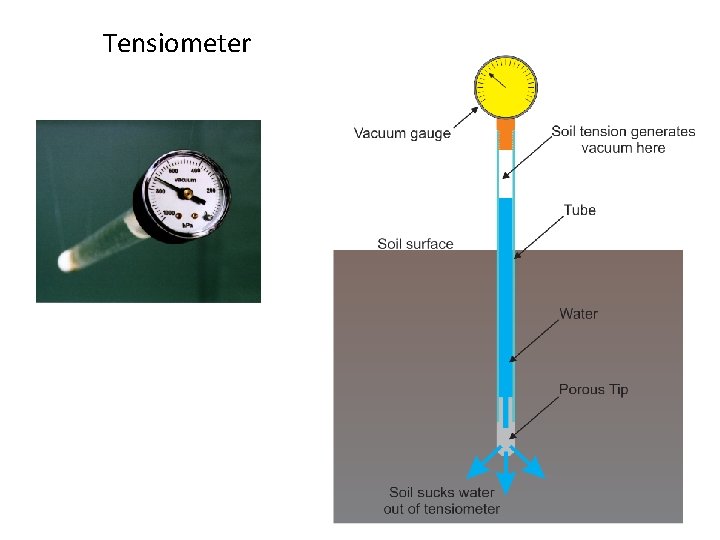
Determination of irrigation • Fruit growth • Wilting symptoms • Tensiometer
Tensiometer
Pruning • For establishment of strong well balanced framework • Facilitate management practices like spraying, picking etc. • To ensure balance between vegetative vigor and fruitfulness • To improve penetration and increase the set of inferior fruit • Increase soluble solids and improve rind color • To produce new and productive wood • Tree age 70 -100 years California due to pruning
Physiological Disorders • • Alternate Bearing Unfruitfulness Fruit Drop Granulation
For disease there is some specific causal organism and which can be corrected It is very hard and difficult to correct/control the physiological disorder
Alternate Bearing Heavy crop: on year No or less crop: off year Nutritional imbalance Varietal character Mandarin Sweet orange Grape fruit 1. 2. 3. 4. Kinnow , Wilking V. Late, W. Navel Marsh seedless, Heavy manuring during off year Fruit thinning during on year Delayed harvesting during off year Early harvesting during on year
Unfruitfulness q Physiological or genetic causes q Involve hormonal or nutritional imbalances q Climatic factors • • Genetic or physiological Incompatibility Heterostyly Ovule abortion
• • • Involvement of hormonal or nutritional imbalances General weakness may be removed by an appropriate fertilizer program While excessive vegetative growth Withholding nutrition Root pruning or ringing of main branches Climatic factors Certain varieties refused to produce in particular environments e. g Washington navel
Fruit Drop Start from blooming and continue up to harvest 1 - Flower drop Bloom heavily---- thousand of flowers Usually 95% drop and 5% set fruit Fruit set % range form 1 -4% Reasons: 1. Climatic conditions 2. Weak plant, deficiency of nutrients 3. Mutual flower competition 4. Heavy winds, or rain fall
Fruit Drop 2 - Initial fruit drop Fruit drop after fruit set Due to nutritional imbalance Weak trees 3 - June drop 1. Occurs in month of May and June 2. Natural load sharing 3. Drop of poorly developing fruits 4. Around 96% young fruit drop occurs in Pineapple orange 5. Around 75% drop ----- in Kinnow
Fruit Drop 4 - Pre-harvest drop 1. This drop is at mature stage 2. It is a commercial loss to the grower 3. Failure in auxins synthesis due to abscission layer 4. Attack of insects and disease 5. Controlled with application of hormones 6. GA and 2, 4 -D, NAA etc 7. Ethylene inhibitors
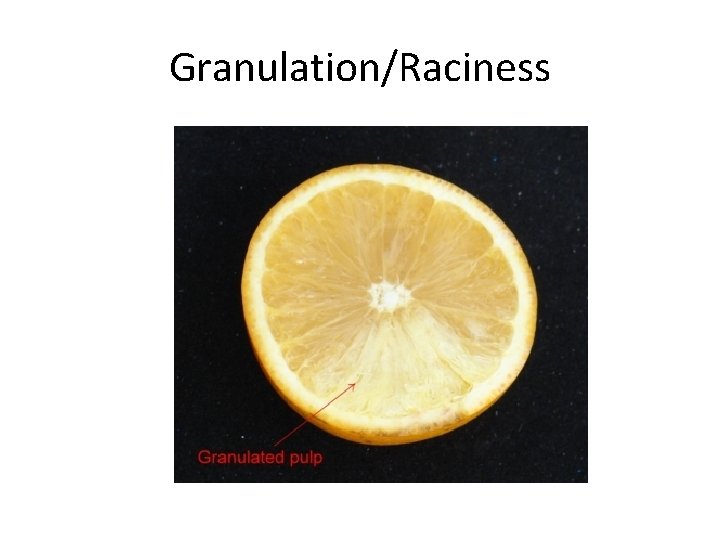
Granulation/Raciness • The condition is characterised by large, hardened and apparently dry juice vesicles • The stem end of fruit is more effected as compared to styler end • Some time one half, one third or under extreme cases whole fruit is affected • It cannot be identified externally, because there is no external abnormality 1. The cell wall of granulated vesicles are thick 2. Sugar contents are reduced then normal 3. Mineral content are increased then the normal
Granulation/Raciness • Due to thick walls of fruit vesicles more minerals, less sugar content it seems to be dry • Granulation increase of harvesting is delayed • Frequent irrigation or water standing in the root zone for longer period of time may also increase the incidence of granulation Corrective measure • Spot picking of larger fruits at earlier stage • Large interval of irrigation • Spraying of growth regulators
Granulation/Raciness
Major Diseases • • Phytophthora Gummosis or Foot rot Trunk Gummosis Damping off/ Root rot Wither tip Citrus Canker Citrus Greening Citrus Quick Decline Citrus Slow Decline
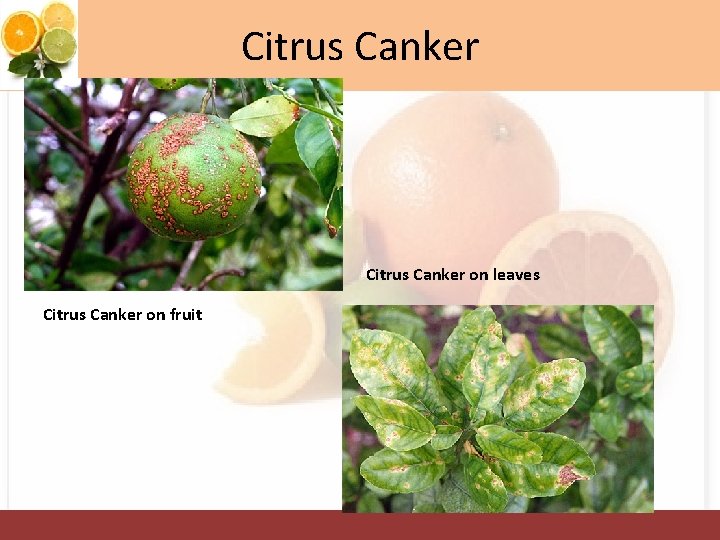
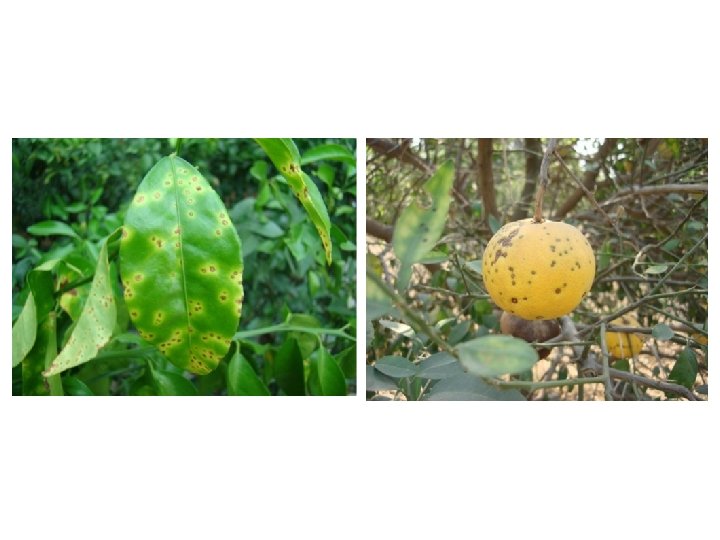
Citrus Canker 1 - Citrus Canker (Xanthomonas compestris) Bacterial disease Appear on leaves, branches, fruit a- Symptoms 1. Small yellow spots are formed on upper epidermis, then on lower epidermis 2. Later, spots become bigger, brown, raised 3. Diseased area die and leaving hole 4. Spots also appear on twigs and fruit drop Example: K lime, Lemon, Grapefruit, Sweet lime, Sweet orange b- Corrective measure 1. Selection of healthy nursery plants 2. Prune the affected part and spray with bacteriaside
Citrus Canker on leaves Citrus Canker on fruit
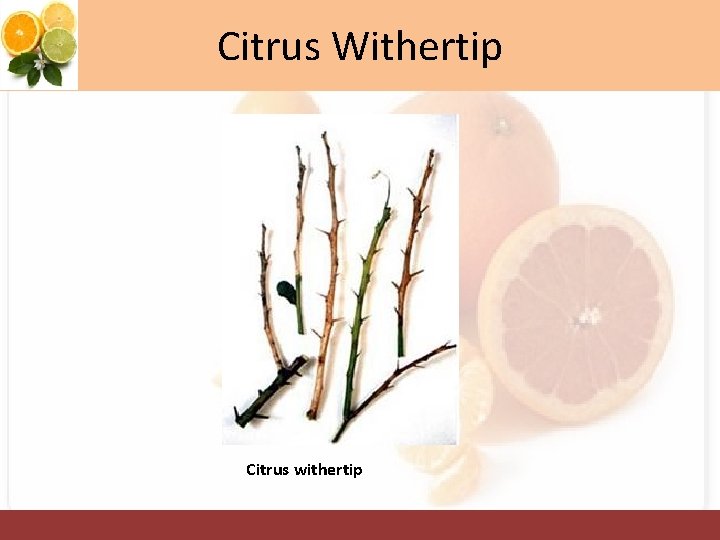
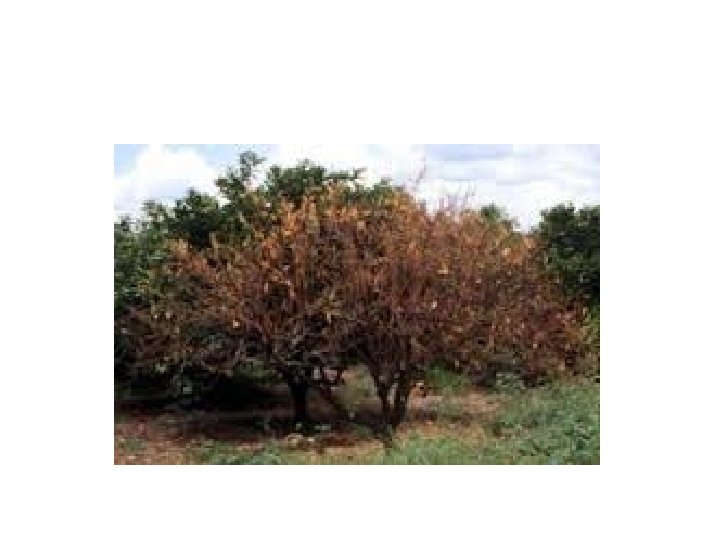
Citrus Withertip 2 - Citrus wither tip (Colletotricum gloeosporioids) Fungal disease a- Symptoms 1. All aerial part, leaves, braches and fruit are affected 2. Wilting from braches from top to bottom 3. Branches looks silvery grey leafless 4. Leaf fall is common 5. Pathogen kill the plant b- Corrective measure 1. Improve growing conditions of the orchard 2. Spraying with copper based fungicides
Citrus Withertip Citrus withertip
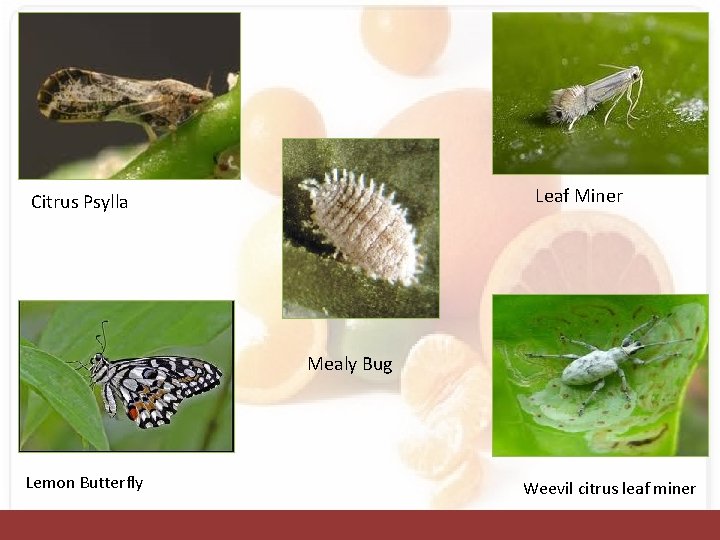
Insect Pests of Citrus • • • Citrus psylla Citrus leaf miner Citrus fruit fly Lemon butterfly Citrus mealy bug Citrus thrips
Leaf Miner Citrus Psylla Mealy Bug Lemon Butterfly Weevil citrus leaf miner
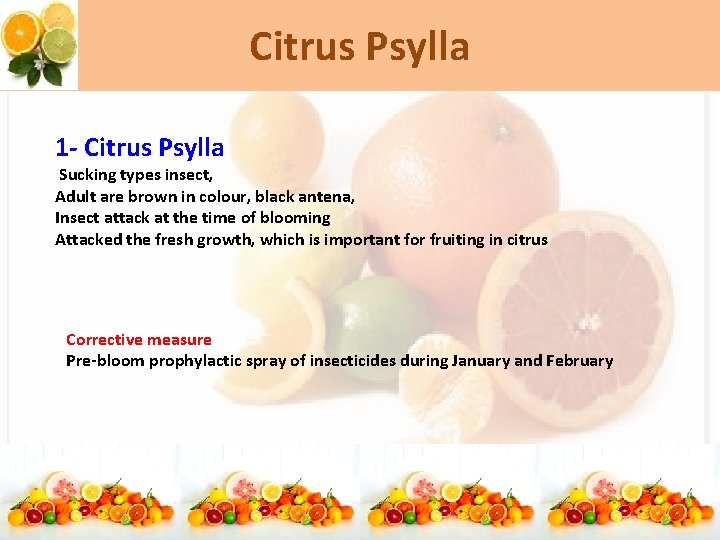
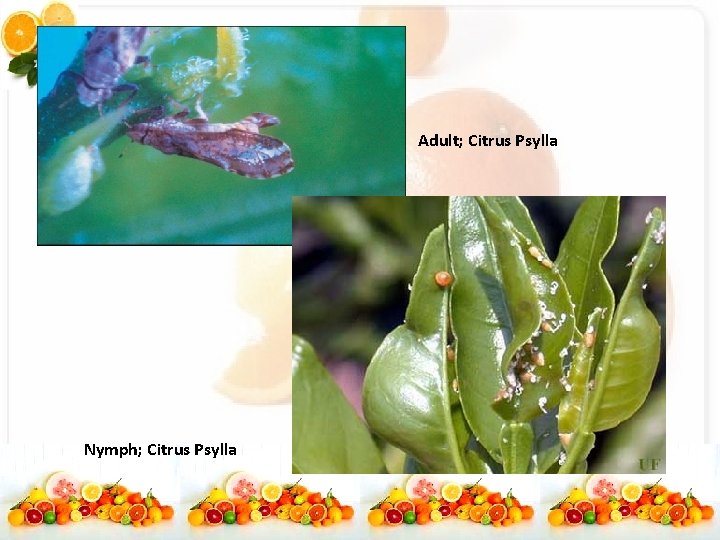
Citrus Psylla 1 - Citrus Psylla Sucking types insect, Adult are brown in colour, black antena, Insect attack at the time of blooming Attacked the fresh growth, which is important for fruiting in citrus Corrective measure Pre-bloom prophylactic spray of insecticides during January and February
Adult; Citrus Psylla Nymph; Citrus Psylla
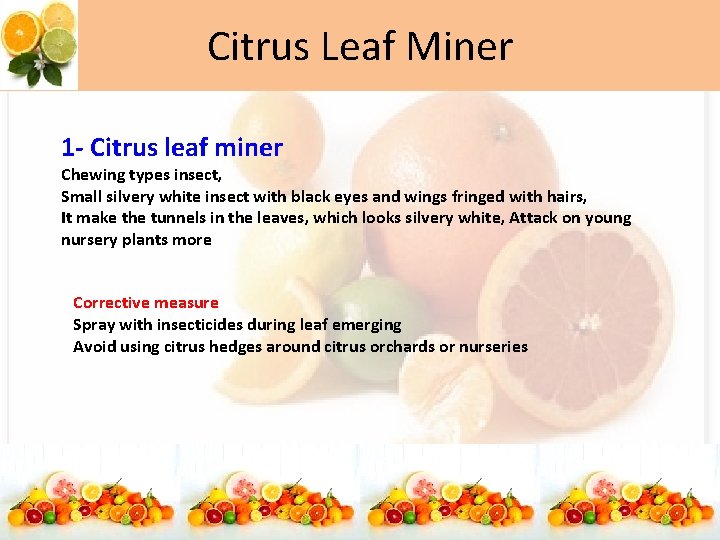
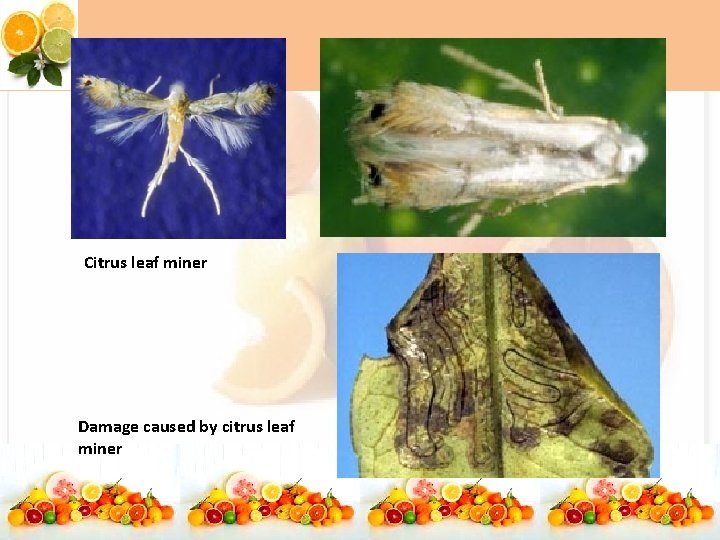
Citrus Leaf Miner 1 - Citrus leaf miner Chewing types insect, Small silvery white insect with black eyes and wings fringed with hairs, It make the tunnels in the leaves, which looks silvery white, Attack on young nursery plants more Corrective measure Spray with insecticides during leaf emerging Avoid using citrus hedges around citrus orchards or nurseries
Citrus leaf miner Damage caused by citrus leaf miner
Thanks