
Citric Acid Cycle Dr Nesrin Mwafi Biochemistry Molecular
Citric Acid Cycle Dr. Nesrin Mwafi Biochemistry & Molecular Biology Department Faculty of Medicine, Mutah University
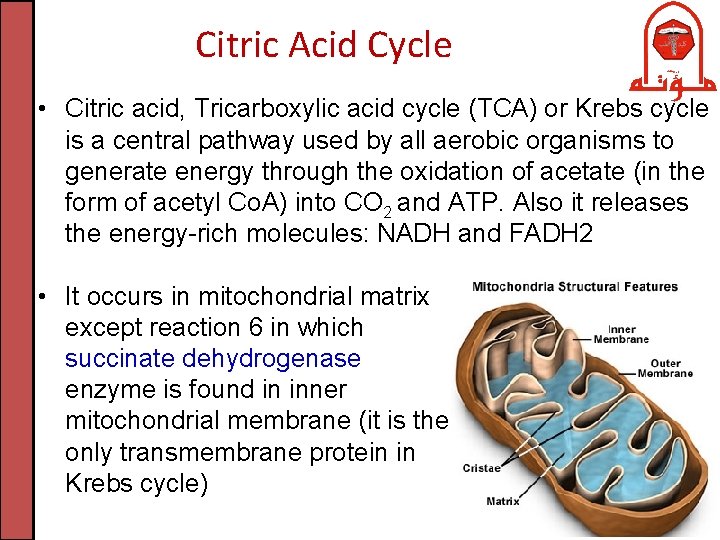
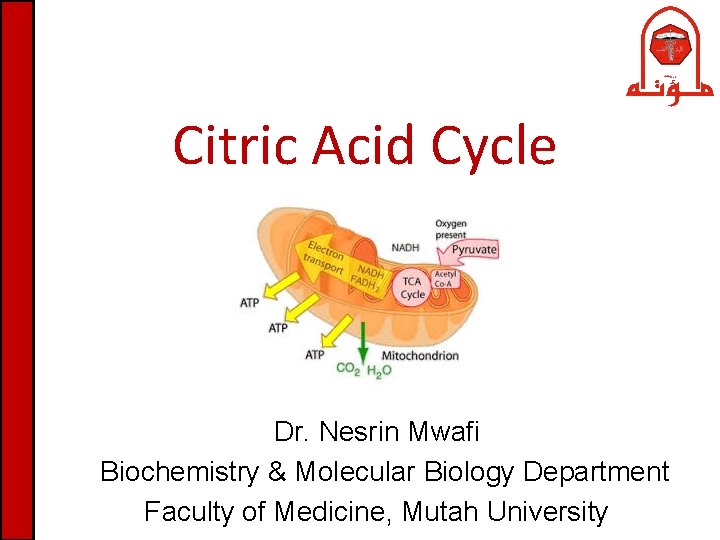
Citric Acid Cycle • Citric acid, Tricarboxylic acid cycle (TCA) or Krebs cycle is a central pathway used by all aerobic organisms to generate energy through the oxidation of acetate (in the form of acetyl Co. A) into CO 2 and ATP. Also it releases the energy-rich molecules: NADH and FADH 2 • It occurs in mitochondrial matrix except reaction 6 in which succinate dehydrogenase enzyme is found in inner mitochondrial membrane (it is the only transmembrane protein in Krebs cycle)
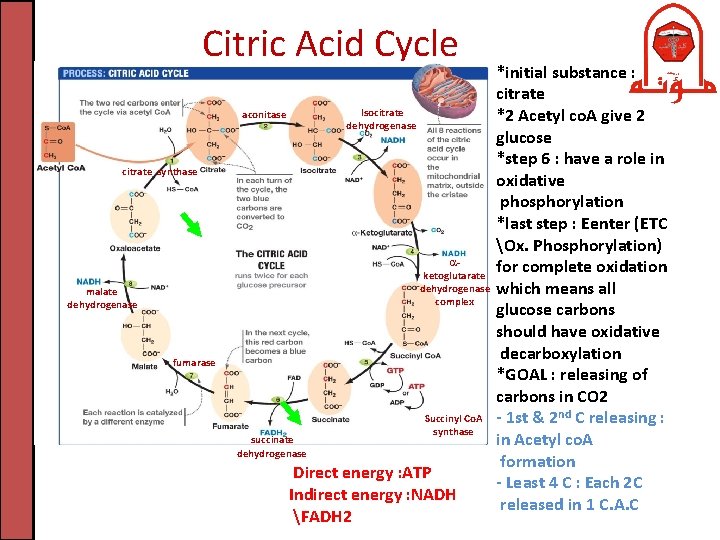
Citric Acid Cycle Isocitrate dehydrogenase aconitase citrate synthase ketoglutarate dehydrogenase complex malate dehydrogenase fumarase succinate dehydrogenase Succinyl Co. A synthase Direct energy : ATP Indirect energy : NADH FADH 2 *initial substance : citrate *2 Acetyl co. A give 2 glucose *step 6 : have a role in oxidative phosphorylation *last step : Eenter (ETC Ox. Phosphorylation) for complete oxidation which means all glucose carbons should have oxidative decarboxylation *GOAL : releasing of carbons in CO 2 - 1 st & 2 nd C releasing : in Acetyl co. A formation - Least 4 C : Each 2 C released in 1 C. A. C
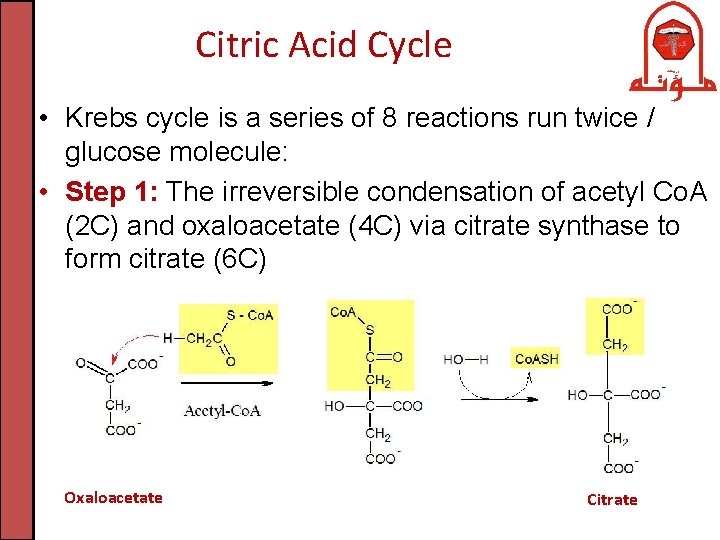
Citric Acid Cycle • Krebs cycle is a series of 8 reactions run twice / glucose molecule: • Step 1: The irreversible condensation of acetyl Co. A (2 C) and oxaloacetate (4 C) via citrate synthase to form citrate (6 C) Oxaloacetate Citrate
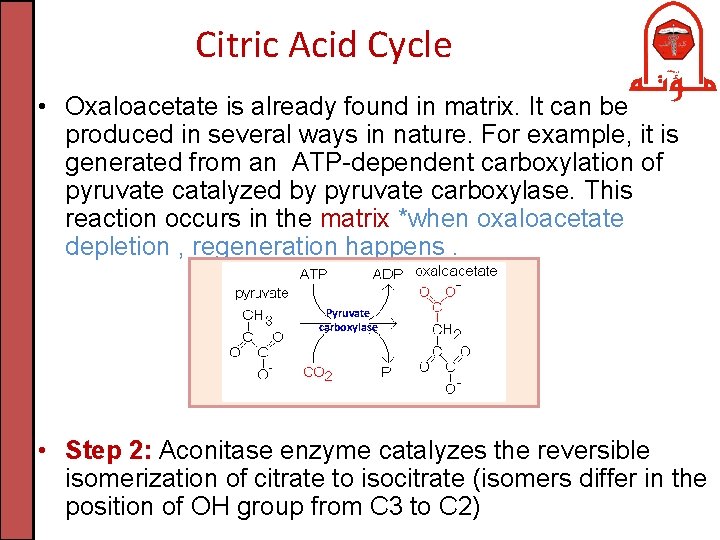
Citric Acid Cycle • Oxaloacetate is already found in matrix. It can be produced in several ways in nature. For example, it is generated from an ATP-dependent carboxylation of pyruvate catalyzed by pyruvate carboxylase. This reaction occurs in the matrix *when oxaloacetate depletion , regeneration happens. Pyruvate carboxylase • Step 2: Aconitase enzyme catalyzes the reversible isomerization of citrate to isocitrate (isomers differ in the position of OH group from C 3 to C 2)
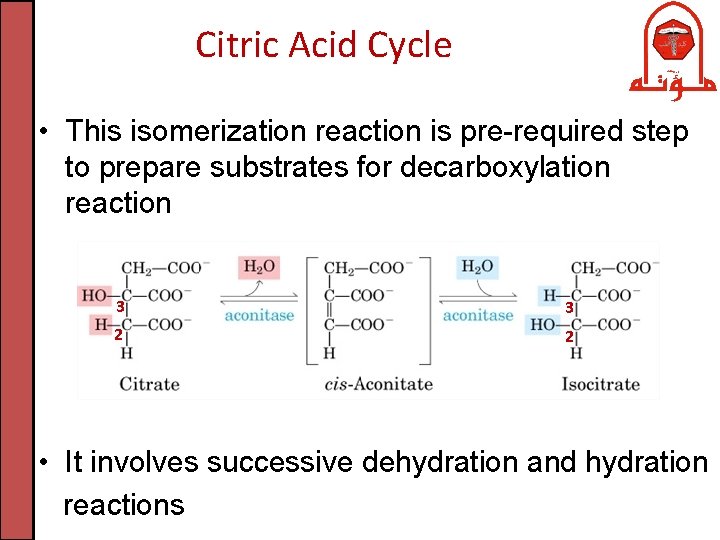
Citric Acid Cycle • This isomerization reaction is pre-required step to prepare substrates for decarboxylation reaction 3 3 2 2 • It involves successive dehydration and hydration reactions
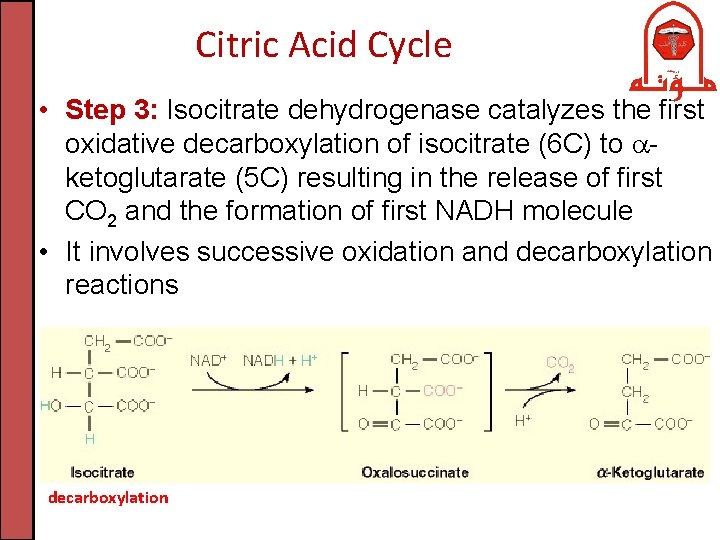
Citric Acid Cycle • Step 3: Isocitrate dehydrogenase catalyzes the first oxidative decarboxylation of isocitrate (6 C) to ketoglutarate (5 C) resulting in the release of first CO 2 and the formation of first NADH molecule • It involves successive oxidation and decarboxylation reactions decarboxylation
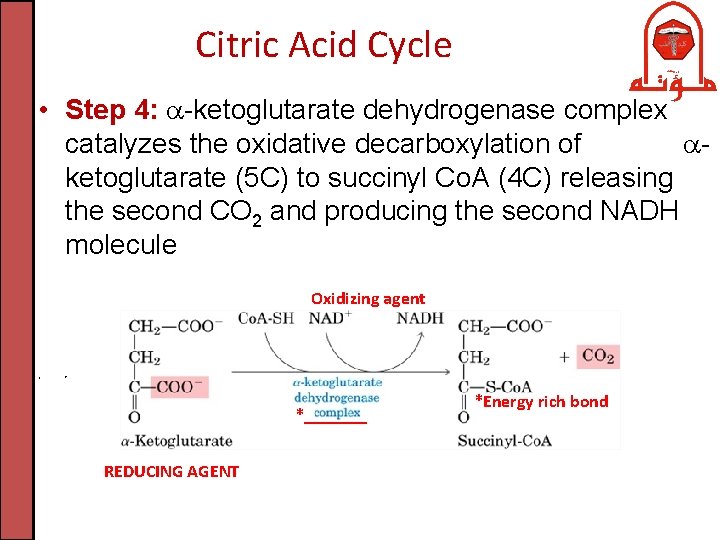
Citric Acid Cycle • Step 4: -ketoglutarate dehydrogenase complex catalyzes the oxidative decarboxylation of ketoglutarate (5 C) to succinyl Co. A (4 C) releasing the second CO 2 and producing the second NADH molecule Oxidizing agent • * *_______ REDUCING AGENT *Energy rich bond
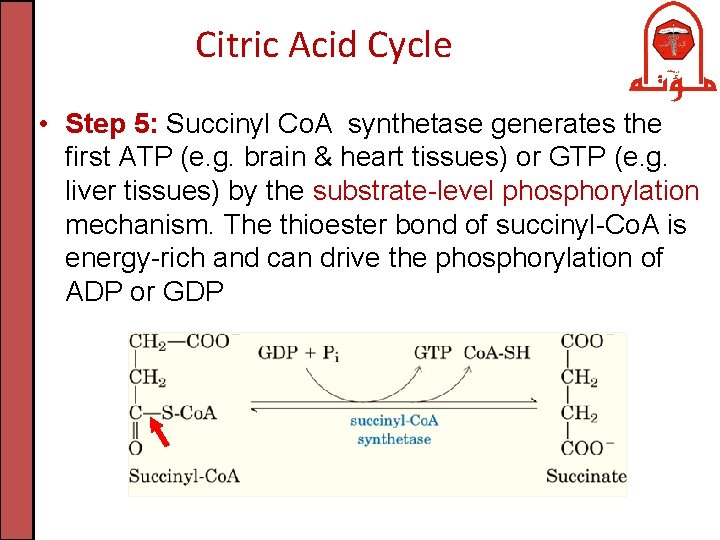
Citric Acid Cycle • Step 5: Succinyl Co. A synthetase generates the first ATP (e. g. brain & heart tissues) or GTP (e. g. liver tissues) by the substrate-level phosphorylation mechanism. The thioester bond of succinyl-Co. A is energy-rich and can drive the phosphorylation of ADP or GDP
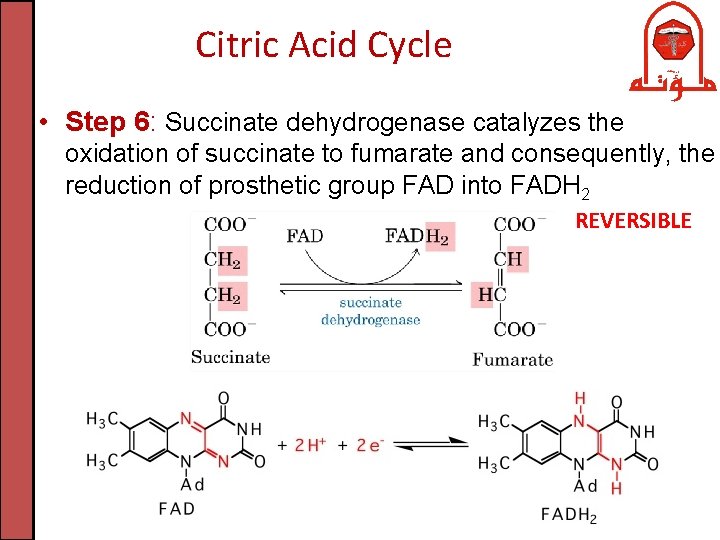
Citric Acid Cycle • Step 6: Succinate dehydrogenase catalyzes the oxidation of succinate to fumarate and consequently, the reduction of prosthetic group FAD into FADH 2 REVERSIBLE
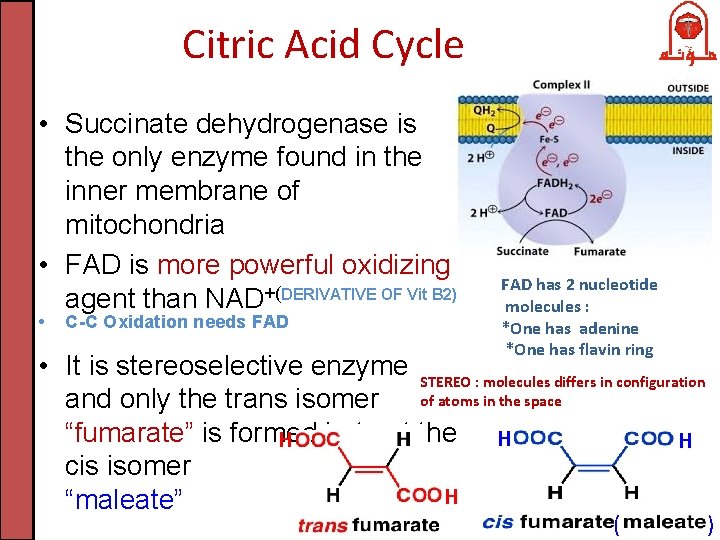
Citric Acid Cycle • Succinate dehydrogenase is the only enzyme found in the inner membrane of mitochondria • FAD is more powerful oxidizing agent than NAD+(DERIVATIVE OF Vit B 2) • C-C Oxidation needs FAD has 2 nucleotide molecules : *One has adenine *One has flavin ring • It is stereoselective enzyme STEREO : molecules differs in configuration and only the trans isomer of atoms in the space “fumarate” is formed H H but not the H cis isomer H “maleate” ( )
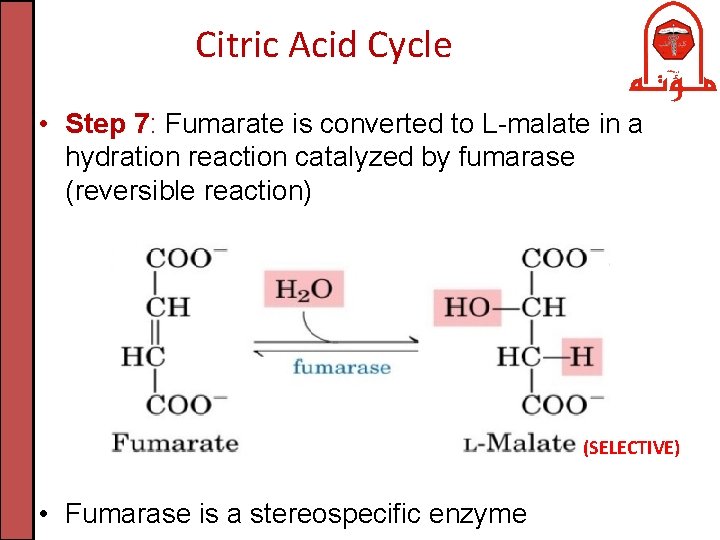
Citric Acid Cycle • Step 7: Fumarate is converted to L-malate in a hydration reaction catalyzed by fumarase (reversible reaction) (SELECTIVE) • Fumarase is a stereospecific enzyme
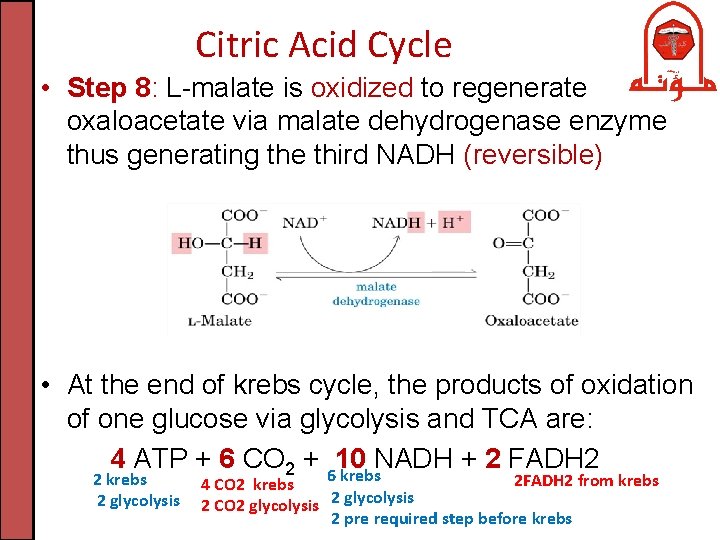
Citric Acid Cycle • Step 8: L-malate is oxidized to regenerate oxaloacetate via malate dehydrogenase enzyme thus generating the third NADH (reversible) • At the end of krebs cycle, the products of oxidation of one glucose via glycolysis and TCA are: 4 ATP + 6 CO 2 + 610 NADH + 2 FADH 2 krebs 2 glycolysis 2 FADH 2 from krebs 4 CO 2 krebs 2 CO 2 glycolysis 2 pre required step before krebs
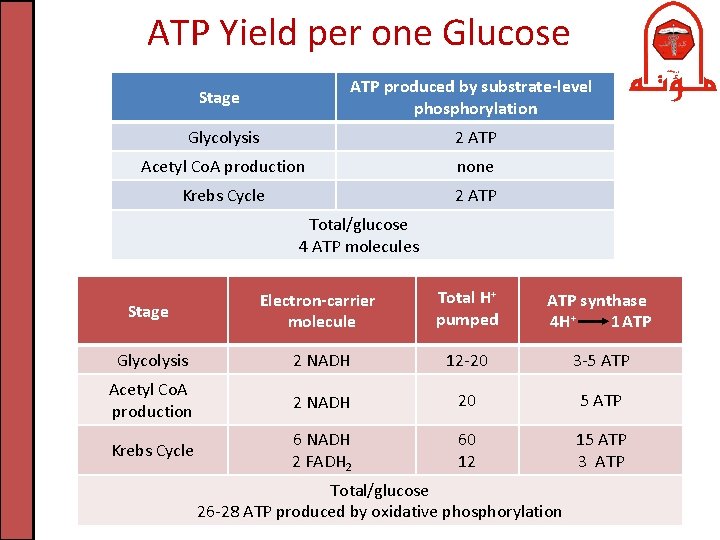
ATP Yield per one Glucose Stage ATP produced by substrate-level phosphorylation Glycolysis 2 ATP Acetyl Co. A production none Krebs Cycle 2 ATP Total/glucose 4 ATP molecules Stage Electron-carrier molecule Total H+ pumped ATP synthase 4 H+ 1 ATP Glycolysis 2 NADH 12 -20 3 -5 ATP Acetyl Co. A production 2 NADH 20 5 ATP Krebs Cycle 6 NADH 2 FADH 2 60 12 15 ATP 3 ATP Total/glucose 26 -28 ATP produced by oxidative phosphorylation
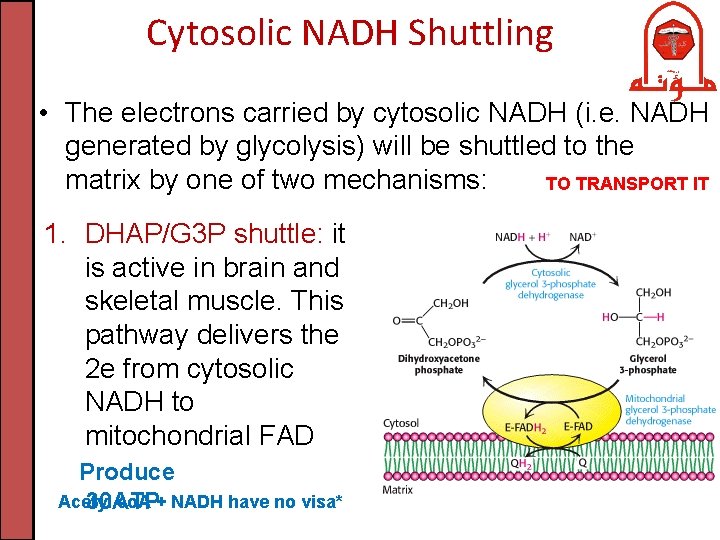
Cytosolic NADH Shuttling • The electrons carried by cytosolic NADH (i. e. NADH generated by glycolysis) will be shuttled to the matrix by one of two mechanisms: TO TRANSPORT IT 1. DHAP/G 3 P shuttle: it is active in brain and skeletal muscle. This pathway delivers the 2 e from cytosolic NADH to mitochondrial FAD Produce Acetyl co. A + NADH have no visa* 30 ATP
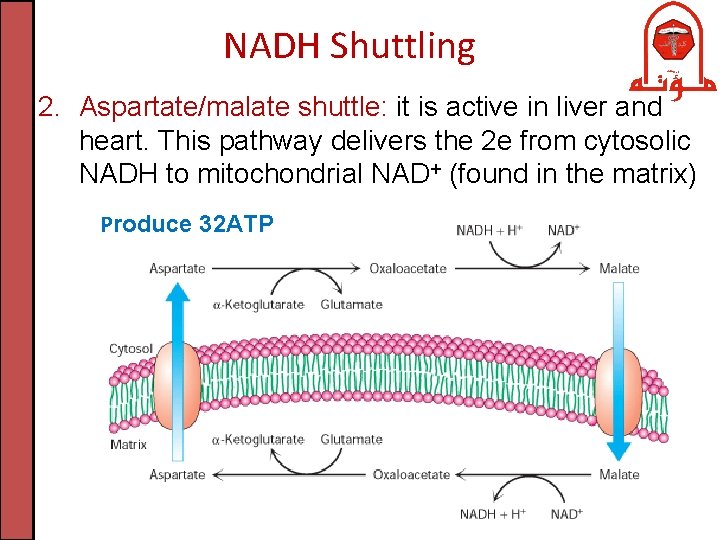
NADH Shuttling 2. Aspartate/malate shuttle: it is active in liver and heart. This pathway delivers the 2 e from cytosolic NADH to mitochondrial NAD+ (found in the matrix) Produce 32 ATP
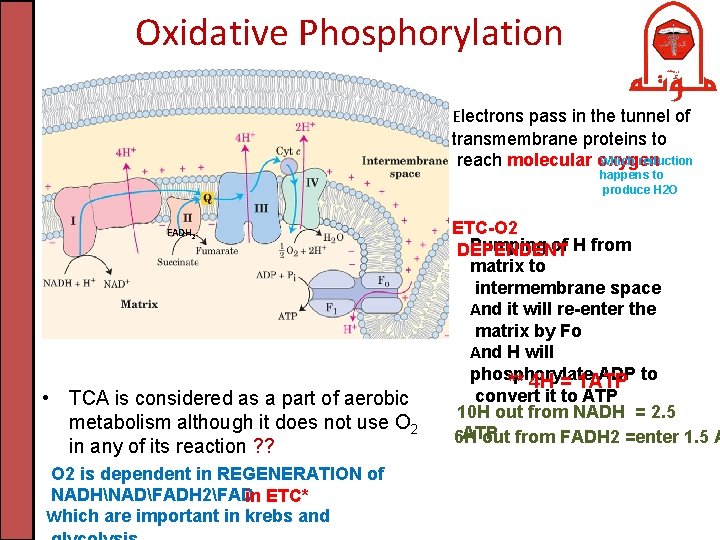
Oxidative Phosphorylation Electrons pass in the tunnel of transmembrane proteins to Which reduction reach molecular oxygen happens to produce H 2 O FADH 2 • TCA is considered as a part of aerobic metabolism although it does not use O 2 in any of its reaction ? ? O 2 is dependent in REGENERATION of NADHNADFADH 2FADin ETC* Which are important in krebs and ETC-O 2 Pumping of H from DEPENDENT matrix to intermembrane space And it will re-enter the matrix by Fo And H will phosphorylate ADP to ** 4 H = 1 ATP convert it to ATP 10 H out from NADH = 2. 5 ATP 6 H out from FADH 2 =enter 1. 5 A
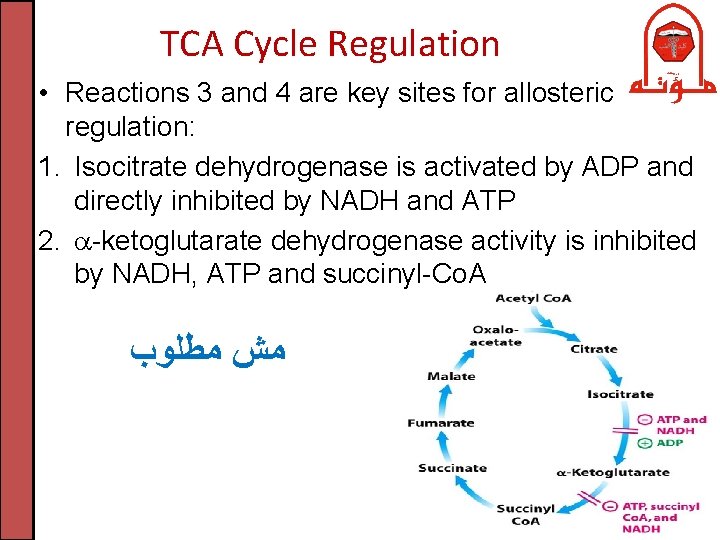
TCA Cycle Regulation • Reactions 3 and 4 are key sites for allosteric regulation: 1. Isocitrate dehydrogenase is activated by ADP and directly inhibited by NADH and ATP 2. -ketoglutarate dehydrogenase activity is inhibited by NADH, ATP and succinyl-Co. A ﻣﺶ ﻣﻄﻠﻮﺏ
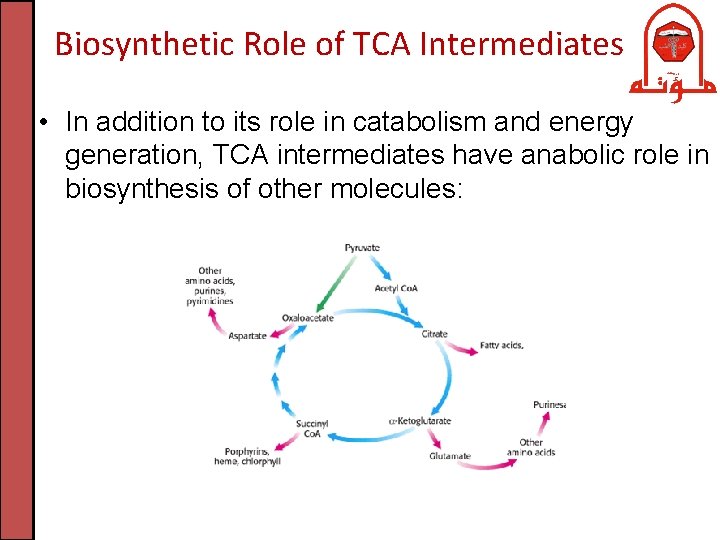
Biosynthetic Role of TCA Intermediates • In addition to its role in catabolism and energy generation, TCA intermediates have anabolic role in biosynthesis of other molecules: 2 3 1 2
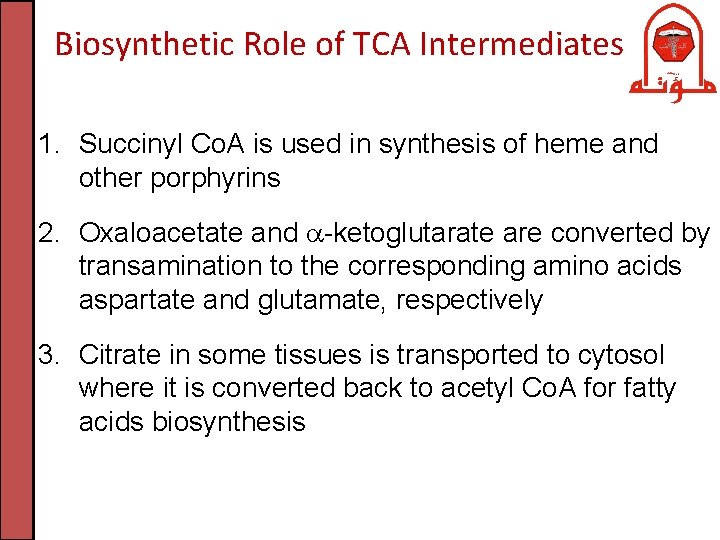
Biosynthetic Role of TCA Intermediates 1. Succinyl Co. A is used in synthesis of heme and other porphyrins 2. Oxaloacetate and -ketoglutarate are converted by transamination to the corresponding amino acids aspartate and glutamate, respectively 3. Citrate in some tissues is transported to cytosol where it is converted back to acetyl Co. A for fatty acids biosynthesis
Anaplerotic Pathway • Anaplerotic pathways (from Greek word meaning filling up) are the processes that replenish TCA intermediates so that the flow of carbon out of the cycle is balanced by these reactions • Reactions that replenish oxaloacetate: 1. Pyruvate carboxylase (PC) catalyzes the irreversible ATP-dependent carboxylation of pyruvate to generate oxaloacetate (occurs in the matrix)
Anaplerotic Pathway • Transamination replenish TCA intermediates: Transamination are reversible reaction in which an amino acid loses an amino group thereby converted itself to a keto acid • For example glutamate and aspartate undergo transamination to generate the TCA intermediates -ketoglutarate and oxaloacetate, respectively
- Slides: 22