
Citizen Recordings of Officers on Duty Legal Liability
Citizen Recordings of Officers on Duty: Legal Liability and Best Practices MAT T DO LAN ATT ORNEY PUBLIC AGENCY T RAINING C OU NCIL
Overview First Amendment Right to Record Officers Fourth Amendment Right to be Free of Unreasonable Search/Seizure of Recording Devices (cell phones in particular) Legal Liability and Public Trust Model Policy Components
The First Amendment and Citizen Recordings of Officers Glik v. Cunniffe, 655 F. 3 d 78 (1 st Cir. 2011) "The filming of government officials engaged in their duties in a public place, including police officers performing their responsibilities, fits comfortably within [First Amendment] principles. Gathering information about government officials in a form that can readily be disseminated to others serves a cardinal First Amendment interest. ” Am. Civ. Liberties Union v. Alvarez, 679 F. 3 d 583 (7 th Cir. 2012) “The eavesdropping statute restricts a medium of expression--the use of a common instrument of communication--and thus an integral step in the speech process. As applied here, it interferes with the gathering and dissemination of information about government officials performing their duties in public. Any way you look at it, the eavesdropping statute burdens speech and press rights and is subject to heightened First Amendment scrutiny. " Smith v. City of Cumming, 212 F. 3 d 1332 (11 th Cir. 2000) recognizing a First Amendment right to photograph police activity, subject to reasonable time, place, and manner restrictions. Fordyce v. Seattle, 55 F. 3 d 436 (9 th Cir. 1995) upholding a "First Amendment right to film matters of public interest".
Glik v. Cunniffe 1 st Circuit addressed the question: “Is there a constitutionally protected right to videotape police carrying out their duties in in public? ” 1 st Circuit: “Basic First Amendment principles, along with case law from this and other circuits, answer that question unambiguously in the affirmative. ” “First Amendment principles” establish that private individuals possess “a constitutionally protected right to videotape police carrying out their duties. ” The right to “[g]ather information about government officials in a form that can readily be disseminated to others serves as a cardinal First Amendment interest in protecting and promoting ‘the free discussion of governmental affairs. ’” (citing Mills v. Alabama, 384 U. S. 214, 218 (1966)). See Glik v. Cunniffe, 2011 U. S. App. LEXIS 17841 (1 st Cir. 2011).
City of Houston v. Hill Pre-smart phone activist case. Court gives examples of instances in which speech is NOT protected: ◦ “A municipality constitutionally may punish an individual who chooses to stand near a police officer and persistently attempt to engage the officer in conversation while the officer is directing traffic at a busy intersection. ” ◦ An individual who “run[s] beside [an officer pursuing a felon] in a public street shouting at the officer. ” See City of Houston v. Hill, 482 U. S. 451 (1987)
Am. Civ. Liberties Union v. Alvarez 7 th Circuit: “Unlike the federal wiretapping statute and the eavesdropping laws of most other states, the gravamen of the Illinois eavesdropping offense is not the secret interception or surreptitious recording of a private communication. Instead, the statute sweeps much more broadly, banning all audio recording of any oral communication absent consent of the parties regardless of whether the communication is or was intended to be private. ” State's Attorney defends the application of the statute based on the “government's interest in protecting conversational privacy. ” District Court subsequently entered a preliminary injunction preventing future prosecutions. See Am. Civ. Liberties Union v. Alvarez, 679 F. 3 d 583 (7 th Cir. 2012)
Contradictory Case Law Kelly v. Borough of Carlisle, 622 F. 3 d 248 (3 d Cir. 2010) “there was insufficient case law establishing a right to videotape police officers during a traffic stop to put a reasonably competent officer on ‘fair notice’ that seizing a camera or arresting an individual for videotaping police during the stop would violate the First Amendment. ” Szymecki, v. Houck, 353 Fed. Appx. 852 (4 th Cir. 2009) "Here, the district court concluded that [Plaintiff’s] asserted First Amendment right to record police activities on public property was not clearly established in this circuit at the time of the alleged conduct. We have thoroughly reviewed the record and the relevant legal authorities and we agree. "
First Amendment Protection Limitations Totality of the circumstances analysis is required. (“To be sure, the right to film is not without limitations. It may be subject to reasonable time, place, and manner restrictions. ” Glik v. Cunniffe, 655 F. 3 d 78 (1 st Cir. 2012)) Unlawful activity, independent of recording, is not protected. (“Criminal conduct…cannot have shelter in the First Amendment. ” Gremillion v. National Ass’n for the Advancement of Colored People, 366 U. S. 293 (1961)) Obstruction of Officer’s Investigation. 407 U. S. 104 (1972) Colten v. Commonwealth of Kentucky,
Bleish v. Moriarty Post-Glik 1 st Circuit Case. P physically interfered with lawful police arrests—within 1 foot of one officer, reaching into the squad car to interview an arrestee, constantly and loudly asking questions of the officers, and refusing to comply with repeated officer requests to back away. Court: “The video recordings do show that she was arrested while she was engaged in activities that are ordinarily protected by the First Amendment, but being arrested while exercising constitutional rights is very different from being arrested for exercising those rights. ” Held: “None of the defendant officers either committed a tort against [Plaintiff] or denied her any of her constitutional rights…” See Bleish v. Moriarty, 2012 DNH 118 (D. N. H. 2012)
Beyond First Amendment Protection… What law is the person violating? Is it unlawful for them to be where they are? Or to take the actions they are taking?
The Fourth Amendment and Citizen Recordings United States v. Place, 462 U. S. 696 (1983) Warrantless seizures permitted only if an officer has probable cause to believe that the property “holds contraband or evidence of a crime” and “the exigencies of the circumstances demand it. ” Roaden v. Kentucky, 413 U. S. 496 (1973) The warrantless seizure of material protected by the First Amendment “calls for a higher hurdle in the evaluation of reasonableness” under the Fourth Amendment.
Fourth Amendment Confiscation Prohibition Exceptions Evidence of a Crime ◦ “We have found no case in which this Court has held unlawful a temporary seizure that was supported by probable cause and was designed to prevent the loss of evidence while the police diligently obtained a warrant in a reasonable period of time. ” Illinois v. Mc. Arthur, 531 U. S. 326 (2001). Search Incident to Arrest ◦ “In the case of a lawful custodial arrest a full search of the person is not only an exception to the warrant requirement of the Fourth Amendment, but is also a 'reasonable' search under that Amendment. " United States v. Robinson, 414 U. S. 218 (1973). ◦ In Riley v. California, S Ct held that conducting a search of a cellular phone is a more intrusive search, and therefore requires a warrant absent exigent circumstances, Riley v. California 134 S. Ct. 999 (U. S. 2014)
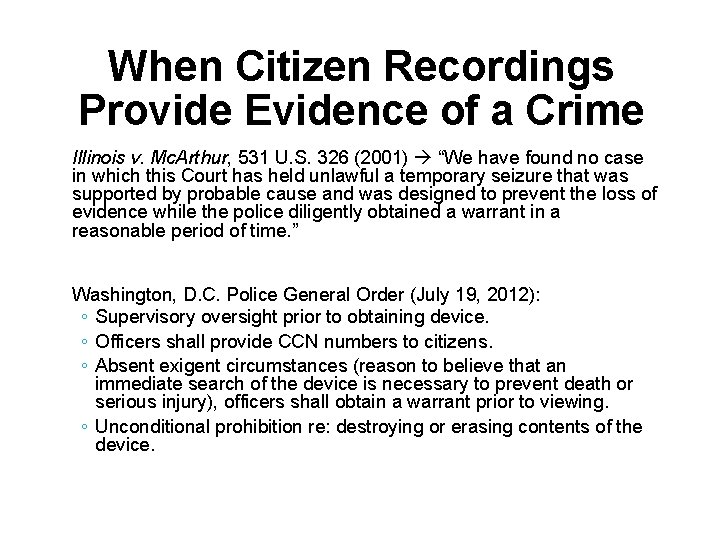
When Citizen Recordings Provide Evidence of a Crime Illinois v. Mc. Arthur, 531 U. S. 326 (2001) “We have found no case in which this Court has held unlawful a temporary seizure that was supported by probable cause and was designed to prevent the loss of evidence while the police diligently obtained a warrant in a reasonable period of time. ” Washington, D. C. Police General Order (July 19, 2012): ◦ Supervisory oversight prior to obtaining device. ◦ Officers shall provide CCN numbers to citizens. ◦ Absent exigent circumstances (reason to believe that an immediate search of the device is necessary to prevent death or serious injury), officers shall obtain a warrant prior to viewing. ◦ Unconditional prohibition re: destroying or erasing contents of the device.
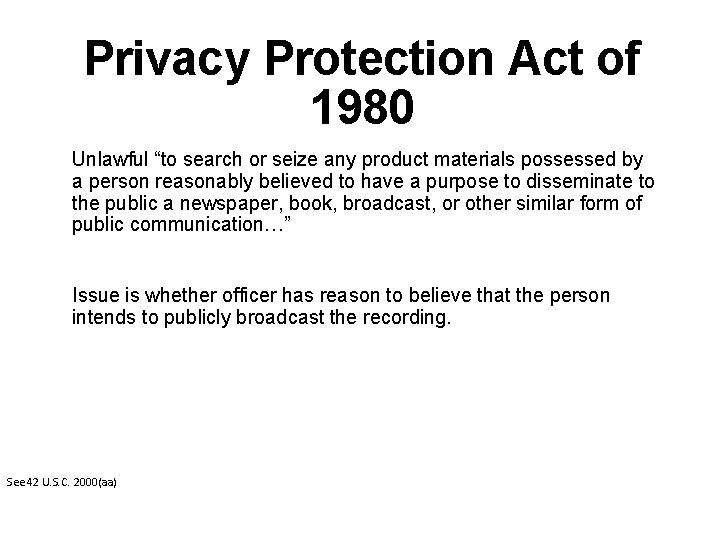
Privacy Protection Act of 1980 Unlawful “to search or seize any product materials possessed by a person reasonably believed to have a purpose to disseminate to the public a newspaper, book, broadcast, or other similar form of public communication…” Issue is whether officer has reason to believe that the person intends to publicly broadcast the recording. See 42 U. S. C. 2000(aa)
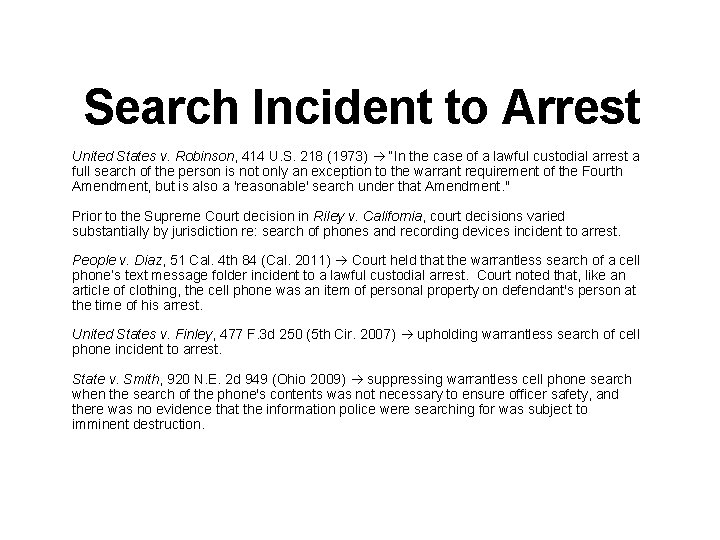
Search Incident to Arrest United States v. Robinson, 414 U. S. 218 (1973) “In the case of a lawful custodial arrest a full search of the person is not only an exception to the warrant requirement of the Fourth Amendment, but is also a 'reasonable' search under that Amendment. " Prior to the Supreme Court decision in Riley v. California, court decisions varied substantially by jurisdiction re: search of phones and recording devices incident to arrest. People v. Diaz, 51 Cal. 4 th 84 (Cal. 2011) Court held that the warrantless search of a cell phone’s text message folder incident to a lawful custodial arrest. Court noted that, like an article of clothing, the cell phone was an item of personal property on defendant's person at the time of his arrest. United States v. Finley, 477 F. 3 d 250 (5 th Cir. 2007) upholding warrantless search of cell phone incident to arrest. State v. Smith, 920 N. E. 2 d 949 (Ohio 2009) suppressing warrantless cell phone search when the search of the phone's contents was not necessary to ensure officer safety, and there was no evidence that the information police were searching for was subject to imminent destruction.
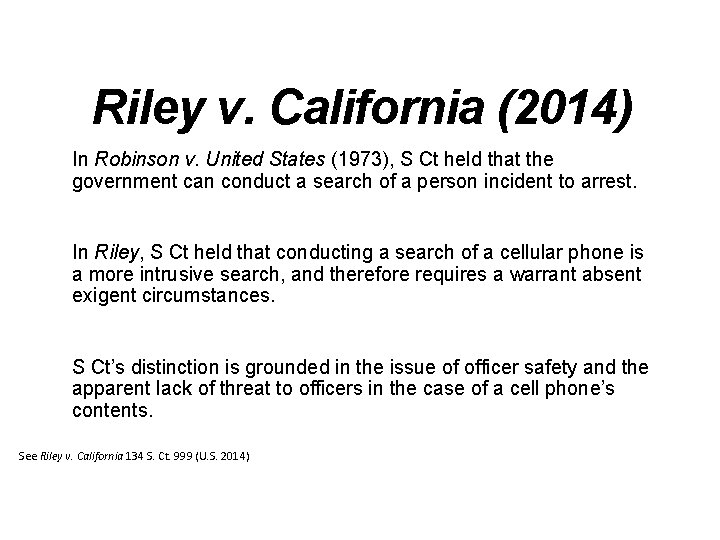
Riley v. California (2014) In Robinson v. United States (1973), S Ct held that the government can conduct a search of a person incident to arrest. In Riley, S Ct held that conducting a search of a cellular phone is a more intrusive search, and therefore requires a warrant absent exigent circumstances. S Ct’s distinction is grounded in the issue of officer safety and the apparent lack of threat to officers in the case of a cell phone’s contents. See Riley v. California 134 S. Ct. 999 (U. S. 2014)
Potential Consequences of Unlawful Arrest or Confiscation Legal Liability Costs (Financial) Public Trust


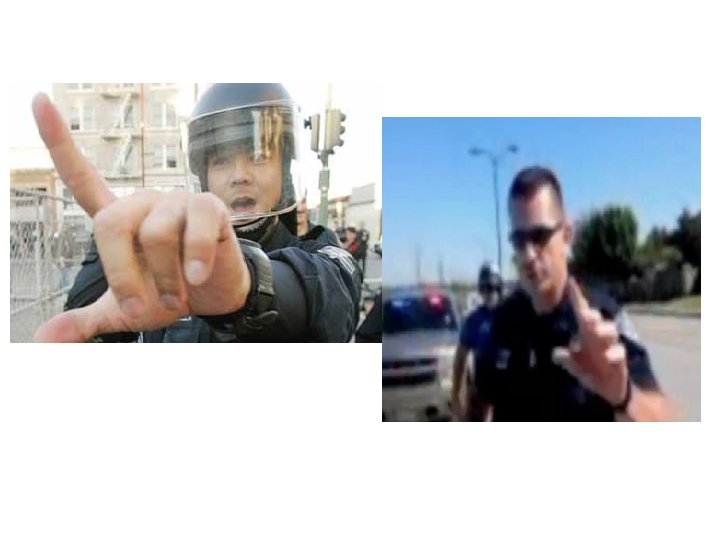
Are Officer Responses to Cameras Negatively Impacting the Public Perception of Otherwise Appropriate Police Actions?
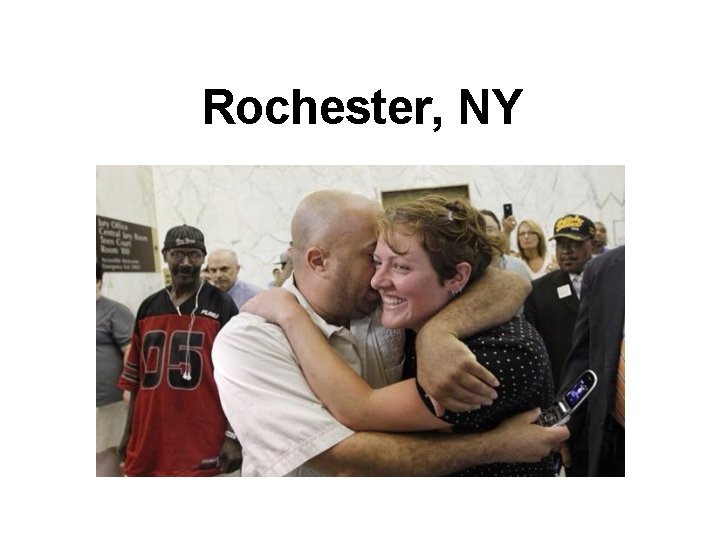
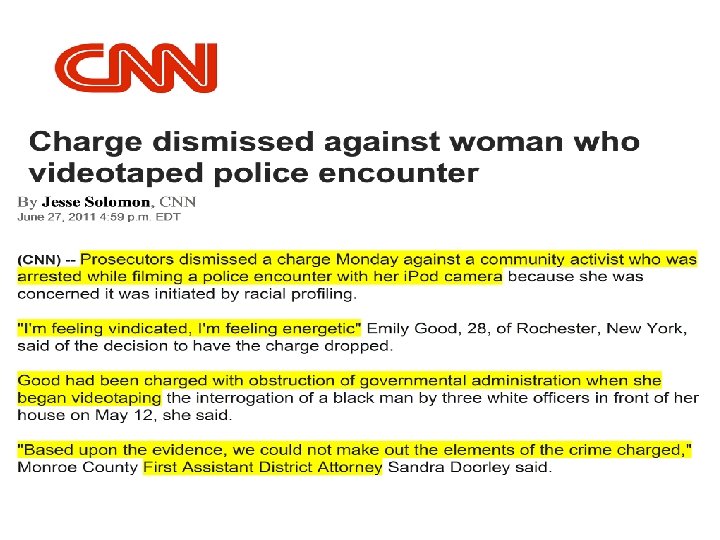
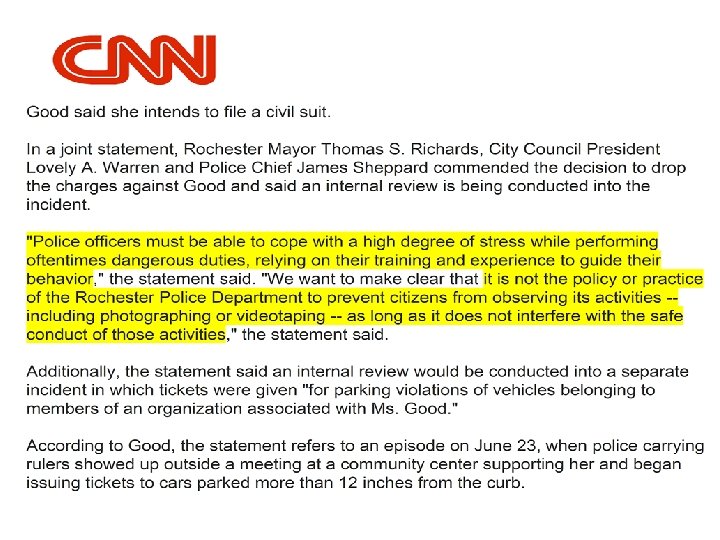
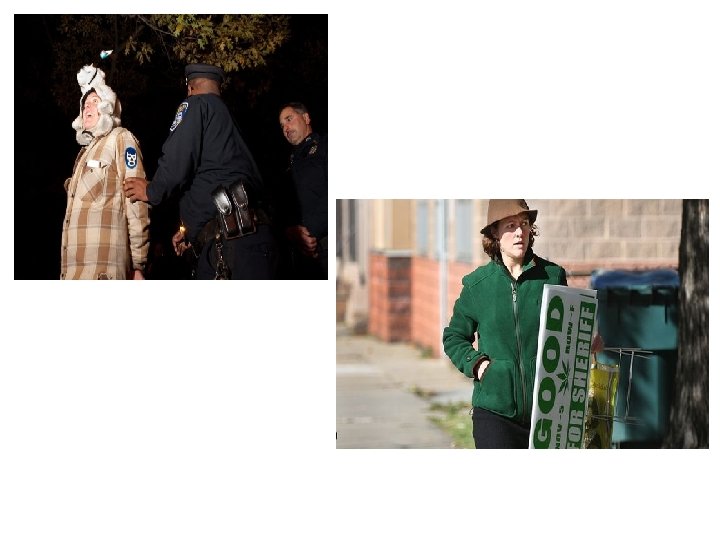
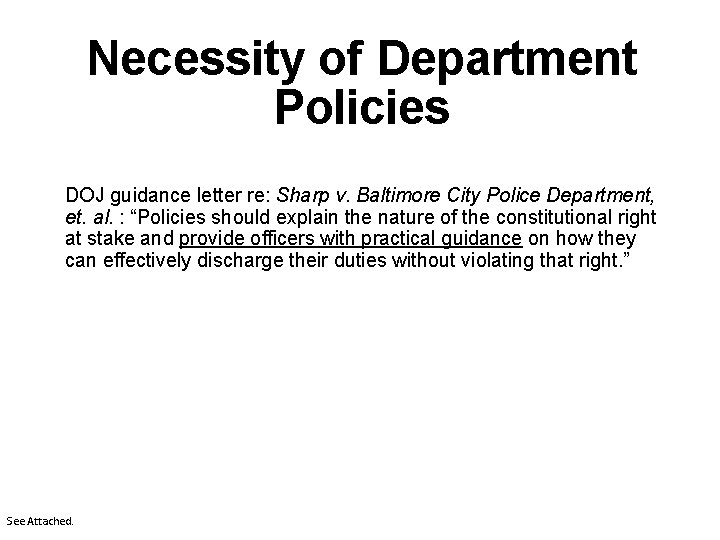
Rochester, NY
Necessity of Department Policies DOJ guidance letter re: Sharp v. Baltimore City Police Department, et. al. : “Policies should explain the nature of the constitutional right at stake and provide officers with practical guidance on how they can effectively discharge their duties without violating that right. ” See Attached.
Model Policy in LLRMI Recording of Law Enforcement Activity © 2013 III. (C) Definition of “Enforcement Action” IV. (A-E) Simple, Concise and Absolute Acknowledgement of 1 st Amendment Right to Record IV. I. (a) Legitimate Obstructing/Hindering/Interference Charges Where Exigent Circumstances are Present IV. L. (g) Exigent Circumstances for Purposes of Seizing or Inspecting Devices or Recordings IV. (N) Limitations on Seizing or Inspecting Devices or Recordings See Attached.
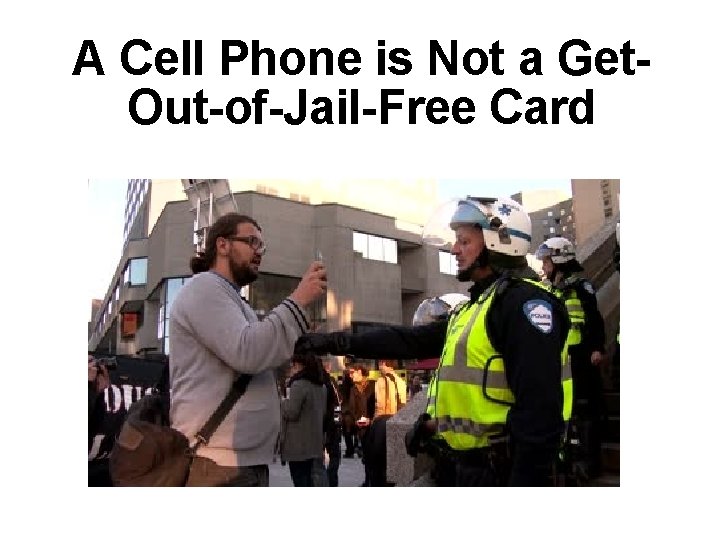
A Cell Phone is Not a Get. Out-of-Jail-Free Card
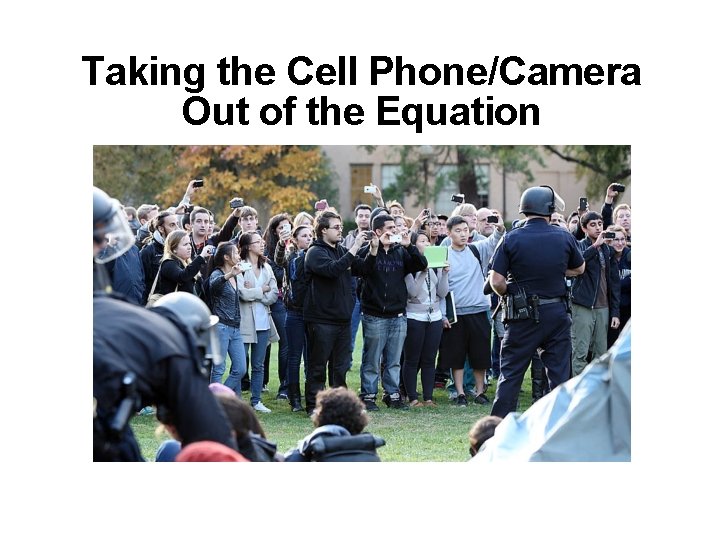
Taking the Cell Phone/Camera Out of the Equation
A Training Challenge? How many agencies are conducting training on what officers can and cannot do when facing individuals recording them on duty? How many agencies are walking officers through various realworld scenarios? Should we surprised that officers “look bad” on camera or fail to comply with complex agency policies when they are not being trained? ? ?
Thank You! Matt Dolan Attorney Public Agency Training Council 800 -365 -0119 mdolan@patc. com
Disclaimer Court holdings can vary significantly between jurisdictions. As such, it is advisable to seek the advice of a local prosecutor or legal advisor regarding questions on specific cases. This presentation is not intended to constitute legal advice on a specific case.
- Slides: 32