
CitationsWriting By Rachel Feliciano MLA InText Citations The

Citations/Writing By Rachel Feliciano
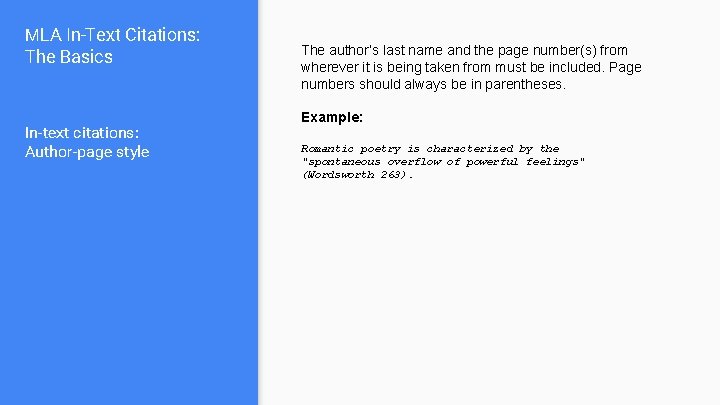
MLA In-Text Citations: The Basics In-text citations: Author-page style The author’s last name and the page number(s) from wherever it is being taken from must be included. Page numbers should always be in parentheses. Example: Romantic poetry is characterized by the "spontaneous overflow of powerful feelings" (Wordsworth 263).
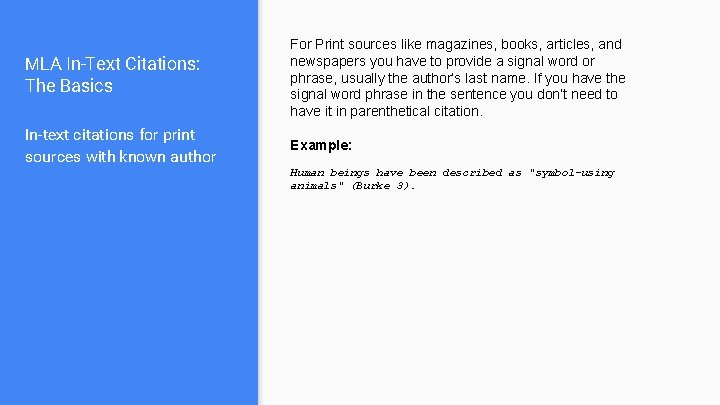
MLA In-Text Citations: The Basics In-text citations for print sources with known author For Print sources like magazines, books, articles, and newspapers you have to provide a signal word or phrase, usually the author’s last name. If you have the signal word phrase in the sentence you don’t need to have it in parenthetical citation. Example: Human beings have been described as "symbol-using animals" (Burke 3).
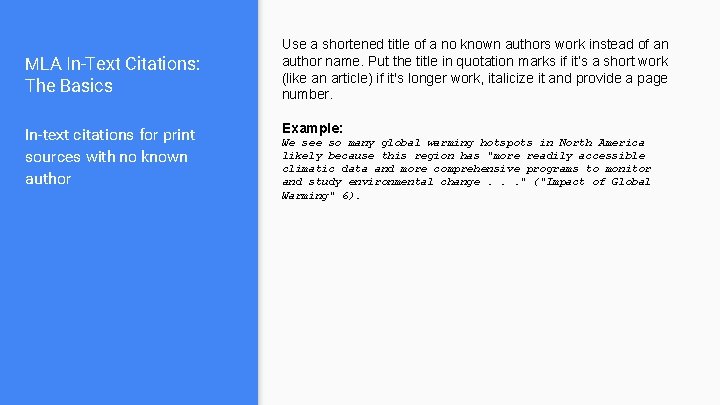
MLA In-Text Citations: The Basics In-text citations for print sources with no known author Use a shortened title of a no known authors work instead of an author name. Put the title in quotation marks if it’s a short work (like an article) if it's longer work, italicize it and provide a page number. Example: We see so many global warming hotspots in North America likely because this region has "more readily accessible climatic data and more comprehensive programs to monitor and study environmental change. . . " ("Impact of Global Warming" 6).
MLA In-Text Citations: The Basics Author-page citation for classic and literary works with multiple editions Page numbers are mandatory but additional citation information can help people who may have different edition of a classic work. Example: Marx and Engels described human history as marked by class struggles (79; ch. 1).
MLA In-Text Citations: The Basics You have to list the authors' last names in the text or in the parenthetical citation Example: Citing a work by multiple authors Smith, Yang, and Moore argue that tougher gun control is not needed in the United States (76).

The End
- Slides: 8