
CISM Critical Incident Stress Management Presentation by David
CISM Critical Incident Stress Management Presentation by David Maher MSc, MIIRSM, Grad IOSH.
What is Critical Incident Stress Management (CISM) ? � Critical Incident Stress Management, or CISM, is an intervention protocol developed specifically for dealing with traumatic events or critical incidents. � It is a formal, highly structured and professionally recognised process for helping those involved in a critical incident to share their experiences, vent emotions, learn about stress reactions and symptoms and given referral for further help if required. � It is not psychotherapy. It is a confidential, voluntary and educative process, sometimes called 'psychological first aid'.
Who uses CISM in Ireland? � � � � National Ambulance Service Irish Coast Guard State Claims Agency Defence Forces Civil Defence Irish Prison Service Search and Rescue Dogs Association of Ireland Order of Malta Pre-Hospital Emergency Care Council VHI Healthcare Dublin Fire Brigade HSE Office of Emergency Management Irish Red Cross Irish Aviation Authority
CISM � CISM was adopted by the United Nations for supporting field personnel. (UN, 2007)
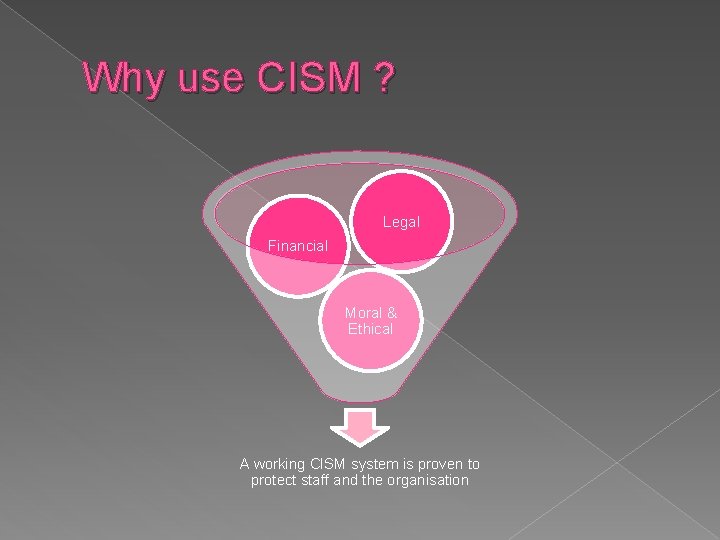
Why use CISM ? Legal Financial Moral & Ethical A working CISM system is proven to protect staff and the organisation
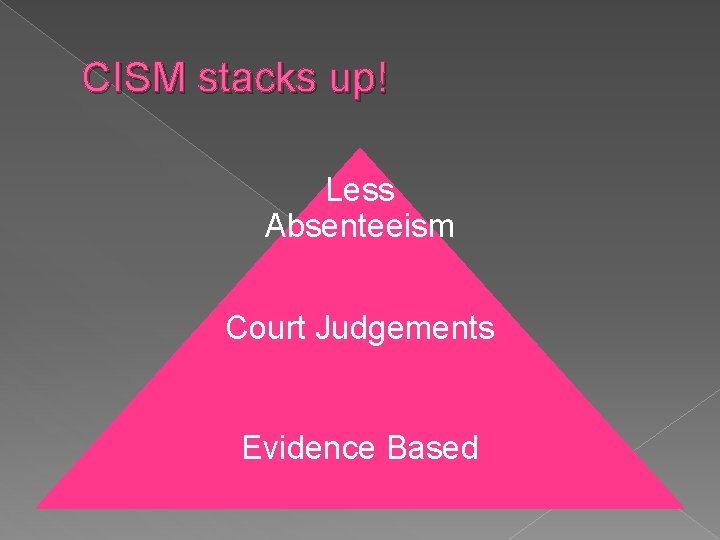
CISM stacks up! Less Absenteeism Court Judgements Evidence Based
All grades need to buy into CISM for it to work successfully � High psychological stress and low social support are consistently associated with more symptoms of mental health problems. (Sterud, 2006)
Critical Incident Stress* is Normal After Trauma � It becomes dangerous to health when it is not resolved � *AKA Post Traumatic Stress (Mitchell, 2015)
Post Traumatic Stress Disorder � If Critical Incident Stress is not managed properly and if it remains unresolved, it may turn into one or more psychological conditions that can interfere with normal life functions. � One of the worst conditions is Posttraumatic Stress Disorder (PTSD) (Mitchell, 2015)
Crisis Intervention Who should do crisis Intervention? BOTH mental health clinicians and peer support personnel may preform crisis interventions and CISM services……. but specialized training is essential for both groups. (Everly, 2015)
Legal � ‘As a litigation risk, PTSD – type claims resulting from critical incidents is controllable. Pre and post event interventions such as those provided through Critical Incident Stress Management (CISM) programmes can be used to prevent and successfully defend PTSD –type personal injury claims’ (State Claims Agency, 2012)
Successful litigious claim…how much? � Pat Kirwan Deputy Director & Head of Risk Management and Operations at National Treasury Management Agency/State Claims Agency stated in 2012 that one successful claim could cost the state between € 500, 000 to € 600, 000
What needs to be done? � � � � � Develop an operational CISM Policy. (Policy must be supported and signed by the organisations leadership) Identify, assess activities of your volunteers. Put in controls to decrease traumatic/critical incidents occurring. Identify persons for training. Trained persons offer CISM pre and post event interventions Individual Peer Support Group support Generic support information provided Path way for support identified (Mental health professionals) Clinical Psychologist trained in CISM (Clinical Director)
International Critical Incident Stress Foundation (ICISF) Approved Courses for Peer Support Workers � Assisting Individuals in crisis (2 days) � Group Crisis Intervention (2 days)
A warning to us all. . . � Oster & Doyle, (2007) argue that Critical Incidents are more incapacitating than physical trauma because it can still be present long after the physical healing is completed.
References � � � Everly, G. 2015. Who should do crisis intervention? . In: Everly, G. Assisting Individuals in Crisis. 5 th ed. Ellicott City USA: International Critical Incedent Stress Foundations. p 16. Kirwan, P. 2012 “PTSD Litigation Risk: The Need for Policies, Procedures and Systems” State Claims Agency, Power. Point Presentation, viewed 01 October 2015. Mitchell, J. 2015 Group Crisis Intervention, 5 th Edition Slides, ICISF, Power. Point Presentation, viewed 01 October 2015. Oster, N. & Doyle, C. (2007). Critical incident stress. In D. Hogan & J. Burnstein (Eds. ), Disaster Medicine. Baltimore, MD, Lippicott, Williams & Wilkins, pp 64– 71. United Nations Department of Safety and Security CISMU Staff. 2007. New Crisis and stress management training programme launched. I seek 2007, My 2. New York, NY: Uninted Nations Secretariat. Tom Sterud*, Øivind Ekeberg and Erlend Hem. (2006). Health status in the ambulance services: a systematic review. BMC Health Services Research. 82 (6), p 7.
- Slides: 16