
Cisco Certified Technician CCT Supporting Cisco Routing Switching

- Slides: 39
Cisco Certified Technician: CCT Supporting Cisco Routing & Switching Network Devices CCT Exam Topic 1: General Networking Section 1. 1 Use the OSI and TCP/IP models and their associated protocols to explain how data flows in a network (This topic is covered in Intro to Networks v 7 – 3. 5, 4. 2. 1, 6. 1. 1, 8. 1. 1, 14. 1. 1)
Cisco Certified Technician: CCT Supporting Cisco Routing & Switching Network Devices CCT Exam Topic 1: General Networking Section 1. 2 Describe the basic functionality and key differences of this hardware: LAN switch, router, and wireless access points (This topic is covered in Intro to Networks v 7 – 1. 2. 3, 1. 2. 4, 1. 3. 2, 1. 4. 2)
Cisco Certified Technician: CCT Supporting Cisco Routing & Switching Network Devices CCT Exam Topic 1: General Networking Section 1. 3 Differentiate between these Layer 2 technologies: Ethernet, Fast Ethernet, Gigabit Ethernet, Serial, and Optical
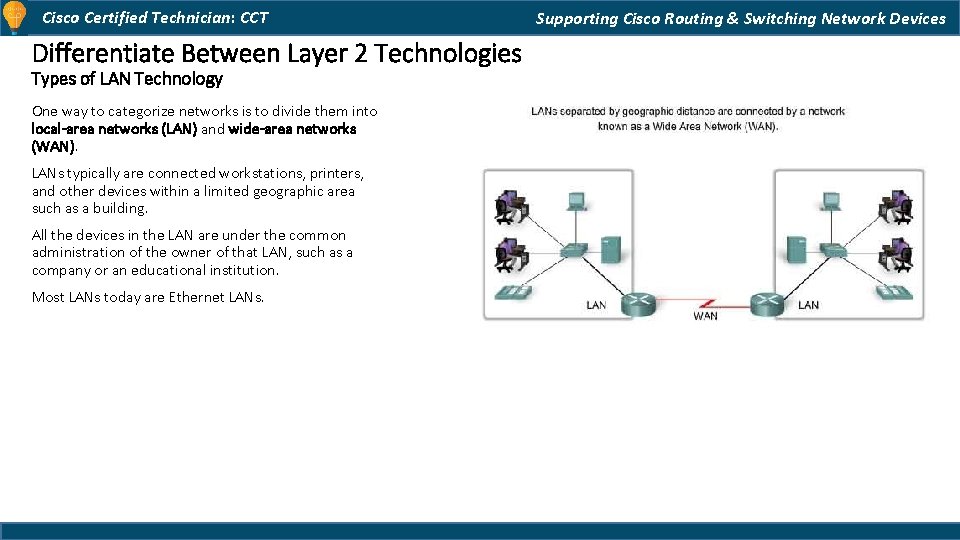
Cisco Certified Technician: CCT Differentiate Between Layer 2 Technologies Types of LAN Technology One way to categorize networks is to divide them into local-area networks (LAN) and wide-area networks (WAN). LANs typically are connected workstations, printers, and other devices within a limited geographic area such as a building. All the devices in the LAN are under the common administration of the owner of that LAN, such as a company or an educational institution. Most LANs today are Ethernet LANs. Supporting Cisco Routing & Switching Network Devices
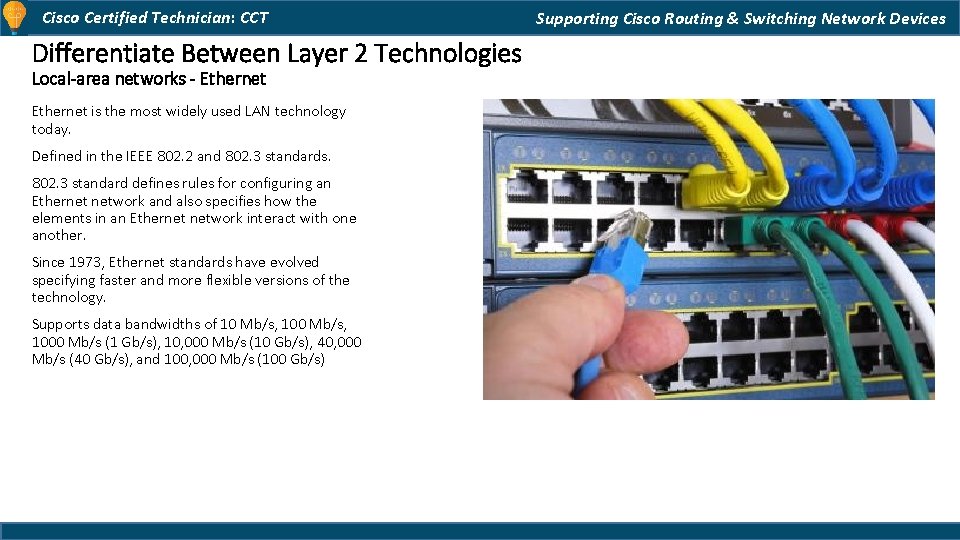
Cisco Certified Technician: CCT Differentiate Between Layer 2 Technologies Local-area networks - Ethernet is the most widely used LAN technology today. Defined in the IEEE 802. 2 and 802. 3 standards. 802. 3 standard defines rules for configuring an Ethernet network and also specifies how the elements in an Ethernet network interact with one another. Since 1973, Ethernet standards have evolved specifying faster and more flexible versions of the technology. Supports data bandwidths of 10 Mb/s, 1000 Mb/s (1 Gb/s), 10, 000 Mb/s (10 Gb/s), 40, 000 Mb/s (40 Gb/s), and 100, 000 Mb/s (100 Gb/s) Supporting Cisco Routing & Switching Network Devices
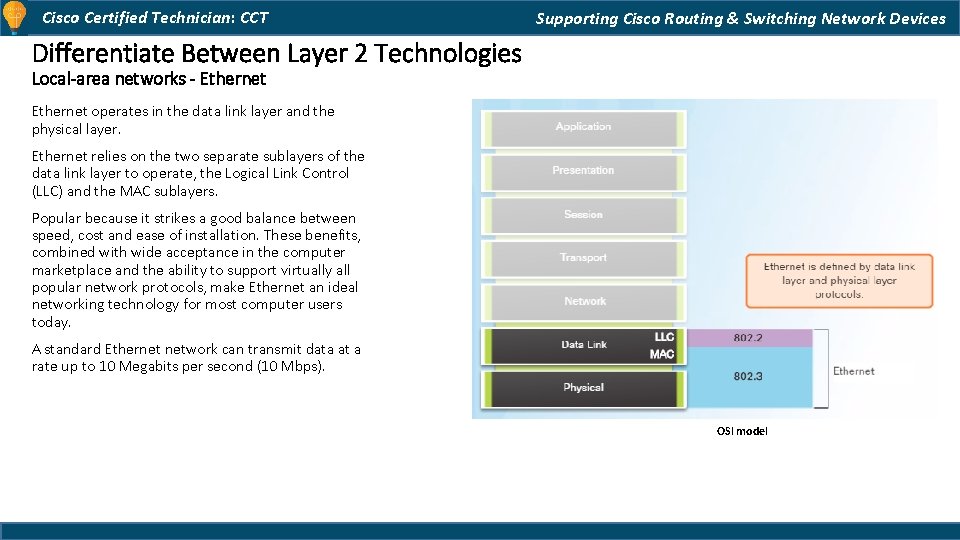
Cisco Certified Technician: CCT Supporting Cisco Routing & Switching Network Devices Differentiate Between Layer 2 Technologies Local-area networks - Ethernet operates in the data link layer and the physical layer. Ethernet relies on the two separate sublayers of the data link layer to operate, the Logical Link Control (LLC) and the MAC sublayers. Popular because it strikes a good balance between speed, cost and ease of installation. These benefits, combined with wide acceptance in the computer marketplace and the ability to support virtually all popular network protocols, make Ethernet an ideal networking technology for most computer users today. A standard Ethernet network can transmit data at a rate up to 10 Megabits per second (10 Mbps). OSI model
Cisco Certified Technician: CCT Differentiate Between Layer 2 Technologies Local-area networks - Fast Ethernet standard (IEEE 802. 3 u) was established in 1995 for Ethernet networks that need higher transmission speeds. This standard raises the Ethernet speed limit from 10 Mbps to 100 Mbps with only minimal changes to the existing cable structure. Fast Ethernet provides faster throughput for video, multimedia, graphics, Internet surfing and stronger error detection and correction. Supporting Cisco Routing & Switching Network Devices
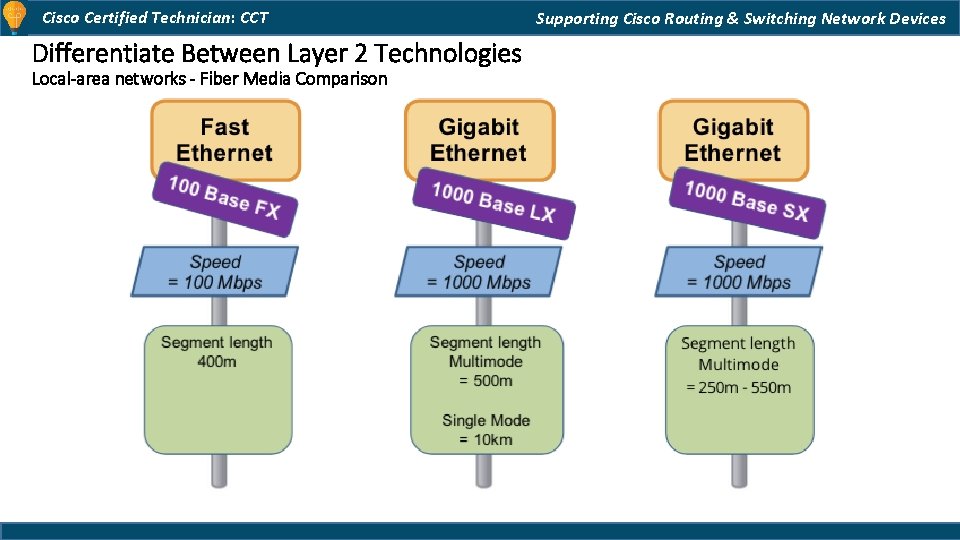
Cisco Certified Technician: CCT Differentiate Between Layer 2 Technologies Local-area networks - Fast Ethernet Initially designed for copper-based twisted pair cable networks and included the 100 Base-TX, 100 Base-T 4 and 100 Base-T 2 standards. Uses CAT 5 and higher-rated twisted pair copper cable to connect various hubs, switches and end-nodes. Length of the cable in copper-based fast Ethernet is restricted to 100 meters. Fiber-based fast Ethernet standards 100 Base-FX, 100 Base SX, 100 Base BX and 100 Base LX 10 use one or more strands and modes of fiber optics to transmit data. 100 Base-FX which is used primarily to connect hubs and switches together either between wiring closets or between buildings. 100 Base-FX uses multimode fiber-optic cable to transport Fast Ethernet traffic. Supporting Cisco Routing & Switching Network Devices
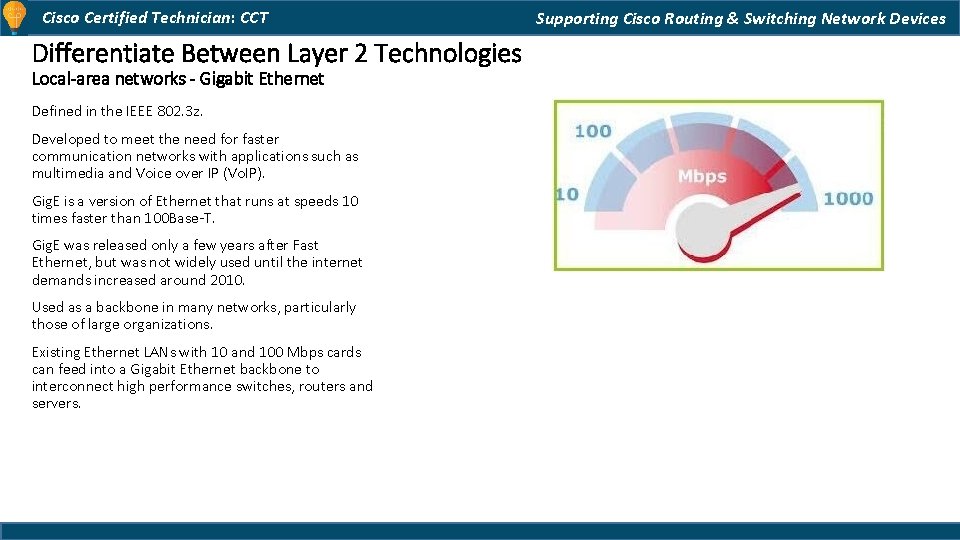
Cisco Certified Technician: CCT Differentiate Between Layer 2 Technologies Local-area networks - Gigabit Ethernet Defined in the IEEE 802. 3 z. Developed to meet the need for faster communication networks with applications such as multimedia and Voice over IP (Vo. IP). Gig. E is a version of Ethernet that runs at speeds 10 times faster than 100 Base-T. Gig. E was released only a few years after Fast Ethernet, but was not widely used until the internet demands increased around 2010. Used as a backbone in many networks, particularly those of large organizations. Existing Ethernet LANs with 10 and 100 Mbps cards can feed into a Gigabit Ethernet backbone to interconnect high performance switches, routers and servers. Supporting Cisco Routing & Switching Network Devices
Cisco Certified Technician: CCT Differentiate Between Layer 2 Technologies Local-area networks - Fiber Media Comparison Supporting Cisco Routing & Switching Network Devices
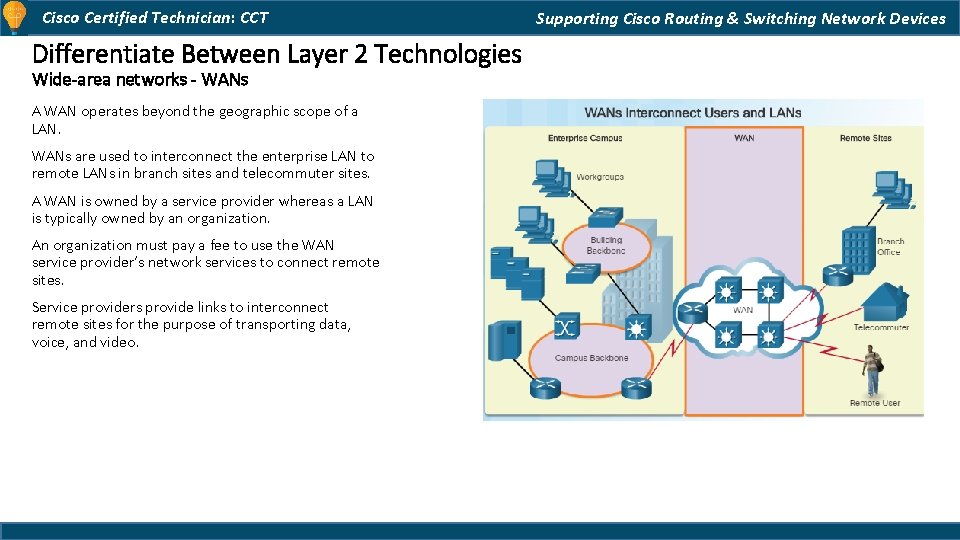
Cisco Certified Technician: CCT Differentiate Between Layer 2 Technologies Wide-area networks - WANs A WAN operates beyond the geographic scope of a LAN. WANs are used to interconnect the enterprise LAN to remote LANs in branch sites and telecommuter sites. A WAN is owned by a service provider whereas a LAN is typically owned by an organization. An organization must pay a fee to use the WAN service provider’s network services to connect remote sites. Service providers provide links to interconnect remote sites for the purpose of transporting data, voice, and video. Supporting Cisco Routing & Switching Network Devices
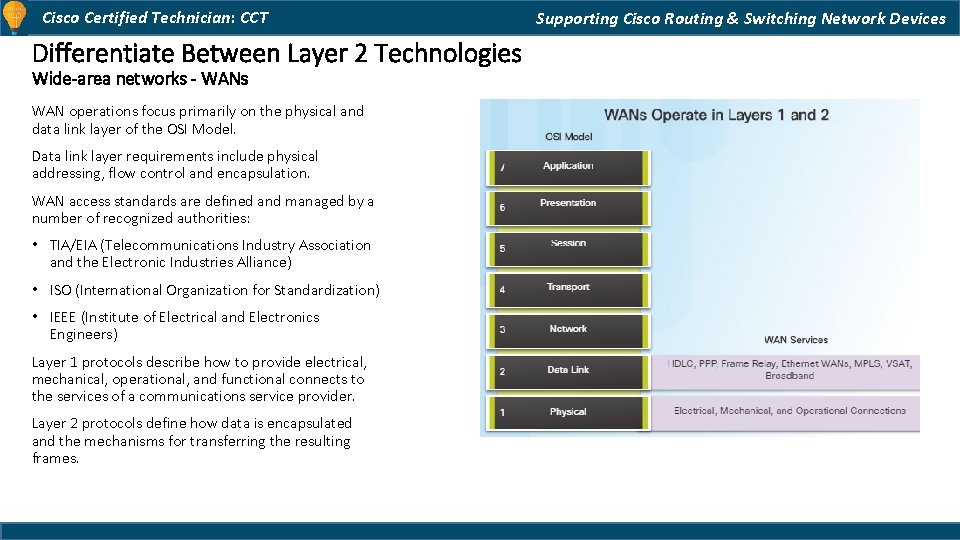
Cisco Certified Technician: CCT Differentiate Between Layer 2 Technologies Wide-area networks - WANs WAN operations focus primarily on the physical and data link layer of the OSI Model. Data link layer requirements include physical addressing, flow control and encapsulation. WAN access standards are defined and managed by a number of recognized authorities: • TIA/EIA (Telecommunications Industry Association and the Electronic Industries Alliance) • ISO (International Organization for Standardization) • IEEE (Institute of Electrical and Electronics Engineers) Layer 1 protocols describe how to provide electrical, mechanical, operational, and functional connects to the services of a communications service provider. Layer 2 protocols define how data is encapsulated and the mechanisms for transferring the resulting frames. Supporting Cisco Routing & Switching Network Devices
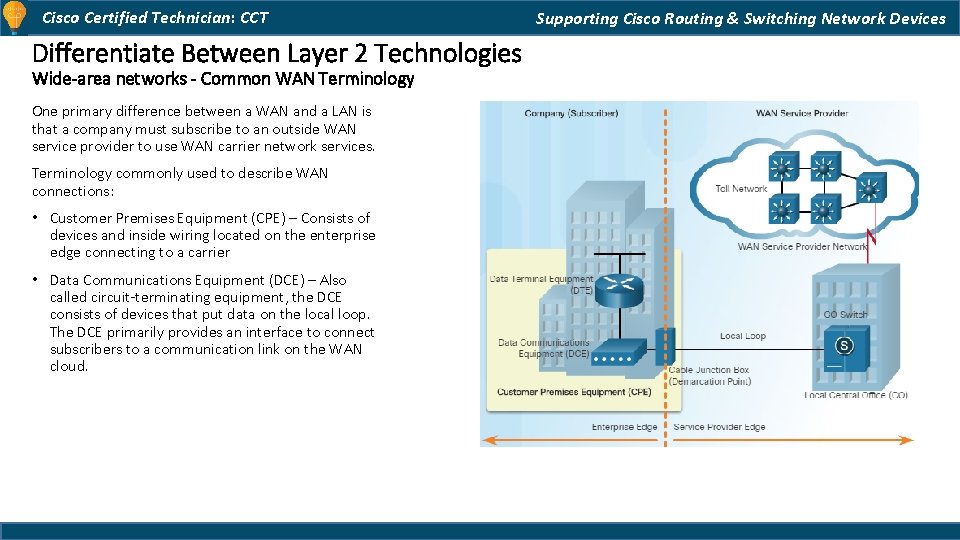
Cisco Certified Technician: CCT Differentiate Between Layer 2 Technologies Wide-area networks - Common WAN Terminology One primary difference between a WAN and a LAN is that a company must subscribe to an outside WAN service provider to use WAN carrier network services. Terminology commonly used to describe WAN connections: • Customer Premises Equipment (CPE) – Consists of devices and inside wiring located on the enterprise edge connecting to a carrier • Data Communications Equipment (DCE) – Also called circuit-terminating equipment, the DCE consists of devices that put data on the local loop. The DCE primarily provides an interface to connect subscribers to a communication link on the WAN cloud. Supporting Cisco Routing & Switching Network Devices
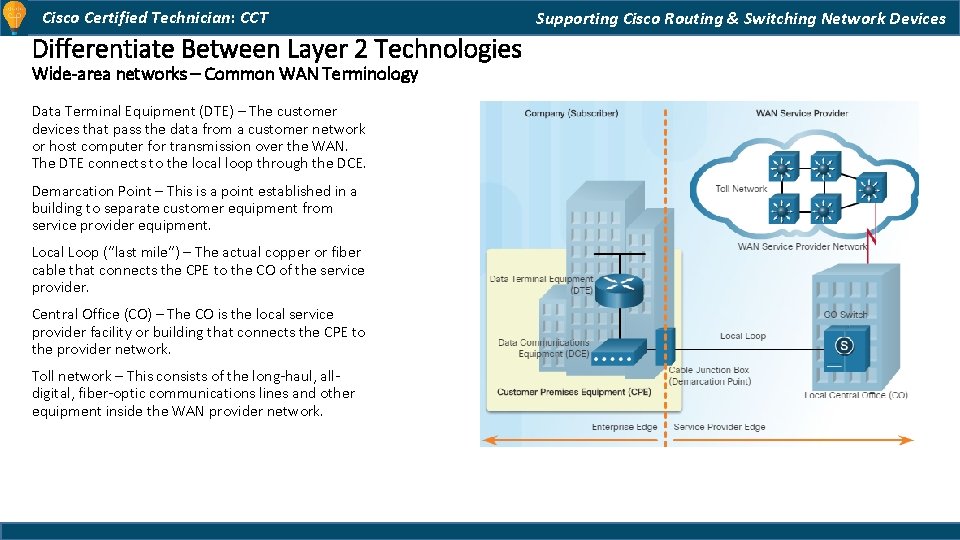
Cisco Certified Technician: CCT Differentiate Between Layer 2 Technologies Wide-area networks – Common WAN Terminology Data Terminal Equipment (DTE) – The customer devices that pass the data from a customer network or host computer for transmission over the WAN. The DTE connects to the local loop through the DCE. Demarcation Point – This is a point established in a building to separate customer equipment from service provider equipment. Local Loop (“last mile”) – The actual copper or fiber cable that connects the CPE to the CO of the service provider. Central Office (CO) – The CO is the local service provider facility or building that connects the CPE to the provider network. Toll network – This consists of the long-haul, alldigital, fiber-optic communications lines and other equipment inside the WAN provider network. Supporting Cisco Routing & Switching Network Devices
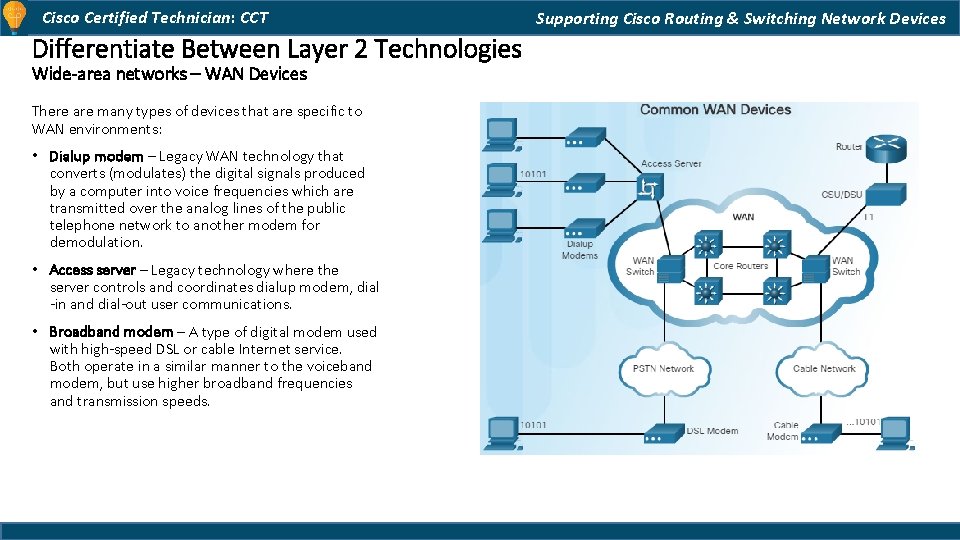
Cisco Certified Technician: CCT Differentiate Between Layer 2 Technologies Wide-area networks – WAN Devices There are many types of devices that are specific to WAN environments: • Dialup modem – Legacy WAN technology that converts (modulates) the digital signals produced by a computer into voice frequencies which are transmitted over the analog lines of the public telephone network to another modem for demodulation. • Access server – Legacy technology where the server controls and coordinates dialup modem, dial -in and dial-out user communications. • Broadband modem – A type of digital modem used with high-speed DSL or cable Internet service. Both operate in a similar manner to the voiceband modem, but use higher broadband frequencies and transmission speeds. Supporting Cisco Routing & Switching Network Devices
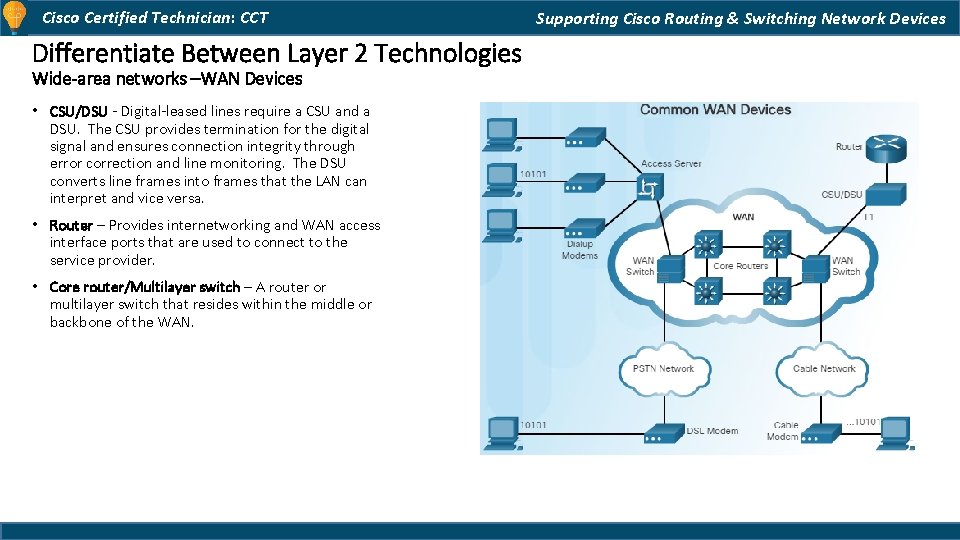
Cisco Certified Technician: CCT Differentiate Between Layer 2 Technologies Wide-area networks –WAN Devices • CSU/DSU - Digital-leased lines require a CSU and a DSU. The CSU provides termination for the digital signal and ensures connection integrity through error correction and line monitoring. The DSU converts line frames into frames that the LAN can interpret and vice versa. • Router – Provides internetworking and WAN access interface ports that are used to connect to the service provider. • Core router/Multilayer switch – A router or multilayer switch that resides within the middle or backbone of the WAN. Supporting Cisco Routing & Switching Network Devices
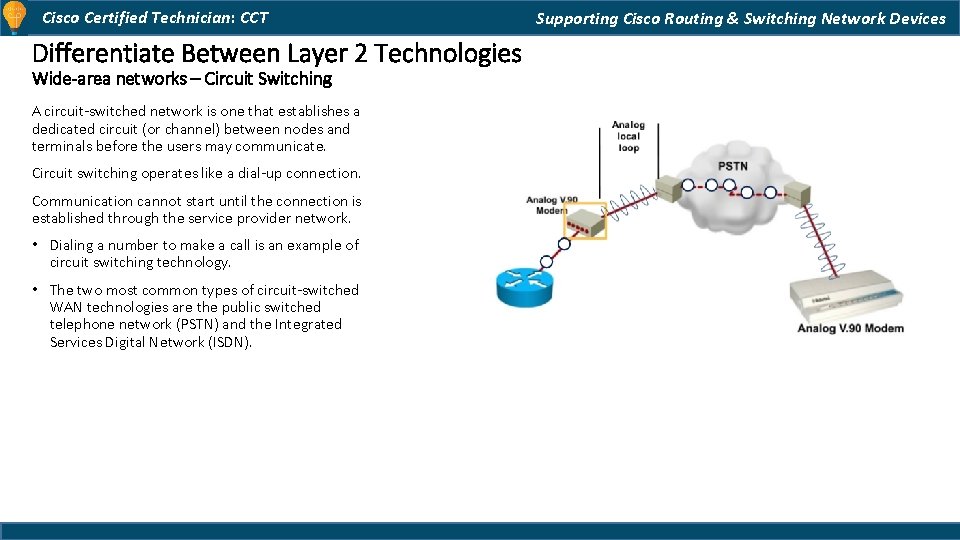
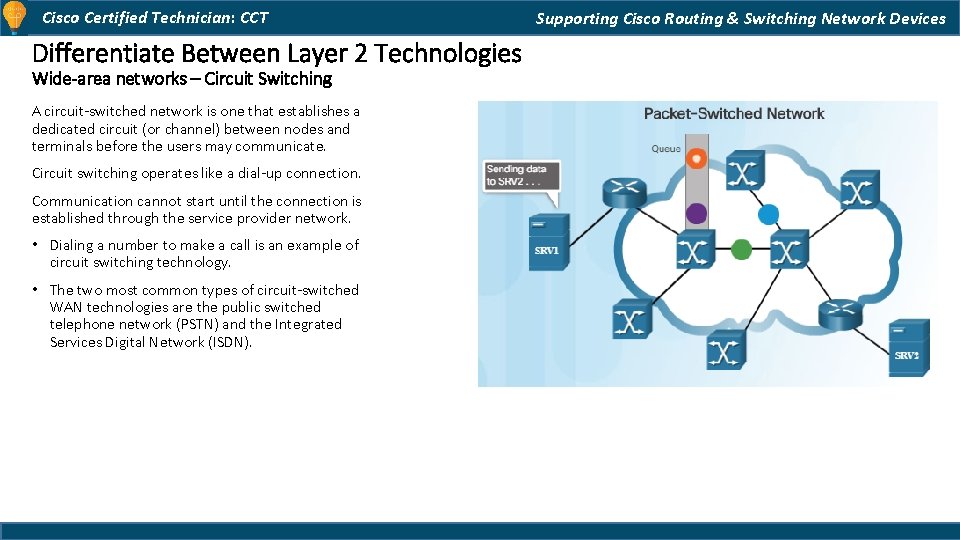
Cisco Certified Technician: CCT Differentiate Between Layer 2 Technologies Wide-area networks – Circuit Switching A circuit-switched network is one that establishes a dedicated circuit (or channel) between nodes and terminals before the users may communicate. Circuit switching operates like a dial-up connection. Communication cannot start until the connection is established through the service provider network. • Dialing a number to make a call is an example of circuit switching technology. • The two most common types of circuit-switched WAN technologies are the public switched telephone network (PSTN) and the Integrated Services Digital Network (ISDN). Supporting Cisco Routing & Switching Network Devices
Cisco Certified Technician: CCT Differentiate Between Layer 2 Technologies Wide-area networks – Circuit Switching A circuit-switched network is one that establishes a dedicated circuit (or channel) between nodes and terminals before the users may communicate. Circuit switching operates like a dial-up connection. Communication cannot start until the connection is established through the service provider network. • Dialing a number to make a call is an example of circuit switching technology. • The two most common types of circuit-switched WAN technologies are the public switched telephone network (PSTN) and the Integrated Services Digital Network (ISDN). Supporting Cisco Routing & Switching Network Devices
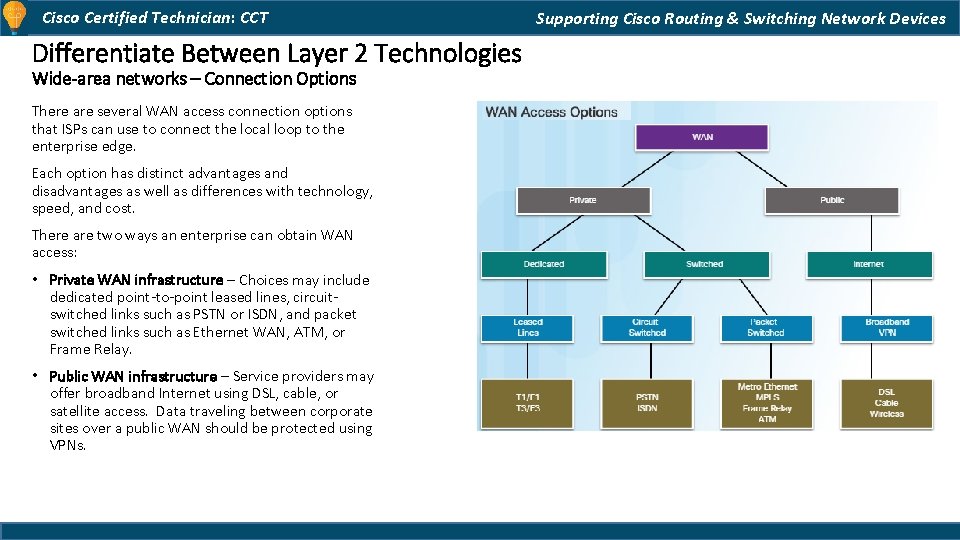
Cisco Certified Technician: CCT Differentiate Between Layer 2 Technologies Wide-area networks – Connection Options There are several WAN access connection options that ISPs can use to connect the local loop to the enterprise edge. Each option has distinct advantages and disadvantages as well as differences with technology, speed, and cost. There are two ways an enterprise can obtain WAN access: • Private WAN infrastructure – Choices may include dedicated point-to-point leased lines, circuitswitched links such as PSTN or ISDN, and packet switched links such as Ethernet WAN, ATM, or Frame Relay. • Public WAN infrastructure – Service providers may offer broadband Internet using DSL, cable, or satellite access. Data traveling between corporate sites over a public WAN should be protected using VPNs. Supporting Cisco Routing & Switching Network Devices
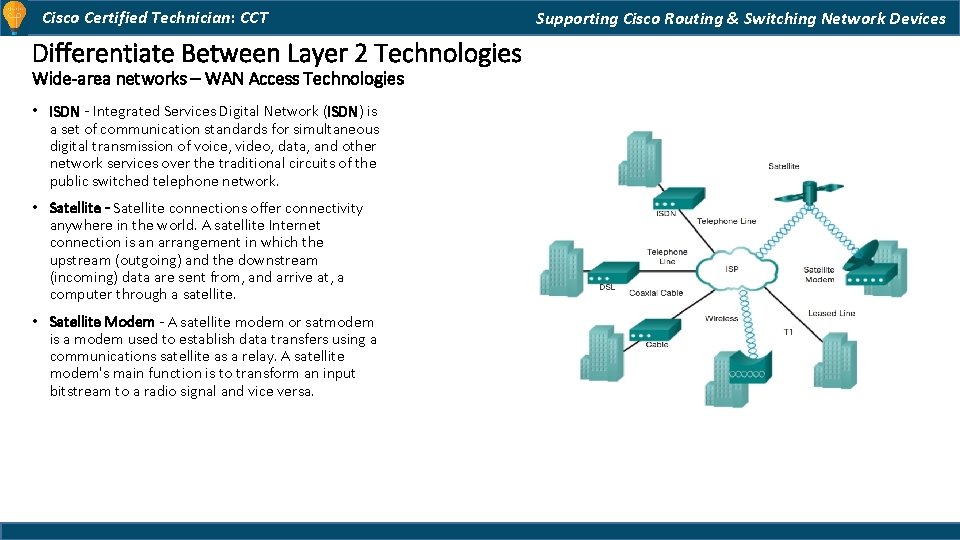
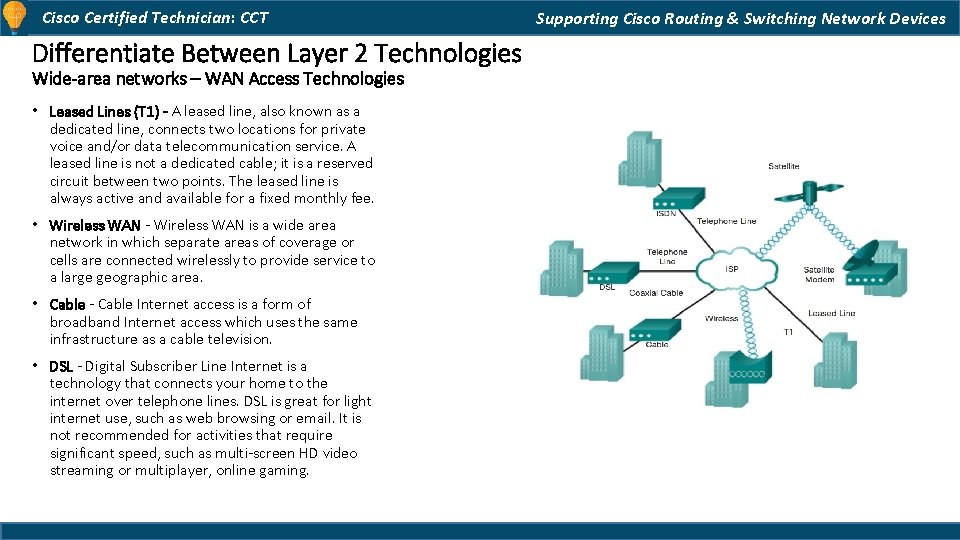
Cisco Certified Technician: CCT Differentiate Between Layer 2 Technologies Wide-area networks – WAN Access Technologies • ISDN - Integrated Services Digital Network (ISDN) is a set of communication standards for simultaneous digital transmission of voice, video, data, and other network services over the traditional circuits of the public switched telephone network. • Satellite - Satellite connections offer connectivity anywhere in the world. A satellite Internet connection is an arrangement in which the upstream (outgoing) and the downstream (incoming) data are sent from, and arrive at, a computer through a satellite. • Satellite Modem - A satellite modem or satmodem is a modem used to establish data transfers using a communications satellite as a relay. A satellite modem's main function is to transform an input bitstream to a radio signal and vice versa. Supporting Cisco Routing & Switching Network Devices
Cisco Certified Technician: CCT Differentiate Between Layer 2 Technologies Wide-area networks – WAN Access Technologies • Leased Lines (T 1) - A leased line, also known as a dedicated line, connects two locations for private voice and/or data telecommunication service. A leased line is not a dedicated cable; it is a reserved circuit between two points. The leased line is always active and available for a fixed monthly fee. • Wireless WAN - Wireless WAN is a wide area network in which separate areas of coverage or cells are connected wirelessly to provide service to a large geographic area. • Cable - Cable Internet access is a form of broadband Internet access which uses the same infrastructure as a cable television. • DSL - Digital Subscriber Line Internet is a technology that connects your home to the internet over telephone lines. DSL is great for light internet use, such as web browsing or email. It is not recommended for activities that require significant speed, such as multi-screen HD video streaming or multiplayer, online gaming. Supporting Cisco Routing & Switching Network Devices
Cisco Certified Technician: CCT Supporting Cisco Routing & Switching Network Devices Differentiate Between Layer 2 Technologies Wide-area networks – WAN Access Technologies • Most WAN protocols and technologies are layer 2 protocols (data link layer). The key WAN protocols that are in use are Asynchronous Transfer Mode (ATM), Broadband Access, Frame Relay, Point-to. Point Protocol (PPP), Synchronous Optical Network (SONET), Synchronous Digital Hierarchy (SDH), X. WAN Access and the OSI Model
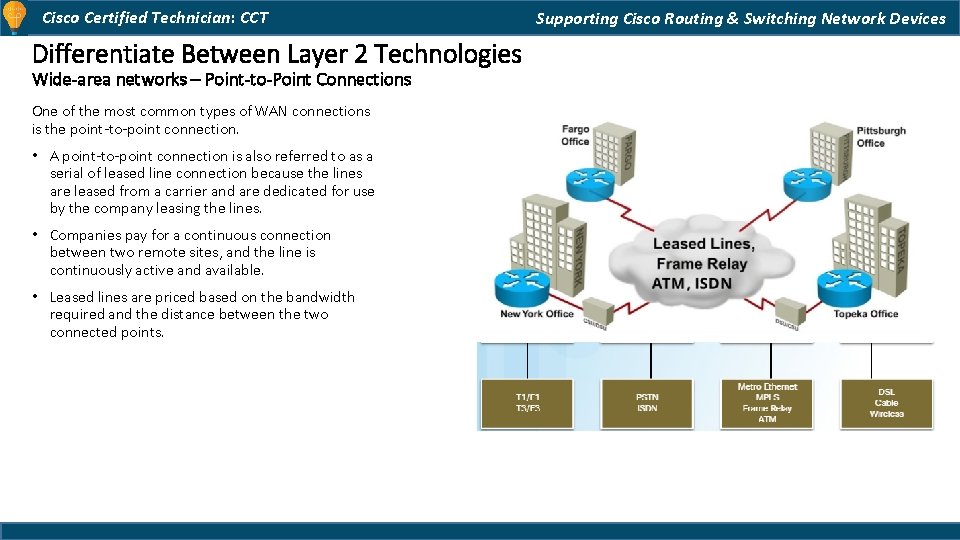
Cisco Certified Technician: CCT Differentiate Between Layer 2 Technologies Wide-area networks – Point-to-Point Connections One of the most common types of WAN connections is the point-to-point connection. • A point-to-point connection is also referred to as a serial of leased line connection because the lines are leased from a carrier and are dedicated for use by the company leasing the lines. • Companies pay for a continuous connection between two remote sites, and the line is continuously active and available. • Leased lines are priced based on the bandwidth required and the distance between the two connected points. Supporting Cisco Routing & Switching Network Devices
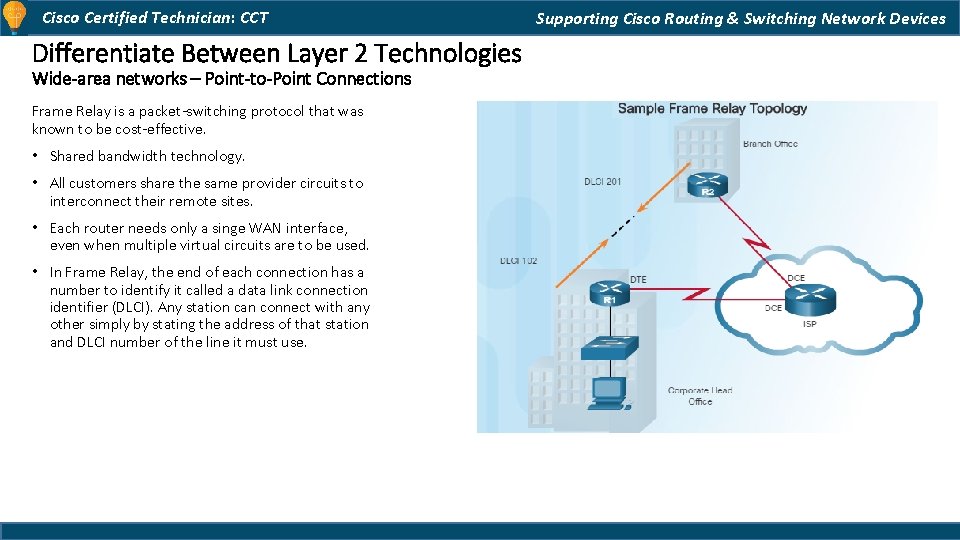
Cisco Certified Technician: CCT Differentiate Between Layer 2 Technologies Wide-area networks – Point-to-Point Connections Frame Relay is a packet-switching protocol that was known to be cost-effective. • Shared bandwidth technology. • All customers share the same provider circuits to interconnect their remote sites. • Each router needs only a singe WAN interface, even when multiple virtual circuits are to be used. • In Frame Relay, the end of each connection has a number to identify it called a data link connection identifier (DLCI). Any station can connect with any other simply by stating the address of that station and DLCI number of the line it must use. Supporting Cisco Routing & Switching Network Devices
Cisco Certified Technician: CCT Supporting Cisco Routing & Switching Network Devices CCT Exam Topic 1: General Networking Section 1. 4 Describe LAN Cabling (This topic is covered in Intro to Networks v 7 – 4. 4 and 4. 5
Cisco Certified Technician: CCT Supporting Cisco Routing & Switching Network Devices CCT Exam Topic 1: General Networking Section 1. 5 Describe the function of the CSU/DSU
Cisco Certified Technician: CCT Supporting Cisco Routing & Switching Network Devices Describe what a CSU/DSU does CSU/DSU Video: https: //www. professormesser. com/network-plus/n 10 -007/wan-termination/
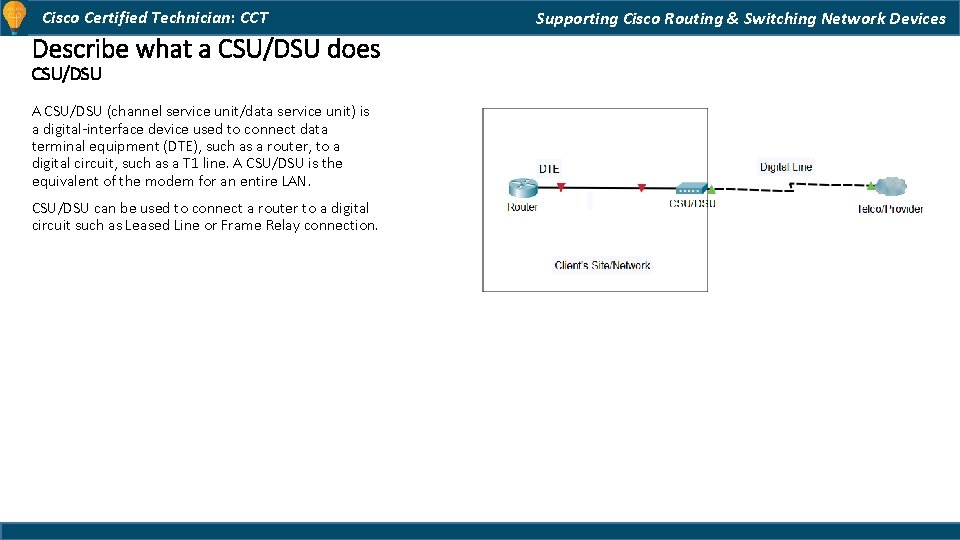
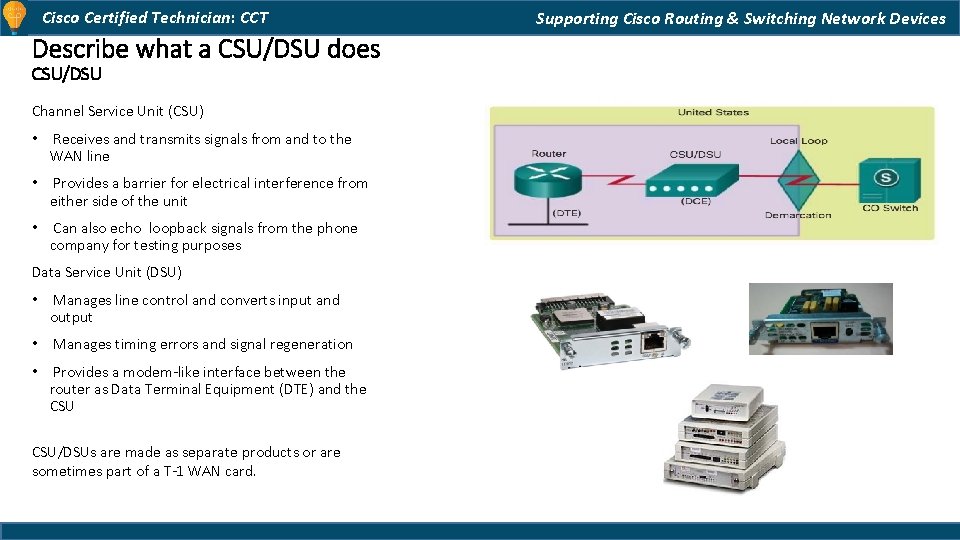
Cisco Certified Technician: CCT Describe what a CSU/DSU does CSU/DSU A CSU/DSU (channel service unit/data service unit) is a digital-interface device used to connect data terminal equipment (DTE), such as a router, to a digital circuit, such as a T 1 line. A CSU/DSU is the equivalent of the modem for an entire LAN. CSU/DSU can be used to connect a router to a digital circuit such as Leased Line or Frame Relay connection. Supporting Cisco Routing & Switching Network Devices
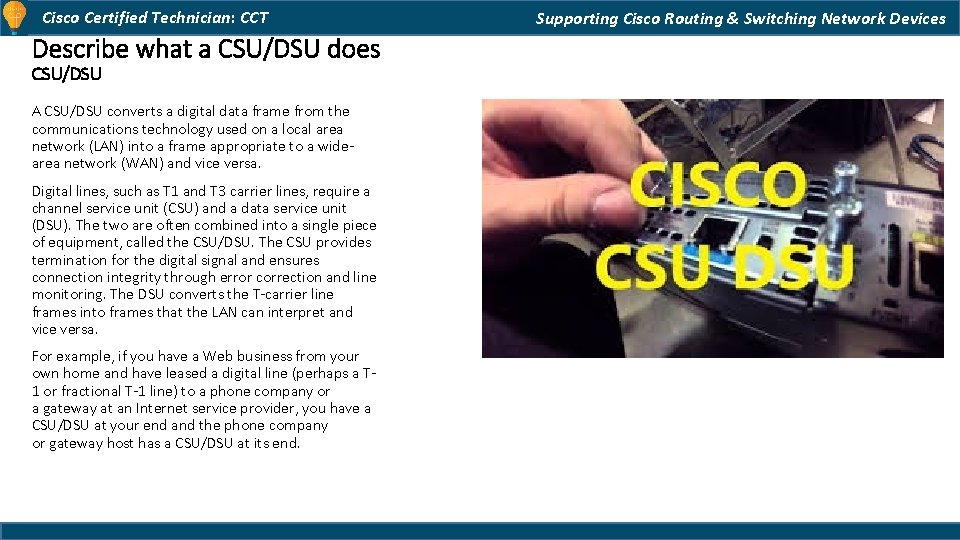
Cisco Certified Technician: CCT Describe what a CSU/DSU does CSU/DSU A CSU/DSU converts a digital data frame from the communications technology used on a local area network (LAN) into a frame appropriate to a widearea network (WAN) and vice versa. Digital lines, such as T 1 and T 3 carrier lines, require a channel service unit (CSU) and a data service unit (DSU). The two are often combined into a single piece of equipment, called the CSU/DSU. The CSU provides termination for the digital signal and ensures connection integrity through error correction and line monitoring. The DSU converts the T-carrier line frames into frames that the LAN can interpret and vice versa. For example, if you have a Web business from your own home and have leased a digital line (perhaps a T 1 or fractional T-1 line) to a phone company or a gateway at an Internet service provider, you have a CSU/DSU at your end and the phone company or gateway host has a CSU/DSU at its end. Supporting Cisco Routing & Switching Network Devices
Cisco Certified Technician: CCT Describe what a CSU/DSU does CSU/DSU Channel Service Unit (CSU) • Receives and transmits signals from and to the WAN line • Provides a barrier for electrical interference from either side of the unit • Can also echo loopback signals from the phone company for testing purposes Data Service Unit (DSU) • Manages line control and converts input and output • Manages timing errors and signal regeneration • Provides a modem-like interface between the router as Data Terminal Equipment (DTE) and the CSU/DSUs are made as separate products or are sometimes part of a T-1 WAN card. Supporting Cisco Routing & Switching Network Devices
Cisco Certified Technician: CCT Supporting Cisco Routing & Switching Network Devices CCT Exam Topic 1: General Networking Section 1. 6 Describe Telco termination point
Cisco Certified Technician: CCT Supporting Cisco Routing & Switching Network Devices Describe Telco Termination Point Demarcation Point Video: https: //www. professormesser. com/network-plus/n 10 -007/wan-termination/
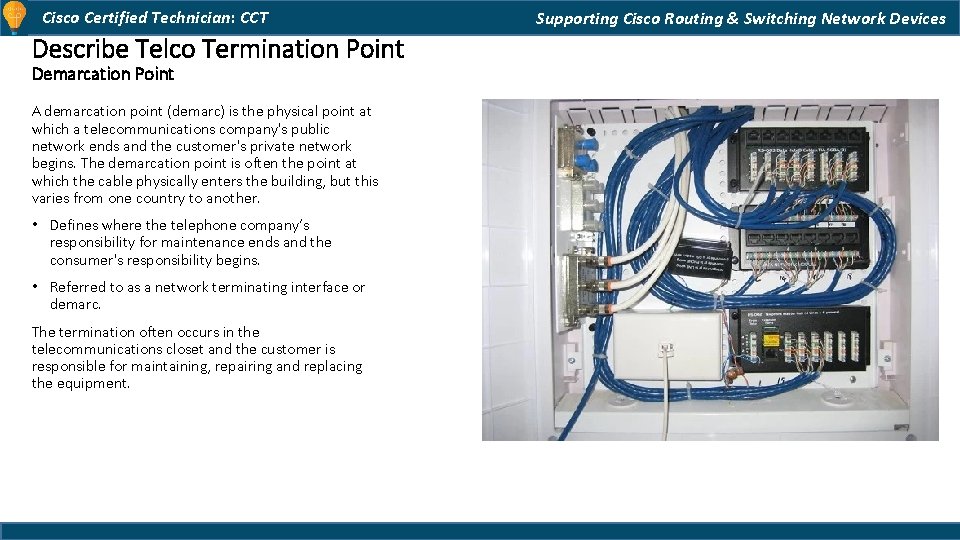
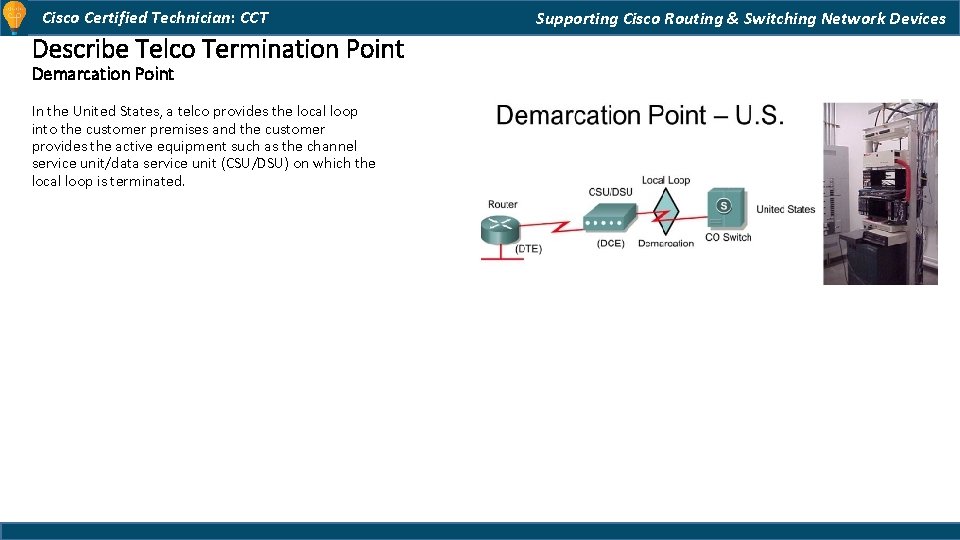
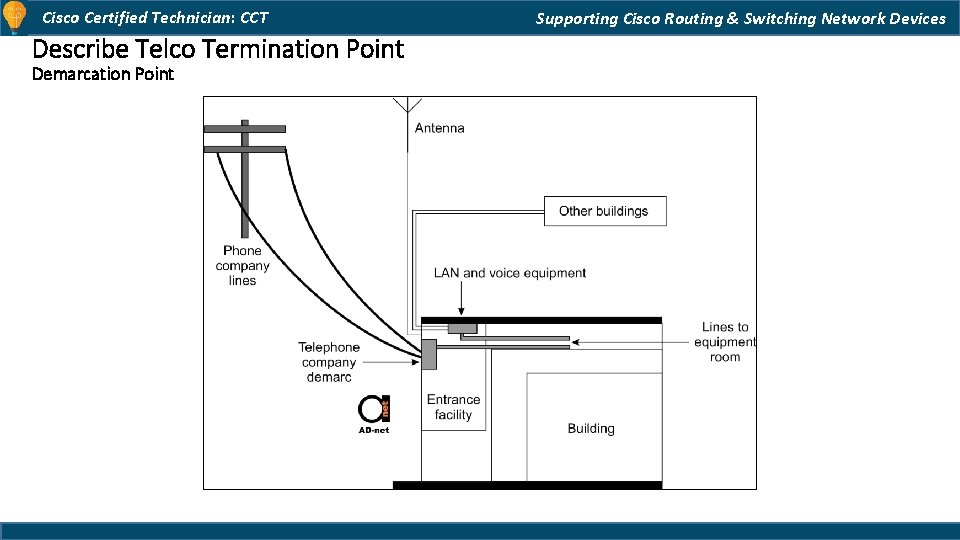
Cisco Certified Technician: CCT Describe Telco Termination Point Demarcation Point A demarcation point (demarc) is the physical point at which a telecommunications company's public network ends and the customer's private network begins. The demarcation point is often the point at which the cable physically enters the building, but this varies from one country to another. • Defines where the telephone company’s responsibility for maintenance ends and the consumer's responsibility begins. • Referred to as a network terminating interface or demarc. The termination often occurs in the telecommunications closet and the customer is responsible for maintaining, repairing and replacing the equipment. Supporting Cisco Routing & Switching Network Devices
Cisco Certified Technician: CCT Describe Telco Termination Point Demarcation Point In the United States, a telco provides the local loop into the customer premises and the customer provides the active equipment such as the channel service unit/data service unit (CSU/DSU) on which the local loop is terminated. Supporting Cisco Routing & Switching Network Devices
Cisco Certified Technician: CCT Describe Telco Termination Point Demarcation Point Supporting Cisco Routing & Switching Network Devices
Cisco Certified Technician: CCT Supporting Cisco Routing & Switching Network Devices CCT Exam Topic 1: General Networking Section 1. 7 Describe an IPv 4 and IPv 6 address and subnet (This topic is covered in Intro to Networks v 7 – 3. 7. 2, 11. 1, 12. 2)
Cisco Certified Technician: CCT Supporting Cisco Routing & Switching Network Devices CCT Exam Topic 1: General Networking Section 1. 8 Describe the function of FTP, TFTP and Ping (This topic is covered in Intro to Networks v 7 – Sections 3. 3. 4, 14. 1. 3, 14. 2. 4, 14. 3. 4, 15. 1. 3, 15. 5. 1, and Module 13
Cisco Certified Technician: CCT Supporting Cisco Routing & Switching Network Devices CCT Exam Topic 1: General Networking Section 1. 9 Describe the function of Telnet and SSH (This topic is covered in Intro to Networks v 7 – 16. 4. 4, 17. 2. 2, 17. 6. 4)
Cisco Certified Technician: CCT