
CISA CYBERSECURITY AND INFRASTRUCTURE SECURITY AGENCY CHEMICAL FACILITY
CISA | CYBERSECURITY AND INFRASTRUCTURE SECURITY AGENCY CHEMICAL FACILITY ANTITERRORISM STANDARDS (CFATS) Frank Bernhard – September 10, 2019
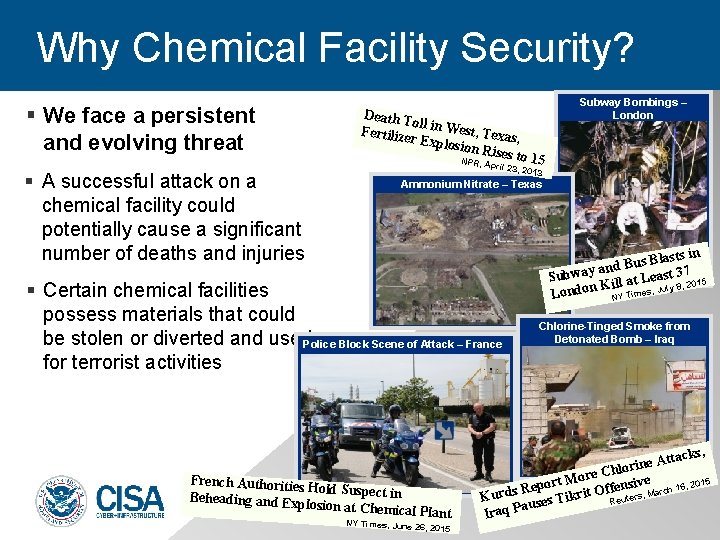
Why Chemical Facility Security? § We face a persistent and evolving threat § A successful attack on a chemical facility could potentially cause a significant number of deaths and injuries Death T oll Fertilize in West, Texas , r Explo sion Ris es to 15 NPR Subway Bombings – London , April 2 3, 2013 Ammonium Nitrate – Texas § Certain chemical facilities possess materials that could be stolen or diverted and used. Police Block Scene of Attack – France for terrorist activities French Authoritie s Hold Suspect in Beheading and Exp losion at Chemical Plant NY Times, June 26 , 2015 n Blasts i s u B d an Subway ill at Least 3, 72015 K ly 8 London NY Times, Ju Chlorine-Tinged Smoke from Detonated Bomb – Iraq s, Attack e n i r lo ore Ch sive M 15 t r ffen rs, March 16, 20 Repo s O d t i r r u K Reute ses Tik u a P q Ira Frank Bernhard September 10, 2019 2
Ensuring Chemical Facility Security Statutory Authority § In December 2006, Congress authorized DHS to regulate security at “high-risk” chemical facilities § The Department developed the Chemical Facility Anti-Terrorism Standards (CFATS), 6 CFR Part 27, to implement this authority § In December 2014, Congress extended the Department’s authority through the Protecting and Securing Chemical Facilities from Terrorist Attacks Act of 2014 - 6 U. S. Code Chapter 1, Subchapter XVI: Chemical Facility Anti-Terrorism Standards (CFATS) § In January 2019, CFATS received a 15 -month extension to its current authorization Frank Bernhard September 10, 2019 3

The CISA Structure In 2018 Congress passed the Cybersecurity and Infrastructure Security Agency Act. Previously known as National Protection and Programs Directorate, CISA seeks to defend our Nation against the digital, physical, manmade, technological, and natural threats that we face. Cybersecurity and Infrastructure Security Agency (CISA) National Risk Management Center Cybersecurity Division Infrastructure Security Division Federal Protective Service Emergency Communications Division Infrastructure Security Division (ISD) IICD NICC ISCD PSCD SOPD Infrastructure Security Compliance Division (ISCD) administers the Chemical Facility Anti-Terrorism Standards (CFATS) Program and the Ammonium Nitrate Security Program (ANSP) Frank Bernhard September 10, 2019 4
The CFATS Regulation The CFATS program identifies and regulates high-risk chemical facilities to ensure they implement appropriate security measures to reduce the risk of a terrorist attack associated with more than 300 chemicals of interest (COI). If held in specified quantities and concentrations, these chemicals must be reported to DHS. Facilities that store, manufacture, or distribute COI at or above screening threshold quantities (STQ) are required to comply with the CFATS standards. Ø CFATS follows a risk-based approach, allowing DHS to focus on high-risk chemical facilities in accordance with their specific level of risk Frank Bernhard September 10, 2019 5
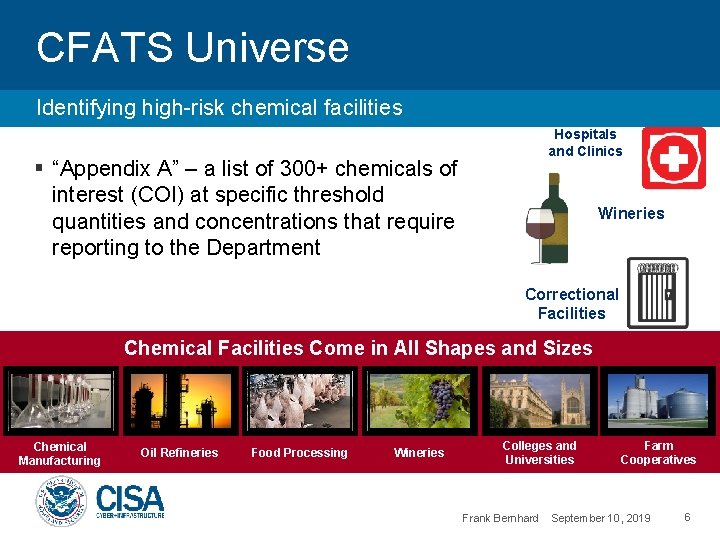
CFATS Universe Identifying high-risk chemical facilities Hospitals and Clinics § “Appendix A” – a list of 300+ chemicals of interest (COI) at specific threshold quantities and concentrations that require reporting to the Department Wineries Correctional Facilities Chemical Facilities Come in All Shapes and Sizes Chemical Manufacturing Oil Refineries Food Processing Wineries Colleges and Universities Frank Bernhard Farm Cooperatives September 10, 2019 6
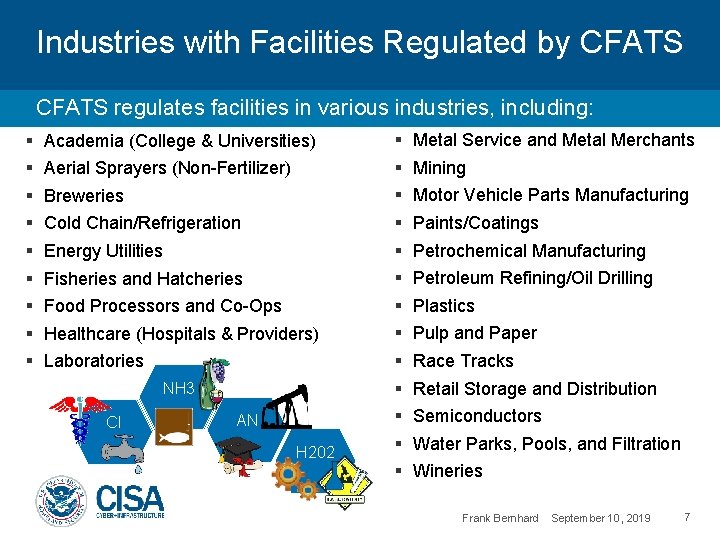
Industries with Facilities Regulated by CFATS regulates facilities in various industries, including: § § § § § Academia (College & Universities) Aerial Sprayers (Non-Fertilizer) Breweries Cold Chain/Refrigeration Energy Utilities Fisheries and Hatcheries Food Processors and Co-Ops Healthcare (Hospitals & Providers) Laboratories NH 3 CI AN H 202 § § § § Metal Service and Metal Merchants Mining Motor Vehicle Parts Manufacturing Paints/Coatings Petrochemical Manufacturing Petroleum Refining/Oil Drilling Plastics Pulp and Paper Race Tracks Retail Storage and Distribution Semiconductors Water Parks, Pools, and Filtration Wineries Frank Bernhard September 10, 2019 7
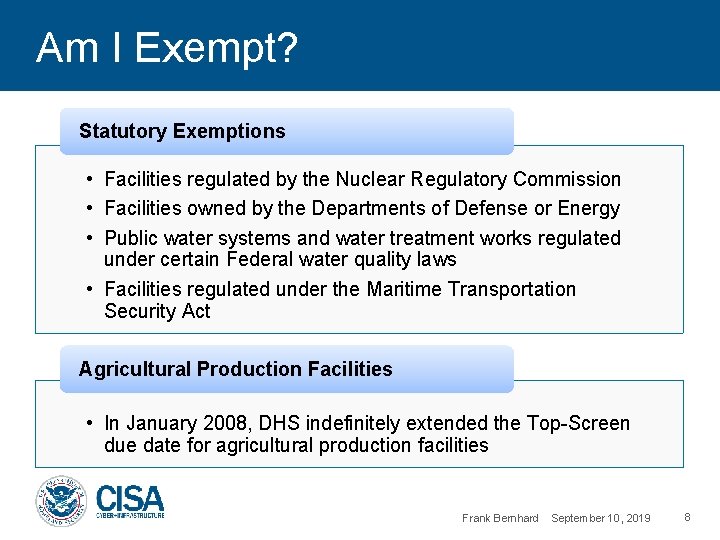
Am I Exempt? Statutory Exemptions • Facilities regulated by the Nuclear Regulatory Commission • Facilities owned by the Departments of Defense or Energy • Public water systems and water treatment works regulated under certain Federal water quality laws • Facilities regulated under the Maritime Transportation Security Act Agricultural Production Facilities • In January 2008, DHS indefinitely extended the Top-Screen due date for agricultural production facilities Frank Bernhard September 10, 2019 8
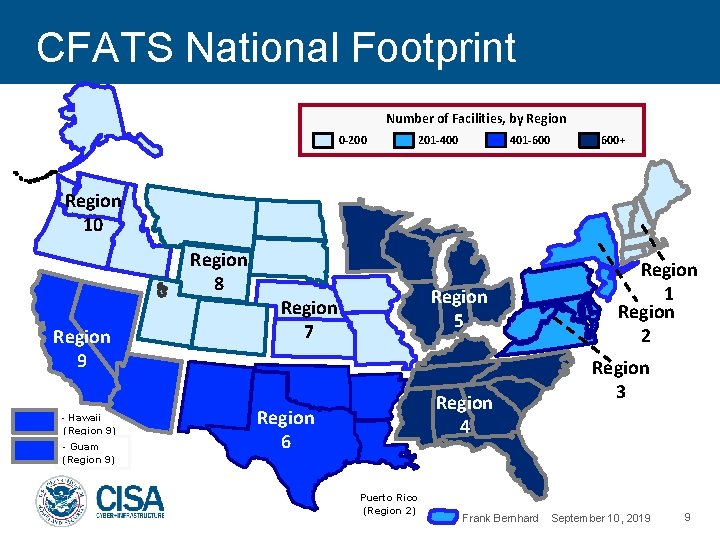
CFATS National Footprint Number of Facilities, by Region 0 -200 201 -400 401 -600 600+ Region 10 Region 8 Region 9 - Hawaii (Region 9) - Guam (Region 9) Region 5 Region 7 Region 4 Region 6 Puerto Rico (Region 2) Frank Bernhard Region 1 Region 2 Region 3 September 10, 2019 9
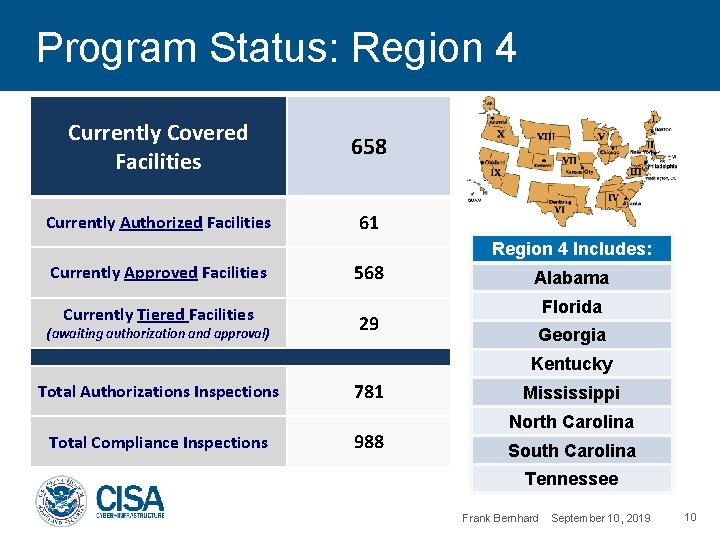
Program Status: Region 4 Currently Covered Facilities 658 Currently Authorized Facilities 61 Region 4 Includes: Currently Approved Facilities Currently Tiered Facilities (awaiting authorization and approval) 568 29 Alabama Florida Georgia Kentucky Total Authorizations Inspections Total Compliance Inspections 781 988 Mississippi North Carolina South Carolina Tennessee Frank Bernhard September 10, 2019 10
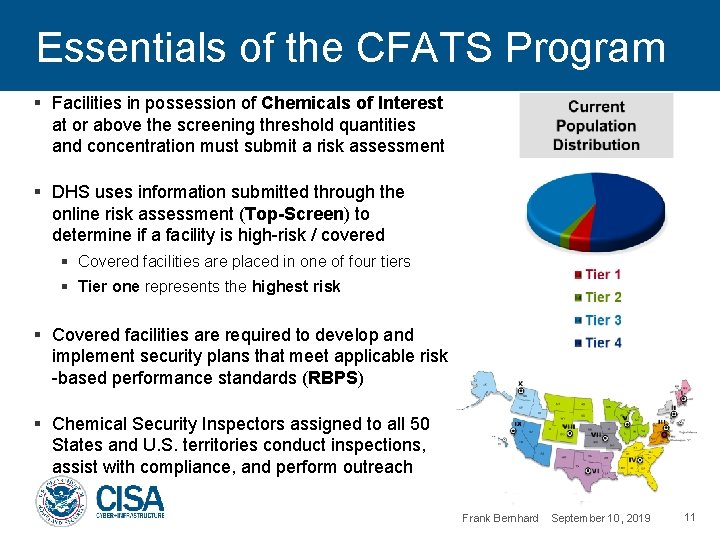
Essentials of the CFATS Program § Facilities in possession of Chemicals of Interest at or above the screening threshold quantities and concentration must submit a risk assessment § DHS uses information submitted through the online risk assessment (Top-Screen) to determine if a facility is high-risk / covered § Covered facilities are placed in one of four tiers § Tier one represents the highest risk § Covered facilities are required to develop and implement security plans that meet applicable risk -based performance standards (RBPS) § Chemical Security Inspectors assigned to all 50 States and U. S. territories conduct inspections, assist with compliance, and perform outreach Frank Bernhard September 10, 2019 11
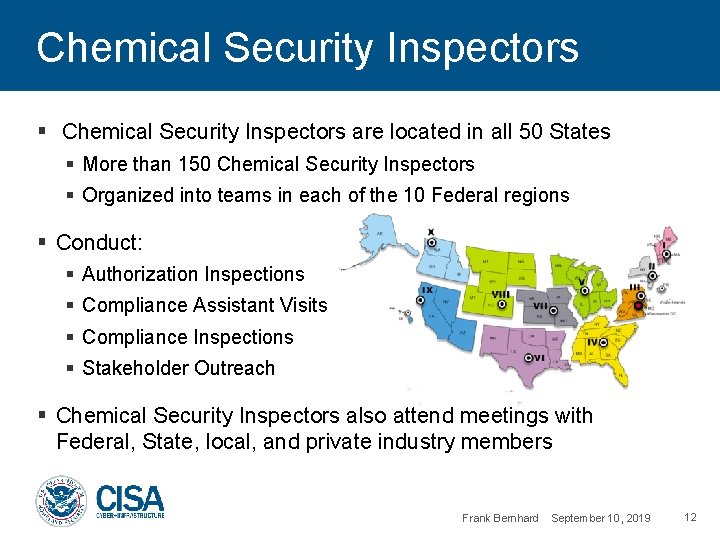
Chemical Security Inspectors § Chemical Security Inspectors are located in all 50 States § More than 150 Chemical Security Inspectors § Organized into teams in each of the 10 Federal regions § Conduct: § Authorization Inspections § Compliance Assistant Visits § Compliance Inspections § Stakeholder Outreach § Chemical Security Inspectors also attend meetings with Federal, State, local, and private industry members Frank Bernhard September 10, 2019 12
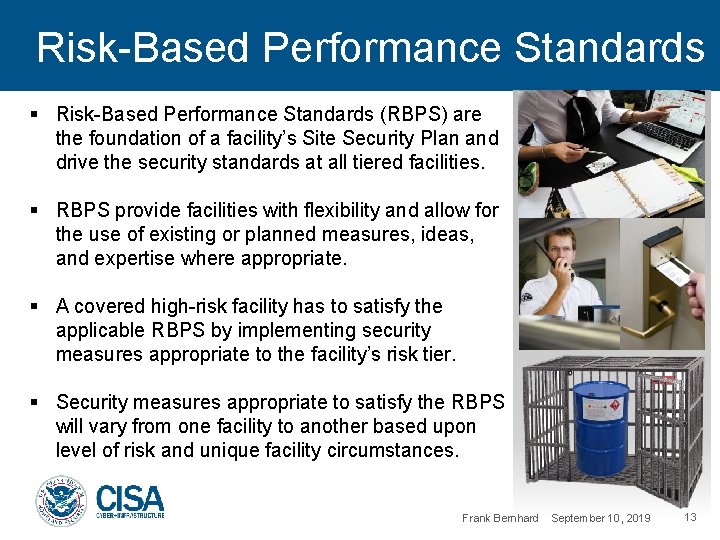
Risk-Based Performance Standards § Risk-Based Performance Standards (RBPS) are the foundation of a facility’s Site Security Plan and drive the security standards at all tiered facilities. § RBPS provide facilities with flexibility and allow for the use of existing or planned measures, ideas, and expertise where appropriate. § A covered high-risk facility has to satisfy the applicable RBPS by implementing security measures appropriate to the facility’s risk tier. § Security measures appropriate to satisfy the RBPS will vary from one facility to another based upon level of risk and unique facility circumstances. Frank Bernhard September 10, 2019 13
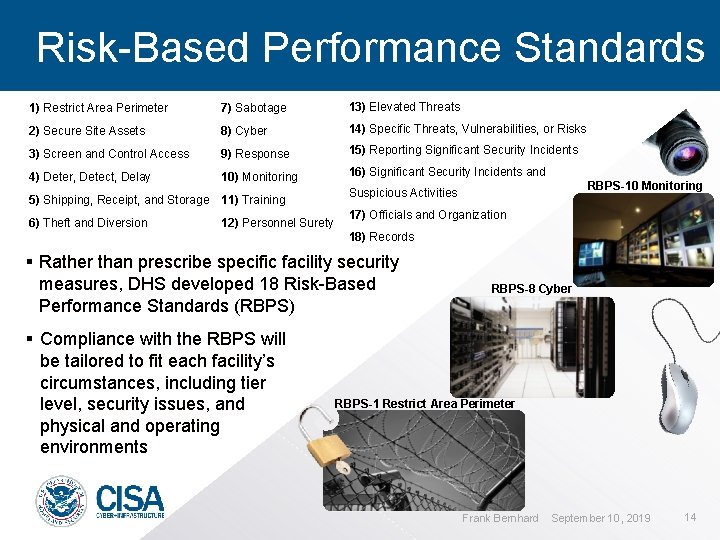
Risk-Based Performance Standards 1) Restrict Area Perimeter 7) Sabotage 13) Elevated Threats 2) Secure Site Assets 8) Cyber 14) Specific Threats, Vulnerabilities, or Risks 3) Screen and Control Access 9) Response 15) Reporting Significant Security Incidents 4) Deter, Detect, Delay 10) Monitoring 16) Significant Security Incidents and 5) Shipping, Receipt, and Storage 11) Training 6) Theft and Diversion 12) Personnel Surety RBPS-10 Monitoring Suspicious Activities 17) Officials and Organization 18) Records § Rather than prescribe specific facility security measures, DHS developed 18 Risk-Based Performance Standards (RBPS) § Compliance with the RBPS will be tailored to fit each facility’s circumstances, including tier level, security issues, and physical and operating environments RBPS-8 Cyber RBPS-1 Restrict Area Perimeter Frank Bernhard September 10, 2019 14
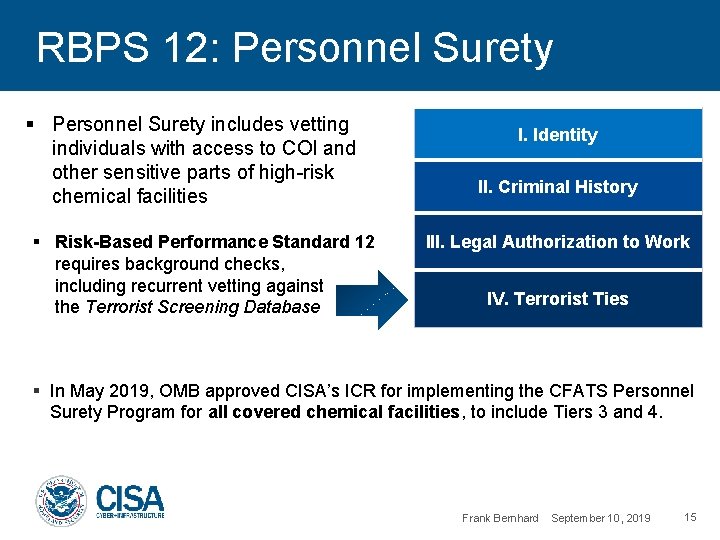
RBPS 12: Personnel Surety § Personnel Surety includes vetting individuals with access to COI and other sensitive parts of high-risk chemical facilities § Risk-Based Performance Standard 12 requires background checks, including recurrent vetting against the Terrorist Screening Database I. Identity II. Criminal History III. Legal Authorization to Work IV. Terrorist Ties § In May 2019, OMB approved CISA’s ICR for implementing the CFATS Personnel Surety Program for all covered chemical facilities, to include Tiers 3 and 4. Frank Bernhard September 10, 2019 15
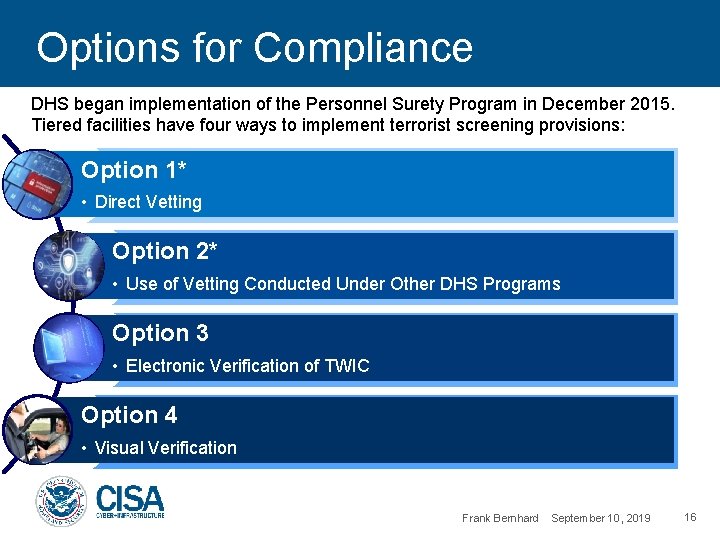
Options for Compliance DHS began implementation of the Personnel Surety Program in December 2015. Tiered facilities have four ways to implement terrorist screening provisions: Option 1* • Direct Vetting Option 2* • Use of Vetting Conducted Under Other DHS Programs Option 3 • Electronic Verification of TWIC Option 4 • Visual Verification Frank Bernhard September 10, 2019 16
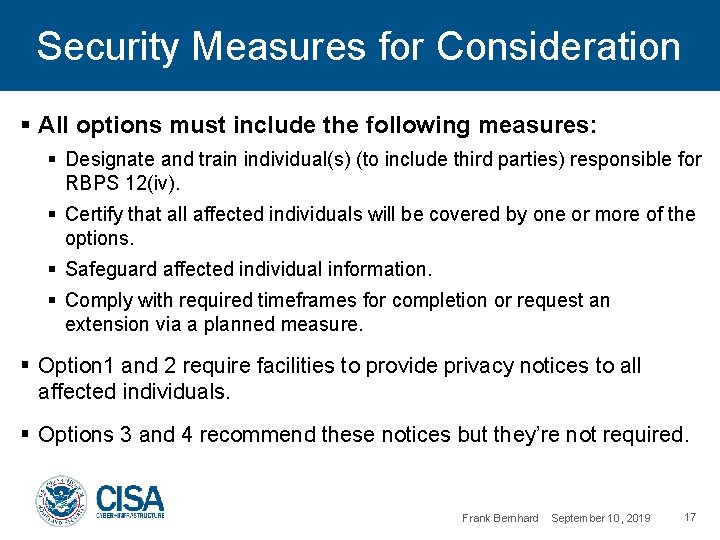
Security Measures for Consideration § All options must include the following measures: § Designate and train individual(s) (to include third parties) responsible for RBPS 12(iv). § Certify that all affected individuals will be covered by one or more of the options. § Safeguard affected individual information. § Comply with required timeframes for completion or request an extension via a planned measure. § Option 1 and 2 require facilities to provide privacy notices to all affected individuals. § Options 3 and 4 recommend these notices but they’re not required. Frank Bernhard September 10, 2019 17
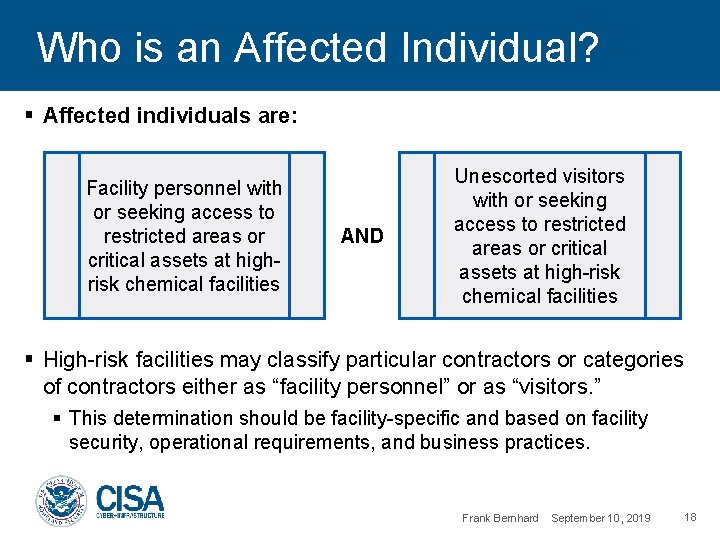
Who is an Affected Individual? § Affected individuals are: Facility personnel with or seeking access to restricted areas or critical assets at highrisk chemical facilities AND Unescorted visitors with or seeking access to restricted areas or critical assets at high-risk chemical facilities § High-risk facilities may classify particular contractors or categories of contractors either as “facility personnel” or as “visitors. ” § This determination should be facility-specific and based on facility security, operational requirements, and business practices. Frank Bernhard September 10, 2019 18
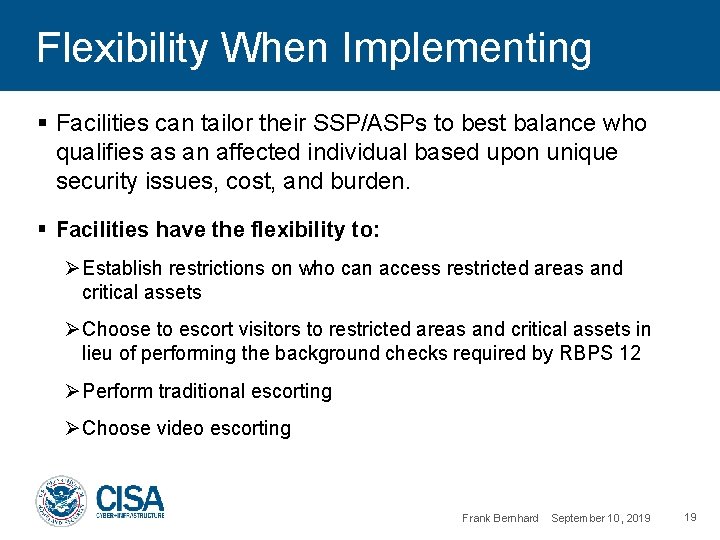
Flexibility When Implementing § Facilities can tailor their SSP/ASPs to best balance who qualifies as an affected individual based upon unique security issues, cost, and burden. § Facilities have the flexibility to: Ø Establish restrictions on who can access restricted areas and critical assets Ø Choose to escort visitors to restricted areas and critical assets in lieu of performing the background checks required by RBPS 12 Ø Perform traditional escorting Ø Choose video escorting Frank Bernhard September 10, 2019 19
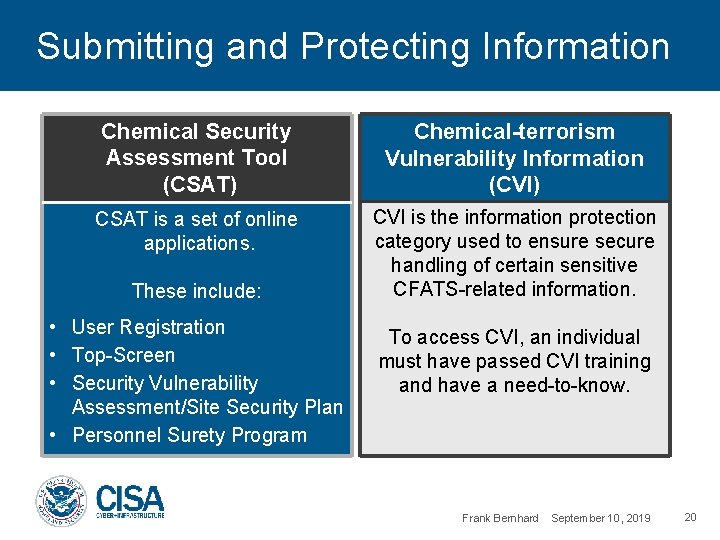
Submitting and Protecting Information Chemical Security Assessment Tool (CSAT) Chemical-terrorism Vulnerability Information (CVI) CSAT is a set of online applications. CVI is the information protection category used to ensure secure handling of certain sensitive CFATS-related information. These include: • User Registration • Top-Screen • Security Vulnerability Assessment/Site Security Plan • Personnel Surety Program To access CVI, an individual must have passed CVI training and have a need-to-know. Frank Bernhard September 10, 2019 20
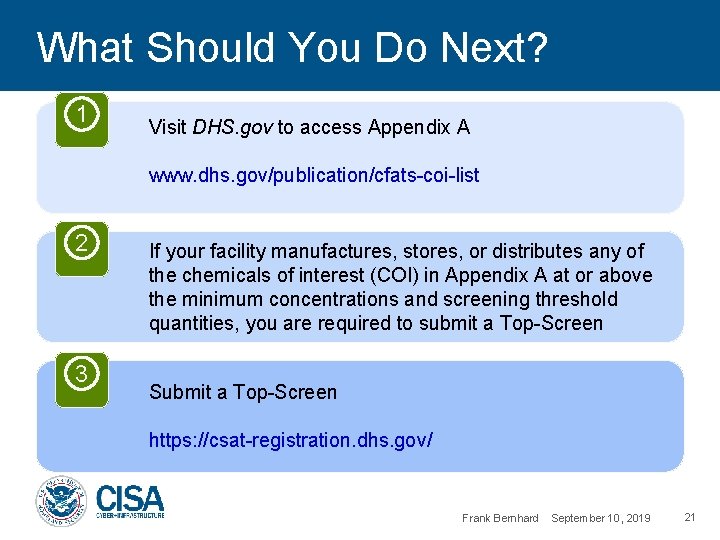
What Should You Do Next? 1 Visit DHS. gov to access Appendix A www. dhs. gov/publication/cfats-coi-list 2 3 If your facility manufactures, stores, or distributes any of the chemicals of interest (COI) in Appendix A at or above the minimum concentrations and screening threshold quantities, you are required to submit a Top-Screen Submit a Top-Screen https: //csat-registration. dhs. gov/ Frank Bernhard September 10, 2019 21
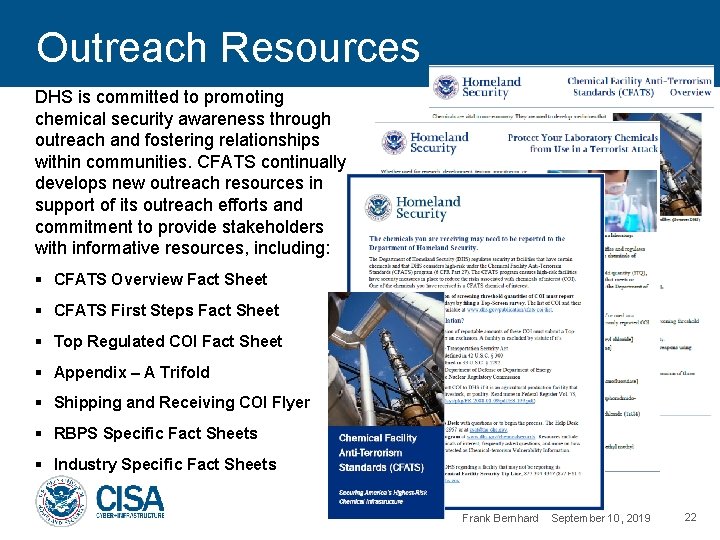
Outreach Resources DHS is committed to promoting chemical security awareness through outreach and fostering relationships within communities. CFATS continually develops new outreach resources in support of its outreach efforts and commitment to provide stakeholders with informative resources, including: § CFATS Overview Fact Sheet § CFATS First Steps Fact Sheet § Top Regulated COI Fact Sheet § Appendix – A Trifold § Shipping and Receiving COI Flyer § RBPS Specific Fact Sheets § Industry Specific Fact Sheets Frank Bernhard September 10, 2019 22
Available Resources Outreach: DHS outreach for CFATS is a continuous effort to educate stakeholders on the program. • To request a CFATS presentation or a CAV, submit a request through the program website www. dhs. gov/cfats, or email DHS at CFATS@hq. dhs. gov. CFATS Help Desk: Direct questions about the CFATS program to the CFATS Help Desk. • • • Hours of Operation are Mon. – Fri. 8: 30 AM – 5: 00 PM (ET) CFATS Help Desk toll-free number 1 -866 -323 -2957 CFATS Help Desk email address csat@dhs. gov CFATS Web Site: For CFATS Frequently Asked Questions (FAQs), CVI training, and other useful CFATS-related information, please go to www. dhs. gov/cfats Frank Bernhard September 10, 2019 23
Frank Bernhard – September 10, 2019 24
- Slides: 24