
CIS POETRY Sullivan 2017 Figurative Language What does

- Slides: 16
CIS POETRY Sullivan 2017
Figurative Language ◦ What does that mean? ◦ Types?
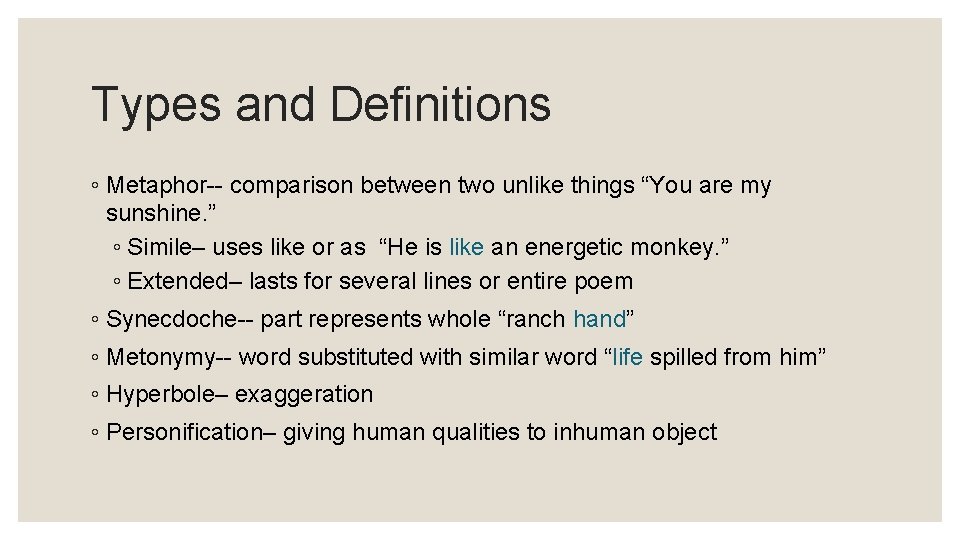
Types and Definitions ◦ Metaphor-- comparison between two unlike things “You are my sunshine. ” ◦ Simile– uses like or as “He is like an energetic monkey. ” ◦ Extended– lasts for several lines or entire poem ◦ Synecdoche-- part represents whole “ranch hand” ◦ Metonymy-- word substituted with similar word “life spilled from him” ◦ Hyperbole– exaggeration ◦ Personification– giving human qualities to inhuman object
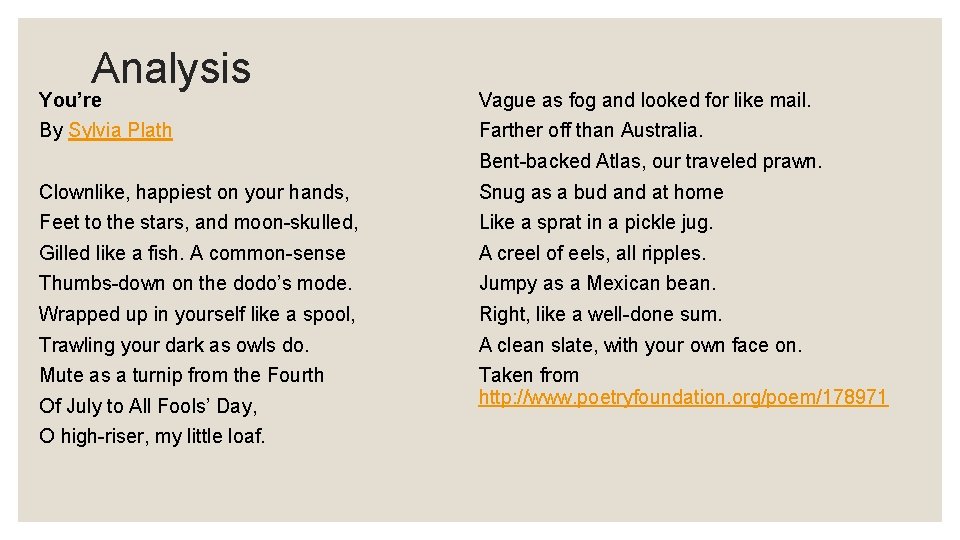
Analysis You’re Vague as fog and looked for like mail. By Sylvia Plath Farther off than Australia. Bent-backed Atlas, our traveled prawn. Clownlike, happiest on your hands, Snug as a bud and at home Feet to the stars, and moon-skulled, Like a sprat in a pickle jug. Gilled like a fish. A common-sense A creel of eels, all ripples. Thumbs-down on the dodo’s mode. Jumpy as a Mexican bean. Wrapped up in yourself like a spool, Right, like a well-done sum. Trawling your dark as owls do. A clean slate, with your own face on. Mute as a turnip from the Fourth Taken from http: //www. poetryfoundation. org/poem/178971 Of July to All Fools’ Day, O high-riser, my little loaf.
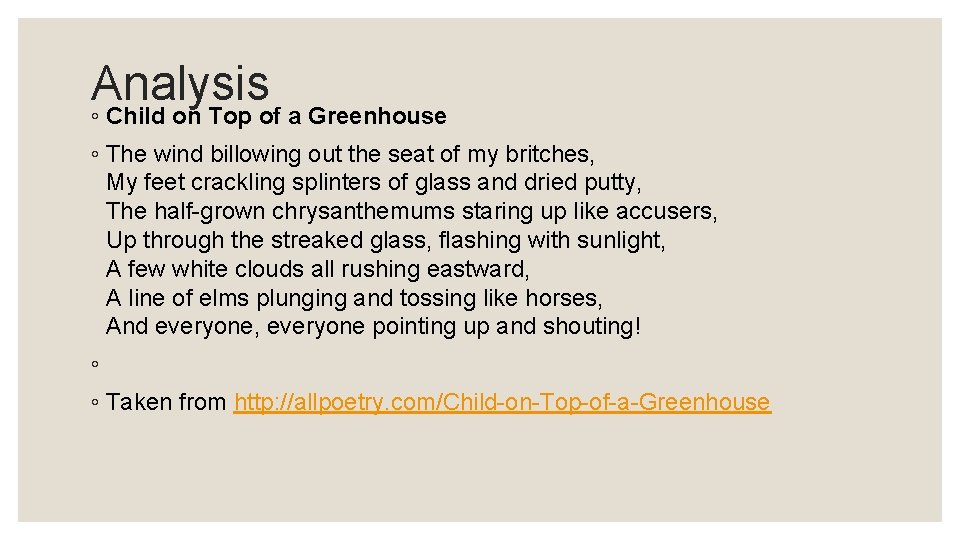
Analysis ◦ Child on Top of a Greenhouse ◦ The wind billowing out the seat of my britches, My feet crackling splinters of glass and dried putty, The half-grown chrysanthemums staring up like accusers, Up through the streaked glass, flashing with sunlight, A few white clouds all rushing eastward, A line of elms plunging and tossing like horses, And everyone, everyone pointing up and shouting! ◦ ◦ Taken from http: //allpoetry. com/Child-on-Top-of-a-Greenhouse
Assignment #1 ◦ Write a poem, at least 9 lines, called “You’re” ◦ Use figurative language to write about your partner in the class ◦ Highlight your uses of figurative language and label them! ◦ Can be typed or handwritten– due at the start of class on Tuesday
Sound Devices ◦ What are they? ◦ Why use them?
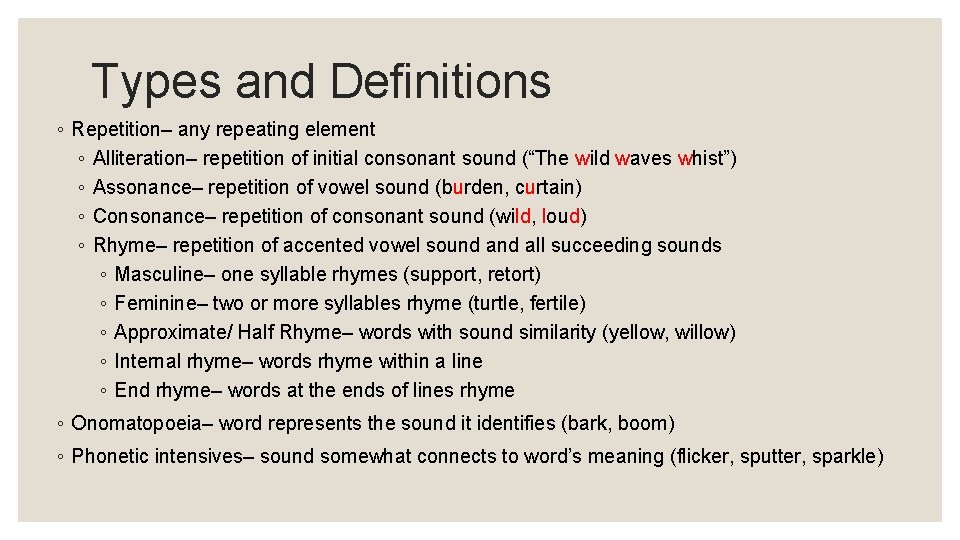
Types and Definitions ◦ Repetition– any repeating element ◦ Alliteration– repetition of initial consonant sound (“The wild waves whist”) ◦ Assonance– repetition of vowel sound (burden, curtain) ◦ Consonance– repetition of consonant sound (wild, loud) ◦ Rhyme– repetition of accented vowel sound all succeeding sounds ◦ Masculine– one syllable rhymes (support, retort) ◦ Feminine– two or more syllables rhyme (turtle, fertile) ◦ Approximate/ Half Rhyme– words with sound similarity (yellow, willow) ◦ Internal rhyme– words rhyme within a line ◦ End rhyme– words at the ends of lines rhyme ◦ Onomatopoeia– word represents the sound it identifies (bark, boom) ◦ Phonetic intensives– sound somewhat connects to word’s meaning (flicker, sputter, sparkle)
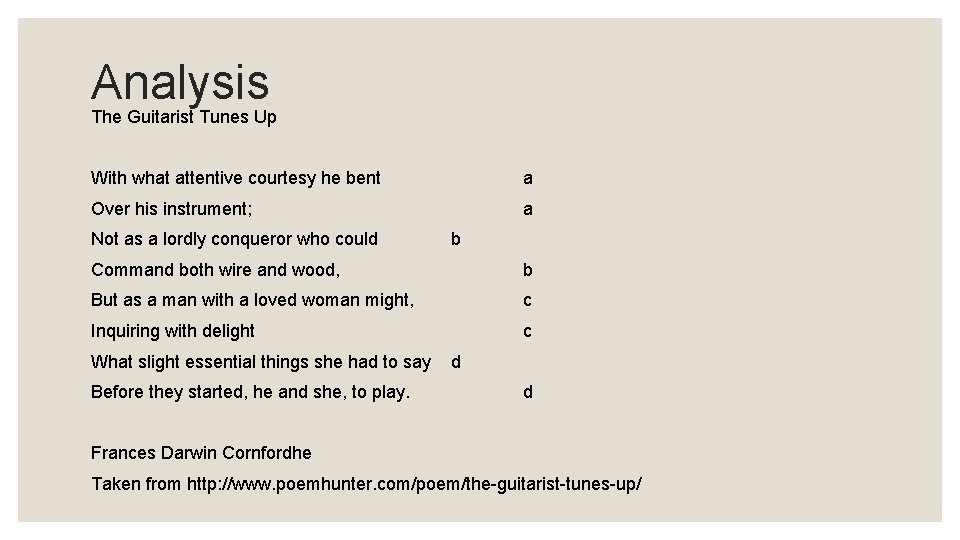
Analysis The Guitarist Tunes Up With what attentive courtesy he bent a Over his instrument; a Not as a lordly conqueror who could b Command both wire and wood, b But as a man with a loved woman might, c Inquiring with delight c What slight essential things she had to say d Before they started, he and she, to play. d Frances Darwin Cornfordhe Taken from http: //www. poemhunter. com/poem/the-guitarist-tunes-up/
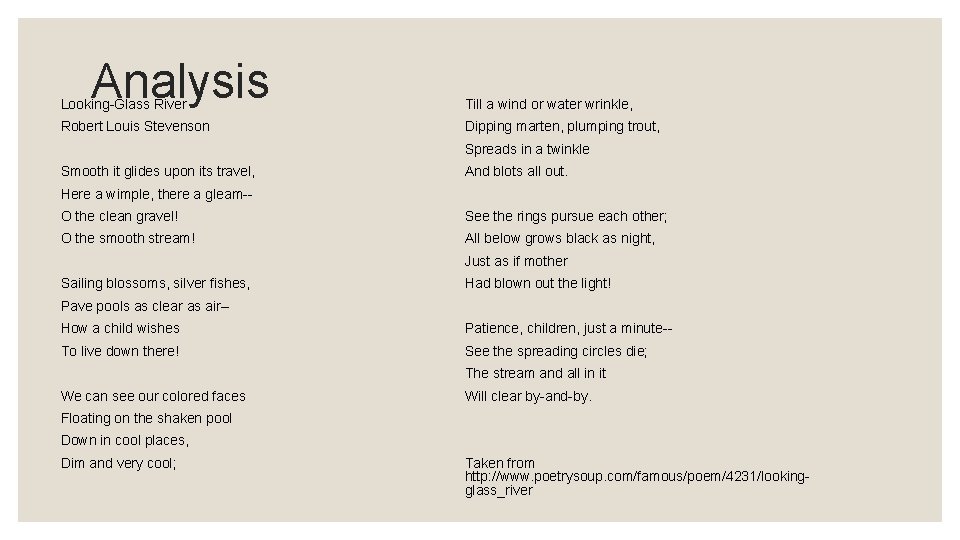
Analysis Looking-Glass River Till a wind or water wrinkle, Robert Louis Stevenson Dipping marten, plumping trout, Spreads in a twinkle Smooth it glides upon its travel, And blots all out. Here a wimple, there a gleam-- O the clean gravel! See the rings pursue each other; O the smooth stream! All below grows black as night, Just as if mother Sailing blossoms, silver fishes, Had blown out the light! Pave pools as clear as air-- How a child wishes Patience, children, just a minute-- To live down there! See the spreading circles die; The stream and all in it We can see our colored faces Will clear by-and-by. Floating on the shaken pool Down in cool places, Dim and very cool; Taken from http: //www. poetrysoup. com/famous/poem/4231/lookingglass_river
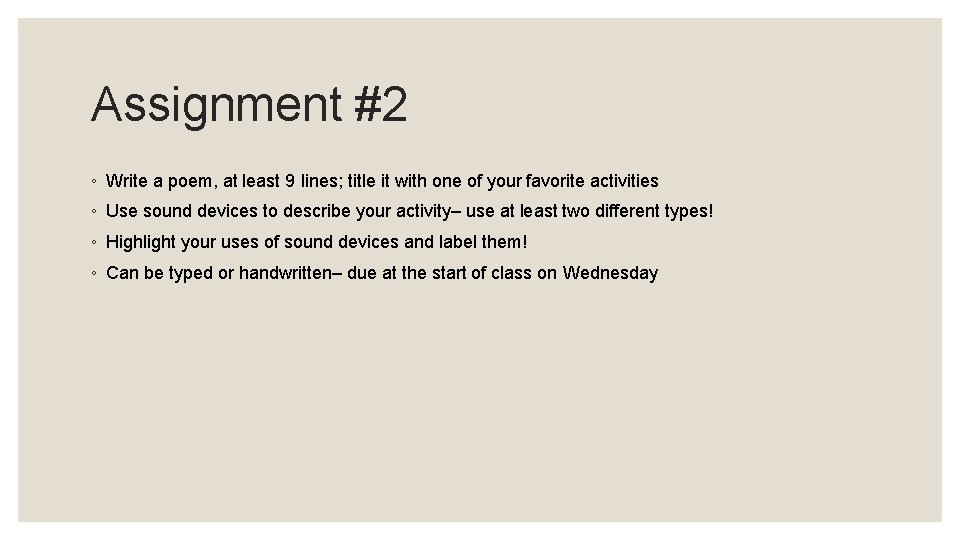
Assignment #2 ◦ Write a poem, at least 9 lines; title it with one of your favorite activities ◦ Use sound devices to describe your activity– use at least two different types! ◦ Highlight your uses of sound devices and label them! ◦ Can be typed or handwritten– due at the start of class on Wednesday
Structure ◦ Why does it matter? ◦ What type of structures exist in poetry?
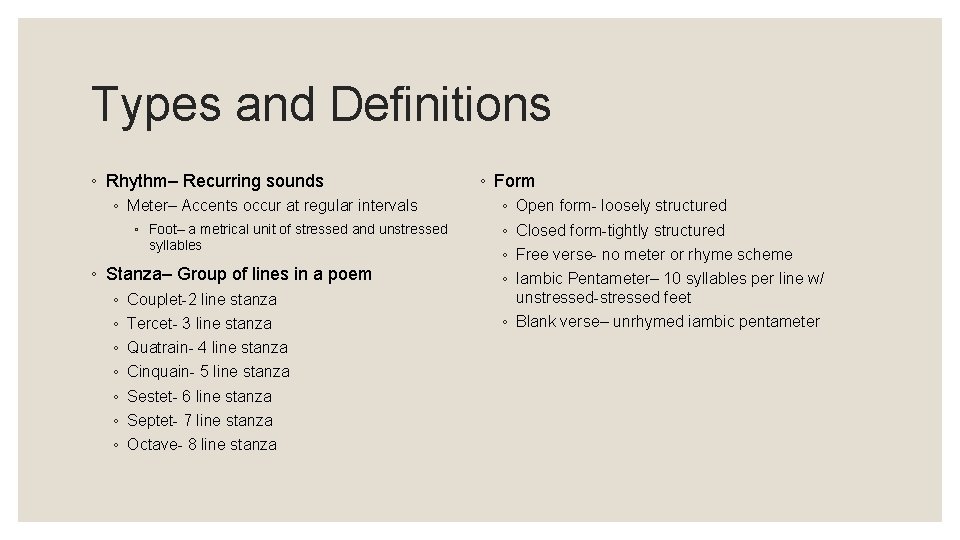
Types and Definitions ◦ Rhythm– Recurring sounds ◦ Meter– Accents occur at regular intervals ◦ Foot– a metrical unit of stressed and unstressed syllables ◦ Stanza– Group of lines in a poem ◦ ◦ ◦ ◦ Couplet-2 line stanza Tercet- 3 line stanza Quatrain- 4 line stanza Cinquain- 5 line stanza Sestet- 6 line stanza Septet- 7 line stanza Octave- 8 line stanza ◦ Form ◦ ◦ Open form- loosely structured Closed form-tightly structured Free verse- no meter or rhyme scheme Iambic Pentameter– 10 syllables per line w/ unstressed-stressed feet ◦ Blank verse– unrhymed iambic pentameter
Analysis Those Winter Sundays I’d wake and hear the cold splintering, breaking. BY ROBERT HAYDEN When the rooms were warm, he’d call, and slowly I would rise and dress, Sundays too my father got up early fearing the chronic angers of that house, and put his clothes on in the blueblack cold, then with cracked hands that ached Speaking indifferently to him, from labor in the weekday weather made who had driven out the cold banked fires blaze. No one ever thanked him. and polished my good shoes as well. What did I know, what did I know of love’s austere and lonely offices? Taken from http: //www. poetryfoundation. org/learning/poem/175758
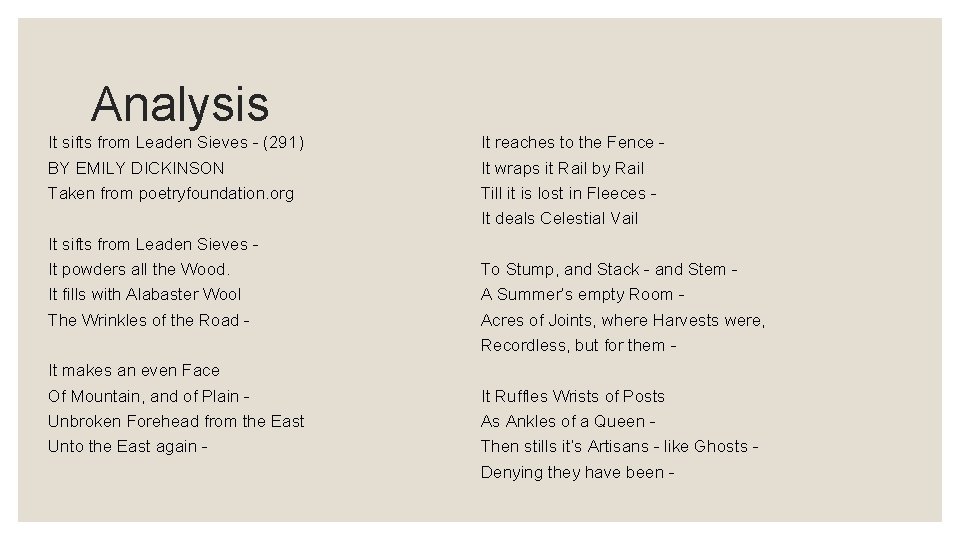
Analysis It sifts from Leaden Sieves - (291) BY EMILY DICKINSON Taken from poetryfoundation. org It sifts from Leaden Sieves It powders all the Wood. It fills with Alabaster Wool The Wrinkles of the Road It makes an even Face Of Mountain, and of Plain Unbroken Forehead from the East Unto the East again - It reaches to the Fence It wraps it Rail by Rail Till it is lost in Fleeces It deals Celestial Vail To Stump, and Stack - and Stem A Summer’s empty Room Acres of Joints, where Harvests were, Recordless, but for them It Ruffles Wrists of Posts As Ankles of a Queen Then stills it’s Artisans - like Ghosts Denying they have been -
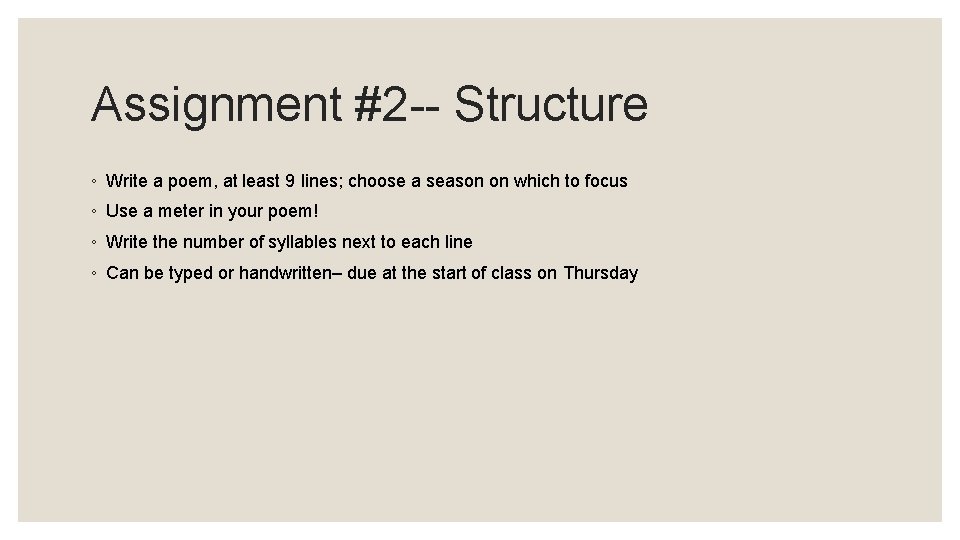
Assignment #2 -- Structure ◦ Write a poem, at least 9 lines; choose a season on which to focus ◦ Use a meter in your poem! ◦ Write the number of syllables next to each line ◦ Can be typed or handwritten– due at the start of class on Thursday