
CIS 700 ADVANCED MACHINE LEARNING STRUCTURED MACHINE LEARNING
![CLASSIFICATION: AMBIGUITY RESOLUTION Illinois’ bored of education [board] Nissan Car and truck plant; plant](https://slidetodoc.com/presentation_image_h2/c6abf7194779b76d0c0574501c9ea12b/image-10.jpg "CLASSIFICATION: AMBIGUITY RESOLUTION Illinois’ bored of education [board] Nissan Car and truck plant; plant")


- Slides: 32
CIS 700 ADVANCED MACHINE LEARNING STRUCTURED MACHINE LEARNING: THEORY AND APPLICATIONS IN NATURAL LANGUAGE PROCESSING Dan Roth Department of Computer and Information Science University of Pennsylvania What’s the class about q Motivation q How I plan to teach it q Requirements q Page 1 1
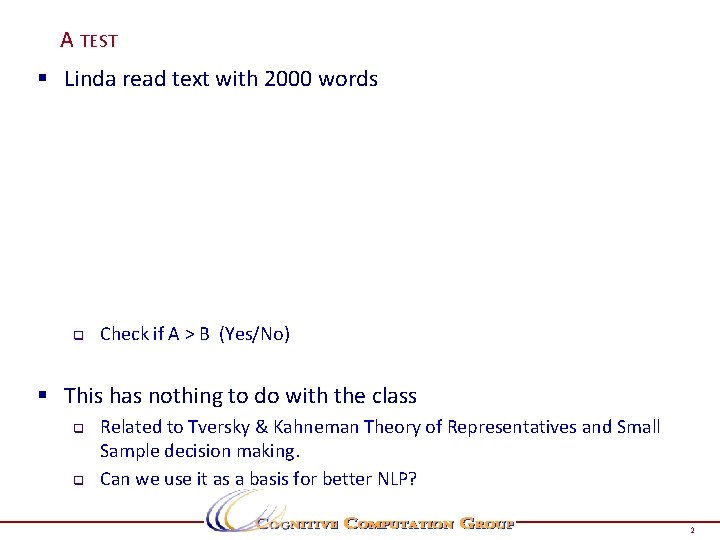
A TEST § Linda read text with 2000 words q How many words had 7 characters and ended with an “ing”? § Write down a number A = …. . q How many words had 7 characters and had an “n” in the 6 th position? § Write down a number B = …… q Check if A > B (Yes/No) § This has nothing to do with the class q q Related to Tversky & Kahneman Theory of Representatives and Small Sample decision making. Can we use it as a basis for better NLP? 2
BEFORE INTRODUCTION § Who are you? § § ML Background NLP Background AI Background Programming Background 3
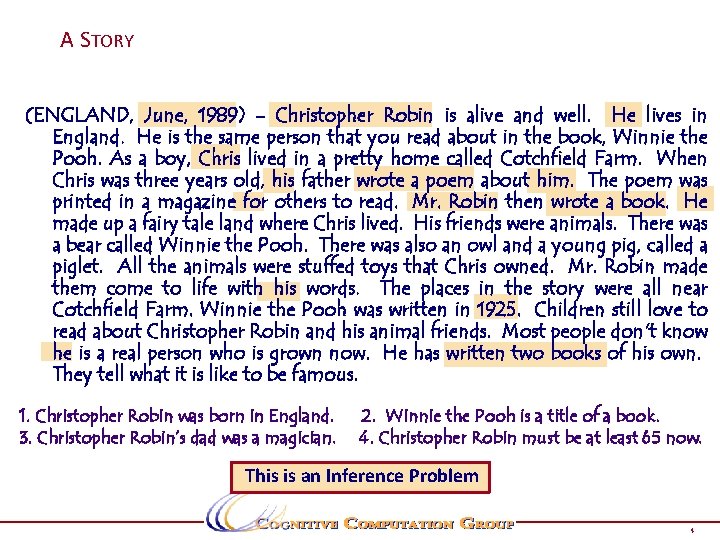
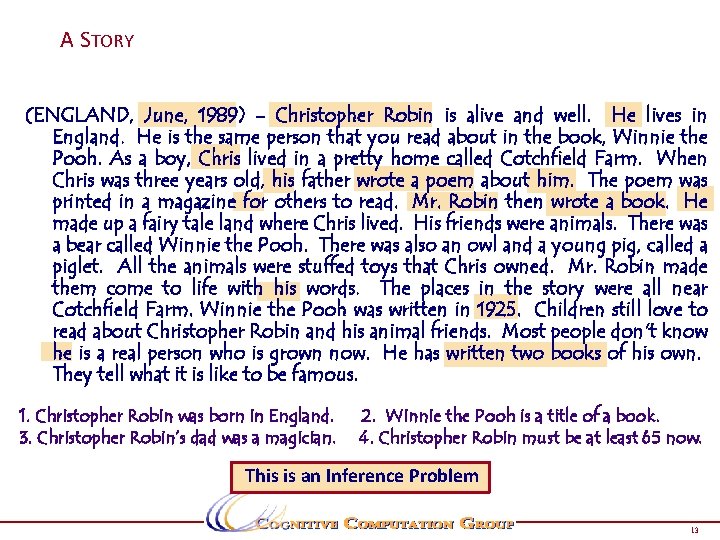
P a g e A STORY 4 (ENGLAND, June, 1989) - Christopher Robin is alive and well. He lives in England. He is the same person that you read about in the book, Winnie the Pooh. As a boy, Chris lived in a pretty home called Cotchfield Farm. When Chris was three years old, his father wrote a poem about him. The poem was printed in a magazine for others to read. Mr. Robin then wrote a book. He made up a fairy tale land where Chris lived. His friends were animals. There was a bear called Winnie the Pooh. There was also an owl and a young pig, called a piglet. All the animals were stuffed toys that Chris owned. Mr. Robin made them come to life with his words. The places in the story were all near Cotchfield Farm. Winnie the Pooh was written in 1925. Children still love to read about Christopher Robin and his animal friends. Most people don't know he is a real person who is grown now. He has written two books of his own. They tell what it is like to be famous. 1. Christopher Robin was born in England. 3. Christopher Robin’s dad was a magician. 2. Winnie the Pooh is a title of a book. 4. Christopher Robin must be at least 65 now. This is an Inference Problem 4
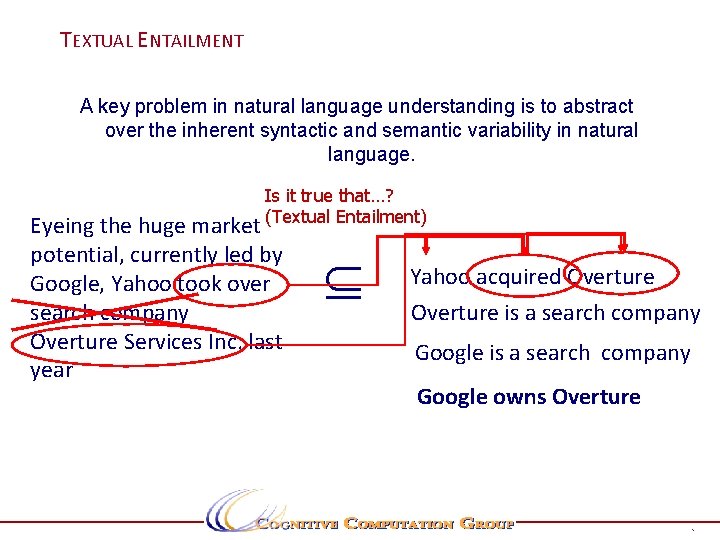
TEXTUAL ENTAILMENT A key problem in natural language understanding is to abstract over the inherent syntactic and semantic variability in natural language. Is it true that…? (Textual Entailment) Eyeing the huge market potential, currently led by Google, Yahoo took over search company Overture Services Inc. last year Yahoo acquired Overture is a search company Google owns Overture ………. Page 5 5
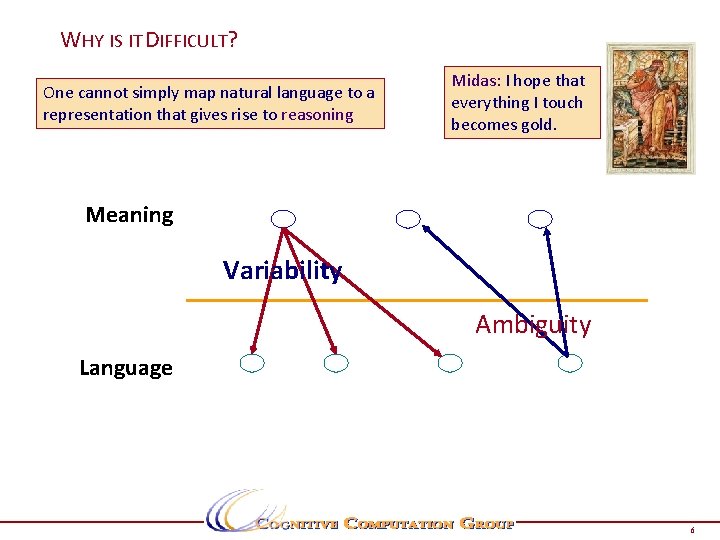
P a g e 6 WHY IS IT DIFFICULT? One cannot simply map natural language to a representation that gives rise to reasoning Midas: I hope that everything I touch becomes gold. Meaning Variability Ambiguity Language 6
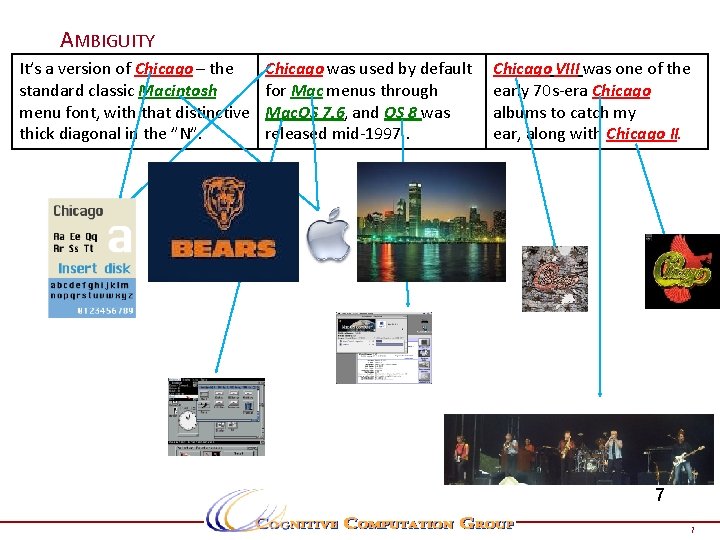
AMBIGUITY It’s a version of Chicago – the standard classic Macintosh menu font, with that distinctive thick diagonal in the ”N”. Chicago was used by default for Mac menus through Mac. OS 7. 6, and OS 8 was released mid-1997. . Chicago VIII was one of the early 70 s-era Chicago albums to catch my ear, along with Chicago II. 7 7
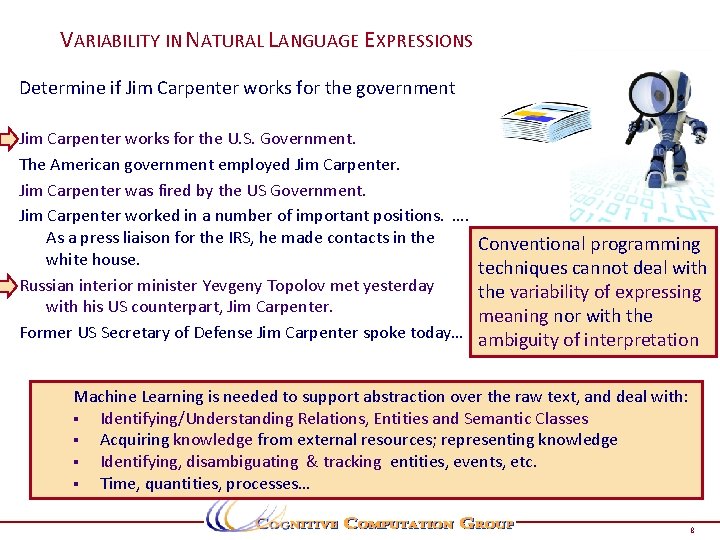
P a VARIABILITY IN NATURAL LANGUAGE EXPRESSIONS g e Determine if Jim Carpenter works for the government 8 Jim Carpenter works for the U. S. Government. The American government employed Jim Carpenter was fired by the US Government. Jim Carpenter worked in a number of important positions. …. As a press liaison for the IRS, he made contacts in the white house. Russian interior minister Yevgeny Topolov met yesterday with his US counterpart, Jim Carpenter. Former US Secretary of Defense Jim Carpenter spoke today… Conventional programming techniques cannot deal with the variability of expressing meaning nor with the ambiguity of interpretation Machine Learning is needed to support abstraction over the raw text, and deal with: § Identifying/Understanding Relations, Entities and Semantic Classes § Acquiring knowledge from external resources; representing knowledge § Identifying, disambiguating & tracking entities, events, etc. § Time, quantities, processes… 8
LEARNING § The process of Abstraction has to be driven by statistical learning methods. § Over the last two decades or so it became clear that machine learning methods are necessary in order to support this process of abstraction. § But— Page 9 9
CLASSIFICATION: AMBIGUITY RESOLUTION Illinois’ bored of education [board] Nissan Car and truck plant; plant and animal kingdom (This Art) (can N) (will MD) (rust V) V, N, N The dog bit the kid. He was taken to a veterinarian; a hospital Tiger was in Washington for the PGA Tour Finance; Banking; World News; Sports Important or not important; love or hate 10 10
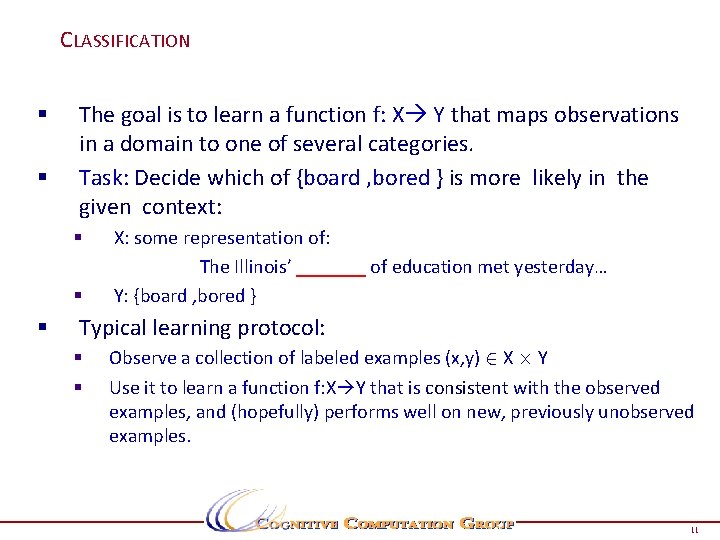
CLASSIFICATION § § The goal is to learn a function f: X Y that maps observations in a domain to one of several categories. Task: Decide which of {board , bored } is more likely in the given context: § § § X: some representation of: The Illinois’ _______ of education met yesterday… Y: {board , bored } Typical learning protocol: § § Observe a collection of labeled examples (x, y) 2 X £ Y Use it to learn a function f: X Y that is consistent with the observed examples, and (hopefully) performs well on new, previously unobserved examples. 11 11
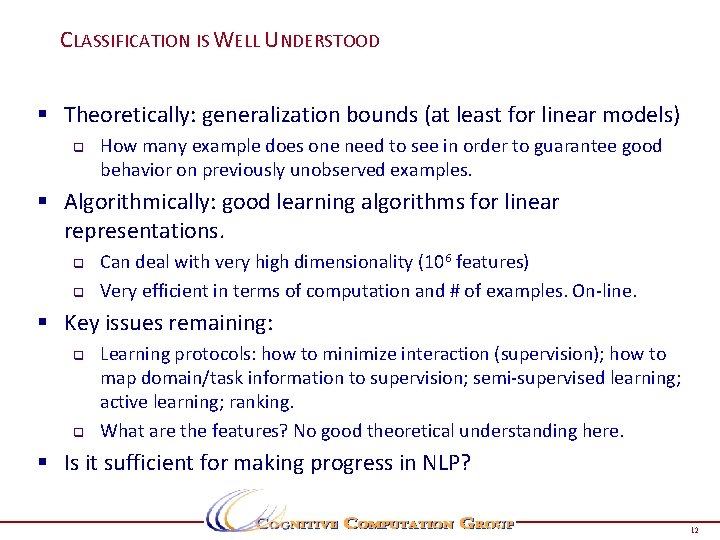
CLASSIFICATION IS WELL UNDERSTOOD § Theoretically: generalization bounds (at least for linear models) q How many example does one need to see in order to guarantee good behavior on previously unobserved examples. § Algorithmically: good learning algorithms for linear representations. q q Can deal with very high dimensionality (106 features) Very efficient in terms of computation and # of examples. On-line. § Key issues remaining: q q Learning protocols: how to minimize interaction (supervision); how to map domain/task information to supervision; semi-supervised learning; active learning; ranking. What are the features? No good theoretical understanding here. § Is it sufficient for making progress in NLP? 12 12
P a g e A STORY 1 (ENGLAND, June, 1989) - Christopher Robin is alive and well. He lives in England. He is the same person that you read about in the book, Winnie the 3 Pooh. As a boy, Chris lived in a pretty home called Cotchfield Farm. When Chris was three years old, his father wrote a poem about him. The poem was printed in a magazine for others to read. Mr. Robin then wrote a book. He made up a fairy tale land where Chris lived. His friends were animals. There was a bear called Winnie the Pooh. There was also an owl and a young pig, called a piglet. All the animals were stuffed toys that Chris owned. Mr. Robin made them come to life with his words. The places in the story were all near Cotchfield Farm. Winnie the Pooh was written in 1925. Children still love to read about Christopher Robin and his animal friends. Most people don't know he is a real person who is grown now. He has written two books of his own. They tell what it is like to be famous. 1. Christopher Robin was born in England. 3. Christopher Robin’s dad was a magician. 2. Winnie the Pooh is a title of a book. 4. Christopher Robin must be at least 65 now. This is an Inference Problem 13
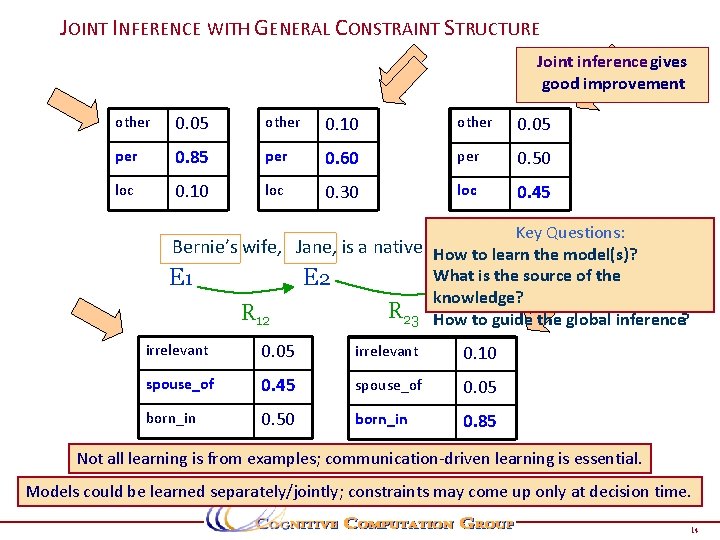
JOINT INFERENCE WITH GENERAL CONSTRAINT STRUCTUREENTITIES AND RELATIONS Joint inference gives good improvement other 0. 05 other 0. 10 other 0. 05 per 0. 85 per 0. 60 per 0. 50 loc 0. 10 loc 0. 30 loc 0. 45 Key Questions: Bernie’s wife, Jane, is a native of Brooklyn How to learn the model(s)? What is the E 1 E 2 E 3 source of the knowledge? R 23 How to guide the global inference? R 12 irrelevant 0. 05 irrelevant 0. 10 spouse_of 0. 45 spouse_of 0. 05 born_in 0. 50 born_in 0. 85 Not all learning is from examples; communication-driven learning is essential. Models could be learned separately/jointly; constraints may come up only at decision time. 14
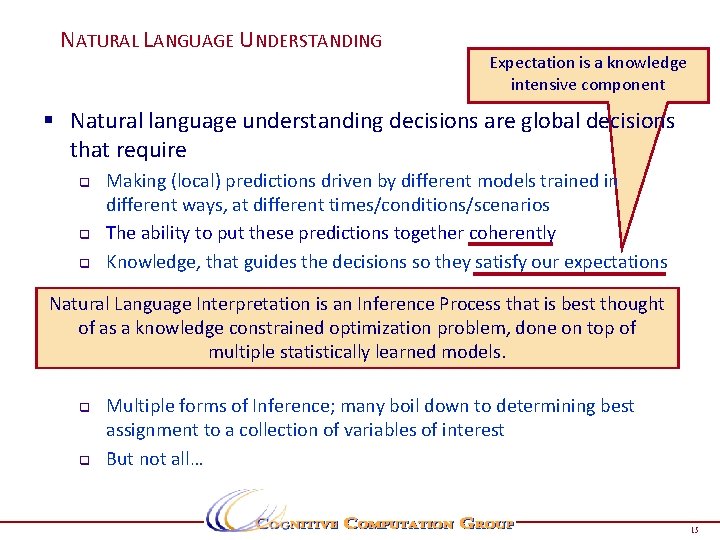
P a g e 1 5 NATURAL LANGUAGE UNDERSTANDING Expectation is a knowledge intensive component § Natural language understanding decisions are global decisions that require q q q Making (local) predictions driven by different models trained in different ways, at different times/conditions/scenarios The ability to put these predictions together coherently Knowledge, that guides the decisions so they satisfy our expectations Natural Language Interpretation is an Inference Process that is best thought of as a knowledge constrained optimization problem, done on top of multiple statistically learned models. q q Multiple forms of Inference; many boil down to determining best assignment to a collection of variables of interest But not all… 15
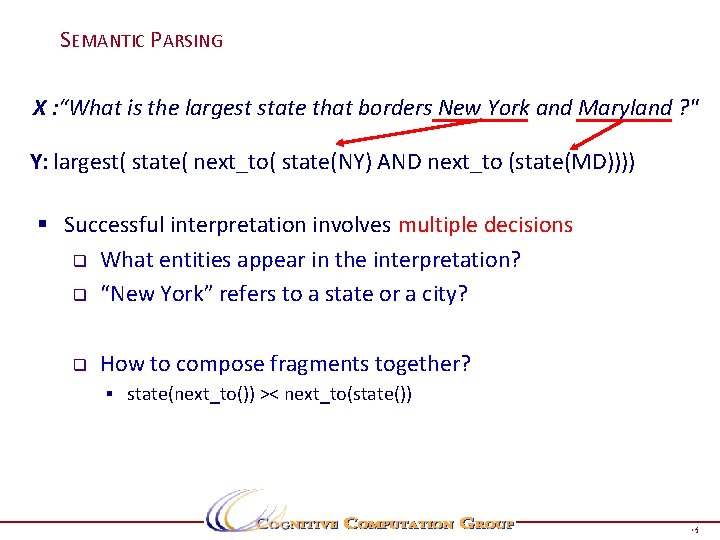
SEMANTIC PARSING X : “What is the largest state that borders New York and Maryland ? " Y: largest( state( next_to( state(NY) AND next_to (state(MD)))) § Successful interpretation involves multiple decisions q What entities appear in the interpretation? q “New York” refers to a state or a city? q How to compose fragments together? § state(next_to()) >< next_to(state()) Page 16
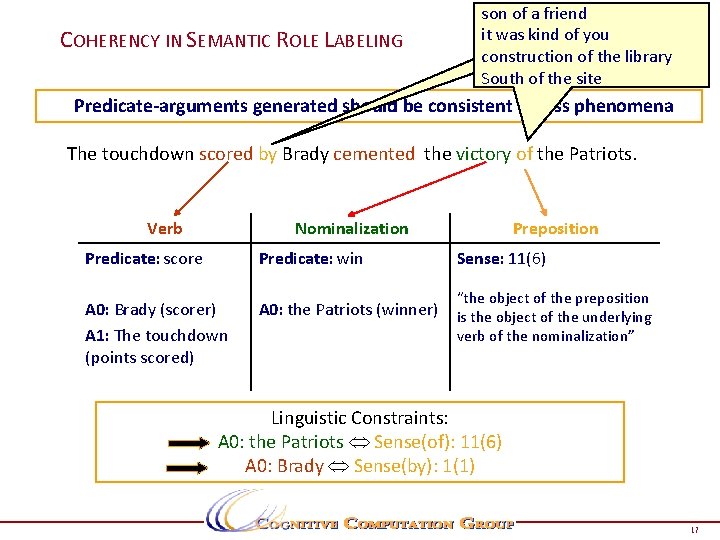
P a g e 1 7 COHERENCY IN SEMANTIC ROLE LABELING son of a friend byyou bus it Traveling was kind of book by Hemmingway construction of the library his son by his South of the sitethird wife Predicate-arguments generated should be consistent across phenomena The touchdown scored by Brady cemented the victory of the Patriots. Verb Nominalization Preposition Predicate: score Predicate: win Sense: 11(6) A 0: Brady (scorer) A 1: The touchdown (points scored) A 0: the Patriots (winner) “the object of the preposition is the object of the underlying verb of the nominalization” Linguistic Constraints: A 0: the Patriots Sense(of): 11(6) A 0: Brady Sense(by): 1(1) 17
LEARNING AND INFERENCE § Natural Language Decisions are Structured q Global decisions in which several local decisions play a role but there are mutual dependencies on their outcome. § It is essential to make coherent decisions in a way that takes the interdependencies into account. Joint, Global Inference. § Unlike “standard” classification problems, in most interesting NLP problems there is a need to predict values for multiple interdependent variables. § These are typically called Structured Output Problems – and will be the focus of this class. Page 18
STATISTICS OR LINGUISTICS? § Statistical approaches were very successful in NLP § But, it has become clear that there is a need to move from strictly Data Driven approaches to Knowledge Driven approaches § Knowledge: Linguistics, Background world knowledge § How to incorporate Knowledge into Learning & Decision Making? § In many respects Structured Prediction addresses this question. q This also distinguishes it from the “standard” study of probabilistic models. Page 19
HARD CO-REFERENCE PROBLEMS Knowledge representation ? § Requires knowledge Acquisition q The bee landed on the flower because it had/wanted pollen. § Lexical knowledge q John Doe robbed Jim Roy. He was arrested by the police. § The Subj of “rob” is more likely than the Obj of “rob” to be the Obj of “arrest” § Requires an inference framework that can make use of this knowledge § NL interpretation is an inference problem best modelled as a knowledge constrained optimization problem over multiple statistically learned models. Page 20
THIS CLASS § Problems q that will motivate us § Perspectives q q we’ll develop it’s not only the learning algorithm… § What we’ll do q and how Page 21
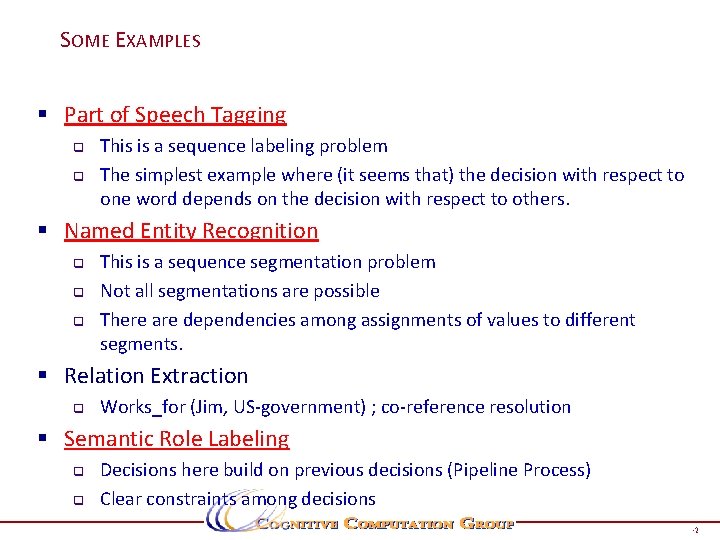
SOME EXAMPLES § Part of Speech Tagging q q This is a sequence labeling problem The simplest example where (it seems that) the decision with respect to one word depends on the decision with respect to others. § Named Entity Recognition q q q This is a sequence segmentation problem Not all segmentations are possible There are dependencies among assignments of values to different segments. § Relation Extraction q Works_for (Jim, US-government) ; co-reference resolution § Semantic Role Labeling q q Decisions here build on previous decisions (Pipeline Process) Clear constraints among decisions Page 22
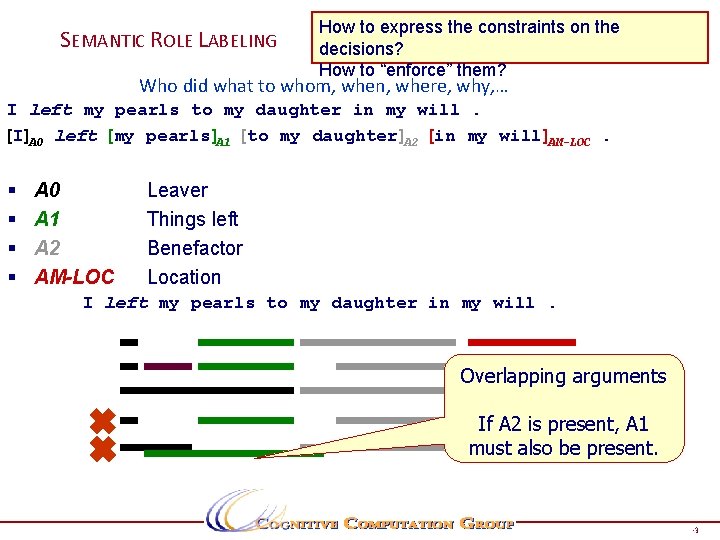
SEMANTIC ROLE LABELING How to express the constraints on the decisions? How to “enforce” them? Who did what to whom, when, where, why, … I left my pearls to my daughter in my will. [I]A 0 left [my pearls]A 1 [to my daughter]A 2 [in my will]AM-LOC. § § A 0 A 1 A 2 AM-LOC Leaver Things left Benefactor Location I left my pearls to my daughter in my will. Overlapping arguments If A 2 is present, A 1 must also be present. Page 23
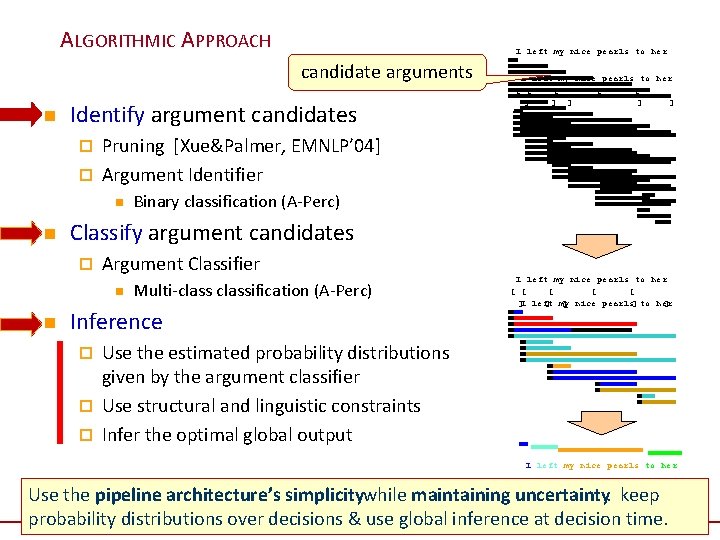
ALGORITHMIC APPROACH I left my nice pearls to her candidate arguments n Identify argument candidates I left my nice pearls to her [ [ [ ] ] ] Pruning [Xue&Palmer, EMNLP’ 04] ¨ Argument Identifier ¨ n n Classify argument candidates ¨ Argument Classifier n n Binary classification (A-Perc) Multi-classification (A-Perc) Inference I left my nice pearls to her [ [ [ ]I left ] my ] nice pearls] to her ] Use the estimated probability distributions given by the argument classifier ¨ Use structural and linguistic constraints ¨ Infer the optimal global output ¨ I left my nice pearls to her Use the pipeline architecture’s simplicitywhile maintaining uncertainty: keep probability distributions over decisions & use global inference at decision. Page time. 24 24
A Lot More Problems n POS/Shallow Parsing/NER n SRL n Parsing/Dependency Parsing n Information Extraction/Relation Extraction n Co-Reference Resolution n Transliteration n Textual Entailment Page 25
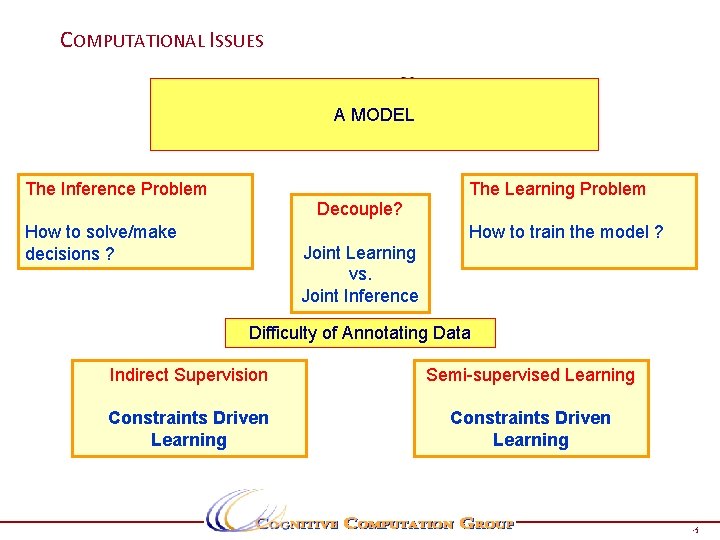
COMPUTATIONAL ISSUES A MODEL The Inference Problem The Learning Problem Decouple? How to solve/make decisions ? How to train the model ? Joint Learning vs. Joint Inference Difficulty of Annotating Data Indirect Supervision Semi-supervised Learning Constraints Driven Learning Page 26
PERSPECTIVE § Models q Generative/ Descriminative § Training q Supervised, Semi-Supervised, indirect supervision § Knowledge q q q Features Models Structure Declarative Information § Approach q q q Unify treatment Demistify Survey key ML techniques used in Structured NLP Page 27
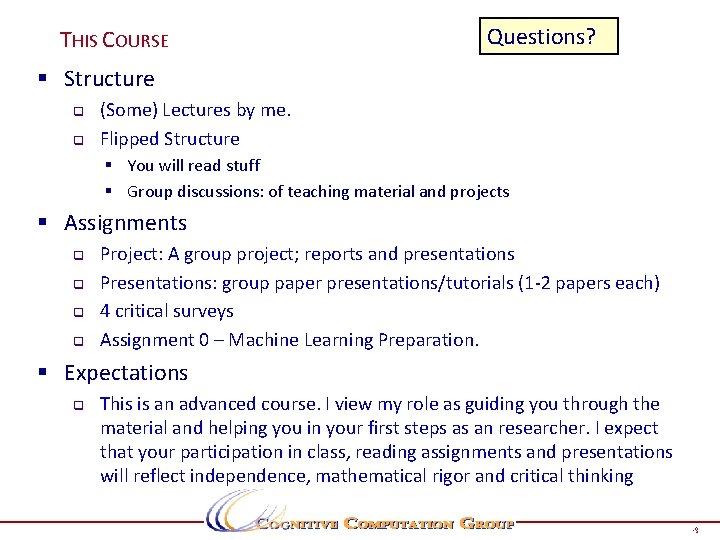
THIS COURSE Questions? § Structure q q (Some) Lectures by me. Flipped Structure § You will read stuff § Group discussions: of teaching material and projects § Assignments q q Project: A group project; reports and presentations Presentations: group paper presentations/tutorials (1 -2 papers each) 4 critical surveys Assignment 0 – Machine Learning Preparation. § Expectations q This is an advanced course. I view my role as guiding you through the material and helping you in your first steps as an researcher. I expect that your participation in class, reading assignments and presentations will reflect independence, mathematical rigor and critical thinking Page 28
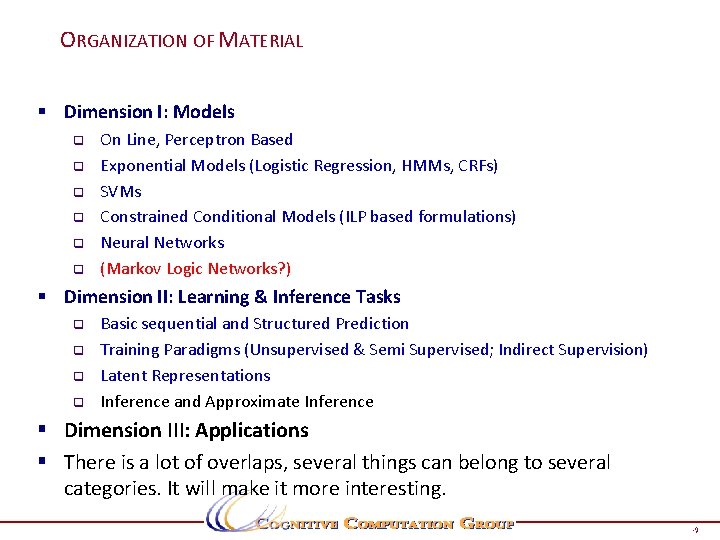
ORGANIZATION OF MATERIAL § Dimension I: Models q q q On Line, Perceptron Based Exponential Models (Logistic Regression, HMMs, CRFs) SVMs Constrained Conditional Models (ILP based formulations) Neural Networks (Markov Logic Networks? ) § Dimension II: Learning & Inference Tasks q q Basic sequential and Structured Prediction Training Paradigms (Unsupervised & Semi Supervised; Indirect Supervision) Latent Representations Inference and Approximate Inference § Dimension III: Applications § There is a lot of overlaps, several things can belong to several categories. It will make it more interesting. Page 29
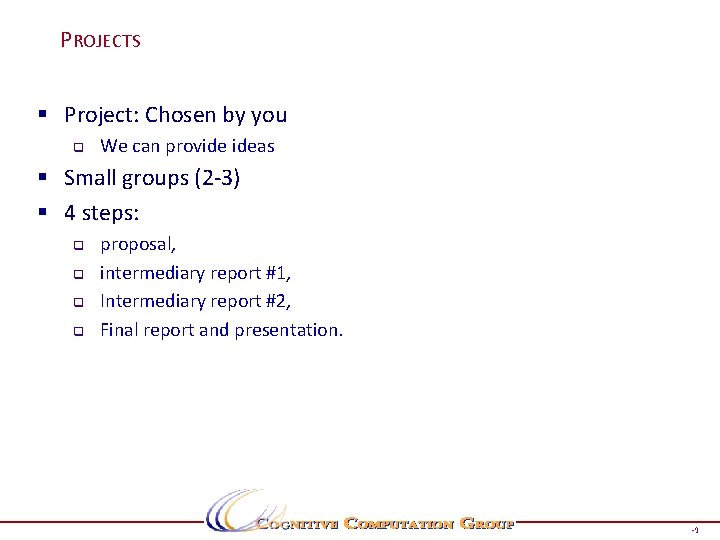
PROJECTS § Project: Chosen by you q We can provide ideas § Small groups (2 -3) § 4 steps: q q proposal, intermediary report #1, Intermediary report #2, Final report and presentation. Page 30
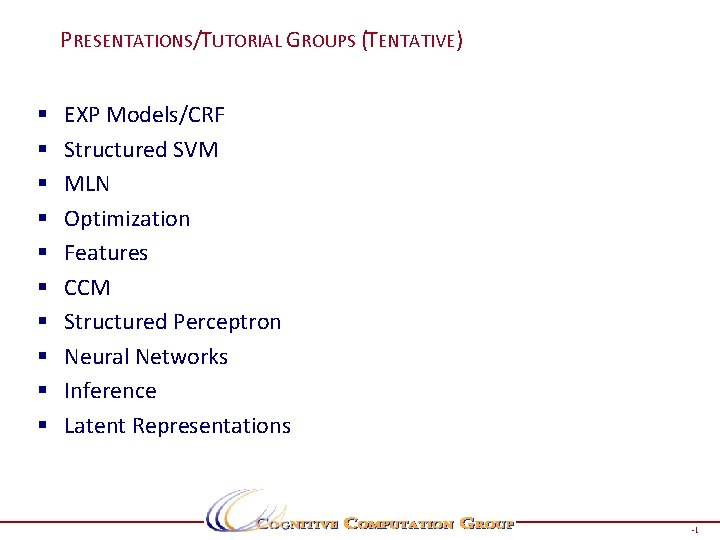
PRESENTATIONS/TUTORIAL GROUPS (TENTATIVE) § § § § § EXP Models/CRF Structured SVM MLN Optimization Features CCM Structured Perceptron Neural Networks Inference Latent Representations Page 31
SUMMARY § Class will be taught (mostly) as a flipped seminar + a project § Tues/Thurs meetings might be replaced by Friday morning meetings, say. § Critical readings of papers + Projects + Presentation § Attendance is mandatory § If you want to drop the class, do it quickly – not to affect the projects. § Web site with all the information is already available. • On Thursday, I will hand you a Homework 0: • A ML prerequisites Exam (take home: 3 hours). Page 32