
CIS 640 Writing in Computer Science Research Lecture




- Slides: 46
CIS 640 Writing in Computer Science Research “Lecture 1”: Class Overview September 28, 2021 Hank Childs, University of Oregon
Disclaimers • I love teaching this class • We have had some great groups – Enjoyed our class time – Learned a lot • Some of these slides are harsh – sorry – (“Do this or No Pass”)
Class Webpage • https: //classes. cs. uoregon. edu/21 F /cis 640/ • These slides are posted on the class webpage
Course Outcomes • The main goal of this course is for students develop their writing ability for computer science research. • Students will submit writing samples, and provide and accept constructive criticism with their peers, in a workshop format. • Students also may read and discuss authoritative texts on technical writing. • Throughout the term, students will apply what they learn to their writing.
Course Outcomes • The main goal of this course is for students develop their writing ability for computer science research. • Students will submit writing samples, and provide and accept constructive criticism with their peers, in a workshop format. • Students also may read and discuss authoritative texts on technical writing. • Throughout the term, students will apply what they learn to their writing.
Course Outcomes • The main goal of this course is for students develop their writing ability for computer science research. • Students will submit writing samples, and provide and accept constructive criticism with their peers, in a workshop format. • Students also may read and discuss authoritative texts on technical writing. • Throughout the term, students will apply what they learn to their writing.
Course Outcomes • The main goal of this course is for students develop their writing ability for computer science research. • Students will submit writing samples, and provide and accept constructive criticism with their peers, in a workshop format. • Students also may read and discuss authoritative texts on technical writing. • Throughout the term, students will apply what they learn to their writing.
Learning Outcomes • Develop writing skills consistent with producing a research paper in computer science. Most activities will occur in a workshop format. – Effective writing at the sentence-level. – Organization of a research paper, including important elements of each section in a research paper (for example, the important elements in an introduction, in related work, etc. ). – Writing from the perspective of the peer review process. This includes both how writing may be interpreted during peer review and the process of peer review itself (conferences and journals).
Learning Outcomes • Develop writing skills consistent with producing a research paper in computer science. Most activities will occur in a workshop format. – Effective writing at the sentence-level. – Organization of a research paper, including important elements of each section in a research paper (for example, the important elements in an introduction, in related work, etc. ). – Writing from the perspective of the peer review process. This includes both how writing may be interpreted during peer review and the process of peer review itself (conferences and journals).
Learning Outcomes • Develop writing skills consistent with producing a research paper in computer science. Most activities will occur in a workshop format. – Effective writing at the sentence-level. – Organization of a research paper, including important elements of each section in a research paper (for example, the important elements in an introduction, in related work, etc. ). – Writing from the perspective of the peer review process. This includes both how writing may be interpreted during peer review and the process of peer review itself (conferences and journals).
Learning Outcomes • Develop writing skills consistent with producing a research paper in computer science. Most activities will occur in a workshop format. – Effective writing at the sentence-level. – Organization of a research paper, including important elements of each section in a research paper (for example, the important elements in an introduction, in related work, etc. ). – Writing from the perspective of the peer review process. This includes both how writing may be interpreted during peer review and the process of peer review itself (conferences and journals).
Course Prerequisite • Must be writing something this term – Ph. D students: • Typically DRP or Area Exam • Could be dissertation or a paper • Fellowship proposal – MS students: • MS thesis • Survey paper (did you do a survey for 630 or 631? )
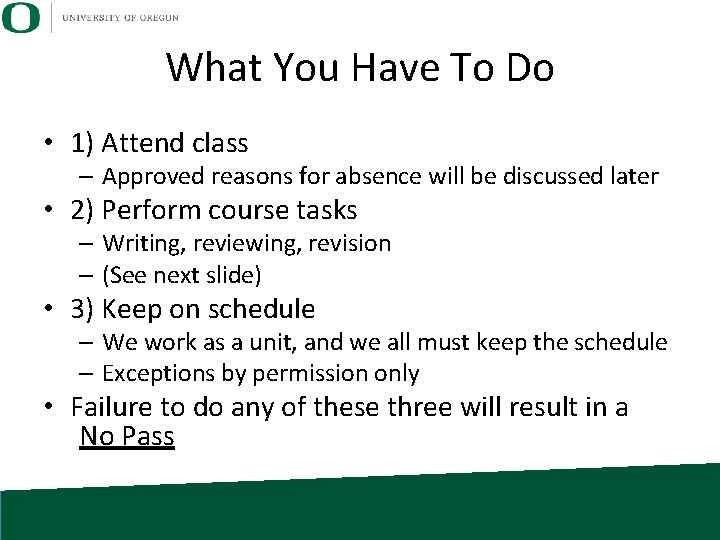
What You Have To Do • 1) Attend class – Approved reasons for absence will be discussed later • 2) Perform course tasks – Writing, reviewing, revision – (See next slide) • 3) Keep on schedule – We work as a unit, and we all must keep the schedule – Exceptions by permission only • Failure to do any of these three will result in a No Pass
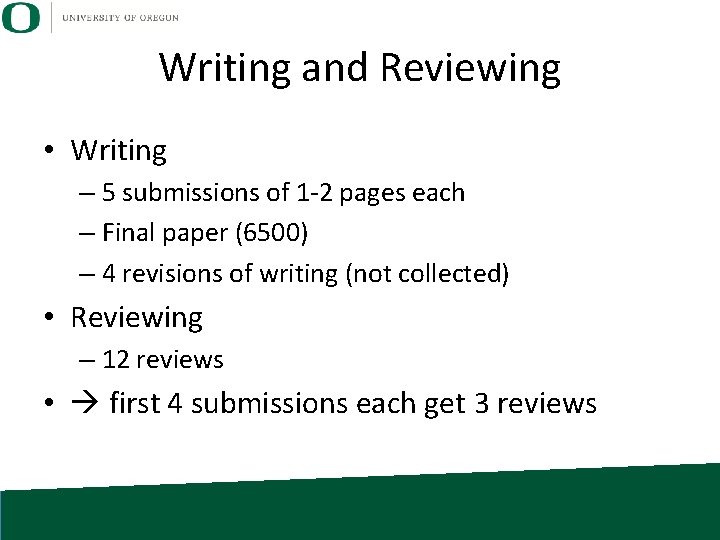
Writing and Reviewing • Writing – 5 submissions of 1 -2 pages each – Final paper (6500) – 4 revisions of writing (not collected) • Reviewing – 12 reviews • first 4 submissions each get 3 reviews
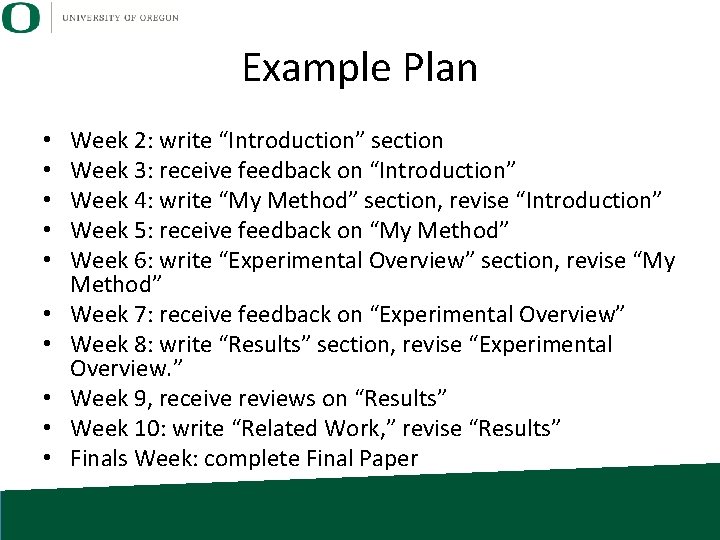
Example Plan • • • Week 2: write “Introduction” section Week 3: receive feedback on “Introduction” Week 4: write “My Method” section, revise “Introduction” Week 5: receive feedback on “My Method” Week 6: write “Experimental Overview” section, revise “My Method” Week 7: receive feedback on “Experimental Overview” Week 8: write “Results” section, revise “Experimental Overview. ” Week 9, receive reviews on “Results” Week 10: write “Related Work, ” revise “Results” Finals Week: complete Final Paper
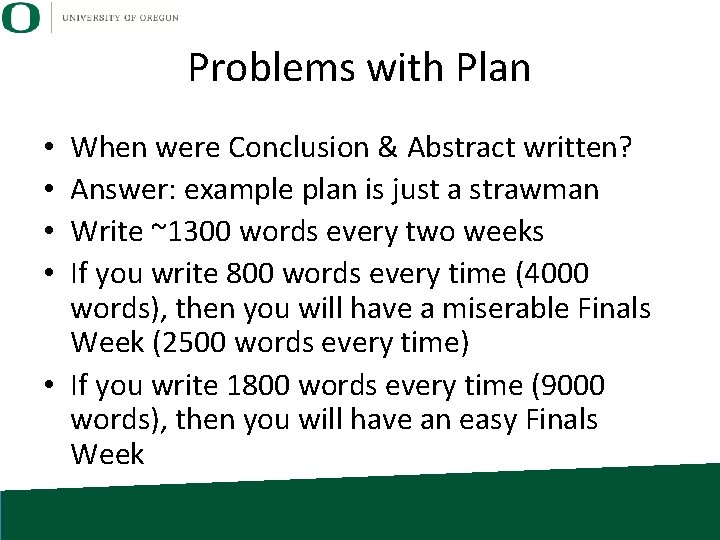
Problems with Plan When were Conclusion & Abstract written? Answer: example plan is just a strawman Write ~1300 words every two weeks If you write 800 words every time (4000 words), then you will have a miserable Finals Week (2500 words every time) • If you write 1800 words every time (9000 words), then you will have an easy Finals Week • •
Final Paper • Length: 6500 words – This will use all the text from 1 st 5 submissions • Why 6500 words? approx. word count from IEEE 8 page paper, double column • Final paper must be submission quality • Due Monday Dec 6 th, 1230 pm – We will revisit on Week 8 and see if we should extend
What does “submission” quality mean? • When you “submit” a paper to a conference or journal, you are expecting 100 s of people to read it • The author (you) should work hard to make the paper as accessible as possible
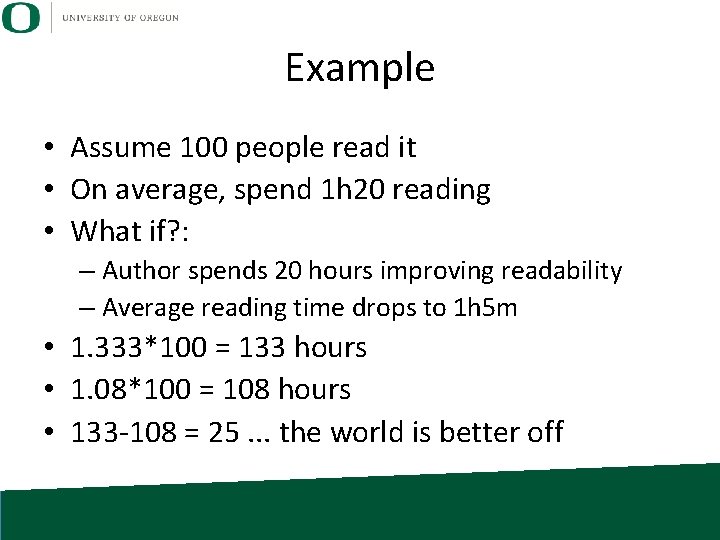
Example • Assume 100 people read it • On average, spend 1 h 20 reading • What if? : – Author spends 20 hours improving readability – Average reading time drops to 1 h 5 m • 1. 333*100 = 133 hours • 1. 08*100 = 108 hours • 133 -108 = 25. . . the world is better off
More on “Submission” Quality • I review a ton of papers – If someone has not done me the courtesy of making my experience as efficient as possible, then it puts me in a bad mood • This is a very different setting than writing a term paper for a class (one author, one reader)
4 Reviews • Each review must have the following: – 5 -10 grammatical / wordsmithing suggestions • If the writing is great, then 5 • If the paper is rough, you stop at 10 – 3 “big picture” suggestions on how to improve
Revisions • Each revision should take into account reviews and fix all problems • We will not collect revisions • . . . but your final paper should reflect fixes that came from your reviews
Participation • Every student will attend lecture and participate in peer review of cohort's writing samples • Every student will offer up text for group review
Logistics (1/2) • Will be run through Easy. Chair – Easy. Chair link on class website – (I know Canvas is beloved) • Reviews must be completed 5 days after assignment – Can go “on vacation”
Logistics (2/2) End of Week Min # of submissions Min # of reviews completed 2 1 0 4 2 3 6 8 4 9 10 5 12 Finals 5+1 final paper 12 If you fall behind the minimums at any of these weeks, then you will receive a “NP” in the course (This class only works if everyone is making steady progress)
How Will We Spend Class Time? • Look at writing examples and collectively edit – While this seems like it might be uncomfortable, it has been OK so far – We are each on a personal journey to become our best writing self • Also, I can talk about topics as needed – How papers are accepted? – What should go in each section? – Other?
My Own Personal Writing Story • Summary: – poor writer as a Ph. D student, good writer now • Observations: – writing improves and is easier as you practice – I used to hate writing and now _enjoy_ it – students often put way too little time into writing • since they hate doing it • coding is more fun
Anna Karenina Principle • “All happy families are alike; each unhappy family is unhappy in its own way” • While each problematic paper is uniquely unhappy, there are common themes • We will be collectively identifying “unhappy families” themes throughout the term
“Unhappy Families” From Hank (1/3) • (1) every sentence reads well, but the whole is a jumbled mess – No sense of purpose per paragraph / section – Facts appear in random places • (2) only makes sense if the reader already knows what you are talking about • (3) procrastinate, write hastily and declare done and then get co -authors to fix
“Unhappy Families” From Hank (1/3) • (1) every sentence reads well, but the whole is a jumbled mess – No sense of purpose per paragraph / section – Facts appear in random places • (2) only makes sense if the reader already knows what you are talking about • (3) procrastinate, write hastily and declare done and then get co -authors to fix
“Unhappy Families” From Hank (1/3) • (1) every sentence reads well, but the whole is a jumbled mess – No sense of purpose per paragraph / section – Facts appear in random places • (2) only makes sense if the reader already knows what you are talking about • (3) procrastinate, write hastily and declare done and then get co -authors to fix
“Unhappy Families” from Hank (2/3) • (4) Writing is overly complicated – Example: • lots and lots of clauses, • Clauses are not well connected – leave it to the reader to figure out how they relate • say what the subject is at the end of the sentence • (5) Writer assumes the reader is as fascinated by the topic as the author and will endure endless details because of their mutual shared fascination
“Unhappy Families” from Hank (2/3) • (4) Writing is overly complicated – Example: • lots and lots of clauses, • Clauses are not well connected – leave it to the reader to figure out how they relate • say what the subject is at the end of the sentence • (5) Writer assumes the reader is as fascinated by the topic as the author and will endure endless details because of their mutual shared fascination
“Unhappy Families” from Hank (3/3) • (6) Writer assumes too much knowledge • (7) Writer assumes too little knowledge • (8) Writer has not properly digested/synthesized their own work, and expects reader to be excited about learning details and also expect the reader to do this digesting/synthesis on their behalf
“Unhappy Families” from Hank (3/3) • (6) Writer assumes too much knowledge • (7) Writer assumes too little knowledge • (8) Writer has not properly digested/synthesized their own work, and expects reader to be excited about learning details and also expect the reader to do this digesting/synthesis on their behalf
“Unhappy Families” from Hank (3/3) • (6) Writer assumes too much knowledge • (7) Writer assumes too little knowledge • (8) Writer has not properly digested/synthesized their own work, and expects reader to so excited about that their work that the reader will do this digesting/synthesis on their behalf
Non-Native Speakers • You may consider typing in MS-Word • This way MS-Word will catch many problems before they make it to your reviews
Pitfalls: Area Exam • This class has worked well when Area Exam document is already in progress • Not as good for those just starting, unless you can really devote yourself • • Typical Area Exam: 20 pages, 6 months of 30 hours/week ~40 hours of effort per page This class: 8 pages, 10 weeks of 8 hours/week (for 640) 10 hours of effort per page (? ? ? )
Pitfalls: DRP / Research Paper • Can be harrowing if results are coming “just in time” for paper writing • Remediation: – focus on what you can do – write good sentences that are factually wrong and revise when the real results come – Deliver 8 pages of mashup: 6 pages of DRP, 2 pages of Area Exam
Pitfalls: MS • In my previous offerings, we had no MS students • If you are doing a thesis or research paper, then this will be like Ph. D students • If not, then you should do a survey – Perhaps you join forces on what to survey? – I am softer on “submission quality” standards here – this is an 8 hour / week course – That said, it must be 8 pages, IEEE format
How to Begin? • For you doing your writing? – Pick a section and write it • by <when>? – Note: there are often slight variations in how papers are organized between fields • For this class? – Two volunteers who can be ready in one week?
COVID! • We will all wear masks the whole term • If you have a concern about spreading COVID, then skip class – But email me BEFOREHAND • More info on syllabus
Attendance is Mandatory, Except When. . . • A student is concerned about spreading illness, in which case they should contact the instructor before class begins and stay home. • A student has received permission from the instructor ahead of time to miss the course. Such reasons should be significant (attending a conference or wedding) and not insignificant (need to be home to receive a package). • An unforeseeable event, such as a flat tire or the public bus fails to run. In this case, the student should do their best to contact the instructor.
Let’s Introduce Ourselves
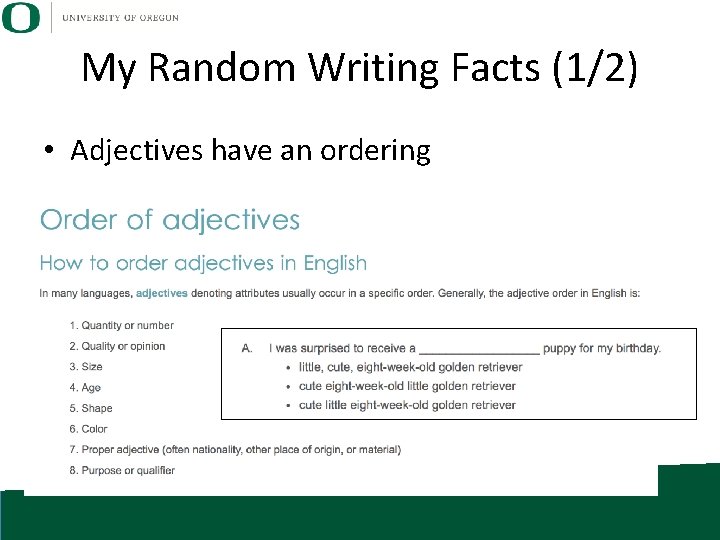
My Random Writing Facts (1/2) • Adjectives have an ordering
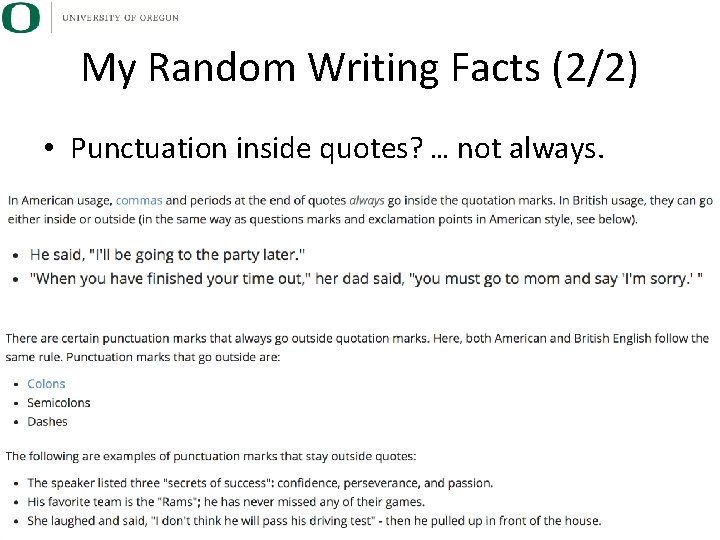
My Random Writing Facts (2/2) • Punctuation inside quotes? … not always.