
CIS 5365 Entity Relationship Diagrams Chapter 3 EntityRelationship
- Slides: 35
CIS 5365 Entity Relationship Diagrams Chapter 3: Entity-Relationship Modeling: Part 1 1
CIS 5365 Entity Relationship Diagrams 2 The Entity Relationship Diagram (ERD) • Developed by Chen (1976) • THE Most commonly used data modeling tool • Shows the structure, requirements and constraints of the intended system, independent of software (DBMS), at a higher level of abstraction • Tool for communications between database designers and users • Also used as a planning/organization tool
3 A Quick Aside: • How many times have you been shown a model in a class only to find out it is useless ? ? Too Many !!! • This is NOT one of those times -- • ERDs form the foundation of all database modeling • It is IMPOSSIBLE to develop a working Database without them
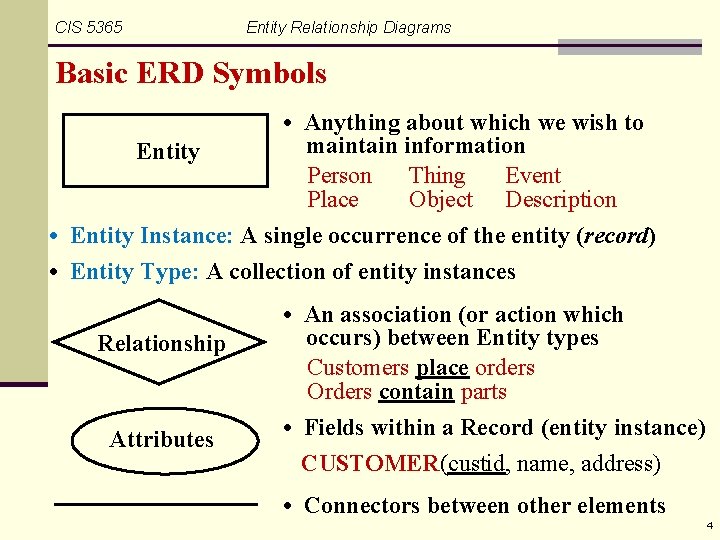
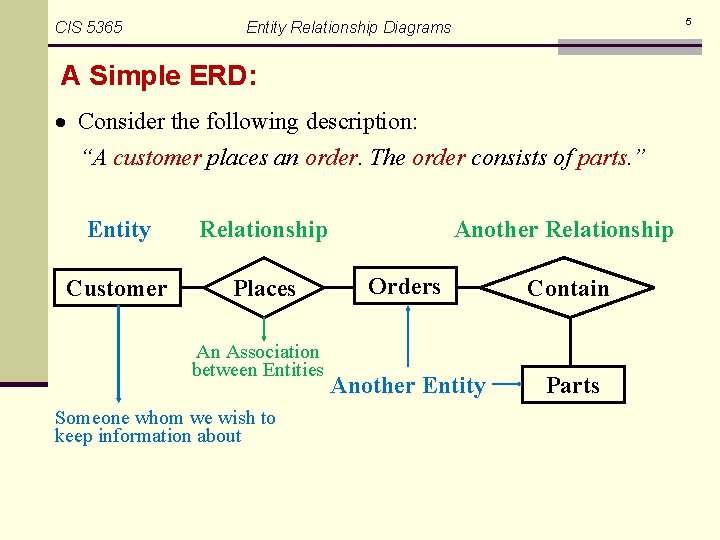
CIS 5365 Entity Relationship Diagrams Basic ERD Symbols • Anything about which we wish to maintain information Entity Person Thing Event Place Object Description • Entity Instance: A single occurrence of the entity (record) • Entity Type: A collection of entity instances Relationship Attributes • An association (or action which occurs) between Entity types Customers place orders Orders contain parts • Fields within a Record (entity instance) CUSTOMER(custid, name, address) • Connectors between other elements 4
CIS 5365 5 Entity Relationship Diagrams A Simple ERD: Consider the following description: “A customer places an order. The order consists of parts. ” Entity Relationship Customer Places An Association between Entities Someone whom we wish to keep information about Another Relationship Orders Contain Another Entity Parts
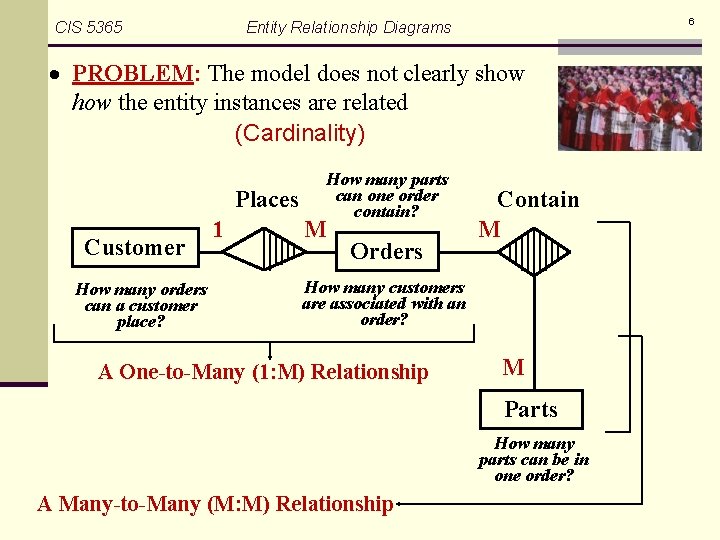
CIS 5365 6 Entity Relationship Diagrams PROBLEM: The model does not clearly show the entity instances are related (Cardinality) Places Customer How many orders can a customer place? 1 How many parts can one order contain? M Orders Contain M How many customers are associated with an order? A One-to-Many (1: M) Relationship M Parts How many parts can be in one order? A Many-to-Many (M: M) Relationship
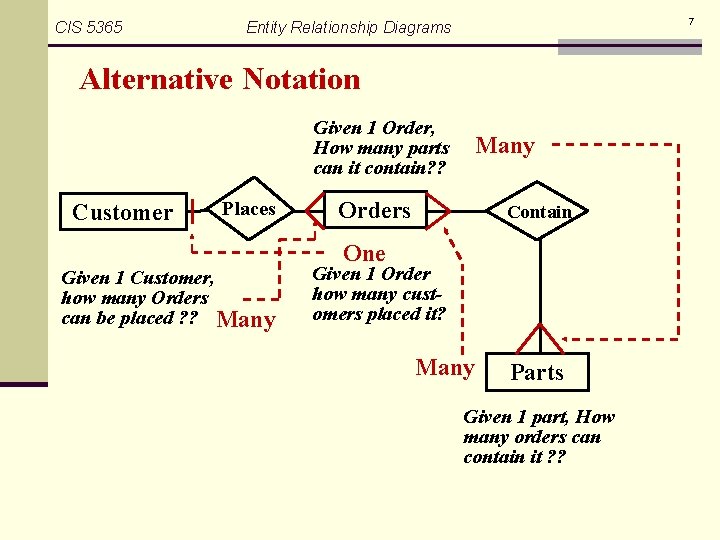
CIS 5365 7 Entity Relationship Diagrams Alternative Notation Given 1 Order, How many parts can it contain? ? Customer Places Given 1 Customer, how many Orders can be placed ? ? Many Orders Contain One Given 1 Order how many customers placed it? Many Parts Given 1 part, How many orders can contain it ? ?
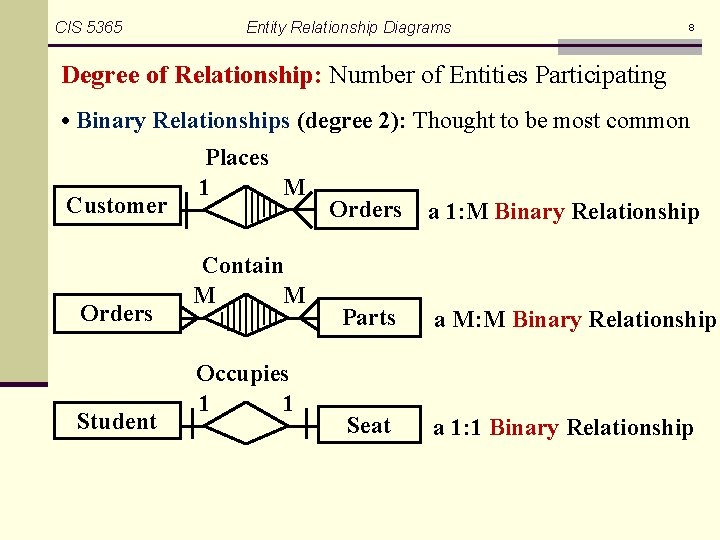
CIS 5365 Entity Relationship Diagrams 8 Degree of Relationship: Number of Entities Participating • Binary Relationships (degree 2): Thought to be most common Customer Orders Student Places 1 M Contain M M Occupies 1 1 Orders a 1: M Binary Relationship Parts a M: M Binary Relationship Seat a 1: 1 Binary Relationship
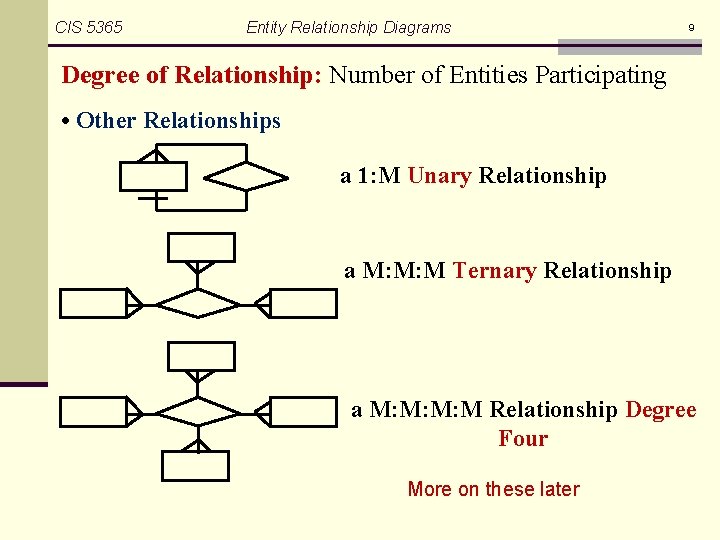
CIS 5365 Entity Relationship Diagrams 9 Degree of Relationship: Number of Entities Participating • Other Relationships a 1: M Unary Relationship a M: M: M Ternary Relationship a M: M: M: M Relationship Degree Four More on these later
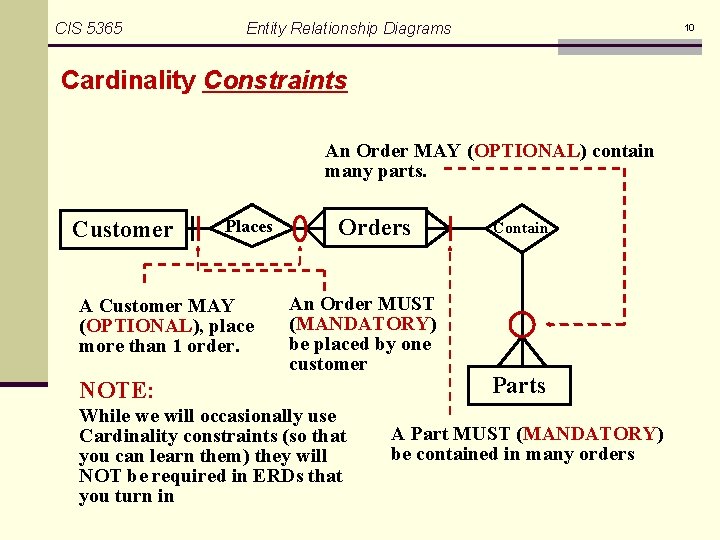
CIS 5365 Entity Relationship Diagrams 10 Cardinality Constraints An Order MAY (OPTIONAL) contain many parts. Customer Places A Customer MAY (OPTIONAL), place more than 1 order. Orders An Order MUST (MANDATORY) be placed by one customer NOTE: While we will occasionally use Cardinality constraints (so that you can learn them) they will NOT be required in ERDs that you turn in Contain Parts A Part MUST (MANDATORY) be contained in many orders
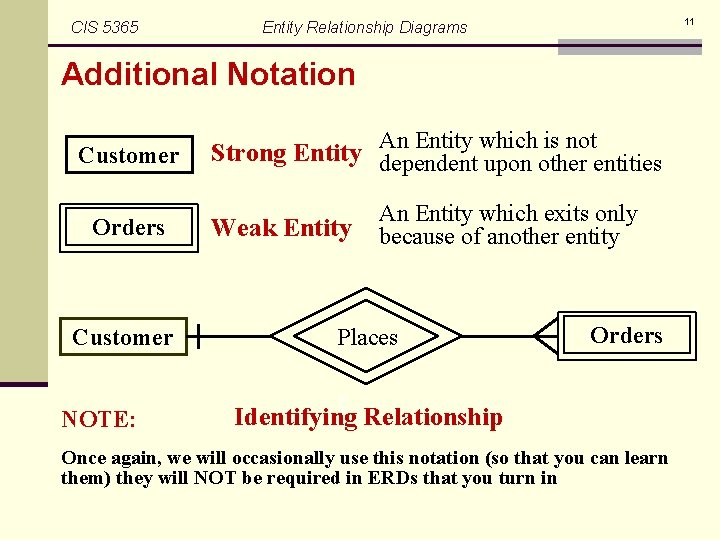
CIS 5365 11 Entity Relationship Diagrams Additional Notation Customer Orders Customer NOTE: Entity which is not Strong Entity An dependent upon other entities Weak Entity An Entity which exits only because of another entity Places Orders Identifying Relationship Once again, we will occasionally use this notation (so that you can learn them) they will NOT be required in ERDs that you turn in
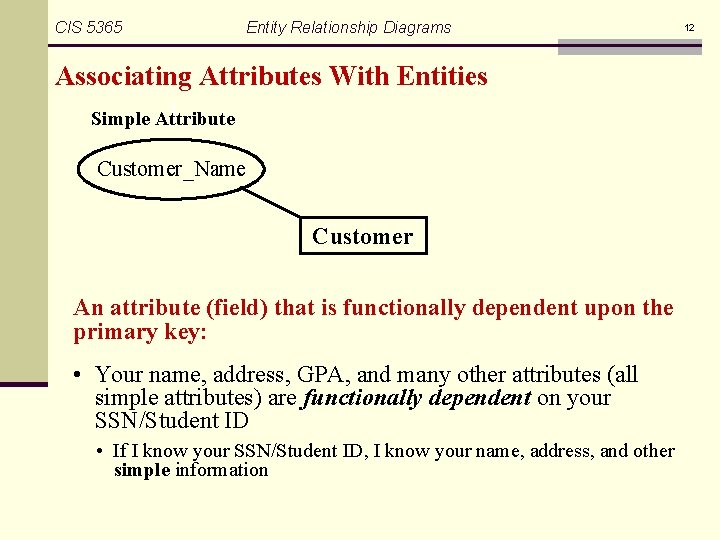
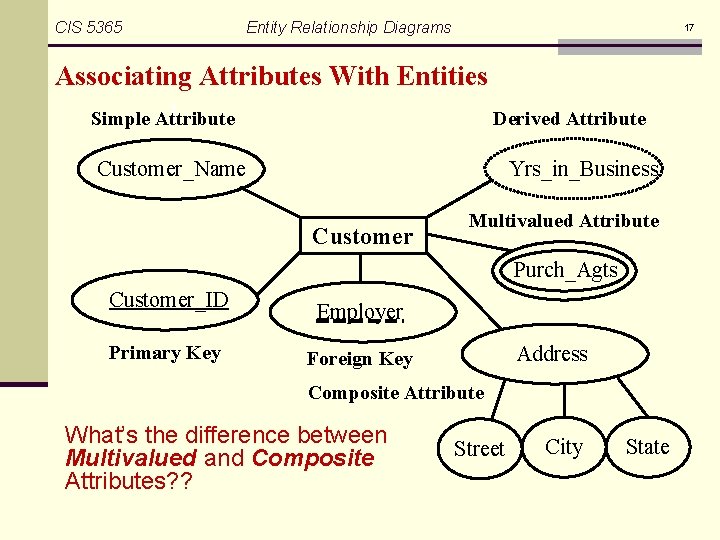
CIS 5365 Entity Relationship Diagrams Associating Attributes With Entities Simple Attribute Customer_Name Customer An attribute (field) that is functionally dependent upon the primary key: • Your name, address, GPA, and many other attributes (all simple attributes) are functionally dependent on your SSN/Student ID • If I know your SSN/Student ID, I know your name, address, and other simple information 12
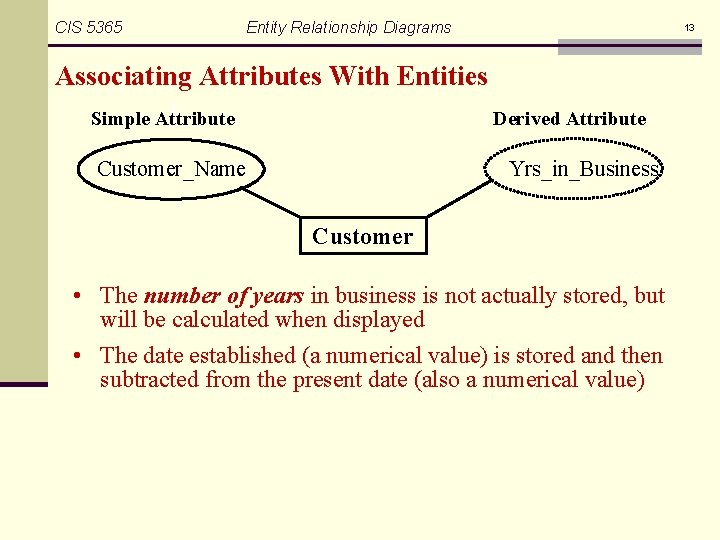
CIS 5365 Entity Relationship Diagrams 13 Associating Attributes With Entities Simple Attribute Derived Attribute Yrs_in_Business Customer_Name Customer • The number of years in business is not actually stored, but will be calculated when displayed • The date established (a numerical value) is stored and then subtracted from the present date (also a numerical value)
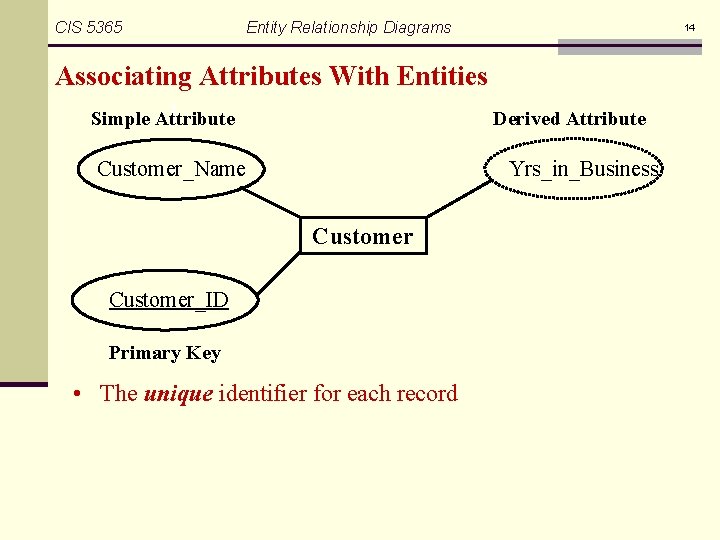
CIS 5365 Entity Relationship Diagrams 14 Associating Attributes With Entities Simple Attribute Derived Attribute Yrs_in_Business Customer_Name Customer_ID Primary Key • The unique identifier for each record
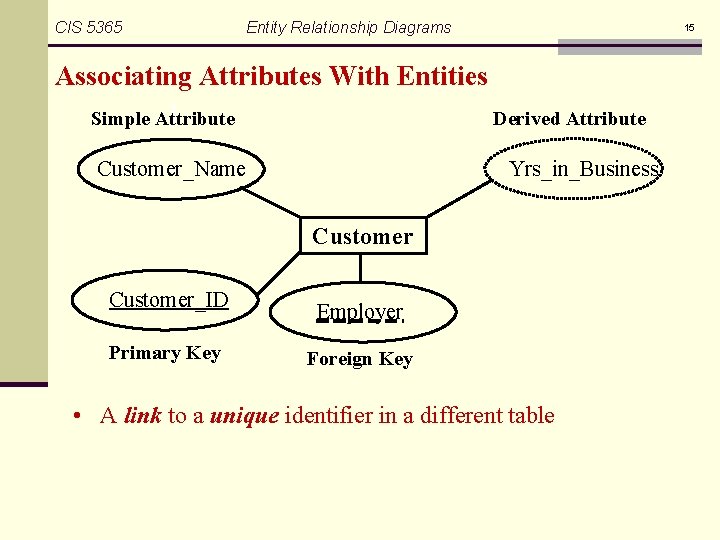
CIS 5365 Entity Relationship Diagrams 15 Associating Attributes With Entities Simple Attribute Derived Attribute Yrs_in_Business Customer_Name Customer_ID Primary Key Employer Foreign Key • A link to a unique identifier in a different table
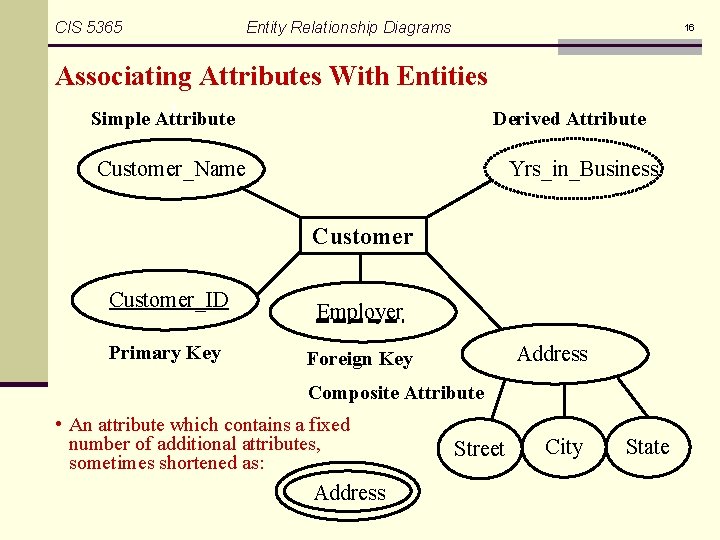
CIS 5365 Entity Relationship Diagrams 16 Associating Attributes With Entities Simple Attribute Derived Attribute Yrs_in_Business Customer_Name Customer_ID Primary Key Employer Address Foreign Key Composite Attribute • An attribute which contains a fixed number of additional attributes, sometimes shortened as: Address Street City State
CIS 5365 Entity Relationship Diagrams 17 Associating Attributes With Entities Simple Attribute Derived Attribute Yrs_in_Business Customer_Name Customer Multivalued Attribute Purch_Agts Customer_ID Primary Key Employer Address Foreign Key Composite Attribute What’s the difference between Multivalued and Composite Attributes? ? Street City State
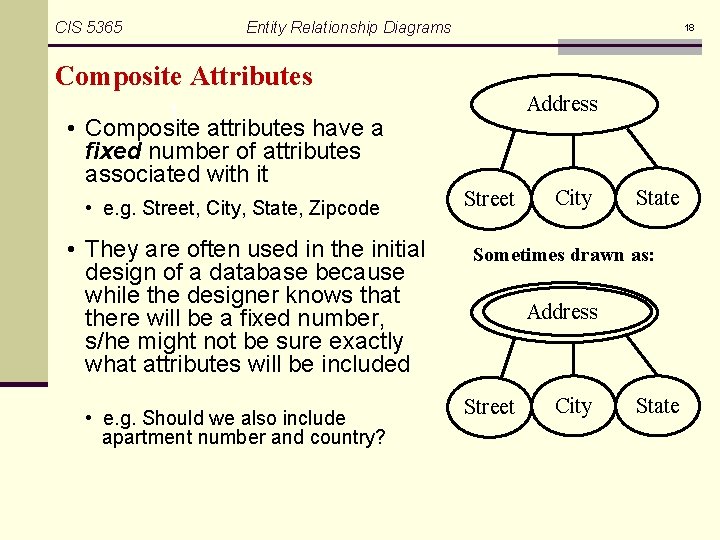
CIS 5365 Entity Relationship Diagrams 18 Composite Attributes • Composite attributes have a fixed number of attributes associated with it • e. g. Street, City, State, Zipcode • They are often used in the initial design of a database because while the designer knows that there will be a fixed number, s/he might not be sure exactly what attributes will be included • e. g. Should we also include apartment number and country? Address Street City State Sometimes drawn as: Address Street City State
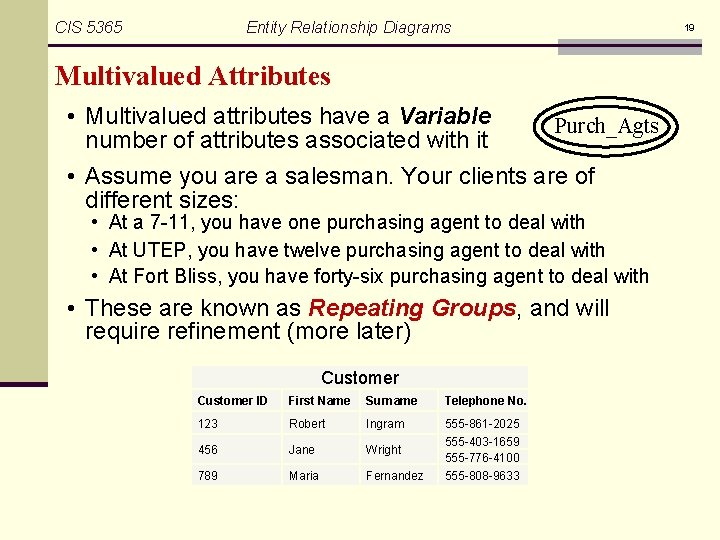
CIS 5365 Entity Relationship Diagrams 19 Multivalued Attributes • Multivalued attributes have a Variable number of attributes associated with it Purch_Agts • Assume you are a salesman. Your clients are of different sizes: • At a 7 -11, you have one purchasing agent to deal with • At UTEP, you have twelve purchasing agent to deal with • At Fort Bliss, you have forty-six purchasing agent to deal with • These are known as Repeating Groups, and will require refinement (more later) Customer ID First Name Surname Telephone No. 123 Robert Ingram 555 -861 -2025 456 Jane Wright 555 -403 -1659 555 -776 -4100 789 Maria Fernandez 555 -808 -9633
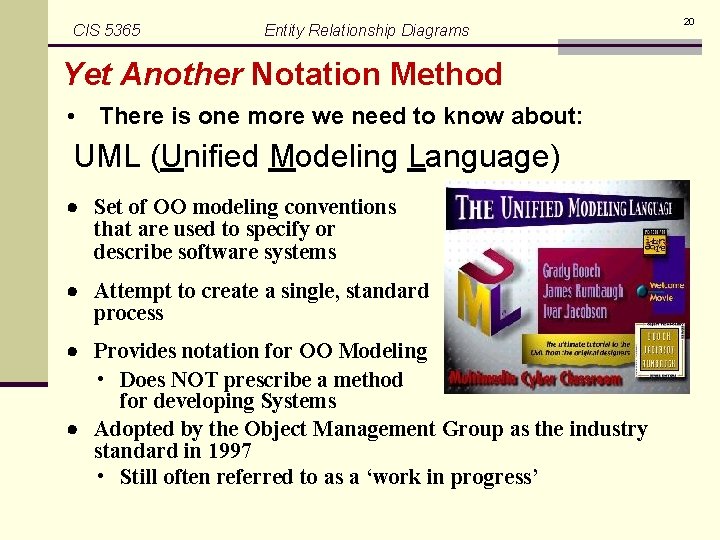
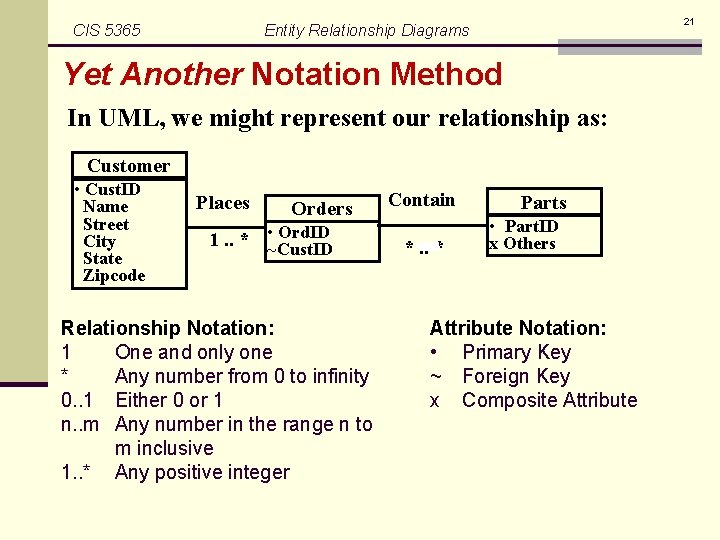
CIS 5365 Entity Relationship Diagrams Yet Another Notation Method • There is one more we need to know about: UML (Unified Modeling Language) Set of OO modeling conventions that are used to specify or describe software systems Attempt to create a single, standard process Provides notation for OO Modeling • Does NOT prescribe a method for developing Systems Adopted by the Object Management Group as the industry standard in 1997 • Still often referred to as a ‘work in progress’ 20
CIS 5365 21 Entity Relationship Diagrams Yet Another Notation Method In UML, we might represent our relationship as: Customer • Cust. ID Name Street City State Zipcode Places Orders Ord. ID 1. . * • ~Cust. ID Relationship Notation: 1 One and only one * Any number from 0 to infinity 0. . 1 Either 0 or 1 n. . m Any number in the range n to m inclusive 1. . * Any positive integer Contain *. . * Parts • Part. ID x Others Attribute Notation: • Primary Key ~ Foreign Key x Composite Attribute
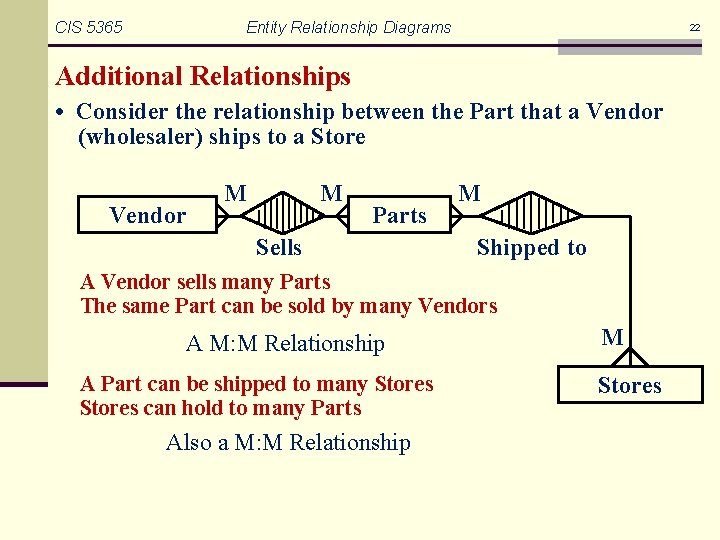
CIS 5365 Entity Relationship Diagrams 22 Additional Relationships • Consider the relationship between the Part that a Vendor (wholesaler) ships to a Store Vendor M M Parts Sells M Shipped to A Vendor sells many Parts The same Part can be sold by many Vendors A M: M Relationship A Part can be shipped to many Stores can hold to many Parts Also a M: M Relationship M Stores
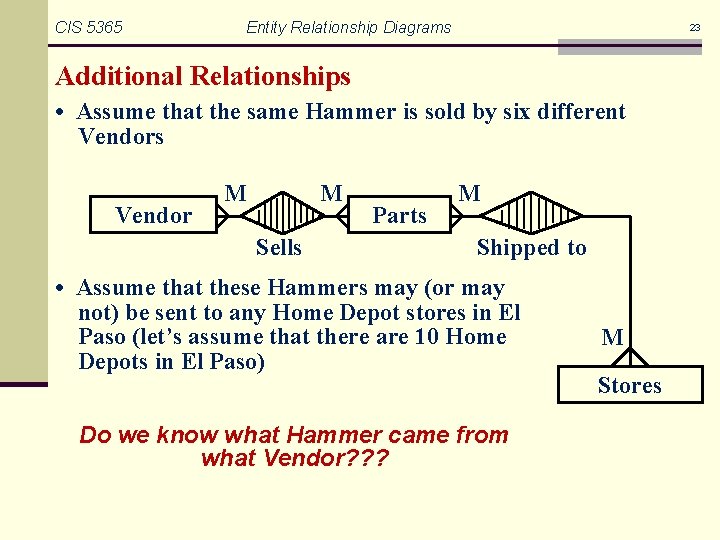
CIS 5365 Entity Relationship Diagrams 23 Additional Relationships • Assume that the same Hammer is sold by six different Vendors Vendor M M Sells Parts M Shipped to • Assume that these Hammers may (or may not) be sent to any Home Depot stores in El Paso (let’s assume that there are 10 Home Depots in El Paso) Do we know what Hammer came from what Vendor? ? ? M Stores
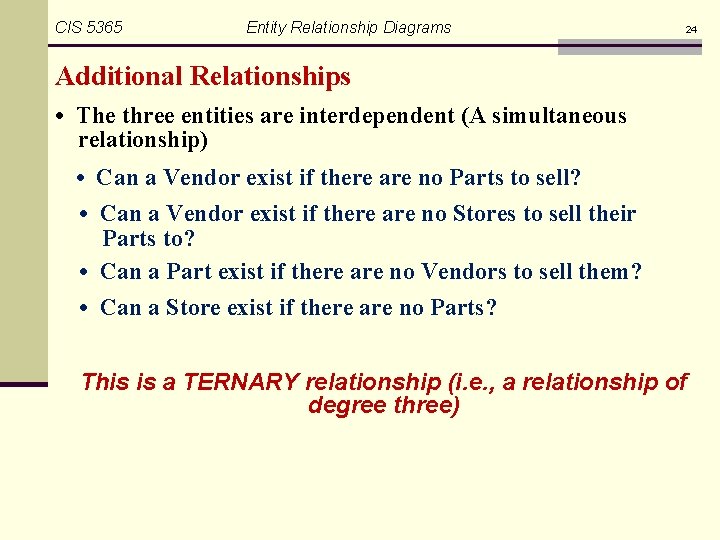
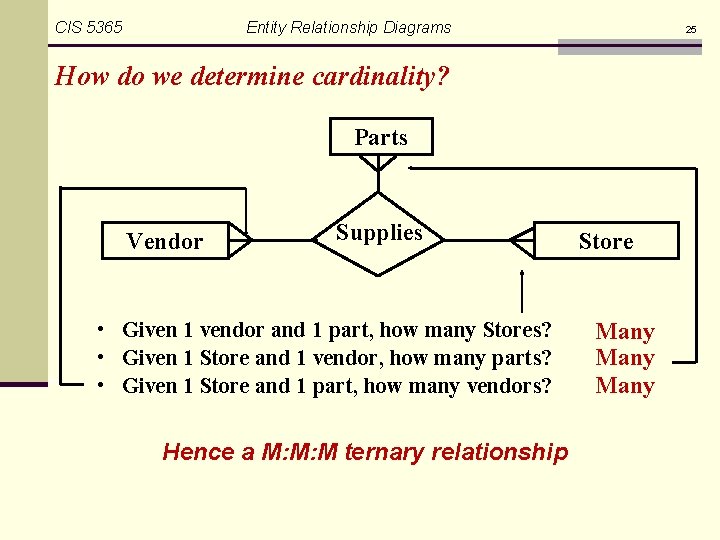
CIS 5365 Entity Relationship Diagrams 24 Additional Relationships • The three entities are interdependent (A simultaneous relationship) • Can a Vendor exist if there are no Parts to sell? • Can a Vendor exist if there are no Stores to sell their Parts to? • Can a Part exist if there are no Vendors to sell them? • Can a Store exist if there are no Parts? This is a TERNARY relationship (i. e. , a relationship of degree three)
CIS 5365 Entity Relationship Diagrams 25 How do we determine cardinality? Parts Vendor Supplies • Given 1 vendor and 1 part, how many Stores? • Given 1 Store and 1 vendor, how many parts? • Given 1 Store and 1 part, how many vendors? Hence a M: M: M ternary relationship Store Many
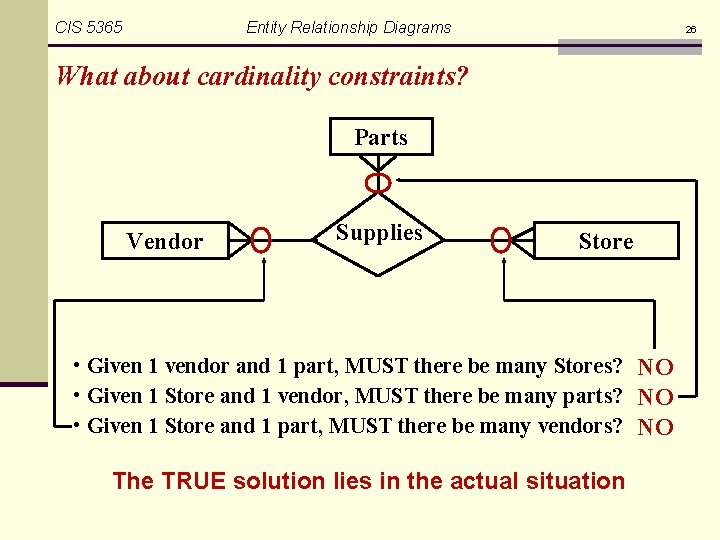
CIS 5365 Entity Relationship Diagrams 26 What about cardinality constraints? Parts Vendor Supplies Store • Given 1 vendor and 1 part, MUST there be many Stores? NO • Given 1 Store and 1 vendor, MUST there be many parts? NO • Given 1 Store and 1 part, MUST there be many vendors? NO The TRUE solution lies in the actual situation
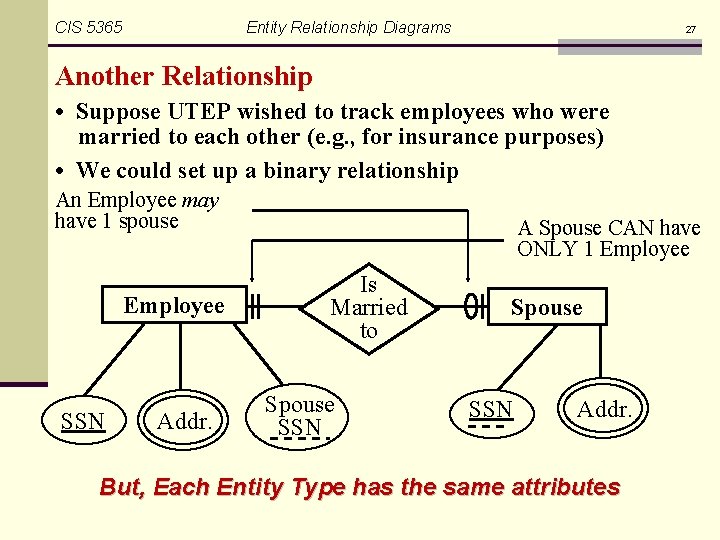
CIS 5365 Entity Relationship Diagrams 27 Another Relationship • Suppose UTEP wished to track employees who were married to each other (e. g. , for insurance purposes) • We could set up a binary relationship An Employee may have 1 spouse Employee SSN Addr. A Spouse CAN have ONLY 1 Employee Is Married to Spouse SSN Addr. But, Each Entity Type has the same attributes
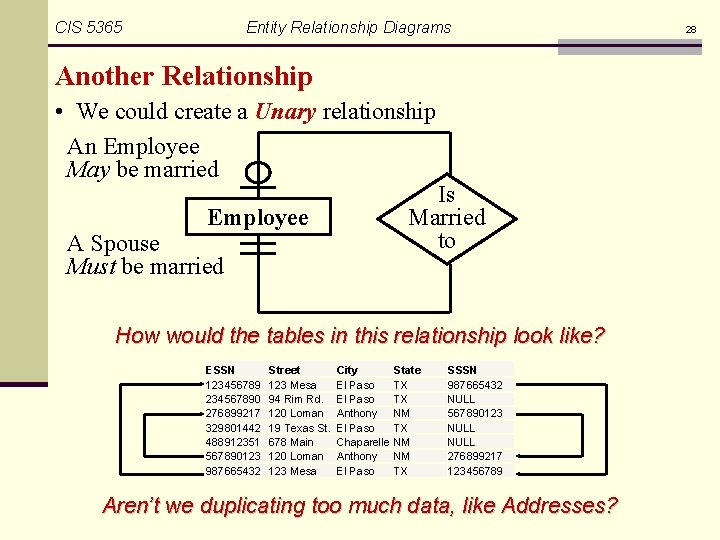
CIS 5365 Entity Relationship Diagrams Another Relationship • We could create a Unary relationship An Employee May be married Is Married to Employee A Spouse Must be married How would the tables in this relationship look like? ESSN 1234567890 276899217 329801442 488912351 567890123 987665432 Street 123 Mesa 94 Rim Rd. 120 Loman 19 Texas St. 678 Main 120 Loman 123 Mesa City El Paso Anthony El Paso Chaparelle Anthony El Paso State TX TX NM NM TX SSSN 987665432 NULL 567890123 NULL 276899217 123456789 Aren’t we duplicating too much data, like Addresses? 28
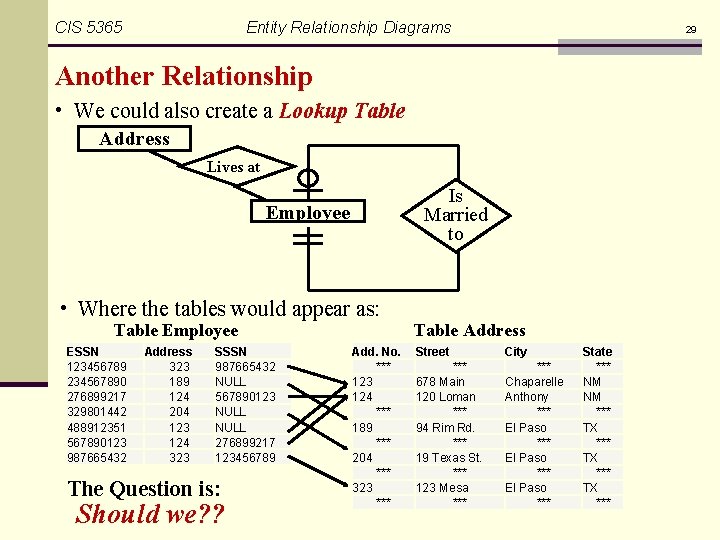
CIS 5365 Entity Relationship Diagrams 29 Another Relationship • We could also create a Lookup Table Address Lives at Is Married to Employee • Where the tables would appear as: Table Employee ESSN 1234567890 276899217 329801442 488912351 567890123 987665432 Address 323 189 124 204 123 124 323 SSSN 987665432 NULL 567890123 NULL 276899217 123456789 The Question is: Should we? ? Add. No. *** 123 124 *** 189 *** 204 *** 323 *** Table Address Street City *** 678 Main 120 Loman *** 94 Rim Rd. *** 19 Texas St. *** 123 Mesa *** Chaparelle Anthony *** El Paso *** State *** NM NM *** TX ***
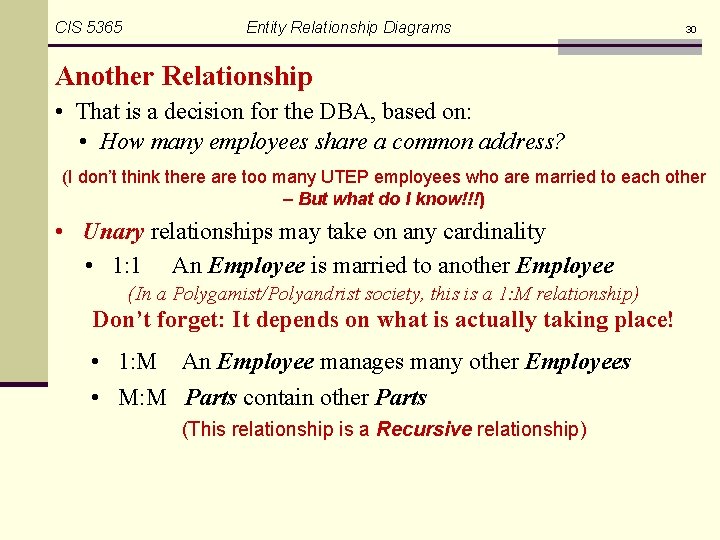
CIS 5365 Entity Relationship Diagrams 30 Another Relationship • That is a decision for the DBA, based on: • How many employees share a common address? (I don’t think there are too many UTEP employees who are married to each other – But what do I know!!!) • Unary relationships may take on any cardinality • 1: 1 An Employee is married to another Employee (In a Polygamist/Polyandrist society, this is a 1: M relationship) Don’t forget: It depends on what is actually taking place! • 1: M An Employee manages many other Employees • M: M Parts contain other Parts (This relationship is a Recursive relationship)
CIS 5365 Entity Relationship Diagrams 31 Another Relationship • Consider another example: “At this college, there are many departments. Each department has a number of faculty members, and a faculty member may belong to only one department. In each department, there is one faculty member assigned to supervise the other faculty members”. • Let’s build the ERD in stages • Keep in mind that there are many ways to arrive at the same solution (Equifinality)
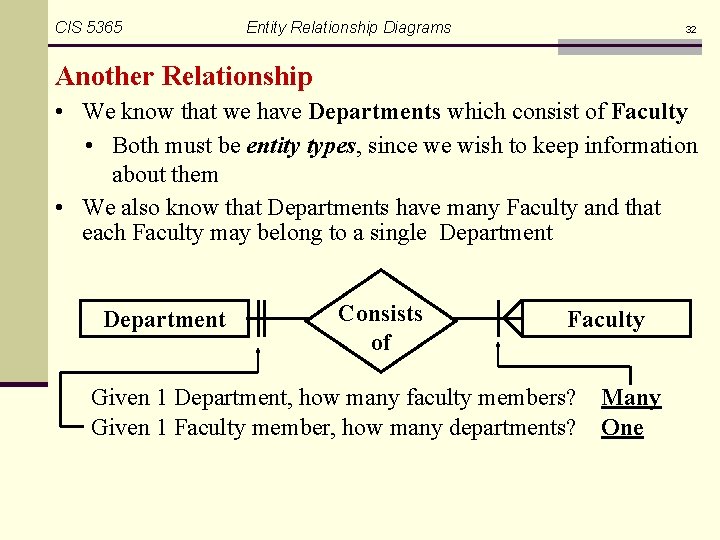
CIS 5365 Entity Relationship Diagrams 32 Another Relationship • We know that we have Departments which consist of Faculty • Both must be entity types, since we wish to keep information about them • We also know that Departments have many Faculty and that each Faculty may belong to a single Department Consists of Faculty Given 1 Department, how many faculty members? Given 1 Faculty member, how many departments? Many One
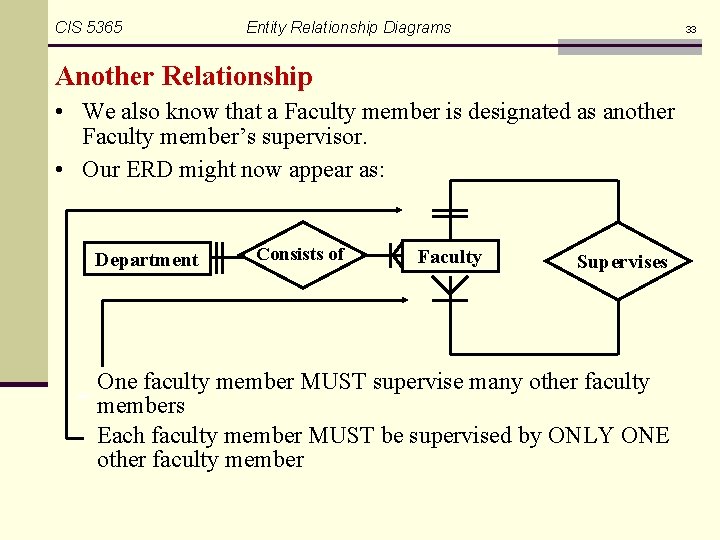
CIS 5365 Entity Relationship Diagrams 33 Another Relationship • We also know that a Faculty member is designated as another Faculty member’s supervisor. • Our ERD might now appear as: Department Consists of Faculty Supervises One faculty member MUST supervise many other faculty members Each faculty member MUST be supervised by ONLY ONE other faculty member
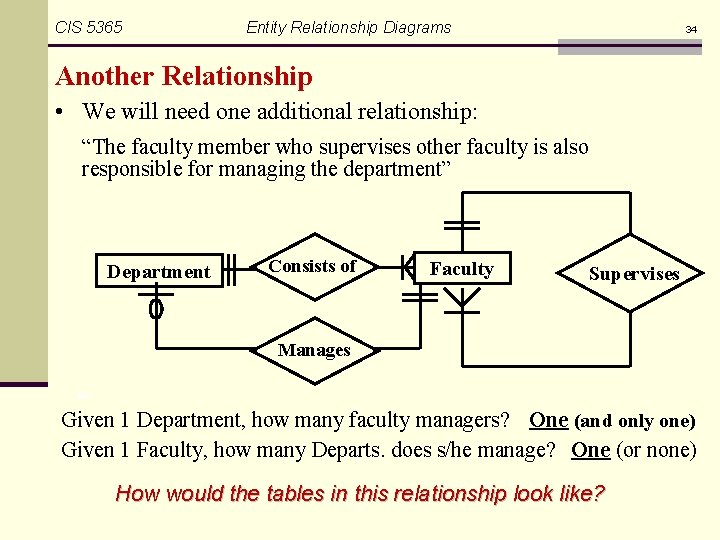
CIS 5365 Entity Relationship Diagrams 34 Another Relationship • We will need one additional relationship: “The faculty member who supervises other faculty is also responsible for managing the department” Department Consists of Faculty Supervises Manages Given 1 Department, how many faculty managers? One (and only one) Given 1 Faculty, how many Departs. does s/he manage? One (or none) How would the tables in this relationship look like?
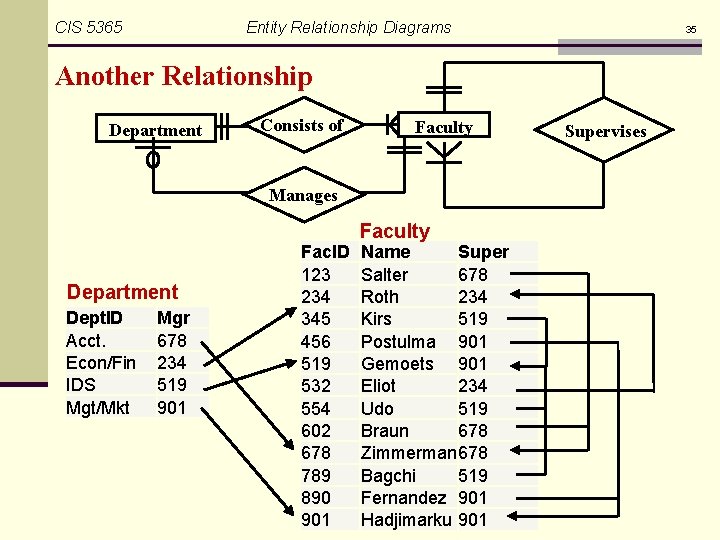
CIS 5365 Entity Relationship Diagrams 35 Another Relationship Department Consists of Faculty Manages Faculty Department Dept. ID Acct. Econ/Fin IDS Mgt/Mkt Mgr 678 234 519 901 Fac. ID 123 234 345 456 519 532 554 602 678 789 890 901 Name Super Salter 678 Roth 234 Kirs 519 Postulma 901 Gemoets 901 Eliot 234 Udo 519 Braun 678 Zimmerman 678 Bagchi 519 Fernandez 901 Hadjimarku 901 Supervises