
CIS 460 Network Analysis and Design Introduction Overview




- Slides: 13
CIS 460 - Network Analysis and Design Introduction & Overview Chapter 1 - Analyzing Business Goals and Constraints
Student Introductions • Name • Company or Government Service • Job Title/Description • Networking Experience • Seeking Certification • Course Expectations
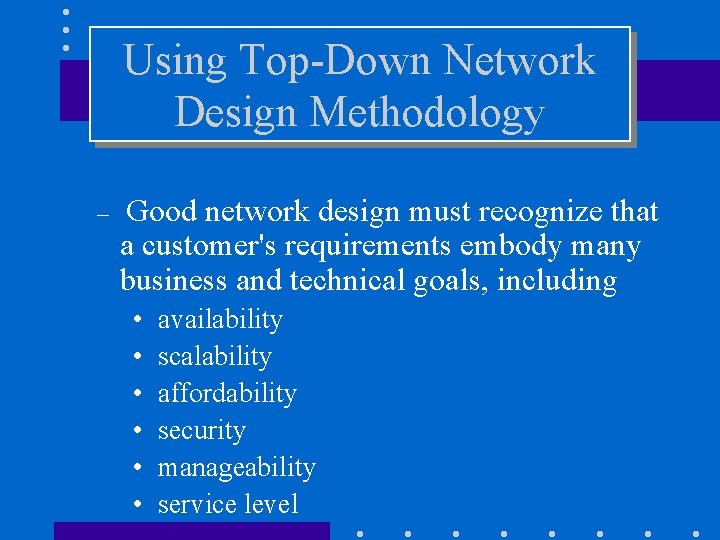
Using Top-Down Network Design Methodology – Good network design must recognize that a customer's requirements embody many business and technical goals, including • • • availability scalability affordability security manageability service level
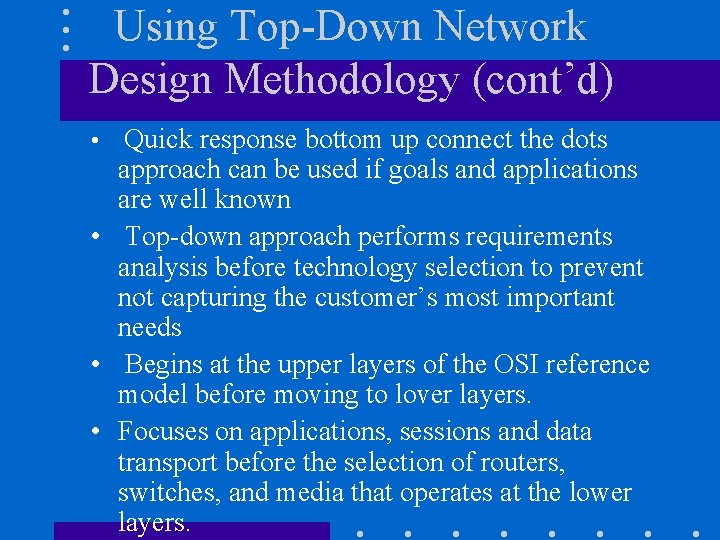
Using Top-Down Network Design Methodology (cont’d) • Quick response bottom up connect the dots approach can be used if goals and applications are well known • Top-down approach performs requirements analysis before technology selection to prevent not capturing the customer’s most important needs • Begins at the upper layers of the OSI reference model before moving to lover layers. • Focuses on applications, sessions and data transport before the selection of routers, switches, and media that operates at the lower layers.
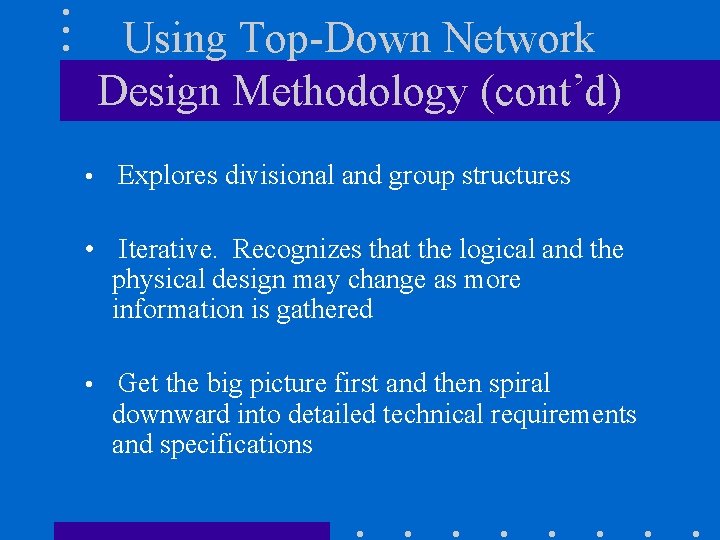
Using Top-Down Network Design Methodology (cont’d) • Explores divisional and group structures • Iterative. Recognizes that the logical and the physical design may change as more information is gathered • Get the big picture first and then spiral downward into detailed technical requirements and specifications
Analyzing Business Goals • Understand your customer’s business goals and constraints is critical to designing a network that meets customer’s objectives and approval. – Working with your client- research business, what industry, suppliers, market, products, services, and competitive advantages – Criteria for success - goals to meet, how success is defined – Consequences of failure - project fails, does not perform to specifications, how visible to upper- management, unforeseen behavior disrupt business operations
Changes in Enterprise Networks • Undergoing major changes - making vast amounts of corporate data available to employees, customers, and business partners. • Have become mission critical. Budgets have been reduced, greater worker productivity, use fewer people, decrease recurring WAN costs • Telecommunications/networking have merged
Changes in Enterprise Networks (Cont’d) • Today web surfing is common, increased outsourcing, alliances, partnerships, and virtual corporations. Global network-business model • Virtual Private Networking (VPN) is growing • Improve corporate communication, CAD? CAM to improve productivity, shorten development cycles • Provide Better customer service
Typical Network Design Business Goals • Increase revenue and profit • Improve corporate communications • Shorten product-development cycles • Build partnerships • Expand into worldwide markets • Move to a global-network business model • Modernize out-dated technologies
Identifying the Scope of a Network Design Project • New network or a modification, single, set of LANs, a set of WAN or remote-access or the whole enterprise network. • USE OSI to specify the types of functionality of new network design. • Define scope in terms of segment, LAN, Building network, Campus network, remote access, WAN or enterprise network
Identify a customer’s network applications • After determining business goals and scope now time to focus on real reason networks exist: • Use a chart of network applications such as Table 1 -1 and identify their criticality as extremely, somewhat and not critical
Analyzing Business Constraints • Analyze business constraints • Politics and Policies - office politics, personnel issues (advocates/opponents), job loss, client's business style, policies regarding protocols, standards, vendors, policies regarding distributed authority for network design and implementation • Budgetary and Staffing constraints • Scheduling
Business Goals Checklist • Use a checklist similar to the on page 17