
CIS 2033 based on Dekking et al A
CIS 2033 based on Dekking et al. A Modern Introduction to Probability and Statistics. 2007 Slides by Michael Maurizi Instructor Longin Jan Latecki C 9: Joint Distributions and Independence
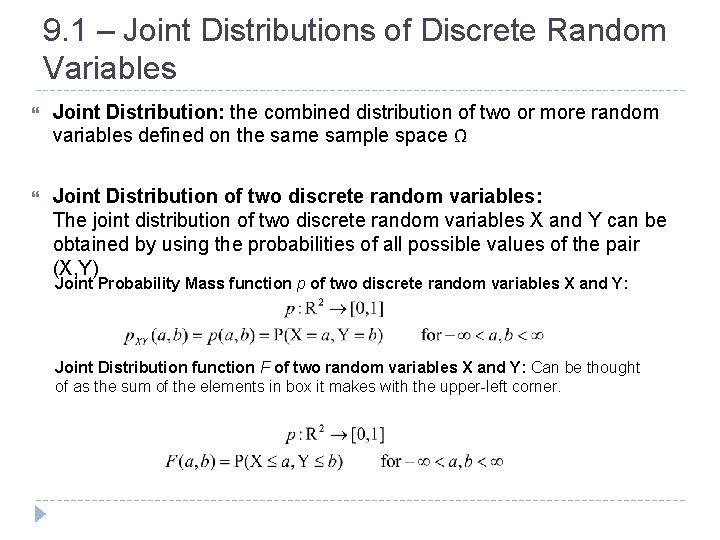
9. 1 – Joint Distributions of Discrete Random Variables Joint Distribution: the combined distribution of two or more random variables defined on the sample space Ω Joint Distribution of two discrete random variables: The joint distribution of two discrete random variables X and Y can be obtained by using the probabilities of all possible values of the pair (X, Y) Joint Probability Mass function p of two discrete random variables X and Y: Joint Distribution function F of two random variables X and Y: Can be thought of as the sum of the elements in box it makes with the upper-left corner.
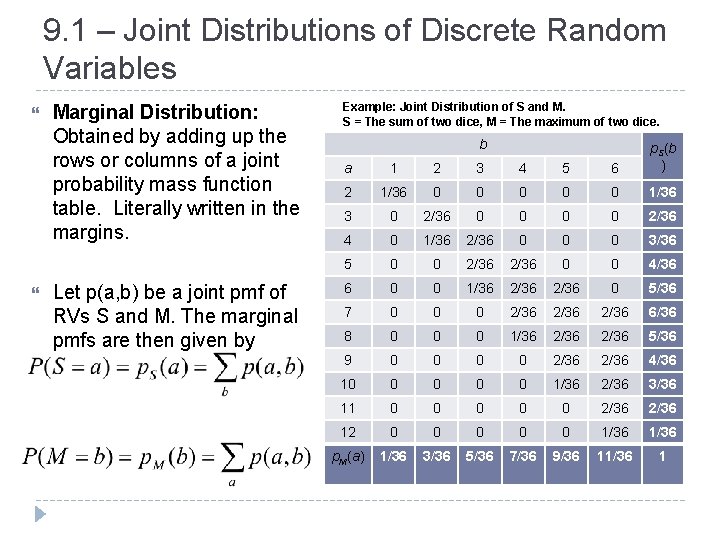
9. 1 – Joint Distributions of Discrete Random Variables Marginal Distribution: Obtained by adding up the rows or columns of a joint probability mass function table. Literally written in the margins. Let p(a, b) be a joint pmf of RVs S and M. The marginal pmfs are then given by Example: Joint Distribution of S and M. S = The sum of two dice, M = The maximum of two dice. b a 1 2 3 4 5 6 p. S(b ) 2 1/36 0 0 0 1/36 3 0 2/36 0 0 2/36 4 0 1/36 2/36 0 0 0 3/36 5 0 0 2/36 0 0 4/36 6 0 0 1/36 2/36 0 5/36 7 0 0 0 2/36 6/36 8 0 0 0 1/36 2/36 5/36 9 0 0 2/36 4/36 10 0 0 1/36 2/36 3/36 11 0 0 0 2/36 12 0 0 0 1/36 p. M(a) 1/36 3/36 5/36 7/36 9/36 11/36 1
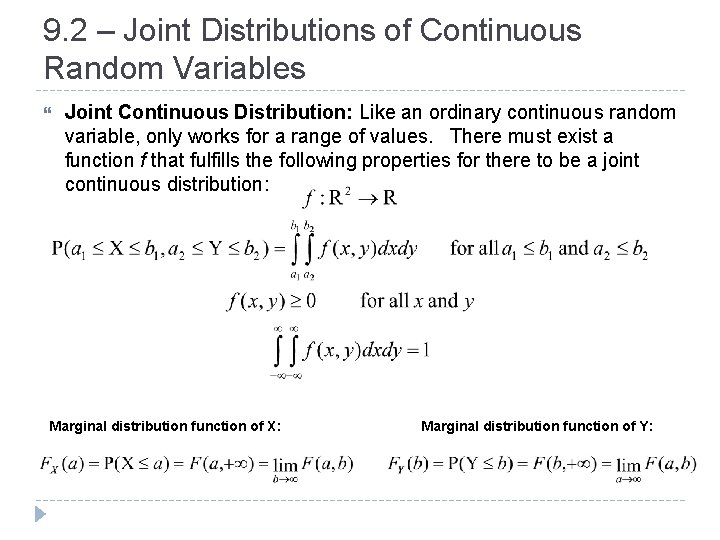
9. 2 – Joint Distributions of Continuous Random Variables Joint Continuous Distribution: Like an ordinary continuous random variable, only works for a range of values. There must exist a function f that fulfills the following properties for there to be a joint continuous distribution: Marginal distribution function of X: Marginal distribution function of Y:
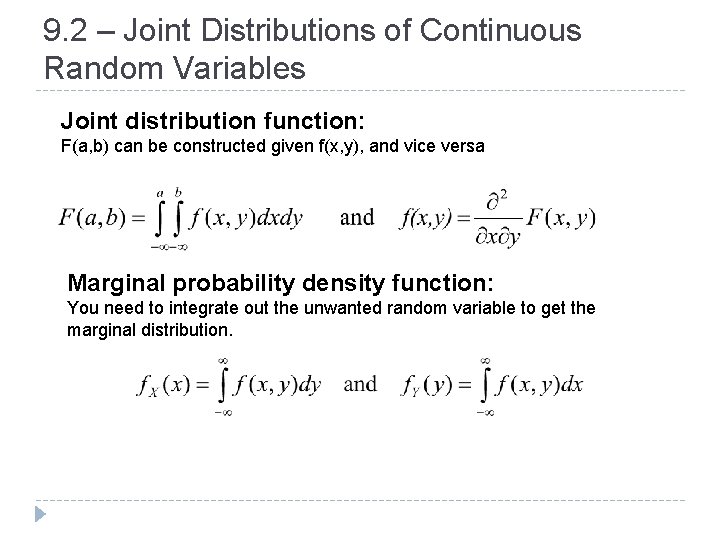
9. 2 – Joint Distributions of Continuous Random Variables Joint distribution function: F(a, b) can be constructed given f(x, y), and vice versa Marginal probability density function: You need to integrate out the unwanted random variable to get the marginal distribution.
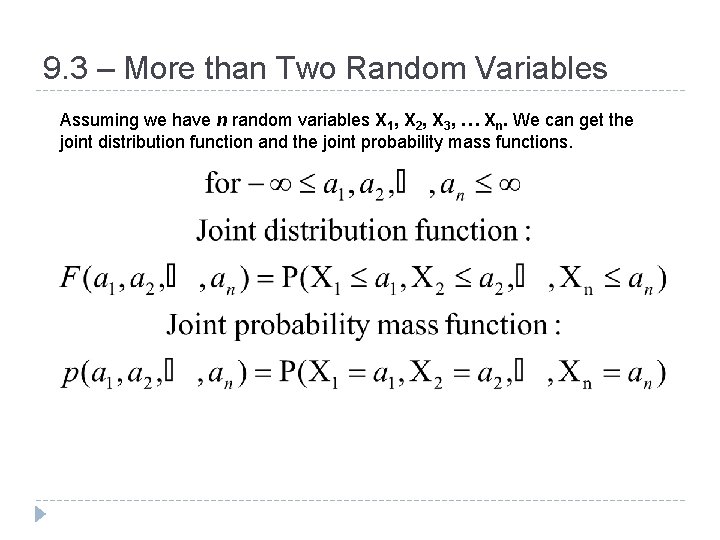
9. 3 – More than Two Random Variables Assuming we have n random variables X 1, X 2, X 3, … Xn. We can get the joint distribution function and the joint probability mass functions.
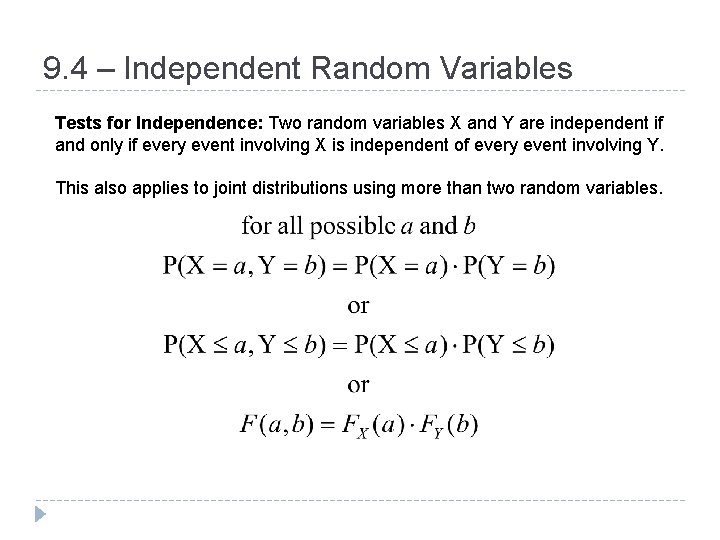
9. 4 – Independent Random Variables Tests for Independence: Two random variables X and Y are independent if and only if every event involving X is independent of every event involving Y. This also applies to joint distributions using more than two random variables.
9. 5 – Propagation of Independence after a change of variable: If a function is applied to several independent random variables, the new resulting random variables will also be independent.
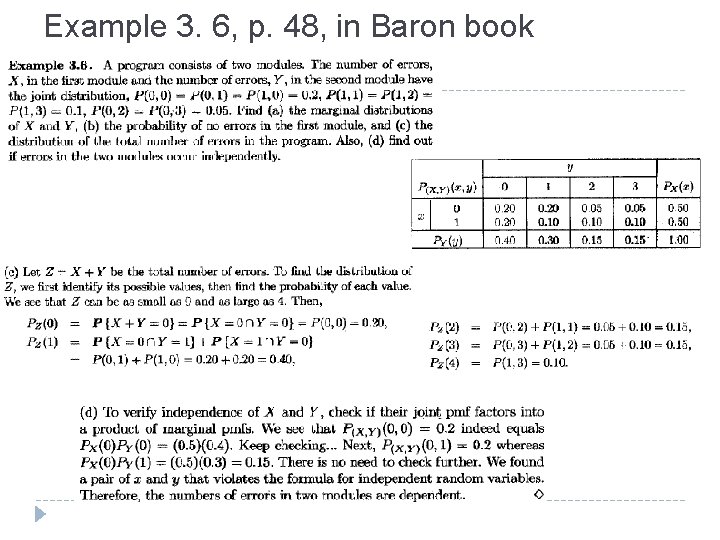
Example 3. 6, p. 48, in Baron book
- Slides: 9