
CIRIA RP 1055 Code of Practice and Guidance
- Slides: 35
CIRIA RP 1055: Code of Practice and Guidance for property flood resilience December 2019 1
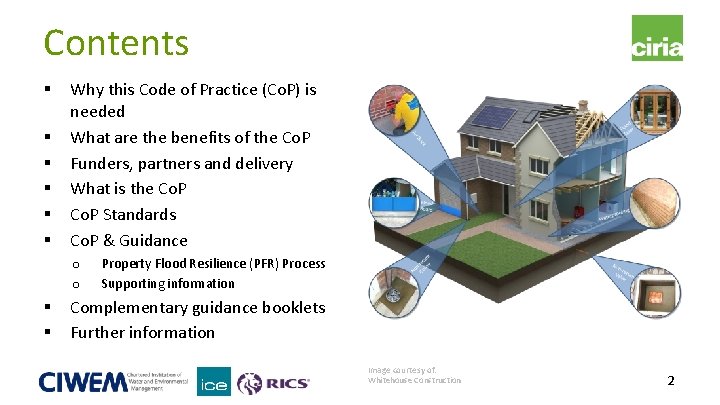
Contents § § § Why this Code of Practice (Co. P) is needed What are the benefits of the Co. P Funders, partners and delivery What is the Co. P Standards Co. P & Guidance o o § § Property Flood Resilience (PFR) Process Supporting information Complementary guidance booklets Further information Image courtesy of: Whitehouse Construction 2
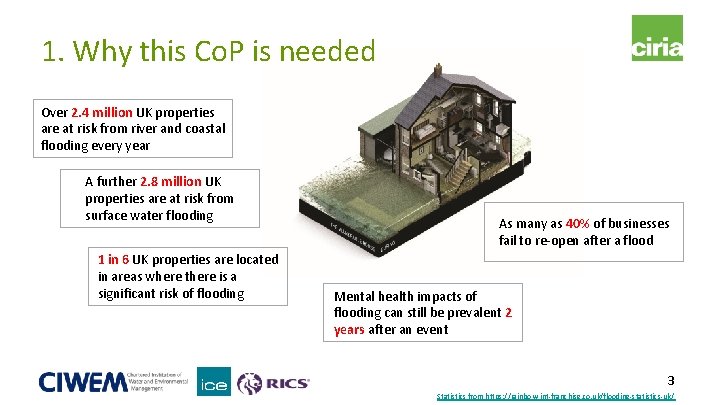
1. Why this Co. P is needed Over 2. 4 million UK properties are at risk from river and coastal flooding every year A further 2. 8 million UK properties are at risk from surface water flooding 1 in 6 UK properties are located in areas where there is a significant risk of flooding As many as 40% of businesses fail to re-open after a flood Mental health impacts of flooding can still be prevalent 2 years after an event 3 Statistics from https: //rainbow-int-franchise. co. uk/flooding-statistics-uk/
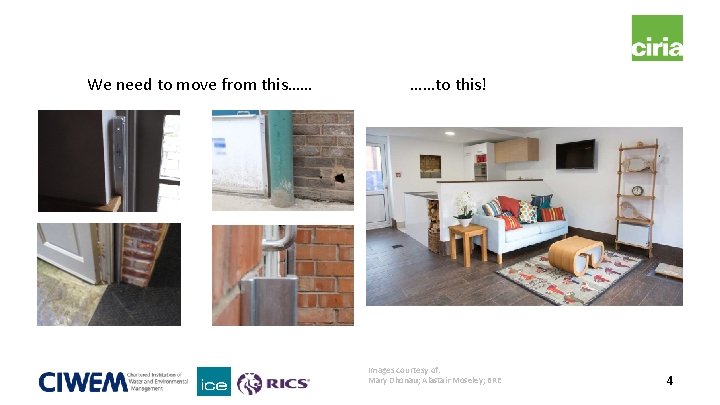
We need to move from this…… ……to this! Images courtesy of: Mary Dhonau; Alastair Moseley; BRE 4
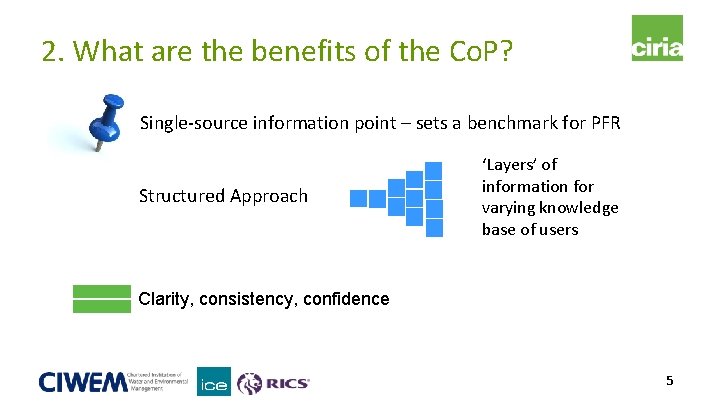
2. What are the benefits of the Co. P? Single-source information point – sets a benchmark for PFR Structured Approach ‘Layers’ of information for varying knowledge base of users Clarity, consistency, confidence 5
3. Funders and partners § Funders o o o Aviva Environment Agency Welsh Government Department for Infrastructure Scottish Government § Supporters o CIWEM o ICE o RICS 6
4. Project delivery § Project Management o CIRIA o Independent Chair § Authoring team o o BRE (technical lead) University of the West of England Whitehouse Construction Environment Agency § Support from representative Project Steering Group 7
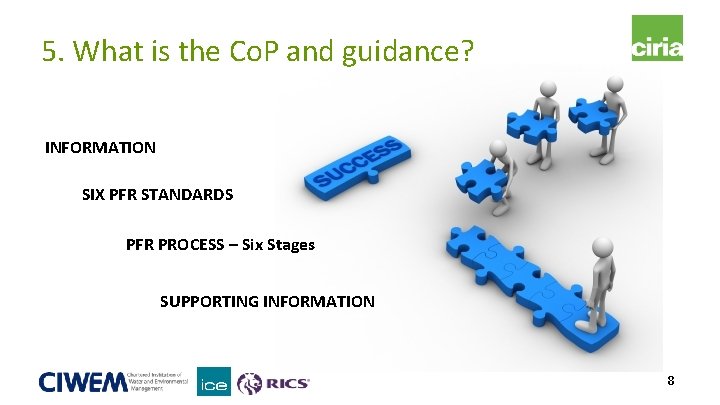
5. What is the Co. P and guidance? INFORMATION SIX PFR STANDARDS PFR PROCESS – Six Stages SUPPORTING INFORMATION 8
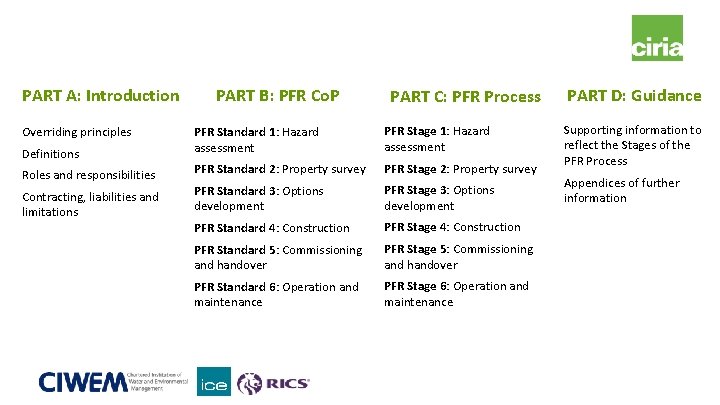
PART A: Introduction Overriding principles Definitions Roles and responsibilities Contracting, liabilities and limitations PART B: PFR Co. P PART C: PFR Process PFR Standard 1: Hazard assessment PFR Stage 1: Hazard assessment PFR Standard 2: Property survey PFR Stage 2: Property survey PFR Standard 3: Options development PFR Stage 3: Options development PFR Standard 4: Construction PFR Stage 4: Construction PFR Standard 5: Commissioning and handover PFR Stage 5: Commissioning and handover PFR Standard 6: Operation and maintenance PFR Stage 6: Operation and maintenance PART D: Guidance Supporting information to reflect the Stages of the PFR Process Appendices of further information
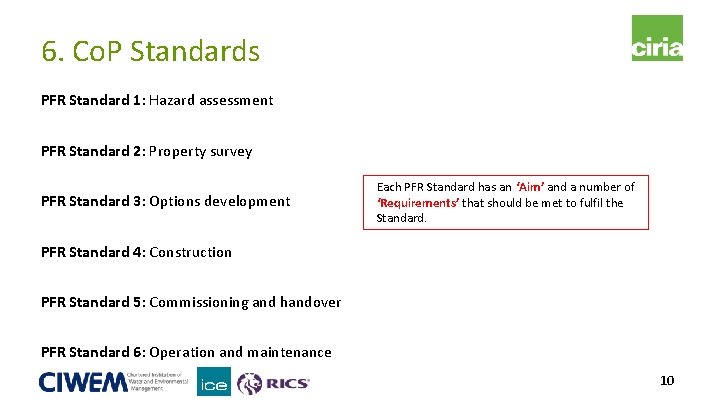
6. Co. P Standards PFR Standard 1: Hazard assessment PFR Standard 2: Property survey PFR Standard 3: Options development Each PFR Standard has an ‘Aim’ and a number of ‘Requirements’ that should be met to fulfil the Standard. PFR Standard 4: Construction PFR Standard 5: Commissioning and handover PFR Standard 6: Operation and maintenance 10
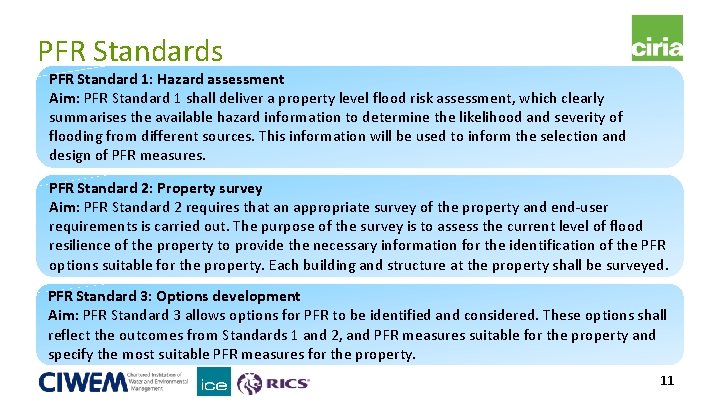
PFR Standards PFR Standard 1: Hazard assessment Aim: PFR Standard 1 shall deliver a property level flood risk assessment, which clearly summarises the available hazard information to determine the likelihood and severity of flooding from different sources. This information will be used to inform the selection and design of PFR measures. PFR Standard 2: Property survey Aim: PFR Standard 2 requires that an appropriate survey of the property and end-user requirements is carried out. The purpose of the survey is to assess the current level of flood resilience of the property to provide the necessary information for the identification of the PFR options suitable for the property. Each building and structure at the property shall be surveyed. PFR Standard 3: Options development Aim: PFR Standard 3 allows options for PFR to be identified and considered. These options shall reflect the outcomes from Standards 1 and 2, and PFR measures suitable for the property and specify the most suitable PFR measures for the property. 11
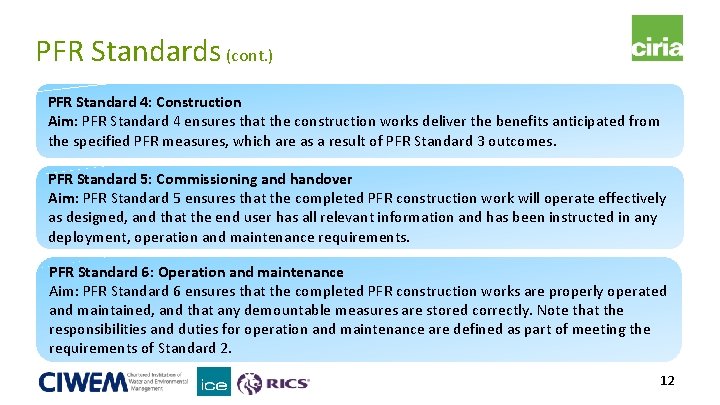
PFR Standards (cont. ) PFR Standard 4: Construction Aim: PFR Standard 4 ensures that the construction works deliver the benefits anticipated from the specified PFR measures, which are as a result of PFR Standard 3 outcomes. PFR Standard 5: Commissioning and handover Aim: PFR Standard 5 ensures that the completed PFR construction work will operate effectively as designed, and that the end user has all relevant information and has been instructed in any deployment, operation and maintenance requirements. PFR Standard 6: Operation and maintenance Aim: PFR Standard 6 ensures that the completed PFR construction works are properly operated and maintained, and that any demountable measures are stored correctly. Note that the responsibilities and duties for operation and maintenance are defined as part of meeting the requirements of Standard 2. 12
PFR Standard 1: Hazard assessment PFR Standard 1 shall deliver a property level flood risk assessment, which clearly summarises the available hazard information to determine the likelihood and severity of flooding from different sources. This information will be used to inform the selection and design of PFR measures. Requirements: 1. A survey of the flood risk to the property shall be carried out. The scale and detail of the survey shall be proportionate to the perceived level of risk and the potential size of the project. Surveys shall be extended should a greater complexity of flood risk become apparent during the survey. 2. The site of the property shall be assessed for the likelihood of flooding based on a ‘source–pathway–receptor’ approach for all potential sources and range of probabilities of flooding. 3. The potential source(s) of flooding shall be determined using appropriate methods of hazard identification. This shall be accompanied by an assessment of flood frequency, as well as depth and duration for all sources at a range of return periods. 4. The property flood risk assessment shall take account of relevant flood risk information from local authorities, utilities and other environment agencies. It shall take account of additional flood risk information from other relevant sources (including property owners). 5. The potential routes of floodwater (pathways) to the buildings/structures within the property from the sources shall be identified. 6. The pathways for flooding from each source to the property and likely speed of onset shall be identified, including measures that currently exist, or are planned, for controlling that pathway at the property, community or catchment scale (including flood defence works). This analysis shall include all relevant structures near to the property. 13
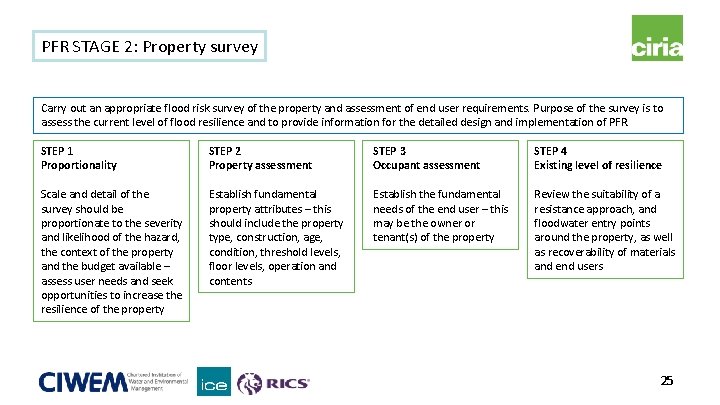
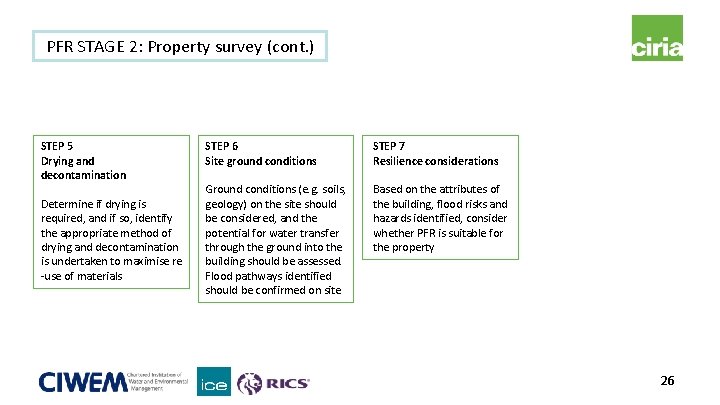
PFR Standard 2: Property survey PFR Standard 2 requires that an appropriate survey of the property and end-user requirements is carried out. The purpose of the survey is to assess the current level of flood resilience of the property to provide the necessary information for the identification of the PFR options suitable for the property. Each building and structure at the property shall be surveyed. Requirements: 1. The scale and detail of the survey shall be proportionate to the level of risk and the size of the project. The survey shall also identify appropriate approaches to increase resilience and minimise damage, with reference to the end-user needs. 2. The survey shall establish the building type, age, construction, condition, operation and contents as described in Defra (2012). 3. The current level of PFR shall be established, including estimating the water leakage resistance capacity of the walls and floors, the recoverability of the materials and components, and end-user capacity to implement measures. 4. The method of drying and decontamination of the building after a flood shall be assessed, including the impact of wetting of building materials and that of voids and cavities in walls and floors. 5. The ground conditions on the site shall be established, and in particular, the potential for water to transfer through the ground or from an adjacent building into the building shall be assessed. 14
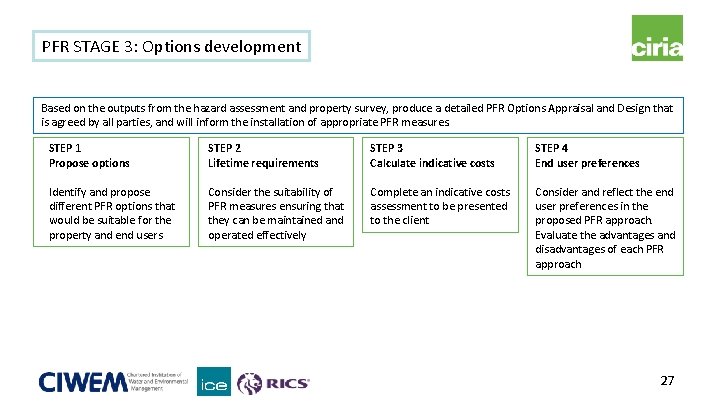
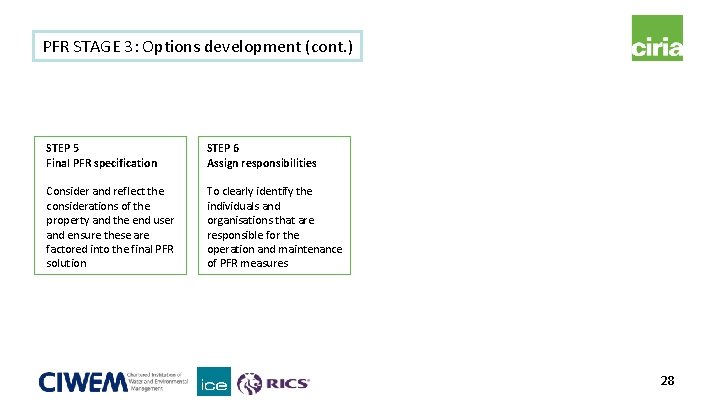
PFR Standard 3: Options development PFR Standard 3 allows options for PFR to be identified and considered. These options shall reflect the outcomes from Standards 1 and 2, and PFR measures suitable for the property and specify the most suitable PFR measures for the property. The options for PFR will consider the use of: • measures that restrict water entry to the building under defined conditions • materials that are recoverable after water contact • services, fixtures and fittings that are recoverable by their location and/or ability to resist water damage. The design and specification will be based on the information provided by Standard 1 and 2, and the measures specified shall be selected impartially. Requirements: 1. An options appraisal of flood resilience measures shall be undertaken based on the information generated within Standards 1 and 2. These appraisals shall also evaluate costs and benefits of suitable approaches, end-user needs, operation and performance. 2. The appraisal of these options shall consider the lifetime maintenance and operation requirements of the measures specified. 3. Wherever possible and where relevant, specified PFR measures shall make use of products and processes that are compliant with a recognised industry standard and/or are warranted. 4. The preferred options shall be agreed and documented. 5. This specification shall be set out in drawings and/or written text and shall adequately describe the measures to be taken and their method of installation. 6. The output is the identification and specification of the most suitable PFR measures for the property. This information shall then be developed into a construction/installation plan, undertaken by the appropriate person before any works or installation 15 commence.
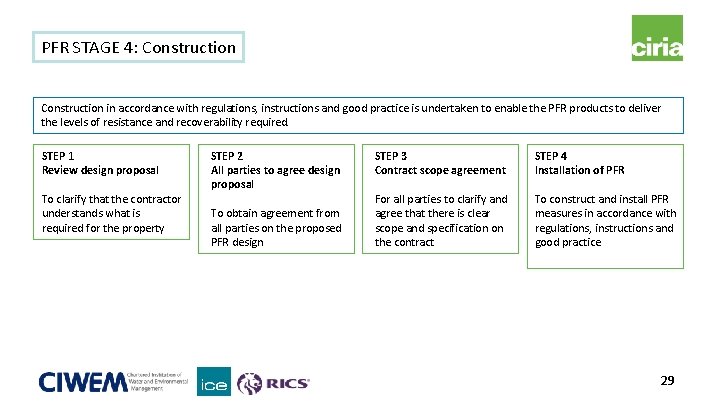
PFR Standard 4: Construction PFR Standard 4 ensures that the construction works deliver the benefits anticipated from the specified PFR measures, which are as a result of PFR Standard 3 outcomes. Requirements: 1. The appropriate person shall deliver all the necessary works associated with the construction and installation of PFR measures. 2. Where subcontractors are used, the appropriate person shall retain overall responsibility for the works. 3. All necessary preliminary work, including drying out and decontamination where appropriate, shall be carried out before implementation of PFR measures. These works shall be carried out in accordance with the design and specification in PFR Standard 3, and shall take due note of the flood risk assessment (PFR Standard 1) and the survey (PFR Standard 2). 4. The construction work shall be undertaken in accordance with good practice, including relevant standards, guidance and legislation, and shall comply with the Construction (Design and Management) Regulations 2015 (CDM 2015). 5. All PFR measures shall be inspected during construction by an appropriate person (see Table 2. 1). 16
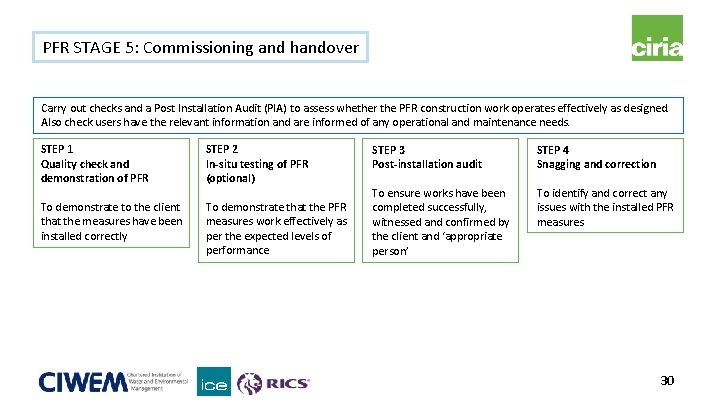
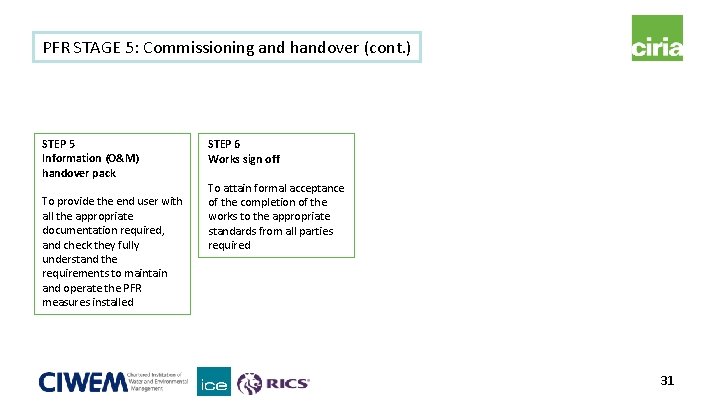
PFR Standard 5: Commissioning and handover PFR Standard 5 ensures that the completed PFR construction work will operate effectively as designed, and that the end user has all relevant information and has been instructed in any deployment, operation and maintenance requirements. Requirements: 1. PFR measures shall be inspected during construction (PFR Standard 4) and on completion by an appropriate person to ensure that the work meets the specification requirements of PFR Standard 3. The inspection shall be conducted in an objective and impartial manner. 2. Any products used that have an agreed in situ flood resistant test procedure shall be tested after their installation within the building(s) at the request of the end user. These tests shall be supervised by an appropriate person. 3. The appropriate person shall provide all relevant information on the PFR works, design, specification, and operation and maintenance requirements in a project file (ie a handover ‘pack’) to the end user. 4. Where PFR measures need to be deployed for flood events, a person shall be nominated and agreed to take responsibility for deploying the measures in the event of a flood warning. This person shall be referred to as the ‘nominated person’. 5. The appropriate person shall demonstrate the method of deployment of measures (where appropriate) to the nominated person and shall ensure that this person understands how to prepare for a flood. 17
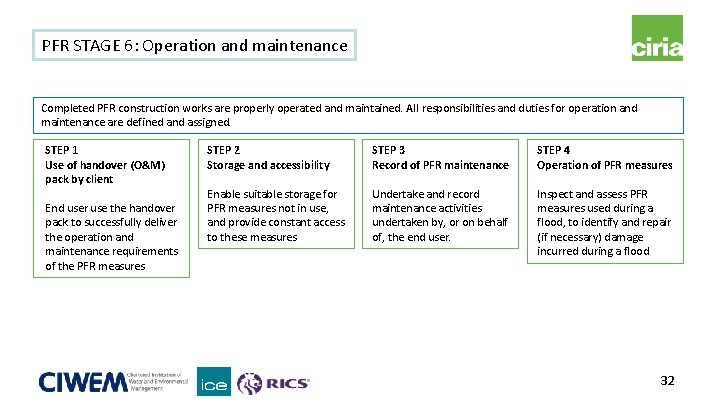
PFR Standard 6: Operation and maintenance PFR Standard 6 ensures that the completed PFR construction works are properly operated and maintained, and that any demountable measures are stored correctly. Note that the responsibilities and duties for operation and maintenance are defined as part of meeting the requirements of Standard 2. Requirements: 1. The appropriate person, in accordance with CDM 2015, shall provide an operation and maintenance plan to the end user at the point of handover (PFR Standard 6). 2. The nominated person shall ensure that the PFR measures remain operative by following the guidance provided in the handover pack. 3. In the event of a flood warning, the nominated person shall deploy any measures following guidance provided in the handover pack. 4. Any operation of the PFR measures shall be recorded and the information retained and kept securely as an appendage to the handover pack. 5. All maintenance work shall be recorded and kept securely as an appendage to the handover pack. 6. The PFR measures shall be reviewed periodically to ensure that they continue to meet the needs of the end user and that the nominated person can continue with their obligations. 7. After a flood event the PFR measures shall be fully checked and inspected by an appropriate person taking account of the information in the handover pack. Any necessary maintenance shall be commissioned. 18
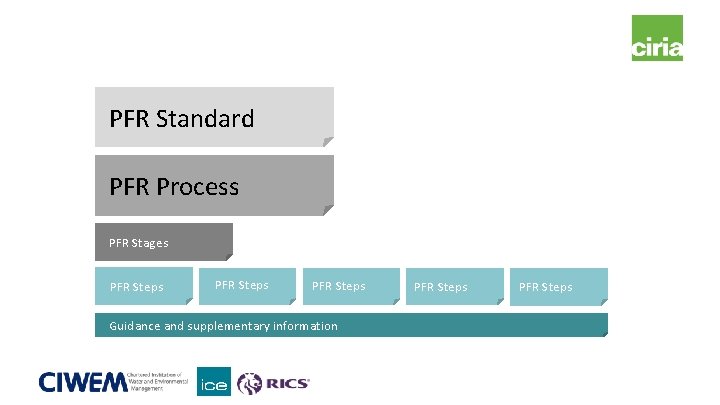
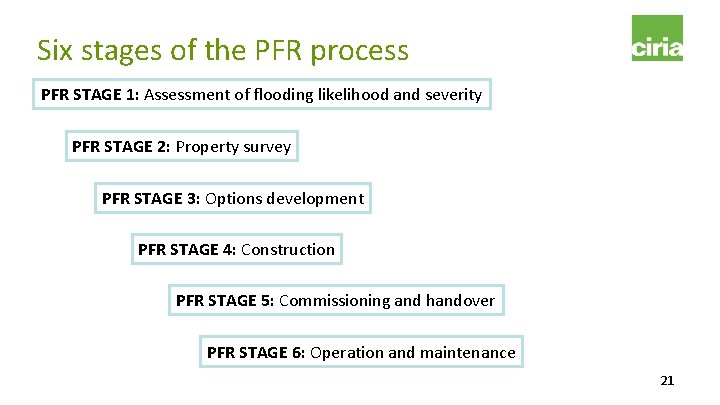
7. PFR process The PFR Process is defined by six ‘Stages’. These Stages relate to the six PFR Standards. Each Stage has a number of ‘Steps’ that guides the user through the Process, which will allow the Requirements of the Standards to be met. 19
PFR Standard PFR Process PFR Stages PFR Steps Guidance and supplementary information PFR Steps
Six stages of the PFR process PFR STAGE 1: Assessment of flooding likelihood and severity PFR STAGE 2: Property survey PFR STAGE 3: Options development PFR STAGE 4: Construction PFR STAGE 5: Commissioning and handover PFR STAGE 6: Operation and maintenance 21
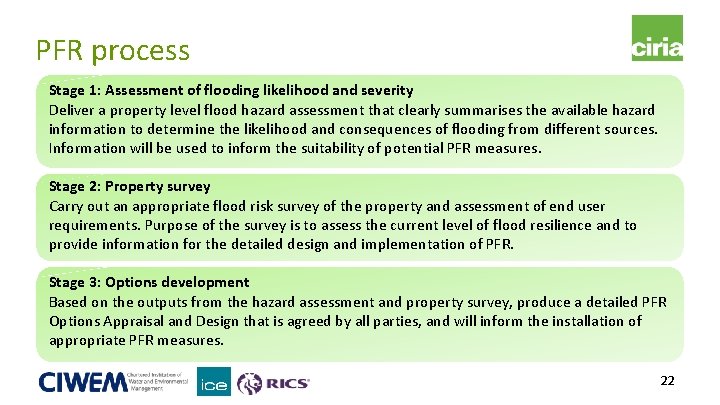
PFR process Stage 1: Assessment of flooding likelihood and severity Deliver a property level flood hazard assessment that clearly summarises the available hazard information to determine the likelihood and consequences of flooding from different sources. Information will be used to inform the suitability of potential PFR measures. Stage 2: Property survey Carry out an appropriate flood risk survey of the property and assessment of end user requirements. Purpose of the survey is to assess the current level of flood resilience and to provide information for the detailed design and implementation of PFR. Stage 3: Options development Based on the outputs from the hazard assessment and property survey, produce a detailed PFR Options Appraisal and Design that is agreed by all parties, and will inform the installation of appropriate PFR measures. 22
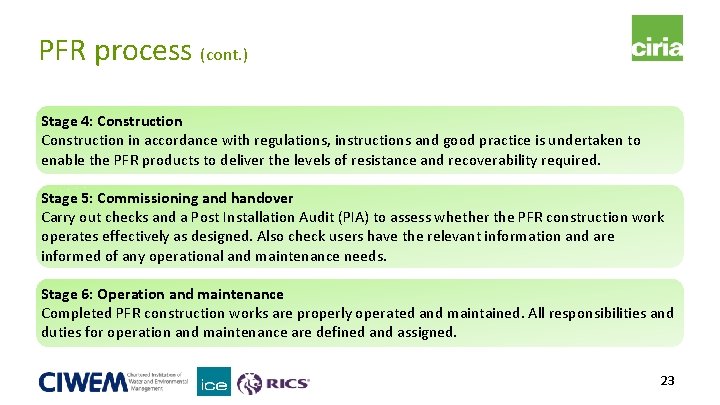
PFR process (cont. ) Stage 4: Construction in accordance with regulations, instructions and good practice is undertaken to enable the PFR products to deliver the levels of resistance and recoverability required. Stage 5: Commissioning and handover Carry out checks and a Post Installation Audit (PIA) to assess whether the PFR construction work operates effectively as designed. Also check users have the relevant information and are informed of any operational and maintenance needs. Stage 6: Operation and maintenance Completed PFR construction works are properly operated and maintained. All responsibilities and duties for operation and maintenance are defined and assigned. 23
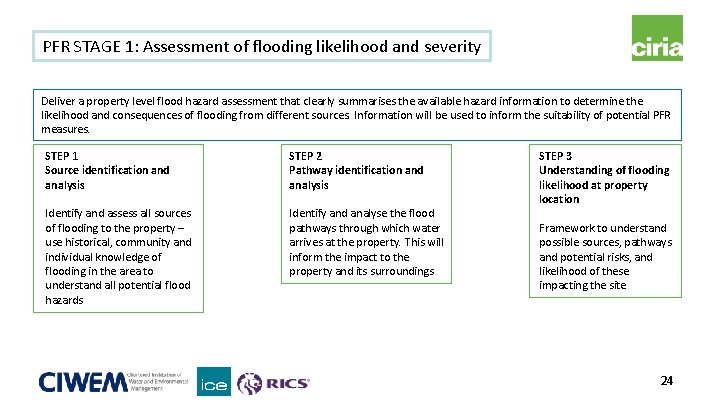
PFR STAGE 1: Assessment of flooding likelihood and severity Deliver a property level flood hazard assessment that clearly summarises the available hazard information to determine the likelihood and consequences of flooding from different sources. Information will be used to inform the suitability of potential PFR measures. STEP 1 Source identification and analysis STEP 2 Pathway identification and analysis Identify and assess all sources of flooding to the property – use historical, community and individual knowledge of flooding in the area to understand all potential flood hazards Identify and analyse the flood pathways through which water arrives at the property. This will inform the impact to the property and its surroundings STEP 3 Understanding of flooding likelihood at property location Framework to understand possible sources, pathways and potential risks, and likelihood of these impacting the site 24
PFR STAGE 2: Property survey Carry out an appropriate flood risk survey of the property and assessment of end user requirements. Purpose of the survey is to assess the current level of flood resilience and to provide information for the detailed design and implementation of PFR. STEP 1 Proportionality STEP 2 Property assessment STEP 3 Occupant assessment STEP 4 Existing level of resilience Scale and detail of the survey should be proportionate to the severity and likelihood of the hazard, the context of the property and the budget available – assess user needs and seek opportunities to increase the resilience of the property Establish fundamental property attributes – this should include the property type, construction, age, condition, threshold levels, floor levels, operation and contents Establish the fundamental needs of the end user – this may be the owner or tenant(s) of the property Review the suitability of a resistance approach, and floodwater entry points around the property, as well as recoverability of materials and end users 25
PFR STAGE 2: Property survey (cont. ) STEP 5 Drying and decontamination Determine if drying is required, and if so, identify the appropriate method of drying and decontamination is undertaken to maximise re -use of materials STEP 6 Site ground conditions STEP 7 Resilience considerations Ground conditions (e. g. soils, geology) on the site should be considered, and the potential for water transfer through the ground into the building should be assessed. Flood pathways identified should be confirmed on site Based on the attributes of the building, flood risks and hazards identified, consider whether PFR is suitable for the property 26
PFR STAGE 3: Options development Based on the outputs from the hazard assessment and property survey, produce a detailed PFR Options Appraisal and Design that is agreed by all parties, and will inform the installation of appropriate PFR measures. STEP 1 Propose options STEP 2 Lifetime requirements STEP 3 Calculate indicative costs STEP 4 End user preferences Identify and propose different PFR options that would be suitable for the property and end users Consider the suitability of PFR measures ensuring that they can be maintained and operated effectively Complete an indicative costs assessment to be presented to the client Consider and reflect the end user preferences in the proposed PFR approach. Evaluate the advantages and disadvantages of each PFR approach 27
PFR STAGE 3: Options development (cont. ) STEP 5 Final PFR specification STEP 6 Assign responsibilities Consider and reflect the considerations of the property and the end user and ensure these are factored into the final PFR solution To clearly identify the individuals and organisations that are responsible for the operation and maintenance of PFR measures 28
PFR STAGE 4: Construction in accordance with regulations, instructions and good practice is undertaken to enable the PFR products to deliver the levels of resistance and recoverability required. STEP 1 Review design proposal To clarify that the contractor understands what is required for the property STEP 2 All parties to agree design proposal To obtain agreement from all parties on the proposed PFR design STEP 3 Contract scope agreement STEP 4 Installation of PFR For all parties to clarify and agree that there is clear scope and specification on the contract To construct and install PFR measures in accordance with regulations, instructions and good practice 29
PFR STAGE 5: Commissioning and handover Carry out checks and a Post Installation Audit (PIA) to assess whether the PFR construction work operates effectively as designed. Also check users have the relevant information and are informed of any operational and maintenance needs. STEP 1 Quality check and demonstration of PFR STEP 2 In-situ testing of PFR (optional) To demonstrate to the client that the measures have been installed correctly To demonstrate that the PFR measures work effectively as per the expected levels of performance STEP 3 Post-installation audit STEP 4 Snagging and correction To ensure works have been completed successfully, witnessed and confirmed by the client and ‘appropriate person’ To identify and correct any issues with the installed PFR measures 30
PFR STAGE 5: Commissioning and handover (cont. ) STEP 5 Information (O&M) handover pack To provide the end user with all the appropriate documentation required, and check they fully understand the requirements to maintain and operate the PFR measures installed STEP 6 Works sign off To attain formal acceptance of the completion of the works to the appropriate standards from all parties required 31
PFR STAGE 6: Operation and maintenance Completed PFR construction works are properly operated and maintained. All responsibilities and duties for operation and maintenance are defined and assigned. STEP 1 Use of handover (O&M) pack by client End user use the handover pack to successfully deliver the operation and maintenance requirements of the PFR measures STEP 2 Storage and accessibility STEP 3 Record of PFR maintenance STEP 4 Operation of PFR measures Enable suitable storage for PFR measures not in use, and provide constant access to these measures Undertake and record maintenance activities undertaken by, or on behalf of, the end user. Inspect and assess PFR measures used during a flood, to identify and repair (if necessary) damage incurred during a flood 32
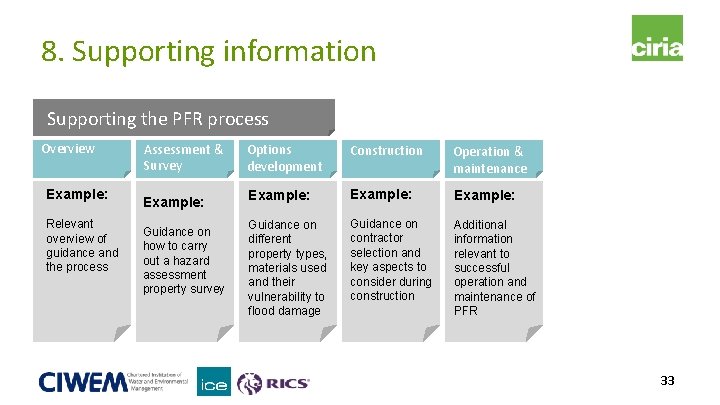
8. Supporting information Supporting the PFR process Overview Example: Relevant overview of guidance and the process Assessment & Survey Example: Guidance on how to carry out a hazard assessment property survey Options development Construction Operation & maintenance Example: Guidance on different property types, materials used and their vulnerability to flood damage Guidance on contractor selection and key aspects to consider during construction Additional information relevant to successful operation and maintenance of PFR 33
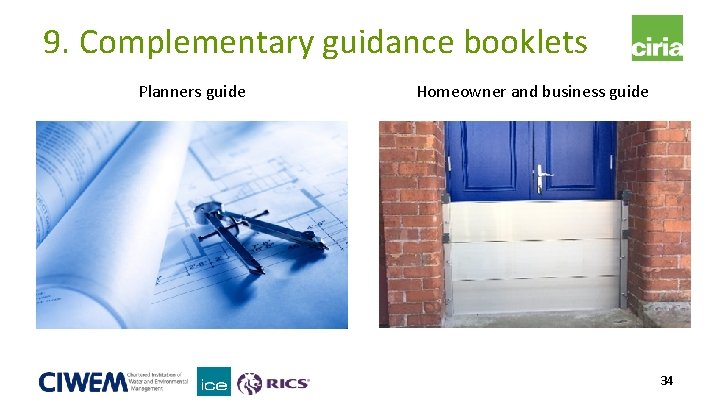
9. Complementary guidance booklets Planners guide Homeowner and business guide 34
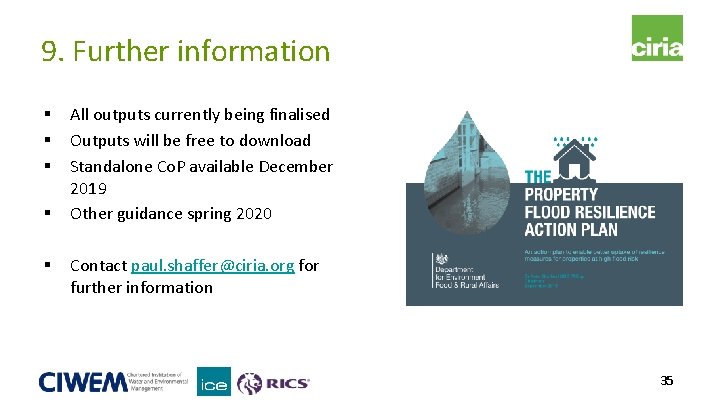
9. Further information § § § All outputs currently being finalised Outputs will be free to download Standalone Co. P available December 2019 Other guidance spring 2020 Contact paul. shaffer@ciria. org for further information 35