
Circumference of Circles Lesson 9 1 1 Ketchum

- Slides: 14
Circumference of Circles Lesson 9. 1. 1 Ketchum
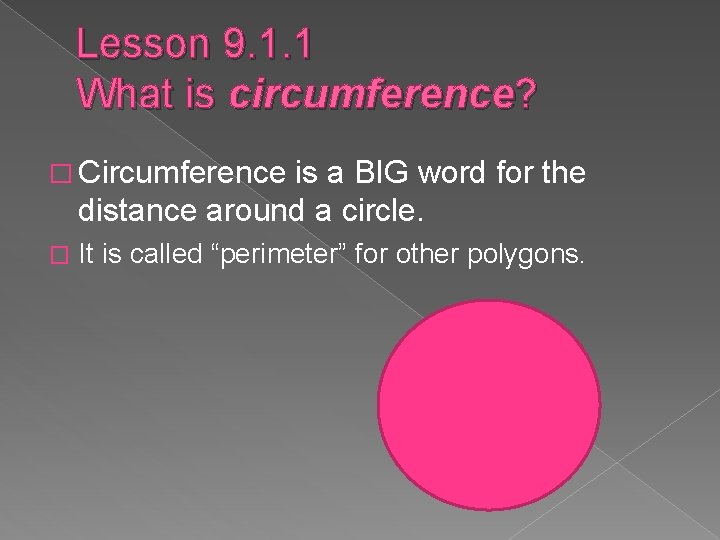
Lesson 9. 1. 1 What is circumference? � Circumference is a BIG word for the distance around a circle. � It is called “perimeter” for other polygons.
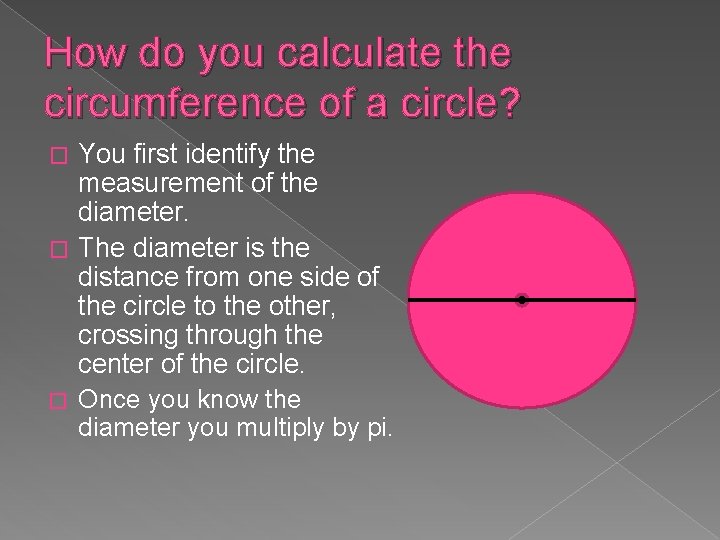
How do you calculate the circumference of a circle? You first identify the measurement of the diameter. � The diameter is the distance from one side of the circle to the other, crossing through the center of the circle. � Once you know the diameter you multiply by pi. �
What is Pi? Mathematicians found a relationship between the diameter of a circle and the circumference of the circle. • What was the relationship? • 3. 141592653589793238462643383279502… • A mathematical pattern we now call pi, other wise known as 3. 14
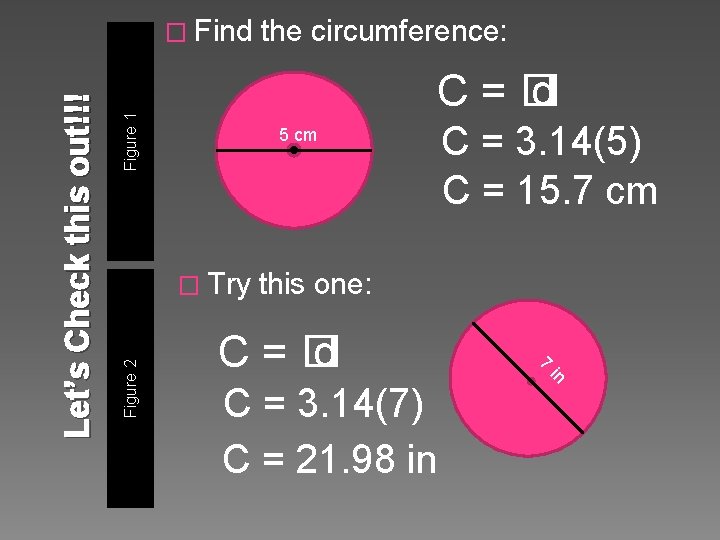
the circumference: Figure 1 C=� d 5 cm � Try Figure 2 Let’s Check this out!!! � Find C = 3. 14(5) C = 15. 7 cm this one: C=� d C = 3. 14(7) C = 21. 98 in 7 in
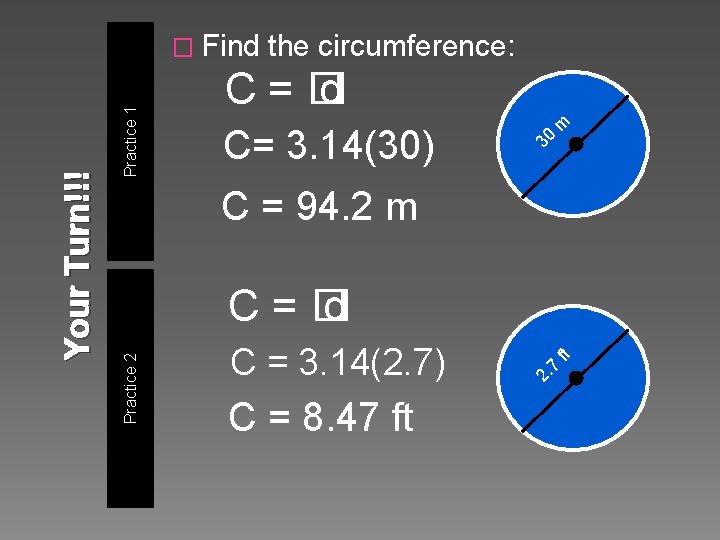
Practice 1 the circumference: C=� d C= 3. 14(30) 30 m C = 94. 2 m C=� d Practice 2 Your Turn!!! � Find C = 3. 14(2. 7) C = 8. 47 ft 7 2. ft
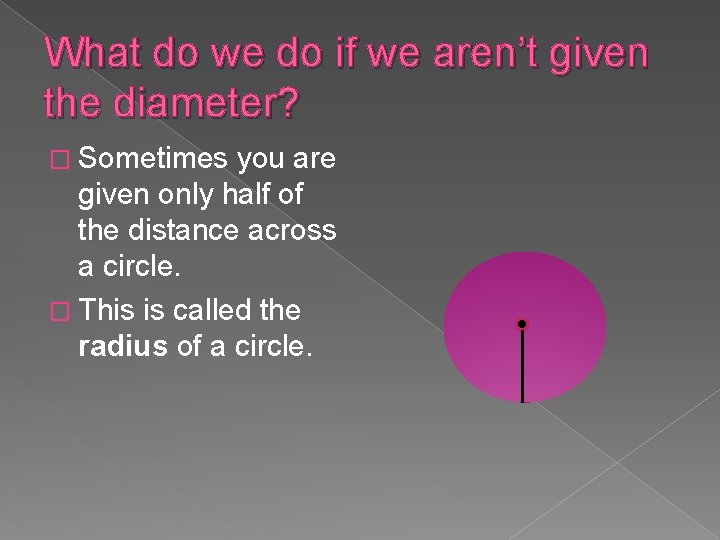
What do we do if we aren’t given the diameter? � Sometimes you are given only half of the distance across a circle. � This is called the radius of a circle.
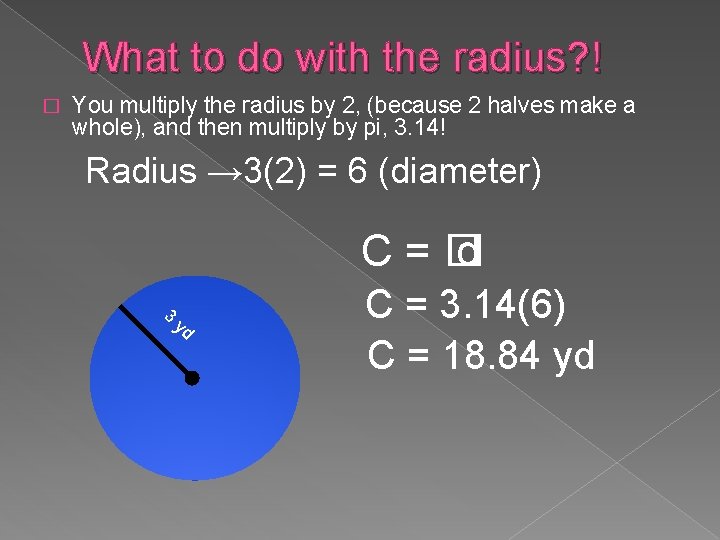
What to do with the radius? ! � You multiply the radius by 2, (because 2 halves make a whole), and then multiply by pi, 3. 14! Radius → 3(2) = 6 (diameter) C=� d 3 yd C = 3. 14(6) C = 18. 84 yd
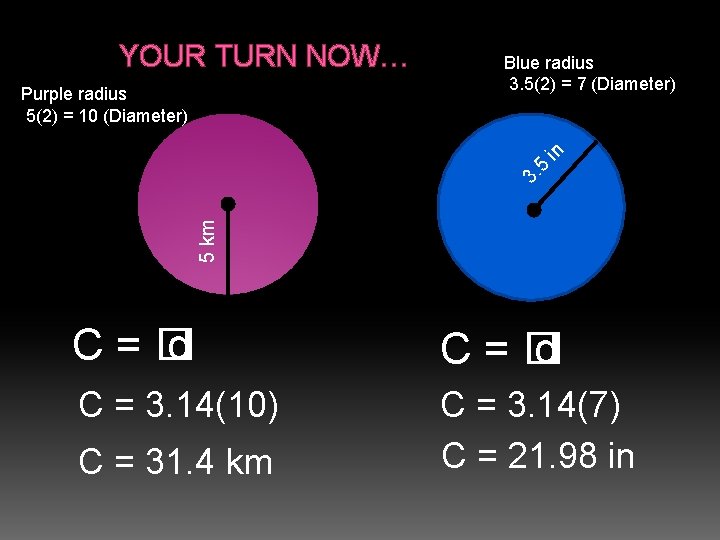
YOUR TURN NOW… 5 km 3. 5 in Purple radius 5(2) = 10 (Diameter) Blue radius 3. 5(2) = 7 (Diameter) C=� d C = 3. 14(10) C = 3. 14(7) C = 21. 98 in C = 31. 4 km
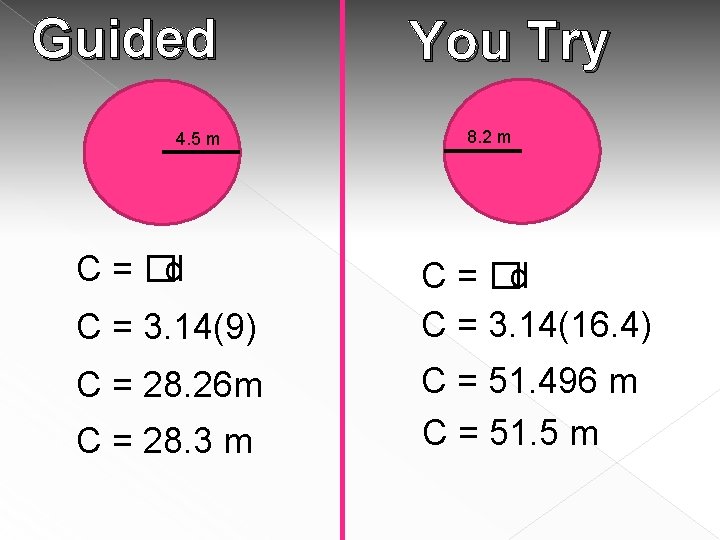
Guided 4. 5 m C = �d C = 3. 14(9) C = 28. 26 m C = 28. 3 m You Try 8. 2 m C = �d C = 3. 14(16. 4) C = 51. 496 m C = 51. 5 m
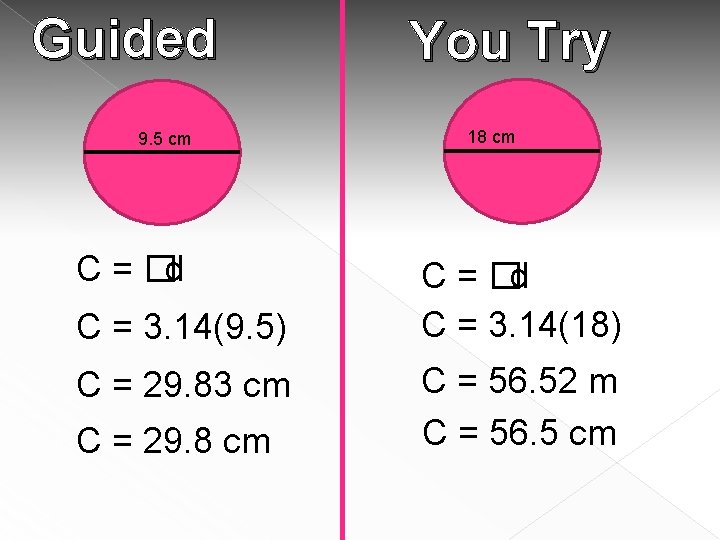
Guided 9. 5 cm C = �d C = 3. 14(9. 5) C = 29. 83 cm C = 29. 8 cm You Try 18 cm C = �d C = 3. 14(18) C = 56. 52 m C = 56. 5 cm
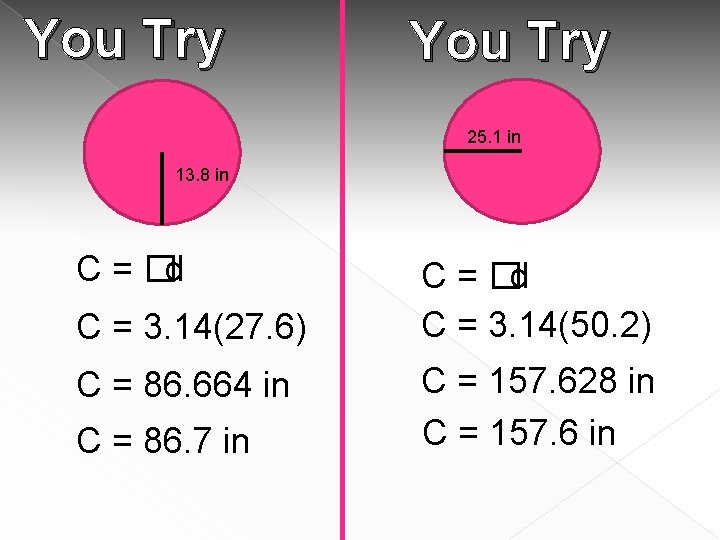
You Try 25. 1 in 13. 8 in C = �d C = 3. 14(27. 6) C = 86. 664 in C = 86. 7 in C = �d C = 3. 14(50. 2) C = 157. 628 in C = 157. 6 in
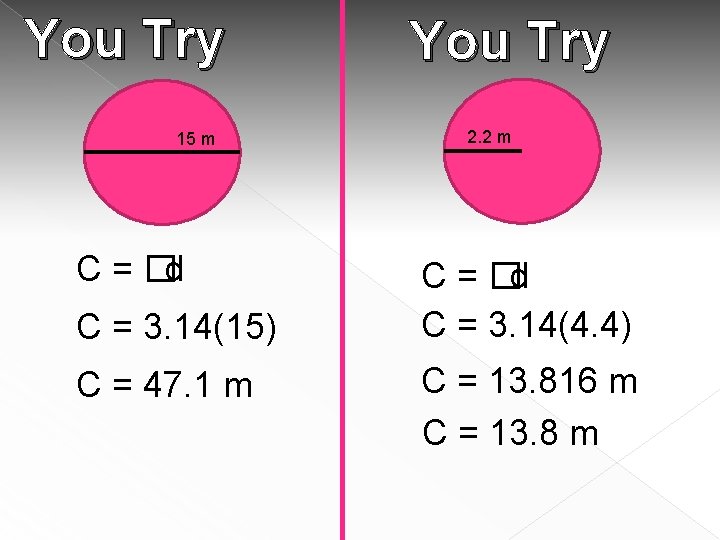
You Try 15 m C = �d C = 3. 14(15) C = 47. 1 m You Try 2. 2 m C = �d C = 3. 14(4. 4) C = 13. 816 m C = 13. 8 m
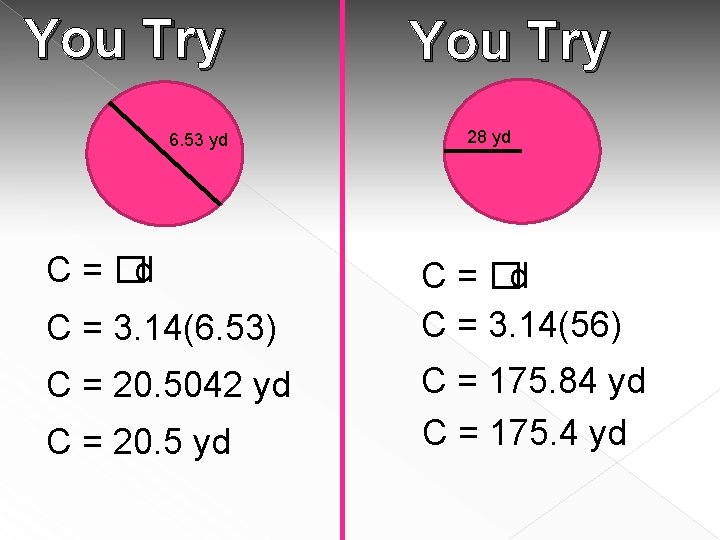
You Try 6. 53 yd C = �d C = 3. 14(6. 53) C = 20. 5042 yd C = 20. 5 yd You Try 28 yd C = �d C = 3. 14(56) C = 175. 84 yd C = 175. 4 yd