
Circulatory System The Heart Learning Goal I will
- Slides: 21
Circulatory System The Heart Learning Goal: I will understand the anatomy of the heart and its function in transporting blood throughout the body (pulmonary/systemic circuit), including the terms systolic, diastolic, coronary and cardiac arrest
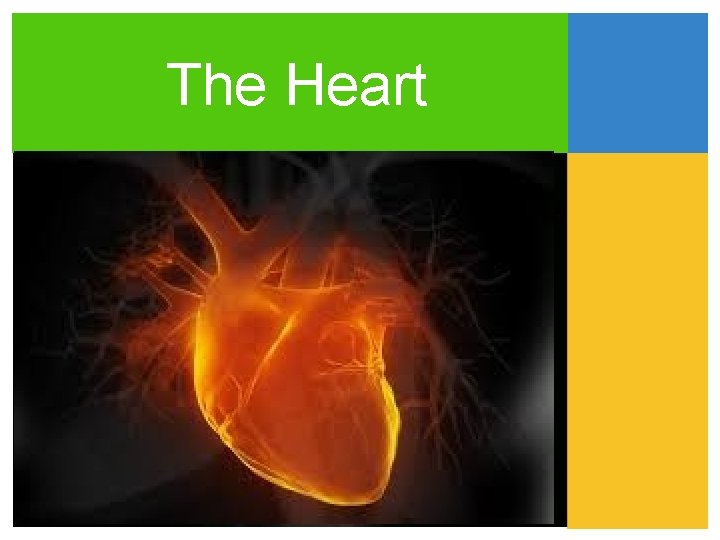
The Heart
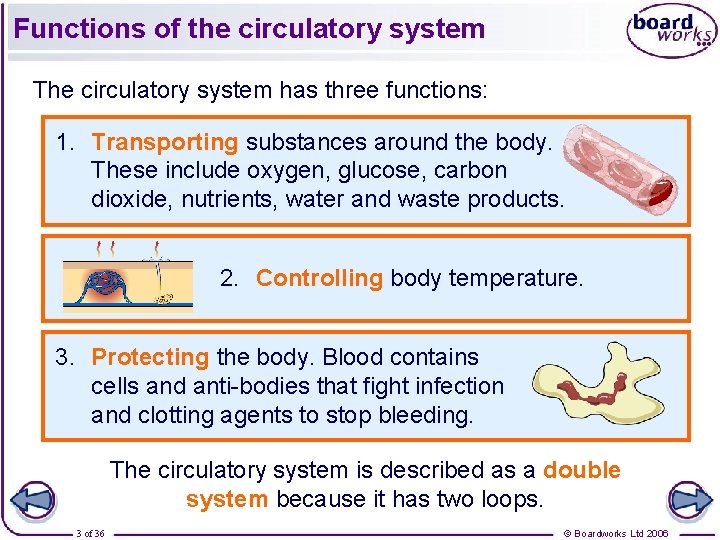
Functions of the circulatory system The circulatory system has three functions: 1. Transporting substances around the body. These include oxygen, glucose, carbon dioxide, nutrients, water and waste products. 2. Controlling body temperature. 3. Protecting the body. Blood contains cells and anti-bodies that fight infection and clotting agents to stop bleeding. The circulatory system is described as a double system because it has two loops. 3 of 36 © Boardworks Ltd 2006
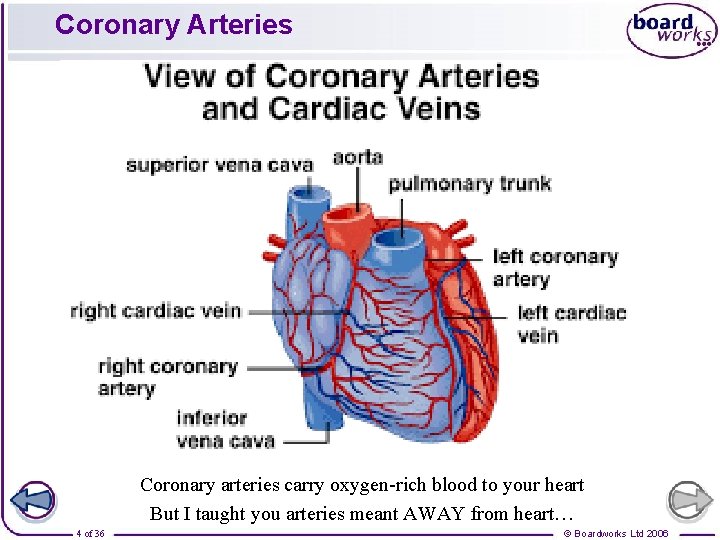
Coronary Arteries Coronary arteries carry oxygen-rich blood to your heart But I taught you arteries meant AWAY from heart… 4 of 36 © Boardworks Ltd 2006
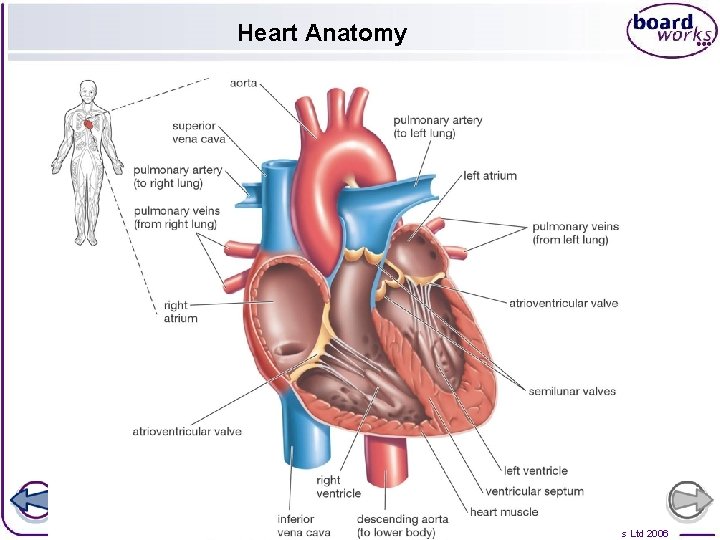
Heart Anatomy 5 of 36 © Boardworks Ltd 2006
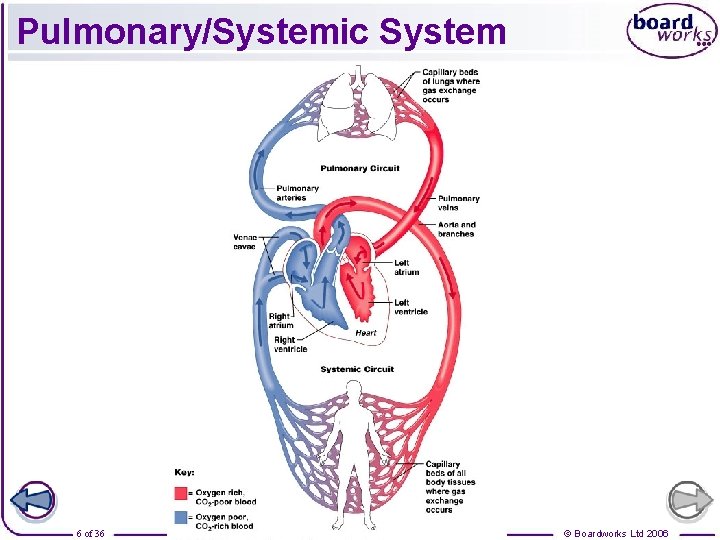
Pulmonary/Systemic System 6 of 36 © Boardworks Ltd 2006
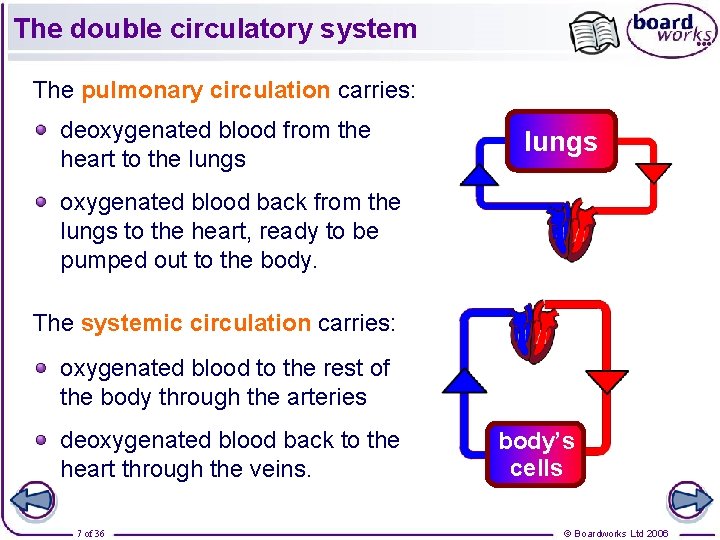
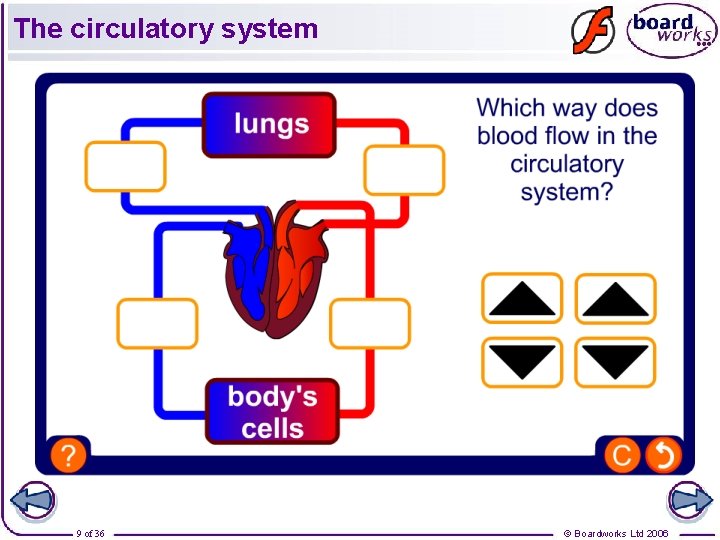
The double circulatory system The pulmonary circulation carries: deoxygenated blood from the heart to the lungs oxygenated blood back from the lungs to the heart, ready to be pumped out to the body. The systemic circulation carries: oxygenated blood to the rest of the body through the arteries deoxygenated blood back to the heart through the veins. 7 of 36 body’s cells © Boardworks Ltd 2006
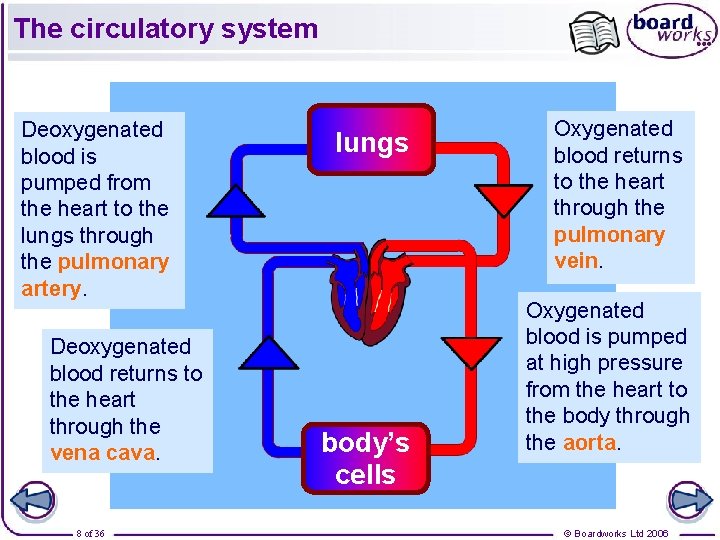
The circulatory system Deoxygenated blood is pumped from the heart to the lungs through the pulmonary artery. Deoxygenated blood returns to the heart through the vena cava. 8 of 36 lungs body’s cells Oxygenated blood returns to the heart through the pulmonary vein. Oxygenated blood is pumped at high pressure from the heart to the body through the aorta. © Boardworks Ltd 2006
The circulatory system 9 of 36 © Boardworks Ltd 2006
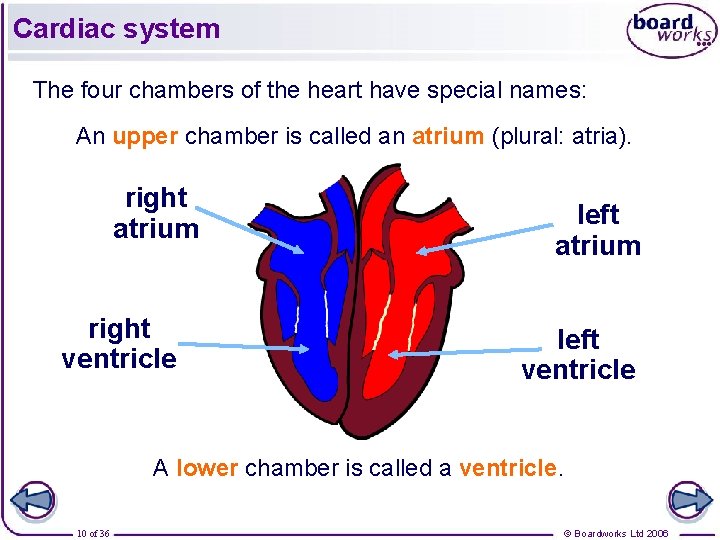
Cardiac system The four chambers of the heart have special names: An upper chamber is called an atrium (plural: atria). right atrium right ventricle left atrium left ventricle A lower chamber is called a ventricle. 10 of 36 © Boardworks Ltd 2006
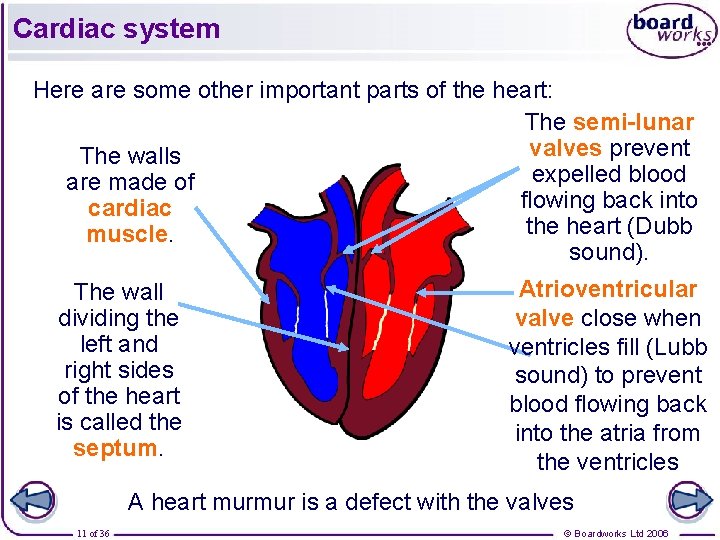
Cardiac system Here are some other important parts of the heart: The semi-lunar valves prevent The walls expelled blood are made of flowing back into cardiac the heart (Dubb muscle. sound). The wall dividing the left and right sides of the heart is called the septum. Atrioventricular valve close when ventricles fill (Lubb sound) to prevent blood flowing back into the atria from the ventricles A heart murmur is a defect with the valves 11 of 36 © Boardworks Ltd 2006
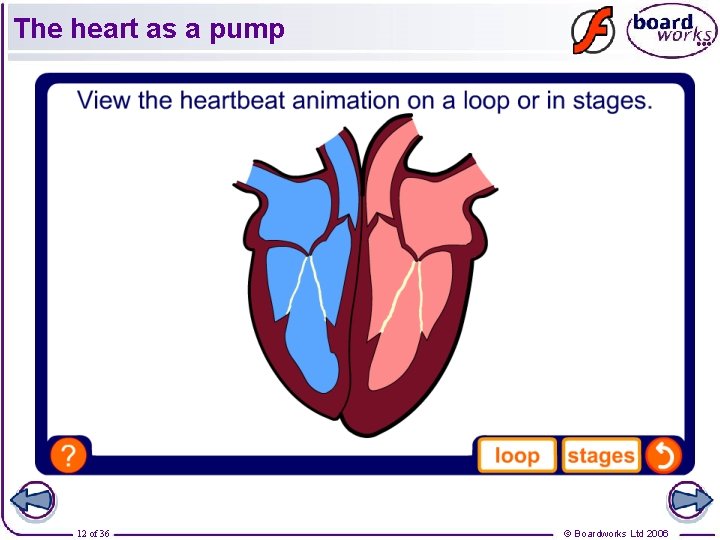
The heart as a pump 12 of 36 © Boardworks Ltd 2006
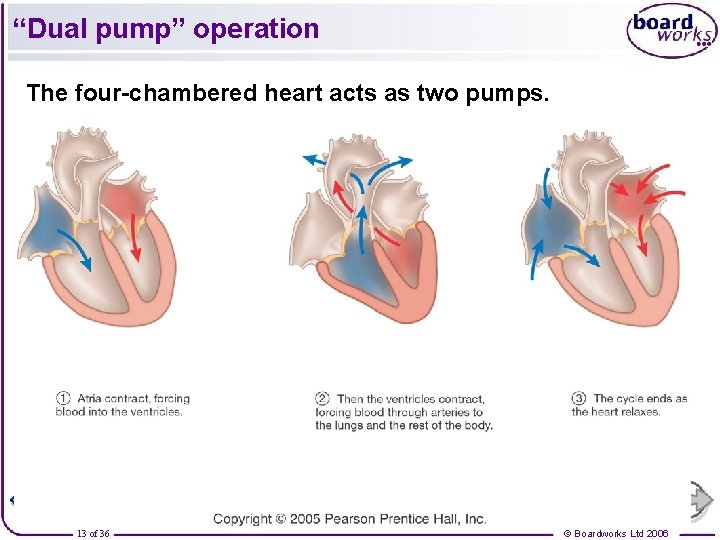
“Dual pump” operation The four-chambered heart acts as two pumps. 13 of 36 © Boardworks Ltd 2006
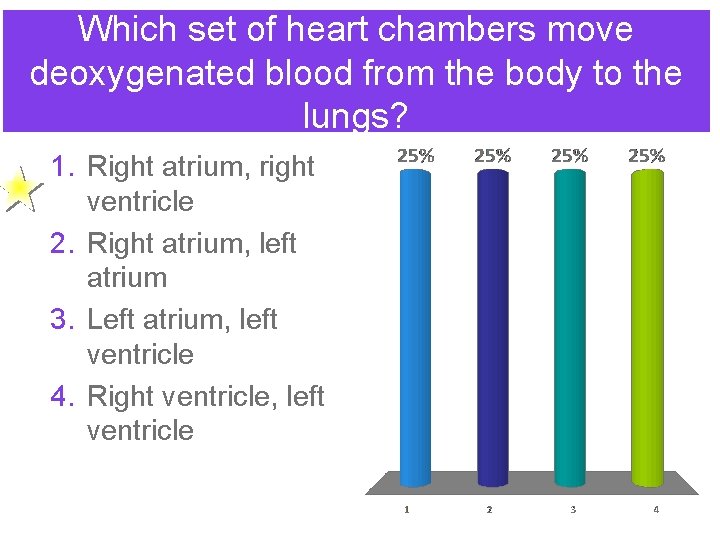
Which set of heart chambers move deoxygenated blood from the body to the lungs? 1. Right atrium, right ventricle 2. Right atrium, left atrium 3. Left atrium, left ventricle 4. Right ventricle, left ventricle
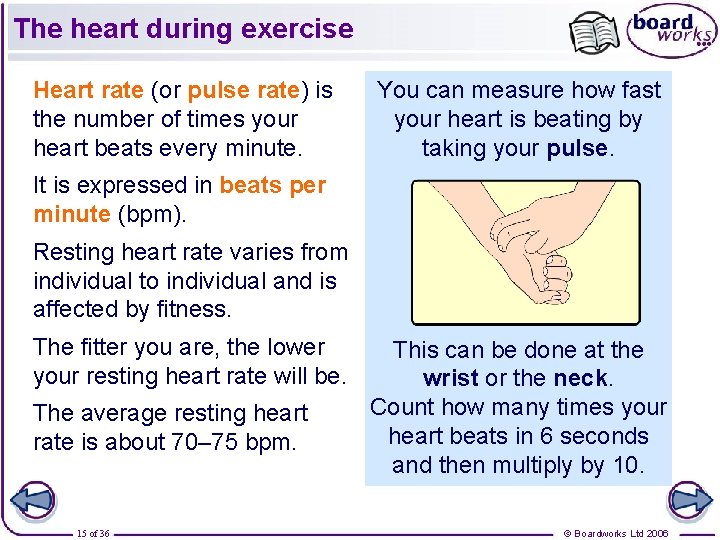
The heart during exercise Heart rate (or pulse rate) is the number of times your heart beats every minute. You can measure how fast your heart is beating by taking your pulse. It is expressed in beats per minute (bpm). Resting heart rate varies from individual to individual and is affected by fitness. The fitter you are, the lower your resting heart rate will be. The average resting heart rate is about 70– 75 bpm. 15 of 36 This can be done at the wrist or the neck. Count how many times your heart beats in 6 seconds and then multiply by 10. © Boardworks Ltd 2006
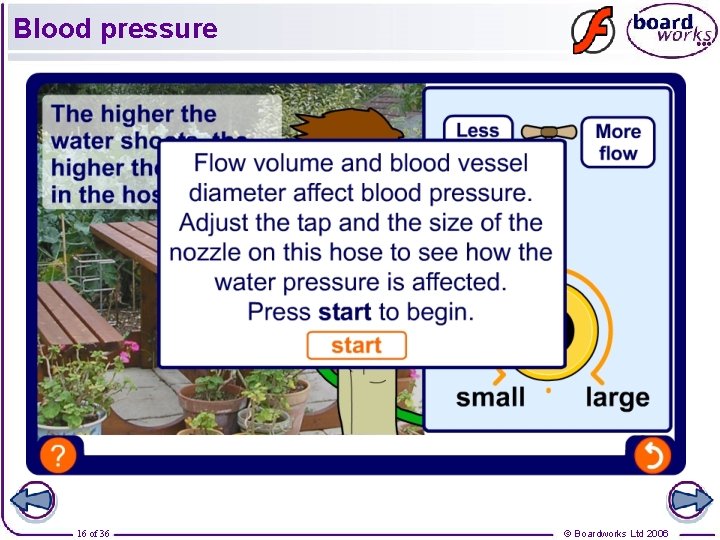
Blood pressure 16 of 36 © Boardworks Ltd 2006
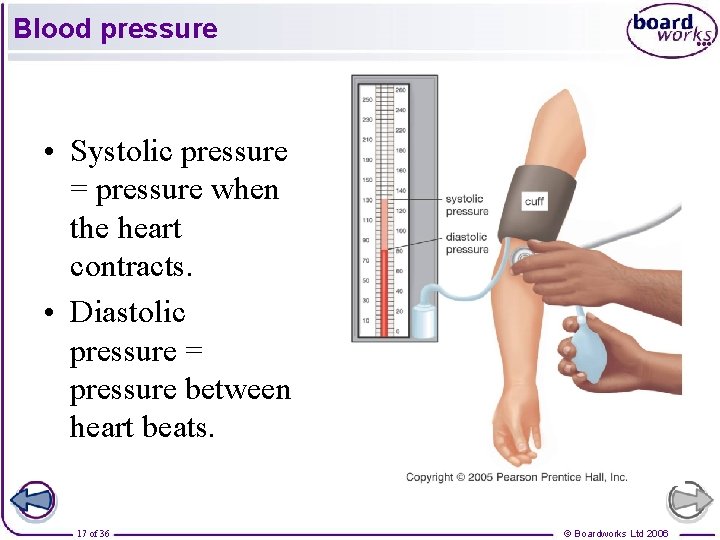
Blood pressure • Systolic pressure = pressure when the heart contracts. • Diastolic pressure = pressure between heart beats. 17 of 36 © Boardworks Ltd 2006
If your blood pressure is 90/70, the 70 represents: 1. Systolic pressure – heart contracts 2. Systolic pressure – heart is relaxed 3. Diastolic pressure – heart contracts 4. Diastolic pressure – heart is relaxed
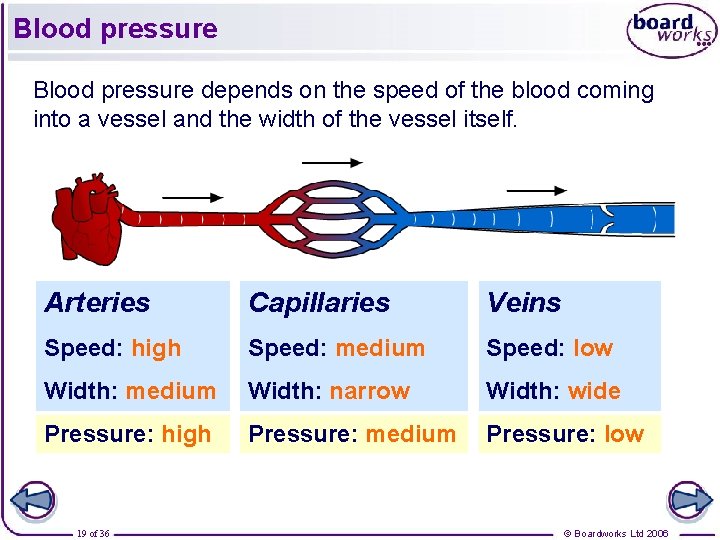
Blood pressure depends on the speed of the blood coming into a vessel and the width of the vessel itself. Arteries Capillaries Veins Speed: high Speed: medium Speed: low Width: medium Width: narrow Width: wide Pressure: high Pressure: medium Pressure: low 19 of 36 © Boardworks Ltd 2006
Blood pressure An individual’s blood pressure is affected by a number of factors. Age – it increases as you get older. Gender – men tend to have higher blood pressure than women. Stress can cause increased blood pressure. Diet – salt and saturated fats can increase blood pressure. Exercise – the fitter you are the lower your blood pressure is likely to be. Having high blood pressure puts stress on your heart. It can lead to angina, heart attacks and strokes. 20 of 36 © Boardworks Ltd 2006
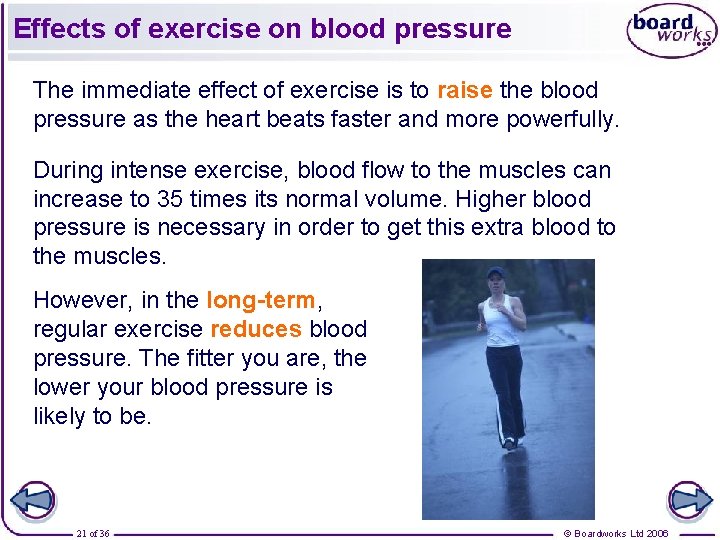
Effects of exercise on blood pressure The immediate effect of exercise is to raise the blood pressure as the heart beats faster and more powerfully. During intense exercise, blood flow to the muscles can increase to 35 times its normal volume. Higher blood pressure is necessary in order to get this extra blood to the muscles. However, in the long-term, regular exercise reduces blood pressure. The fitter you are, the lower your blood pressure is likely to be. 21 of 36 © Boardworks Ltd 2006