
Circulatory System Part 2 1 Blood pressure 2
Circulatory System: Part 2
1. Blood pressure 2. Other nutrients (not oxygen) 3. Coronary arteries
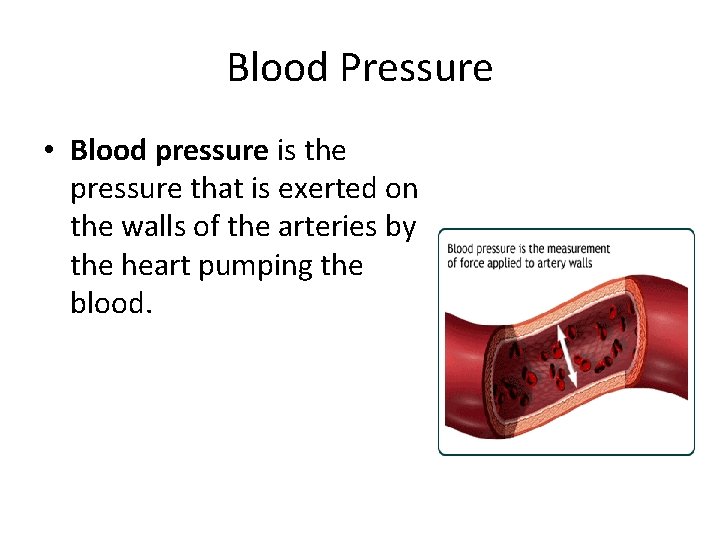
Blood Pressure • Blood pressure is the pressure that is exerted on the walls of the arteries by the heart pumping the blood.
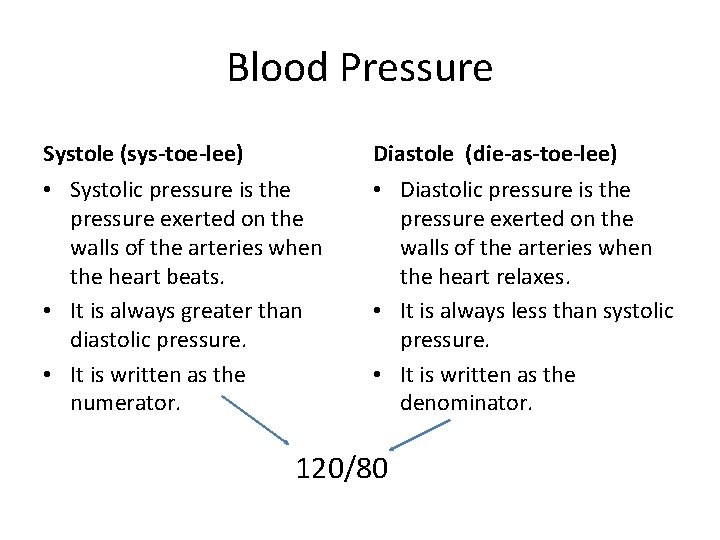
Blood Pressure Systole (sys-toe-lee) Diastole (die-as-toe-lee) • Systolic pressure is the pressure exerted on the walls of the arteries when the heart beats. • It is always greater than diastolic pressure. • It is written as the numerator. • Diastolic pressure is the pressure exerted on the walls of the arteries when the heart relaxes. • It is always less than systolic pressure. • It is written as the denominator. 120/80
Normal Blood Pressure • 100 -140 (systolic) • 60 -90 (diastolic)
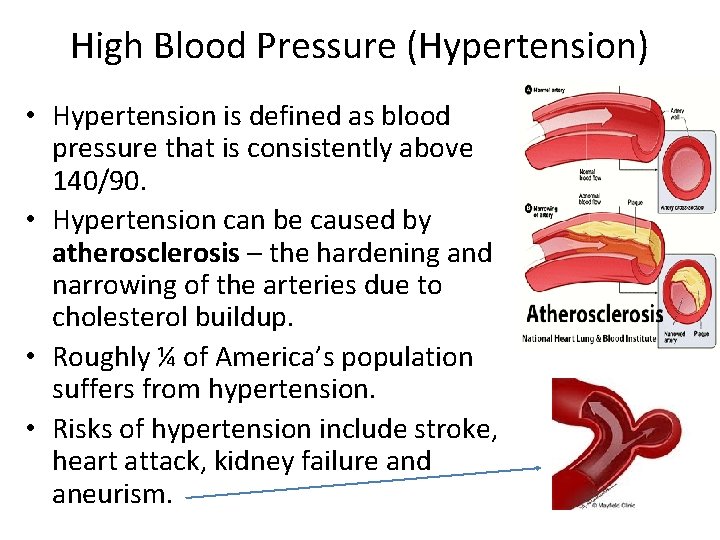
High Blood Pressure (Hypertension) • Hypertension is defined as blood pressure that is consistently above 140/90. • Hypertension can be caused by atherosclerosis – the hardening and narrowing of the arteries due to cholesterol buildup. • Roughly ¼ of America’s population suffers from hypertension. • Risks of hypertension include stroke, heart attack, kidney failure and aneurism.
Low Blood Pressure (Hypotension) • Hypotension is defined as blood pressure that is consistently below 90/60. • Hypotension can be caused by lack of water (caused by lack of drinking or diarrhea), or bleeding. • People with hypotension can experience dizziness, fainting, oxygen deprivation. • Less common than hypertension.
Other nutrients – Fatty Acids, Amino Acids, Monosaccharides (FAM) • The blood carries nutrients other than just oxygen. • We know where the blood gets the oxygen that it carries- the lungs. • Where does the blood get the other nutrients (FAM) that it carries?
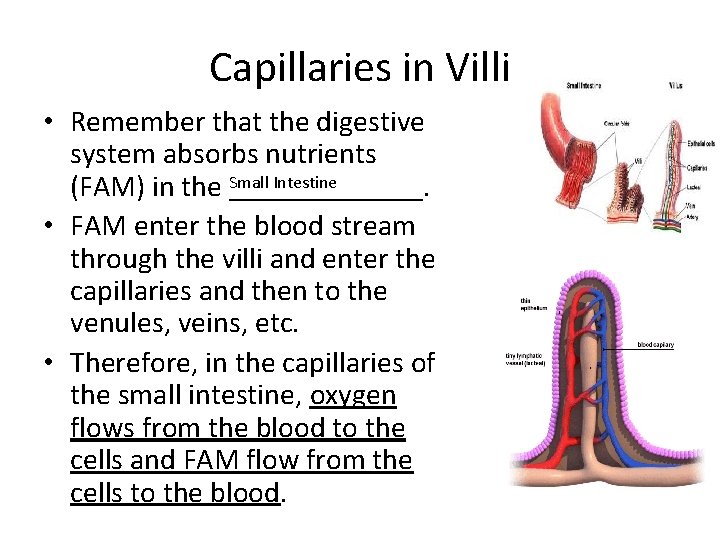
Capillaries in Villi • Remember that the digestive system absorbs nutrients Small Intestine (FAM) in the _______. • FAM enter the blood stream through the villi and enter the capillaries and then to the venules, veins, etc. • Therefore, in the capillaries of the small intestine, oxygen flows from the blood to the cells and FAM flow from the cells to the blood.
Quiz • Trace the progress of monosaccharide in a cracker from the saltine box into the big toe. Mouth Pharynx Esophagus Stomach Small intestine Capillaries Venules Veins Vena Cava Right atrium Right ventricle Pulmonary Artery Capillaries of Lungs Pulmonary Vein Left Atrium Left Ventricle Aorta Arteries Arterioles Capillaries (of big toe)
Coronary Arteries • The heart needs to feed itself. • Just like the kidneys, liver, pancreas, hands, brain, genitals, etc all need oxygen, so does the heart. • The heart cannot get the oxygen it needs from the blood it is pumping because to feed all of the cells of the heart, the blood needs to be in capillaries, to allow gas exchange. • The arteries that feed the heart are called coronary arteries.
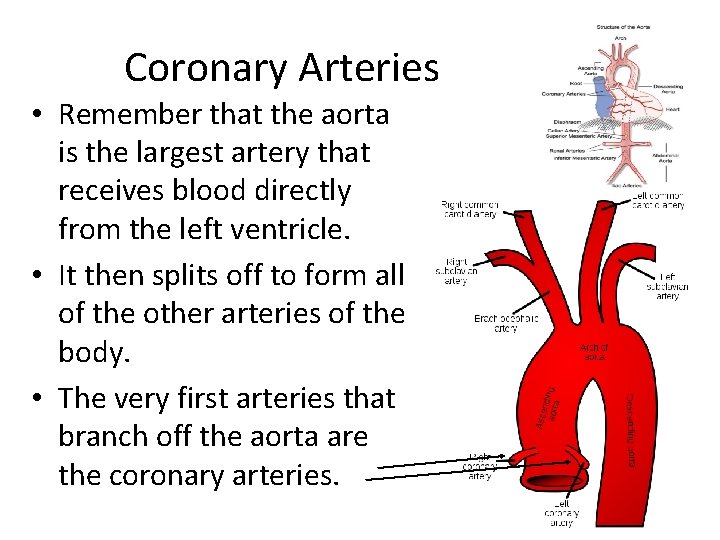
Coronary Arteries • Remember that the aorta is the largest artery that receives blood directly from the left ventricle. • It then splits off to form all of the other arteries of the body. • The very first arteries that branch off the aorta are the coronary arteries.
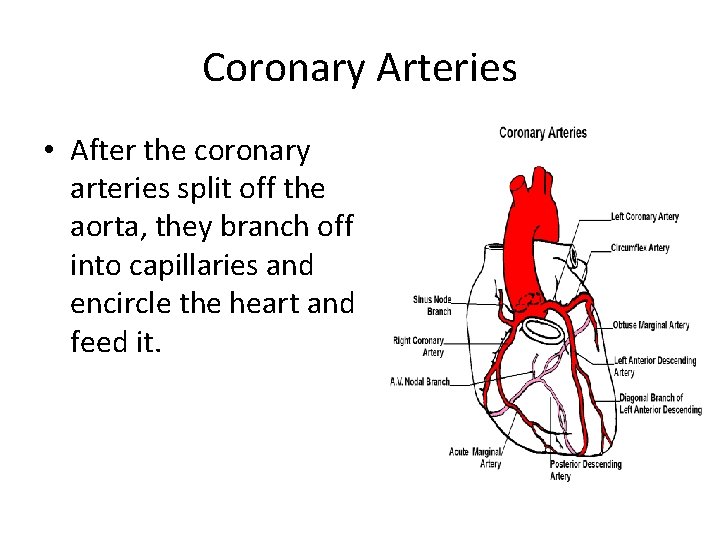
Coronary Arteries • After the coronary arteries split off the aorta, they branch off into capillaries and encircle the heart and feed it.
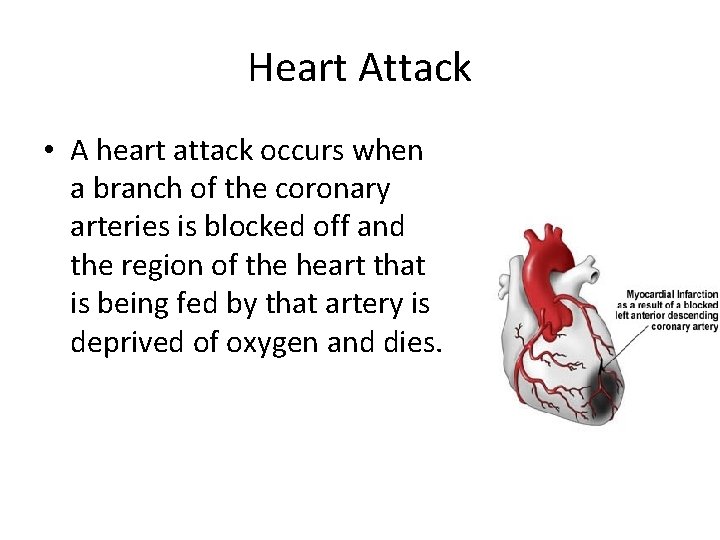
Heart Attack • A heart attack occurs when a branch of the coronary arteries is blocked off and the region of the heart that is being fed by that artery is deprived of oxygen and dies.
Treatments 1. Lifestyle changes 2. Balloon Angioplasty with Stent 3. Bypass Surgery
Balloon Angioplasty with Stent • http: //video. about. com/heartdisease/Angiopl asty. htm
Bypass Surgery • http: //www. youtube. com/watch? v=3 Nf 6 Q 2 sk GOM
- Slides: 17