
Circulatory System of a Mammal 13 5 13
- Slides: 12
Circulatory System of a Mammal 13. 5
13. 5 Circulatory System of a Mammal �Learning Objectives: �Over large distances, efficient supply of materials is provided by mass transport. �The general pattern of blood circulation in a mammal. �(Names are required only of the coronary arteries and of blood vessels entering and leaving the heart, liver and kidneys).
Mass Transport – Why is it needed? � Diffusion is adequate for transport over small distances. � Efficient supply of materials over larger distances requires a mass transport system. � With increasing size, and decreasing surface area to volume ratio, the needs of the organism cannot be met by use of the body surface alone. � Specialised exchange surfaces are located in specific regions of the body to allow absorption of nutrients and respiratory gases and the excretion of waste substances. � Materials need to then be transported from the exchange
Factors determining the presence of mass transport �The surface area to volume ratio �The activity of the organism �Obviously, the greater the activity and smaller the ratio, the greater the need for mass transport and a pump.
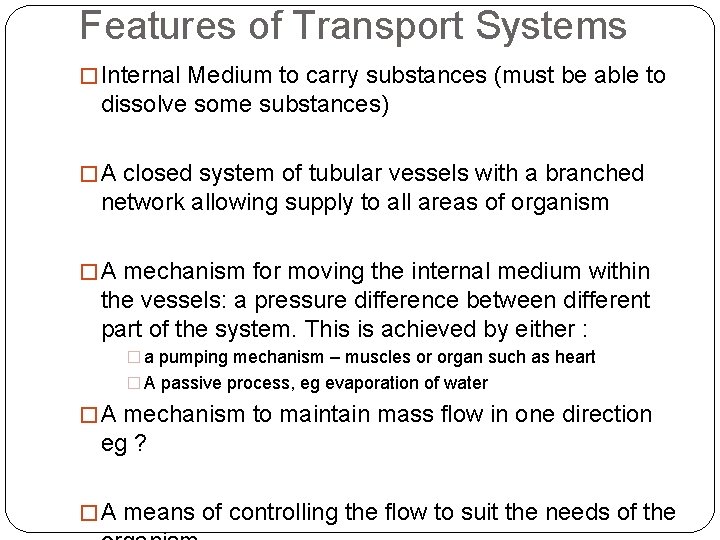
Features of Transport Systems � Internal Medium to carry substances (must be able to dissolve some substances) � A closed system of tubular vessels with a branched network allowing supply to all areas of organism � A mechanism for moving the internal medium within the vessels: a pressure difference between different part of the system. This is achieved by either : � a pumping mechanism – muscles or organ such as heart � A passive process, eg evaporation of water � A mechanism to maintain mass flow in one direction eg ? � A means of controlling the flow to suit the needs of the
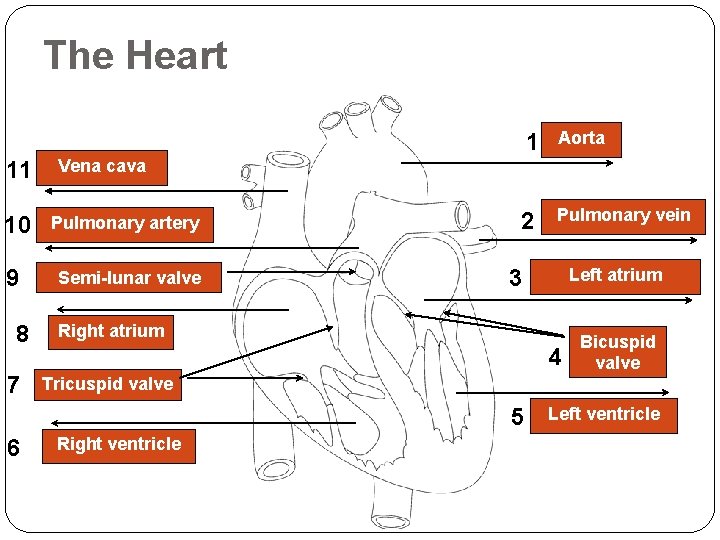
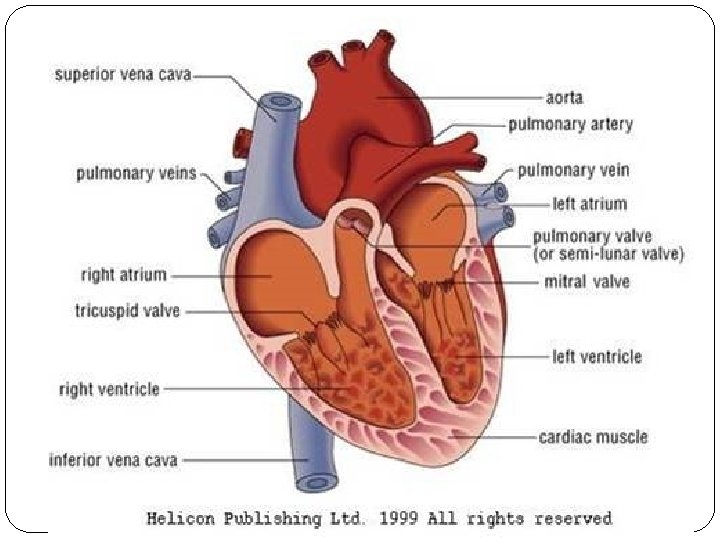
The Heart 11 Pulmonary artery 9 Semi-lunar valve 7 Aorta 2 Pulmonary vein Vena cava 10 8 1 3 Right atrium 4 Bicuspid valve Tricuspid valve 5 6 Left atrium Right ventricle Left ventricle
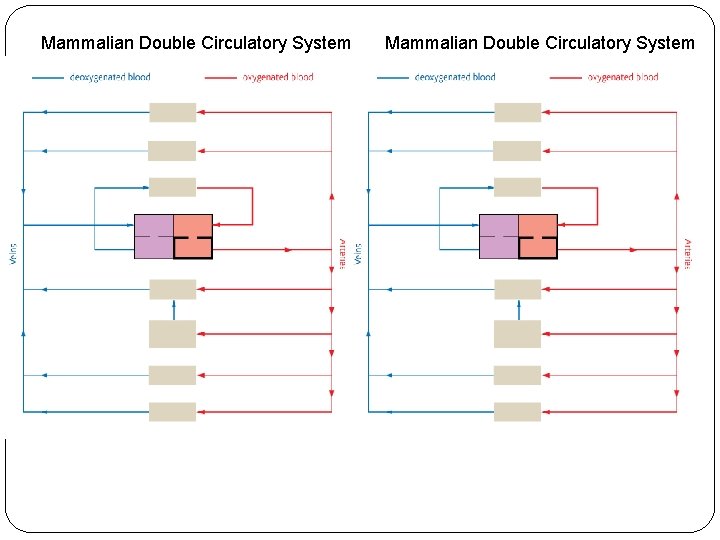
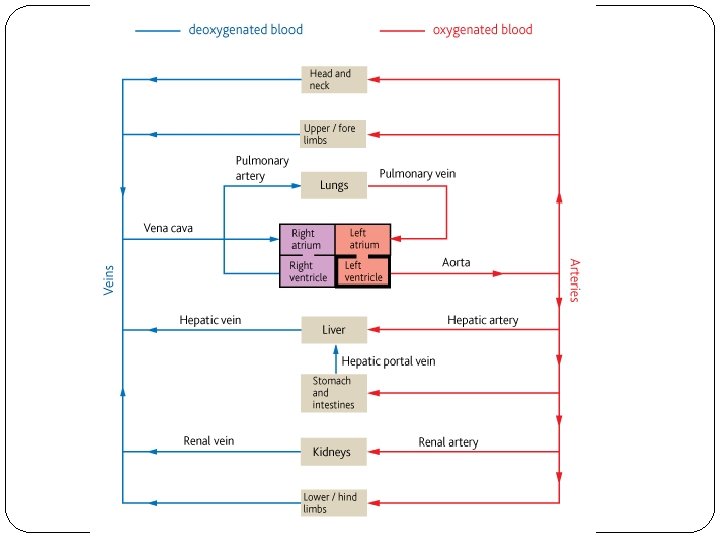
Mammalian Double Circulatory System
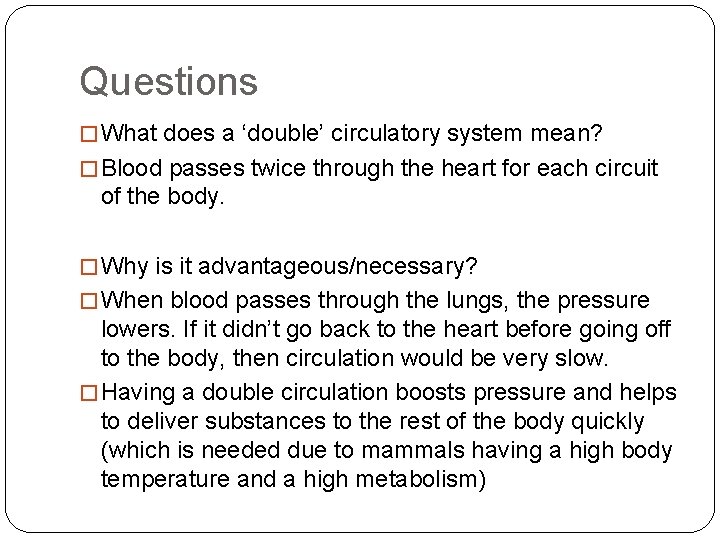
Questions � What does a ‘double’ circulatory system mean? � Blood passes twice through the heart for each circuit of the body. � Why is it advantageous/necessary? � When blood passes through the lungs, the pressure lowers. If it didn’t go back to the heart before going off to the body, then circulation would be very slow. � Having a double circulation boosts pressure and helps to deliver substances to the rest of the body quickly (which is needed due to mammals having a high body temperature and a high metabolism)
Task �Complete Summary Questions on page 185.
13. 5 Circulatory System of a Mammal �Learning Objectives: �Over large distances, efficient supply of materials is provided by mass transport. �The general pattern of blood circulation in a mammal. �(Names are required only of the coronary arteries and of blood vessels entering and leaving the heart, liver and kidneys).