
CIRCULATORY LYMPHATIC AND RESPIRATORY SYSTEMS Regents Biology OBJECTIVES
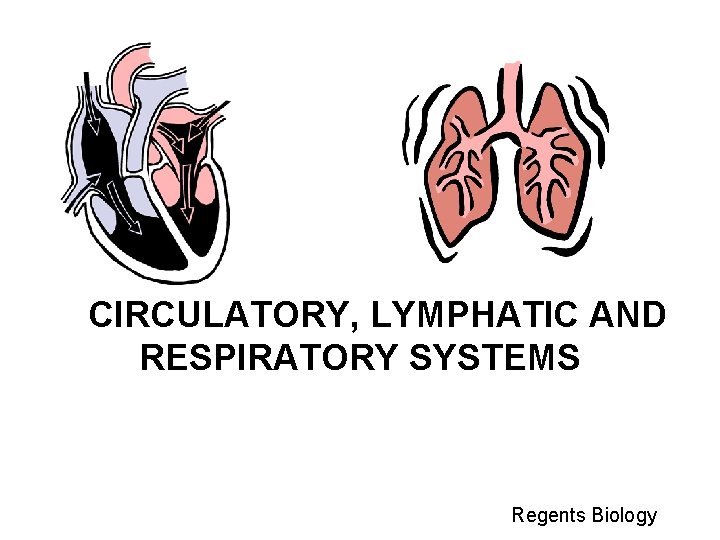
CIRCULATORY, LYMPHATIC AND RESPIRATORY SYSTEMS Regents Biology
OBJECTIVES Upon completion of this unit students will be able to: 1. Explain the importance of the transport process, for both simple and complex organisms. 2. Differentiate the structure and function of an artery, vein and capillary. 3. Trace the path of blood to and through the heart. 4. Discuss the exchange of gases that occurs in the lungs. 5. Differentiate systemic and pulmonary circulation. 6. Understand the connection between blood types and blood clotting. 7. Identify the structures of the lymphatic systems and explain their functions. 8. Compare and describe the two types of immunity. 9. Explain the three lines of defense against disease-causing organisms. 10. Describe disorders of the immune system. 11. Describe how AIDS affects the immune system. 12. Explain how the spread of AIDS can be prevented. 13. Define the term gas exchange and list the characteristics of a respiratory surface. 14. Identify the structures of the human respiratory surface and state their functions. 15. Explain how the body cells obtain oxygen and get rid of carbon dioxide.
KEY WORDS 1. 2. 3. 4. 5. 6. 7. 8. active immunity AIDS allergy alveoli antibodies antigen autoimmune disease clotting 9. 10. 11. 12. 13. 14. 15. 16. gas exchange lungs passive immunity pathogen plasma platelets red blood cells white blood cells
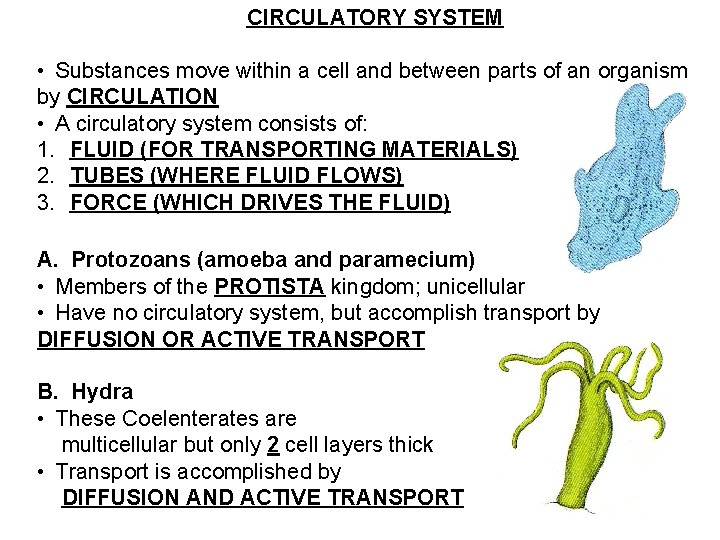
CIRCULATORY SYSTEM • Substances move within a cell and between parts of an organism by CIRCULATION • A circulatory system consists of: 1. FLUID (FOR TRANSPORTING MATERIALS) 2. TUBES (WHERE FLUID FLOWS) 3. FORCE (WHICH DRIVES THE FLUID) A. Protozoans (amoeba and paramecium) • Members of the PROTISTA kingdom; unicellular • Have no circulatory system, but accomplish transport by DIFFUSION OR ACTIVE TRANSPORT B. Hydra • These Coelenterates are multicellular but only 2 cell layers thick • Transport is accomplished by DIFFUSION AND ACTIVE TRANSPORT
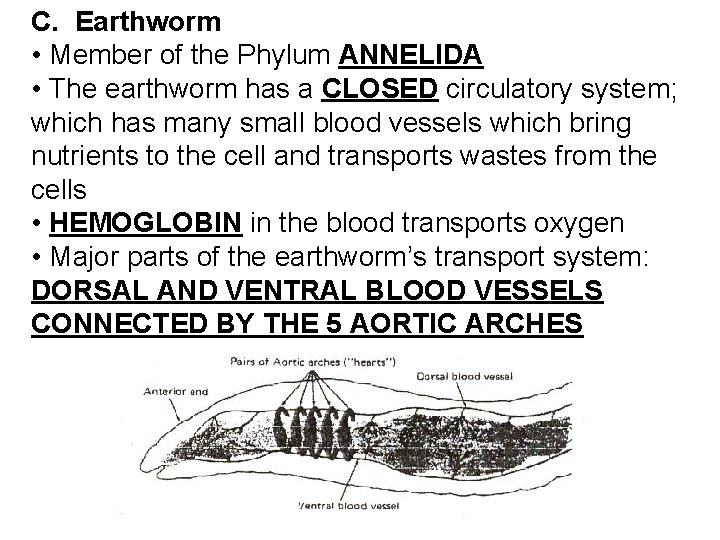
C. Earthworm • Member of the Phylum ANNELIDA • The earthworm has a CLOSED circulatory system; which has many small blood vessels which bring nutrients to the cell and transports wastes from the cells • HEMOGLOBIN in the blood transports oxygen • Major parts of the earthworm’s transport system: DORSAL AND VENTRAL BLOOD VESSELS CONNECTED BY THE 5 AORTIC ARCHES
D. Grasshopper • Member of the Phylum ARTHROPODA and Class INSECTA • Grasshoppers have an OPEN circulatory system • The blood does NOT transport oxygen • Blood is kept moving by BREATHING and MOVEMENT • The blood flows towards the head and leaves the aorta and flows through the body cavities called SINUSES
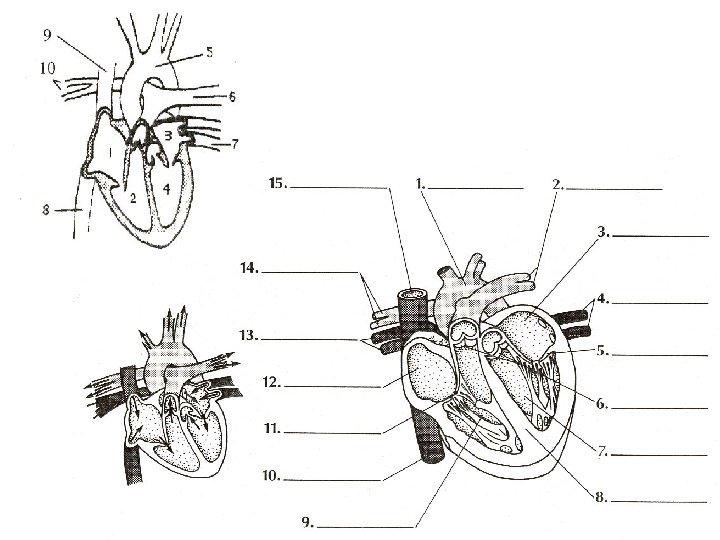
E. Human • Member of the Phylum Chordata and Class MAMMALIA • This advanced circulatory system includes the BLOOD (FLUID), BLOOD VESSELS (TUBES), and HEART (FORCE) which transports the materials via blood The Human Circulatory System 1. HEART • Muscular organ found on the LEFT side of the body • Made of CARDIAC tissue; outside surrounded by protective membrane (pericardium) • There are 2 ATRIA and 2 VENTRICLES (4 chambers total) • The RIGHT side of the heart receives blood from the BODY and pumps it to the LUNGS • The LEFT side of the heart receives the blood from the lungs and pumps it to ALL ARTERIES IN THE BODY
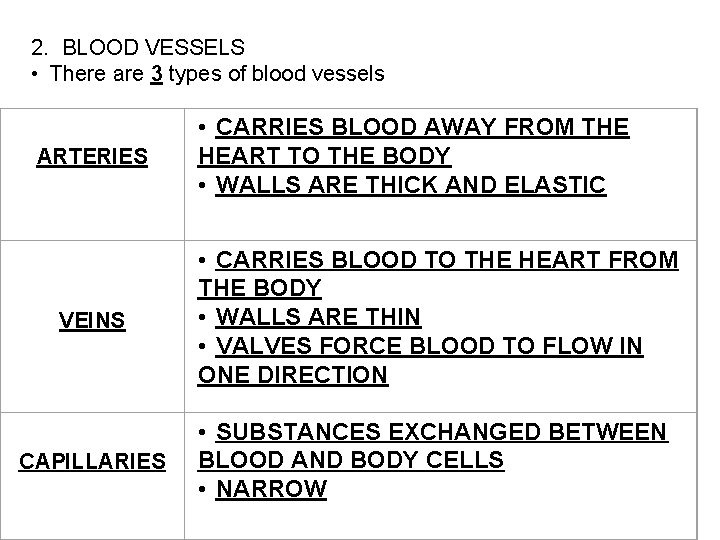
2. BLOOD VESSELS • There are 3 types of blood vessels ARTERIES • CARRIES BLOOD AWAY FROM THE HEART TO THE BODY • WALLS ARE THICK AND ELASTIC VEINS • CARRIES BLOOD TO THE HEART FROM THE BODY • WALLS ARE THIN • VALVES FORCE BLOOD TO FLOW IN ONE DIRECTION CAPILLARIES • SUBSTANCES EXCHANGED BETWEEN BLOOD AND BODY CELLS • NARROW

3. TYPES OF CIRCULATION • Pulmonary circulation: CARRIES BLOOD BETWEEN HEART AND LUNGS • Systemic circulation: CARRIES BLOOD BETWEEN HEART AND THE REST OF THE BODY
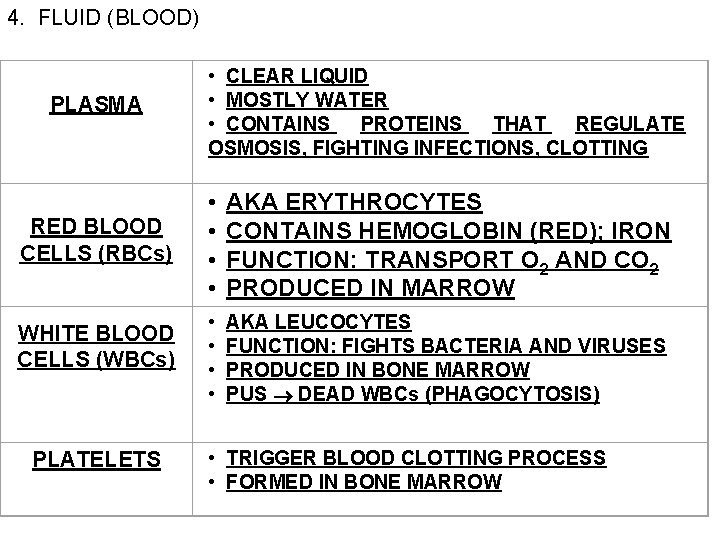
4. FLUID (BLOOD) PLASMA RED BLOOD CELLS (RBCs) WHITE BLOOD CELLS (WBCs) PLATELETS • CLEAR LIQUID • MOSTLY WATER • CONTAINS PROTEINS THAT REGULATE OSMOSIS, FIGHTING INFECTIONS, CLOTTING • • AKA ERYTHROCYTES CONTAINS HEMOGLOBIN (RED); IRON FUNCTION: TRANSPORT O 2 AND CO 2 PRODUCED IN MARROW • • AKA LEUCOCYTES FUNCTION: FIGHTS BACTERIA AND VIRUSES PRODUCED IN BONE MARROW PUS DEAD WBCs (PHAGOCYTOSIS) • TRIGGER BLOOD CLOTTING PROCESS • FORMED IN BONE MARROW
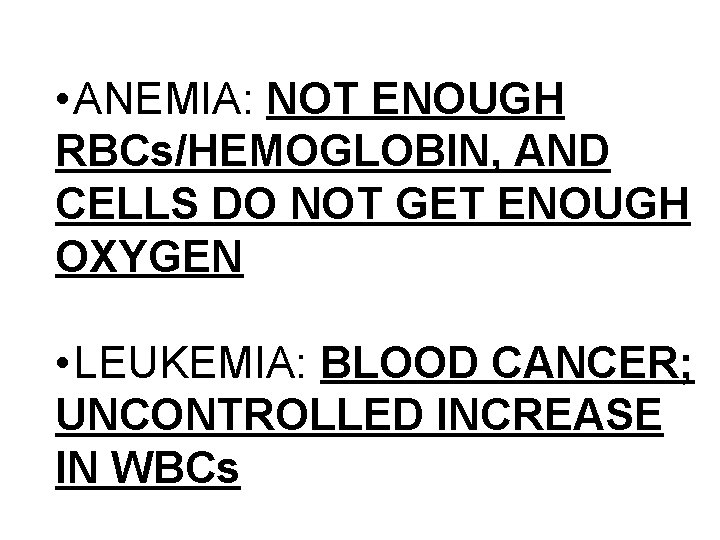
• ANEMIA: NOT ENOUGH RBCs/HEMOGLOBIN, AND CELLS DO NOT GET ENOUGH OXYGEN • LEUKEMIA: BLOOD CANCER; UNCONTROLLED INCREASE IN WBCs
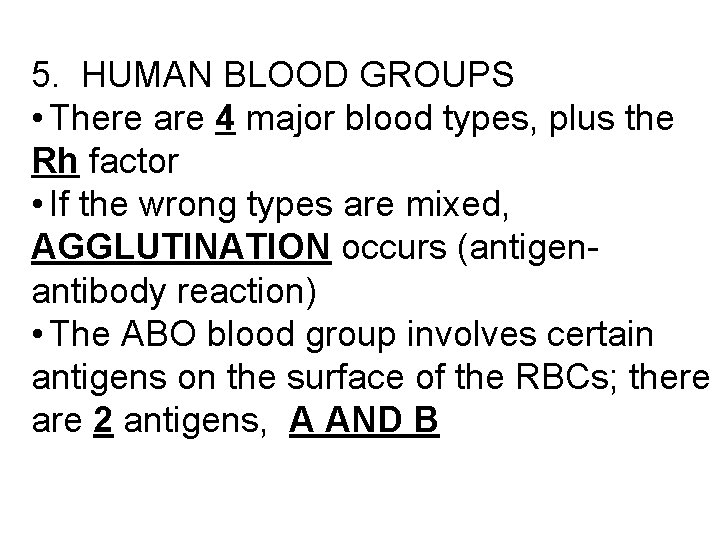
5. HUMAN BLOOD GROUPS • There are 4 major blood types, plus the Rh factor • If the wrong types are mixed, AGGLUTINATION occurs (antigenantibody reaction) • The ABO blood group involves certain antigens on the surface of the RBCs; there are 2 antigens, A AND B
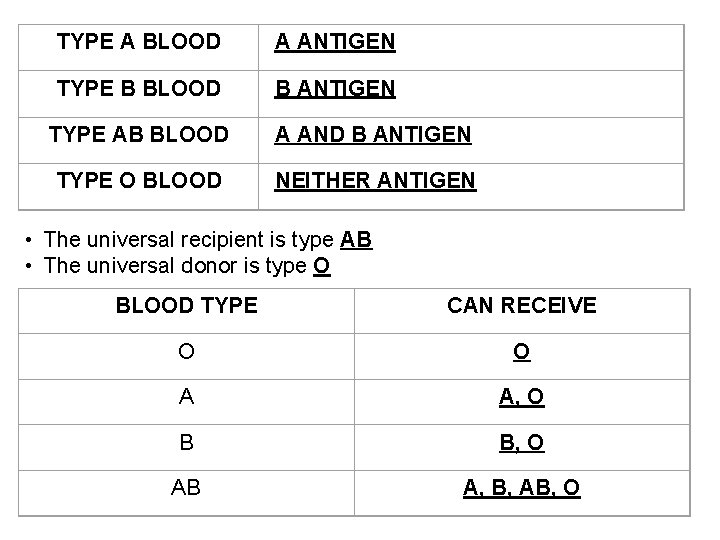
TYPE A BLOOD A ANTIGEN TYPE B BLOOD B ANTIGEN TYPE AB BLOOD A AND B ANTIGEN TYPE O BLOOD NEITHER ANTIGEN • The universal recipient is type AB • The universal donor is type O BLOOD TYPE CAN RECEIVE O O A A, O B B, O AB A, B, AB, O
THE LYMPHATIC SYSTEM • This system of tubes provides a means for exchange between BLOOD and body cells • Excess fluids and proteins are returned to the blood • The fluid inside lymph vessels is called LYMPH • LYMPH NODES are found along lymph vessels and play a role in fighting disease, as it filters foreign matter from lymph and PREVENTS IT FROM ENTERING THE BLOOD STREAM
• Lymph nodes become ENLARGED when infected • Immunity is the ability of the body to RESIST DISEASES • The immune system recognizes foreign cells and uses LYMPHOCYTES (WBCs) and the LYMPHATIC system to produce an immune response • Organ transplants are successful when the recipient’s immune system does not REJECT the new organ or tissue (family members are you’re best bet!)
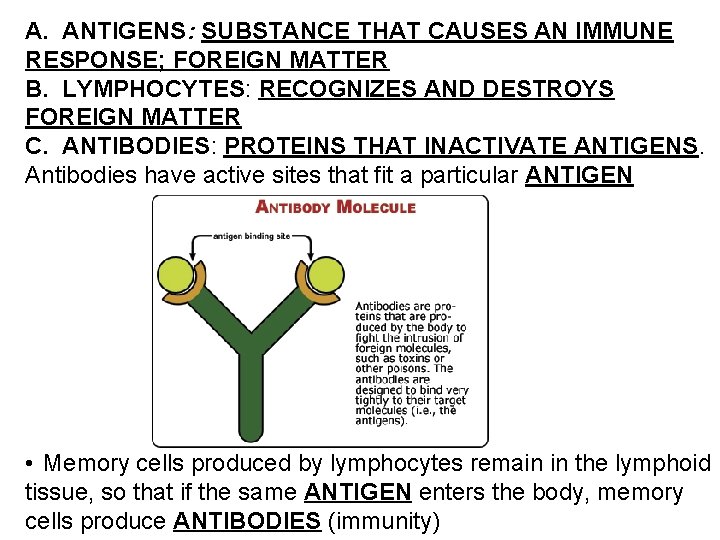
A. ANTIGENS: SUBSTANCE THAT CAUSES AN IMMUNE RESPONSE; FOREIGN MATTER B. LYMPHOCYTES: RECOGNIZES AND DESTROYS FOREIGN MATTER C. ANTIBODIES: PROTEINS THAT INACTIVATE ANTIGENS. Antibodies have active sites that fit a particular ANTIGEN • Memory cells produced by lymphocytes remain in the lymphoid tissue, so that if the same ANTIGEN enters the body, memory cells produce ANTIBODIES (immunity)
D. TYPES OF IMMUNITY (there are two types): 1. INBORN: FROM BIRTH; HUMANS CANNOT BE INFECTED 2. ACQUIRED: INVOLVES ANTIBODIES; EITHER ACTIVE OR PASSIVE • Active acquired immunity is when ANTIBODIES are made by the body; this can develop by having a disease OR by getting a VACCINE which is a dead or weakened virus • Passive acquired immunity is when the antibodies are “BORROWED” for example, babies get Mom’s antibodies for the first few months of life
E. DISORDERS OF THE IMMUNE SYSTEM • Autoimmune diseases are when a person’s immune system breaks down and ANTIBODIES develop against one’s own body • Allergies are an OVERRESPONSE to antigens • AIDS stands for ACQUIRED IMMUNE DEFICIENCY SYNDROME and is caused by the virus HIV, which stands for HUMAN IMMUNODEFICIENCY VIRUS • HIV infects and disables LYMPHOCYTES which makes you susceptible to infection • HIV is transmitted by four bodily fluids: BLOOD, SEMEN, VAGINAL SECRETIONS, BREAST MILK; CAN BE PASSED VIA SEX, NEEDLES, TRANSFUSIONS
RESPIRATORY SYSTEM • Respiration is the process of obtaining OXYGEN and getting rid of CARBON DIOXIDE • For proper gas exchange to occur, the following are needed: 1. RESPIRATORY SURFACE MUST BE THIN SO DIFFUSION CAN HAPPEN READILY 2. RESPIRATORY SURFACE MUST BE MOIST 3. RESPIRATORY SURFACE MUST BE IN CONTACT WITH OXYGEN SOURCE 4. RESPIRATORY SURFACE MUST BE IN CONTACT WITH CIRCULATORY SYSTEM (IF MULTICELLULAR) There are different types of cellular wastes produced by the body. Respiratory wastes are one type. Respiratory wastes include CARBON DIOXIDE and WATER
A. Protozoans (amoeba and paramecium) • Each cell takes care of itself by DIFFUSION B. Hydra • Respiratory gases enter and leave by the process of DIFFUSION C. Earthworm • The respiratory surface for the earthworm is its SKIN • Oxygen diffuses through the skin into CAPILLARIES, and the blood in the capillaries picks up the OXYGEN (hemoglobin) and transports it to body cells • Damp soil helps to keep the earthworm’s skin MOIST • If it’s too dry, the skin dries out and the earthworm SUFFOCATES • If it’s too wet (rain), the skin cannot obtain adequate OXYGEN from the WATER
D. Grasshopper • Respiration does not depend on a CIRCULATORY SYSTEM • There is no HEMOGLOBIN in the blood; the blood does NOT transport oxygen • Oxygen is carried to the body by a branched system of TRACHEAL TUBES E. Human • The blood and the respiratory system work together to transport respiratory gases to and from the cells of the body
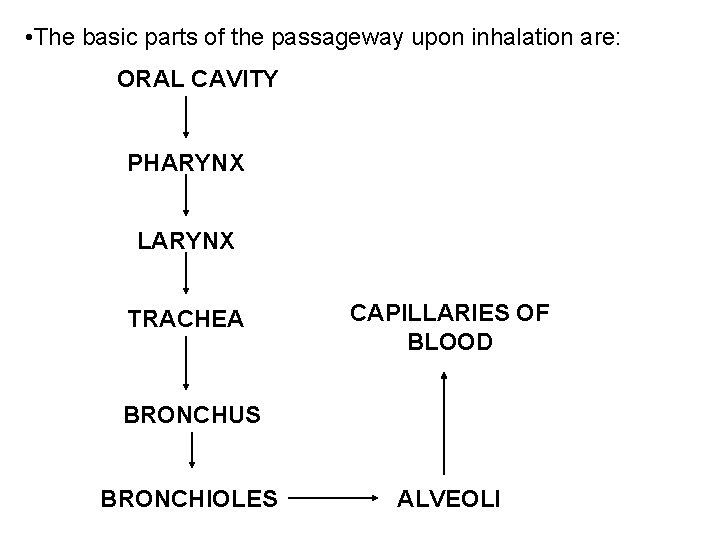
• The basic parts of the passageway upon inhalation are: ORAL CAVITY PHARYNX LARYNX TRACHEA CAPILLARIES OF BLOOD BRONCHUS BRONCHIOLES ALVEOLI
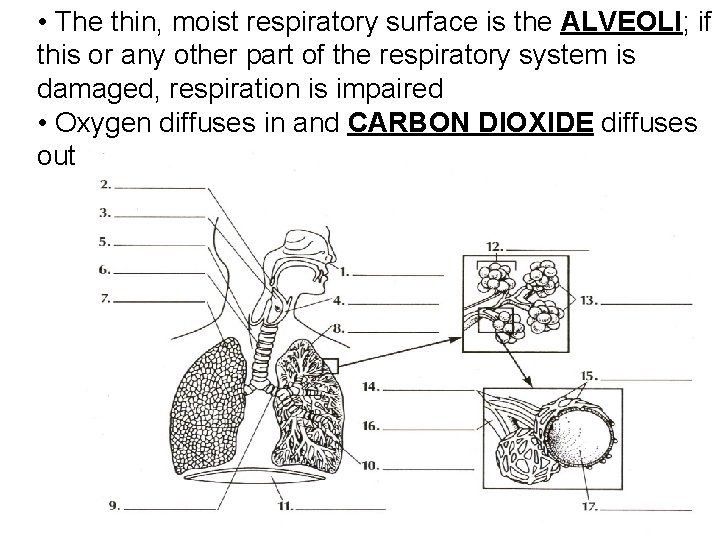
• The thin, moist respiratory surface is the ALVEOLI; if this or any other part of the respiratory system is damaged, respiration is impaired • Oxygen diffuses in and CARBON DIOXIDE diffuses out
• Upon EXHALATION, the carbon dioxide follows the pathway in reverse order to leave the body • CILIATED EPITHEILIAL CELLS line the respiratory system. The function of these cells is to PREVENT ENTRANCE OF LARGE PARTICLES • The mucus-producing cells function to keep the lining MOIST and also captures BACTERIA, DUST, ETC • During inhalation, the diaphragm position is LOWERED and during exhalation, it is RAISED
• Breathing rate is influenced mainly by the amount of CARBON DIOXIDE in the blood rather than the amount of oxygen. The high concentration of this gas in the blood is detected by receptors in some blood vessels. This causes impulses to be sent to the brain; the brain sends impulses to the rib muscle and the diaphragm to increase breathing rate. • Advantages to breathing through the nostrils: 1. FILTERS AIR 2. MOISTENS AIR 3. WARMS AIR
- Slides: 26