
Circulation in the Assessment and Management of the
- Slides: 23
Circulation in the Assessment and Management of the Trauma Patient Unfolding scenarios Practical skills Reflective self-assessment April 2020 © The Royal College of Surgeons of England 2020. All rights reserved
Circulation Relevance of content • The failure to identify and treat shock can be fatal. Once shock is identified, it is important to initiate resuscitation immediately based on physiological performance. Once treatment has started, the cause of the shock is sought. In the trauma setting, haemorrhage is the most likely cause. • Resuscitation is not the sole treatment of haemorrhagic shock. The source must be identified and controlled – Stop the Bleeding.
Circulation Learning Outcomes - by the end of this module, you will be able to: • • Diagnose the presence of shock, both compensated and uncompensated. Determine the type of shock present. Choose appropriate fluid resuscitation. Explain the application of a staged approach to control external haemorrhage utilising direct pressure, wound packing and application of a tourniquet. Know the steps for intraosseous (IO) access and discuss options for vascular access and their indications. Describe how to apply a pelvic stabilisation device (pelvic binder). Recognise the need for patient reassessment and for additional resuscitation based on patient response. Identify the need for definitive haemorrhage control (operative or interventional radiology) and/or the need for prompt transfer to a higher level of care.
Clinical Scenario 1 M 25 -year-old female fell two floors from a balcony onto a concrete surface. Paramedics report she is complaining of pain in her left chest and her pelvis. I S T She has visible bruising over her perineum. Vital signs: BP 70/50, HR 130/min, RR 28, Sp. O 2 91% on room air. Oxygen 10 L/min is applied. A cervical collar is placed and she is immobilised on a spinal board. The paramedics have been unable to site a peripheral IV line. Self-assessment questions (suggested responses on next slide): Is this patient in shock? How would we assess for the presence of shock?
Circulation Yes, the patient is in shock. The following are initial means of assessing for shock. Look for evidence of: • • Pallor, skin mottling, cold and clammy skin. Tachypnoea Tachycardia Lower than normal blood pressure, narrow pulse pressure, poor volume peripheral pulses, prolonged capillary refill. • Depressed mental status, agitation or anxiety.
Circulation Additional self-assessment questions and answers • What are the potential causes of shock? • • Haemorrhage Obstructive (tension pneumothorax, cardiac tamponade) Neurogenic, septic, cardiogenic (all are possible in this patient but always think haemorrhage first!) • What are potential sources of haemorrhage in this patient? • ”Blood on bones) the floor and 4 more”. (Chest, abdomen, pelvis and long • Are there groups of patients in whom the recognition of shock may be more challenging? • Athletes, children, pregnant women and the elderly
Circulation Case progression On examination, the patient has bruising of the perineum and pain to gentle examination of the pelvis. Blood is sent (FBC, U&E, amylase, clotting screen, cross match, pregnancy test) and a venous gas returns with a base deficit of -7 m. Eq/L. Self-assessment question (suggested responses on next slide): What would be your priorities in the management of this patient?
Circulation • Consider initiating a massive transfusion protocol. • Prioritise prevention of further blood loss: • Avoid excessive pelvic manipulation • Call an orthopaedic surgeon • Internal rotation of the lower legs can reduce pelvic volume • Apply a pelvic binder. • Consider definitive control of bleeding (surgery or interventional radiology). Video: Pelvic binder
Circulation Application of pelvic binder • Avoid unnecessary movement of pelvis. • A binder can usually be inserted behind the patient’s knees and can be slid up to behind the buttocks with an assistant on either side. • The binder is placed at the level of the greater trochanters. • The binder should be tightened to reduce an ‘open book’ fracture. • This reduces pelvic volume and can help to tamponade bleeding in the pelvis.
Circulation Case progression Pelvic binder is in place and repeat vital signs are: HR 120, BP 80/50 mm. Hg. 2 peripheral IV attempts have failed. Self-assessment question (suggested responses on next slide): What would you do next for this patient?
Circulation • Intraosseous (IO) needle insertion or central venous access is indicated after 2 failed peripheral IV attempts. • Suitable sites for IO: • Upper humerus in adults • Upper tibia in children • Usually inserted with a powered driver. • Aspirated blood can be sent to the labs for cross match etc. • Crystalloid and blood can be transfused through the cannula.
Circulation Self-assessment question (suggested responses on next slide): What resuscitation fluids and amounts would you give this patient? Any drugs to consider?
Circulation • Warmed isotonic crystalloid in 250 m. L aliquots may be given (up to 1 L). • This patient needs BLOOD! Consider massive transfusion protocol. • Fluids need to be warmed to prevent hypothermia with compromise of clotting processes. • Potentially helpful medications: • Tranexamic acid (TXA) – initial dose may have been given pre-hospital • Analgesia
Circulation Case progression After crystalloid is initiated and blood products given, an x-ray shows an AP compression fracture of the pelvis. Vital signs are: HR 100/min, BP 80/50. Self-assessment questions (suggested responses on next slide): How do we assess the response to fluid resuscitation? What should be the next priority for this patient?
Circulation • Normalising vital signs, improved end-organ perfusion, adequate urine output and correction of the metabolic acidosis are signs of response to resuscitation. • This patient has minimal or no response. • Immediate, definitive intervention to control exsanguinating haemorrhage is required. • Non-haemorrhagic shock causes may also be considered (cardiac tamponade, tension pneumothorax, blunt cardiac injury).
Clinical Scenario 2 M 32 -year-old male is involved in a motorcycle crash. He was not wearing a helmet. I He was initially unconscious. His right leg is nearly amputated below the knee and his left leg is externally rotated. S T Vital signs: BP 80/40, HR 130/min, RR 20, Sp. O 2 89% on air. A dressing is applied to the right leg and bleeding controlled. Self-assessment questions (suggested responses on next slide): Is this patient in shock? What are the potential sources of haemorrhage?
Circulation Yes, the patient is in shock. Potential sources of haemorrhage include: • • “Blood on the floor and 4 more”. External haemorrhage from near amputation. Long bone fracture. Chest, abdominal, retroperitoneal and pelvic injuries remain potential sources of bleeding.
Circulation Case progression The patient is intubated and ventilated. A massive transfusion protocol was activated. The vital signs are: HR 120/min, BP 90/60 mm. Hg. There is now bleeding through the applied dressing. Self-assessment question (suggested responses on next slide): What should you do now? What is a staged approach to control external haemorrhage?
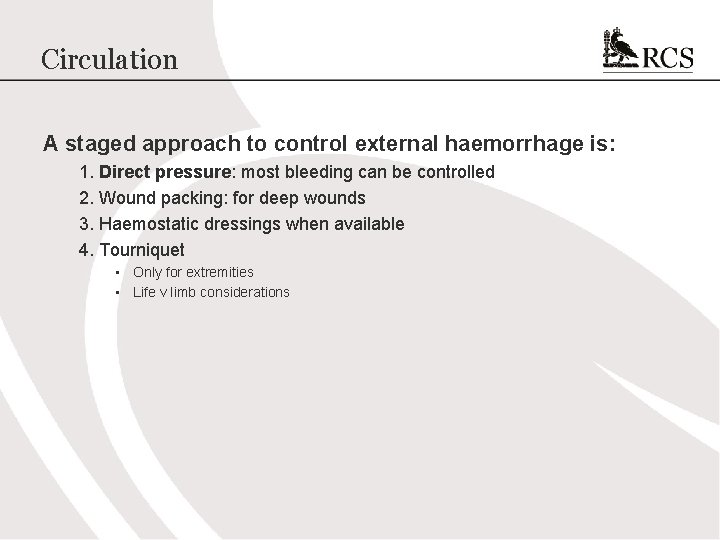
Circulation A staged approach to control external haemorrhage is: 1. Direct pressure: most bleeding can be controlled 2. Wound packing: for deep wounds 3. Haemostatic dressings when available 4. Tourniquet • Only for extremities • Life v limb considerations
Circulation Case progression A tourniquet is applied, time noted, and bleeding controlled. No other evidence of external haemorrhage is found but there is an angulated deformity of the left thigh. The FAST scan is negative and the pelvic x-ray shows no fracture. Self-assessment question (suggested responses on next slide): What else should you do for this patient? Why?
Circulation • Femoral fracture may be a source of significant haemorrhage. • A traction splint may be useful to reduce further blood loss • Tamponade bleeding • Prevent further soft tissue damage • Control pain • Consider other sources of bleeding. Patients may respond to resuscitation but then deteriorate (transient responder), mandating definitive haemorrhage control.
Circulation You have learned: • • • How to recognise shock and determine the likely cause. How to choose appropriate fluid resuscitation. To understand the indications and technique for IO placement. To recognise the need for and how to place a pelvic binder. The staged approach to controlling external haemorrhage. That bleeding control, including definitive management, is of utmost importance.
Further learning Shock can develop over time so frequent re-assessment is necessary. The patient must be stable or be stabilizing prior to secondary survey. Haemorrhage is the most common cause of shock in the trauma patient but other causes occur and must be considered.