
Circulation in mollusks Mollusks have a welldeveloped circulatory
- Slides: 42
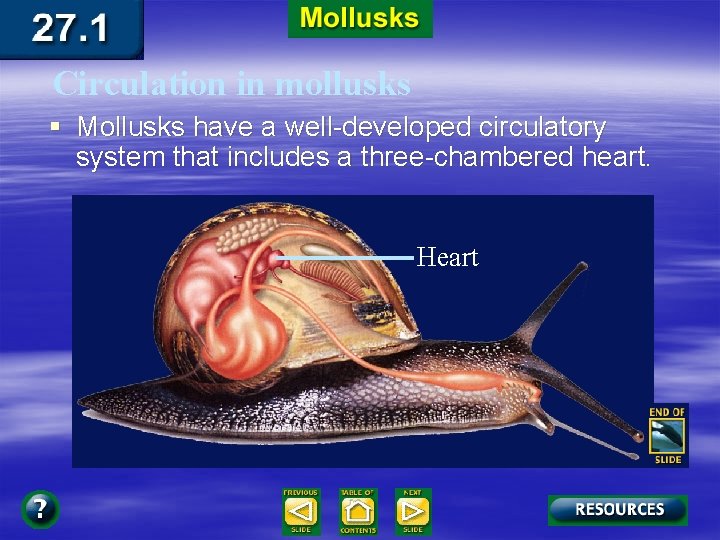
Circulation in mollusks § Mollusks have a well-developed circulatory system that includes a three-chambered heart. Heart
Circulation in mollusks § In most mollusks, the heart pumps blood through an open circulatory system. § In an open circulatory system, the blood moves through vessels and into open spaces around the body organs.
Circulation in mollusks § Some mollusks, such as octopuses, move nutrients and oxygen through a closed circulatory system. § In a closed circulatory system, blood moves through the body enclosed entirely in a series of blood vessels.
Respiration in mollusks § Most mollusks have respiratory structures called gills. § Gills are specialized parts of the mantle that consist of a system of filamentous projections that contain a rich supply of blood for the transport for gases.
The water vascular system § The water vascular system is a hydraulic system that operates under water pressure. § Water enters and leaves the water vascular system of a sea star through the madreporite (mah druh POHR ite), a sievelike, disk-shaped opening on the upper surface of the echinoderm’s body.
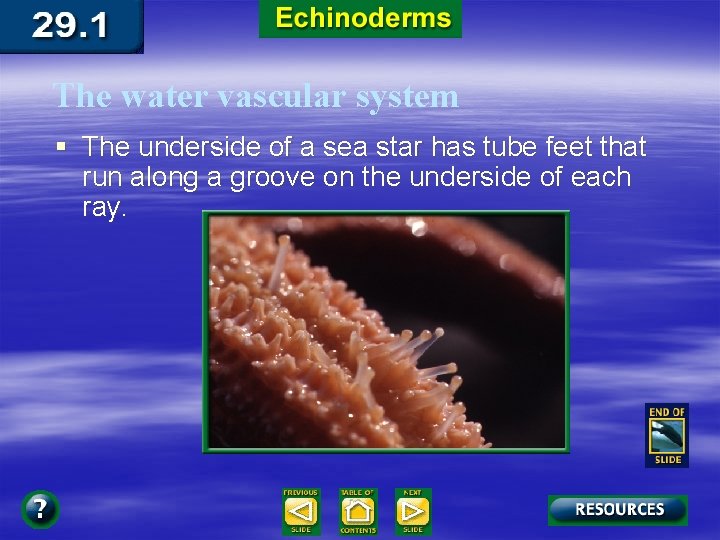
The water vascular system § The underside of a sea star has tube feet that run along a groove on the underside of each ray.
The water vascular system § Tube feet are hollow, thin-walled tubes that end in a suction cup. § Tube feet look somewhat like miniature droppers. § The round, muscular structure called the ampulla (AM pew lah) works something like the bulb of a dropper.
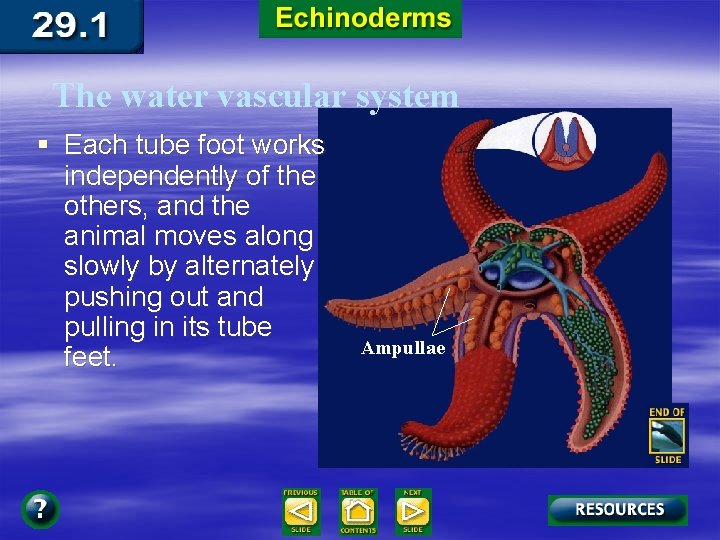
The water vascular system § Each tube foot works independently of the others, and the animal moves along slowly by alternately pushing out and pulling in its tube feet. Ampullae
The water vascular system § Tube feet also function in gas exchange and excretion. Gases are exchanged and wastes are eliminated by diffusion through the thin walls of the tube feet.
Arthropods have efficient gas exchange § Arthropods have efficient respiratory structures that ensure rapid oxygen delivery to cells. § This large oxygen demand is needed to sustain the high levels of metabolism required for rapid movements.
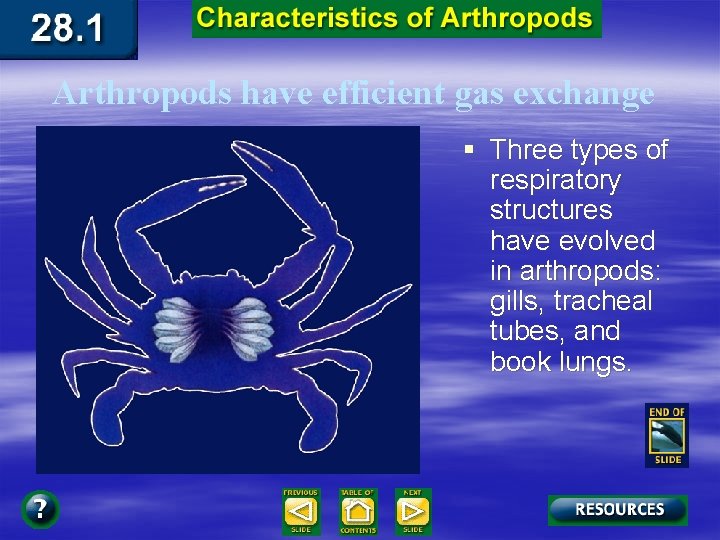
Arthropods have efficient gas exchange § Three types of respiratory structures have evolved in arthropods: gills, tracheal tubes, and book lungs.
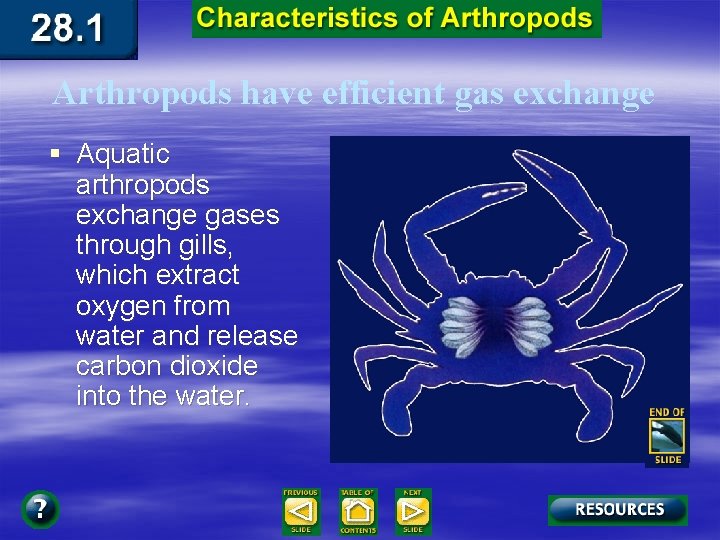
Arthropods have efficient gas exchange § Aquatic arthropods exchange gases through gills, which extract oxygen from water and release carbon dioxide into the water.
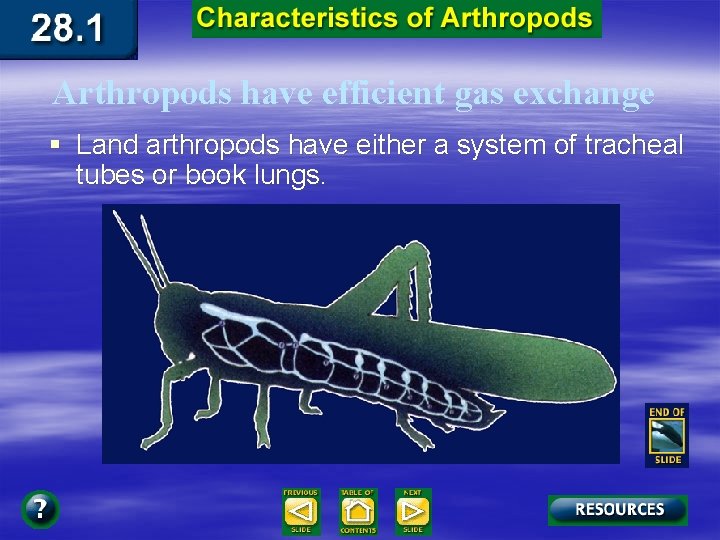
Arthropods have efficient gas exchange § Land arthropods have either a system of tracheal tubes or book lungs.
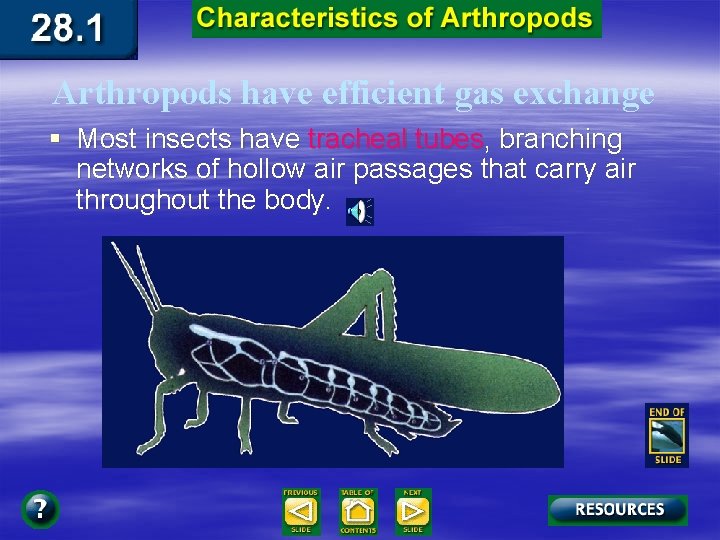
Arthropods have efficient gas exchange § Most insects have tracheal tubes, branching networks of hollow air passages that carry air throughout the body.
Arthropods have efficient gas exchange § Muscle activity helps pump the air through the tracheal tubes. § Air enters and leaves the tracheal tubes through openings on the thorax and abdomen called spiracles.
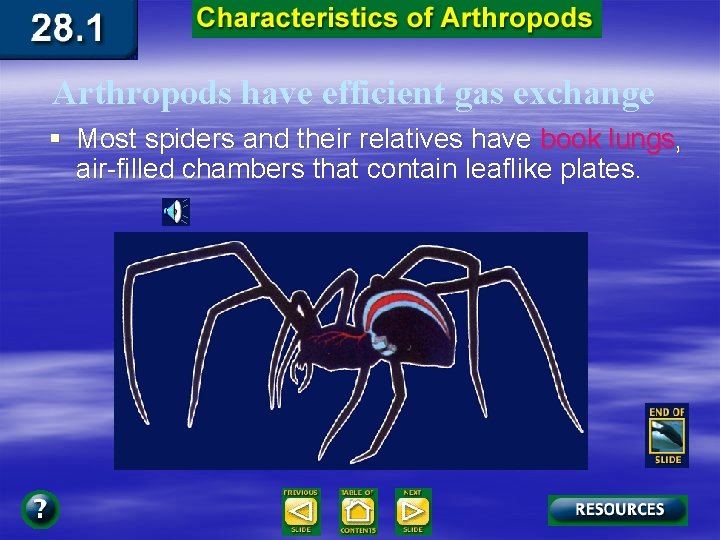
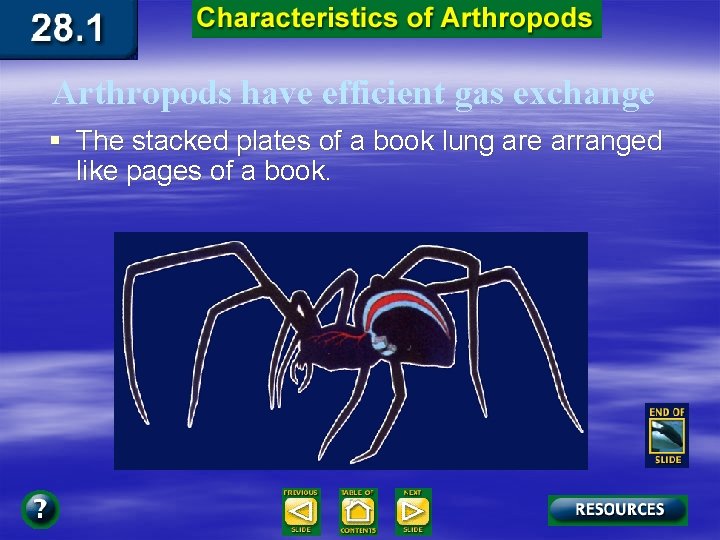
Arthropods have efficient gas exchange § Most spiders and their relatives have book lungs, air-filled chambers that contain leaflike plates.
Arthropods have efficient gas exchange § The stacked plates of a book lung are arranged like pages of a book.
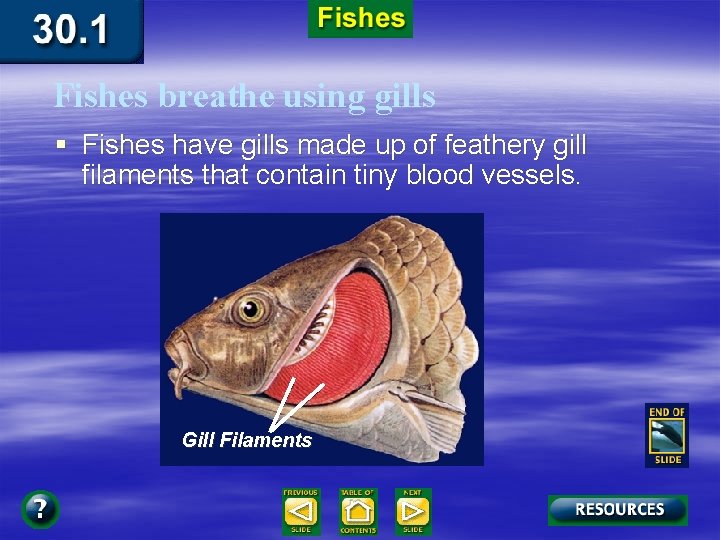
Fishes breathe using gills § Fishes have gills made up of feathery gill filaments that contain tiny blood vessels. Gill Filaments
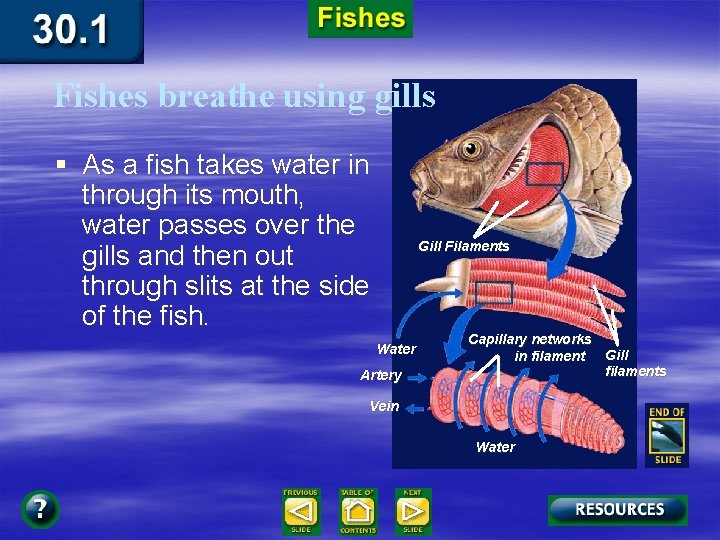
Fishes breathe using gills § As a fish takes water in through its mouth, water passes over the gills and then out through slits at the side of the fish. Gill Filaments Water Artery Capillary networks in filament Gill filaments Vein Water
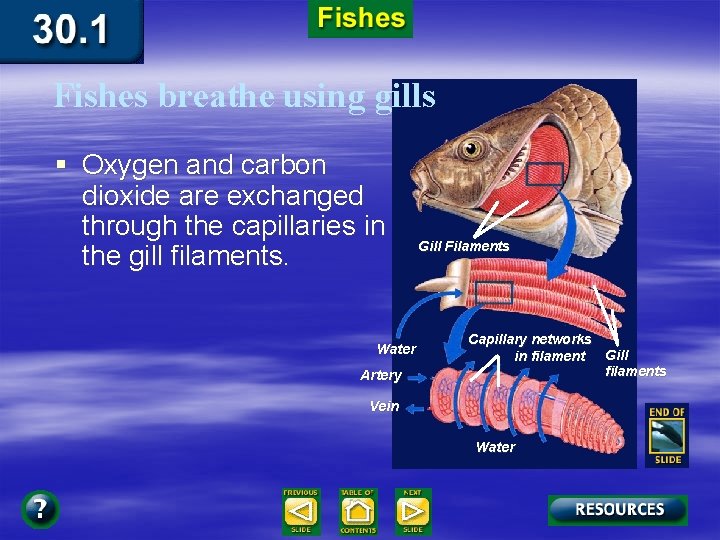
Fishes breathe using gills § Oxygen and carbon dioxide are exchanged through the capillaries in the gill filaments. Water Artery Gill Filaments Capillary networks in filament Gill filaments Vein Water
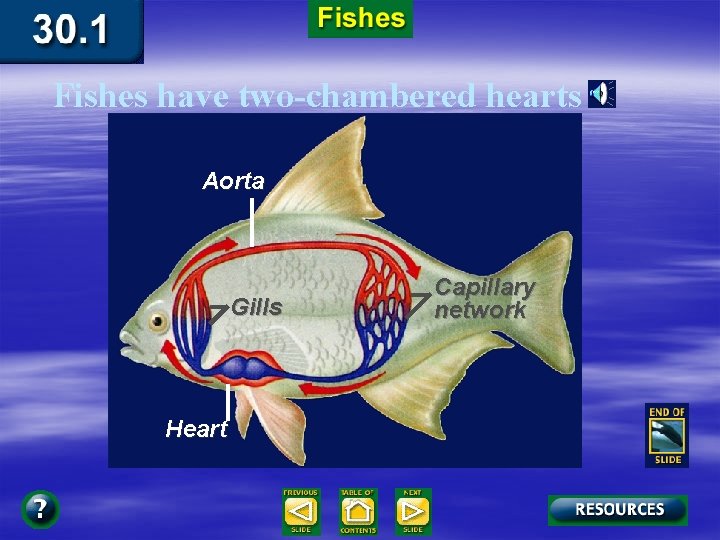
Fishes have two-chambered hearts Aorta Gills Heart Capillary network
Flight requires energy § Flight requires high levels of energy. § Several factors are involved in maintaining these high energy levels.
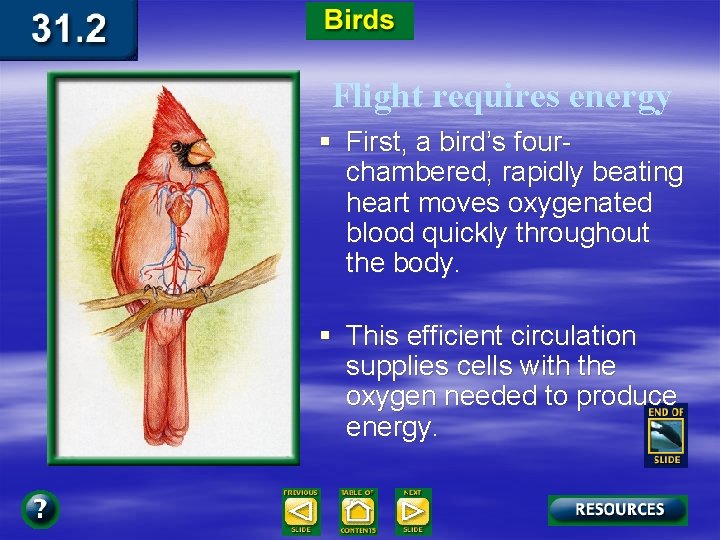
Flight requires energy § First, a bird’s fourchambered, rapidly beating heart moves oxygenated blood quickly throughout the body. § This efficient circulation supplies cells with the oxygen needed to produce energy.
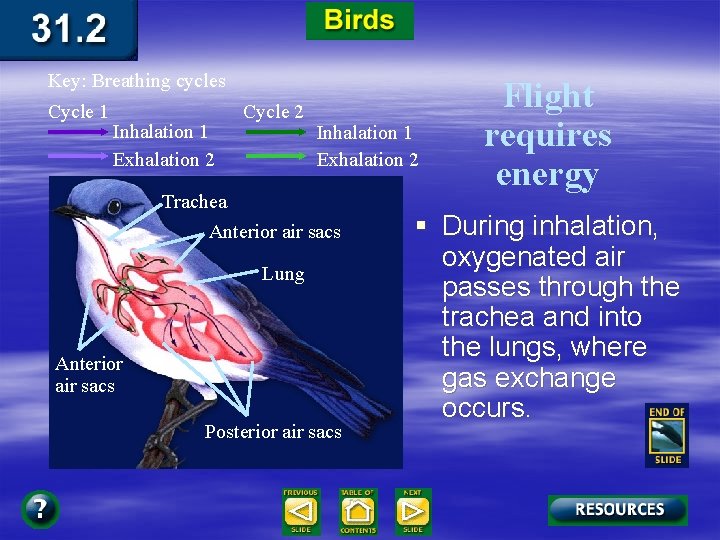
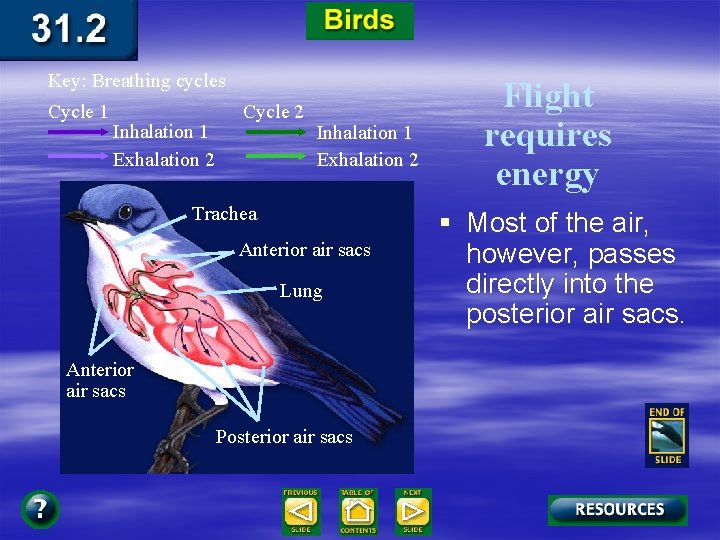
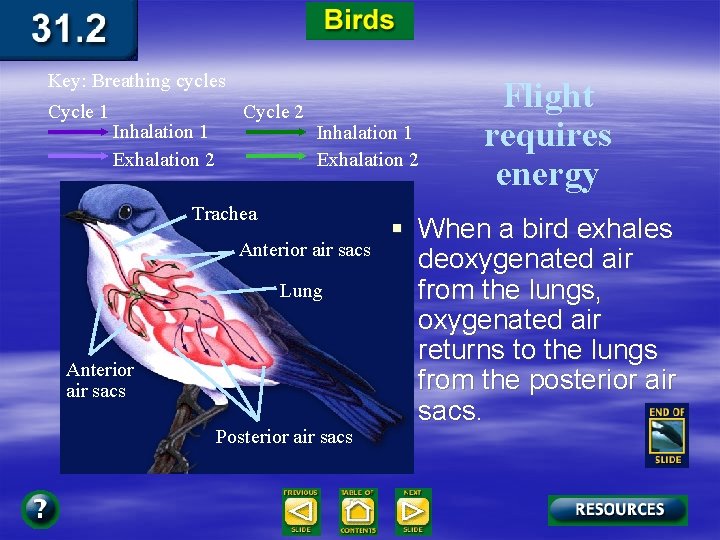
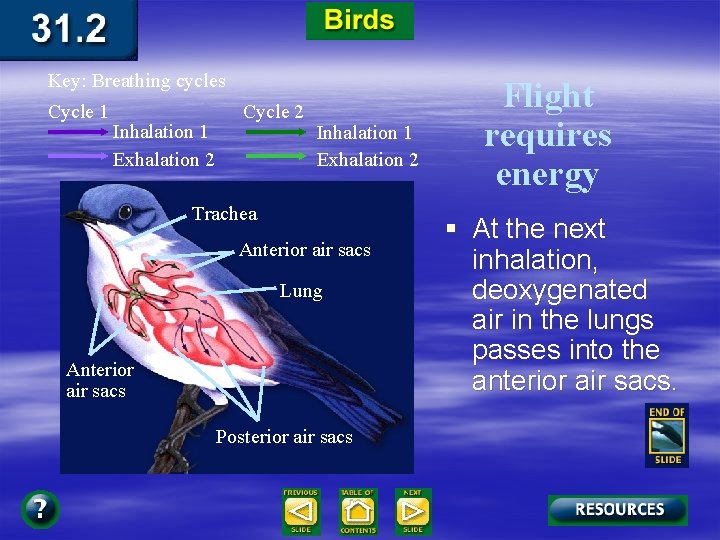
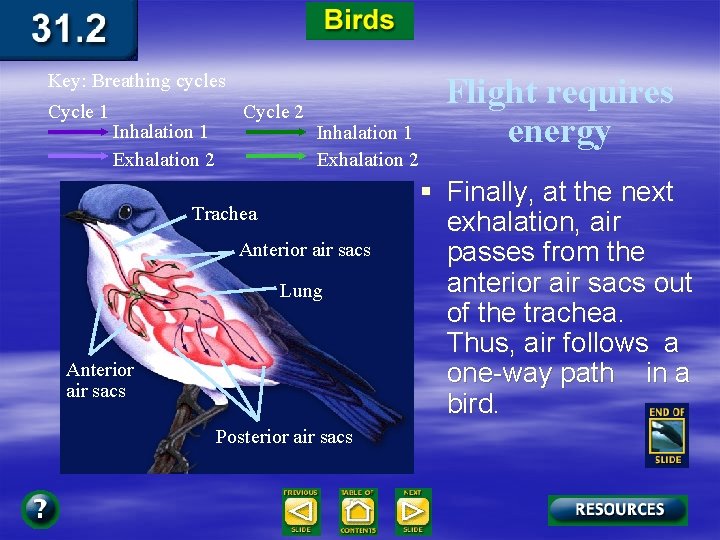
Flight requires energy § Second, a bird’s respiratory system supplies oxygenated air to the lungs when it inhales as well as when it exhales. § A bird’s respiratory system consists of lungs and anterior and posterior air sacs.
Key: Breathing cycles Cycle 1 Inhalation 1 Exhalation 2 Cycle 2 Inhalation 1 Exhalation 2 Trachea Anterior air sacs Lung Anterior air sacs Posterior air sacs Flight requires energy § During inhalation, oxygenated air passes through the trachea and into the lungs, where gas exchange occurs.
Key: Breathing cycles Cycle 1 Inhalation 1 Exhalation 2 Cycle 2 Inhalation 1 Exhalation 2 Trachea Anterior air sacs Lung Anterior air sacs Posterior air sacs Flight requires energy § Most of the air, however, passes directly into the posterior air sacs.
Key: Breathing cycles Cycle 1 Inhalation 1 Exhalation 2 Cycle 2 Inhalation 1 Exhalation 2 Trachea Anterior air sacs Lung Anterior air sacs Posterior air sacs Flight requires energy § When a bird exhales deoxygenated air from the lungs, oxygenated air returns to the lungs from the posterior air sacs.
Key: Breathing cycles Cycle 1 Inhalation 1 Exhalation 2 Cycle 2 Inhalation 1 Exhalation 2 Trachea Anterior air sacs Lung Anterior air sacs Posterior air sacs Flight requires energy § At the next inhalation, deoxygenated air in the lungs passes into the anterior air sacs.
Key: Breathing cycles Cycle 1 Inhalation 1 Exhalation 2 Cycle 2 Inhalation 1 Exhalation 2 Trachea Anterior air sacs Lung Anterior air sacs Posterior air sacs Flight requires energy § Finally, at the next exhalation, air passes from the anterior air sacs out of the trachea. Thus, air follows a one-way path in a bird.
Walking requires more energy • The laborious walking of early amphibians required a great deal of energy from food and large amounts of oxygen for aerobic respiration. • The evolution of the three-chambered heart in amphibians ensured that cells received the proper amount of oxygen.
Walking requires more energy • In the three-chambered heart of amphibians, one chamber receives oxygen-rich blood from the lungs and skin, and another chamber receives oxygen-poor blood from the body tissues.
Walking requires more energy • Blood from both chambers then moves to the third chamber, which pumps oxygen-rich blood to body tissues and oxygen-poor blood back to the lungs and skin so it can pick up more oxygen.
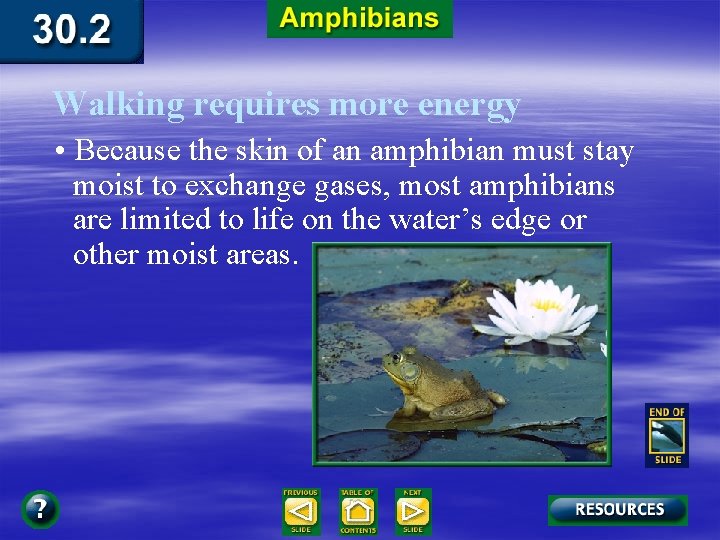
Walking requires more energy • Because the skin of an amphibian must stay moist to exchange gases, most amphibians are limited to life on the water’s edge or other moist areas.
Some reptiles have four-chambered hearts § Most reptiles have three-chambered hearts. § Some reptiles, notably the crocodilians, have a four-chambered heart that completely separates the supply of blood with oxygen from blood without oxygen. § This separation is an adaptation that supports a higher level of energy use required by land animals.
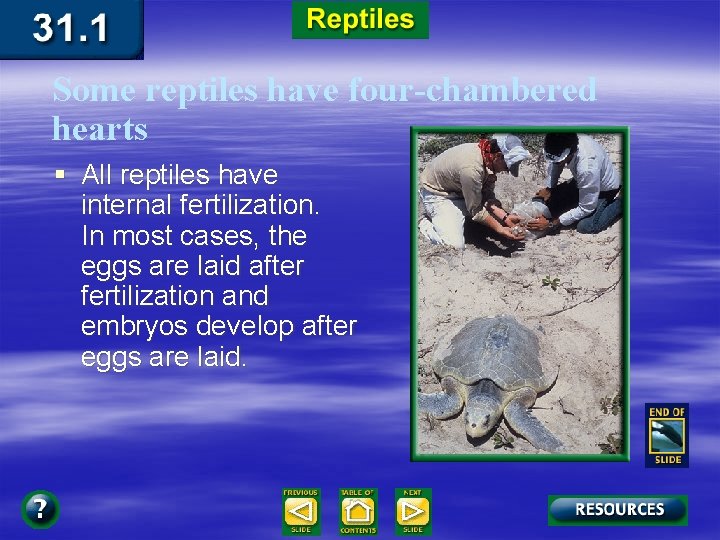
Some reptiles have four-chambered hearts § All reptiles have internal fertilization. In most cases, the eggs are laid after fertilization and embryos develop after eggs are laid.
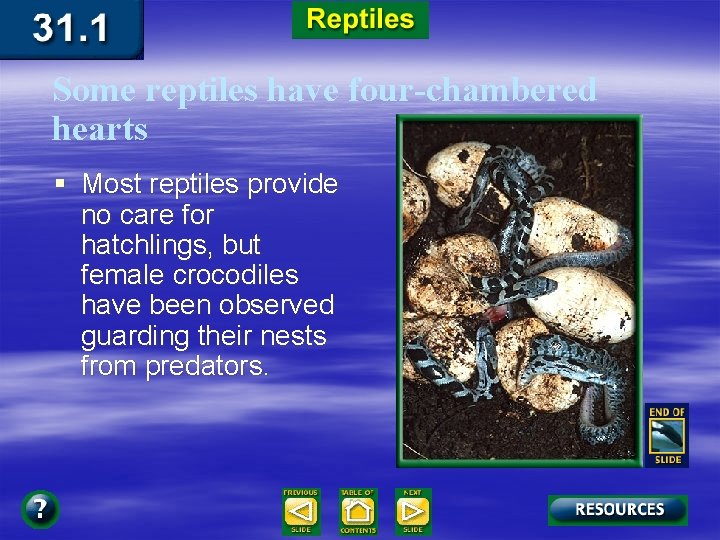
Some reptiles have four-chambered hearts § Most reptiles provide no care for hatchlings, but female crocodiles have been observed guarding their nests from predators.
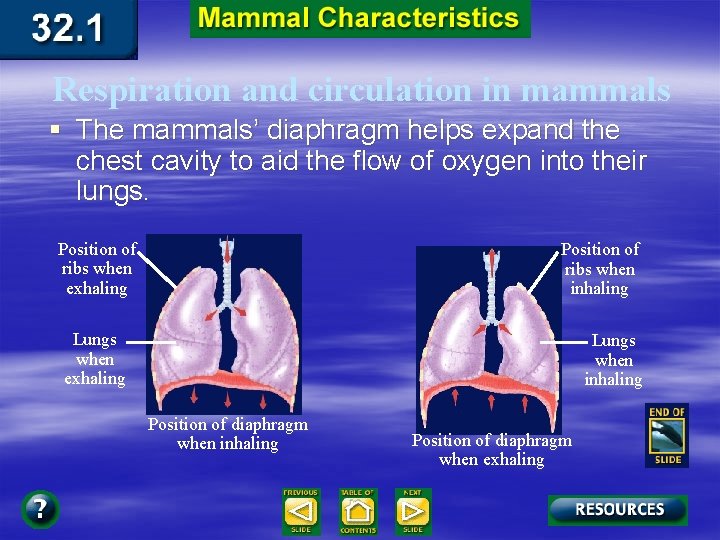
Respiration and circulation in mammals § The mammals’ diaphragm helps expand the chest cavity to aid the flow of oxygen into their lungs. Position of ribs when exhaling Position of ribs when inhaling Lungs when exhaling Lungs when inhaling Position of diaphragm when exhaling
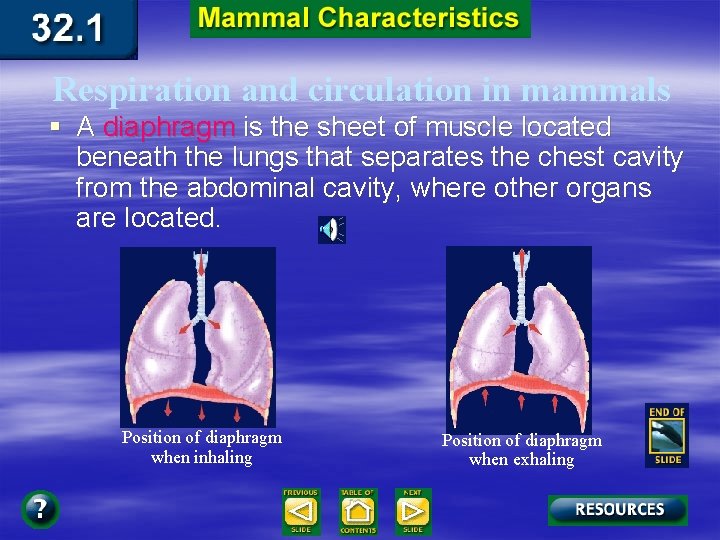
Respiration and circulation in mammals § A diaphragm is the sheet of muscle located beneath the lungs that separates the chest cavity from the abdominal cavity, where other organs are located. Position of diaphragm when inhaling Position of diaphragm when exhaling
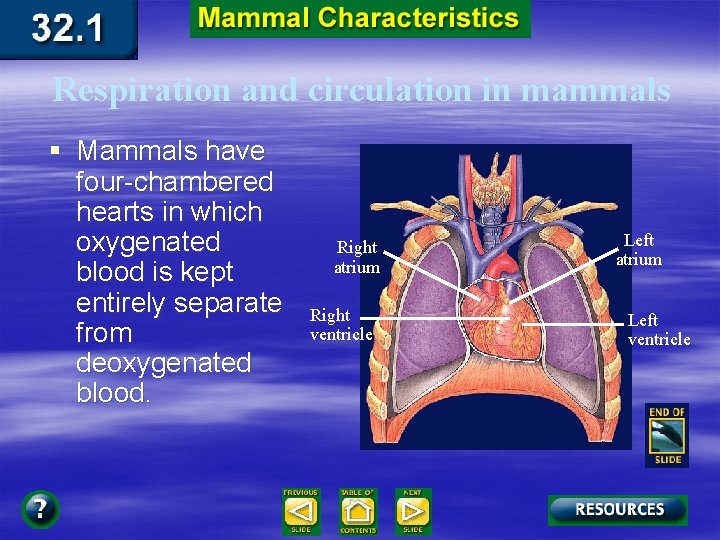
Respiration and circulation in mammals § Mammals have four-chambered hearts in which oxygenated blood is kept entirely separate from deoxygenated blood. Right atrium Right ventricle Left atrium Left ventricle
Respiration and circulation in mammals § Circulation also removes waste products from cells and helps regulate body temperature. § Blood helps keep a constant cellular environment, which maintains homeostasis.
1)Compare and contrast gills and lungs 2) What components do all gas exchange systems have? 3) Define tracheal tubes 4) Why do some animals have simple system and some complex 5)Compare and contrast open and closed circulatory system
6) List all of the possible ways animals can capture O 2 from the air 7) What factors shape the type and complexity of the system