
Circular Motion What is circular motion Objects that
Circular Motion
What is circular motion? • Objects that move in a circle experience circular motion. • I know that’s tough. • Let’s take a moment and let it sink in…
Now that is out of the way… • There are specific features of circular motion that make it different from linear or projectile motion
Constant speed • An object with a constant speed, which experiences no other forces, will travel in a straight line at that speed infinitely • Newton’s First Law
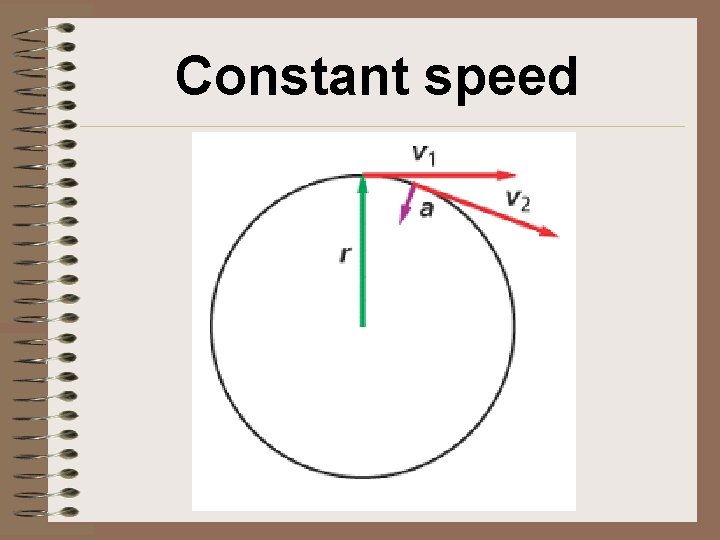
Constant speed
Constant speed • Objects can travel in a circle and maintain a constant speed
Is velocity constant? • No • Velocity is speed in a given direction • Those directions cannot be circular
What is acceleration? • Acceleration is a change in velocity • We have so far defined acceleration as a change in speed but it can be a change in direction, also
Circular Motion • An object traveling in a circle travels at a constant speed but is accelerating
What causes acceleration? • All changes in velocity are caused by a force • F = ma • Newton’s Second Law
What is the force? • The force keeping the object in its circular path is called a centripetal force • Centripetal means “center seeking”
Centripetal force • It is a real force • It is a contact force
What direction does it point? • The centripetal force always points towards the center of the circle
What applies the force? • It depends on the situation • In general, whatever keeps the item in it’s circular path applies the centripetal force
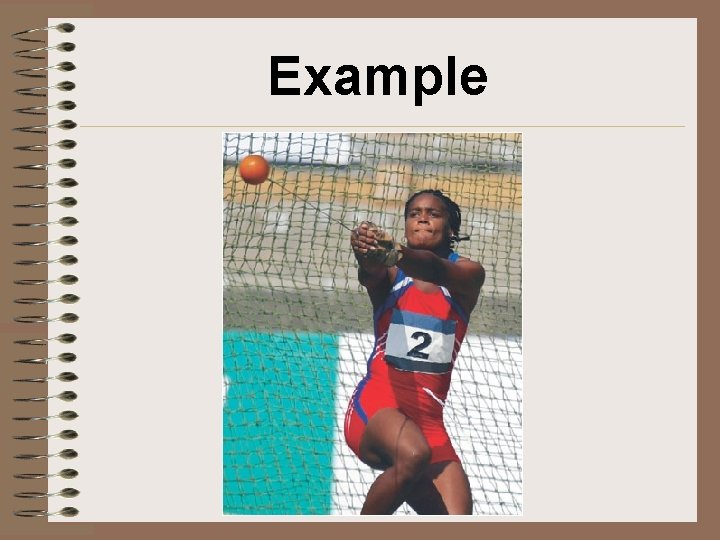
Example
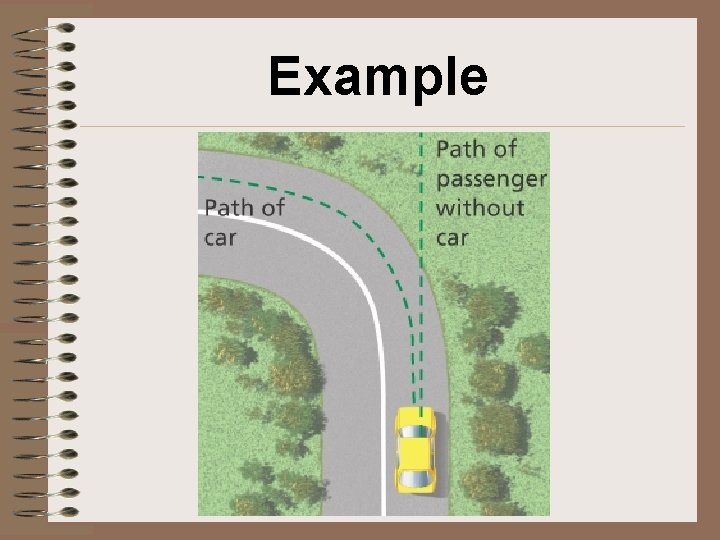
Example
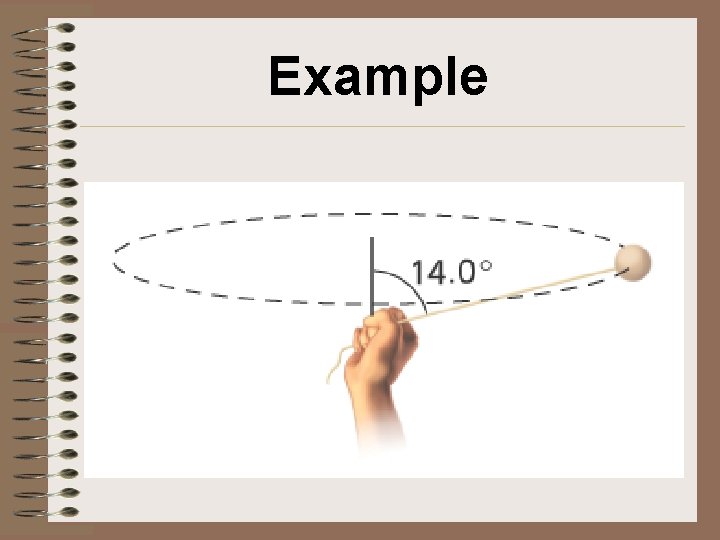
Example
Are there other forces? • When you make a turn in your car, what makes you pull to one side? • When you swing a bucket of water above your head, what keeps the water in the bucket?
What causes that? • In truth, it is a delicate interplay between the inertia of the item and the acceleration • It is another force
Centrifugal force • From the Latin, centrum, “center, ” and fugere, “fleeing” • This is the force that pushes away from the center of the circle
Centrifugal Force • It is the reaction force that compliments the action of the centripetal force • Newton’s Third Law
Centrifugal • The centrifugal force is a fictitious force • Is it also a contact force
Example • You have a bucket of water and you are swinging it around above you head. What forces are acting on it and what do they act on?
The two forces • Remember, we have two forces, the centripetal and the centrifugal • The centripetal acts on the bucket • The centrifugal acts on the water
The math • You knew it was coming • Math is the language of physics and you need to learn to speak that language
Centripetal acceleration • There are two equations we can use depending on what we know
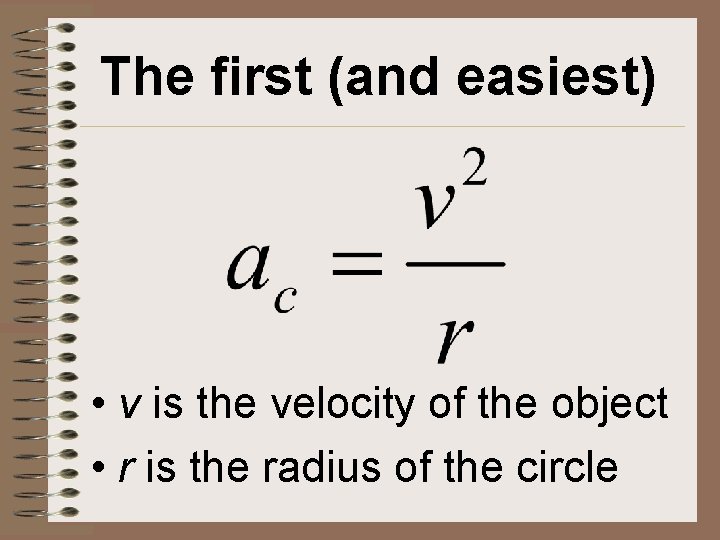
The first (and easiest) • v is the velocity of the object • r is the radius of the circle
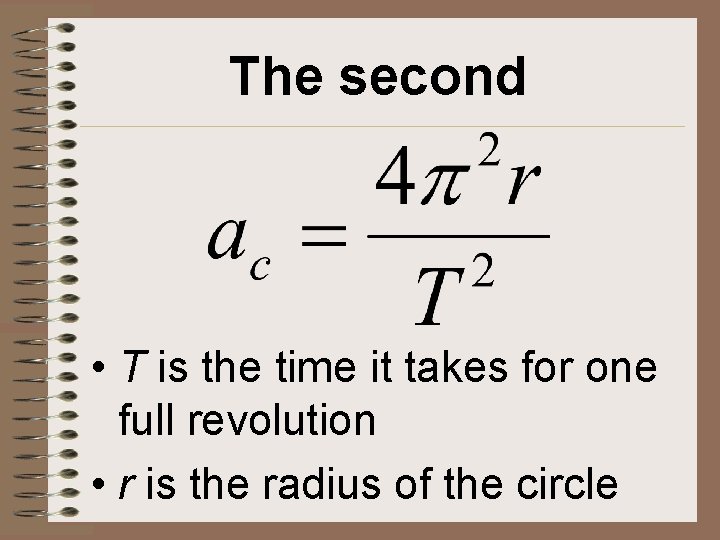
The second • T is the time it takes for one full revolution • r is the radius of the circle
Centrifugal acceleration • If the centrifugal force arises from Newton’s Third Law and is the equal but opposite reaction to the centripetal force, what is the equation going to be?
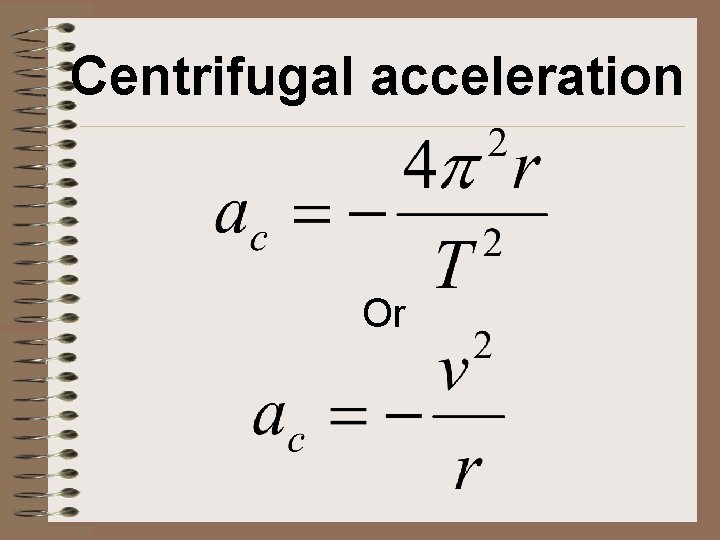
Centrifugal acceleration Or
Sample problem • A 1000 kg car enters an 80 meter radius curve at 20 m/s. What centripetal force must be supplied by friction so the car does not skid?
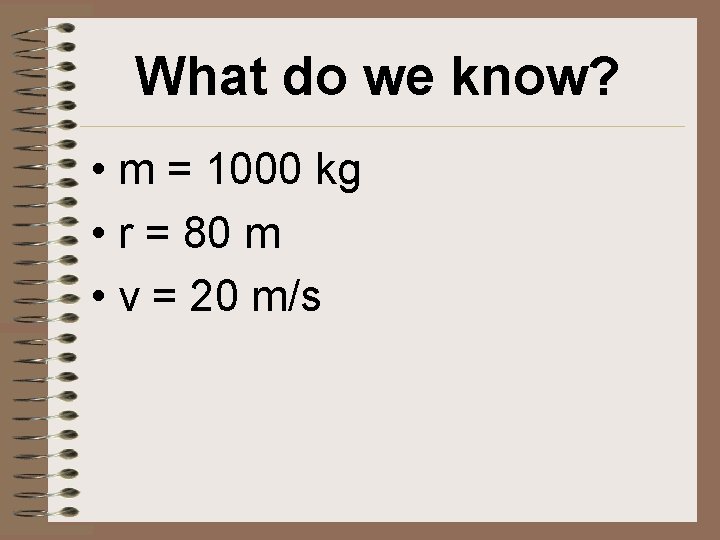
What do we know? • m = 1000 kg • r = 80 m • v = 20 m/s
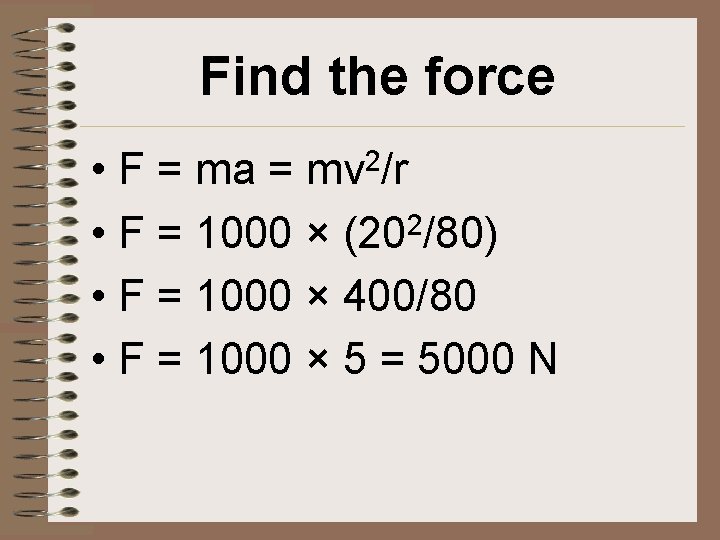
Find the force • F = ma = • F = 1000 × (202/80) • F = 1000 × 400/80 • F = 1000 × 5 = 5000 N 2 mv /r
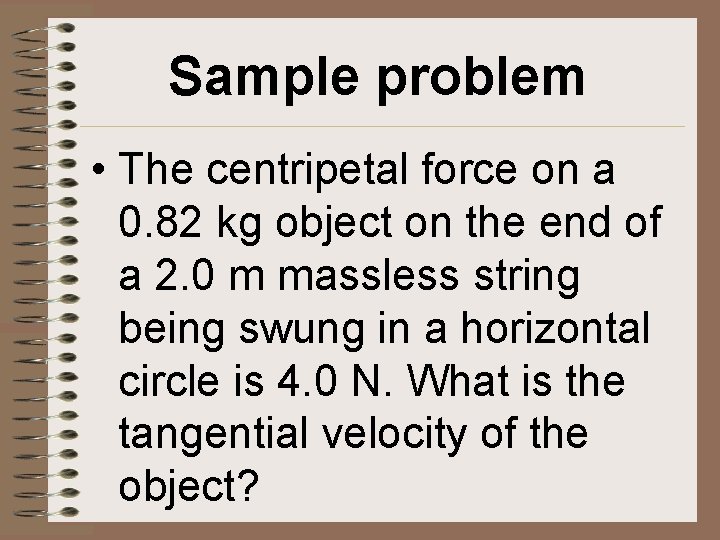
Sample problem • The centripetal force on a 0. 82 kg object on the end of a 2. 0 m massless string being swung in a horizontal circle is 4. 0 N. What is the tangential velocity of the object?
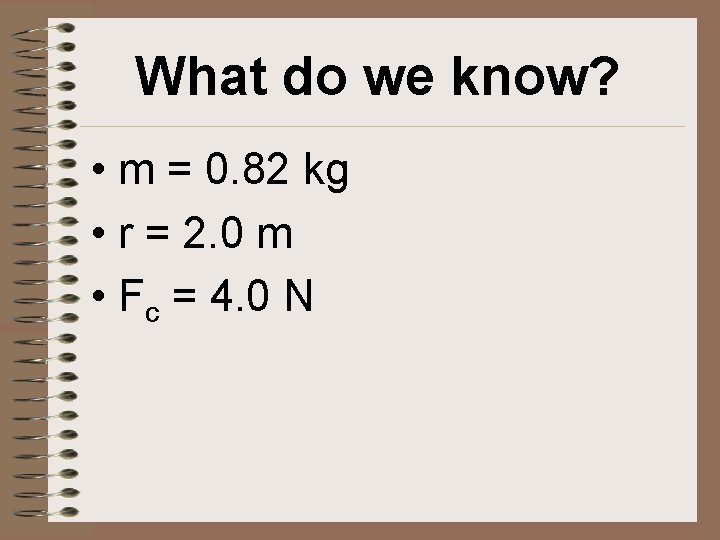
What do we know? • m = 0. 82 kg • r = 2. 0 m • Fc = 4. 0 N
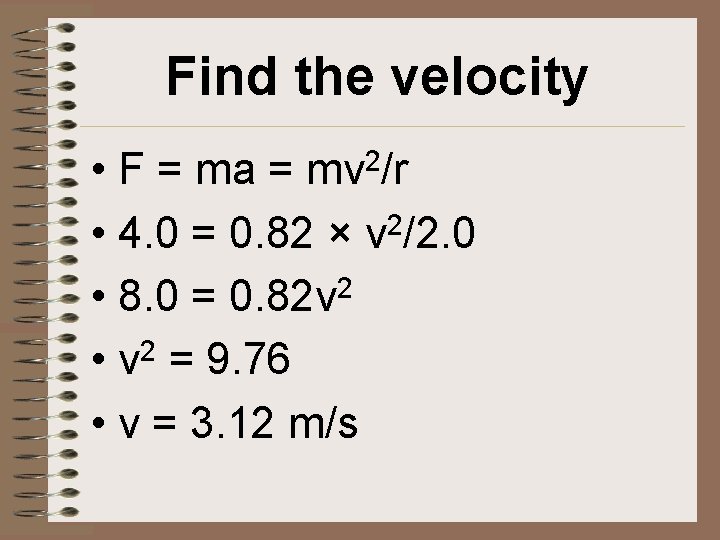
Find the velocity • F = ma = • 4. 0 = 0. 82 × v 2/2. 0 • 8. 0 = 0. 82 v 2 • v 2 = 9. 76 • v = 3. 12 m/s 2 mv /r
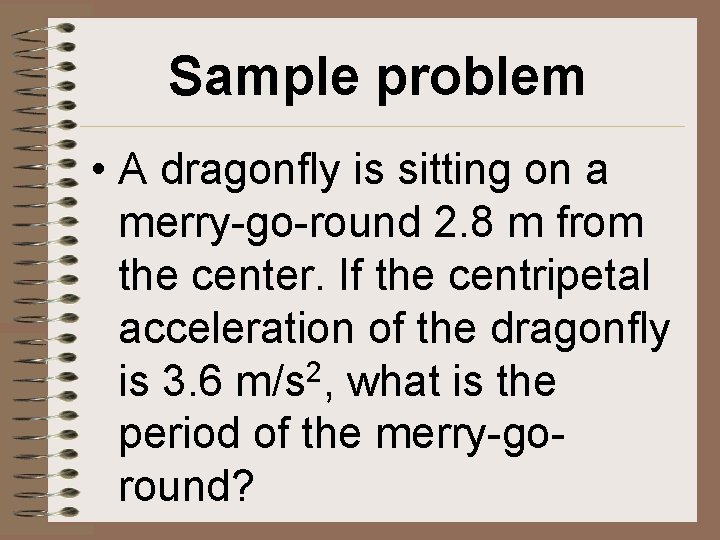
Sample problem • A dragonfly is sitting on a merry-go-round 2. 8 m from the center. If the centripetal acceleration of the dragonfly is 3. 6 m/s 2, what is the period of the merry-goround?
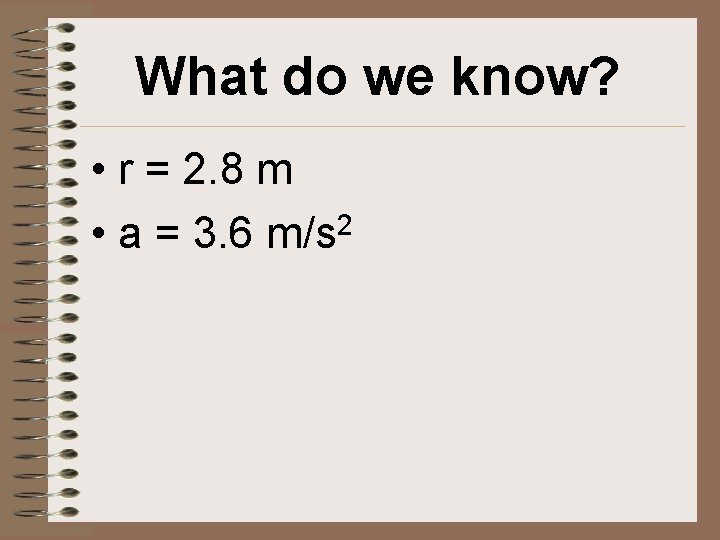
What do we know? • r = 2. 8 m • a = 3. 6 m/s 2
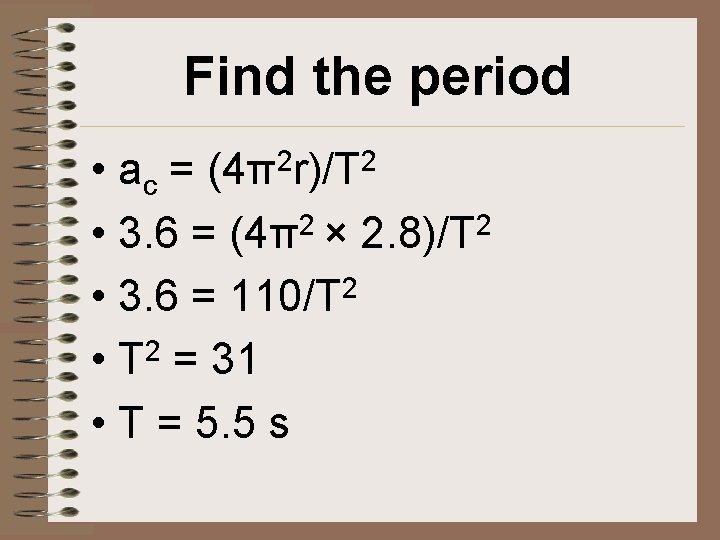
Find the period • ac = • 3. 6 = (4π2 × 2. 8)/T 2 • 3. 6 = 110/T 2 • T 2 = 31 • T = 5. 5 s 2 2 (4π r)/T
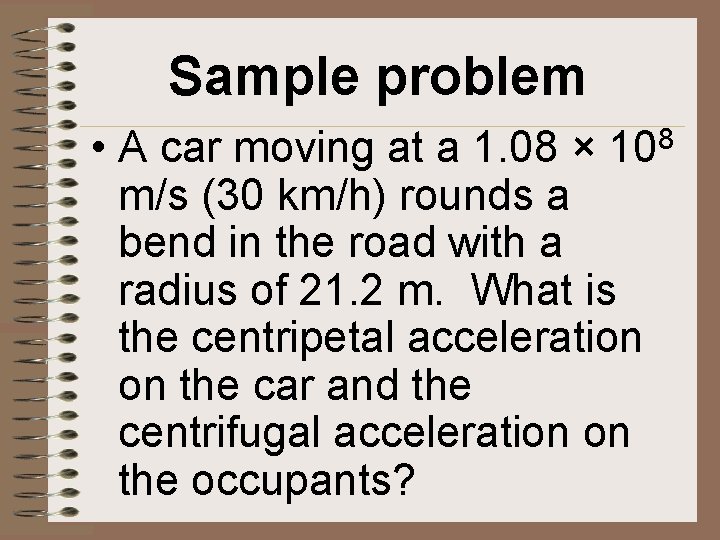
Sample problem • A car moving at a 1. 08 × 108 m/s (30 km/h) rounds a bend in the road with a radius of 21. 2 m. What is the centripetal acceleration on the car and the centrifugal acceleration on the occupants?
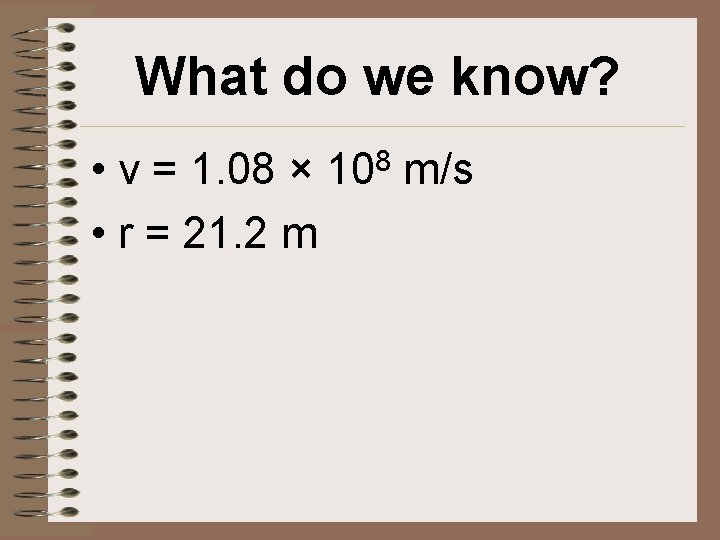
What do we know? • v = 1. 08 × • r = 21. 2 m 8 10 m/s
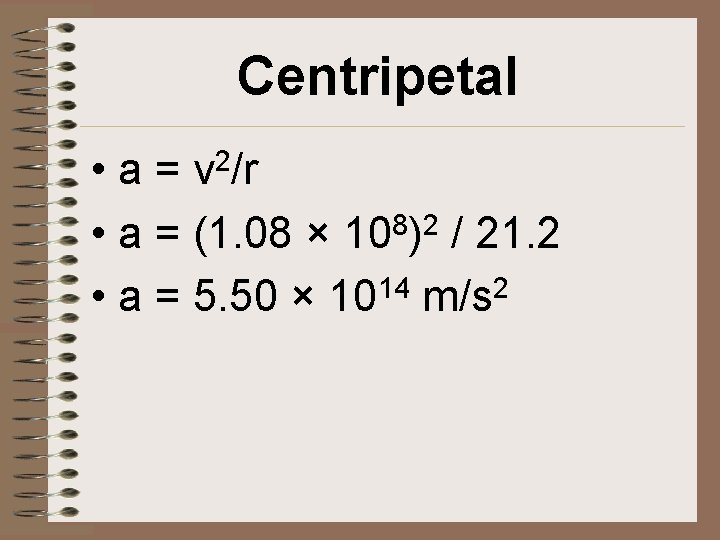
Centripetal • a= • a = (1. 08 × 108)2 / 21. 2 • a = 5. 50 × 1014 m/s 2 2 v /r
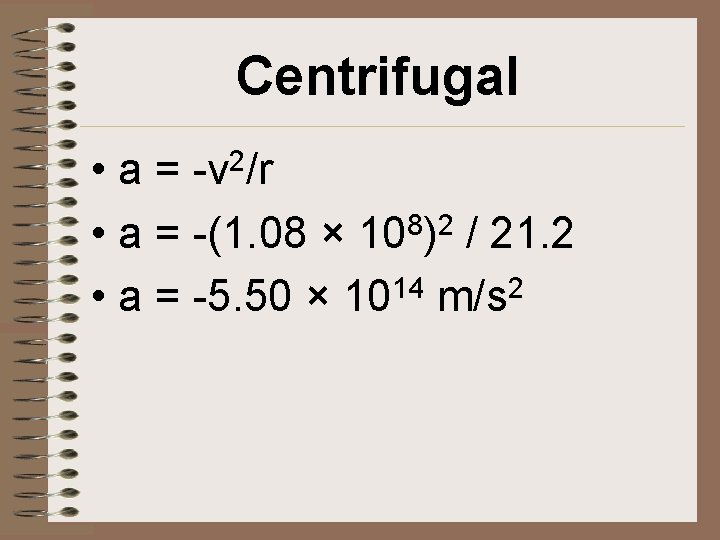
Centrifugal • a= • a = -(1. 08 × 108)2 / 21. 2 • a = -5. 50 × 1014 m/s 2 2 -v /r
- Slides: 43